Digital Marketing for MBA Students: A Complete Guide
Most MBA graduates will never run a Google Ads account themselves. But almost all of them will approve a marketing budget, hire or manage someone who runs one, or sit across the table from an agency asking for more money. That is why digital marketing for MBA students is not about becoming a specialist. It is about becoming a manager who can set the right goals, read the numbers and make good investment decisions.
About the author: I am Arjan KC, a digital marketing expert in Kathmandu and co-founder of Gurkha Technology. I design and teach MBA digital marketing curriculum and publish the full module as open notes. Everything in this guide is drawn from that course.
Why digital marketing matters for MBA students
An MBA teaches you to allocate scarce resources. Digital marketing is now one of the largest and most measurable places those resources go. A brand manager, a bank’s product head, a startup founder and a consultant all face the same questions:
- Which channel should get the next NPR 1 lakh?
- Is this agency actually delivering, or reporting vanity metrics?
- How much can we afford to pay to acquire a customer?
- Why did enquiries drop this month, and what should we change?
You cannot answer these from a textbook definition of “the 4Ps”. You need to understand how the channels work together and how to read the data they produce.

What a good MBA digital marketing course covers
My MBA Digital Marketing module is built around one project: each student builds a small live web asset in the first week and then drives and measures traffic to it across every channel. Here is what that covers, session by session.
| Area | What you learn | Course notes |
|---|---|---|
| Strategy and customer journey | Objectives, audiences, funnel stages and KPIs | Session 1 |
| Owned media | A mobile landing page with a form or WhatsApp path | Session 2 |
| SEO | Keyword research, on-page SEO and content architecture | Session 3 |
| Paid search | Google Ads structure, keywords, bidding and budgets | Session 4 |
| Paid social | Meta Ads audiences, creative and testing | Session 5 |
| Email and retention | Nurture sequences and automation | Session 6 |
| Analytics | GA4, Meta Insights and data-driven decisions | Session 7 |
| Capstone | Pitch an integrated plan with an NPR budget and KPIs | Session 8 |
Phase 2 (Sessions 9–24) turns this into an agency simulation aligned to the Kathmandu University Digital Marketing (3 credit) syllabus: funnel audits, budget and compliance frameworks, content calendars, AI-assisted creative, A/B testing, technical SEO audits, email automation flows, attribution and stakeholder reporting.
If your own programme covers less than this, the notes are free to use alongside it.
The manager’s math: CAC, LTV and ROAS
The single most useful thing an MBA student can take from a digital marketing course is a handful of unit-economics metrics.
- Customer acquisition cost (CAC): total marketing spend divided by new customers acquired.
- Customer lifetime value (LTV): the gross profit you expect from a customer over the whole relationship.
- Return on ad spend (ROAS): revenue generated divided by ad spend.
The course uses a simple health check: LTV should be at least three times CAC.
Worked example (hypothetical): a Kathmandu coaching institute spends NPR 50,000 on ads in a month and gets 25 new enrolments at NPR 12,000 each.
- CAC = 50,000 ÷ 25 = NPR 2,000
- Revenue = 25 × 12,000 = NPR 3,00,000, so ROAS = 3,00,000 ÷ 50,000 = 6
- If the average student takes 1.5 courses at a 40% gross margin, LTV = 12,000 × 1.5 × 0.4 = NPR 7,200
- LTV ÷ CAC = 7,200 ÷ 2,000 = 3.6, which passes the 3× test
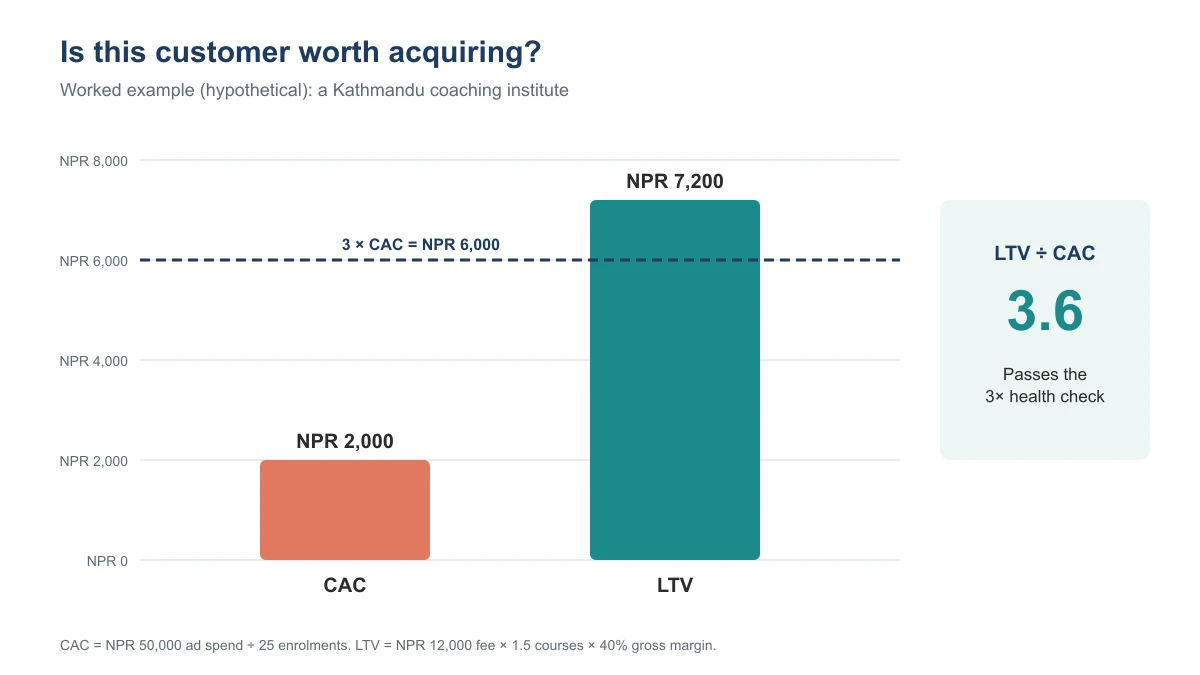
Chart: the worked example above. Hypothetical figures for teaching, not client data.
A ROAS of 6 sounds great on its own. The LTV-to-CAC ratio tells you whether the business can actually afford to keep growing this way. That shift from channel metrics to business metrics is exactly what separates a manager from an operator. For the wider strategy toolkit, from positioning to pricing, see 12 marketing strategies every MBA graduate should know.
Nepal realities a textbook will not teach you
Most digital marketing textbooks are written for Western markets. If you plan to work in Nepal, learn these differences early.
- Conversations convert. Many Nepali customers prefer to message before buying. A WhatsApp, Viber or Messenger path often matters as much as the website form, and it must be tracked.
- Cash on delivery and digital wallets. E-commerce funnels need to account for COD, wallet payments and the drop-off between order and delivery.
- Language and search behaviour. People search in English, Nepali and romanised Nepali. Your keyword research has to cover all three.
- Seasonality. Dashain, Tihar, admission seasons and wedding seasons shift demand and ad costs. Plan budgets around them.
- Ad payments. Paying Google and Meta from Nepal involves foreign-currency cards and limits, which affects how quickly campaigns can scale.
For a full picture of how these channels fit together for Nepali businesses, see my digital marketing stack for Nepal, plus the channel guides for SEO in Nepal and Google Ads in Nepal.
Tools every MBA student should try
You do not need paid software. These free tools are enough to learn the fundamentals:
- Google Analytics 4 for website behaviour and conversions
- Google Search Console for organic search performance
- Google Tag Manager for tracking forms, clicks and WhatsApp taps
- Looker Studio for building a one-page dashboard
- Google Keyword Planner for search demand
- Meta Business Suite and Ads Manager for Facebook and Instagram
- Canva for simple creative
- An AI assistant, used responsibly for drafts and ideas, never as a substitute for judgement or real data
Build proof during your MBA, not after
Employers in Nepal increasingly hire on evidence. A certificate shows you watched videos; a project shows you can deliver. Before you graduate, aim to have:
- One live asset (a landing page or small site) that you built and promoted.
- A tracked result, even a small one: enquiries, sign-ups or sales with a GA4 screenshot to back it up.
- A strategy deck with objectives, audience, channel mix, an NPR budget and KPIs.
- A short written reflection on what worked, what failed and what you would change.
The course’s deliverable templates and samples and grading rubrics show what a strong submission looks like. Free certifications such as Google Skillshop and Meta Blueprint are a useful extra, not the main event.
Careers that use digital marketing after an MBA
Digital marketing skills feed into several MBA career paths:
- Brand and product management, where you own budgets and briefs
- Digital marketing or growth management, leading channel teams and agencies
- Consulting, where clients expect digital strategy as part of any go-to-market plan
- Entrepreneurship, where you are the marketing team until you can hire one
- Banking, insurance and education, where digital acquisition is now central
For realistic salary ranges and what employers test in interviews, read my digital marketing career and salary guide for Nepal.
Common mistakes MBA students make
- Starting with channels instead of goals. “We need TikTok” is not a strategy. Start with the business objective and the customer journey.
- Celebrating vanity metrics. Likes, reach and impressions are not results. Tie everything back to enquiries, sales, CAC and LTV.
- Skipping tracking. If conversions are not measured, you cannot optimise or defend a budget.
- Copying Western case studies. Adjust for Nepali payment habits, languages and platforms.
- Letting AI think for you. AI can draft copy quickly, but the strategy, the numbers and the accountability are yours.
A 12-week self-study plan
If your programme does not include a full digital marketing module, you can work through the open notes on your own:
- Weeks 1–2: strategy, customer journey and building your landing page (Sessions 1–2)
- Weeks 3–4: SEO and Google Ads fundamentals (Sessions 3–4)
- Weeks 5–6: Meta Ads and email automation (Sessions 5–6)
- Weeks 7–8: analytics, then a capstone pitch to friends or classmates (Sessions 7–8)
- Weeks 9–12: pick Phase 2 sessions that match your career goal, such as attribution and reporting for consulting or A/B testing and creative for brand roles
Use the case readings map to pair each week with a worked Nepal example.
Next steps
Start with the course syllabus, build your sandbox in week one and track one real result before you graduate. If you teach an MBA programme or run a team that needs this training, see my digital marketing training in Nepal or read more about my work as a digital marketing educator. For results from client work, see the case studies.


