Session 2: Owned Media & Rapid Prototyping
Welcome to Session 2. This week, we transition from planning to building. You will create the foundational asset of your digital marketing strategy: your Owned Media hub (the Sandbox).
View lecture slides: Session 2 Slides
1. Pre-Work: Fundamentals of UX and CRO
Before you build your site, you must understand how users interact with websites. The goal is not just to make a site look good, but to make it convert.
User Experience (UX) Basics: A Manager’s Guide
Good UX means minimizing friction. A user should understand exactly what you offer and what they should do next within the first 3 seconds of landing on your page. As a manager, you do not need to code or design, but you must know how to critique a layout objectively rather than subjectively (e.g., “Make the button red because I like red” vs “Make the button red to increase contrast and adhere to Fitts’s Law”).
- Clarity over cleverness: Use simple, direct language. Don’t use industry jargon unless your audience consists solely of experts.
- Visual Hierarchy: Use size, color, and placement to guide the user’s eye to the most important elements. The CTA should be the most visually dominant element.
- Psychology of Persuasion: Leverage principles like scarcity, urgency, and authority (industry certifications) to nudge behavior.
Conversion Rate Optimization (CRO)
CRO is the systematic process of increasing the percentage of website visitors who take a desired action.
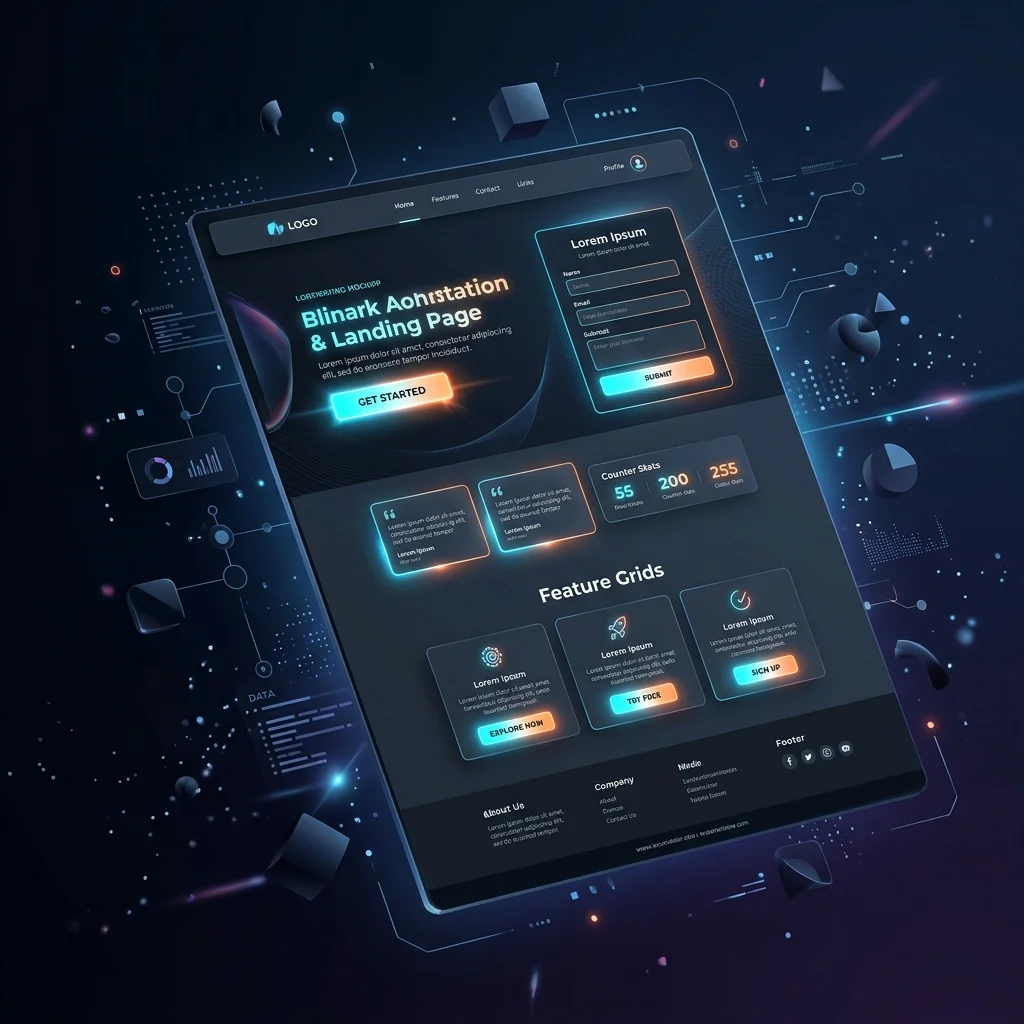
A high-converting landing page typically includes:
- A compelling Headline: States the primary value proposition.
- A clear Call to Action (CTA): What do you want them to do? (e.g., “Get a Quote”, “Download Now”).
- Social Proof: Testimonials, reviews, or trust badges.
- Low-Friction Forms: Only ask for the information you absolutely need.
2. Lab Session: Building The Sandbox
In today’s lab, we favor speed and function over perfection. We will use agile builders to deploy a live asset.
Agile Website Deployment
Select one of the following free tools to build your sandbox:
- Google Sites: Best for absolute beginners; integrates seamlessly with Google Workspace.
- Carrd: Excellent for simple, single-page landing pages.
- Webflow (Free Tier): Best for those who want more design control and are willing to learn a slightly steeper interface.
Structuring for Lead Generation
Your sandbox must be structured to capture leads.
mindmap
  root((Landing Page Structure))
    Hero Section
      Value Proposition Headline
      Subheadline
      Primary CTA Button
    Benefits
      Feature 1
      Feature 2
      Feature 3
    Social Proof
      Testimonials
      Trust Logos
    Lead Capture
      Simple Form Name/Email
      Secondary CTA
Mobile Responsiveness and Speed
Over 60% of web traffic is mobile.
- Use the preview tools in your builder to ensure your site looks good on a smartphone screen.
- Keep image sizes small to ensure fast loading. A slow site kills conversions before they happen.

AI + CRO (manager rule)
You may use AI to draft headlines and CTA variants. Ship only what a human would say to a Nepali customer: clear benefit, credible proof, no exaggerated claims.
A/B vs Multivariate Testing As a manager, you must dictate testing parameters.
- A/B Testing: Changing one variable at a time (e.g., just the headline, or just the CTA color) to isolate exactly what caused the change in conversion rate. Best for lower traffic sites.
- Multivariate Testing (MVT): Changing multiple elements simultaneously to see which combination works best. This requires massive amounts of traffic (often >100,000 monthly visitors) to reach statistical significance and should be avoided for new sandbox projects.
Measurement readiness
Even on Google Sites/Carrd, plan for Session 7: note which button is the primary conversion and how you will capture leads (form → sheet/Mailchimp). Optional: Microsoft Clarity for heatmaps once you have traffic.
Real-world proof (CRO)
Anonymized Kathmandu bookstore checkout work (published): cart abandonment −22%, completed purchases +15%, online revenue +10% in ~3 months — by shortening checkout, guest checkout, and local wallets (eSewa/Khalti).
Teaching brief: Bookstore CRO
For service sandboxes, the analogue is often a 2-field form or WhatsApp CTA, not a 5-step checkout — same principle: remove friction and add trust.
Pause and decide
Your service landing page has traffic but few WhatsApp inquiries. What should you test first: button color, or form length + trust proof above the form?
3. Deliverable
Use the MBA DM Deliverable Toolkit (Templates + Samples) before submitting.
Live URL of your sandbox website.
- The site must be published and publicly accessible.
- It must clearly articulate the value proposition of your chosen business concept.
- It must include a visible Call to Action (CTA) designed to capture a lead.
Submit the live URL to the instructor before the start of Session 3.
4. Summary & Review
Owned media (your website and landing pages) is the asset you control. Basic UX principles (clarity, hierarchy, mobile-first, speed) and conversion rate optimisation turn visitors into leads. The sandbox is deployed quickly using agile, low-code tools, structured around one value proposition and one call to action, and made measurement-ready from day one. A/B tests change one element; multivariate tests need much more traffic.
Key Takeaways
- Launch fast, then improve with evidence.
- One page, one value proposition, one primary CTA.
- Mobile speed and clarity drive conversion in Nepal’s mobile-first market.
- Set up tracking before you send traffic.
Review Questions
Short answer
- Define conversion rate optimisation (CRO).
- State three UX principles a manager should check on a landing page.
- Compare A/B testing with multivariate testing.
Applied (case) questions
- Audit a local business website on your phone: list three friction points and the fix for each.
- Write the headline, sub-headline and CTA for a lead-generation landing page for a coworking space in Lalitpur.