12 Marketing Strategies Every MBA Graduate Should Know
An MBA gives you frameworks. Your first marketing or management role asks you to turn them into decisions with a real budget, a real deadline and a boss who wants results by the end of the quarter. This guide covers the marketing strategies every MBA graduate should know and, more importantly, how to apply them in practice, with notes for working in Nepal.
If you are still studying and want the channel skills (SEO, ads, email and analytics), read my companion digital marketing guide for MBA students first. This post is about strategy: deciding where to compete and how to win.
About the author: I am Arjan KC, a digital marketing expert in Kathmandu and co-founder of Gurkha Technology. I plan full-stack marketing for clients and teach marketing to BBA and MBA students. Results from client work are on our case studies page.
1. Start with customer understanding, not the plan
Every good strategy begins with knowing who buys, why and what alternatives they consider. Clayton Christensen’s “jobs to be done” idea, set out in Competing Against Luck (2016), is a useful lens: customers “hire” a product to make progress in a specific situation.

In practice, that means talking to customers before writing a plan. Ten honest interviews will teach you more than a 40-slide market overview. My guide to customer research for Nepali businesses shows how to run interviews, surveys and review analysis on a small budget.
2. Segment, target and choose
Market segmentation is taught in every MBA, but the hard part is the choice that follows. Segment by needs and behaviour, not only demographics, then pick the segments where you can win profitably.
A useful test for each segment: is it large enough, can you reach it efficiently, do you have a real advantage there, and will it pay enough? Saying “everyone” is not a target market; it is the absence of a decision.
3. Position the brand clearly
Positioning is the place you want to occupy in the customer’s mind relative to alternatives, an idea popularised by Al Ries and Jack Trout. A clear positioning statement answers: for whom, what category, what main benefit, and why we are believable.
In Nepal, many businesses default to “best price” or “best quality”, which customers stop hearing. My guide to positioning for Nepali businesses shows how to find a sharper angle.
4. Build a value proposition customers can repeat
A value proposition turns positioning into a promise people can understand in seconds. Good ones are specific, provable and easy to repeat to a friend. If your own sales team describes the product differently every time, you do not yet have one.
5. Price on value, not on fear
Pricing is the most powerful and most neglected marketing lever. Three principles worth remembering:
- Price on the value delivered, not just cost plus a margin or whatever the cheapest competitor charges.
- Protect your margin. Frequent discounts train customers to wait for the next sale.
- Use structure: good, better and best tiers, bundles and clear anchors help customers choose.
Festival seasons like Dashain and Tihar create pressure to discount. Before you do, run the numbers with my pricing, margin and festival discount calculator to see how much extra volume a discount really needs.
6. Balance brand building and activation
New managers often over-invest in campaigns that produce immediate clicks, because those are easy to measure. Les Binet and Peter Field’s analysis of advertising effectiveness for the IPA, published as The Long and the Short of It (2013), found that long-term brand building and short-term activation work differently, and suggested that most brands need a substantial share of budget on brand building, around 60% as a starting point.
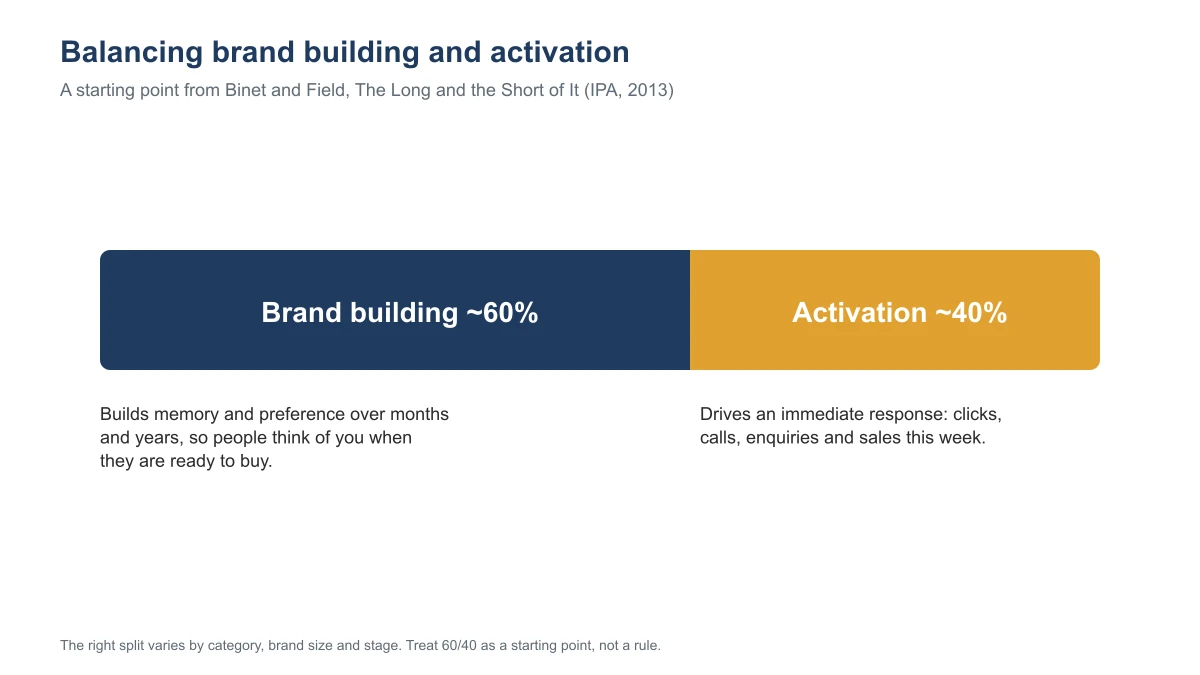
Chart: the 60/40 starting point from Binet and Field (IPA, 2013). The right split varies by category and brand.
Byron Sharp’s How Brands Grow (2010) adds that brands grow mainly by reaching more buyers and by being easy to think of and easy to buy. For a manager, the lesson is simple: do not cut all brand activity just because its payoff is slower to show. My brand identity guide covers building a consistent, recognisable brand on a small budget.
7. Know your unit economics
Before you scale any campaign, know whether each customer is profitable:
- Customer acquisition cost (CAC): marketing spend divided by new customers
- Customer lifetime value (LTV): gross profit per customer over the relationship
- Payback period: how many months of gross profit it takes to recover CAC
Worked example (hypothetical): if CAC is NPR 2,000 and each customer brings NPR 400 of gross profit a month, payback is 2,000 ÷ 400 = 5 months. If customers typically leave after four months, every new customer loses money, however good the click-through rate looks. My MBA guide, linked above, includes a fuller CAC, LTV and ROAS example.
8. Plan the full funnel, not single channels
Customers move from not knowing you, to considering you, to buying, to returning. Each stage needs different messages and channels. A common mistake is to pour budget into bottom-of-funnel ads while nobody new is entering the funnel.
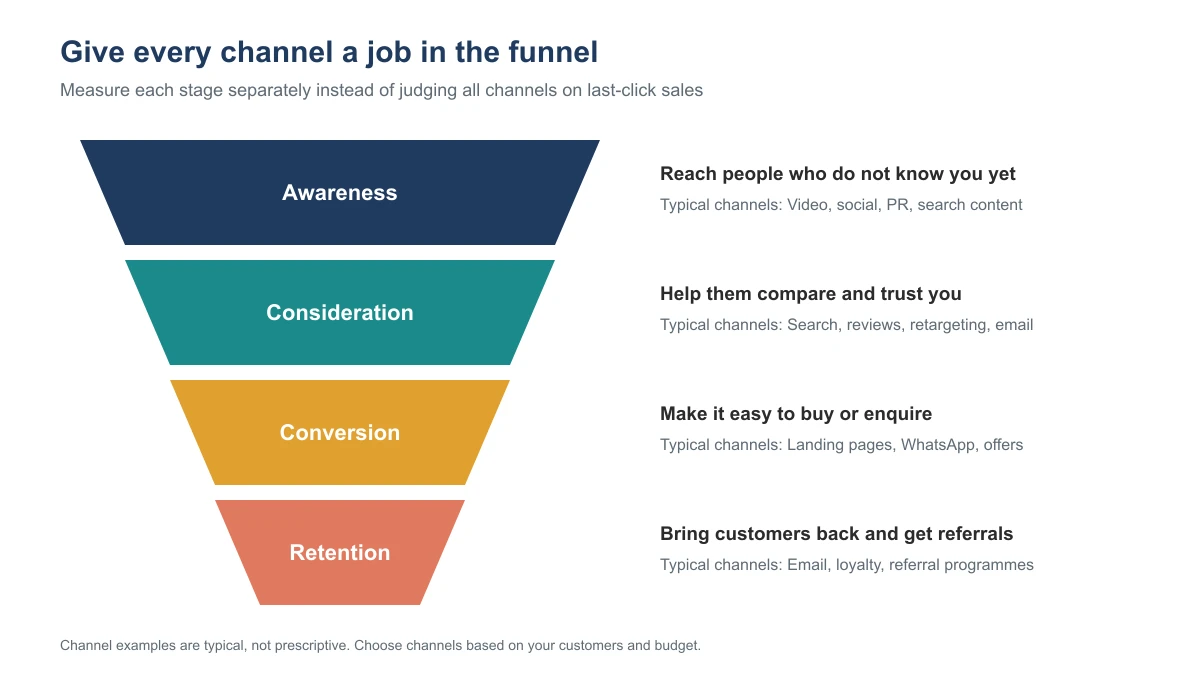
Diagram: typical channel jobs at each funnel stage. Choose channels based on your customers and budget.
Map your funnel, assign each channel a job, and measure each stage separately. For how channels fit together for Nepali businesses, see my digital marketing stack for Nepal.
9. Treat retention as a growth strategy
Keeping customers is usually cheaper than replacing them, and retained customers drive LTV. Track repeat purchase and churn, build a simple CRM, and use the customer data you collect with permission. My guide to first-party data in Nepal explains how to collect and use it with consent.
10. Turn word of mouth into a system
In Nepal, recommendations from friends, family and community groups carry enormous weight. Rather than hoping for word of mouth, design for it: make the experience worth talking about, ask at the right moment and make sharing easy. My referral marketing guide shows how to structure a referral programme.
11. Measure, test and learn
Good managers replace opinions with evidence. Three habits make the difference:
- Define success before launch, with one primary metric per campaign.
- Test one change at a time, and be honest about sample sizes. My A/B testing guide for low-traffic sites covers what to do when traffic is small.
- Ask about incrementality: would these sales have happened without the campaign? Platform dashboards tend to claim credit generously.
12. Build a go-to-market plan
When you launch a product or enter a new market, pull the strategies above into one plan: target segment, positioning, value proposition, price, channels by funnel stage, launch timeline, budget, success metrics and the risks you are watching. B2B plans usually add sales enablement, longer sales cycles and multiple decision-makers; B2C plans lean more on brand, reach and conversion.
Applying these strategies in Nepal
Frameworks travel, but the details change. Plan for:
- Conversation-led buying: WhatsApp, Viber and phone calls often matter as much as website forms.
- Payment realities: cash on delivery, digital wallets and the gap between order and delivery.
- Seasonality: Dashain, Tihar, admission seasons and wedding seasons shift demand.
- Trust signals: reviews, physical presence and known faces carry more weight than polished ads.
Your first 90 days in a marketing role
- Weeks 1–4: talk to customers and the sales team, and audit current data and tracking.
- Weeks 5–8: write down the segment, positioning and unit economics, and fix the biggest measurement gaps.
- Weeks 9–12: run one well-designed test, report honestly on what you learned and propose the next quarter’s plan.
Strategy is not the slide deck you present. It is the set of choices you are willing to defend with numbers. If your organisation needs help putting these into practice, my team and I at Gurkha Technology work with Nepali businesses on exactly this.


