TikTok Ads vs Meta Ads Nepal: Spark Ads Strategy 2026
TikTok ads vs Meta ads in Nepal is no longer a question of “which app is popular”. Both are. For a Nepali direct-to-consumer (D2C) brand selling clothing, skincare, snacks or gadgets, the real question is narrower: should your next NPR 50,000 go into TikTok Spark Ads built on creator videos, or into Meta (Facebook and Instagram) ads that end in a DM, a WhatsApp chat or a checkout?
This 2026 strategy guide compares the two the way a D2C owner actually experiences them: creator ad formats, creative, targeting, buying intent, measurement for cash-on-delivery (COD) and WhatsApp orders, and a budget split you can test without guessing. Cost ranges come from the Nepal Digital Marketing Benchmark Report 2027; platform mechanics are checked against TikTok’s and Meta’s own help documentation.
Short answer: Use TikTok Spark Ads to find new buyers cheaply with creator-style video. Use Meta to catch, retarget and close those buyers in Instagram DMs, Messenger, WhatsApp and checkout. Most Nepali D2C brands should run both, but not in equal amounts on day one.
What changed since the “TikTok is just dancing” era
The original version of this post (early 2026) treated TikTok as a cheap-attention experiment. A few things make a fresh comparison necessary:
- TikTok’s legal footing is clearer. TikTok registered with Nepal’s government in November 2024, after a period when the app was banned. Brands that paused TikTok then can plan for it as a normal channel.
- Single-platform risk is real. Meta’s platforms were briefly blocked in Nepal in September 2025. Brands that depended only on Instagram DMs lost their order channel for those days. Running two ad platforms and owning a customer list (phone numbers, WhatsApp opt-ins, email) is basic risk management now.
- Creator ads became the main event on both platforms. TikTok Spark Ads and Meta partnership ads both let a brand pay to distribute a creator’s post under the creator’s name. The comparison is now creator format against creator format, not “UGC on TikTok, polished on Facebook”.
For the wider channel picture, see the ultimate guide to social media marketing in Nepal.
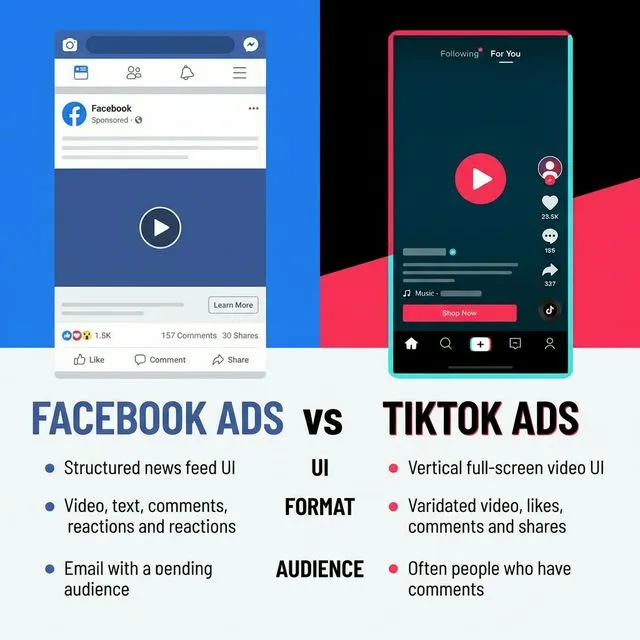
TikTok vs Meta at a glance (Nepali D2C view)
| Factor | TikTok (Spark Ads and in-feed) | Meta (Facebook, Instagram, Messenger, WhatsApp) |
|---|---|---|
| Creator ad format | Spark Ads (creator or own-account posts) | Partnership ads (creator post, story or Reel shown with both names) |
| Typical click cost (Nepal) | Feed CPC ~NPR 2–8 (benchmark, looser method) | Traffic CPC NPR 5–18; retargeting NPR 8–25 (benchmark) |
| Buying intent | Discovery and impulse | Discovery plus DM, WhatsApp and retargeting closers |
| Order path most brands use | Website or landing page, then WhatsApp or checkout | Instagram DM, Messenger, click-to-WhatsApp, website checkout |
| Targeting style | Broad, algorithm-led | Broad prospecting plus strong custom audiences and retargeting |
| Measurement | TikTok Pixel + Events API | Meta Pixel + Conversions API |
| Minimum budget | Above USD 20/day per ad group, USD 50/day per campaign | Lower floor in practice; the benchmark suggests NPR 500–1,000/day to start |
| Best for | Products under roughly NPR 3,000 that demo well on video | Higher-consideration products, repeat buyers, retargeting, DM-led sales |
Click costs are planning ranges, not quotes. Cheaper clicks are usually colder clicks, so judge both platforms on cost per delivered order. The Meta ads cost benchmarks for Nepal and the TikTok ads guide for Nepal go deeper on each platform’s pricing.
What TikTok Spark Ads are (and how authorization works)
A Spark Ad promotes an existing organic TikTok post as an ad. The post keeps its original handle, caption, sound and engagement, and the paid views add likes, comments and follows to the original post rather than to a separate “dark” ad.
You can run Spark Ads from two kinds of posts:
- Your own brand account’s posts, linked to TikTok Ads Manager through Business Center.
- A creator’s post, with the creator’s permission. This is the version most D2C brands care about.
According to TikTok’s Ads Manager help documentation, the creator authorizes a specific post like this:
- Open the post in the TikTok app and tap the three dots.
- Tap Ad settings, agree to the advertising content terms and turn on Ad authorization.
- Choose an authorization period of 7, 30, 60 or 365 days and generate the video code.
- Copy the code and send it to the brand.
The brand then pastes the code in Ads Manager under Tools → Creative assets → Spark Ads posts → Apply for authorization (TikTok allows batch authorization of up to 20 codes at a time) and selects the post when building the ad. Brands that work with the same creator repeatedly can instead request account-level authorization through Business Center.
Three practical rules for Nepali brands:
- Match the code period to the campaign. TikTok rejects ads whose end date is later than the authorization end date, and expired or deleted codes need a fresh code. Ask for 30 or 60 days in the creator contract.
- Finalise captions first. Authorization ties the ad to the post as published, so get the caption, price and offer right before the creator generates the code.
- Pay for usage rights separately. A creator fee for an organic post does not automatically include paid usage. Put “Spark Ad authorization for N days” in writing. The creator ads guide for Nepal covers contracts and disclosure.
Meta’s equivalent: partnership ads
Meta’s creator format is called partnership ads. Older guides call it “branded content ads”; partnership ads is the current name. The ad runs with both the creator’s and the brand’s names in the header, and the brand controls the budget, targeting and destination from Meta Ads Manager.
Permission works in one of two ways:
- Per post: the creator opens the post, story or Reel, taps Options → Partnership label & ads, turns on Get partnership ad code and shares the code. The brand enters it in Ads Manager when it turns on the partnership ad option.
- Account level: the brand sends a partnership request from Meta’s partnership tools, and the creator accepts it in the Instagram or Facebook app. This suits ongoing creator programmes.
Meta’s help pages also refer to this tooling as the partnership ads hub or creator marketing hub, and eligibility rules change, so check the current Meta Business Help Center wording before you sign a creator contract.
What this means for D2C brands: you can buy one creator video and run it on both platforms, as a Spark Ad on TikTok and as a partnership ad on Instagram, provided the creator posted it on both and your contract covers paid use on both. That doubles your creative testing for one production cost. Use the influencer campaign calculator to check whether the creator’s fee makes sense against expected CPM and engagement.
Creative: what wins on each platform in Nepal
You cannot just export one ad and paste it everywhere. The same creator footage usually needs two edits.
TikTok creative
- Hook in the first two seconds. A face, a problem or a visible result (“this kurta survived three washes”).
- Native sound and on-screen text. Romanized Nepali or mixed Nepali-English captions read naturally; formal English often feels like an ad.
- Price on screen in NPR, plus “COD available inside Valley” if true. Price surprises kill impulse buys.
- Demonstration over description: try-ons, before and after, unboxing, a taste test.
- Volume. Expect most videos to fail. Brief three to five creators per test cycle rather than one.
Meta creative
- Reels and Stories behave much like TikTok: vertical, creator-led, fast hook. A partnership ad using the same creator video is the natural test.
- Carousels and catalogue-style ads still work for multi-product D2C stores and retargeting (“still thinking about the black hoodie?”).
- DM and WhatsApp prompts. Much of Nepal’s social commerce still happens in conversation. Ads with “Message us on WhatsApp” or Instagram Direct as the call to action fit how customers want to buy. See the WhatsApp marketing playbook for Nepal.
- Proof. Delivery photos, real customer comments and clear return terms do more on Meta, where buyers are often closer to purchase.
For format-level differences between short-video platforms, read TikTok vs Instagram Reels for Nepali brands.
Targeting: broad vs signal-rich
TikTok works best with broad targeting (age, location, maybe a few interest or behaviour categories) and lets the algorithm find buyers based on how people react to the creative. In practice, your creative is your targeting on TikTok: a video about acne patches finds people who care about acne.
Meta has also moved towards broad, algorithm-led prospecting, where detailed targeting acts more as a suggestion. Its edge for D2C brands is first-party and retargeting audiences:
- Website visitors and add-to-cart users (via Meta Pixel and Conversions API).
- Instagram and Facebook engagers, including people who messaged you.
- Customer lists (phone numbers and emails) for exclusion or repeat-purchase offers.
- Video viewers, including people who watched your partnership ads.
Location reality: most COD-reliable delivery is inside Kathmandu Valley and major cities. Restrict prospecting to areas you can actually deliver to at your stated price, on both platforms. Wasted clicks from districts you can’t serve inflate cost per order.
Buying intent: discovery vs closing
Think of the two platforms as different stages of the same funnel:
- TikTok = discovery. People are not looking for your product. Spark Ads create demand, especially for products that are visual, cheap enough to buy on impulse and easy to explain in 15–30 seconds.
- Meta = discovery and closing. Instagram Reels and partnership ads create demand too, but Meta’s strength is the second and third touch: retargeting, DMs, WhatsApp conversations and catalogue reminders.
- Google Search = existing demand. When people search a product name, Search usually beats both. The Google Ads vs Meta Ads decision guide covers when to add it.
A common pattern for Nepali D2C brands: a TikTok Spark Ad gets a cheap first view, the viewer later sees the same creator in an Instagram partnership ad, clicks to the site or WhatsApp, and buys. Last-click reports will credit Meta for that order. Your budget decisions need to account for that, which is why the measurement setup matters.
graph LR
    A["TikTok Spark Ad<br/>(creator video, cold reach)"] --> B["Landing page or<br/>product page visit"]
    C["Instagram partnership ad<br/>(same creator)"] --> B
    B --> D{"Order path"}
    D --> E["Website checkout<br/>(eSewa, Khalti, card, COD)"]
    D --> F["WhatsApp or DM order"]
    E --> G["Server event on<br/>confirmed / delivered order"]
    F --> G
    G --> H["Meta CAPI + TikTok Events API<br/>(deduplicated with event_id)"]
Figure 1: How a Nepali D2C order typically moves across TikTok and Meta, and where conversion data goes back to each platform.
Measurement: pixels, server events, COD and WhatsApp
If you can’t measure delivered orders by platform, any budget split is a guess. The minimum setup for a D2C site:
1. Browser pixels on both platforms
Install the TikTok Pixel and the Meta Pixel (directly or through Google Tag Manager) and fire standard events: ViewContent, AddToCart, InitiateCheckout and Purchase or PlaceAnOrder.
2. Server-side events
- Meta Conversions API (CAPI) sends events from your server to Meta. See the Meta Conversions API setup guide and the Conversions API dictionary entry.
-
TikTok Events API does the same for TikTok. TikTok’s documentation says that if you send the same event through both the Pixel and the Events API, you must include an identical
event_idin both. TikTok then deduplicates matching events within a 48-hour window.
3. COD orders: fire Purchase when money is real
COD return and refusal rates mean a “Purchase” at order placement overstates revenue. A cleaner approach:
- Fire PlaceAnOrder (or a custom “order placed” event) in the browser at checkout.
- Fire Purchase server-side only when the order is confirmed by phone or marked delivered, with the same order ID as the
event_id. - Optimise campaigns on the event that matches your real goal once you have enough volume.
4. WhatsApp and DM orders
These don’t trigger pixels. Track them manually but consistently:
- Use a separate pre-filled WhatsApp message or UTM-tagged link per campaign (“Hi, I saw the TT-HOODIE-OCT video”).
- Log each order in a sheet or CRM with source, creator, order value and delivery status.
- Upload confirmed orders back as offline or server events where your setup allows it.
5. Payment gateways
If you take prepaid orders, make sure eSewa, Khalti or Fonepay success returns your customer to an order confirmation page that fires the conversion. The eSewa, Khalti and Fonepay payment gateway guide covers the integration side.
Finally, work out your break-even ROAS before you judge either platform. The break-even ROAS calculator and the ROAS dictionary entry explain the maths.
Budget split framework for a Nepali D2C brand
The tiers below use the ad spend bands in the Nepal Digital Marketing Benchmark Report 2027: NPR 20,000–40,000 a month for a test, NPR 50,000–120,000 for a stable programme and NPR 150,000+ for e-commerce scale. The percentage splits are a starting framework to test, not published results.
One constraint shapes everything: TikTok’s minimum budget. TikTok’s Help Center lists daily budgets above USD 20 per ad group and USD 50 per campaign, with lifetime ad group budgets calculated as USD 20 × scheduled days. Convert that at your card’s exchange rate. On a small Nepali budget, TikTok often has to run in short bursts rather than all month.
| Monthly media budget | Meta share | TikTok share | Creator / content fees | How to run it |
|---|---|---|---|---|
| NPR 20,000–40,000 (test) | 70–80% | One 7-day Spark Ad burst | Pay 1–2 creators | Meta: one prospecting and one retargeting ad set. TikTok: test 2–3 creator videos in one burst. |
| NPR 50,000–120,000 (stable) | 55–65% | 25–35% | ~10% of total | Run partnership ads and Spark Ads on the same creator videos. Keep Meta retargeting always on. |
| NPR 150,000+ (scale) | 40–60% | 40–60% | 10–15% | Shift budget monthly towards the platform with the lower cost per delivered order. |
How to use the table:
- Keep Meta retargeting funded at every tier. Retargeting site visitors and engagers is usually the cheapest source of orders. The benchmark lists Meta retargeting CPC at NPR 8–25, with CPM of NPR 100–250.
- Reserve 10–15% for tests (new creators, new hooks, new offers) once you pass the test tier.
- Budget creator fees separately from media. A brilliant creator video with no paid distribution, or paid distribution behind a weak video, both waste money.
- Agency management is extra. The benchmark lists ads management at NPR 15,000–40,000 a month plus media spend.
- Adjust for seasonality. The benchmark records CPC uplifts of 30–50% around Dashain and Tihar. Plan for tighter auctions in those weeks, and book creators before the festival rush.
For a fuller planning sheet, use the ad budget planner for Nepal and the Facebook ads budget guide.
A 4-week testing plan
Week 0: setup. Install pixels and server events, define your COD Purchase rule, create WhatsApp tracking codes, and confirm delivery zones. Brief three creators with one product and one offer. Get Spark Ad codes and partnership ad codes for 30+ days.
Week 1: Meta baseline. Run one broad prospecting ad set with two or three creator videos as partnership ads, plus one retargeting ad set. Note cost per landing page view, cost per order and cost per delivered order.
Week 2: TikTok burst. Run the same creator videos as Spark Ads in one ad group at or above the minimum budget for 7 days. Keep the landing page and offer identical so the platform is the only variable.
Week 3: cross-retargeting. Retarget TikTok-driven site visitors on Meta (both pixels see the same visitors), and keep the winning Spark Ad running if budget allows. Watch whether blended cost per delivered order falls.
Week 4: decide. Compare platforms on:
- Cost per delivered order (not cost per click).
- COD refusal rate by platform. Impulse buyers refuse more often, so check it.
- Average order value.
- Repeat purchase signals (WhatsApp follow-ups, second orders).
Then move 10–20% of budget towards the winner and repeat with new creatives. If your traffic is small, the A/B testing guide for low-traffic Nepali sites explains how to avoid reading noise as a result.
When each platform wins
TikTok Spark Ads usually win when:
- The product is visual, demo-able and priced for impulse purchase (roughly under NPR 3,000).
- Your buyers are 18–30 and urban.
- You can produce or source several creator videos a month.
- You need reach for a new brand that nobody is searching for yet.
Meta usually wins when:
- The product needs trust, explanation or comparison (higher price, skincare with claims, electronics).
- Sales close in DMs or WhatsApp.
- You have warm audiences to retarget: site visitors, engagers, past customers.
- You sell many SKUs and need catalogue-style reminders.
Run both when you have at least a stable-tier budget, a creator pipeline and server-side tracking. Use TikTok to feed new people into the funnel and Meta to convert and retain them.
Common mistakes Nepali D2C brands make
- Judging TikTok on CPC. Cheap clicks that never order are not cheap.
- Counting COD orders as revenue at checkout. Track delivered orders, or you’ll scale the platform with the worst refusal rate.
- Running one creator video. Creative fatigue arrives fast on both platforms. Plan for new videos every two to three weeks.
- No paid usage clause. Running a creator’s post without written authorization damages relationships and can get ads rejected.
- Spreading TikTok budget too thin. Below the minimum, the ad group can’t learn. One focused burst beats a month of starved delivery.
- Depending on one platform. The September 2025 Meta block showed why your customer list and a second channel matter.
Proof and next steps
This post uses benchmark ranges, not client results. Published, numbered outcomes for Arjan KC and Gurkha Technology work live only on the case studies page. For paid social execution in Nepal, see TikTok ads management in Nepal, Facebook ads in Nepal and the full digital marketing stack for Nepal.
Related reading
- TikTok Ads Guide for Nepal (2026)
- TikTok vs Instagram Reels for Nepali Brands
- Meta Ads Cost in Nepal: CPM and CPC Benchmarks
- Creator Ads in Nepal: Partnership Ads and Spark Ads
- Influencer Campaign Calculator for Nepal
- Ultimate Guide to Social Media Marketing in Nepal
- Meta Conversions API Setup Guide
- Facebook Ads Budget in Nepal
- Cultural PPC in Nepal: Festival and Local Timing
- Facebook Ads in Nepal
- TikTok Ads in Nepal
- Digital Marketing Strategy Template