AI in Digital Marketing: What Students Need to Learn
Every semester my students ask a version of the same question: if AI can write ads and posts in seconds, what is left for us to learn? It is a fair question. AI has changed how marketing work gets done faster than most university syllabuses can keep up with.
The short answer is that AI is replacing tasks, not judgement. This guide explains what is actually changing and the specific skills students should learn now to stay valuable. For the broader industry trends, see my earlier post on the future of AI in digital marketing.
About the author: I am Arjan KC, a digital marketing expert in Kathmandu and co-founder of Gurkha Technology. I use AI tools daily in client work and teach students how to use them responsibly, including through my free DM AI Launchpad programme.
What AI is changing in digital marketing
Three shifts matter most for anyone starting a marketing career.

1. Content production is faster and cheaper. Drafting copy, generating image variations and summarising research now take minutes. That raises the bar: average content is everywhere, so original insight and accuracy stand out more.
2. Ad platforms are increasingly automated. Google and Meta now offer campaign types where the platform decides much of the targeting, bidding, placement and creative combinations. The marketer’s job shifts from pulling levers to feeding the system good inputs (conversion data, creative and budgets) and judging whether the results are real.
3. Search now includes AI answers. Google’s AI Overviews and AI Mode summarise topics and link to supporting websites. Google says the same SEO fundamentals apply and that there are “no additional requirements” or special optimisations needed to appear in them (Google Search Central).
The skills students need to learn
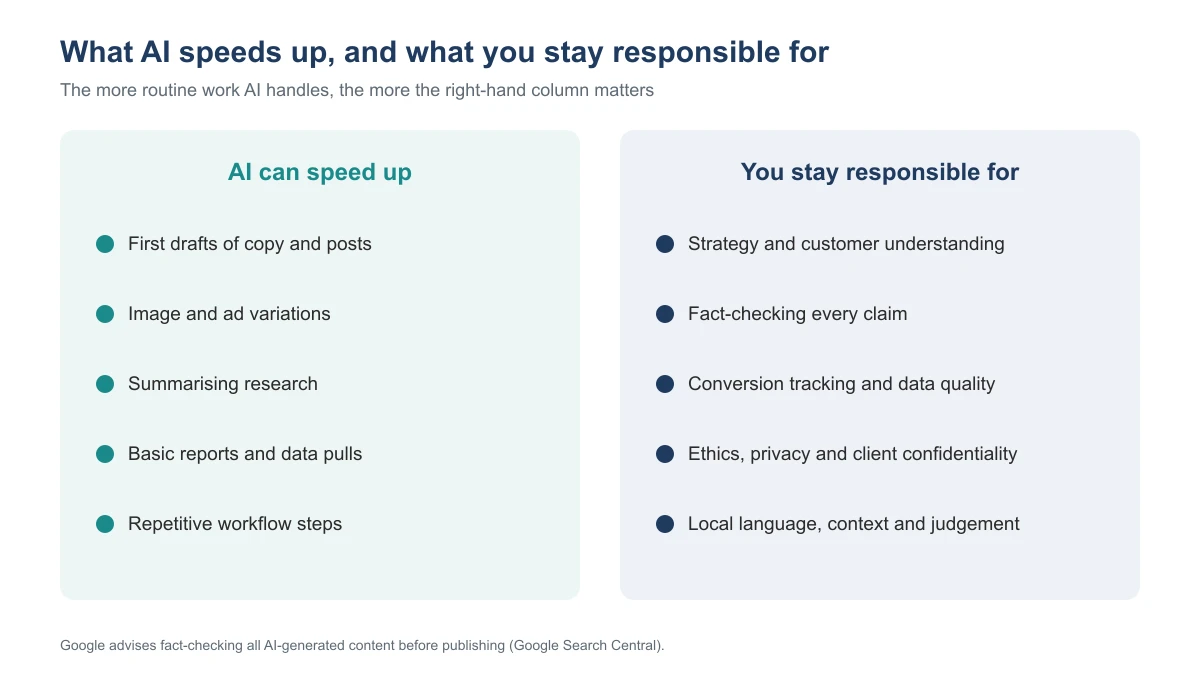
The more routine work AI handles, the more the right-hand column matters.
1. Marketing fundamentals, more than ever
AI can produce a campaign plan in seconds, but it cannot tell you whether it is the right plan for this customer, this budget and this market. Customer research, segmentation, positioning, pricing and unit economics are what let you judge AI output. My guide to marketing strategies every MBA graduate should know covers the essentials.
2. Briefing AI clearly
The quality of AI output depends on the quality of your instructions. Learn to write a brief that includes:
- Context: the business, audience and goal
- Constraints: tone, length, platform rules and words to avoid
- Examples: what good looks like
- The format you need: headlines, a table, three options and so on
This is the same skill as briefing a designer or an agency, which is why good briefers become good managers.
3. Fact-checking and editing
Google’s own guidance is blunt: generative models “don’t retrieve facts, but predict a likely sequence of words,” so their output can contain inaccuracies. Google says it is critical to fact-check and review all AI-generated content before publishing, including titles, meta descriptions, structured data and image alt text (Google Search Central).
For students, that means learning to verify claims against primary sources, catch invented statistics and edit for voice and clarity. The person who can spot what is wrong with an AI draft is worth more than the person who can generate ten of them.
4. Data literacy and measurement
Automated campaigns are only as good as the data they learn from. If conversion tracking is broken, the algorithm optimises for the wrong thing. Students need to understand:
- How to set up and test conversion tracking in Google Analytics 4 and ad platforms
- How to read reports and spot when numbers do not add up
- How to collect customer data with consent. My guide to first-party data in Nepal explains the basics.
5. Working with automated ad systems
Instead of micromanaging bids, the modern ads specialist decides what to feed the system and how to judge it: which conversions count, how much creative variety to supply, how to structure budgets and when results are genuine rather than the platform taking credit for sales that would have happened anyway. My MBA course covers this in sessions on AI-assisted ad copy and creative and A/B test design.
6. SEO for AI search
Students do not need a new rulebook for AI search; they need the fundamentals done well. Google’s checklist for AI features includes allowing crawling, clear internal links, good page experience, important content in text form and structured data that matches the visible page. It also says you do not need special AI text files or markup, and that traffic from AI features is reported in Search Console’s Performance report under the “Web” search type (Google Search Central).
Be careful with content at scale. Google warns that using generative AI to create many pages without adding value may violate its spam policy on scaled content abuse (Google Search Central). For more on this area, see my AEO and GEO hub and my guide to AI Overviews for Nepal websites.
7. Simple automation
Many marketing tasks are repetitive: moving leads from a form to a spreadsheet, sending follow-up messages, compiling weekly reports. Learning a no-code automation tool and basic logic (triggers, conditions, actions) lets you save hours and makes you useful to any small team. The final day of DM AI Launchpad covers workflow automation.
8. Ethics, privacy and disclosure
AI raises questions every marketer must be ready to answer:
- Client confidentiality: do not paste private client or customer data into public AI tools without permission.
- Privacy: respect consent and local law. In Nepal, the Individual Privacy Act, 2075 (2018) sets out rights over personal information.
- Transparency: Google suggests giving readers context about how automated content was created, and Google Merchant Center requires AI-generated product images and data to be labelled (Google Search Central).
- Bias and accuracy: check outputs for stereotypes and errors, especially in sensitive categories.
9. Local language and context
AI tools are trained mostly on English-language data. Output in Nepali and romanised Nepali can be uneven, and AI may miss local references, festivals and humour. Always review local-language content with a fluent speaker who knows the audience. This is an area where Nepali marketers have a clear advantage.
10. The human skills
The more routine work AI handles, the more these matter: creativity, persuasion, client communication, presenting to stakeholders, negotiating budgets and taking responsibility when things go wrong. My post on AI’s impact on marketing roles looks at which roles are changing most.
How to practise these skills as a student
- Run the same brief twice. Create a campaign for a real or imaginary business once without AI and once with it. Compare quality, speed and accuracy, and write down what you had to fix.
- Keep an AI log. For each project, record what you asked, what the tool produced and what you changed. That log becomes portfolio evidence of judgement, not just output.
- Fact-check one AI article a week. Find every claim and verify it. You will quickly learn how often confident text is wrong.
- Build one automation. Connect a form to a spreadsheet and an email or chat follow-up.
- Follow a structured course. Work through DM AI Launchpad, and see my list of AI tools for students in Nepal for practical options.
What employers will look for
When I review junior candidates, I am less interested in which AI tools someone has tried and more interested in whether they can explain a decision, show tracked results and point out what an AI draft got wrong. Show your thinking, keep your sources and present AI as a tool you direct, not a substitute for your judgement.
Sources
- Google Search Central, AI features and your website
- Google Search Central, Guidance on using generative AI content


