AI tools for Nepali teachers and students should reduce prep time and improve feedback — not replace classrooms or encourage cheating. This guide lists practical, low-cost tools vetted for schools and colleges with uneven internet, limited budgets, and growing pressure to teach digital literacy.
It extends themes from low-tech high-impact teaching and AI assessment in Nepal for faculty who need a 2026-ready toolkit.
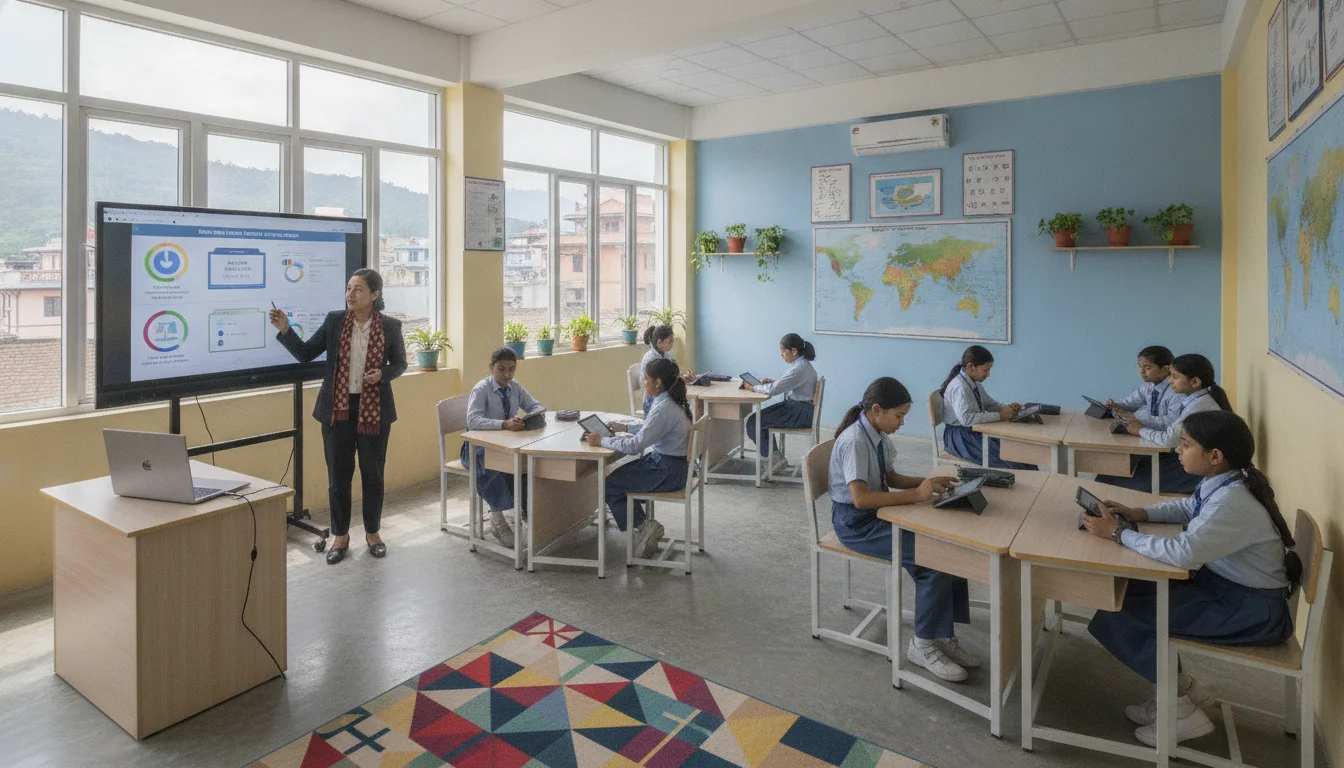
Image: Arjan KC media library — ICT tools for Nepali teachers.
Principles before tools
- Disclose AI use in syllabi — what is allowed on drafts vs finals.
- Process over product — require outlines, reflections, and viva where integrity matters.
- Nepali context — AI often mishandles Nepali idioms; teach students to verify facts and localize examples.
- Data privacy — do not paste identifiable student records into public AI chats.
- Teacher judgment — AI suggests; you approve.
Tool matrix by use case
| Use case | Tool | Cost | Nepal notes |
|---|---|---|---|
| Lesson plan draft | ChatGPT / Gemini | Free tier | Specify grade, subject, 40-min period, Nepali examples |
| Slides | Canva / Google Slides + AI | Free–Edu | Export PDF for low-bandwidth classrooms |
| Quiz generation | Google Forms + AI draft | Free | Teacher edits every question |
| Reading simplification | Gemini / Claude | Free tier | Good for ESL science texts |
| Image for class | Ideogram / DALL·E | Limited free | Verify cultural accuracy manually |
| Coding (IT programs) | GitHub Copilot / Cursor | Paid / student packs | Teach ethics + attribution |
| Local/offline lab | Ollama + small model | Free (hardware) | See local SLM guide |
| Translation assist | Google Translate + human edit | Free | Never submit raw translation as essay |
For teachers: five workflows that save time
1. Lesson plan in 15 minutes
Prompt template:
“Create a 40-minute lesson on [topic] for Grade [X] in Nepal. Include learning objective, 5-min hook, 15-min explanation, 10-min group activity, 5-min exit ticket. Use a Kathmandu daily-life example.”
Edit for curriculum alignment (CDC / university syllabus).
2. Rubric generation
Ask AI for a 4-level rubric; then adjust weights to match your actual grading priorities. Publish rubric to students before assignments — reduces disputes.
3. Differentiated homework
Three difficulty tiers from one prompt: support / core / extension. Reduces prep vs writing three worksheets manually.
4. Parent communication
Draft Nepali + English SMS about PTA, exams, or holidays. Principal approves before send.
5. Formative feedback bank
Generate comment snippets (“Your thesis is clear but evidence is thin”) — paste and personalize. Faster than writing from scratch.
Related: data-driven grading Nepal · flipped classroom.
For students: ethical use ladder
| Level | Allowed when policy permits | Example |
|---|---|---|
| 1 — Research | Summarize sources you will verify | “Explain Keynesian policy in 200 words” |
| 2 — Structure | Outline only; student writes prose | Bullet essay plan |
| 3 — Language | Grammar check on own writing | Fix tense errors |
| 4 — Prohibited | Submit AI output as final work | Full essay copy-paste |
When in doubt, cite AI assistance like a calculator or tutor.
Academic integrity policy snippet (adapt for syllabus)
Students may use AI for brainstorming and grammar if they document tools used. All factual claims must be verified with course materials or cited sources. Submitting AI-generated text as original work without permission is academic misconduct.
Universities should publish institution-wide guidance — until then, course-level clarity prevents unfair penalties.
Infrastructure for Nepali schools
| Constraint | Workaround |
|---|---|
| Slow Wi-Fi | Pre-download slides; use offline Ollama on one lab PC |
| No Edu licenses | Google personal accounts + shared class Drive (mind privacy) |
| Power cuts | UPS for router + teacher laptop; async homework |
| Device gap | Pair programming; group submissions with role logs |
Align with school Wi-Fi budget guide for connectivity planning.
Four-week school pilot (minimal budget)
| Week | Activity | Owner |
|---|---|---|
| 1 | Publish AI policy one-pager; faculty meeting | Principal |
| 2 | Two demo lessons using lesson-plan workflow | Early adopter teachers |
| 3 | Student workshop: ethical use ladder | IT coordinator |
| 4 | Survey staff + students; adjust syllabus | Academic head |
Budget: NPR 0–15,000 if using free tiers; optional Ollama lab PC NPR 80,000–150,000 one-time.
Policy landscape in Nepal (2026)
Universities and CEHRD-adjacent bodies increasingly expect digital literacy, not AI bans. Until your institution publishes formal rules:
- Default to disclose-and-verify for student work
- Document faculty AI use in course outlines
- Prefer institutional Google Workspace over personal ChatGPT accounts for student data
Link ICT curriculum work to ICT tools for Nepali teachers and national ICT index context.
Tools to avoid in formal assessment
- Undisclosed ghostwriting on final theses
- Face recognition “proctoring” with weak privacy policy
- Auto-grading essays without human sample audit
- Uploading student PII to unvetted apps
Connecting to careers
Students in IT204, PRC112, and digital marketing programs should see AI as workflow literacy, not a shortcut. Link to digital marketing career paths and portfolio building.
Related reading
- AI assessment Nepal
- Learning in the age of AI
- Low-tech high-impact teaching
- Open source for schools Nepal
- Cyber hygiene Nepal
For institutions: Gurkha Technology runs faculty workshops on AI policy and classroom integration — contact for training.