Top WMS for 3PL Providers: 2026 Logistics Guide
The third-party logistics (3PL) industry in 2026 operates at the intersection of extreme execution density and rapid technological convergence. As global supply chains navigate an era of persistent volatility, 3PL providers have transitioned from simple warehousing intermediaries into critical technology hubs that manage multi-client complexity, diverse service level agreements (SLAs), and a fragmented ecosystem of digital integrations. At the core of this transformation is the Warehouse Management System (WMS), which has evolved from a passive inventory record into a dynamic “trust engine” that governs the physical and financial performance of the logistics enterprise. The selection of a 3PL-optimized WMS is no longer a tactical procurement task but a strategic imperative that determines a provider’s ability to minimize revenue leakage, scale operations without proportional increases in headcount, and satisfy the high-transparency demands of modern omnichannel brands.
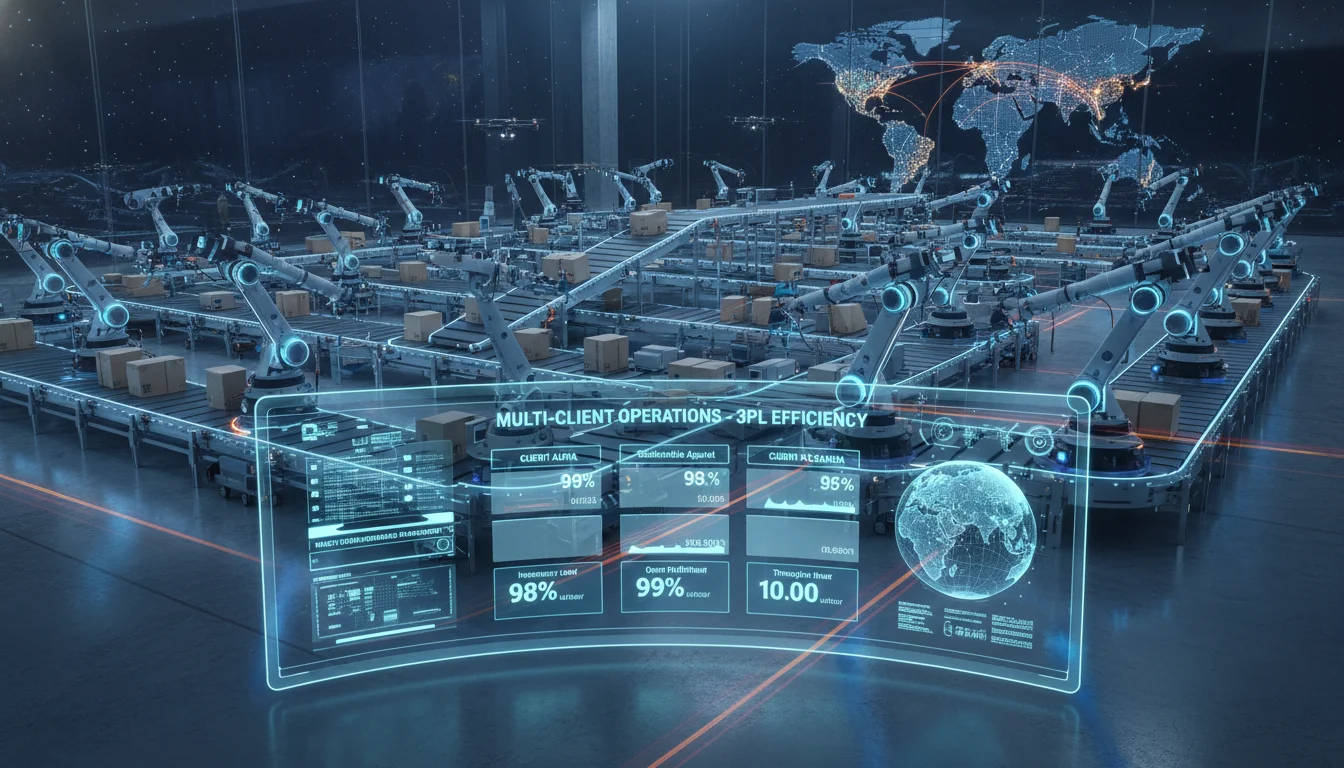
Architectural Foundations: Multi-Tenancy and Execution Density
The fundamental challenge of a 3PL operation is the management of multiple clients with distinct rules, billing cycles, and packaging requirements within the same physical infrastructure. Unlike standard WMS solutions designed for a single company, 3PL-specific platforms are built on multi-tenant architectures that ensure strict data and inventory segregation while allowing the provider to manage the entire facility through a single interface. This architecture eliminates the need for siloed logins and cumbersome workarounds, allowing for the application of different workflows, rates, and rules to different clients seamlessly.
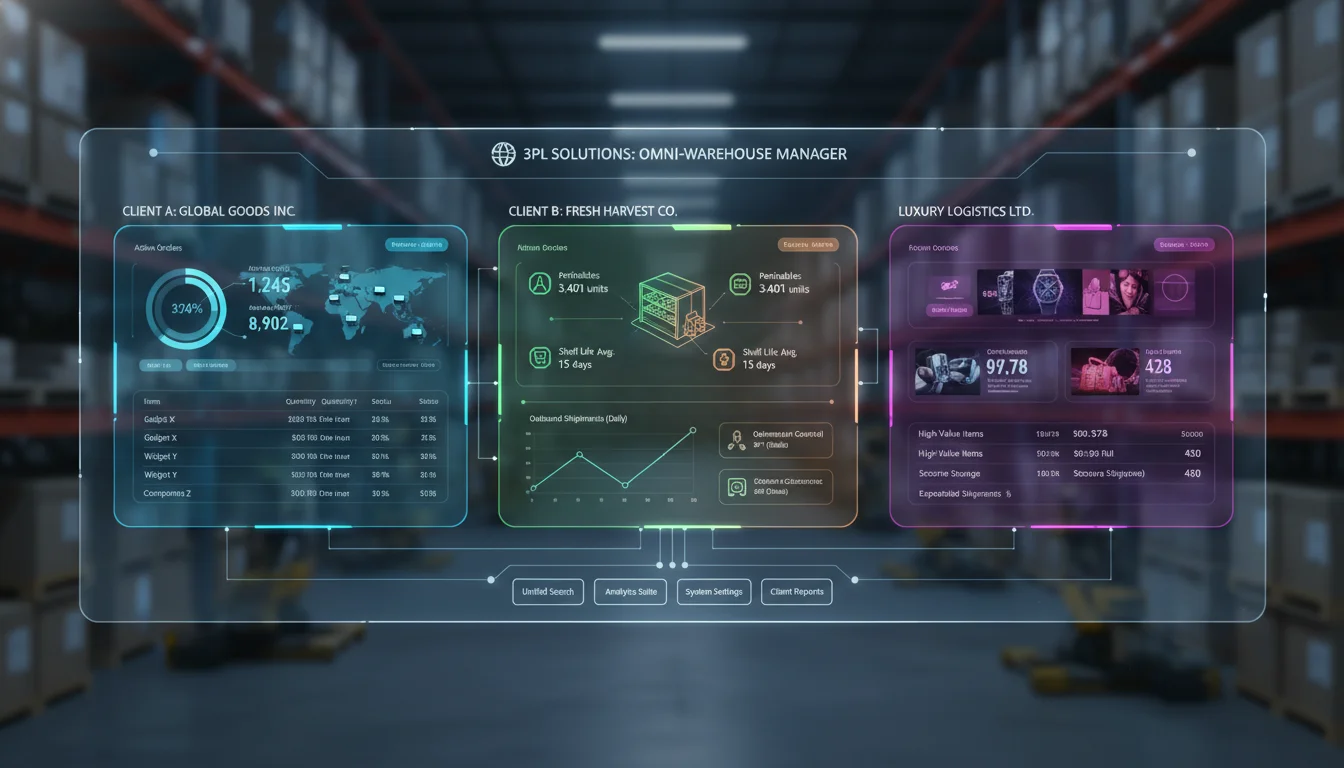
Cloud-native platforms like Deposco, Logiwa, and ShipHero exemplify this shift toward multi-tenant scalability. These systems allow 3PLs to run their entire operation on a single codebase, facilitating continuous updates and removing the risk of “forklift upgrades” that previously plagued legacy on-premise installations. In this environment, the system capacity grows automatically as the business expands, enabling 3PLs to open new sites or acquire facilities without investing in localized hardware.
| Architectural Attribute | Multi-Tenant Cloud (e.g., Deposco, ShipHero) | Enterprise Microservices (e.g., Manhattan Active) | Hybrid/Single-Tenant (e.g., Infios/Körber) |
|---|---|---|---|
| Update Cycle | Continuous weekly or monthly updates | Quarterly updates via versionless design | Periodic updates; may require instance-level sync |
| Data Structure | Logical separation in shared database | Microservices-driven data isolation | Physical or instance-based separation |
| Integration Model | API-first with high standard-connector counts | 100% extensible API-first architecture | Modular suites with deep ERP integrations |
| Resource Efficiency | Optimized for high-throughput DTC | Heavy orchestration of labor and robotics | Scalable from manual to highly automated |
The emergence of microservices, most notably in Manhattan Active Warehouse Management, has further decoupled system functions. This allows for simultaneous resource orchestration, where human pickers and autonomous robots are viewed as a single pool of capacity. This architectural flexibility is critical for 3PLs that must support complex omnichannel demand, such as manufacturing-to-consumer (M2C) models and ultra-short fulfillment windows.
The 3PL Profit Engine: Automated Billing and Revenue Assurance
Revenue leakage is the most persistent threat to 3PL profitability. In manual environments, uncaptured value-added services (VAS)—such as specialized kitting, labeling, or returns processing—frequently lead to losses of 3% to 15% in potential billings. A modern 3PL WMS addresses this through activity-based billing engines that capture events in real-time as they occur on the warehouse floor.
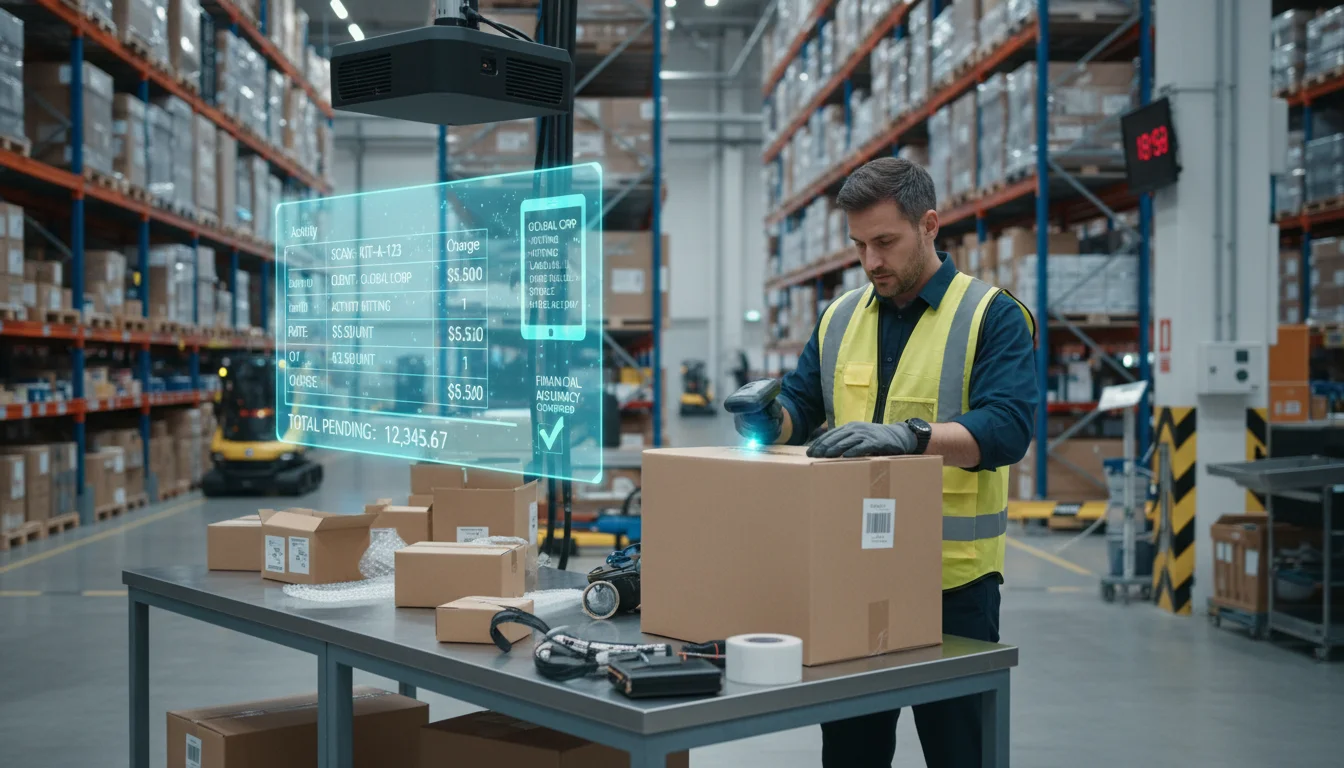
Platforms like Extensiv (formerly 3PL Central) and Da Vinci WMS have built their reputations on these robust billing modules. By defining roles, rules, and workflows, these systems adapt to individual client requirements without the need for custom coding. When a worker scans a barcode during a kitting process, the system automatically logs the activity and associates it with the specific rate card for that client, ensuring that the labor and materials are accurately reflected in the next invoice. This automation transforms billing from a month-end administrative burden into a continuous, accurate process.
The impact of automated billing on operational finance is significant. Case studies indicate that implementing specialized 3PL billing tools, such as Extensiv’s Billing Manager, can cut monthly billing time by 50% and save tens of thousands of dollars in staffing costs annually. Furthermore, by providing clients with real-time access to their billing data via self-service portals, 3PLs reduce support tickets and build long-term contractual trust through transparency.
Market Segmentation: Identifying the Right-Fit Solution
SMB and Growth-Focused Solutions
Small 3PL providers, typically managing 1 to 20 clients, require systems that prioritize fast implementation (2-5 weeks) and ease of use for non-technical teams. Affordability is paramount, with typical pricing ranging from $750 to $1,800 per month.
Zenventory has emerged as a leader in this segment by offering flat-rate subscriptions with unlimited users, which avoids the “growth taxes” associated with per-user licensing. It includes native 3PL logic such as client portals and billing automation out-of-the-box. Similarly, Packiyo is designed for operators who need speed and pick accuracy without enterprise complexity, utilizing barcode-driven workflows at every stage from receiving to packing.
Other notable contenders in the SMB space include WareGo and MRPeasy. WareGo offers an all-in-one cloud platform that is particularly strong for very small operations with 1 to 5 clients. For small 3PLs that also handle light manufacturing or assembly, MRPeasy provides a specialized solution that bridges the gap between production and distribution.
Mid-Market and High-Throughput Leaders
As 3PLs grow to handle 20 to 100 clients or process more than 5,000 orders per day, the focus shifts to AI-powered forecasting, advanced wave planning, and deep integration with e-commerce ecosystems.
Logiwa is optimized for these high-volume environments, using AI demand forecasting to help adjust inventory positioning and automated wave planning to reduce the labor hours per order that eat into margins at scale. It provides over 200 pre-built integrations, making it a versatile choice for 3PLs serving diverse retail and e-commerce clients.
Deposco offers a unified suite that combines WMS, Order Management (OMS), and planning on a single codebase. It is known for rapid implementations—some as fast as 55 days—and is a top choice for mid-market companies experiencing rapid growth. Its library of 150+ open connectors allows it to integrate seamlessly with robotic systems and major parcel carriers.
Extensiv remains the “standard” for established 3PLs operating multiple facilities. Its workflows are modeled on real-world operational patterns observed since 2006, and its ability to manage custom rate cards across dozens of clients remains an industry benchmark.
Enterprise Orchestration and Robotics
At the highest end of the market, the priority is the orchestration of human labor, advanced robotics, and multi-site global networks.
Manhattan Active Warehouse Management is a cloud-native, microservices-based system that receives new features every 90 days. It unifies distribution, labor, and transportation, and its built-in Warehouse Execution System (WES) allows for the vendor-agnostic onboarding of robotics, such as autonomous mobile robots (AMRs).
Blue Yonder focuses on AI-powered predictive analysis and labor optimization. Its “Cognitive Suite” can predict labor shortages and use pull-based streaming to release work based on real-time carrier capacity and shipping dock availability. Following its acquisition of Optoro, it has also embedded specialized returns management directly into the WMS, making it a powerful choice for high-return industries like apparel and electronics.
Infios (formerly Körber/HighJump) is designed for complex, high-automation environments. Its “Robotics Hub” is a plug-and-play system that integrates different robot brands into one workflow in hours rather than months. It also pioneers the use of virtual reality (VR) picking tools for rapid employee training, which can reduce onboarding time by up to 70%.
| Vendor | Primary User Base | Strategic Differentiator | Est. | | —— | —————– | ———————— | —- |
Price Range (Monthly)
Zenventory
Growing SMB 3PLs
Unlimited users; built-in shipping discounts
$750 - $1,800
ShipHero
DTC-focused 3PLs
iOS mobile focus; Pack-to-Light systems
$1,995+
Logiwa
High-volume fulfillment
AI demand forecasting; automated wave planning
Quote-based
Deposco
Rapid-growth mid-market
Unified WMS/OMS; rapid 55-day go-lives
Quote-based
Manhattan Active
Enterprise distribution
Microservices; built-in WES; Agentic AI
$20,000 - $60,000
Infios (Körber)
Automation-heavy 3PLs
Robotics Hub; Agentic AI; high customizability
Quote-based
Technical Deep-Dives: Features that Move the Needle
For a 3PL to stay competitive in 2026, the WMS must support features that automate the “chaos” of multi-client logistics. These capabilities go beyond simple inventory tracking to include sophisticated resource and demand management.
Advanced Inventory and Order Orchestration
Inventory trust is the foundation of the 3PL-client relationship. If cycle counts do not match system numbers or if quarantined stock is not visible to the client, trust evaporates. Leading systems solve this through scan-driven moves and real-time updates across all locations, including holds, QA, lots, and serials.
Order orchestration must support complex batching and priority rules. For example, Manhattan’s “Order Streaming” uses AI to constantly re-prioritize the queue, ensuring that the most urgent shipments are processed first while maximizing picker density. ShipHero uses similar AI route optimization to reduce the distance staff walk by up to 30%, speeding up fulfillment times significantly.
Labor Management and Gamification
Labor constraints and rising wages have made labor management a critical WMS module. Manhattan Active WM utilizes gamification to motivate employees and provides real-time task prioritization, which has been shown to improve productivity by up to 20%. Blue Yonder’s labor management module goes further, using machine learning to predict labor needs based on historical patterns and upcoming demand spikes.
These systems allow supervisors to gain granular visibility into worker performance, identifying bottlenecks and recognizing top performers. By creating a more engaging work environment, 3PLs can reduce turnover in a highly competitive labor market.
The Evolution of Returns and Reverse Logistics
Reverse logistics has shifted from an afterthought to a core service offering, especially for e-commerce 3PLs. An ideal WMS incorporates streamlined RMA (Return Merchandise Authorization) workflows with dedicated quarantine bins and detailed reason codes. Systems like Blue Yonder have integrated specialized returns management through the acquisition of Optoro, allowing 3PLs to process returns more efficiently and turn them back into sellable inventory faster.
Effective returns handling also impacts the financial side of the business. By tracking the labor and materials used in inspecting and re-stocking items, 3PLs can ensure they are properly billing for these reverse flows, which are often more labor-intensive than outbound shipments.
Economic Architecture: Total Cost of Ownership and ROI
Understanding the financial implications of a WMS deployment requires looking beyond the initial license fee to the Total Cost of Ownership (TCO) over a five-year period.
The Components of WMS Cost
A mid-market 3PL WMS investment typically comprises five distinct lines:
- Software Subscription: The recurring fee, which may be per-user, per-warehouse, or per-order.
- Implementation Services: Vendor or partner labor for configuration and training. This often represents 30% to 100% of the year-one subscription cost. For enterprise systems like Manhattan, implementation fees can reach $750,000.
- Integrations: Connecting to client ERPs, shopping carts, and carriers. This is often the biggest source of cost surprises.
- Hardware: Barcode scanners, thermal printers, and tablets. Re-using existing hardware can save significant capital, but newer systems often require modern Android or iOS devices.
- Internal Labor: The time spent by the 3PL’s own team during the cutover. Under-investing here is a common cause of implementation failure.
Pricing Psychology and Scaling
The pricing model a WMS uses can fundamentally change how costs behave during growth. Transaction-based pricing scales directly with volume, providing clear visibility into per-order costs. However, for high-volume 3PLs, this can become more expensive than flat-rate models that offer unlimited volume or users.
On average, a warehouse with 10 users might spend $20,000 annually on a cloud-based WMS, while a 50-user operation could exceed $100,000. Most companies achieve a full return on investment within 6 to 12 months due to a 20% to 30% increase in operational efficiency and a significant reduction in mis-picks and rework.
Cost Element: Monthly Subscription
Small 3PL (1-20 clients): $750 - $1,800
Mid-Market (20-100 clients): $2,000 - $5,000
Enterprise (100+ clients): $10,000+
Cost Element: Implementation Fee
Small 3PL (1-20 clients): $2,000 - $10,000
Mid-Market (20-100 clients): $20,000+
Enterprise (100+ clients): $750,000
Cost Element: Implementation Time
Small 3PL (1-20 clients): 2 - 5 weeks
Mid-Market (20-100 clients): 8 - 12 weeks
Enterprise (100+ clients): 3 - 6 months
Cost Element: Scaling Metric
Small 3PL (1-20 clients): Often flat-rate
Mid-Market (20-100 clients): Per-order or per-user
Enterprise (100+ clients): Enterprise annual
Strategic Integration: Carriers, ERPs, and Global Trade
In 2026, a WMS cannot exist in isolation. It must be the “nerve center” of a larger logistics ecosystem, connecting seamlessly to external partners and regulatory frameworks.
The Multi-Carrier Shipping Strategy
For e-commerce 3PLs, the WMS must integrate with a variety of carriers to offer clients the best balance of speed and cost.
- Veho: Best for DTC brands shipping to metro areas that want “Amazon-level” delivery experiences.
- DHL eCommerce: The leader for cross-border shipping, particularly to Europe and Asia, with built-in customs expertise that reduces clearance delays.
- FedEx: Preferred for time-sensitive, high-value, and specialized shipments due to its fast domestic air network.
- UPS: Best for high-volume shippers that can negotiate deep discounts and require strong returns handling via the UPS Returns Manager.
- USPS: The most cost-effective option for lightweight parcels under 1 lb, such as supplements or small beauty products.
Global Trade Management (GTM) and Compliance
As international trade complexity rises, 3PLs are increasingly integrating their WMS with Global Trade Management (GTM) platforms. These systems serve as a “control layer” for cross-border operations, unifying compliance, documentation, and risk management.
GTM systems automate restricted party screening, ensuring that 3PLs do not inadvertently ship goods to sanctioned entities or individuals, which could result in massive fines. They also manage HS (Harmonized System) classifications and duty qualified under trade agreements like the USMCA, reducing the total landed cost for the client. Platforms like Oracle GTM and SAP Global Trade Services are the leaders in this space, providing real-time visibility into customs clearance milestones and potential regulatory bottlenecks.
ERP and CRM Synchronization
The integration of the WMS with a client’s ERP (e.g., NetSuite, Microsoft Dynamics) or CRM is essential for maintaining a “single source of truth”. NetSuite WMS, being native to the NetSuite ERP ecosystem, offers a unique advantage by eliminating the need for third-party connectors and potential sync errors. This ensures that inventory data, financials, and order information always align, allowing leaders to make faster, data-driven decisions.
For 3PLs not using a native ERP-WMS, middleware like Spacefill can play a critical role in normalizing data flows between disparate systems, ensuring that every shipment or return confirmation in the WMS is reflected in the client’s financial records in real-time.
Operational Excellence: Specialized Use Cases
Certain 3PL niches require specialized WMS functionality that goes beyond standard retail fulfillment.
Cold Chain and Perishable Goods
Managing temperature-sensitive goods requires a WMS with robust lot and serial tracking for full traceability. Cold chain WMS modules provide real-time monitoring to prevent food recalls and ensure regulatory compliance. Systems like Infios (Körber) have a long-standing reputation for managing these complex environments, supporting multiple product categories with unique handling rules inside the same warehouse.
High-Value and Bulky Items
For 3PLs specializing in heavy, oversized, or high-value goods—such as Red Stag Fulfillment—the WMS must support specialized handling rules and optimized slotting for large items. These operations often utilize yard management modules to track trailers and containers before they even reach the dock, ensuring that the warehouse floor is never overcrowded and that high-priority inbound shipments are processed first.
Subscription Boxes and Kitting
Subscription fulfillment requires a WMS that can handle massive “waves” of identical orders simultaneously. ShipHero and Logiwa excel in this area, providing tools for high-speed kitting and automated order routing that can process thousands of identical kits in a single production run. These systems track the labor and materials for each kit, ensuring that the 3PL is compensated for the specialized assembly work.
The Future Frontier: Agentic AI and Autonomous Execution
The year 2026 marks the arrival of “Agentic AI” in the warehouse.
Unlike standard AI that simply provides advice or dashboards, these AI agents can take autonomous action within the WMS. For example, Manhattan Active Agents can diagnose the root cause of an operational bottleneck—such as a delayed inbound shipment—and automatically orchestrate a change in the picking sequence to keep the outbound flow moving. Infios has introduced agents that can autonomously post gig-work shifts to integrated labor platforms when they predict a labor shortage for the next day, ensuring that the 3PL can meet its SLAs without manual intervention. AI is also transforming warehouse layout through predictive reslotting. Agents monitor demand patterns and recommend moves that put the items predicted to have the highest volume in the next two weeks in the most accessible “golden zone” locations, potentially saving hundreds of hours of travel time per month.
Final Strategic Considerations for WMS Selection
Selecting a 3PL WMS is a long-term commitment. Implementation often takes 15-20 years for enterprise systems due to the availability of continuous upgrades. Therefore, the decision must be based on a provider’s 2030 roadmap, not just their 2026 features.
A true 3PL-optimized system is characterized by its ability to manage “multi-client density” efficiently. It should automate the most complex parts of the business—billing, client reporting, and resource orchestration—allowing the 3PL to focus on service quality and customer growth. As the market continues to shift toward ultra-fast fulfillment and highly automated environments, the WMS will remain the most critical piece of infrastructure in the 3PL technology stack.
Ultimately, the providers that “win” in the 2026 logistics landscape will be those that treat their WMS as a strategic “trust engine.” By combining accurate data, clean integrations, and configurable workflows, these 3PLs can onboard new clients faster, ship more accurately, and protect their margins even as global supply chain demands continue to evolve.