Top Geofencing Platforms for QSR Franchises in 2026
Strategic Evaluation of Geofencing Advertising Platforms for QSR Franchises in 2026

Executive Synthesis
The Quick Service Restaurant (QSR) sector in 2026 operates in an environment defined by intense hyper-competition, continuously evolving consumer dining habits, and an increasingly stringent digital privacy landscape. Geofencing advertising, historically utilized as a rudimentary instrument for proximity-based mobile display, has matured into a sophisticated, multi-layered discipline combining deterministic location intelligence, predictive machine learning, and advanced cross-device attribution. For multi-location franchise operations, the deployment of location-based marketing (LBM) is no longer solely about driving top-of-funnel brand awareness; it is an operational imperative designed to generate highly measurable, deterministic foot traffic, optimize daypart-specific revenue, and foster long-term loyalty through personalized, context-aware engagement.
However, the architecture of franchise organizations introduces unique complexities into the deployment of geofencing technologies. Franchisors must balance the necessity of maintaining strict corporate brand safety with the imperative to empower individual franchisees with localized, agile marketing capabilities. Furthermore, the advertising technology ecosystem is currently navigating seismic shifts in privacy infrastructure. The widespread rollout of Apple’s iOS 26, featuring mandatory Link Tracking Protection (LTP) and Advanced Fingerprinting Protection, alongside the systematic deprecation of third-party cookies, has rendered legacy tracking methodologies obsolete. Consequently, platforms that rely on fragile identifiers are being supplanted by those utilizing predictive audience modeling, proprietary server-side tracking, and robust first-party data integrations.
This comprehensive analysis examines the leading geofencing advertising platforms optimized for QSR franchises. The report evaluates the technical mechanics, attribution validity, franchise governance capabilities, and integration capacities of these platforms, providing strategic recommendations for engineering a future-proof location-based marketing stack capable of driving sustained offline revenue.
The Evolution of Location-Based Marketing in Quick Service Restaurants
The fundamental premise of geofencing—triggering a digital action based on a mobile device crossing a virtual boundary—has transcended simple radial targeting. In 2026, the efficacy of location-based advertising is determined by polygonal precision, intent signals, and predictive intelligence.
From Radial Zones to Polygonal Property Blueprints
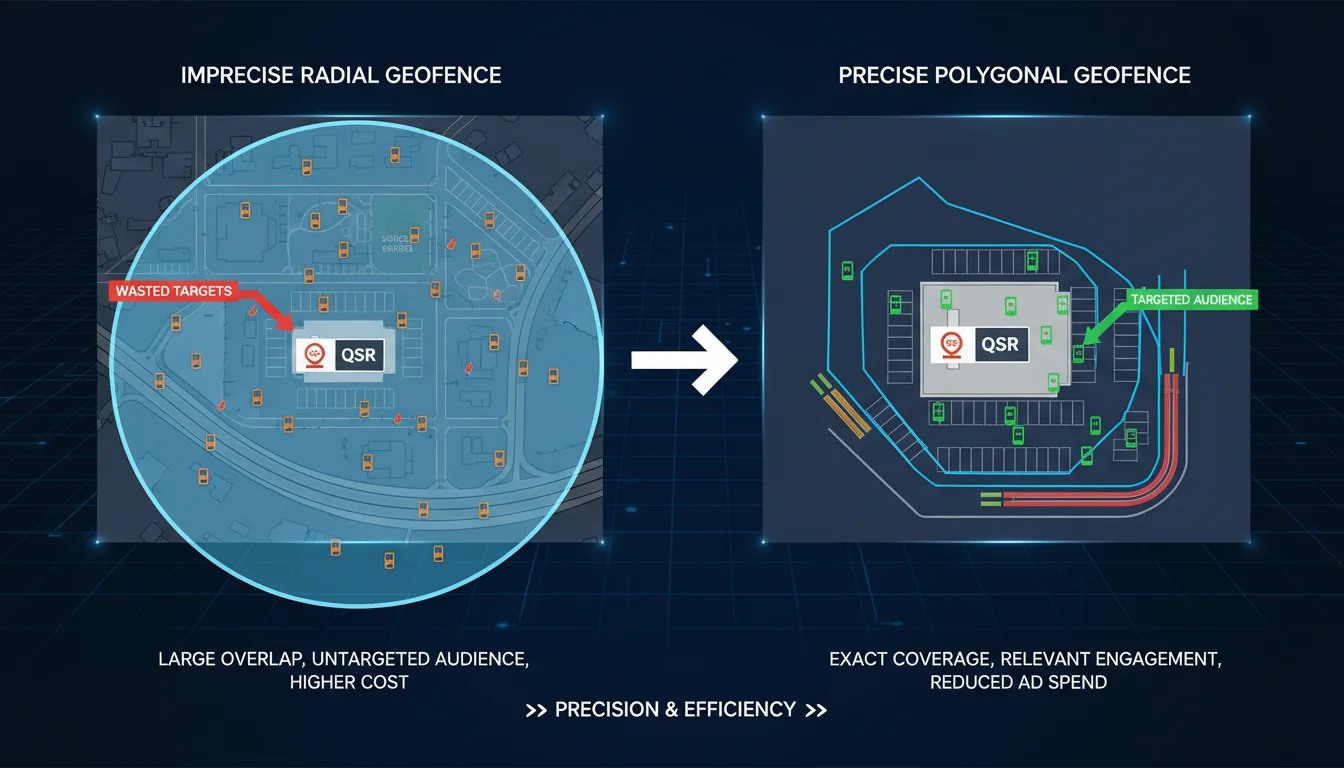
Radial mapping, which historically blanketed geographic areas in a circular radius, inherently wastes advertising spend by capturing irrelevant traffic. For a QSR located near a major intersection, a simple radial fence captures consumers traveling on adjacent highways at high speeds or visiting entirely unrelated businesses nearby. Modern platforms rely on polygonal mapping, commonly referred to as blueprinting or plat-line targeting, which matches GPS coordinates to the exact architectural shape and dimensions of a target property.
This evolution allows QSR brands to deploy hyper-targeted strategies such as geo-conquesting, wherein a virtual perimeter is established strictly around the property lines of a direct competitor, enabling the delivery of promotional messaging to consumers demonstrating competitive affinity. Advanced platforms even allow for the isolation of specific zones within a commercial footprint, such as drawing a perimeter exclusively around a competitor’s drive-thru lane rather than the entire shopping center.
Temporal Optimization and Dayparting Strategies
Geofencing strategies have become intrinsically tied to temporal optimization, known in the QSR industry as dayparting. The analysis indicates that consumer intent fluctuates dramatically based on the time of day and the immediate context of their location. For instance, a coffee and breakfast franchise can leverage predictive geofencing to target morning commuters within a one-to-two mile radius, dynamically adjusting the creative to highlight breakfast offerings. Conversely, that same operation can pivot to high-margin promotional deals targeted at nearby university campuses or entertainment districts during late-night hours, resulting in significant lifts in response rates.
The integration of predictive machine learning further refines this process. Rather than merely serving ads to any device within a polygon, advanced platforms evaluate historical visitation patterns, app-usage behavior, and demographic overlays to score the probability of a conversion. By understanding non-traditional dayparts—acknowledging that modern consumer eating habits often blur traditional meal times—QSR retailers can promote best-selling items at the exact moment a specific demographic is most likely to convert, thereby increasing foot traffic, relevancy, and average order value (AOV).
The Franchise Cannibalization Paradox: Corporate Governance vs. Local Agility
One of the most persistent operational challenges in QSR marketing is the inherent tension between national corporate strategy and local franchisee execution. This dynamic frequently results in what industry analysts term the “franchise cannibalization paradox”.
The Tension Between National Campaigns and Local Ad Spends
When corporate marketing teams run national programmatic or search campaigns, they often overlap geographically with the localized ad campaigns executed by individual franchisees. Because both entities are bidding on the same digital inventory to reach the same consumer within a specific market, they inadvertently drive up the cost-per-impression (CPM) and cost-per-acquisition (CPA) for the brand as a whole, essentially bidding against themselves.
Furthermore, franchisees are generally only concerned with generating sales at their specific locations. When franchisees contribute to a national marketing fund, they frequently demand localized transparency, requiring verifiable data that demonstrates how their specific financial contributions are driving foot traffic directly to their individual storefronts rather than corporate-owned locations. Without specialized multi-location technology, corporate teams struggle to optimize campaigns at a granular enough level to provide this localized return on investment.
Centralized Command Centers and Democratized Local Advertising
To mitigate these inefficiencies, leading AdTech platforms have engineered hierarchical franchise management infrastructures. These systems democratize local advertising by allowing the central corporate entity to establish strict brand safety guardrails—such as pre-approved creative assets, locked messaging frameworks, and maximum budget thresholds—while granting franchisees the autonomy to activate campaigns based on local market nuances.
By utilizing centralized platforms, franchisors can create overarching digital marketing “Programs” that serve as a foundational structure. Individual franchisees are then granted access to local dashboards where they can fund and activate these pre-approved campaigns for their specific territories with a few clicks, bypassing the need to hire independent local marketing agencies or become digital marketing experts themselves. This ensures brand consistency while leveraging the franchisee’s intimate knowledge of their local consumer base.

Real-Time Crisis Management and Hyper-Local Event Activation
A centralized local advertising model ensures that when a franchisee needs to respond to a hyper-local event, they can immediately pivot their ad spend without violating brand standards. The importance of this agility was highlighted during the COVID-19 pandemic, where brands like JINYA Ramen Bar utilized multi-location platforms to instantly pause advertisements for temporarily closed locations and update localized messaging regarding takeout policies, without disrupting national campaigns.
Similarly, this localized agility allows QSRs to capitalize on micro-events. For example, during the Super Bowl, a QSR franchise can utilize real-time tools to run limited-time flash deals tied to key game moments (such as halftime or a touchdown) specifically targeted at local sports fans. Pop-up locations also benefit immensely; macaron franchise Woops! successfully deployed highly targeted local marketing to support temporary winter holiday pop-up locations in major metropolitan areas, ensuring localized visibility for the short duration of the lease.
Demand-Side Platforms (DSPs) and Ad-Tech Ecosystems for QSRs
The 2026 market for QSR geofencing is dominated by platforms that successfully merge programmatic media buying with deterministic location intelligence. The following analysis dissects the leading demand-side platforms and ad-tech ecosystems engineered specifically for multi-location and franchise architectures.
Simpli.fi: Unstructured Data and Addressable Cross-Device Geofencing
Simpli.fi operates as a prominent programmatic DSP utilizing a proprietary infrastructure designed explicitly for unstructured data. Its headline capability for the QSR sector is its Addressable Geo-Fencing technology, which enables localized targeting at the precise individual household level.
By converting first-party CRM lists or curated demographic segments into custom-shaped target fences based on exact property plat lines, Simpli.fi enables QSRs to deliver highly precise messaging without relying on outdated and overly broad postal code targeting. A key differentiator for Simpli.fi is its cross-device matching capability.
Simpli.fi
If a consumer enters a geofenced area, Simpli.fi captures the device ID and extends the advertising reach to all devices associated with that user’s household, including Connected TV (CTV), desktop, laptop, and tablet environments. Consumers can then be served targeted ads for up to thirty days following their initial visit to the geofenced location.
For franchises, Simpli.fi offers a dedicated multi-location architecture that allows agencies or corporate marketers to set up campaigns wherein each tactic, creative asset, and budget is broken out and optimized for individual storefronts. This ensures that performance tracking via custom “Conversion Zones” accurately attributes physical walk-ins to the correct local operation. While the platform excels in hyperlocal precision and variable recency targeting—which adjusts bidding based on how recently a consumer visited a location—analysts note that its operation as a single, closed DSP means advertisers must consolidate their programmatic buying entirely within the Simpli.fi ecosystem to realize full value.
GroundTruth: Proprietary Blueprints and Self-Serve Democratization
GroundTruth distinguishes itself through its proprietary mapping technology, known as Blueprints, and its accessible Ads Manager platform. Operating on a foundation of massive scale, GroundTruth reported over 151.4 million verified physical visits driven for its clients in a single year.
The platform’s technological core relies on creating exact polygonal boundaries around more than 5 million commercial locations. When attempting to measure QSR foot traffic, GroundTruth utilizes a patented Location Verification algorithm that scrubs incoming location data, filtering out noisy or inaccurate GPS signals to ensure high-fidelity attribution. GroundTruth provides a critical distinction in its reporting metrics by dividing foot traffic into “Verified Visits” (deterministic visits directly tied to an ad exposure via a high-confidence location signal) and “Projected Visits” (inferred traffic based on algorithmic modeling when a verified signal is absent).
Furthermore, GroundTruth has evolved into a full-funnel omnichannel platform by integrating Digital Out-of-Home (DOOH) and Digital Audio, allowing QSR brands to execute coordinated campaigns across mobile display, streaming audio, and digital billboards, all tied to the same underlying footfall measurement. Its Ads Manager is widely praised for democratizing access to enterprise-grade location intelligence, providing local franchisees with a highly accessible user interface and the ability to execute localized campaigns without requiring the massive minimum ad spends historically mandated by managed-service agencies. Early adopters in the restaurant space, such as Ted’s Montana Grill, reported achieving a 10x return on ad spend by leveraging the self-service platform’s precise location targeting.
AdTheorent: Machine Learning, Point Geo-Intelligence, and CPIV
AdTheorent represents the leading edge of machine learning applications in location-based advertising, positioning its “Point” geo-intelligence suite as a predictive, privacy-forward alternative to traditional ID-based targeting.
Rather than relying on static geofences that capture all nearby devices indiscriminately, AdTheorent’s ML engine ingests massive datasets regarding historical visitation patterns across its database of over 29 million consumer-focused Points of Interest (POI). By utilizing contextual signals, the platform scores the statistical probability of an individual consumer engaging with an ad and subsequently visiting a location. This results in the platform’s ability to offer specialized pricing models such as Cost Per Incremental Visit (CPIV), which guarantees performance by optimizing bids toward consumers who demonstrate the highest mathematical likelihood of driving true incremental sales lift, rather than just organic traffic.
AdTheorent’s approach is particularly potent for competitive conquesting. By analyzing app-usage behavior and historical visits to competitor locations, the platform constructs custom ML models for each campaign. Utilizing Studio A\T, the platform dynamically assembles creative elements in real-time, assigning a likelihood of engagement to each available creative option to ensure the optimal message is served to the consumer. As privacy regulations tighten and third-party identifiers face extinction, AdTheorent’s ID-independent predictive modeling ensures that QSR brands can maintain high-fidelity targeting without relying on individualized tracking profiles.
Propellant Media: White-Label Architecture and Conversion Zone Tracking
Propellant Media operates as an omnichannel digital agency heavily specialized in geofencing, maintaining a strong position in the QSR and franchise sectors. It is particularly notable for providing robust white-label geofencing services, allowing other digital marketing agencies to resell its enterprise-grade technology to their own clients under their own branding.
The firm’s technological methodology centers heavily on the deployment of “Conversion Zones.” After constructing precise virtual boundaries around target areas (such as competitor restaurants, convention centers, or localized neighborhoods), Propellant Media establishes secondary geofences around the client’s physical storefronts. When a device exposed to an ad in the target zone crosses into the Conversion Zone, it is deterministically recorded as an offline walk-in conversion. Propellant Media’s solution does not require the installation of physical Bluetooth beacons at the retail location, instead relying on the fact that approximately 90% of individuals keep location services active on their mobile devices.
SOCi: Agentic AI, Listings Consolidation, and Social Amplification
While historically classified alongside listings management tools, SOCi has expanded aggressively into localized digital advertising for franchises, leveraging what it terms “Agentic AI”. SOCi’s platform acts as an automated command center designed to eliminate the immense manual labor associated with executing hyper-local marketing across hundreds or thousands of QSR locations.
Agentic AI systems go beyond basic generative text; they are goal-directed autonomous agents that reason, plan, and execute marketing workflows within predefined compliance guardrails. SOCi’s “Genius Agents” automate the deployment of localized social advertising, ensuring that ads are dynamically customized with local store promotions, authentic community involvement, and localized copy, while simultaneously blocking off-brand phrases and unapproved imagery.
By unifying geofenced ad campaigns, localized social media content amplification (SOCi Boost), reputation and review management, and local SEO listings within a single login, SOCi provides franchisors with a deeply integrated ecosystem. This consolidation is highly effective for QSR brands seeking to align their organic local presence with paid proximity-based advertising, generating significant efficiencies for marketing teams constrained by limited headcount.
Hyperlocology: The Blueprint for Multi-Location Franchise Execution
Unlike generalized DSPs, Hyperlocology is a specialized SaaS advertising platform architected entirely around the operational realities of multi-location and franchise brands. It explicitly addresses the corporate-versus-local dilemma by centralizing the management of local advertising while completely empowering per-location execution.
Hyperlocology integrates directly via API with major ad networks—including Google, Meta, Connected TV (CTV), and Digital Out-of-Home (DOOH)—allowing corporate teams to build overarching programs containing locked, brand-safe creative assets and pre-approved targeting parameters. Individual franchisees are given dedicated predetermined budgets and are empowered to launch these sophisticated campaigns for their specific territories without needing to become digital marketing experts.
The platform’s analytical strength lies in its profound location-level reporting. It offers drill-down capabilities showing exactly how local ad-fund contributions are translating into ROI for a specific storefront (tracking impressions, clicks, and walk-in conversions), while providing corporate executives a comprehensive roll-up view to identify system-wide trends.
ad-driven foot traffic.
- SOCi: Agency / White-Label. Agentic AI & Listings Consolidation. Automating local social ads, review responses, and organic presence. SaaS Subscription
- Hyperlocology: Democratized Franchise Governance. Preventing ad cannibalization; empowering local franchisees via API. SaaS Subscription
QSR Campaign Case Studies: Demonstrating ROI and Incrementality
To fully grasp the financial impact of modern geofencing platforms, analyzing specific industry deployments reveals the profound metrics achievable when combining location data with sophisticated media strategy.
Omnichannel and CTV Integrations
The convergence of mobile location data with Connected TV (CTV) has yielded extraordinary results for QSR brands seeking to bridge the gap between premium living room exposure and localized storefront visitation. In a campaign executed by NBCUniversal’s NBC Spot On portfolio, a national chicken QSR chain aimed to increase physical traffic across nearly 70 Designated Market Areas (DMAs). By deploying geo-targeted campaigns specifically aimed at adults aged 18-49 who were identified as “chicken QSR diners,” ads were served across Peacock and the NBCUniversal streaming network. Utilizing rigorous foot traffic attribution over a 14-day conversion window, the campaign recorded 186,000 exposed store visits. This translated to an exceptional $3.52 campaign cost per attributed visit, a 1.8% conversion rate, and an ultimate sales revenue generation of $2.4 million, representing a 4X Return on Ad Spend (ROAS) and a 15.4% behavioral lift.
Similarly, MobileFuse executed a geofencing campaign for a QSR brand targeting adults on-the-go during peak commuting hours. By utilizing proprietary Mindset Targeting combined with verified location geofencing around the brand’s exact QSR footprints, the campaign identified that the messaging resonated most deeply with budget-conscious, lower-income households. The resulting metrics demonstrated a 12.91% engagement rate and an 88.60% video completion rate. Most importantly, the visitation study confirmed that ad exposure resulted in a 40% lift in foot traffic, with 97% of those visitors recording a dwell time of more than three minutes inside the restaurant, indicating actual dining behavior rather than mere drive-by traffic.
Menu Launches and Competitive Conquesting
Geofencing provides highly effective support for new menu rollouts by explicitly targeting proximity-based audiences. When a prominent fast-food burger chain operating across the Northeast and Midwest launched its new vegetarian “Impossible Burger,” it partnered with GreenBanana SEO to execute a comprehensive programmatic and geofencing strategy. The dual objective was to drive traffic to 353 locations across 11 DMAs while specifically promoting the new vegetarian item. By curating a custom addressable audience and deploying geo-fences to actively conquest competitor locations, the campaign vastly outperformed its initial goal of a $5 Cost Per Store Visit. The execution generated over 215,000 verified restaurant visits at a remarkably low $1.09 Cost Per Store Visit.
In another instance demonstrating the power of audience segmentation, a QSR brand collaborated with Reddit to promote a new menu item specifically aimed at increasing morning daypart foot traffic. The strategy integrated Reddit’s native ‘live near’ targeting features with Foursquare (FSQ) Audience segments to reach consumers in the immediate geographic vicinity who had the highest likelihood of engagement. Foursquare Attribution deterministic modeling proved the campaign generated a highly efficient $0.05 cost per visit (72% lower than Foursquare’s industry benchmarks) and a 9.95% conversion rate. The FSQ audience segments specifically achieved a substantial behavioral lift of 7.8%.
Demographic Specific Modeling
AdTheorent’s machine learning capabilities were showcased in a campaign for a national quick-service restaurant aiming to increase in-store visits specifically among the gaming community. Instead of relying on broad geofences, AdTheorent leveraged campaign-specific data attributes to build custom predictive audiences tailored strictly to consumers who owned video game systems or demonstrated interest in PC gaming, and who also exhibited an affinity for fast food. By serving mobile display banners to these highly targeted consumers on the go, AdTheorent’s predictive models continuously optimized for incremental visits, ultimately achieving a massive 23% behavioral lift among the gaming enthusiast demographic.
Franchise-focused platforms also exhibit profound localized results. PJ’s Coffee leveraged Hyperlocology’s platform to execute customized per-location advertising, resulting in a staggering 49% increase in same-store sales. Similarly, Board & Brush franchise owners who utilized “Always-On” localized campaigns reported generating enough immediate sales to cover their marketing investment for the entire year within mere months, validating the democratization of franchise advertising.
Operationalizing Location Data: Mobile Application SDKs
Beyond programmatic media buying, geofencing is a critical operational technology embedded directly into the native mobile applications of QSR brands. This infrastructure powers the customer experience from the moment an order is placed to the moment the food is retrieved. In this domain, the comparison between enterprise Software Development Kits (SDKs) focuses heavily on location accuracy, real-time latency, battery preservation, and advanced journey orchestration.
Bluedot: Millisecond Latency and Drive-Thru Personalization
Bluedot is frequently deployed by major QSRs—including McDonald’s, KFC, and Dunkin’—requiring mission-critical precision, particularly for complex drive-thru and curbside pickup workflows. According to industry data, Bluedot is distinguished by its proprietary location detection algorithms that achieve high-confidence, “visit-level” precision in milliseconds.
A critical vulnerability in operational geofencing is battery drain; excessive power consumption frequently prompts users to revoke location permissions or uninstall the app entirely. Bluedot’s SDK circumvents the need for frequent, power-hungry GPS polling. It operates efficiently in the background, utilizing machine learning to differentiate between walking, driving, and stationary behaviors, preserving mobile battery at less than one-tenth of expected drain rates. This allows the SDK to trigger events with extremely low latency, such as identifying a specific vehicle entering a complex, overlapping geofence in a drive-thru lane, and immediately matching it to a loyalty profile to personalize digital menu screens in real-time without compromising the user’s device.
Radar: Scalable APIs, Trip Tracking, and Order-Ahead Logistics
Radar positions itself as a developer-friendly, highly scalable enterprise location platform, utilized by major QSR brands such as Panera, Dairy Queen, Bojangles, and Whataburger. The platform processes a staggering volume of data, handling over one billion API requests daily across hundreds of millions of installed devices with 99.99% API uptime.
For QSRs, Radar is highly effective at powering order-ahead applications. By utilizing its “Trip tracking” capabilities, the platform calculates live Estimated Times of Arrival (ETAs) and precise arrival detection for pickup and delivery workflows. This allows kitchen staff to dynamically sequence food preparation so that meals are completed exactly as the customer arrives, significantly reducing wait times and optimizing backend staff efficiency. Furthermore, Radar’s “Places” dataset provides out-of-the-box Points-of-Interest (POI) detection for millions of commercial chains. This enables contextual app experiences, such as changing the in-app user interface or triggering a push notification the moment a user crosses the geofence of a restaurant, or even tracking when a user enters a competitor’s location for aggressive geo-conquesting.
CleverTap: AI-Driven Journey Orchestration and Loyalty Mechanics
While Bluedot and Radar focus heavily on the raw location signaling, platforms like CleverTap excel at taking those location triggers and orchestrating complex customer journeys. CleverTap is positioned as a comprehensive growth marketing and customer engagement platform that unifies location signals with transactional data and behavioral history to build high-intent segmentation.
CleverTap’s architecture is distinguished by its CleverAI suite, which includes Predictive, Generative, and Agentic AI tools. For a QSR loyalty app, the CleverAI “Predictions Agent” scores users in real-time, determining the likelihood of future actions—such as making a purchase or churning—and focuses engagement budgets on those most likely to convert. When a location event occurs (such as entering a geofence), CleverTap can instantly deploy its “Copywriter Agent” and “Designer Agent” to generate personalized, brand-aligned messaging and visuals tailored specifically to that user’s historical preferences. This deep orchestration, utilized by brands like Domino’s and Burger King, has driven verifiable results, including a 159% boost in revenue via multi-channel engagement and a 68% higher engagement rate with personalized push notifications.
Comparative Matrix of Operational SDKs
Feature / Capability Bluedot Radar
- 1–30 Seconds
- Complex/Overlapping Polygons
- High Reliability
- Lower Reliability
- Drive-Thru / Screen Personalization
- Native Support
- Requires beacons
- Battery Preservation
- High (Background tracking)
- Requires customer trade-offs
- Developer Ecosystem / APIs
- Focus on Operational Workflows
- Extensive Maps & Search APIs
Note: While platforms like PlotProjects, HEROW, and Xtremepush offer geofencing capabilities with varying degrees of real-time arrival detection and journey orchestration, enterprise QSRs predominantly favor the robust SDK infrastructure provided by Bluedot and Radar for mission-critical logistical operations.
Synergizing Geofencing with POS and Loyalty Infrastructure
To actualize the financial return of geofencing, the location data generated by media platforms or mobile SDKs must be seamlessly ingested by the QSR’s Customer Relationship Management (CRM) and Point of Sale (POS) infrastructure. In 2026, loyalty platforms act as the central nervous system connecting anonymous ad exposure to identified, personalized transactional data.
The US loyalty management market represents a multi-billion dollar sector, with modern platforms having evolved drastically from the simple punch-card models of the past into AI-powered predictive engines. The selection of a loyalty platform depends heavily on the scale and technological maturity of the QSR franchise.
The Transition to Frictionless Enrollment
Platforms such as Thanx focus heavily on frictionless enrollment and the elimination of heavy discounting. Thanx integrates directly with sophisticated POS systems, such as Qu POS, to capture loyalty sign-ups natively at the checkout terminal. By utilizing credit card tokenization, guests are enrolled using their phone number or email, and all subsequent purchases (both in-store and online) are automatically tracked behind the scenes without the need for manual scanning or toggling between apps.
When Thanx is integrated with location data, restaurant marketers gain a complete 360-degree view of the guest. The platform automatically segments users and deploys automated lifecycle marketing campaigns. By utilizing robust A/B/C/D testing functionality, marketers can test targeted, geo-triggered promotions that drive repeat visits based on real purchase behavior, vastly reducing the brand’s reliance on margin-eroding third-party delivery platforms.
Enterprise vs. Mid-Market Loyalty Platform Architecture
For massive, multi-national enterprise QSRs (defined as having 100+ locations, such as Taco Bell or Panera Bread), platforms like Punchh (by PAR Technology) and Paytronix form the operational backbone.
- Punchh offers an open API ecosystem built for global QSR franchises, heavily featuring omnichannel loyalty tracking, sophisticated gamification tools, points banking, and AI-driven personalization.
- Paytronix similarly caters to the enterprise space, boasting over 450 integrations (including 30+ POS systems) and serving as an all-in-one suite capable of massive multi-region rollouts and real-time profile management.
Conversely, mid-market chains and smaller franchises may find the custom pricing and complex implementations of Punchh and Paytronix cost-prohibitive. For these entities, solutions tied directly to existing POS infrastructure are highly favorable. Toast Loyalty provides a seamless, integrated experience built explicitly for the Toast POS ecosystem at an accessible price point ($50-$75/month). Similarly, platforms like BonusQR offer a top-tier, flexible loyalty platform for QSRs requiring rapid setup, offering points and rewards programs, Google and Apple Wallet integration, and a free entry tier.
| Loyalty Platform | Target QSR Segment | Key Technical Strengths | Estimated Pricing |
|---|---|---|---|
| Punchh (PAR) | Enterprise (100+ locations) | Omnichannel gamification, APIs, Points banking. | Custom Pricing |
| Paytronix | Enterprise / Global Chains | AI personalization, 450+ deep integrations. | Custom Pricing |
| Thanx | Mid-to-Large Chains | Frictionless credit card tokenization, Qu POS link. | Custom Pricing |
| Toast Loyalty | Mid-Market / Local | Deep integration with existing Toast POS hardware. | $50-$75/mo |
| BonusQR | Small-to-Mid Market | Rapid setup, Apple/Google Wallet integration. | Free tier available |
Advanced Footfall Attribution: Eradicating Measurement Inflation
The validity of location-based marketing relies entirely on the accuracy of footfall attribution. Foot traffic attribution attempts to answer a critical business question: Did a specific advertising campaign generate an actual, incremental visit to a physical storefront? However, the methodology behind this measurement is a subject of intense industry scrutiny, as poorly executed attribution leads to measurement inflation, dashboards that feel precise but lack trustworthiness, and ultimately, flawed capital allocation.
The Fallacy of Modeled Panel Data
A primary vulnerability in modern attribution modeling is the over-reliance on unobserved, “modeled panel data.” Algorithms that extrapolate visitation behavior from a minute sample of mobile devices frequently introduce severe geographic and demographic biases. For example, panel data often skews toward urban, higher-income demographics who are more likely to opt into location-sharing applications. Consequently, rural markets and lower-income audiences are massively underrepresented. When platforms use this flawed foundation to extrapolate data to the broader population, the resulting metrics reflect algorithmic statistical assumptions rather than verified physical presence, causing marketers to suffer from the “invisibility of store visits” and wasted advertising spend.
Furthermore, attribution requires precise polygonal boundaries to confirm a device is truly inside a retail location. If a platform lacks high-quality filtering mechanisms, it will erroneously count pedestrians merely passing by the storefront or stopping at a neighboring business as successful conversions. High-fidelity platforms actively discard between 35% and 40% of incoming location observations that fail to meet strict quality and dwell-time thresholds.
Deterministic Lift and Industry Benchmarks
To combat measurement inflation, enterprise marketers rely on deterministic attribution specialists such as Foursquare (FSQ) and Cuebiq.
Foursquare Attribution provides granular, always-on dashboards that offer a unified, deduplicated view of store visits across all media channels. Foursquare’s “Sales Impact” capability connects media exposure to actual transactions in real-time, helping QSRs optimize campaign performance in-flight. This is critical for assessing true impact; in one case study, while visit lift performance did not vastly exceed benchmarks, FSQ Attribution proved a massive increase in the average basket size ($12.02), resulting in a 42.43% behavioral transaction lift (73% higher than the industry benchmark) and a 42.09% behavioral sales lift.
Cuebiq maintains extensive Footfall Attribution Benchmarks, allowing QSRs to empirically compare their campaign performance against industry standards across specific verticals. By tracking core metrics—such as Uplift (the percentage difference in visitors between an exposed group and a control group), Visit Rate (the percentage of exposed consumers who ultimately visited), and Dwell Time (the duration spent on-premise)—Cuebiq provides the verifiable evidence necessary to calculate the true Incrementality Effect of a campaign, determining the proportion of visits that were generated purely by the ad versus natural, organic traffic.
Technical Friction, Privacy Regulations, and the iOS 26 Landscape
The execution of a flawless geofencing strategy is fraught with technical limitations and a rapidly tightening regulatory environment. For QSR franchises, navigating these frictions is mandatory for ensuring both campaign efficacy and legal compliance.
Mitigating GPS Drift and Battery Depletion
The accuracy of mobile location data is highly susceptible to environmental interference. “GPS drift” occurs when physical obstructions—such as tall buildings in urban centers or dense cloud cover—cause a device’s reported coordinates to scatter inaccurately. If a QSR relies on a poorly calibrated geofence, GPS drift can trigger misplaced promotional alerts to consumers who are actually miles away from the target location, severely degrading the brand experience, causing annoyance, and generating negative sentiment. Furthermore, constant background GPS tracking is an intensely power-consuming process. If a QSR application aggressively drains a user’s battery, the immediate consumer response is to revoke location permissions or delete the application entirely, severing the brand’s direct connection to the customer.
Navigating GDPR, CCPA, and Franchise Data Liabilities
The data privacy landscape in 2026 presents the most formidable obstacle to traditional geofencing. Franchise organizations face unique exposure to privacy risks due to their decentralized structure; data collected via a corporate loyalty app is frequently shared with third-party delivery aggregators, independent franchisee HR systems, and local POS terminals. This complex web increases the risk of “purpose drift”—utilizing data collected originally for order fulfillment for unauthorized marketing purposes without explicit consent.
Regulatory bodies are actively prosecuting these violations.
In Australia, the privacy commissioner (OAIC) took action against 7-Eleven for unnecessarily collecting biometric faceprints via customer feedback kiosks without adequate consent. In Nigeria, a Federal High Court awarded a ₦3 Million penalty against Domino’s for sending marketing texts without consent after customer data flowed improperly from a delivery platform (Jumia Food) to the franchise operation. These precedents underscore that robust data protection policies, transparent consent mechanisms, and strict data-sharing limits are non-negotiable.
Apple’s iOS 26: Link Tracking Protection and Advanced Fingerprinting
The technological enforcement of privacy is currently spearheaded by Apple. The widespread rollout of iOS 26 and Safari 26 marks a paradigm shift that fundamentally reshapes digital advertising measurement.
Apple has implemented Link Tracking Protection (LTP) as a default setting across all standard Safari browsing sessions, Mail, and Messages. LTP automatically strips common, privacy-invasive tracking parameters from URLs the moment a user clicks a link. This explicitly targets the identifiers utilized by major ad networks, removing parameters such as Google’s gclid, Meta’s fbclid, and Microsoft’s msclkid. This action severs the deterministic link that ad networks have historically used to tie a specific ad click back to a granular user profile.
Simultaneously, iOS 26 makes Advanced Fingerprinting Protection the default standard. Fingerprinting is a tracking methodology that combines minute details about a user’s device (such as screen resolution, installed fonts, and time zones) to create a unique identifier. By actively blocking or masking these characteristics, Apple has neutralized the primary fallback mechanism advertisers relied upon to track anonymous users.
Crucially, testing reveals that while specific click IDs are stripped, Apple currently permits standard UTM parameters (such as utm_source, utm_medium, and utm_campaign) to survive, as they measure high-level campaign attribution rather than tracking individual user behavior across the web. The industry response to this profound tracking disruption involves a rapid migration toward server-side tracking architectures, such as the Conversions API (CAPI), and a reliance on platforms like Triple Whale or Cometly, which build measurement infrastructure that works harmoniously with privacy restrictions to feed unified data back to the ad networks. Furthermore, this reinforces the strategic value of predictive machine learning models, championed by platforms like AdTheorent, which utilize probabilistic, ID-independent scoring rather than relying on the fragile, individualized tracking profiles currently being dismantled by Apple and global regulators.
Strategic Directives for QSR Franchisors
Based on the synthesis of platform capabilities, technological limitations, and the shifting regulatory environment of 2026, QSR franchise operators should adhere to the following strategic directives to maximize the efficacy of their location-based marketing investments:
- Deploy Hierarchical Franchise Management Platforms: To eliminate cross-market ad cannibalization and ensure brand safety, franchisors must migrate from fragmented local agency models to centralized platforms like Hyperlocology or SOCi. This architecture empowers local franchisees to execute geographically relevant campaigns using pre-approved assets while providing corporate executives with transparent, system-wide attribution data.
- Transition to Polygon-Based Blueprints and Predictive ML: Abandon broad radial geofencing strategies. Capitalize on platforms like GroundTruth or Simpli.fi for precise polygonal property mapping, and integrate machine learning solutions like AdTheorent to shift from reactive proximity targeting to predictive audience generation, optimizing specifically for Cost Per Incremental Visit (CPIV).
- Upgrade Native Application SDKs for Operational Logistics: Evaluate the underlying location SDK within corporate loyalty applications. For operations heavily dependent on drive-thru velocity and curbside pickup efficiency, prioritize low-latency, battery-efficient SDKs like Bluedot to ensure highly accurate arrival detection without compromising user device performance or triggering privacy uninstalls.
- Demand Deterministic, Observed Footfall Attribution: Reject reporting based solely on extrapolated, modeled panel data. Partner with attribution specialists such as Foursquare or Cuebiq to mandate measurement protocols based on high-fidelity, filtered location signals that verify actual on-premise dwell time and true incremental behavioral lift.
- Future-Proof Against iOS 26 Tracking Deprecation: In immediate response to Link Tracking Protection and Advanced Fingerprinting Protection, QSRs must expedite the implementation of server-side tracking (Conversions API) and pivot aggressively toward zero-party and first-party data capture. Integrating robust, frictionless loyalty systems (e.g., Thanx, Punchh) that seamlessly connect POS transactions directly to individual user profiles is the ultimate defense against tracking degradation, ensuring attribution integrity remains intact within a cookieless, privacy-restricted ecosystem.
By engineering a sophisticated technology stack that harmonizes programmatic media buying, operational SDK precision, hierarchical franchise governance, and privacy-forward attribution, QSR franchises can successfully transform raw location data from a superficial marketing metric into a sustainable driver of operational efficiency and highly measurable revenue growth.