Local SEO for Commercial Construction: Dominate in 2026
The commercial construction sector operates within a highly complex, protracted business-to-business (B2B) procurement ecosystem. Unlike residential contracting, where impulse and immediate necessity often drive consumer search behavior, commercial real estate development, infrastructure expansion, and industrial facility retrofitting demand rigorous due diligence, multi-tiered stakeholder consensus, and substantial capital deployment. The United States construction market, representing over a $1.2 trillion economic engine, has experienced a resurgence in private and public spending, necessitating highly targeted digital marketing strategies to capture this capital. Consequently, the digital discovery process for commercial contractors has evolved into a highly sophisticated search landscape. In 2026, prospective clients—ranging from corporate procurement managers to institutional real estate developers—rely heavily on localized digital signals, algorithmic entity recognition, and semantic search queries to identify, vet, and shortlist construction partners.

If a construction company relies solely on a basic website and an unoptimized profile, its digital visibility remains incredibly fragile; successful firms must build an omnipresent visibility across the entire ecosystem, encompassing maps, traditional organic results, AI overviews, and authoritative industry directories. This comprehensive research report examines the multifaceted architecture of local Search Engine Optimization (SEO) specifically tailored for the commercial construction industry. By synthesizing advanced machine learning insights regarding localized ranking factors, high-intent firmographic keyword targeting, entity optimization through Google Business Profiles, robust JSON-LD structured data implementation, localized regulatory content marketing, and systematic B2B reputation management, this analysis provides an exhaustive, data-backed blueprint for dominating regional commercial construction search queries.
Algorithmic Architecture and Machine Learning Insights in Local Search
The local search ecosystem is fundamentally governed by a tripartite framework established by Google’s algorithm: proximity, relevance, and prominence. However, the proportional weight of these factors is neither static nor uniform across all industries. Recent empirical analyses leveraging XGBoost regression models—an advanced machine learning technique designed to handle massive datasets and identify non-linear feature importance—have quantified the precise drivers of local visibility for the construction and B2B manufacturing sectors.
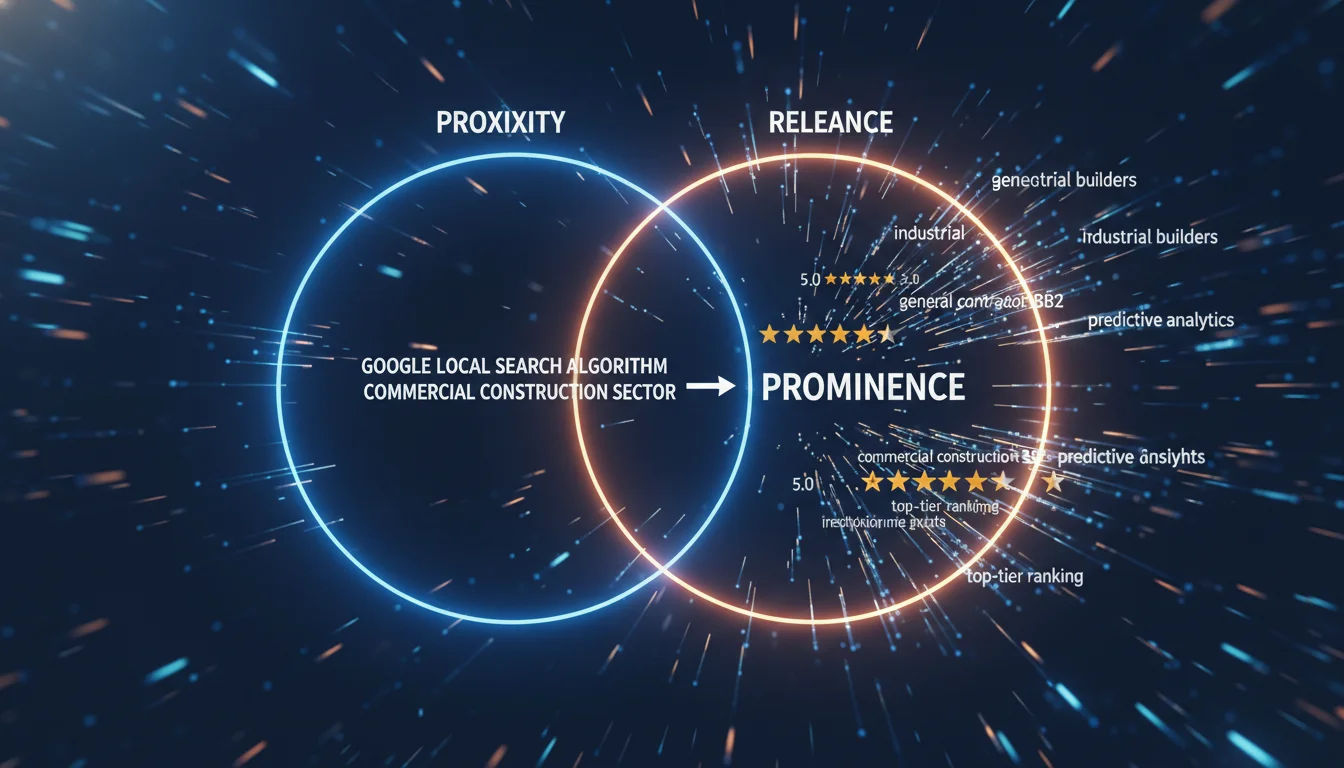
The data reveals a compelling dichotomy between the baseline requirements for entering the local search ecosystem and the distinguishing factors required to dominate the highly coveted top-tier ranking positions. For the construction sector broadly, proximity to the search centroid dictates foundational visibility. However, as a firm approaches the highest echelons of the search engine results pages (SERPs), the algorithmic weighting shifts dramatically toward prominence, review velocity, and semantic relevance.
| Ranking Factor | Importance (Positions 1-21) | Importance (Top 10 Positions) | Strategic Implication for Commercial Construction |
|---|---|---|---|
| Proximity (Distance to Centroid) | 40.8% | 18.8% | Acts as a geographic gatekeeper. Spatial relevance is essential for baseline inclusion but highly insufficient for top-tier dominance. |
| Review Count / Volume | 45.1% | 52.8% | The absolute dominant differentiator for top-tier placement in construction. High volume signals established community trust and scale. |
| Review Keyword Relevance | 6.3% | 22.5% | Semantic alignment between user queries and natural language text within customer reviews is critical for breaking into the top 10. |
| Domain Power / Website Authority | 3.6% | < 5.0% | Provides secondary support. Off-page authority acts as a baseline trust signal rather than a primary local driver for construction. |
| Profile & Category Relevance | < 5.0% | 14.1% (B2B Specific) | Ensuring exact primary category alignment resolves entity ambiguity for the algorithm, heavily utilized in B2B queries. |
The underlying trend suggested by this machine learning data indicates that proximity functions as a binary threshold. Once a cluster of commercial construction firms satisfies the geographic constraints of a user’s query, the algorithm relies almost exclusively on crowd-sourced validation (reviews) to rank them. The dramatic increase in the importance of “Review Keyword Relevance”—jumping from approximately 6.3% across all positions to a staggering 22.5% in the top 10 positions—underscores a permanent algorithmic shift toward semantic search. The search algorithm no longer merely counts aggregate star ratings; it employs advanced natural language processing (NLP) to parse the unstructured text of client reviews, matching phrases such as “industrial warehouse build-out” or “Class A office renovation” directly to the underlying intent of the searcher’s query.
A critical corollary to this dynamic is the necessity of offline-to-online signal cohesion. Beyond static data points, behavioral signals—such as user engagement metrics, dwell time, bounce rates, and the physical transition from digital discovery to real-world interaction via driving directions—continually reinforce the commercial entity’s spatial reality. For B2B commercial entities, where physical foot traffic is significantly lower compared to consumer retail storefronts, these behavioral signals must be artificially catalyzed through precise architectural alignment between the firm’s physical operational radius and its interconnected digital footprint. This requirement extends to B2B sub-sectors like manufacturing and logistics, where multi-regional operators benefit from a complex blend of local geographic activity and overarching web authority.
High-Intent Keyword Strategy and Semantic Firmographic Targeting
The foundation of any commercial construction SEO strategy relies on the rigorous segmentation of search intent. B2B procurement professionals, real estate developers, and municipal planners do not execute generalized queries; their search behavior meticulously mirrors their progression through the buyer’s journey. The lexicon of a commercial buyer is distinctly professional, characterized by extreme specificity, contextual relevance to particular project phases, and a notably lower search volume that belies an exponentially higher financial conversion value.

Search queries within the construction vertical can be stratified into three distinct categories based on user intent. The first category represents informational intent, encompassing queries designed to resolve top-of-funnel ambiguity, such as inquiries regarding the cost per square foot for a commercial office build-out or the technical differences between building materials. While these queries rarely yield immediate conversions, capturing this early-stage traffic via long-form, authoritative content establishes foundational trust and initiates critical brand recall. The second category comprises commercial investigation queries, where the user evaluates options or seeks specialized capabilities, often utilizing modifiers like “best,” “top,” or “specialists”. The third and most lucrative category involves highly transactional, bottom-of-funnel queries indicating immediate procurement readiness, such as searches for local industrial HVAC installation bids or design-build general contractors.
The economic value of these high-intent commercial construction keywords is starkly reflected in their highly competitive Cost Per Click (CPC) metrics across paid advertising ecosystems. An exhaustive analysis of industry-standard keyword data illuminates the financial imperatives of organic ranking dominance. Securing organic visibility for these terms provides a profound structural economic advantage, immunizing the construction firm against the inflationary pressures of paid acquisition while simultaneously capturing the 97% of consumers who search online for local services before making a hiring decision.
| High-Intent Keyword Segment | Estimated Monthly Search Volume | Average Cost Per Click (CPC) | Search Intent Classification |
|---|---|---|---|
| contractor | 110,000 | $6.52 | Generalized / Ambiguous |
| commercial contractor | 8,100 | $13.32 | Commercial Investigation |
| commercial hvac contractor | 1,300 | $36.31 | Highly Transactional / Specific |
| exterior remodeling contractor | 880 | $18.90 | Transactional |
| commercial building contractor | 880 | $11.26 | Commercial Investigation |
| modular office building | 1,600 | High (Undisclosed) | Niche B2B / High Intent |
| industrial construction | 2,900 | Low (Undisclosed) | Commercial Investigation |
| general contractor bathroom remodel | 390 | $26.36 | Transactional (Residential Focus) |
| design build general contractor | 140 | $6.62 | Highly Specific B2B |
The data dictates that high-volume keywords are often a deceptive metric in the commercial B2B space. A highly specialized term such as design build general contractor, despite its exceptionally low monthly search volume of merely 140 searches, represents a highly sophisticated, procurement-ready buyer. In B2B environments, a long-tail keyword generating just 100 searches a month that yields five qualified leads can easily culminate in multi-million dollar contracts, rendering raw search volume a misleading and often counterproductive metric of ultimate success.
Furthermore, the strategic application of negative keywords is paramount when managing both paid and organic search architectures.
Commercial contractors must actively suppress their visibility for residential or low-value queries to prevent algorithmic confusion, protect user engagement metrics, and avoid exhausting marketing budgets on unqualified traffic. By focusing exclusively on firmographic descriptors—such as “industrial,” “warehouse,” “commercial,” “corporate,” “municipal,” and “associated general contractors”—the search architecture ensures that the inbound traffic profile consists entirely of qualified commercial decision-makers rather than homeowners seeking minor repairs. The utilization of phrase match structures and negative keyword implementations filters out informational noise, leaving a distilled stream of high-quality prospect intent.
Entity Optimization: The Google Business Profile Architecture
The Google Business Profile (GBP) is the fundamental locus of local SEO. It is not merely a digital directory listing; it is the semantic core of the business entity as definitively understood by Google’s Knowledge Graph. Optimizing the GBP requires a meticulous alignment of the construction firm’s real-world operational reality with the algorithm’s stringent structured data requirements. The profile acts as the primary signal for both traditional map rankings and emerging AI-generated local answers.
The selection of GBP categories is undeniably the single most impactful variable for defining the business entity. Google maintains a constantly evolving repository of approximately 3,936 to 4,039 standardized categories, which function as the primary algorithmic signal for triggering visibility in the Local Pack and Maps interfaces. For commercial construction firms, selecting an ambiguous primary category dilutes entity relevance and confuses the semantic search engine. The primary category must strictly and exclusively define the core operational identity of the business. Optimal primary categories for this sector include “Commercial Builder,” “Construction Company,” “General Contractor,” or highly specialized trades such as “Acoustical Consultant,” “HVAC Contractor,” or “Aggregate Supplier,” depending on the firm’s precise operational focus.
Secondary categories play a critical, albeit supporting, role in expanding semantic reach. A prevailing myth within the amateur SEO community suggests that selecting too many services dilutes profile authority. Empirical testing and industry consensus robustly refute this notion; there is no dilution penalty within the GBP ecosystem analogous to keyword cannibalization on traditional web pages. A commercial contractor should meticulously list every genuine service offered—ranging from “Office Build-outs” and “Tenant Improvements” to “Industrial Concrete Paving”—because each distinct service acts as a discrete semantic hook for highly specific user queries.
Proximity optimization requires highly precise geographic demarcation. Commercial construction firms often serve vast regional territories, transcending localized neighborhood boundaries. However, artificially expanding the GBP service area to encompass entire states or dozens of disconnected municipalities to artificially widen reach is a counterproductive tactic that routinely leads to algorithmic suspension and severe visibility drops. Best practices strictly dictate defining realistic, operational service areas using specific zip codes, contiguous counties, or exact city boundaries. Furthermore, if a commercial contractor maintains multiple physical locations with distinct staffs and localized tax identities, establishing separate, non-overlapping GBPs for each location is fundamentally necessary. Conversely, utilizing virtual offices, remote mailboxes, or P.O. boxes to feign a local presence is a direct violation of Google’s guidelines and will swiftly result in entity penalization. Additionally, the business name must mirror its real-world presentation on signage and stationery; injecting promotional text or localized keywords into the business name field violates platform integrity.
The static elements of the GBP, namely the Name, Address, and Phone number (collectively known as NAP), establish a baseline of algorithmic trust, but dynamic elements are required to drive behavioral engagement and prominence. High-quality, frequently updated multimedia assets are absolutely critical. Commercial contractors must treat the GBP as an active, living portfolio, systematically uploading progress photos of industrial builds, team operations, and completed architectural projects on a weekly or biweekly basis. To maximize the SEO utility of these visual assets, image files must be systematically optimized prior to upload. Instead of utilizing generic alphanumeric filenames generated by cameras, images should feature descriptive, geo-modified nomenclature (e.g., Class-A-Office-Buildout-Downtown-Chicago.jpg) to strengthen local relevance. Embedding geographic coordinate metadata (EXIF data) into the images provides the algorithm with verifiable spatial data points, powerfully reinforcing the firm’s physical presence at specific regional job sites.
Furthermore, the utilization of Google Posts functions as a high-visibility micro-blogging platform directly embedded within the SERPs. Weekly posts detailing recent commercial contract awards, significant project milestones, or advanced safety certifications simulate a highly active corporate entity, thereby satisfying the algorithm’s inherent preference for fresh, relevant content. Enabling direct messaging functionality and proactively populating the FAQ section with common commercial inquiries—such as bonding capacities, insurance thresholds, or typical mobilization times—further reduces user friction and exponentially increases dwell time on the profile, which serves as a highly potent behavioral ranking signal.
The Citation Ecosystem, Data Aggregators, and Tiered Syndication
While the Google Business Profile serves as the central anchor within the local SEO ecosystem, citations constitute the expansive gravitational network that distributes and validates the entity’s authority across the internet. A citation represents any online mention of a business’s exact Name, Address, and Phone number (NAP). The absolute, unyielding consistency of this NAP data across the broader internet is the primary mathematical mechanism through which search engines verify the legitimacy, permanence, and stability of a commercial entity. Studies indicate that local citation building remains a powerful component of visibility, with top organic results heavily featuring business directories.
The citation ecosystem is structured hierarchically, and optimization must proceed systematically to ensure flawless data integrity. Before any data syndication occurs, the commercial firm must establish an immutable master NAP record. This record must be uniformly applied down to the finest syntactic detail, such as the abbreviation of street types or the inclusion of corporate suffixes (e.g., standardizing on “Inc.” versus “Incorporated”). This exact syntax must perfectly mirror the contact information published in the HTML footer of the firm’s primary website. Small discrepancies split algorithmic trust and severely damage ranking potential.
Once the master record is established, contractors must prioritize Tier 1 platforms and navigational engines. These critical citations reside on platforms that possess massive domain authority and directly power consumer and corporate search behavior independent of Google. Foremost among these is Apple Business Connect (which natively powers Apple Maps, Siri, and Apple Wallet), Bing Places for Business (powering the Microsoft enterprise ecosystem frequently used in corporate B2B environments), Facebook Business, and Yelp. Discrepancies among these Tier 1 platforms introduce systemic algorithmic doubt, severely retarding overall local rankings.
Rather than manually submitting to thousands of minor, low-value directories, sophisticated commercial contractors must leverage major data aggregators. Entities such as Data Axle, TransUnion/Neustar Localeze, and Foursquare function as wholesale data clearinghouses, programmatically syndicating standardized business profiles to downstream navigation systems, localized mobile applications, and secondary search engines. This automated syndication standardizes formatting, corrects latent NAP issues, and ensures uniform data flows across the digital ecosystem.
For commercial construction, generic directories provide baseline trust, but industry-specific platforms provide vital semantic relevance.
Inclusion in highly authoritative construction networks—such as The Blue Book, ConstructionLinks.net, Procore Directory, or localized entities like the Home Builders Association—signals to the algorithm that the firm is an embedded, recognized operator within the specific construction vertical.
The pervasive presence of duplicate listings—often the unintended result of historical corporate relocations, rebranding initiatives, or slight variations in employee-submitted data—acts as a critical failure point in local SEO architecture. Algorithmic trust is deeply fractured when multiple, conflicting records of the same entity exist online. Consequently, a rigorous citation audit and duplicate suppression protocol must be executed routinely, requesting the removal or merging of duplicates to protect search engine optimization value.
Advanced On-Page Architecture and JSON-LD Schema Markup
Local SEO fundamentally transcends external directory listings; it necessitates a highly optimized, localized on-page architectural framework. A commercial construction website must serve a critical dual purpose: it must present a compelling, persuasive narrative to human procurement officers while simultaneously providing perfectly structured, machine-readable data to autonomous search engine crawlers. The technical fundamentals require the site to load in under three seconds on a mobile connection, accommodating construction professionals who frequently access information while on active job sites.
The architectural standard for multi-regional commercial contractors requires the creation of dedicated service-location matrices. Consolidating all distinct services and operational territories onto a single, generalized webpage creates profound thematic ambiguity. Instead, the site architecture must utilize discrete, hyper-focused URLs with a clean structure. For example, an overarching service such as “Commercial Roofing” should be localized through dedicated landing pages corresponding to distinct operational hubs (e.g., /commercial-roofing/chicago-il/ and /commercial-roofing/naperville-il/). However, these pages must meticulously avoid the SEO pitfall of “thin content” or localized boilerplate text. Each page must feature highly unique contextual data, regional case studies, specific municipal compliance capabilities, and localized testimonials. This depth of content ensures the pages satisfy the algorithm’s requirement for unique, high-value assets rather than programmatic spam, thus strengthening local geographic authority.
In the commercial construction sector, the project portfolio is the primary mechanism for visually demonstrating competence and scale. From an SEO perspective, portfolios provide an unparalleled opportunity to inject localized, semantic density directly into the website’s architecture. Each major completed commercial project should command its own dedicated case study page. These pages must be rigorously optimized to feature the specific scope of work, the precise geographic location, and the engineering challenges overcome. Integrating interactive elements, such as embedded Google Maps pinpointing the exact project site, establishes a direct spatial link between the firm’s website and Google’s geographic database. Additionally, before-and-after multimedia sliders, detailed client testimonials citing specific locations, and lists of applied safety protocols exponentially enhance the page’s dwell time and behavioral engagement metrics.
To completely eliminate algorithmic ambiguity regarding a firm’s physical location, corporate identity, and service offerings, advanced commercial construction SEO requires the meticulous implementation of structured data, specifically utilizing the JSON-LD (JavaScript Object Notation for Linked Data) format. Schema markup acts as a direct, machine-readable translator, converting natural language website text into an organized, standardized database format that search engines natively digest without requiring complex HTML DOM parsing.
By implementing the @type: LocalBusiness (or more specifically, GeneralContractor, RoofingContractor, or HVACBusiness) schema type, a firm explicitly defines its entity attributes for the Knowledge Graph. A robust JSON-LD script securely embedded in the HTML header should unequivocally declare the exact legal name, the primary url, the localized telephone number, the specific addressLocality, addressRegion, and postalCode, alongside the detailed openingHoursSpecification.
Furthermore, advanced schema implementations must include the geo property (classified as GeoCoordinates), specifying the highly precise latitude and longitude of the corporate headquarters or branch office. Including the hasMap property linking directly to the firm’s Google Maps Customer Identification URL solidifies the cryptographic relationship between the standalone website and the Google Business Profile. To leverage broader brand signals and off-page authority, the sameAs property must be utilized to programmatically link the website to the firm’s verified social media profiles (LinkedIn, Facebook, Twitter) and authoritative industry directories. This intricate, invisible web of structured data ensures that when the algorithm evaluates the entity, it perceives a cohesive, geographically anchored, and highly authoritative corporate operation.
Localized Content Marketing: Regulatory Moats, Zoning Laws, and Building Codes
The traditional approach to SEO content marketing often relies on generalized blog posts possessing minimal utility for advanced B2B buyers. In commercial construction, where complex risk mitigation, legal compliance, and municipal adherence are primary drivers of procurement decisions, content must demonstrate highly specialized, localized expertise. Developing comprehensive, authoritative content surrounding regional zoning laws, municipal building codes, and unified development regulations acts as a profound competitive moat that simultaneously generates high-quality B2B traffic.
Commercial real estate developers, corporate architects, and facility managers frequently execute extensive informational searches regarding local compliance parameters long before they formally solicit construction bids. By intercepting this specific traffic, a commercial contractor establishes intellectual authority at the very inception of the project lifecycle. Content should be systematically structured to dissect complex, often opaque municipal codes. For instance, the creation of highly detailed, city-specific guides on commercial zoning classifications provides immense, tangible value. These digital guides should meticulously delineate the specific permissible land uses, required parking ratios, highway setback distances, and absolute building height restrictions associated with local zoning codes.
| Typical Commercial Zoning Classifications | Operational Construction Focus | Content Strategy and SEO Focus |
|---|---|---|
| C-1 (Local Commercial) | Small-scale retail, neighborhood service centers. | Publishing guides on retrofitting existing urban structures, noise compliance regulations, and localized pedestrian access enhancements. |
| C-2 (Community Commercial) | Mid-scale developments, hotels, restaurants, and local theaters. | Detailing complex permitting pathways, mixed-use structural engineering requirements, and vast parking lot paving compliance. |
| C-3 (General Commercial) | Large-scale infrastructure, mega-malls, and major auto dealerships. | Explaining heavy machinery mobilization logistics, highway proximity setbacks, and large-scale industrial waste compliance. |
| Industrial / Manufacturing | Factories, heavy warehousing, logistics hubs. | Navigating air quality regulations, heavy vehicle access pathways, and specialized structural load-bearing building codes. |
The production of this localized regulatory content yields compound dividends. From a strict SEO perspective, articles detailing the nuances of “M.G.L. c. 40A - The Zoning Act” in Massachusetts, the “Tier B street frontage” calculations in New York City, or the specific requirements for “Commercial Zoning Applications” in Denver naturally capture highly specific, low-competition long-tail keywords. Because these regulations are inherently geographically bound, the inclusion of local nomenclature naturally satisfies the algorithm’s requirement for profound geographic relevance without ever resorting to antiquated keyword stuffing tactics. Providing insight into South Carolina’s Enabling Act Section 6-29-1130 or detailing Form-Based Codes and SmartGrowth developments signals deep regional embeddedness.
Furthermore, this highly technical content strategy perfectly aligns with advanced firmographic targeting. The individuals searching for commercial zoning variances, site-specific development plan vested rights, or transit-oriented development codes are universally high-level decision-makers—developers, corporate counsel, procurement managers, and lead architects. By providing them with intelligible, well-structured interpretations of the Unified Development Code, the commercial contractor transitions its brand perception from a mere transactional vendor to an indispensable, highly consultative partner. This dramatically accelerates the B2B acquisition process, efficiently nurturing qualified leads through the mid-funnel by establishing an unshakable foundation of trust before the formal bidding process even commences.
B2B Reputation Management and Semantic Review Velocity
As conclusively established by the XGBoost machine learning data, proximity serves merely as the algorithmic gatekeeper, whereas review velocity and semantic relevance ultimately dictate local market dominance within the top search results. In the B2B commercial construction sector, generating reviews presents a unique and formidable structural challenge.
Unlike retail or residential contracting environments, where daily transaction volumes are exceptionally high and individual consumer sentiment is easily captured, commercial projects feature protracted timelines, complex stakeholder matrices, and strict corporate policies that often inhibit public endorsements or supplier recognition.
Because organic, unprompted reviews are statistically rare in high-stakes commercial B2B environments, reputation management cannot be relegated to an afterthought; it must be an operationalized, systematic component of the project lifecycle. The responsibility for review acquisition must strategically bridge the gap between the digital marketing department and the field operations and sales teams. Construction firms must implement rigorous SMART (Specific, Measurable, Achievable, Relevant, Time-bound) goals surrounding review generation, transforming it into a tracked key performance indicator. For example, integrating a formal review request protocol directly at the execution of the “Certificate of Substantial Completion” or during the final project walkthrough ensures that the request occurs at the exact point of maximum client satisfaction and project relief. Leveraging CRM automation to trigger highly personalized, account-based marketing requests to the specific procurement officers, architects, or facility managers involved in the project ensures systematic, professional outreach.
The algorithmic weight assigned to “Review Keyword Relevance” demands that contractors actively guide the narrative of the reviews they solicit. A generic five-star review stating, “Great company to work with,” provides a minor positive sentiment signal but entirely lacks the semantic density required to influence search rankings for specific, high-value commercial queries. When soliciting feedback, commercial contractors must utilize structured prompts that encourage clients to explicitly mention the specific scope of work, the engineering challenges overcome, and the precise geographic location. Asking a client to answer highly specific questions—such as “What was the scale of your industrial build-out in downtown Austin?” or “How effectively did our team navigate the C-2 zoning restrictions for your new retail center?”—naturally induces the inclusion of high-value, long-tail keywords directly within the review text. This practice ingeniously transforms customer testimonials into user-generated SEO content, directly aligning the firm’s Google Business Profile with the complex, transactional queries executed by future commercial prospects.
Reputation management also encompasses the firm’s active, public engagement with published feedback. Google’s algorithm heavily favors entities that demonstrate high responsiveness and operational vitality. Every review, regardless of sentiment, must receive a professional, timely response, ideally within 24 hours. Responding to positive reviews allows the contractor to subtly reinforce semantic keywords and regional relevance (e.g., “Thank you for the opportunity to partner on this complex medical facility expansion in the Seattle metropolitan area”). More critically, the protocol for handling negative reviews defines the brand’s public resilience and professionalism. Constructive, non-defensive responses to negative feedback—demonstrating a commitment to rapid conflict resolution and professional accountability—mitigate long-term reputational damage. This signals to both algorithmic evaluators and future corporate prospects that the firm operates with profound institutional maturity and reliability. Beyond reviews, engaging in local philanthropy and publishing educational content further solidifies this reputation, creating an impenetrable aura of local authority.
Conclusion
The paradigm of local SEO for commercial construction in 2026 is an intricate, highly technical confluence of geographic precision, flawless digital architecture, semantic optimization, and authoritative reputation signals. Dominance within this highly competitive space cannot be achieved through isolated tactical maneuvers or outdated residential marketing techniques; it requires a cohesive, holistic operational integration that aligns sales, field operations, and digital marketing.
The strategic directives for dominating local commercial construction searches are unequivocally clear. Firms must first secure their foundational algorithmic baseline by establishing flawless NAP consistency across a tiered network of global data aggregators, Tier 1 navigational maps, and highly authoritative industry-specific directories. Simultaneously, the Google Business Profile must be meticulously curated and constantly refreshed, leveraging exact primary categorizations, geo-tagged multimedia project portfolios, and exhaustive service enumerations to eliminate any vestige of algorithmic ambiguity.
With the digital foundation securely established, competitive differentiation is achieved through aggressive, semantically optimized reputation management that turns client feedback into algorithmic fuel. The deployment of advanced on-page architectures—integrating explicit JSON-LD structured data and embedding highly localized, map-integrated project portfolios—ensures the digital infrastructure communicates seamlessly with autonomous search engines. Finally, by transitioning content marketing efforts away from generalized industry commentary toward highly specialized, localized regulatory frameworks—such as complex municipal zoning laws, building codes, and compliance guides—the firm captures high-intent, firmographic search traffic. This multifaceted, highly disciplined approach cements the firm’s position not merely as a transactional contractor, but as the premier, undeniable regional authority in commercial development.