GPS Tracking & CRM Integration for Home Services | Optimize Fleet
Strategic Integration of Fleet GPS Telematics and Customer Relationship Management in Home Services
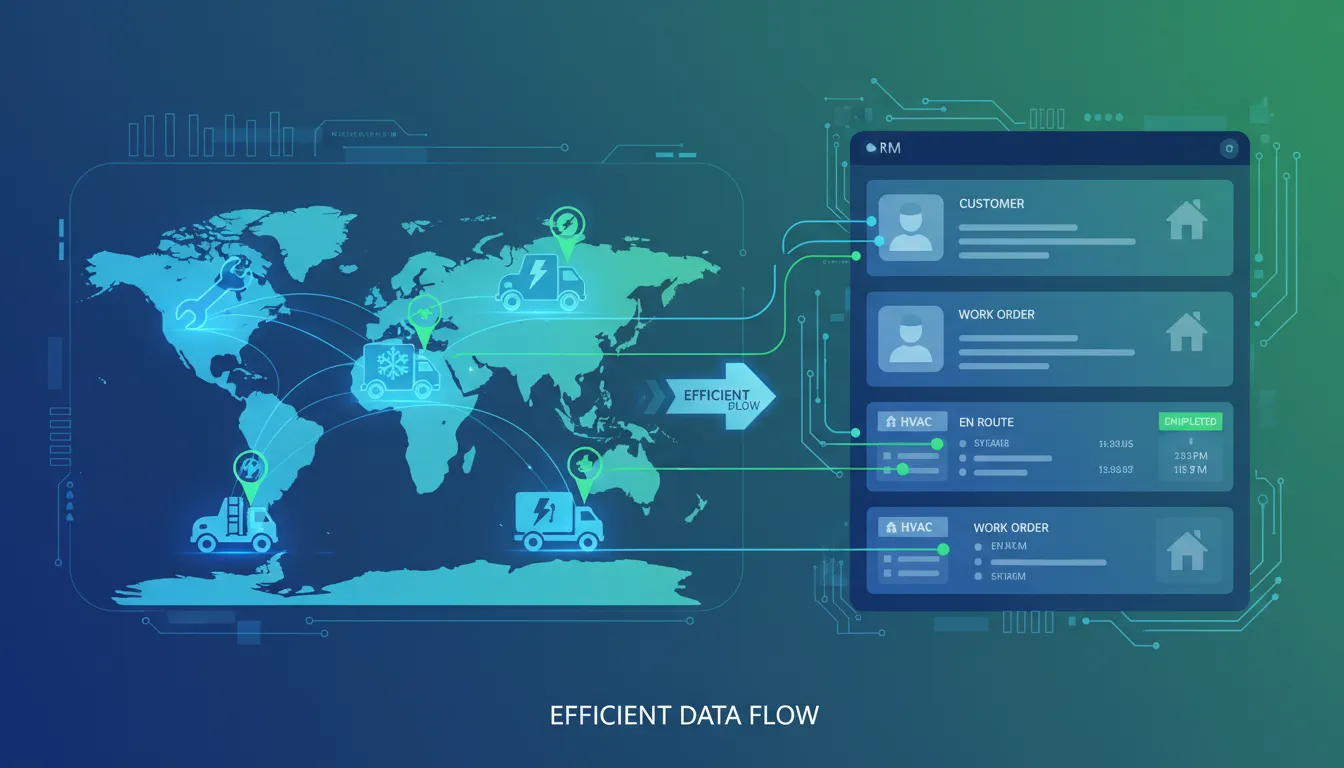
Introduction to the Convergence of Telematics and Field Service Management
The modern home services industry—encompassing heating, ventilation, and air conditioning (HVAC), plumbing, electrical contracting, landscaping, and pest control—operates at a highly volatile intersection of fluctuating operational costs, complex logistical variables, and escalating customer expectations. In 2026, fleet-dependent businesses face profound macroeconomic pressures. Operating a commercial service truck averages $2.260 per mile, leaving virtually no margin for logistical error, while traffic congestion wastes an estimated 6.7 billion gallons of fuel annually across the commercial sector.
To mitigate these pressures, the enterprise architecture of field service management (FSM) has fundamentally shifted. The operational standard no longer relies on disparate software environments. Instead, the strategic imperative demands the deep, bidirectional integration of Customer Relationship Management (CRM) platforms with advanced Fleet Global Positioning System (GPS) telematics.
Historically, CRM systems functioned strictly as centralized repositories for customer data, work orders, invoicing, and marketing communication. Conversely, GPS telematics operated as isolated geographic and diagnostic monitors. The lack of integration between these two foundational systems created profound operational friction. Dispatchers were forced to triangulate technician availability manually, bouncing between mapping dashboards and scheduling matrices. A defect logged on a paper inspection form might take hours to reach the service team, and a vehicle waiting for approval sits idle longer than necessary, costing the fleet time, money, and consumer trust. This disconnected paradigm routinely resulted in inefficient routing, delayed response times, and uncaptured revenue.
Integrating these systems establishes a “digital twin” of the field operation, effectively bridging the physical location of the asset with the financial value of the customer interaction. By synchronizing real-time telematics data with CRM dispatch boards, home service organizations can replace reactive decision-making with predictive, automated logic. This report provides an exhaustive analysis of the market landscape, technical architectures, operational applications, financial returns, and legal compliance considerations inherent in integrating fleet GPS tracking with CRM systems in the home services sector.
The Market Landscape of Customer Relationship Management Platforms
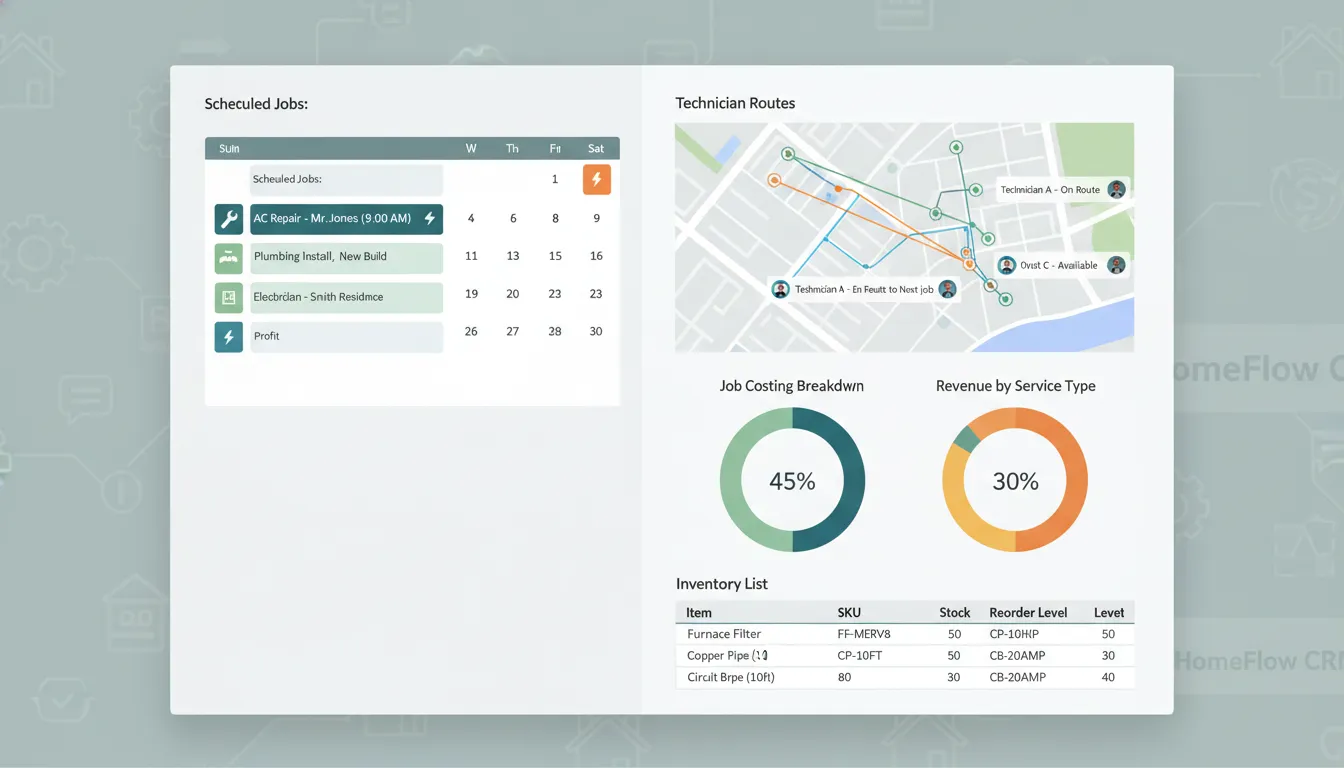
The CRM landscape for home service professionals in 2026 is highly stratified, segmented by operational complexity, total user count, and required integration capabilities. While generalized CRM platforms such as Salesforce, HubSpot, and Zoho offer broad utility across various industries, the home services market requires vertically integrated solutions that natively support estimating, job costing, inventory management, and spatial dispatching.
Enterprise and Mid-Market Field Service Platforms
At the apex of the enterprise tier is ServiceTitan. Recognized as an all-in-one business management system, ServiceTitan caters primarily to medium and large trade contractors in the HVAC, plumbing, and electrical verticals. Its architecture is designed to handle high transaction volumes, multi-location franchising, and deep financial reporting. ServiceTitan distinguishes itself through native integration capabilities, offering direct Application Programming Interface (API) connections to advanced Geographic Information Systems (GIS) and GPS tracking tools. The platform natively supports integrations with Trimble, NexTraq, GPSTrackIt, TomTom, ClearPathGPS, and Samsara. The platform’s proprietary algorithms facilitate features such as “Arrive by GPS” and revenue-optimized dispatching, transforming raw locational data into direct financial yield. Furthermore, ServiceTitan incorporates native GPS access for mobile devices, meaning that if a dedicated hardware tracker fails, the system falls back on cellular triangulation, maintaining accuracy within 500 meters.
Small to Medium Business Solutions
For growing operations that require agility without the overhead of enterprise software, Jobber and Housecall Pro dominate the market. Jobber is engineered for flexibility and user-friendly workflows, focusing on automated reminders, straightforward scheduling, and simplified customer management. Jobber’s integration strategy relies heavily on strategic partnerships, most notably with FleetSharp and Force Fleet Tracking. These integrations embed telematics directly into the Jobber scheduling map via Subscriber Identity Module (SIM)-based vehicle trackers, ensuring that locational telemetry is captured independently of the field worker’s cellular phone battery or signal strength.
Housecall Pro serves a similar demographic, supporting teams ranging from single operators to fleets of over one hundred vehicles, and boasts a user base of over 200,000 field service professionals. Housecall Pro differentiates itself through its extensive App Marketplace, which includes robust integrations with accounting software like QuickBooks, marketing automation via Mailchimp, and integrated vehicle GPS solutions. Specifically, Housecall Pro partners with Force by Mojio to offer plug-and-play On-Board Diagnostics II (OBD-II) tracking, utilizing a “magic link” authentication flow that embeds the fleet dashboard directly within the CRM without requiring a separate login.
Niche and Specialized Software
Beyond the primary market leaders, a tier of specialized CRM platforms exists to serve specific operational niches or budgetary constraints. FieldEdge provides robust contractor workflows, tightly integrating customer historical records with real-time field operations, which is ideal for mid-sized teams requiring streamlined job management. Service Fusion is distinguished by its pricing model, offering unlimited users at a flat rate, making it highly attractive for companies with high employee turnover or large seasonal workforces. Duct Architect represents an emerging class of affordable, highly specialized CRM and project management tools, starting at an accessible price point of $29 per month for nascent operations. Finally, JobNimbus offers a highly tailored CRM specifically optimized for roofing contractors, demonstrating the ongoing micro-segmentation of the FSM software market.
| CRM Platform | Target Market Segment | Key Differentiator | Native GPS Strategy |
|---|---|---|---|
| ServiceTitan | Enterprise / Mid-Market | Advanced inventory, AI-dispatching, multi-location scaling | Extensive API integration (Samsara, Azuga, Trimble) |
| Jobber | Small to Mid-Sized | Simplicity, flexible scheduling, driver event-tracking | Native embedded maps via FleetSharp & Force Fleet |
| Housecall Pro | Small to Mid-Sized | App ecosystem, robust automated communications | Plug-and-play OBD-II integration via Force by Mojio |
| FieldEdge | Mid-Market | Streamlined customer and job history synchronization | Partner-driven FSM workflows |
| Service Fusion | All Segments | Flat-rate pricing for unlimited users | Open API architecture |
Evaluation of Fleet Telematics and GPS Hardware Ecosystems
Telematics platforms have evolved from simple “dots on a map” to sophisticated edge-computing hubs that process engine diagnostics, analyze driver behavior via artificial intelligence (AI) dashcams, and track precise spatial positioning. The selection of a telematics provider and the underlying hardware dictates the granularity and velocity of the data flowing into the CRM.
Hardware Topologies and Installation Protocols
The physical layer of fleet tracking relies on distinct hardware topologies, each presenting unique benefits and limitations for home service fleets. The most ubiquitous form factor for light and medium-duty vans is the OBD-II plug-and-play tracker. Solutions like Force Fleet Tracking utilize devices that plug directly into the diagnostic port of any vehicle manufactured after 1996, eliminating the need for professional installation and reducing deployment friction.
However, OBD-II devices are susceptible to driver tampering and accidental dislodgement.
Conversely, hardwired trackers provide a covert, tamper-proof solution that is wired directly into the vehicle’s ignition and power harness. For commercial heavy-duty vehicles, the industry has widely adopted ‘CAN-bus Click’ technology, which allows the GPS controller to clip onto the Controller Area Network (CAN) bus wires without cutting or splicing, streamlining professional installation to approximately 20 minutes per asset.
Additionally, tracking unpowered assets like generators or landscaping trailers requires low-power solar tracking solutions. While highly autonomous, solar trackers face limitations; performance degrades during prolonged low-light conditions, and high-frequency data transmission demands can rapidly drain the internal battery, necessitating careful optimization of the data polling rate.
Leading Telematics Providers
The telematics vendor landscape is highly diverse, with providers differentiating themselves through data velocity, safety algorithms, and integration capabilities.
Motive, formerly KeepTruckin, leads the market in safety and compliance, emphasizing AI-powered driver coaching and live safety analysis. Its integration architecture is robust, yet its primary differentiator is its one-to-three-second refresh rate, providing hyper-accurate locational telemetry. This velocity is critical for automated dispatch algorithms that depend on micro-adjustments in traffic patterns.
Architectural Paradigms for CRM and Telematics Integration
Integrating a telematics environment with a CRM requires navigating complex data structures and managing API constraints. The integration architecture dictates how seamlessly data flows, how resilient the system is to outages, and how latency impacts real-time decision-making. Organizations typically utilize one of three architectural approaches: native integrations, custom API development, or middleware orchestration.
Native Integration Deployments
Native integrations are pre-configured, bi-directional data bridges built directly by the software vendors. These represent the lowest barrier to entry, requiring minimal technical expertise from the end-user. For example, integrating Force Fleet Tracking with Housecall Pro is entirely native. A user navigates to the CRM’s application marketplace, authorizes the purchase of the trackers, and upon receipt, the CRM automatically populates the telematics dashboard with the employee roster.
Similarly, ServiceTitan offers native connectivity with multiple telematics providers. To integrate GPSTrackIt, an administrator simply extracts a “FEED 2” URL from the GPS provider’s data export settings and pastes it into ServiceTitan’s integration parameters. Once authorized, the CRM downloads the device registry, requiring the administrator only to map each GPS hardware unit to a specific technician profile, taking care not to assign a technician to multiple devices, which causes severe reporting anomalies.
The primary advantage of native integrations is the rapid return on investment due to abbreviated implementation timelines. Furthermore, native connections are maintained by the vendors, ensuring that software updates do not break the data pipeline. However, native connections often limit the customization of data fields, transferring only predefined parameters such as primary meter readings, diagnostic trouble codes (DTC), and geographic coordinates.
Custom Application Programming Interface Development
For enterprise operations requiring bespoke workflows, custom API integration is necessary. Modern telematics platforms expose their data via RESTful APIs, utilizing JavaScript Object Notation (JSON) or Extensible Markup Language payloads to push telemetry to external databases. This allows organizations to pull highly granular data—such as engine hours, fuel card transactions, or precise geofence boundary coordinates—into proprietary ERP or CRM systems.
Developing a custom API integration requires establishing secure authentication, typically via OAuth 2.0 or persistent API keys. Developers must map the JSON objects from the telematics provider to the Custom Objects within the CRM. For instance, a developer might map a Samsara vehicle’s locational array to a custom Line_item or Enterprise Event in HubSpot. When integrating Samsara with facility management software like FMX, administrators must generate specific API tokens equipped with precise “Read” access tags for Vehicles, Trailers, and Equipment, ensuring data security through minimal privilege.
For platforms like Jobber, developers leverage a GraphQL API, which offers a robust set of queries, mutations, and webhooks, supported by the Atlantis open-source design system. However, custom integrations typically face strict governance; Jobber restricts custom apps in a draft state to a maximum of five paying accounts to prevent unverified applications from consuming excessive bandwidth.
The second-order challenge of custom API development is handling rate limits and latency. Enterprise CRMs like Salesforce impose hard limits on data ingestion; for example, a custom code deployment package is restricted to 5 Gigabytes, and real-time data graphs are capped at 1,050 fields per data stream and 10 million data graph profile records. If a telematics system attempts to push data at one-second intervals for a fleet of 500 vehicles, it may rapidly exceed the CRM’s API rate limits, resulting in data throttling, delayed spatial rendering, and ultimate system failure.
Middleware Orchestration and Event-Driven Architecture
When native integrations are insufficient and custom API development is cost-prohibitive, middleware platforms like Zapier, Workato, and Make act as the intermediary translation layer. Middleware utilizes “triggers” and “actions” to orchestrate workflows without requiring advanced coding syntax. For example, a geofence exit event in a system like Navixy can trigger a Zapier workflow that automatically updates a customer’s status in Housecall Pro, generates a new spreadsheet row in Google Sheets, and dispatches a notification via Mailchimp.
However, the choice of middleware introduces distinct operational characteristics. Zapier operates on a linear, row-by-row polling mechanism. On lower-tier plans, Zapier polls for new data only every 15 minutes. In the context of field service, a 15-minute data latency is operationally catastrophic; a technician traveling at highway speeds will be 15 miles away from their reported location by the time the CRM updates, completely negating the value of real-time dispatch mapping. Furthermore, if a business-critical automation drops offline in Zapier, it requires manual execution of missed events upon restart.
In contrast, enterprise middleware like Workato connects to over 2,000 applications and supports complex standards including CSV, HTTP, JSON, XML, and YAML. Workato listens for trigger events in the background asynchronously and automatically executes on all missed events if the system restarts, ensuring that CRM records remain perfectly synchronized with the physical reality of the fleet. Organizations must meticulously match their middleware choice to their tolerance for latency and data loss.
Spatial Automation: Geofencing and Event-Driven Workflows
When telematics and CRM systems achieve seamless synchronization, the combined entity unlocks advanced spatial capabilities that transform the operational paradigm of the home service business. Geofencing replaces raw spatial coordinates with actionable business logic.
Boundary Geometry and Trigger Logic
A geofence is a virtual perimeter drawn over a geographic map using positioning technologies that compare the real-time location of an object with predefined boundary coordinates. Geofences typically take two forms: radial circles and custom polygons. Circle boundaries are ideal for rapid setup and are best suited for large, round areas with clear edges. However, in dense urban environments or near major thoroughfares, radial boundaries often generate “false events” when a technician simply drives past a location without stopping. To mitigate this, fleet managers must utilize custom polygonal shapes, drawing the perimeter specifically around the property line or driveway to ensure the trigger only fires when the vehicle physically enters the service location.
When a GPS-equipped vehicle intersects this boundary, the telematics system generates an entry or exit event. In an integrated environment, these events automate CRM workflows. Rather than relying on a technician to manually update their status on a mobile device—which is prone to human error, forgetfulness, and deliberate time inflation—the CRM updates autonomously. ServiceTitan utilizes a feature called “Arrive by GPS,” wherein the system automatically transitions a job status to ‘Arrived’ when the technician breaches a 125-meter radial boundary around the service address.
To execute these triggers without draining the technician’s mobile device battery, CRM applications utilize specialized background location services. For example, the Resco Mobile CRM application generates a “mobile audit event” when a user crosses a predefined boundary.
This architectural approach only monitors presence at pre-set locations rather than tracking the device’s overall continuous path, which preserves battery life, works even when the device screen is off, and significantly improves user privacy.
Operational Applications of Geofencing
Geofencing extends far beyond the customer site. Fleets can draw boundaries around supply houses and wholesale distributors, allowing dispatchers to automatically audit the time technicians spend acquiring parts versus time spent on billable labor. Establishing geofences around company parking lots or vehicle storage yards can trigger unauthorized use alerts if a vehicle leaves the premises outside of scheduled working hours. This serves as a powerful theft deterrent and policy enforcement tool, notifying management instantly if an employee utilizes a company vehicle for personal errands off the clock. Furthermore, geofencing the company loading dock allows warehouse staff to receive automated alerts when a vehicle is approaching, enabling them to stage cargo and drastically reduce loading times.
Artificial Intelligence and Predictive Dispatch Optimization
The most profound evolution resulting from CRM-Telematics integration is the transition from spatial dispatching to predictive, revenue-optimized dispatching. Manual dispatching relies on a human operator interpreting traffic, technician location, and skillset simultaneously. This inherently limits optimization due to cognitive overload and human bias, where dispatchers might favor technicians who “schmooze the office” over those who generate the highest revenue.
ServiceTitan’s Dispatch Pro product suite utilizes advanced algorithms, branded as Titan Intelligence, to assess the entire dispatch board simultaneously. The algorithm weighs multiple variables: the real-time GPS location of every technician, the drive time between potential jobs, the historical performance of the technician (evaluating closing rates, maintenance conversions, and average ticket size), and the predicted financial value of the incoming work order based on historical CRM data.
Administrators can configure the algorithm’s weighting using soft and hard constraints. A slider interface allows management to dictate the operational philosophy by choosing between “Only Routing” (focusing strictly on proximity and availability to minimize fuel consumption), “Mostly Routing,” or a “Revenue” focus (matching the highest-performing sales technician to the most lucrative lead, even if it requires sending them further out of their immediate zone).
The algorithm calculates thousands of permutations in seconds, executing complex “chess moves” across the schedule to maximize total daily yield. Dispatch Pro operates in two primary modes. In “Assist Mode,” dispatchers generate, review, and manually approve suggested optimizations, retaining ultimate control. In “Auto Mode,” the system reshuffles the entire dispatch board autonomously every 10 minutes during business hours to account for real-time traffic updates and job completions, and every hour outside of business hours. By ensuring the right technician is assigned to the right job, this integrated approach decreases average drive time by 6%, boosts average ticket sizes by 14%, and allows a single dispatcher to manage double the normal technician load with exponentially higher efficiency.
Financial Efficacy, Case Studies, and ROI Modeling
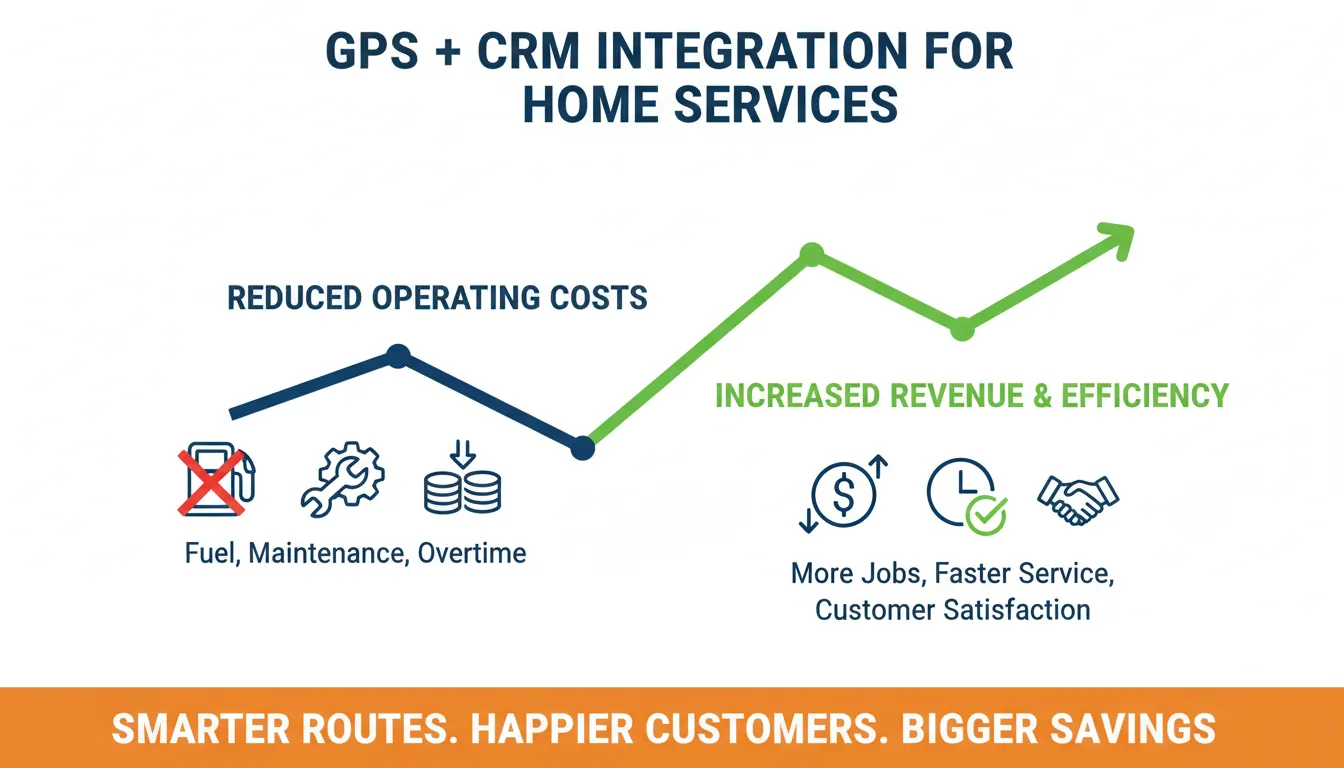
Implementing an integrated GPS and CRM architecture requires capital expenditure for hardware and recurring Software-as-a-Service (SaaS) licensing fees. However, the return on investment (ROI) is rapid and multi-dimensional, driven by asset optimization, reduced operational bloat, and targeted revenue enhancement.
Mitigation of Unplanned Downtime
Vehicle downtime represents a catastrophic disruption to the home service revenue model. According to industry benchmarking data from Samsara’s 2025 Fleet Operations Benchmark, a home service company operating a fleet of 15 to 25 vehicles loses an average of $148,000 annually to unplanned downtime. This figure encapsulates direct repair costs, emergency towing, substitute rental vehicles, idle technician wages, and missed appointment revenue.
Integrated telematics shifts fleet maintenance from a reactive to a predictive posture. Interval-based triggers for routine maintenance based on exact telematics mileage prevent 70% of preventable breakdowns, while AI-powered predictive maintenance analyzing engine diagnostic codes can reduce roadside failures by 40%. The impact on customer retention is profound; CRM data indicates that a customer whose appointment is rescheduled due to a fleet breakdown is 3.4 times more likely to hire a competitor.
Fleetio benchmark data demonstrates that home service companies save between $3,200 and $4,800 per vehicle, per year in avoided breakdown costs. Automation software typically pays for itself within 60 to 90 days, delivering a massive 6-12x annual ROI.
Cost Category
| Reactive Maintenance Cost | Automated Maintenance Cost | Total Savings per Vehicle | |
|---|---|---|---|
| Unplanned breakdowns | $4,200 | $1,400 | $2,800 |
| Emergency towing | $680 | $120 | $560 |
| Rental vehicle replacement | $1,800 | $300 | $1,500 |
| Missed appointment revenue | $3,600 | $600 | $3,000 |
| Technician idle time | $2,100 | $400 | $1,700 |
| Insurance premium impact | $400 | $0 | $400 |
| Total Annual Impact | $12,780 | $2,820 | $9,960 |
Note: Data derived from 2025 commercial fleet analysis highlighting the per-vehicle impact of automated telematics integration.
For a standard 20-vehicle fleet utilizing dispatch-aware scheduling, the net annual ROI is exceptional. Integrating a platform like US Tech Automations yields an estimated net annual ROI of $57,212, Samsara yields $53,680, Fleetio Pro yields $50,240, and Azuga yields $29,200.
Fuel Optimization and Asset Longevity
Fuel expenditure is a highly volatile operational cost that directly threatens profit margins. Integrated tracking directly attacks fuel waste by identifying excessive idling and unauthorized routing. In one documented case study, a regional HVAC business owner identified through telematics that two specific drivers were idling for a combined 90 minutes per day. By addressing this behavior using empirical data, the fleet cut idling by 60% in two weeks. The hardware investment of less than $110 per month for all 12 vans generated over $800 in fuel savings in a single month.
Furthermore, monitoring aggressive driving behaviors—such as harsh braking, rapid acceleration, and speeding—reduces structural wear and tear on the vehicles. Vehicles maintained on an automated, telematics-driven schedule retain 15% to 20% more of their resale value and remain operational for two to three years longer than reactively maintained assets.
Timesheet Reconciliation and Mileage Reimbursement
The financial leakage associated with manual timekeeping and mileage reporting is a pervasive issue. Paper timesheets suffer from rounding errors, and manual mileage logs are frequently inflated. In a case study involving a heating and air distribution company in the Southeast, management discovered that their sales team was reporting 2,800 miles a month, yet productivity had decreased. A CRM analysis revealed a direct correlation: when regional fuel prices increased, the recorded business mileage conveniently increased as well, draining the company’s capital. By integrating a CRM mileage application and implementing a variable “Smart Mileage Rate” tied to actual GPS routing, the company stabilized costs and eliminated fraudulent reimbursement claims.
Similarly, GPS Timekeeping Integrations automatically flag discrepancies between the hours a technician claims and the engine-hours recorded by the telematics unit. The software overlays the breadcrumb trail of the vehicle directly onto the CRM timesheet, allowing payroll managers to resolve anomalies instantly, preventing payroll overages, and protecting the business against labor compliance audits.
Liability Reduction and Insurance Premiums
Driving history is inextricably linked to corporate liability. High-speed infractions or at-fault accidents trigger exponential increases in commercial insurance premiums and expose the company to civil litigation. Telematics integration allows managers to enforce rigorous safety policies. The pest control giant Orkin implemented a strict GPS tracking protocol that mandated immediate termination for severe speeding violations (driving over 140 km/h, over 125 km/h twice in a year, or over 110 km/h three times). As a result, the company reduced its total collision and liability claims from 12,000 in 1996 to 4,700 in 2003, generating over $3.5 million in documented savings.
Modern insurance carriers heavily incentivize the use of fleet telematics. Implementing documented preventive maintenance and driver monitoring programs can qualify fleets for premium discounts ranging from 5% to 15%, translating to an additional $4,000 to $12,000 in annual savings for a 20-vehicle fleet.
Legal Compliance, Cross-Jurisdictional Privacy, and Workforce Adoption
The deployment of locational tracking technology introduces significant legal and psychological complexities. Navigating the fragmented regulatory landscape and securing technician buy-in are as critical to the success of the integration as the technical architecture itself.
Statutory Privacy Frameworks and Interstate Jurisdiction
In the United States, employer GPS tracking on company-owned vehicles during business hours is generally legal in all 50 states. However, the legal landscape fragments considerably regarding notice requirements, off-hours tracking, and the monitoring of personal devices.
State-level legislation creates severe compliance hurdles.
States such as California, Connecticut, New York, and Delaware have enacted strict protections requiring explicit, advance written notice or consent before an employer can monitor an employee’s location. Covert tracking—monitoring an employee without their knowledge—violates privacy laws nationwide, creates criminal and civil liability, and is explicitly illegal under all circumstances.
The tracking of off-duty movement presents a particularly high-risk legal liability. While an employer generally possesses the property right to pull data 24/7 from a company-owned asset, states like California and Connecticut require that off-hours tracking be inextricably tied to a legitimate, documented business purpose. Vague tracking policy language, such as stating tracking occurs “during business operations,” creates liability loopholes. Best practice dictates that the corporate policy explicitly disclose that continuous 24/7 tracking is active, but stipulate that locational data harvested during off-hours cannot be utilized punitively against the employee.
Furthermore, interstate operations complicate compliance. If a vehicle crosses from a less restrictive state (e.g., Arizona) into a highly regulated state (e.g., California), the more restrictive laws generally govern the interaction, particularly if the employee’s primary base of operations resides in the stricter jurisdiction. To avoid regulatory sanctions, fleets must align their operational policies with the strictest jurisdiction they operate within.
Finally, the installation of GPS trackers on an employee’s personal vehicle without explicit, written consent is illegal in every state. States like Illinois criminalize the tracking of a vehicle without the owner’s consent unless the vehicle is explicitly company-owned. Violations regarding personal vehicles can result in criminal charges, civil class-action lawsuits, and statutory damages ranging from $1,000 to $10,000 per incident. For home service contractors utilizing personal vehicles, tracking must be accomplished via a consent-based mobile application linked to the CRM that allows the technician to explicitly control clock-in and clock-out tracking parameters.
Psychological Friction and Strategies for Technician Buy-In
The introduction of telematics often triggers immediate workforce resistance. Technicians frequently perceive GPS integration as an invasive surveillance mechanism or a manifestation of micromanagement. Failure to manage this psychological friction results in low adoption, deliberate hardware tampering, and rapid talent attrition.
To secure buy-in, the integration must be positioned as an operational support tool designed to enhance safety, increase efficiency, and protect the technician from false claims, rather than a punitive monitor. Transparency is paramount. Industry best practices dictate beginning the implementation with a pilot group of 10 to 20 volunteer technicians. This allows management to establish baseline metrics, quickly address technical bugs, and utilize the pilot group to communicate success stories and quick wins to the broader workforce.
Software architecture inherently influences technician perception. Jobber, for instance, focuses on event-driven tracking for its native mobile application. Rather than pinging the technician’s location continuously and presenting a “creepy” live map to management, the CRM map only updates when the employee executes a specific work-related action, such as clocking in, adding a job note, or completing a visit. This granular, action-based approach significantly reduces the feeling of continuous surveillance while providing management with the necessary operational context.
In safety-focused telematics, preventing “false positives” is vital for preserving trust. Telematics algorithms can mistakenly classify a hard brake intended to avoid an erratic pedestrian as an aggressive driving violation. Platforms like Motive address this by routing incident footage through a human review team before the alert reaches the fleet manager’s dashboard. This ensures technicians are not unfairly penalized for defensive driving. Furthermore, providing technicians with access to their own safety data, scorecards, and route histories through a transparent mobile app empowers them to self-correct their driving habits and fosters a culture of mutual accountability.
Conclusion
The integration of fleet GPS telematics with Customer Relationship Management systems represents a foundational evolution in field service management. The transition from siloed asset tracking to unified, predictive data environments allows home service organizations to optimize their two most expensive and critical resources: mobile physical assets and specialized human capital.
By deploying robust technical architectures—whether through seamless native API integrations in platforms like ServiceTitan and Jobber, or via sophisticated asynchronous middleware like Workato—businesses can eliminate the friction of manual dispatching, inaccurate timekeeping, and delayed customer communication. Features suchs as geofence-triggered automated status updates and AI-driven, revenue-weighted dispatching algorithms yield immediate competitive advantages, maximizing daily ticket sizes and minimizing unbillable transit time across the fleet.
Financially, the return on investment of this integration is proven and multi-faceted. The mitigation of unplanned downtime through predictive maintenance, the targeted reduction of fuel waste, the elimination of fraudulent mileage claims, and the stabilization of commercial insurance premiums drive rapid cost recovery, frequently within the first sixty to ninety days of deployment.
However, realizing these profound benefits requires meticulous adherence to state-level privacy statutes, a deep understanding of API rate limits to prevent data latency, and a dedicated strategy for securing workforce buy-in. Organizations that treat telematics purely as a covert surveillance tool will experience high attrition and technical resistance. Conversely, organizations that transparently position integrated tracking as an efficiency multiplier—protecting technicians from false liability claims and eliminating the administrative burden of manual reporting—will cultivate a highly efficient, resilient, and profitable field operation. Ultimately, the successful integration of GPS and CRM software transforms the service vehicle from a blind operational expense into a transparent, fully optimized, and highly lucrative revenue-generating asset.