High-Ticket SaaS Billing & Dunning: Enterprise Solutions
High-Ticket SaaS Billing and Subscription Management: Enterprise Architectures, Platform Comparisons, and Dunning Optimization

The Strategic Imperative of Enterprise Billing Infrastructure
The architecture underlying software-as-a-service (SaaS) billing has irrevocably evolved from a peripheral financial utility into the foundational epicenter of revenue operations, product strategy, and commercial viability. Within the modern enterprise software ecosystem, high-ticket SaaS platforms face unprecedented complexity. This complexity is driven by the rapid proliferation of hybrid pricing models, the stringent demands of global tax compliance, and the existential necessity of preventing involuntary subscriber churn. As software organizations scale from initial product-market fit toward public market readiness or aggressive international expansion, the selection of subscription management software ceases to be a mere operational afterthought. Instead, the billing infrastructure operates as a critical vector capable of either accelerating revenue realization or introducing systemic, crippling friction.
Choosing the incorrect billing platform or delaying infrastructural upgrades introduces a severe organizational phenomenon known as “growth debt.” This specific form of technical and operational debt manifests as highly customized, fragile engineering workarounds required to manage fundamental commercial realities, such as usage-based overages, multi-year ramped enterprise contracts, and strict revenue recognition compliance. As organizations transition beyond simple flat-rate subscriptions to introduce usage-based metering, consumable credit wallets, or hybrid models, legacy systems built exclusively for basic monthly recurring revenue (MRR) rapidly fracture. Furthermore, when these underlying billing systems lack the intelligence to recover declined credit card payments gracefully or manage asynchronous offline wire transfers seamlessly, companies experience massive, compounding revenue leakage.
The comprehensive evaluation of leading platforms such as Stripe Billing, Chargebee, and Recurly, alongside the critical assessment of specialized dunning management tools like Churn Buster, Gravy, and Butter Payments, requires an exceptionally nuanced understanding of an organization’s specific go-to-market motion. The optimal infrastructural choice depends entirely on whether an enterprise prioritizes developer-level application control, centralized financial operations via native CRM connections, or advanced statistical machine learning for churn mitigation. This exhaustive analysis deconstructs the architectural principles of enterprise SaaS billing, provides a meticulous comparison of the leading subscription management platforms, and deeply examines the economics, mechanisms, and tooling of high-ticket automated payment recovery.
Core Architectural Principles for High-Ticket SaaS Billing
To support enterprise agility and commercial experimentation, modern billing architectures must strictly adhere to several core design principles that decouple financial processing from core product behavior. The traditional approach of tightly coupling payment gateways with application logic creates systemic engineering bottlenecks. When billing logic is hardcoded into the product, commercial and revenue operations teams are prevented from rapidly iterating on pricing structures or launching new promotional tiers without triggering massive, costly engineering sprints.
Decoupling Entitlements from Billing Execution
The most critical architectural best practice for enterprise SaaS development is the strict separation of “entitlements“—the logical rules governing what specific features or limits a user is allowed to access—from the actual billing and payment processing engine. High-ticket enterprise software transactions frequently involve highly complex, negotiated contracts where a customer might be granted application access before an initial wire transfer clears, or conversely, where feature access must be instantly revoked or downgraded upon a specific billing failure event. By completely decoupling product access control from payment processing, engineering teams establish a single source of truth for plans, features, and pricing that propagates across all internal microservices.
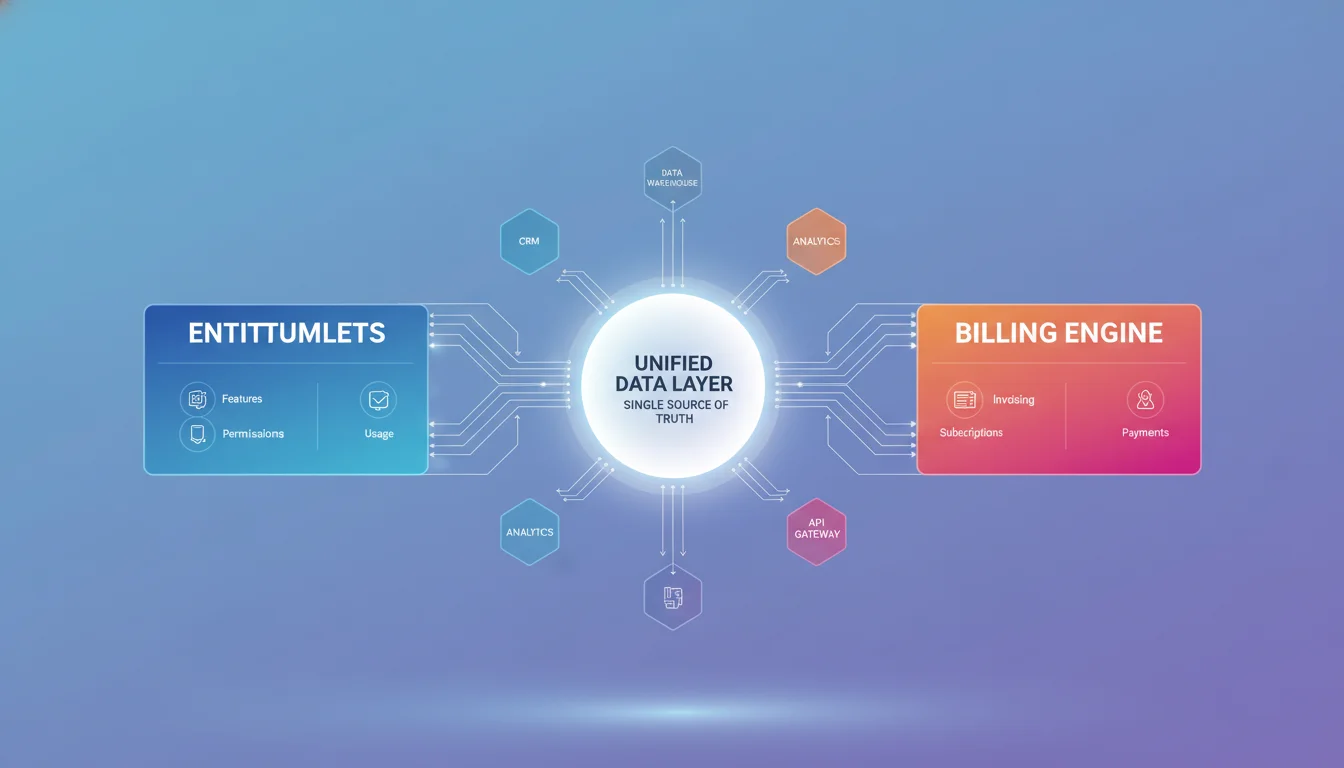
This architectural separation is typically achieved by introducing a dedicated, centralized entitlements layer that sits between the core application and the third-party billing system. Such a modular architecture enables revenue operations teams to unify multiple disparate billing systems—a crucial capability during corporate mergers and acquisitions. When an enterprise acquires another company, an independent entitlements layer allows the parent company to handle billing complexity seamlessly without immediately being forced into a high-risk project to rip and replace the acquired entity’s financial infrastructure. Furthermore, for high-performance enterprise applications, entitlement checks must occur in single-digit milliseconds to avoid degrading the end-user experience. This low-latency requirement is frequently accomplished using a sidecar caching pattern that maintains local access checks adjacent to the application while asynchronously syncing with the central billing ledger for ultimate truth.
Centralized Catalogs and Hybrid Pricing Support
Enterprise SaaS pricing strategy has largely abandoned pure flat-rate subscriptions in favor of hybrid models that combine base platform access fees with usage-based metering or consumable, drawdown credit wallets. High-ticket infrastructure products, artificial intelligence (AI) platforms, and API-first developer tools require billing systems capable of tracking granular consumption in near real-time. To execute this reliably, the underlying billing architecture must utilize a full, immutable transaction ledger rather than a simple numerical counter. A ledger-based approach ensures total mathematical auditability for enterprise cost allocation, dispute resolution, and regulatory compliance, recording every specific consumption event in a tamper-proof format.
Moreover, a centralized product catalog must be robust enough to support both product-led growth (PLG) self-serve motions and sales-led growth (SLG) enterprise motions simultaneously. The identical underlying plan definitions, price points, and feature flags that power a seamless self-serve checkout portal must also inform the quoting process utilized by enterprise account executives for custom contracts. This systemic unification prevents catalog fragmentation, a common dysfunction wherein the sales team manually contracts custom packages that the product infrastructure cannot natively support, meter, or provision without manual engineering intervention.
Advanced Metering for AI and High-Volume Infrastructure
The rapid proliferation of generative artificial intelligence and agentic software tools has introduced entirely new paradigms of usage-based billing complexity. Modern platforms are increasingly forced to meter large language model prompt contexts, multi-dimensional token usage, and fractional graphics processing unit (GPU) minutes. Traditional billing platforms, initially designed for predictable monthly seat licenses, often struggle with the extreme ingestion volume and dimensionality of AI workloads.
When evaluating platforms for AI-heavy architectures, engineering teams must assess the system’s ability to handle complex metered definitions via API, capture critical metadata related to prompt profiling, and manage dynamic credit rollovers. While dedicated usage-billing solutions like Metronome or Orb offer highly specialized, real-time event ingestion for complex infrastructure models, major platforms like Stripe have aggressively acquired or developed native solutions (such as Stripe’s acquisition of Metronome) to capture this high-volume, multi-dimensional consumption market natively.
Comprehensive Platform Analysis: Stripe Billing vs. Chargebee vs. Recurly
The global market for subscription management platforms is dominated by several key industry leaders, each operating with fundamentally different philosophies regarding system architecture, integration depth, and feature prioritization. Stripe Billing, Chargebee, and Recurly represent three distinct approaches to revenue management for high-ticket SaaS, and selecting between them is a decision that dictates the operational posture of the entire finance organization.
Stripe Billing: Developer-First Financial Infrastructure
Stripe Billing is constructed as a native, deeply integrated extension of the broader Stripe payments ecosystem, providing a developer-centric, API-first approach to managing recurring revenue. Unlike its competitors, Stripe Billing is designed to act as composable financial infrastructure rather than a standalone operational application designed solely for business users.
Stripe allows engineering teams to build highly customized billing logic, advanced usage-based metering pipelines, and temporal subscription schedules directly into their proprietary product codebase. The primary strategic advantage of Stripe Billing is its immense flexibility and its seamless native integration with the broader suite of Stripe primitives, including Stripe Payments, Stripe Tax, and Stripe Revenue Recognition. For organizations possessing robust, dedicated engineering resources that wish to retain absolute, programmatic control over the checkout experience, payment routing, and entitlement logic, Stripe provides the ultimate toolkit. The platform recently expanded its capabilities for complex, high-volume consumption models by acquiring Metronome, allowing Stripe to offer native tracking for multi-dimensional rates, negotiated enterprise contracts, and high-throughput marketplace transactions.
However, this developer-first paradigm introduces highly specific operational trade-offs for the business. Stripe Billing relies heavily on continuous engineering support for initial configuration and ongoing maintenance of commercial logic. Advanced commercial features, such as complex enterprise discounting workflows, B2B parent-child account hierarchies, and custom negotiated contract terms, frequently require custom code deployments rather than simple adjustments within a graphical user interface. Furthermore, while Stripe offers extensive APIs, it historically lacks native, bi-directional, out-of-the-box integrations with massive enterprise resource planning (ERP) systems like Oracle NetSuite or customer relationship management (CRM) systems like Salesforce CPQ, typically requiring companies to build custom middleware or purchase third-party connectors to bridge these critical financial systems.
Chargebee: The Comprehensive B2B Revenue Operations Command Center
Chargebee actively positions itself not merely as a transactional billing engine, but as an exhaustive Revenue Growth Management (RGM) platform tailored explicitly for scaling B2B SaaS organizations. If Stripe functions as foundational infrastructure, Chargebee operates as a highly visual, operational command center designed to empower finance, sales, and RevOps teams to configure immensely complex billing rules without relying on continuous engineering bandwidth.
For high-ticket enterprise SaaS, Chargebee excels in managing organizational and commercial complexity at a global scale. The platform natively supports advanced multi-entity management, allowing massive global conglomerates to manage multiple diverse business units, distinct subsidiaries, and regional tax compliance rules from a single, unified interface. Its handling of sophisticated hybrid pricing models—effortlessly combining flat subscription base fees, tiered usage overages, and percentage-based revenue sharing metrics—is considered highly advanced and accessible to non-technical operators.
A defining differentiator for Chargebee in the high-ticket enterprise space is its profound integration depth. Chargebee maintains native, robust, and heavily supported integrations with major CRM and ERP systems, most notably Salesforce and Oracle NetSuite. The proprietary Chargebee-NetSuite integration allows for the automatic, bi-directional synchronization of invoices, the complex mapping of general ledger charts of accounts, and the direct posting of journal entries, effectively automating the order-to-cash cycle. Furthermore, Chargebee includes a native Configure, Price, Quote (CPQ) module designed specifically for Salesforce and HubSpot. This add-on allows high-velocity enterprise sales teams to generate multi-year ramped quotes, apply strict rule-based discounting approval workflows, and execute immediate mid-cycle amendments for existing enterprise contracts entirely within the CRM environment.
Recurly: The Subscription Optimization and Retention Specialist
Recurly approaches the subscription management landscape with a distinct, laser-focused emphasis on optimizing the entire customer lifecycle, specifically targeting high-volume transactional efficiency and the aggressive mitigation of involuntary churn. While Chargebee focuses broadly on global, multi-entity financial operations and CPQ, Recurly specializes in mathematically maximizing payment success rates and preventing revenue leakage for both high-volume B2C and established B2B subscription brands.
Recurly’s core architecture leverages proprietary machine learning models trained on billions of historical transactional data points to optimize intelligent payment routing and retry logic, reportedly recovering over $1.3 billion in at-risk subscriber revenue annually for its clients. The platform provides highly sophisticated, out-of-the-box dunning capabilities, integrating directly with a vast array of global payment gateways (including Adyen, Stripe, and GoCardless) to ensure maximum geographical coverage and authorization success rates across borders. For businesses scaling rapidly through high transaction volumes, Recurly’s ability to seamlessly manage mid-cycle plan upgrades, complex prorations, and subscription pausing is widely considered industry-leading.
However, for uniquely complex enterprise B2B scenarios, Recurly presents certain structural limitations when compared to Chargebee’s RevOps focus. While it adequately supports B2B billing, Recurly’s historical DNA is deeply rooted in high-velocity B2C digital subscriptions, streaming media, and consumer goods. Managing highly intricate B2B account hierarchies, heavily customized manual enterprise contract terms, or bespoke milestone-based billing arrangements often requires operational workarounds within the Recurly platform. Additionally, while Recurly does offer integrations with vital systems like Salesforce and NetSuite, independent analyses note that these connections sometimes operate outside the native relational data schemas of the ERPs, occasionally resulting in data latency or reconciliation friction as transaction complexity scales to the enterprise level.
Comparative Platform Economics and Transactional Fee Structures
The pricing models of these three platforms directly reflect their strategic market positioning and target audiences. Understanding the nuances of these fee structures is critical for high-ticket SaaS companies, as percentage-based fees can severely impact profit margins on massive enterprise deals.
Stripe Billing employs a highly transparent, pay-as-you-go pricing model, typically charging a percentage of recurring revenue—ranging from 0.5% for standard recurring charges to 0.8% for advanced scaling features—strictly in addition to Stripe’s underlying payment processing fees (e.g., 2.9% + $0.30 for standard credit card transactions). For businesses relying purely on manual invoicing, Stripe Invoicing Starter costs 0.4% per paid invoice, while the Plus tier costs 0.5%, notably featuring a $2.00 cap per invoice, which provides significant cost protection for exceptionally high-value enterprise wire transfers. Custom, heavily negotiated pricing tiers are available for massive enterprise volumes.
Chargebee utilizes a tiered hybrid model, historically offering a free “Starter” plan that accommodates up to $250,000 in cumulative lifetime billing. This makes Chargebee highly attractive to early-stage, pre-seed SaaS companies. Once revenue surpasses this threshold, Chargebee institutes a flat monthly platform fee (e.g., the Performance plan starting at $599/month for up to $100,000 in MRR) coupled with an overage fee—typically 0.75%—on any revenue exceeding the plan’s strict limits. Crucially, Chargebee requires customers to purchase distinct, paid add-ons for advanced capabilities like Revenue Recognition (RevRec) and the Salesforce CPQ integration.
Recurly employs a scalable pricing model predominantly based on Total Payment Volume (TPV), specifically targeting businesses with a minimum of $1 million in TPV. Recurly’s pricing typically involves a percentage of MRR (ranging historically from 0.5% for Elite tiers up to 1.5% for Core tiers) alongside fixed transactional fees (e.g., an additional 1.25% + $0.10 per transaction on top of gateway fees). For massive enterprise accounts, these rates are highly negotiable, and Recurly includes features like automated ASC-606 revenue recognition and smart dunning natively within its core upper-tier plans rather than as separate add-ons.
| Billing Platform | Architectural & Strategic Focus | Optimal Enterprise Profile | Native CRM/ERP Integration Depth | High-Ticket Pricing & Fee Structure Focus |
|---|---|---|---|---|
| Stripe Billing | Developer Infrastructure, API-First Flexibility | Developer-led organizations, high technical resources, programmatic pricing | Limited natively (relies on extensive APIs or third-party middleware) | 0.5% - 0.8% of revenue (+ gateway fees); explicit $2.00 caps on large invoices |
| Chargebee | Revenue Operations, B2B Finance Command Center | Mid-market to Enterprise B2B SaaS, sales-led CPQ motions | Exceptionally Deep (Native NetSuite OneWorld, advanced Salesforce CPQ) | Tiered monthly flat fees + percentage overage (e.g., 0.75%); RevRec/CPQ as add-ons |
| Recurly | Churn Mitigation, Global Subscriber Retention | High-volume B2C and B2B subscriptions, media, streaming scale | Moderate (Connections exist but may require bespoke logic for edge case B2B syncs) | Percentage of Total Payment Volume (TPV) + per-transaction fees; highly negotiable |
Managing High-Value B2B Transactions: Wire Transfers and Reconciliation
In the high-ticket SaaS environment, transactions frequently exceed the logical limits or financial practicalities of credit card processing. Enterprise procurement deals often involve annual upfront payments ranging from tens of thousands to multi-million dollar contracts.
Virtual Bank Account Numbers (VBANs) and Automated Workflows
For these transactions, businesses rely heavily on Automated Clearing House (ACH) networks, Single Euro Payments Area (SEPA) direct debits, and traditional bank wire transfers to bypass exorbitant percentage-based credit card interchange fees. When a SaaS company transitions to offline bank transfers, the operational challenge abruptly shifts from securing payment authorization to ensuring payment reconciliation—the complex, historically manual accounting process of matching a received, loosely-referenced bank transfer to an outstanding digital invoice.
To solve the immense manual burden of wire transfer reconciliation, advanced billing platforms utilize Virtual Bank Account Numbers (VBANs). Instead of exposing a primary corporate treasury account routing number to thousands of clients—which leads to indistinguishable deposits arriving simultaneously—the billing platform generates a unique, customer-specific virtual routing and account number for every single buyer. When a client initiates a wire transfer or ACH credit to this specific virtual account, the billing platform automatically recognizes the source, algorithmically matches the funds to the corresponding open invoice, and instantly updates the customer’s cash balance ledger.
Stripe Billing provides exceptionally deep, natively integrated support for VBANs. By default, Stripe applies an automatic reconciliation mode to the cash balance of all customers. When funds are pushed into the Stripe-generated virtual account, the system automatically matches the funds against any open PaymentIntents or invoices associated with that entity. Furthermore, Stripe intelligently handles common enterprise edge cases. If a corporate customer overpays an invoice, Stripe marks the targeted invoice as paid and automatically retains the surplus in the customer’s cash balance, subsequently applying it to the next oldest open invoice on the ledger. In cases of underpayment due to wire fees, businesses can define specific fractional tolerance margins within their Stripe dashboard, instructing the system to automatically reconcile the invoice and credit the negligible difference.
Recurly approaches bank-level payments through a sophisticated mix of integrated ACH/SEPA debit features and manual offline invoice support. For United States-based merchants, Recurly supports seamless ACH direct debits via integrated gateways like Adyen, Stripe, and GoCardless. To ensure high authorization rates and comply with strict NACHA regulations, Recurly provides a frontend JavaScript validation tool, recurly.bankAccount.bankInfo(). This method allows developers to ping Recurly’s validation service with a nine-digit routing number directly in the browser, instantly verifying the structural validity and retrieving the official bank institution name before the transaction is even initiated by the user. For actual, high-value push wire transfers, Recurly typically supports manual invoicing workflows where the invoice is generated and tracked in Recurly, but the actual funds must be reconciled outside the system or marked paid manually by the finance team upon verifying the corporate bank feed.
Chargebee facilitates offline bank payment reconciliation primarily through its deep integrations with comprehensive accounting platforms rather than operating strictly as a native payment gateway feature. When massive enterprise clients pay via wire transfer or physical check, Chargebee automatically syncs the open, unpaid invoices to ERPs like NetSuite or Xero. The recommended architectural approach involves setting up individual clearing accounts for these gateways within the ERP. Chargebee provides browser plugins and automated synchronization logic that parses the bank feed in Xero or NetSuite and matches incoming deposits against the open Chargebee invoices, heavily streamlining the reconciliation of offline payments without requiring manual data entry from the accounting department. Alternatively, companies seeking to entirely offload the complexity of bank debits across European and UK markets frequently integrate GoCardless, which acts as an external Merchant of Record specifically for direct debit processing.
Enterprise Contract Mechanics: Ramping, Amendments, and CPQ
Enterprise software contracts are rarely static documents. Large procurement deals frequently involve complex multi-year agreements featuring structured annual price escalations, phased feature rollouts, and heavily negotiated discounts that intentionally phase out over time. A robust enterprise billing platform must programmatically enforce these temporal contractual complexities without requiring dangerous manual intervention by accounting personnel at the exact moment of a yearly transition.
Stripe Billing manages profound temporal contract changes through a powerful developer feature called Subscription Schedules. This functionality allows engineering teams to automate complex changes to a subscription over time by dividing the subscription lifecycle into up to ten sequential phases. Each phase is defined by a specific duration attribute (e.g., weeks, months, or years) and dictates the exact pricing, quantity, and feature access active during that specific period. To implement a multi-year ramp—where a client pays a heavily discounted base rate in year one and an escalated, full-price rate in year two—Stripe transitions the subscription automatically between these pre-defined phases. Critically, Stripe provides highly granular API control over proration_behavior during these phase transitions, dictating exactly how billing adjustments are mathematically calculated when a customer upgrades mid-cycle.
Recurly offers a dedicated, user-friendly Ramp Pricing feature designed specifically to establish automated pricing trajectories over specific billing periods without requiring developer code. This is utilized extensively for aggressive customer acquisition strategies (offering a deeply discounted introductory rate that automatically scales up over time) or long-term retention strategies (offering loyalty discounts that decrease the recurring price sequentially). Recurly allows RevOps teams to establish up to 12 distinct ramp intervals per subscription, automatically communicating upcoming price changes to customers via triggered, compliant email sequences.
Chargebee handles multi-year complexity through its robust Contract Terms engine and integrated CPQ functionalities. Chargebee defines contract terms mathematically using the strict formula: Contract Term = Billing Frequency of Plan × Number of Billing Cycles for Subscription. This allows businesses to enforce incredibly strict cancellation workflows. For example, enterprise businesses can dictate that a customer cannot cancel an annual contract immediately without triggering a predefined, non-recurring termination fee add-on. Alternatively, they can establish strict cut-off periods requiring a formal cancellation notice a full 30 days prior to auto-renewal. For generating the actual sales agreements, Chargebee’s enterprise CPQ add-on allows sales representatives to construct complex multi-year ramped quotes directly within Salesforce, apply rule-based internal approvals, and capture digital signatures, which then seamlessly translate into automated, locked billing schedules within Chargebee upon contract signature.
Security, Global Compliance, and Revenue Recognition (ASC 606)
As high-ticket SaaS companies target Fortune 500 clients or operate across disparate international borders, the security and compliance posture of their underlying billing infrastructure is subjected to rigorous, unforgiving vendor risk assessments. Any platform handling raw payment data must absolutely maintain Payment Card Industry Data Security Standard (PCI DSS) Level 1 certification. This rigorous framework ensures that cardholder data is stored in deeply segmented networks devoid of public internet access, utilizing robust encryption at rest, and requiring TLS v1.2+ encryption in transit over public networks. Furthermore, strict compliance with the General Data Protection Regulation (GDPR) and the possession of Service Organization Control (SOC) 1 and SOC 2 Type II reports are baseline procurement requirements. These independent audits demonstrate that the provider maintains highly secure organizational controls over data privacy, incident management, and operational continuity. Both Chargebee and Recurly, as well as Stripe, adhere strictly to these frameworks, frequently undergoing independent third-party network penetration testing and security audits to protect merchant ecosystems.
Beyond data security, high-ticket SaaS billing must ensure absolute compliance with complex international accounting standards, specifically ASC 606 (in the United States) and IFRS 15 (internationally). These regulations dictate precisely how and when revenue from contracts with customers must be recognized on the general ledger.
In the SaaS model, where an annual upfront payment of $120,000 is collected for a software service delivered continuously over 12 months, the revenue cannot be recognized immediately upon receipt; it must be recorded as deferred revenue liability and amortized appropriately at $10,000 per month over the service period.
Chargebee provides a highly sophisticated, deeply integrated Revenue Recognition (RevRec) module capable of automating complex, contract-based revenue recognition scenarios. It effortlessly handles multi-element arrangements—such as an enterprise contract combining a flat subscription fee, a one-time implementation setup fee, and highly variable usage charges—applying Standalone Selling Price (SSP) calculations and expense amortization logic. The RevRec module integrates directly with NetSuite and other ERPs, automating the posting of precise journal entries to the general ledger, thereby ensuring audit-readiness and eliminating the need for complex, highly error-prone Excel spreadsheet models.
Recurly similarly offers robust, automated ASC 606 and IFRS 15 compliance directly out-of-the-box, providing granular tracking of performance obligations (POBs) at the individual subscription plan level. It generates detailed revenue waterfall reports, liability transfer documentation, and profoundly automates the financial period close process across multi-currency and multi-entity architectures. Conversely, while Stripe offers Stripe Revenue Recognition as a separate, paid add-on product that analyzes Stripe transactions, its core billing engine often relies heavily on manual data pipeline generation or reliance on third-party accounting software (such as Maxio, which specializes exclusively in deep B2B SaaS rev-rec) to handle the absolute most complex enterprise accounting requirements.
The Mathematics and Mechanics of Dunning Management
While securing new, lucrative enterprise contracts is a primary focus for SaaS executives, retaining existing subscription revenue is mathematically more critical to sustained corporate valuation. A massive, often underestimated threat to subscription businesses is involuntary churn—the phenomenon where a highly satisfied customer loses access to a service entirely unintentionally due to a silent payment failure. Empirical research indicates that payment failures account for up to 48% of all churn in subscription-based businesses, and up to 12% of all card-on-file transactions fail due to expirations, insufficient funds, or erratic network glitches. This represents a massive, highly preventable hemorrhage of annual recurring revenue (ARR).
Payment failures generally fall into two distinct operational categories: “soft” declines and “hard” declines. Soft declines are temporary, transient failures—such as network processing timeouts, temporary insufficient funds, or processor risk glitches—that can often be resolved seamlessly simply by retrying the card at a later, algorithmically optimized time without the customer ever knowing. Hard declines are permanent, terminal failures, most commonly caused by physically expired cards, reported card theft, or complete account closures. Hard declines require direct, active intervention from the customer to input entirely new billing information into a secure portal.

The industry median recovery rate for failed subscription payments is alarmingly low, currently hovering at approximately 47.6%. This stark statistic indicates that the typical SaaS company permanently loses over 52% of the revenue associated with failed transactions. However, this generalized benchmark masks significant variations across market segments. Enterprise SaaS companies with Annual Contract Values (ACVs) exceeding $10,000 typically experience robust recovery rates between 52% and 58%. In these high-ticket scenarios, the commercial stakes are higher, and the business-to-business relationships are closer, prompting immediate accounts payable resolution when a failure occurs. Conversely, SMB and consumer SaaS models see recovery rates plunge dramatically to the 35% to 47% range, where the lack of personal commercial relationships allows accounts to lapse unnoticed.
Dunning management—the automated, systematic process of communicating with customers to recover accounts receivable—is the primary strategic defense against involuntary churn. A highly effective, enterprise-grade dunning strategy operates seamlessly across three distinct chronological phases: proactive prevention, rapid recovery, and strategic escalation.
The prevention phase relies heavily on automated account updater services. These invisible, backend services interface directly with major card networks (like Visa and Mastercard) to securely check for changes to vaulted card information. They automatically update expiration dates or swap in replacement card numbers before a billing cycle is even initiated, thereby circumventing the failure entirely and saving massive operational overhead.
The recovery phase utilizes intelligent, machine-learning-driven retry logic that analyzes the specific decline code returned by the bank and the optimal network timing to retry a soft decline. Algorithmic retries are vastly superior to static schedules (e.g., retrying every 3 days), as hammering a declining card can trigger permanent fraud locks.
Finally, the escalation phase involves highly personalized, multi-channel outreach—combining branded emails, unobtrusive in-app messaging, and targeted SMS—designed to prompt the user to update their credentials. Crucially, enterprise platforms utilize generous grace periods (commonly 7 to 14 days) to prevent abrupt, embarrassing service interruptions that can irreparably sour the B2B customer relationship while the recovery process is underway.
Evaluation of Specialized Dunning and Retention Tools
While native billing platforms like Stripe, Chargebee, and Recurly offer baseline dunning capabilities, high-ticket SaaS operations frequently deploy deeply specialized third-party software to maximize recovery yields. The evaluation of these tools hinges heavily on the average revenue per user (ARPU), the complexity of the underlying billing stack, and the philosophical choice between software-driven automation and human-led intervention.
Automated Algorithmic Recovery: Churn Buster and Butter Payments
Churn Buster is designed specifically for enterprise-grade customer retention, focusing heavily on B2B and SaaS environments running on infrastructure like Stripe or Braintree. It acts as a highly strategic automation layer, replacing basic, static retry schedules with highly customized, decline-specific retry logic powered by machine learning.
By analyzing millions of distinct data points across the broader B2B ecosystem, Churn Buster deploys adaptive retry windows tailored explicitly to specific decline reasons. Beyond pure retry optimization, it provides robust, fully customizable email workflows featuring behavioral logic, multi-channel reminders, and A/B testing for engagement. It provides deep analytics that segment decline categories, granting RevOps leaders clear visibility into true incremental lift rather than vanity metrics. For scaling SaaS companies seeking to maximize automated recovery without manual labor, Churn Buster is consistently recognized as a best-in-class solution, typically priced on a volume-based model starting around $249 per month.
Butter Payments operates entirely differently from standard dunning tools, focusing obsessively on the highly technical authorization layer of the payment process rather than customer outreach. It does not send emails or contact customers to update cards. Instead, Butter Payments utilizes bank-level intelligence and machine learning algorithms to orchestrate transaction data and optimize the exact micro-second timing of payment retries to maximize approval rates on the first attempt from the issuing bank. This highly specialized tool is uniquely suited for massive-scale enterprise merchants processing extraordinarily high transaction volumes, where even a fraction of a percent increase in network authorization rates translates into millions of dollars in preserved revenue. Because it lacks customer communication workflows, it is often paired alongside a communication-based tool like Churn Buster to provide a comprehensive, full-stack recovery methodology.
Human-Led and Conversational AI Recovery: Gravy and Lunos AI
Gravy represents a fundamental departure from automated software tools, offering a done-for-you, completely human-powered recovery service. Rather than relying solely on automated emails that can be ignored, routed to spam filters, or deleted, Gravy employs highly trained retention specialists who conduct personal, empathetic outreach to customers with failed payments via phone, email, and text.
This human-led approach is highly strategic and economically viable specifically for enterprise SaaS companies with high-ticket clients (e.g., ARPUs of $100+/month or ACVs of $5,000+). In these high-value scenarios, a failed payment is rarely just a simple credit card expiration; it may involve complex corporate procurement blockades, expired departmental budgets, or changing executive sponsorships. An automated email pushing a generic billing link fails to address these critical nuances.
Gravy’s representatives successfully navigate these B2B scenarios, negotiating custom payment plans, applying strategic down-sells to preserve the logo, or facilitating alternative wire transfer arrangements to save the account. Operating on a performance-based pricing model (taking a percentage of recovered revenue), Gravy routinely achieves recovery rates significantly higher than industry averages, with some clients reporting the salvation of over 70% of their failed payments.
For high-ticket B2B SaaS companies that operate primarily through complex negotiated contracts and manual invoices rather than automated credit card subscriptions, standard card-focused dunning tools are entirely ineffective. Lunos AI addresses this massive enterprise gap by deploying sophisticated generative artificial intelligence to manage the complex, highly unstructured accounts receivable (AR) workflow.
Lunos AI acts as an autonomous digital financial coworker, capable of intelligently reading customer email replies, understanding nuanced human payment promises (“We will process this on the 15th”), and identifying complex contractual disputes. It dynamically adapts its follow-up cadence based on the specific historical relationship with the client, ensuring that high-value enterprise clients are not alienated by rigid, aggressive collections demands. With native integrations into major ERPs like NetSuite and CRMs like Salesforce, Lunos provides finance teams with granular autonomy controls, allowing them to dictate whether the AI simply monitors inboxes, suggests draft responses for humans to review, or autonomously acts to secure outstanding wire transfers and ACH payments. Implementations of Lunos AI have demonstrated remarkable efficacy, driving up to a 61% reduction in outstanding receivables balances within weeks.
Platform-Native MoR and Retention Ecosystems
For organizations seeking to consolidate their technology stack and avoid integrating multiple third-party tools, platform-integrated retention ecosystems offer significant architectural advantages. Paddle Retain (formerly ProfitWell Retain) provides enterprise-grade dunning deeply woven into its Merchant of Record (MoR) infrastructure. Because Paddle acts as the MoR—technically buying and reselling the software to assume total legal liability for global taxes and compliance—its retention engine leverages vast, aggregated network data to execute highly intelligent retry logic. Furthermore, it simultaneously manages proactive cancellation flows, utilizing predictive analytics to offer targeted, dynamic retention discounts to users attempting to voluntarily churn. For enterprise SaaS requiring SOC 2 and GDPR compliance alongside aggressive retention, Paddle Retain offers a highly integrated, compliant solution.
Similarly, platforms like Finsi approach dunning not as an isolated payment failure process, but as a core component of a broader retention intelligence platform. Finsi connects failed payment recovery with holistic customer behavior tracking, predictive churn analytics, and overall engagement patterns, ensuring that retention efforts are informed by the complete lifetime value and health score of the subscriber.
Specialized Recovery Solution
Churn Buster
- Core Recovery Methodology: Advanced automation, smart retry algorithms, multi-channel targeted workflows
- Optimal Enterprise Profile: Mid-market B2B/SaaS seeking highly optimized software automation
- Pricing Model Structure: Volume-based monthly tier (typically starting at $249/mo)
Butter Payments
- Core Recovery Methodology: Network-level ML authorization optimization; no customer communication
- Optimal Enterprise Profile: Extremely high-volume enterprises fighting soft declines at the processor level
- Pricing Model Structure: Attribution-based / Transaction volume fees
Gravy
- Core Recovery Methodology: Human-led, direct customer phone/email outreach and contract negotiation
- Optimal Enterprise Profile: High-ARPU SaaS, high-value B2B subscriptions requiring deep relationship management
- Pricing Model Structure: Performance-based (Percentage of specifically recovered revenue)
Lunos AI
- Core Recovery Methodology: Conversational Generative AI for manual AR and unstructured invoice follow-ups
- Optimal Enterprise Profile: B2B SaaS relying heavily on massive manual invoices and delayed wire transfers
- Pricing Model Structure: Enterprise licensing (integrates directly with major ERPs)
Paddle Retain
- Core Recovery Methodology: Integrated MoR predictive dunning and active cancellation deflection flows
- Optimal Enterprise Profile: Enterprise SaaS requiring combined tax compliance and global churn deflection
- Pricing Model Structure: Included in MoR platform fees or performance-based
Strategic Synthesis and Future Financial Outlook
The underlying architecture of high-ticket SaaS billing is rapidly, undeniably transitioning from a simple utility mechanism for collecting recurring credit card payments into a highly strategic, data-driven revenue operations layer. As enterprise software monetization models forcefully shift toward complex consumption-based AI pricing, highly modular feature add-ons, and aggressive global market expansion, the reliance on rudimentary, inflexible billing setups inevitably triggers severe operational gridlock and massive engineering debt.
The definitive selection between Stripe Billing, Chargebee, and Recurly must be dictated explicitly by a company’s fundamental operational philosophy and core commercial motion. Stripe Billing remains the unparalleled, supreme choice for engineering-led organizations requiring absolute infrastructural flexibility, native payment network processing, and complex AI token metering, provided they possess the internal development resources to construct their own bespoke accounting and CPQ workflows. Chargebee dominates the market as the optimal Revenue Operations command center for complex, sales-led B2B organizations that absolutely require deep ERP synchronizations, strict multi-entity ASC 606 compliance, and native CPQ capabilities to manage massive global sales motions without demanding constant developer attention. Recurly, conversely, offers unparalleled specialization for consumer and B2B brands whose primary, existential imperative is combating involuntary churn, optimizing high-velocity transactional success, and implementing mathematically sophisticated multi-year ramped pricing models.
Furthermore, the mitigation of involuntary churn via advanced dunning management can no longer be relegated to basic, static email retries triggered by a legacy billing platform. With over half of all failed payments resulting in permanent, compounding revenue loss across the broader software industry, the deployment of highly intelligent, specialized recovery tools is financially mandatory for scaling enterprises. For high-ticket B2B environments, human-led recovery services like Gravy or conversational AI agents like Lunos AI offer critical, relationship-preserving interventions that rigid automated software simply cannot replicate. However, for massive-scale, high-volume SaaS, the algorithmic sophistication of network-level tools like Butter Payments or workflow automation platforms like Churn Buster provides the necessary mathematical edge to capture millions in otherwise silently lost recurring revenue.
Ultimately, the most successful enterprise SaaS organizations treat every single phase of the customer lifecycle—from the initial generation of a multi-year Salesforce CPQ contract quote, to the algorithmic recovery of a soft-declined corporate card, to the eventual ASC 606 revenue recognition on the NetSuite general ledger—as a continuous, highly optimized, and technologically integrated revenue supply chain. Failing to modernize this supply chain guarantees that an enterprise will eventually surrender its growth to operational friction and invisible revenue leakage.