Commercial HVAC Field Software: Choosing the Right FSM Platform
The commercial heating, ventilation, and air conditioning (HVAC) industry in 2026 stands at a critical juncture, defined by a move away from simple administrative digitization toward high-fidelity, asset-centric operational intelligence. The modern commercial mechanical contractor operates within a landscape characterized by extreme equipment complexity, stringent environmental regulations, and an intensified focus on energy efficiency that has redefined the parameters of service excellence. For these organizations, the selection of a Field Service Management (FSM) platform is no longer a peripheral IT concern but a foundational strategic choice that dictates the firm’s ability to maintain margins in the face of skilled labor shortages and rising refrigerant costs.
The Structural Transformation of the Commercial HVAC Market
The transition from residential-focused workflows to commercial-grade operations requires a fundamental shift in how data is structured. In the residential market, the primary entity is the homeowner, and the workflow is optimized for high-volume lead conversion and rapid payment collection. Conversely, the commercial HVAC market operates on a paradigm of long-term asset lifecycle management, where a single customer may represent a multi-site portfolio encompassing thousands of distinct units, each with its own service history, warranty status, and compliance requirements.
The macro-economic drivers of 2026—including the F-gas phase-down and the increasing adoption of smart, eco-friendly systems—have mandated a more sophisticated approach to field service. Mechanical contractors are now expected to serve as energy consultants, leveraging data from FSM platforms to identify underperforming assets and justify capital expenditure (CapEx) for unit replacements. This transition from reactive repair to proactive asset management is the defining characteristic of high-performing HVAC firms in the current era.
Architectural Foundations: Asset-Centric vs. Customer-Centric Systems
At the core of the FSM evaluation process is the distinction between asset-centric and customer-centric architectures. For commercial mechanical contractors, the asset-centric model is indispensable. This architecture ensures that every piece of data—from a technician’s field note to a specialized repair invoice—is anchored to a specific piece of equipment within a hierarchical site structure.
Hierarchical Site and Asset Management
The complexity of commercial facilities demands a “Property-System-Asset” hierarchy. A typical scenario involves a property management firm overseeing a retail shopping center. The “customer” is the management firm, the “location” is the shopping center, the “system” might be the centralized chilled water loop, and the “assets” are the individual air handling units (AHUs) and rooftop units (RTUs) distributed across the site.
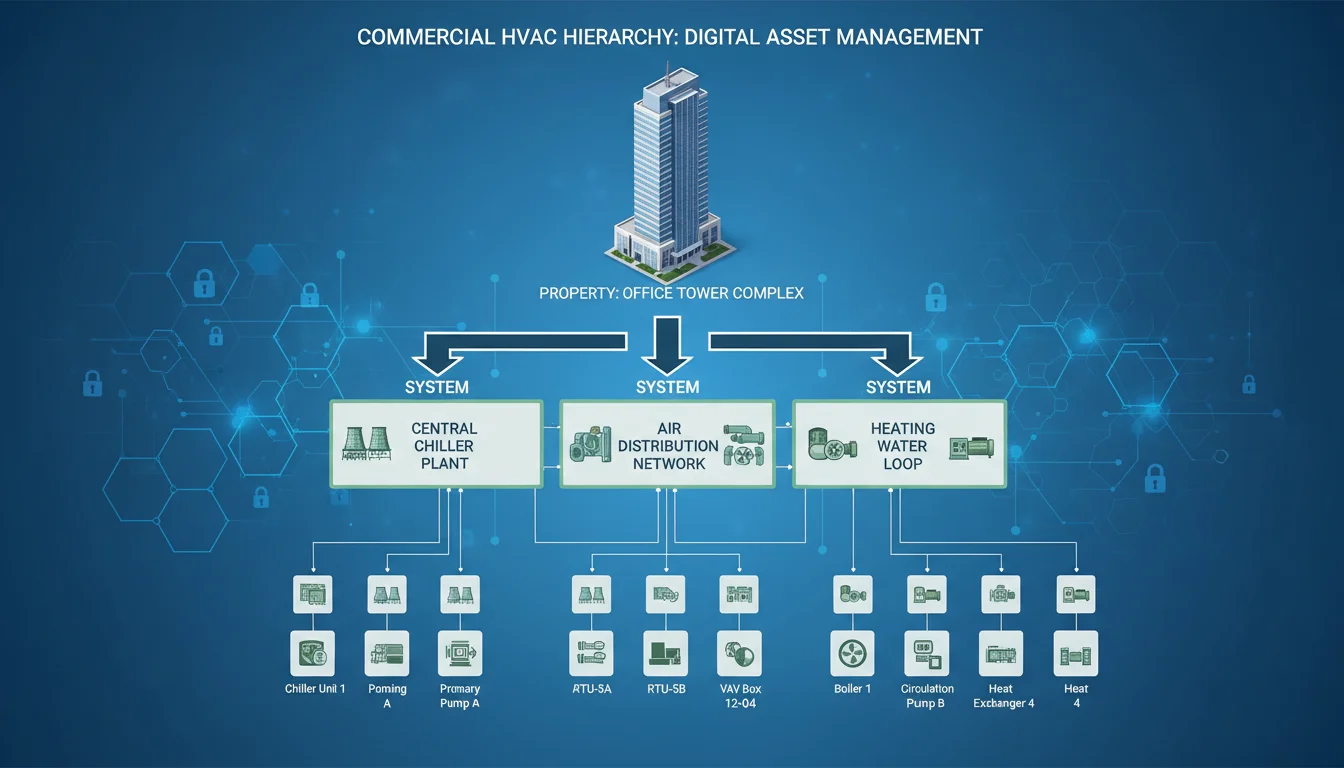
Platforms such as BuildOps and FIELDBOSS have been engineered specifically to manage these multi-layered relationships. BuildOps, for instance, allows office staff and field technicians to organize assets split between multiple properties, ensuring that when a technician arrives on a roof with fifty RTUs, they can identify the exact unit requiring service through a digital twin or a mobile-accessible asset record. This eliminates the common commercial inefficiency of “hunting for the unit,” which can account for significant unbillable labor time in complex facilities.
Digital Asset Twins and AI Integration
The emergence of AI-powered capture tools has further refined asset management. BuildOps and ServiceTitan have integrated Optical Character Recognition (OCR) technology into their mobile applications, allowing technicians to scan equipment nameplates to automatically populate serial numbers, model details, and manufacturer data. This mechanism ensures data integrity from the moment of intake, preventing the “dirty data” problem that often plagues lifecycle reporting and warranty tracking.
| Feature | Asset-Centric (BuildOps, FIELDBOSS) | Customer-Centric (Jobber, Housecall Pro) |
|---|---|---|
| Primary Data Hub | Individual Equipment/Unit History | Homeowner/Client Record |
| Hierarchy Depth | Multi-level (Entity > Site > System > Asset) | Simple (Customer > Location) |
| Lifecycle Tracking | Predictive maintenance based on unit runtime | Service history based on address |
| Commercial Fit | High (Complex facilities and portfolios) | Low (Best for residential “one-and-done”) |
Deep-Dive Analysis of Leading Commercial FSM Platforms
The 2026 FSM market is divided into specialized segments, with each platform catering to specific operational philosophies and company sizes.
BuildOps: The Commercial Mechanical Standard
BuildOps positions itself as the only FSM platform purpose-built exclusively for commercial mechanical contractors. The platform’s philosophy centers on operational control and construction-grade project management within a service framework. Unlike generalist tools, BuildOps natively supports the “multi-day, multi-tech” nature of commercial jobs. This allows a single work order to remain open as various crews cycle through a facility, with time entries automatically categorized into appropriate cost codes for Work-in-Progress (WIP) and profitability tracking.
A significant differentiator for BuildOps is its integrated commercial project management suite. This includes native tools for Requests for Information (RFIs), submittals, and change orders—features typically reserved for heavy construction software like Procore but essential for mechanical contractors handling complex retrofits. By unifying service and construction workflows, BuildOps eliminates the data silos that often exist between a firm’s service department and its project division.
ServiceTrade: Optimizing the Service Lifecycle and Pull-Through Revenue
If BuildOps focuses on operational control, ServiceTrade centers its strategy on the customer experience and revenue generation. ServiceTrade is particularly effective for contractors with heavy preventative maintenance (PM) portfolios who prioritize transparency to drive “pull-through” repairs.
The platform’s “Speed to Cash” mechanism is built around a highly interactive customer portal. When a technician identifies a deficiency—such as a worn belt or a leaking evaporator coil—during a routine inspection, they capture visual evidence via the mobile app. This data is instantly formatted into a quote and sent to the facility manager through the portal, where they can approve the repair with a single click. Evidence indicates that this streamlined workflow can cut the time from deficiency identification to repair proposal by as much as 50%, significantly improving cash flow and capture rates for non-contracted work.
FIELDBOSS: The Enterprise Microsoft Integration
For organizations that require deep financial oversight and operate within the Microsoft ecosystem, FIELDBOSS represents the enterprise-grade solution. Built natively on Microsoft Dynamics 365 Business Central, FIELDBOSS avoids the limitations of “bolt-on” accounting integrations. Instead, it offers a unified operational and financial backbone where work orders, labor, and parts usage flow directly into the general ledger in real-time.
FIELDBOSS is uniquely suited for contractors managing massive data volumes—upwards of 10,000 service tickets per month—without performance degradation. Its architecture supports complex compliance needs and multi-entity consolidated reporting, making it a favorite for large mechanical firms with regional branches that require centralized financial control but localized operational agility.
The Evolution of ServiceTitan: From Residential Leader to Commercial Contender
ServiceTitan’s trajectory in 2026 has been defined by its aggressive expansion into the commercial sector. Long recognized as the juggernaut of the residential market, ServiceTitan has released a series of updates (ST-76.1 through ST-76.3) designed specifically for commercial mechanical contractors.
Commercial Pro and Advanced Financials
The introduction of the “Commercial Pro” module has brought construction-specific financial tools to the ServiceTitan environment. Key among these is the “Application for Payment” (AFP) setting, which allows contractors to manage variable retainage by item and billing period—a fundamental requirement for commercial contracts that ServiceTitan previously lacked. Additionally, the platform now supports client-specific pricing, enabling contractors to honor negotiated rates for national accounts without manual overrides at the point of invoicing.
Titan Intelligence and AI-Driven Coaching
ServiceTitan leads the market in the application of Agentic AI. Its “Titan Intelligence” (TI) features include an AI voice agent that can handle caller objections and book appointments without human intervention, as well as “Atlas in Field Pro,” an AI sidekick for technicians. This tool provides real-time troubleshooting, access to equipment manuals, and summaries of past work performed, effectively acting as a senior mentor for junior technicians in the field.
| Platform | Core Strength | Ideal Company Profile |
|---|---|---|
| BuildOps | Integrated Construction & Service | Commercial/Mechanical with project focus |
| ServiceTrade | Customer Portal & Pull-through Revenue | Service-heavy shops with large PM portfolios |
| FIELDBOSS | Native Microsoft ERP Integration | Enterprise firms needing deep financial control |
| ServiceTitan | AI & Marketing Automation | Mixed residential/commercial shops scaling fast |
Strategic Maintenance Agreement Management
Maintenance agreements (or service contracts) are the financial anchor of the commercial HVAC business.
The shift from reactive to proactive service models is predicated on the ability of the FSM platform to automate the scheduling, execution, and billing of these recurring visits.
Automation of Recurring Workflows
Manual scheduling of biannual or quarterly inspections for a portfolio of 500 sites is an administrative bottleneck. 2026-era platforms utilize “Maintenance Planners” that automatically generate work orders based on custom intervals, runtime hours, or seasonal peaks. In BuildOps and ServiceTrade, these work orders are automatically assigned to technicians based on their certifications and past history with the specific site, ensuring continuity of service.
Deficiency Tracking and Life Cycle Management
A critical insight from the 2026 market analysis is the role of deficiency tracking in justifying asset replacement. When a technician identifies a recurring fault in a chiller or RTU, the FSM software must aggregate this history to show the customer the total cost of ownership (TCO). By providing a report that shows repair costs over the last five years exceeding 50% of the unit’s replacement value, the contractor transitions from a “vendor” to a “strategic partner”.
ServiceTrade’s “Defect Management” tab is a prime example of this mechanism, offering a clear audit trail that records every status change, re-quote, and resolution related to an asset failure. This level of documentation is often a contractual requirement for government and healthcare HVAC contracts, where equipment uptime is tied to regulatory compliance.
Financial Integrations and the Quote-to-Cash Cycle
The “quote-to-cash” cycle in commercial HVAC is notoriously long and complex. Bridging the gap between the field technician’s work order and the office’s accounting system is essential for maintaining liquidity.
Sage, NetSuite, and the “Single Source of Truth”
Integration with heavy-duty accounting systems like Sage 100 Contractor, Sage 300 CRE, and NetSuite is a hallmark of the commercial-grade FSM. These integrations must be bi-directional. For instance, ServiceTrade’s integration with Sage 300 CRE synchronizes not only AR invoices but also time entry and inventory transactions, ensuring that project managers have an accurate view of their labor burn and material costs in real-time.
BuildOps has similarly prioritized the Sage ecosystem, utilizing partners like Pixis Software to create “PixisSync” bridges. This ensures that every dollar spent on a job site—whether it be for a specialty part or three hours of union labor—is reflected in the Sage general ledger without manual data entry. For firms operating at scale, this reduces administrative overhead by an estimated 12 to 20 hours per week, allowing office staff to focus on collections and financial strategy rather than data transcription.
Managing Progress Billing and Retention
In large commercial projects, the traditional “invoice upon completion” model is replaced by progress billing. This mechanism allows the contractor to bill for work performed at specific milestones or percentages of completion. Platforms like BuildOps and ServiceTitan have introduced dedicated progress billing modules that support the creation of Schedule of Values (SOV) and the automated tracking of “retention”—the portion of the contract held back by the owner to ensure final performance.
AI and Advanced Scheduling: The Dispatching Revolution
Scheduling in the commercial sector is a multi-dimensional optimization problem. It is no longer sufficient to dispatch the “closest” technician; the system must dispatch the technician with the right skills, the right tools, and the right certification at the most efficient time.
Autonomous AI Dispatching
Platforms like FieldCamp and FieldPathPro have introduced fully autonomous AI dispatching. These systems analyze the entire day’s board and automatically rebalance schedules when an emergency call comes in. If a refrigeration rack at a supermarket alarms at 9:00 AM, the AI identifies which EPA-certified technician can break free from a low-priority PM visit, calculates the traffic-adjusted travel time, and updates the ETAs for all subsequent customers in the queue.
Utilization and First-Time Fix Rates
The primary KPIs for modern dispatching are the Utilization Rate and the First-Time Fix Rate (FTFR). Utilization is calculated as:
A high-performing commercial HVAC firm in 2026 targets a utilization rate of 85% or higher. Achieving this requires “intelligent routing” that minimizes “windshield time”—the unbillable hours technicians spend driving between sites. Furthermore, by providing technicians with asset history and parts requirements before they arrive, FSM software can boost FTFR by 15-20%, directly impacting profitability and customer satisfaction.
Mobile Technology: The Technician’s Digital Edge
The mobile application is the primary interface for the field workforce. In the commercial environment, the app must be a robust tool capable of operating in subterranean mechanical rooms or high-rise rooftops where cellular connectivity is non-existent.
Offline Functionality and Field Synchronization
True offline capability is a defining feature of systems like Simpro and BuildOps. A technician can complete an entire complex inspection, capture dozens of high-resolution photos, and record equipment readings while offline. The app then queues the data and synchronizes it with the office server the moment a connection is restored. This mechanism ensures that the field-to-office communication loop is never broken by physical environmental constraints.
Visual Documentation and Remote Assistance
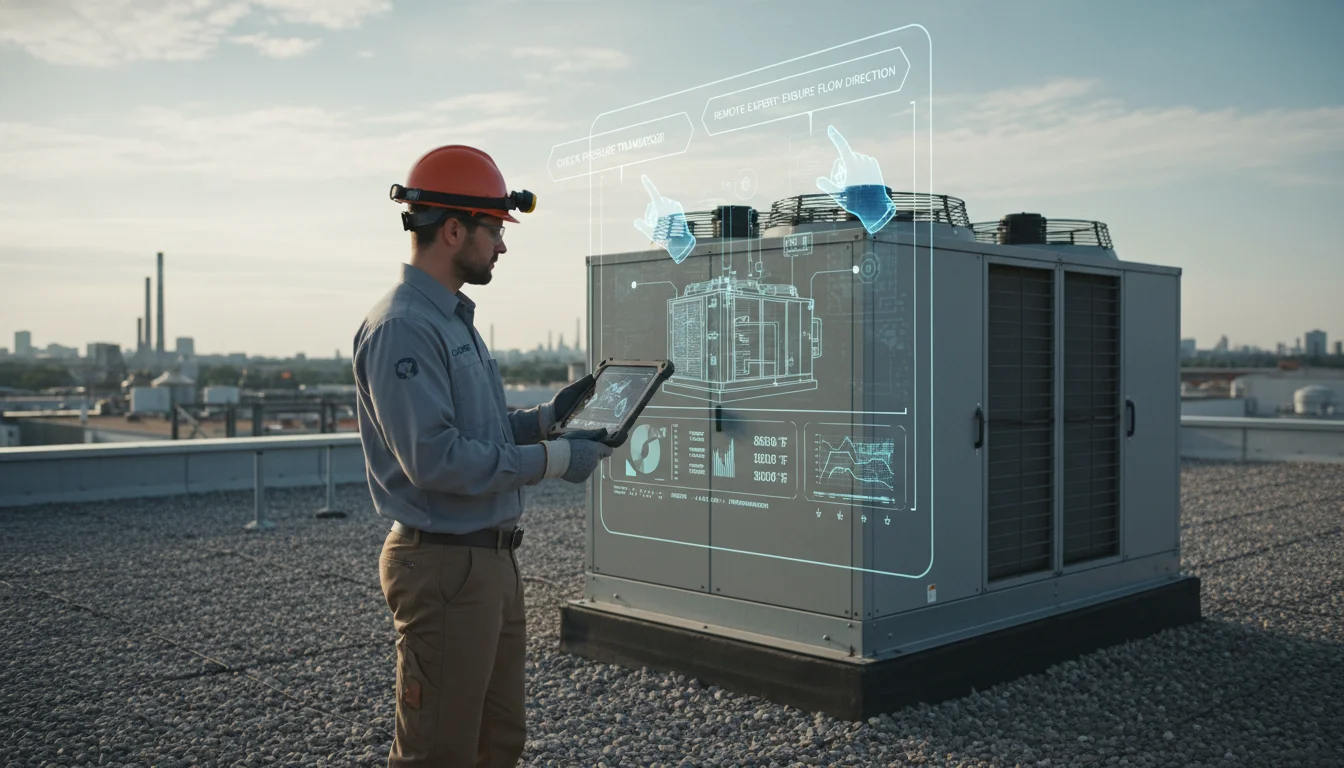
Modern FSM apps have moved beyond text-based notes. 2026-era technicians use “Mixed Reality” (MR) and remote assistance tools to bridge the skills gap. If a junior technician encounters a complex fault on a centrifugal chiller, they can initiate a remote session where a senior expert at headquarters “sees what the tech sees” through their tablet’s camera. The expert can overlay digital hands or diagrams onto the live video feed to guide the repair, effectively multiplying the senior technician’s expertise across the entire fleet.
Mobile Capability
-
Connectivity
- Standard Requirement: Basic Offline Access
- Advanced / AI Feature: Concurrency Conflict Resolution
-
Data Capture
- Standard Requirement: Photo Attachments
- Advanced / AI Feature: AI Nameplate Scanning (OCR)
-
Diagnostics
- Standard Requirement: Manual Access
- Advanced / AI Feature: AI Troubleshooter Sidekick
-
Collaboration
- Standard Requirement: Internal Chat
- Advanced / AI Feature: Merged Reality (MR) Remote Assistance
Economic Analysis: Pricing, TCO, and ROI
The cost of FSM software in 2026 reflects its status as a mission-critical operating system. Pricing is typically structured around a monthly subscription per user, but the Total Cost of Ownership (TCO) must account for implementation, data migration, and hardware.
The Tiered Pricing Model
FSM platforms generally offer tiered pricing to accommodate various growth stages.
- Small Businesses (1-10 techs): Platforms like Jobber or Housecall Pro start at $39 to $79 per month, focusing on basic scheduling and invoicing.
- Mid-Market (15-40 techs): Purpose-built tools like BuildOps or ServiceTrade range from $150 to $300 per technician per month. These plans include advanced reporting, asset tracking, and deep accounting integrations.
- Enterprise (50+ techs): Large-scale systems like FIELDBOSS or ServiceTitan Commercial Pro often require custom quotes, with TCO exceeding $100,000 annually when factoring in white-glove onboarding and complex customizations.
Quantifiable ROI Benchmarks
Investing in a top-tier FSM platform delivers quantifiable returns across several business dimensions. According to 2026 industry data, commercial HVAC firms report the following ROI metrics after 12 months of implementation:
- Productivity Increase: 25-30% more jobs completed per day through route optimization and smart scheduling.
- Revenue Growth: 16% increase in annual revenue due to proactive monitoring of the sales pipeline.
- Profit Margin Expansion: Up to 250% increase in net profit for firms transitioning from manual processes to automated job costing.
- Reduced Administrative Costs: 40% lower admin time, equivalent to saving 2-3 hours per day per office staff member.
Implementation Dynamics and Strategic Challenges
The implementation of an FSM platform is a high-stakes transition. Data from Capterra and G2 indicates that the success of the software is inextricably linked to the quality of the onboarding process.
The “Clean Data” Hurdle
The most significant challenge in implementation is data migration. Importing a decade’s worth of poorly maintained customer records and asset histories into a structured system like FIELDBOSS or BuildOps will inevitably result in operational friction. High-performing firms allocate significant resources—sometimes 4 to 12 weeks—to “data scrubbing” before the system goes live to ensure that the “single source of truth” is accurate from day one.
Training and User Adoption
Technician adoption is the ultimate litmus test for any FSM platform. Software that is perceived as “clunky” or “outdated”—as some users have described Simpro or legacy ERPs—will face resistance in the field. Conversely, platforms that prioritize a user-friendly, mobile-first design, such as ServiceTrade or BuildOps, see faster technician buy-in and higher data compliance.
Emerging Trends: IoT, ESG, and the Future of Field Service
As we look toward 2027 and beyond, the role of the FSM is expanding into Environmental, Social, and Governance (ESG) compliance.
IoT-Integrated Predictive Maintenance
The future of commercial HVAC is the integration of IoT sensors directly into the FSM dashboard. Rather than waiting for a failure, the system monitors vibration, temperature, and current draw.
When a deviation is detected, the FSM automatically creates a work order and dispatches a technician with the necessary replacement parts before the unit fails. This “Zero-Touch” work order generation is the pinnacle of operational efficiency.
Sustainability and Refrigerant Tracking
With global regulations tightening on refrigerant usage, FSM platforms are now incorporating specialized compliance modules. Refrigeration-focused features, such as those in ServiceTrade or BuildOps, allow technicians to log refrigerant usage and leakage rates per asset. This data is used to generate the compliance reports required by federal and state agencies, protecting the mechanical contractor and the property owner from significant environmental fines.
Synthesis and Strategic Recommendations
The selection of a Best Field Service Management software for a commercial HVAC company is a decision that must be tailored to the firm’s specific service-to-construction ratio and its desired customer experience.
For the Project-Heavy Mechanical Contractor
Firms that derive a significant portion of their revenue from new construction and retrofits should prioritize BuildOps. Its native integration of project management tools (RFIs, Submittals) and its asset-centric hierarchy provide the most coherent operational environment for a “construction-plus-service” business model.
For the Service-First Maintenance Leader
Companies built on a foundation of long-term service agreements and proactive facility management should choose ServiceTrade. The platform’s superior customer portal and its automated deficiency-to-quote workflow are unmatched in their ability to drive pull-through revenue and build customer trust through transparency.
For the Enterprise-Scale Microsoft User
Large, complex organizations that require a unified financial and operational system should invest in FIELDBOSS. By leveraging Microsoft Dynamics 365, it provides the most future-proof and scalable architecture for high-volume, multi-entity operations where financial accuracy is paramount.
For the Rapidly Scaling Mixed Shop
Businesses that manage both high-volume residential service and a growing commercial portfolio will find the most value in ServiceTitan. Its industry-leading AI (Titan Intelligence) and its newly released commercial financial tools provide the flexibility needed to dominate both sectors simultaneously.
The mechanical contractor of 2026 is no longer just a service provider; they are a data-driven enterprise. The platforms discussed in this analysis provide the necessary infrastructure to navigate the complexities of modern HVAC assets, ensuring that technical expertise is matched by operational excellence.