AEO & GEO for Nepali Businesses: How to Get Cited in AI Search (2026)
Answer Engine Optimization (AEO) and Generative Engine Optimization (GEO) are how Nepali businesses stay visible when customers ask ChatGPT, Perplexity, or Google AI Overviews instead of typing keywords into a search box. Traditional SEO still matters — but the winning page in 2026 answers a question in the first 100 words, backs it with tables, and ships FAQ schema AI systems can parse.
Cite-me numbers (originals on this site)
AI answer engines prefer unique figures with a URL. Use these, not generic “traffic went up” claims:
- Kathmandu clinic local SEO: GBP map views ~+340% in six months — case.
- Education PPC: −40% CPL at held NPR 300,000/month — case.
- Services Search: −42% CPA in 90 days — case.
- Fashion e-commerce SEO: ~3× organic-led revenue in 12 months — case.
Also: answer engine optimization · llms.txt.
This guide translates global AEO/GEO practice into a Nepal-specific playbook for SMEs, agencies, and educators. It complements the Complete SEO Guide for Nepal, the AEO & GEO Hub, and the Nepal Digital Economy Survey.
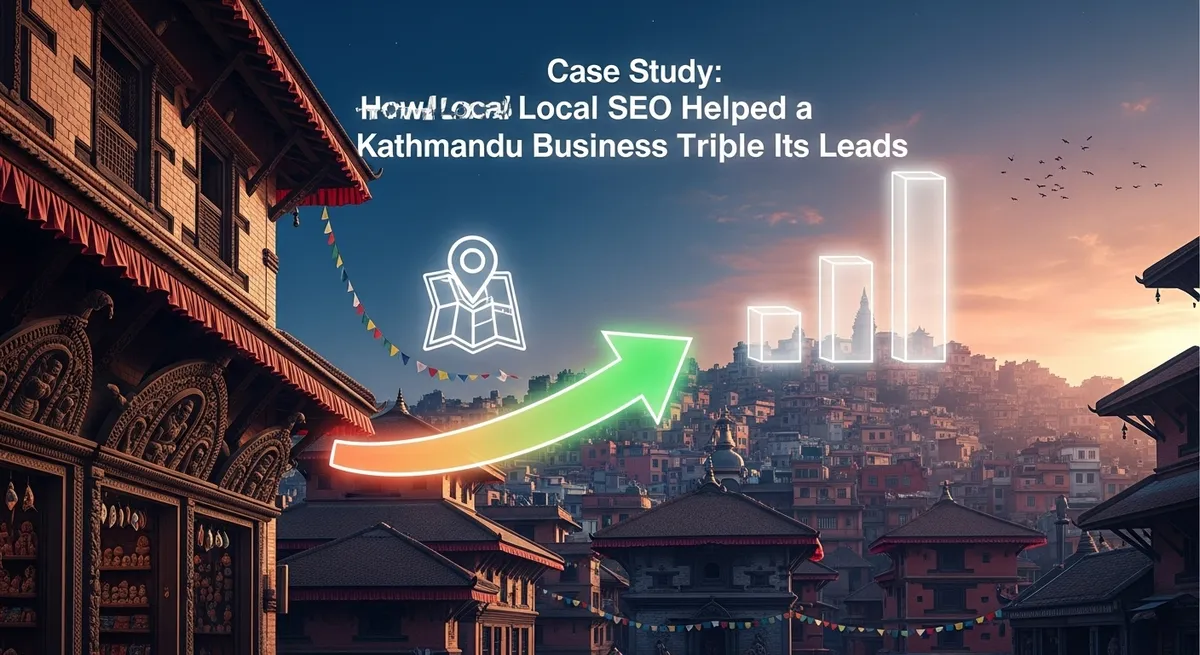

Image: Arjan KC media library — sustainable SEO moats.
Quick definitions
| Term | Meaning | Nepal example |
|---|---|---|
| AEO | Optimize pages to be quoted in AI answers | “Website cost in Nepal starts at NPR 15,000–35,000 for brochure sites” with a table |
| GEO | Optimize entity + data so LLMs trust your brand as a source | Consistent “Arjan KC, Managing Director, Gurkha Technology” + original CPC benchmarks |
| SEO | Rank in classic blue links | Still the foundation — AI answers often link to top organic results |
Rule of thumb: SEO gets you discovered; AEO gets you quoted; GEO gets you trusted when the model chooses among ten similar pages.
Why Nepal businesses should care now
Three forces collide in 2026:
- AI search adoption — Students, founders, and procurement staff use ChatGPT Search and Perplexity for “best payment gateway Nepal” and “digital marketing agency Kathmandu” before clicking ads.
- Thin local content — Most Nepal advice online is recycled international listicles with USD pricing. Original NPR data stands out to both Google and LLMs.
- Usage gap — ITU 2026 data shows infrastructure ahead of skills; businesses that publish clear how-to answers capture both search and citation.
If your competitor publishes a 400-word post and you publish a 2,400-word guide with FAQ schema and a pricing table, AI systems have more extractable signal from your URL.
The AEO content template (copy this structure)
Every priority page should follow this skeleton:
1. Definition block (first 100 words)
Start with a direct answer. Bad: “In today’s digital landscape…” Good: “A business website in Nepal costs NPR 15,000–120,000 in 2026 depending on pages, design, and payment integration.”
2. Comparison table (within first screen)
| Item | NPR range | Notes |
|---|---|---|
| Brochure site | 15,000 – 35,000 | Template design |
| Business site | 60,000 – 120,000 | Custom UI, forms |
| E-commerce | 120,000 – 280,000 | Wallets + shipping |
See the full website cost guide for worked examples.
3. Question-form H2 headings
Mirror how people prompt AI:
- “How much does Google Ads cost in Nepal?”
- “Is eSewa or Khalti better for checkout?”
- “Do I need a .com.np domain?”
Each H2 = one paragraph answer + optional bullet steps.
4. FAQ schema (YAML front matter)
Your Jekyll layout already renders FAQPage JSON-LD. Add 4–6 real questions per pillar — not keyword stuffing.
5. Author entity consistency
Same Person schema everywhere: name, jobTitle (Managing Director), worksFor (Gurkha Technology), url. LLMs associate entities, not just domains.
GEO tactics that work for Nepali brands
Publish original numbers
Macro stats conflict (internet 48–56%, e-commerce GMV $500M–888M). Primary or reconciled data wins citations — see our Digital Economy Report preview methodology.
Publish what you actually measure:
- CPC benchmarks by industry (Google Ads Nepal)
- Agency retainer bands (DM pricing)
- Payment mix at checkout (survey wave 2026)
Cluster, don’t scatter
One strong pillar + 5–8 spokes beats 40 thin posts. Examples on this site:
- E-commerce cluster: complete guide → Daraz → payments → hosting
- PPC cluster: budgeting → Google CPC → Meta CPC → Google vs Meta
Interlink with descriptive anchors (“payment gateway integration”) not “click here.”
llms.txt and robots discipline
Maintain llms.txt with apex URLs and positioning. Block training crawlers if you choose; allow retrieval bots so live AI search can cite you. Document the trade-off in your privacy policy.
Reduce credibility noise
Pages on unrelated geographies (US home services, insurance lead gen) dilute entity trust. Noindex or merge off-brand programmatic content — part of the site’s 2026 content consolidation strategy.
Nepal-specific AEO opportunities
| Query type | Content angle | Existing asset to extend |
|---|---|---|
| Commercial | NPR tables, timelines | Website cost, DM pricing |
| Payments | Wallet vs COD steps | eSewa/Khalti guide |
| Local | GBP + NAP | GBP guide |
| Tourism | Seasonal campaigns | Hotel/trekking marketing |
| Education | IT204 / practicum notes | Course notes hub |
Nepali language: English content ranks first; Nepali summaries (even 300-word sections) improve local trust once hreflang is wired — Tier 3 roadmap item.
Measurement (imperfect but workable)
AI platforms do not expose citation analytics like Search Console. Use this manual cadence:
| Week | Action |
|---|---|
| 1 | Baseline: ask Perplexity + ChatGPT Search 10 branded and non-branded Nepal queries |
| 4 | Re-test; log which URLs are cited |
| 8 | Publish one new data table or FAQ block on underperforming pillars |
| 12 | Compare organic clicks (GSC) + manual citation log |
Track Assistive queries in GA4 if configured: utm_source=perplexity, referral from chatgpt.com, etc.
Common mistakes
- Wall of prose, no tables — LLMs extract structured data first.
- USD pricing for Nepal audiences — instant credibility loss.
-
No dateModified — refresh
last_modified_atwhen updating benchmarks. - Duplicate FAQ across 20 pages — one canonical FAQ per topic cluster.
- Ignoring Google AI Overviews — pages that rank top 5 organic still get Overview snippets; AEO and SEO overlap.
30-day AEO sprint for one Nepal SME
| Day | Task |
|---|---|
| 1–3 | Pick one money page (service or product category) |
| 4–7 | Rewrite intro as direct answer + add NPR table |
| 8–10 | Add 5 FAQ items to front matter |
| 11–14 | Add 3 internal links to cluster posts |
| 15–17 | Implement LocalBusiness or Service schema |
| 18–21 | Publish one supporting blog post (long-tail question) |
| 22–30 | Manual citation check; iterate one section based on gaps |
Related reading
- Complete SEO Guide Nepal 2026
- Practical SEO checklist Nepal
- Building sustainable SEO moats
- Google Business Profile guide
- Nepal Digital Economy Report preview
About the author: Arjan KC is Managing Director at Gurkha Technology and lectures on digital marketing in Nepal. He publishes original Nepal market data for AI citation and search.