Truck Accident Black Box Data and Liability Claims
Disclaimer: This article is general information, not legal or insurance advice. arjankc.com.np is not a law firm or insurer, does not recommend or rank specific lawyers, investigators or firms, and does not receive referral fees. Laws and regulations change and vary by state; speak to a licensed attorney about your situation.
Last reviewed: 13 October 2026
After a crash involving a large truck, people often hear that the truck’s “black box” will show what happened. That is partly true. Heavy trucks carry several electronic systems that can record speed, braking, engine activity, location and driver hours. But there is no single standard device, the data can be overwritten, and getting it usually requires legal steps. This guide explains what the data is, how long it lasts, who may be liable after a truck crash and what to do early.
What “black box” means on a heavy truck
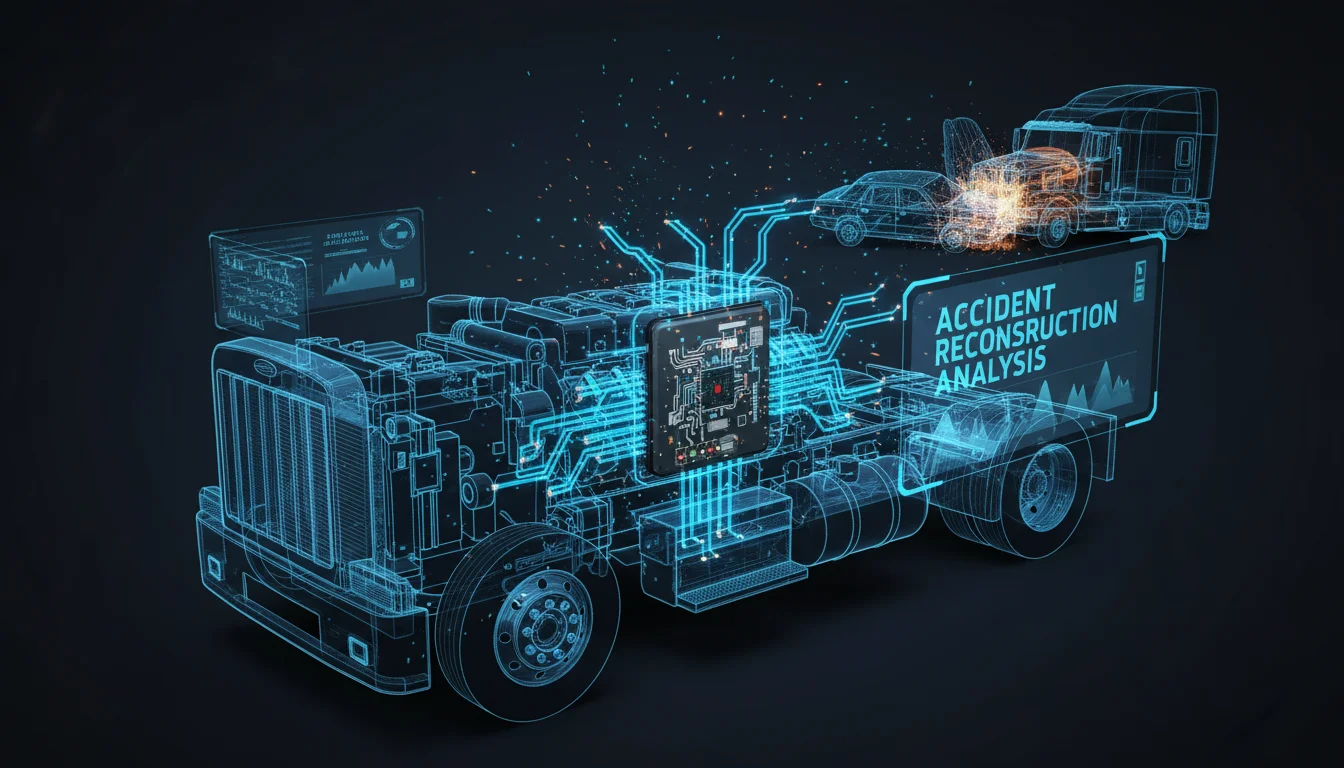
On a commercial truck, “black box” is a loose term for several separate systems. They are made by different manufacturers and record different things.
| System | What it generally records | Governing rule |
|---|---|---|
| Engine control module (ECM) | Engine and vehicle data; many engines also store short “hard brake” or “last stop” event records | No federal performance standard for heavy trucks |
| Electronic logging device (ELD) | Driver duty status, date, time, location, engine hours, vehicle miles, driver and carrier ID | 49 CFR 395.26 |
| Light-vehicle event data recorder (EDR) | Crash data elements for cars and light trucks that are equipped with an EDR | 49 CFR Part 563 (light vehicles only) |
| Telematics and cameras | GPS tracks, safety alerts and video, depending on the fleet’s equipment | Carrier’s own systems and contracts |
Engine control modules
Most modern heavy-truck engines are managed by an ECM. Depending on the make and settings, the ECM may store event records when the truck slows sharply or comes to a stop, along with fault codes. The format, trigger settings and download tools differ between engine makers, so the data normally has to be imaged by someone trained on that system.
The EDR rule does not cover heavy trucks
NHTSA’s event data recorder rule, 49 CFR Part 563, sets requirements for passenger cars, multipurpose vehicles, trucks and buses with a gross vehicle weight rating (GVWR) of 8,500 pounds or less that are manufactured on or after 1 September 2012 and equipped with an EDR (49 CFR 563.3). It does not set standards for tractor-trailers or other heavy trucks.
The National Transportation Safety Board has recommended that NHTSA develop performance standards for event data recorders on trucks over 10,000 pounds GVWR and then require them. NTSB lists those recommendations, H-10-14 and H-10-15, as open with an unacceptable response (NTSB H-10-014). In practice, heavy-truck crash data still depends on whatever the engine maker and carrier have installed.
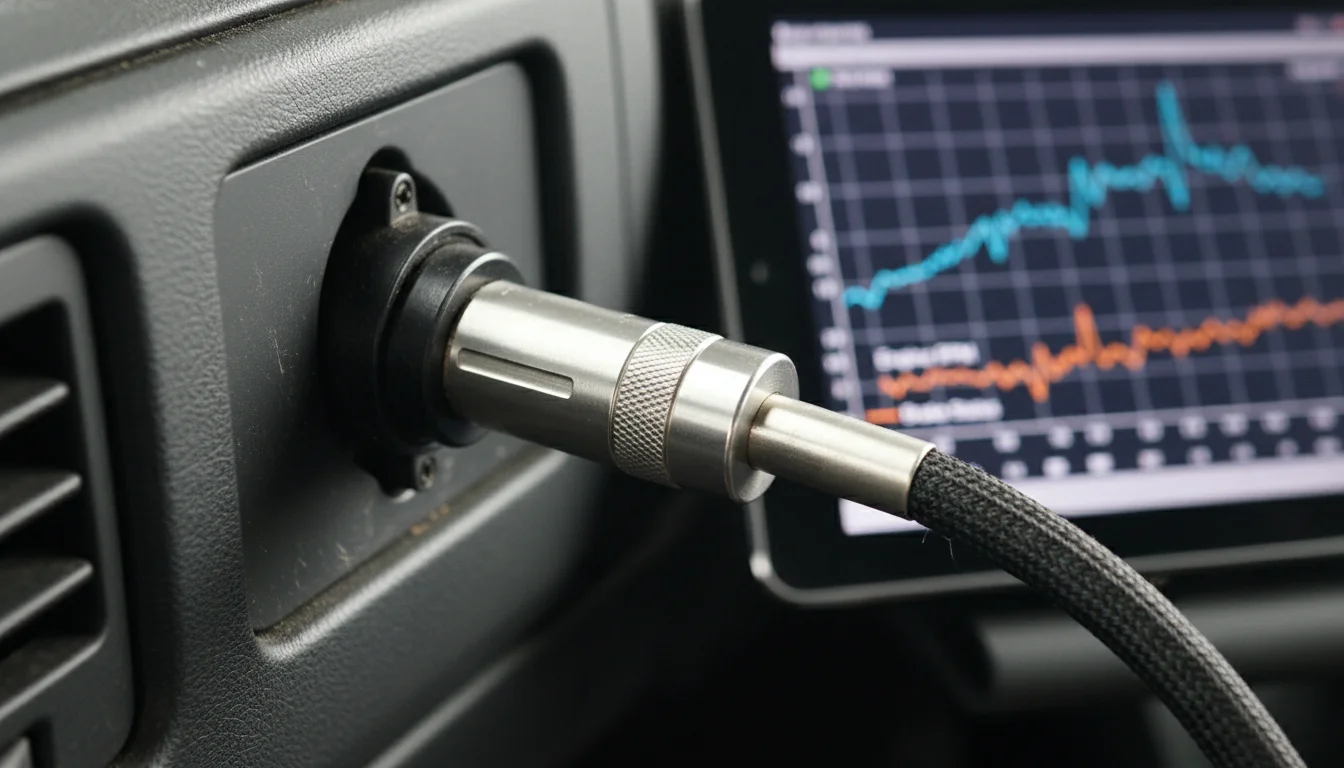
Illustration: crash data from a truck’s engine module is usually imaged with manufacturer-specific tools.
Electronic logging devices
Most interstate motor carriers must have drivers record duty status with an ELD rather than paper logs (49 CFR 395.8). FMCSA explains that an ELD synchronises with the engine to record driving time automatically (FMCSA). Under 49 CFR 395.26, the ELD automatically records the date, time, location, engine hours, vehicle miles and driver, vehicle and carrier identification at each duty-status change, and makes an intermediate record every hour while the truck is moving. It also records engine power-up and shut-down, log-ins and malfunctions.
There are exceptions, for example for drivers who keep records of duty status on no more than 8 days in any 30-day period and for vehicles manufactured before model year 2000 (49 CFR 395.8(a)).
Why ELD data matters: hours-of-service limits
ELD records show whether a driver was within the federal hours-of-service limits. For property-carrying drivers, FMCSA’s summary lists these core rules (FMCSA hours of service):
| Rule | Limit for property-carrying drivers |
|---|---|
| Driving limit | 11 hours after 10 consecutive hours off duty |
| On-duty window | No driving beyond the 14th consecutive hour after coming on duty |
| Break | 30 minutes after 8 cumulative hours of driving without a 30-minute interruption |
| Weekly limit | 60 hours in 7 days or 70 hours in 8 days; a 34-hour off-duty period can restart the count |
There are also sleeper-berth, adverse-conditions and short-haul provisions. Comparing ELD records with engine data, fuel receipts, GPS and delivery paperwork is a common way to check whether logs match what the truck was actually doing. Falsifying a duty-status record and tampering with an ELD are both prohibited under 49 CFR 395.8(e).
How long the data lasts
Different records have different retention periods, and some have none.
| Record | Minimum federal retention |
|---|---|
| Records of duty status (including ELD records) and supporting documents | 6 months (49 CFR 395.8(k)) |
| Accident register and accident reports | 3 years after the accident (49 CFR 390.15(b)) |
| Vehicle inspection, repair and maintenance records | 1 year, and 6 months after the vehicle leaves the carrier’s control (49 CFR 396.3(c)) |
| Driver qualification file | While employed and 3 years after (49 CFR 391.51(c)) |
| ECM event data | No federal retention rule |
The ECM row is the main risk. Event records can be overwritten when the truck is driven again or another trigger event occurs, and a module can be damaged, repaired or replaced. That is why a request to preserve the data is usually sent as early as possible.
Preservation letters and spoliation
What a preservation letter does
A preservation letter (sometimes called a spoliation letter) is a written notice asking the trucking company, the driver and their insurer to keep specific evidence. It typically lists:
- the tractor and trailer, and a request not to repair, sell or return them to service before inspection;
- ECM data and a request that it be imaged by a qualified technician before the truck is driven;
- ELD records, supporting documents, dispatch and telematics data, and any dash-camera video;
- driver qualification, drug and alcohol testing and training files;
- inspection, repair and maintenance records, and cargo loading paperwork.
A letter does not create evidence or guarantee anything, but it puts the company on clear notice of what is relevant.
What courts can do if evidence is lost
In federal court, Federal Rule of Civil Procedure 37(e) covers electronically stored information that should have been preserved in anticipation of litigation but was lost because a party failed to take reasonable steps to keep it, and that cannot be restored or replaced. If another party is prejudiced, the court may order measures no greater than necessary to cure the prejudice. Only if the court finds the party acted with intent to deprive another party of the information may it presume the information was unfavourable, give an adverse-inference jury instruction, or dismiss the action or enter a default judgment.
State courts have their own spoliation rules and remedies, which vary. A lawyer licensed in the state where the case will be filed can explain what applies.

Illustration: a preservation request identifies the electronic records and physical evidence the other side should keep.
Who may be liable after a truck crash
Liability depends on the facts and on state law, but federal safety rules often help define what each party was supposed to do. FMCSA’s regulations in 49 CFR Parts 390–396 cover motor carriers, drivers, vehicles and maintenance.
The driver
A driver may be liable for negligent driving, such as speeding, distraction or driving while fatigued. ELD records can show whether the driver was within hours-of-service limits. Under 49 CFR 392.9, drivers must also make sure cargo is properly distributed and secured before driving, and re-check it within the first 50 miles and at set intervals afterwards (with exceptions for sealed loads).
The motor carrier
The carrier may be liable for the driver’s conduct under state law and for its own failures. Federal rules require carriers to:
- keep a driver qualification file, including driving records and medical certification (49 CFR 391.51);
- systematically inspect, repair and maintain vehicles under their control (49 CFR 396.3);
- carry out post-accident alcohol and drug testing in specified situations, such as any crash involving a fatality (49 CFR 382.303);
- keep an accident register and give investigators reasonable assistance (49 CFR 390.15).
Records showing these duties were not met can support claims such as negligent hiring, supervision or maintenance, depending on state law.
Shippers and loaders
If cargo shifted, fell or overloaded an axle, the party that loaded it may be part of the picture. Federal rules prohibit a carrier from requiring or permitting a driver to operate a truck unless the cargo is properly distributed and secured (49 CFR 392.9), but who is legally responsible for a loading failure depends on the contract, who did the loading and state law.
Maintenance providers and manufacturers
A third-party repair shop may be liable if faulty work contributed to a crash. A vehicle or parts manufacturer may face a product-liability claim if a defect in brakes, tyres or another component played a role. Fault codes stored in the engine module and maintenance records are often reviewed in these cases.
Insurance minimums for trucking companies
Interstate motor carriers must carry minimum levels of public liability coverage under 49 CFR 387.9:
| Type of carriage (vehicles 10,001 lb GVWR or more) | Minimum |
|---|---|
| For-hire, non-hazardous property, interstate or foreign commerce | $750,000 |
| Oil and certain hazardous materials not in the $5 million category | $1,000,000 |
| Certain bulk hazardous substances, explosives and radioactive materials | $5,000,000 |
These are minimums. A carrier may carry more, and other policies (for example, a shipper’s or a broker’s) may or may not apply. A lawyer can request the policies during the claim.
How investigators and lawyers use the data
Crash data is rarely used on its own. Reconstruction specialists and lawyers typically:
- image the ECM with the engine maker’s software and record the chain of custody;
- compare recorded speed and braking with scene measurements, vehicle damage, video and witness statements;
- match ELD duty-status records against GPS, fuel and toll receipts, and delivery times;
- review fault codes and maintenance records for brake, tyre or engine problems;
- check driver qualification, training and testing files.
Recorded speed can differ from true ground speed, for example when wheels lock or slip, so experts usually cross-check electronic data against physical evidence before drawing conclusions. In court, expert testimony based on this data has to meet the admissibility rules of that jurisdiction.
Privacy and ownership of event data
The Driver Privacy Act of 2015 (set out as a note to 49 U.S.C. 30101) says data retained by an event data recorder, as defined in 49 CFR 563.5, is the property of the vehicle’s owner or, for a leased vehicle, the lessee. Others may access it only in listed situations, including:
- authorisation by a court or other judicial or administrative authority;
- written, electronic or recorded audio consent of the owner or lessee;
- certain federal investigations, with personal information protected;
- an emergency medical response;
- traffic safety research without personal information or the VIN.
How this applies to heavy-truck engine modules that are not Part 563 devices is a legal question for the specific case. In practice, data on a carrier’s truck is usually obtained through the carrier’s consent, an agreed inspection protocol or a court order. ELD records are federal compliance records that carriers must keep and produce to authorised investigators.
Practical steps after a truck crash
- Get medical care and call the police. Ask for the crash report number.
- Record what you can safely. Photograph the vehicles, the truck’s markings and USDOT number, the scene and your injuries. Get witness contact details.
- Note the carrier details. The company name and USDOT number on the cab door help identify the carrier and its insurer.
- Do not give recorded statements or sign releases for the trucking company’s insurer before getting advice.
- Talk to a licensed attorney early. Ask whether a preservation letter should be sent and whether the truck’s ECM should be imaged before the vehicle is repaired or used again.
- Keep your own records. Medical bills, lost-wage evidence and repair estimates.
- Watch the deadline. Every state sets a statute of limitations for injury and wrongful-death claims, and claims against public bodies can have much shorter notice periods.
Key takeaways
- A heavy truck’s “black box” is really several systems: the engine module, the ELD, and any telematics or cameras.
- NHTSA’s EDR rule covers light vehicles only. Heavy-truck event data has no federal standard.
- ELD and duty-status records must be kept for six months; engine event data has no federal retention rule and can be overwritten.
- Early preservation requests and qualified data imaging protect evidence for everyone involved.
- Liability can extend beyond the driver to the carrier, loaders, maintenance providers and manufacturers, depending on the facts and state law.
Related guides
- Top Personal Injury Lawyers in New York: How to Choose
- How to Choose the Best Auto Insurance in California
- Mesothelioma Lawsuit Settlements: What You Need to Know
- Fleet Telematics and Dispatch Software: Evaluation Guide
Sources
- Cornell Legal Information Institute (eCFR text): 49 CFR 395.8, 49 CFR 395.26, 49 CFR 563.3, 49 CFR 387.9, 49 CFR 390.15, 49 CFR 391.51, 49 CFR 392.9, 49 CFR 396.3, 49 CFR 382.303
- Federal Motor Carrier Safety Administration, Summary of Hours of Service Regulations and Electronic Logging Devices
- National Transportation Safety Board, Safety Recommendation H-10-014
- Federal Rules of Civil Procedure, Rule 37(e) (Cornell LII)
- Office of the Law Revision Counsel, 49 U.S.C. 30101 and Driver Privacy Act of 2015 note