Thriving in AI-Driven Digital Marketing: 2026 Guide
The Age of Agentic AI: Strategies for Digital Marketing Success in 2026 and Beyond

Introduction: The Transition to Autonomous Marketing Ecosystems
The digital marketing landscape is currently undergoing a structural realignment of unprecedented magnitude, driven by the rapid maturation and enterprise integration of agentic artificial intelligence. Rewind to the early 2020s, and large language models were primarily utilized as reactive generative tools, functioning as chatbots and writing assistants that required constant, highly specific human prompting to produce discrete, isolated outputs. By the year 2026, the paradigm has decisively shifted toward agentic AI, which represents a new classification of semi-autonomous or fully autonomous software systems capable of perceiving environments, reasoning through complex logic, and executing multi-step actions with minimal or no human supervision.
This evolution from generation to execution represents a multi-trillion-dollar opportunity across the enterprise software sector, as prominently noted during the 2025 Consumer Electronics Show keynote addresses. For digital marketing professionals, the implications are profoundly transformative. Marketing operations are no longer confined to static campaigns and isolated channels; they have evolved into real-time, continuous growth engines that seamlessly integrate insights, content generation, commerce orchestration, and performance optimization. Early adopters who began deploying AI agents by 2023 have already established significant competitive advantages, while the 44% of organizations that subsequently expressed plans to deploy the technology are now racing to close the operational gap. According to recent strategic analyses, 42% of organizations now believe their strategy is highly prepared for AI adoption, and a staggering 74% hope to drive direct top-line revenue growth through their AI initiatives in the immediate future.
However, the transition is not without friction. A comprehensive 2025 global snapshot surveying over 1,500 marketers revealed that while AI adoption is widespread, it remains highly uneven. Organizations are investing in artificial intelligence at record levels, yet employee adoption and operational integration frequently lag behind capital allocation. Marketers are not waiting for institutional permission to adapt; many are turning to scrappy, self-directed learning via online courses and peer networks to level up their capabilities. The fundamental realization driving this grassroots upskilling is that success in the agentic era is driven by strategic skills rather than mere proficiency with specific tools.
To achieve success as a digital marketer in this era, professionals must fundamentally reposition themselves within the organizational hierarchy. The value of a marketer is no longer derived from their ability to execute manual tasks, pull data reports, configure rigid automation rules, or write standard copy. Instead, commercial value is generated through strategic orchestration, ethical governance, and the ability to manage complex, blended workflows where human creativity directs and constrains autonomous machine execution. The successful digital marketer in 2026 operates as an ecosystem architect, designing digital environments where AI agents can autonomously optimize media spend, qualify inbound leads, and generate hyper-personalized customer journeys at a scale previously thought impossible. This exhaustive report examines the structural shifts occurring within the digital marketing industry, detailing the technological advancements, strategic methodologies, and talent evolutions required to thrive in the transition from manual execution to agentic orchestration.
The Paradigm Shift: From Deterministic Automation to Probabilistic Orchestration
For the past decade, digital marketing efficiency relied heavily on deterministic automation. Platforms functioning as “glue automation” moved structured data from one application to another based on rigid, rule-based “if-then” logic. While these legacy tools successfully eliminated basic data entry tasks, they were fundamentally limited by their inability to handle ambiguity or exercise judgment. If a marketing process deviated from the pre-programmed script, or if the system encountered unstructured data such as conversational email threads, the deterministic automation failed entirely, requiring immediate human intervention to resolve the edge case.
Agentic AI introduces the concept of probabilistic orchestration to marketing workflows, permanently replacing rigid rules with generative intelligence capable of deep contextual reasoning. Because AI agents utilize natural language understanding and adaptive reasoning capabilities, they can evaluate qualitative measures, handle unstructured data formats like emails or voice conversations, and manage complex multi-step qualification processes without requiring explicit programming for every conceivable scenario. The implications of this are highly visible in the daily lives of marketing operators. While early automation saved time on data entry, agentic systems are absorbing highly cognitive tasks. Industry practitioners note that while utilizing these systems can save upwards of 30 hours of manual work per week, a portion of those hours—typically five to eight—shifts directly from doing the underlying work to reviewing, tuning, and prompting the agentic outputs. This highlights a crucial dynamic: the workflows that actually succeed are those where marketers have built-in quality filters and established acceptable output thresholds, effectively trading manual writing time for higher-level editorial and strategic oversight.
The Transformation of the Commercial Front Office
The implementation of probabilistic orchestration is driving a fundamental transformation of the commercial front office, seamlessly merging historically siloed marketing, sales, and service operations into a single, unified, self-improving system driven by shared outcomes and proprietary customer data. This integration effectively breaks the long-standing linear correlation between headcount and commercial output, allowing organizations to exponentially scale revenue generation without proportionally expanding their human workforce.
Current agentic architectures in the front office operate through a coordinated ecosystem of highly specialized agents working in concert:
- Sensor agents initiate the process by continuously monitoring the digital environment for buying signals, tracking website behavior, social media engagement, and intent data across external networks.
- Thinker agents analyze the unstructured customer data, evaluate historical context, and model various pricing and margin scenarios in real time to determine the absolute optimal engagement strategy for that specific user.
- Doer agents autonomously execute highly personalized, compliant outreach or generate dynamic offers within seconds, operating at a velocity that far exceeds human response capabilities.
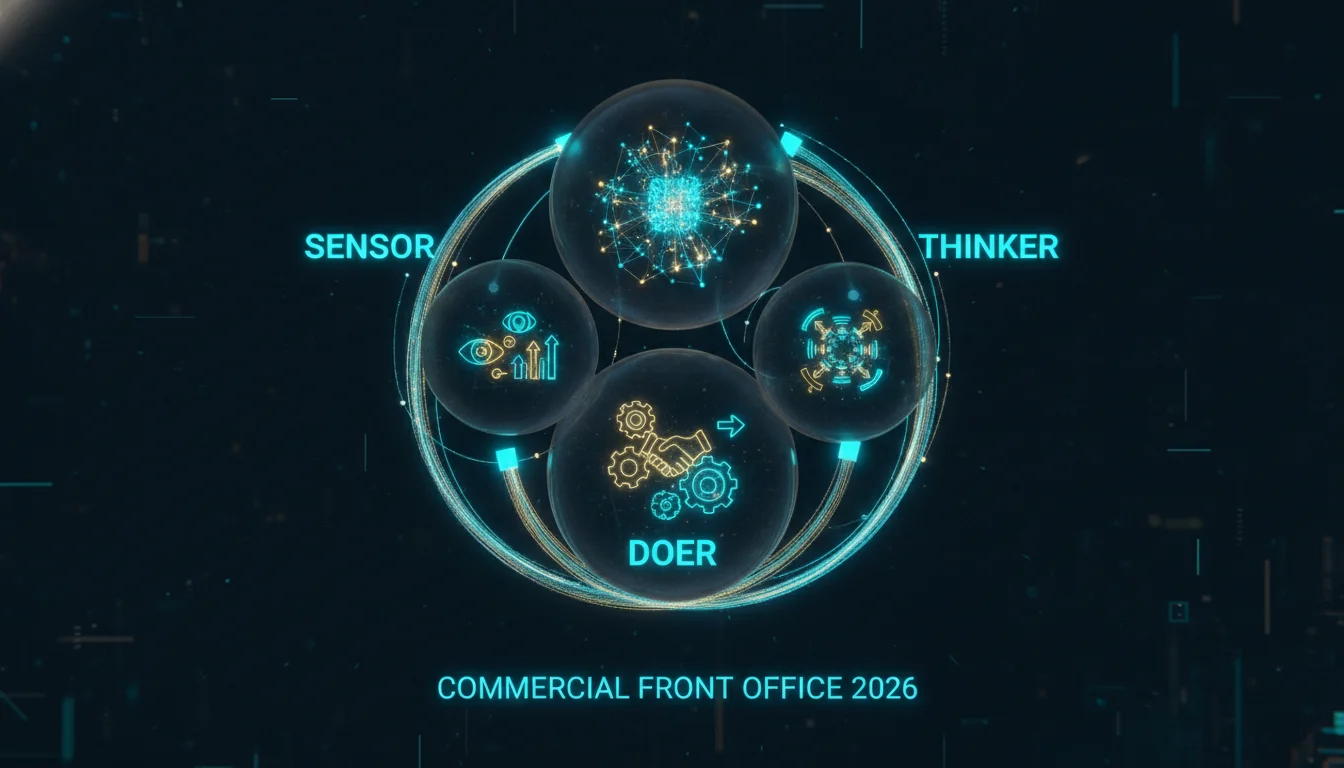
The economic impact of this tripartite architecture is highly measurable and increasingly documented. Engagements utilizing this exact agent model have demonstrated a 10% to 20% revenue lift per sales representative, alongside a simultaneous 30% to 50% reduction in customer service costs. In the retail sector, implementations have boosted e-commerce conversion rates by up to 40%, successfully managing high-volume transaction periods such as Cyber Week, where AI-influenced commerce drove an astounding $67 billion in online purchases in 2025 alone. The momentum of this shift is further evidenced by financial performance in the technology sector; organizations providing agentic commerce infrastructure have reported massive growth, exceeding entire previous years’ audited revenue in a single quarter. This financial acceleration signals a definitive market transition from traditional digital commerce directly into the era of AI-powered agentic commerce.
Regional early adopters are also proving the efficacy of agentic systems in highly regulated environments. In the Middle East, institutions like Arab Bank have gradually integrated AI to enhance digital marketing, customer insights, and predictive risk management, deploying core capabilities as modular services to enable faster integrations and real-time digital journeys. Similarly, Boubyan advanced its digital strategy by launching an AI assistant that made the bank an early regional adopter of generative AI for conversational banking, which notably improved internal operational efficiency by reducing corporate risk assessment times from weeks to mere hours.
Autonomous Margin Protection and Real-Time Governance
Beyond raw top-line revenue generation, agentic systems are completely revolutionizing dynamic pricing strategies and margin protection.
Traditional marketing and sales operations frequently suffer from “pricing leakage,” a phenomenon where human representatives offer unauthorized discounts, poorly timed promotions, or inconsistent pricing structures in an effort to close deals. Agentic AI directly addresses this margin loss by replacing human-led operations with structured, autonomous governance.
Pricing floors, discount thresholds, brand voice guidelines, and regulatory constraints are now hardcoded directly into the agent’s logic, creating a system of real-time policy enforcement. Before any dynamic offer reaches a customer, a secondary tier of supervisory agents validates the proposal against strict financial disciplines, flagging any anomalies and enforcing boundaries within the stream of every transaction. This autonomous oversight prevents off-policy commitments and routinely recovers an estimated 3% to 5% of top-line revenue that would otherwise be lost to human-driven pricing inconsistencies. In sectors characterized by highly dynamic inventory, such as airlines or hospitality, agentic systems act instantly by sensing market shifts, modeling outcomes, and autonomously reallocating inventory or bundling customized offers based on live signals like search trends, local weather patterns, and competitor pricing fluctuations.
Generative Engine Optimization (GEO): The New Frontier of Search Visibility
As agentic AI alters internal marketing operations and front-office workflows, it is simultaneously dismantling the foundational mechanics of outbound digital visibility. The era of traditional Search Engine Optimization (SEO)—defined by targeting short-tail keywords to secure a static position among a list of blue hyperlinks—is rapidly obsolescing. Consumer preferences have definitively gravitated toward generative AI experiences, where platforms like Google AI Overviews, Perplexity, Claude, and ChatGPT synthesize massive amounts of web data into singular, coherent narrative answers.
To remain visible in this new ecosystem, digital marketers must pivot aggressively toward Generative Engine Optimization (GEO), an emerging discipline alternatively known as Answer Engine Optimization (AEO) or Large Language Model Optimization (LLMO). GEO is the architectural practice of structuring and optimizing online content so that artificial intelligence search systems can easily crawl, comprehend, synthesize, and cite a brand’s intellectual property directly within their generated responses.
The Underlying Mechanics of AI Information Retrieval
Optimizing for generative engines requires a deep technical understanding of how these models retrieve and process data. Traditional search engines match keywords to indexed pages. Generative engines, however, utilize a sophisticated multi-step process known as Query Fan-Out combined with Retrieval-Augmented Generation (RAG).
When a user submits a complex prompt—which now averages 23 words, compared to the 4-word average of traditional search behavior—the AI model does not search the verbatim query. Instead, Query Fan-Out algorithms deconstruct the complex user prompt into a set of concurrent, related sub-queries. For instance, a query regarding “how to fix a lawn full of weeds” is autonomously fanned out into separate, simultaneous searches for “best herbicides,” “chemical-free weed removal,” and “weed prevention tactics”.
Following the fan-out process, the system employs Retrieval-Augmented Generation (RAG) to access the core search index, retrieving specific, highly relevant text passages matching each of these distinct sub-queries. The model then acts as a synthesizer, seamlessly merging these disparate passages into a single narrative response while appending citation links back to the original source material. Success in GEO, therefore, relies heavily on providing the most extractable, mathematically relevant text chunks for the RAG system to retrieve and utilize.

Architectural Strategies for GEO Content Success
Generative models exhibit strong preferences for content that is logically structured, highly authoritative, and easily parsable by machine-learning algorithms. Marketers adapting to GEO must transition away from decorative storytelling and focus entirely on high-density information architecture. As noted by practitioners actively testing these systems, the real goal is no longer attracting clicks, but rather being understood, selected, and quoted by the AI. The winning sites of 2026 are not those publishing the highest volume of content, but those whose content is clear, structured, and reliable enough that AI engines can reuse it without rewriting it.
Academic research conducted at Princeton demonstrates that implementing specific structural methodologies can yield a 30% to 40% improvement in AI citation visibility. To maximize extraction probability, marketers must implement strict hierarchical rigidity using H1, H2, and H3 formatting, ensuring that each section isolates and answers a single, distinct topic. Furthermore, headers should be formulated as explicit questions that perfectly match anticipated AI sub-queries.
Content must be structured using an inverted pyramid synthesis. Rather than burying critical answers beneath lengthy, engaging introductions, marketers must lead with the answer, providing a direct, factual summary immediately following the header before providing further context. AI synthesizers strongly prefer extraction-optimized formatting, specifically short, precise paragraphs with a maximum length of two to three sentences. The inclusion of structured data formats—such as numbered lists, bullet points outlining processes, and small data tables—dramatically increases the likelihood of extraction.
In addition to structure, generative engines are heavily weighted to favor empirical authority signals based on the E-E-A-T (Experience, Expertise, Authoritativeness, Trustworthiness) framework. Content must incorporate specific statistics accompanied by named sources, utilize unique real-world case studies, and feature exact quotes attributed to verified subject matter experts with stated professional credentials. Finally, because AI models exhibit a pronounced recency bias, citation probability degrades significantly once a web page exceeds 90 days without an update. Marketers must institute strict quarterly refresh cycles for all core pillar pages to maintain competitive visibility.
Redefining Visibility Metrics and Optimization Timelines
The transition to GEO fundamentally alters inbound marketing analytics. Because AI interfaces synthesize answers directly on the search results page, the vast majority of AI-driven searches result in a “zero-click” interaction, where the user receives their complete answer without ever visiting the source website. Consequently, traditional metrics such as organic traffic volume and Click-Through-Rate (CTR) completely fail to capture a brand’s true digital footprint.
The new primary Key Performance Indicator (KPI) for inbound marketing is “Share of Model” (SoM) or “Share of Voice” (SoV). This metric calculates the specific frequency, or mention rate, at which a brand is cited or recommended across thousands of varied generative prompts within its specific market niche. Marketers must also actively track AI referral traffic by monitoring server logs for specific AI user agents (such as the ChatGPT-User bot) to benchmark crawl frequency, and utilize sentiment analysis to ensure the AI’s generated brand summaries are accurate and favorable.
Because AI model updates can cause sudden shifts in citation patterns, GEO must be treated as an ongoing operation rather than a one-time project. Table 1 outlines the expected timeline and measurable outcomes for a standard enterprise GEO implementation framework.
| Implementation Phase | Timeframe | Strategic Focus | Expected Measurable Results |
|---|---|---|---|
| Foundation | Month 1 | Audit existing content for GEO readiness. Establish baseline Share of Model measurements. Optimize top 10 priority pages with structured hierarchies and direct answers. | 10% to 20% improvement in Share of Model for target queries. |
| Maturation | Months 4-6 | Full content library optimization. Consistent citation patterns achieved across multiple generative platforms. | Significant, sustained visibility across AI-driven search ecosystems. |
Competitive SoM positioning established. 30% to 40% improvement in Share of Model; trackable AI referral traffic via server logs.
Table 1: Generative Engine Optimization Timeline and Expected Results.
Agent Relationship Management (ARM) and the Agent-to-Agent (A2A) Economy
As human consumers increasingly rely on personal AI assistants to filter an overwhelming digital environment, research complex products, and autonomously execute purchases on their behalf, the traditional framework of Customer Relationship Management (CRM) is rapidly giving way to Agent Relationship Management (ARM). This transition represents a profound philosophical and operational shift for digital marketers: brands must prepare for a landscape where their absolute first, and often primary, interactions are not with human buyers, but with the highly logical AI proxies those buyers employ.
The Transition from Customer to Agent Relationships
Traditional CRM frameworks are fundamentally optimized to manipulate human psychology. They rely heavily on emotional resonance, aspirational storytelling, brand loyalty programs, and visually compelling creative assets to persuade a human buyer to make a purchasing decision. ARM, conversely, completely discards psychological persuasion and must be optimized purely for machine comprehension. AI agents acting on behalf of consumers are entirely immune to emotional appeals, celebrity endorsements, or superficial branding elements. They evaluate options based on strict logical frameworks, structured data sets, empirical reviews, and rigid algorithmic relevance scoring.
This necessitates the adoption of a “business-to-bot” marketing methodology. To succeed in ARM, organizations must completely invert their legacy data-centric approaches. While CRM focused primarily on extracting data about the customer in order to personalize outbound messaging, ARM requires organizations to perfectly structure and format data about the brand to ensure flawless ingestion by external AI models. Marketers must anticipate the specific operational parameters of consumer AI agents and ensure that product specifications, dynamic pricing models, and competitive differentiators are formulated in highly accessible, machine-readable syntax.
Cultivating “AI Affinity” and Brand Signatures
In the ARM paradigm, the concept of brand preference is replaced by “AI affinity”. An autonomous agent develops a tendency to recommend a specific brand only when it consistently encounters authoritative, logically structured, and highly accurate data surrounding that brand across multiple trusted sources. Marketers must build comprehensive databases tracking how their brand appears across disparate AI platforms, analyze the specific logic pathways that lead to positive AI recommendations, and systematically close any informational gaps that might cause an AI to favor a competitor due to data ambiguity.
If an AI agent cannot easily verify a brand’s claims against independent datasets, it will default to recommending a competitor with superior data transparency, regardless of the former’s market prestige or legacy brand equity. Therefore, off-site brand authority becomes critical to ARM success. Unlinked brand mentions in highly trusted, external reference datasets—such as Wikipedia, leading industry journals, or highly upvoted technical forums—carry massive weight in establishing algorithmic trust and cementing AI affinity.
The Emergence of Agent-to-Agent (A2A) Marketing
The ultimate strategic evolution of the ARM framework is the acceleration of Agent-to-Agent (A2A) marketing. While ARM is currently viewed as an incremental necessity, its transformative impact will compound rapidly over the next one to three years as consumer AI adoption achieves total market saturation. In the very near future, marketing execution will largely involve a brand’s internal AI agents negotiating and communicating directly with consumer-owned AI agents to facilitate complex transactions without human intervention.
Consumer agents are motivated by a singular algorithmic objective: to provide the most accurate, relevant, and cost-effective solution to their human user. A2A marketing requires brands to program their outbound sales and marketing agents to communicate flawlessly with these inbound consumer agents via secure API interactions. The brand’s agent must be capable of instantly supplying the exact structured data, dynamic pricing adjustments, and objective feature comparisons the consumer agent requires to complete its internal logic loop. Consistently satisfying the target metrics of consumer agents will create a highly profitable virtuous cycle, where reliable inter-agent communication solidifies long-term AI affinity and secures preferential routing for future transactions.
Architecting Composability and the Agentic Marketing Tech Stack
To execute probabilistic orchestration, GEO, and ARM strategies simultaneously, digital marketers must architect a comprehensive technology stack capable of supporting deep interoperability, continuous observability, and autonomous reasoning. The marketplace for agentic platforms in 2026 is rapidly expanding and increasingly fragmented, offering disparate solutions ranging from native ecosystem integrations to complex, cross-stack orchestrators.
A central, existential challenge in building this infrastructure is the mitigation of data silos. Agentic AI relies entirely on robust, centralized data strategies; AI systems that lack observability and unified data access may execute tasks rapidly, but they do so blindly, leading to catastrophic, compounding errors that can damage brand reputation. Organizations must prioritize composability, defined as the ability to utilize shared data foundations that allow planning, activation, measurement, and creative modules to interoperate dynamically and be swapped seamlessly as technological capabilities evolve in the marketplace.
By the end of 2026, the differentiator in digital marketing will not be whether an organization deploys AI agents, but whether they can deploy them responsibly and securely. Leaders who treat agentic AI as a fundamental operating model shift—rather than deploying it as a point solution to solve a single bottleneck—will be best positioned to capture its full value while maintaining trust, operational control, and strategic clarity amid ongoing uncertainty.
Addressing Orchestration and Governance Challenges
As organizations rush to deploy these systems, they frequently encounter severe bottlenecks regarding orchestration, compliance, and measurable ROI. Platforms like Pegasystems have launched solutions such as the Customer Engagement Studio to unify AI agents and enforce governance at scale, but the deployment of such systems exposes the immense difficulty of operationalizing agentic AI across a sprawling enterprise. ActiveCampaign addresses this by utilizing platforms that continuously analyze customer behavior and campaign performance, automatically adjusting messaging, timing, and budget allocation across email, SMS, and social media to create a self-improving engine that operates autonomously 24/7.
Implementing agentic AI successfully requires addressing heavy-lift infrastructure and oversight requirements. MIT Sloan research highlights that 80% of the workload in deploying complex agentic systems is consumed not by glamorous prompt engineering or model tuning, but by critical data engineering, stakeholder alignment, governance, and workflow integration. Because AI agents are granted unprecedented access to multiple enterprise datasets to automate workflows, building robust, permission-based cybersecurity barriers and establishing organizational-level governance boards is crucial to prevent unauthorized actions and ensure that agentic decisions align with human-centered standards.
Comparative Analysis of Agentic Platforms
Choosing the correct platform depends heavily on an organization’s existing data infrastructure, the specific bottlenecks within their workflows, and the technical literacy of their marketing team. Marketers must carefully evaluate native integrations, brand-voice fidelity, workflow complexity handling, and pricing transparency to prevent unpredictable cost escalations. Table 2 categorizes the leading agentic marketing platforms of 2026 based on their operational domains, architectural strengths, and scaling costs.
Arahi AI
- Best Marketing Use Case: Cross-stack orchestration & lead qualification
- Core Strengths & Integrations: Connects 1,500+ apps. Excels at probabilistic lead scoring and multi-step reasoning across fragmented tech stacks.
- Technical Requirement: No-code (Plain English prompts)
- Pricing Model & Cost Dynamics: Flat-rate, agent-based (starting ~$49/mo). Eliminates task-based fees, saving up to 90% at scale.
HubSpot Breeze
- Best Marketing Use Case: Ecosystem-native marketing automation
- Core Strengths & Integrations: Natively accesses HubSpot CRM data. Seamless content generation and prospecting strictly within the HubSpot ecosystem.
- Technical Requirement: No-code
- Pricing Model & Cost Dynamics: Included within paid Hub professional/enterprise tiers.
Salesforce Agentforce
- Best Marketing Use Case: Enterprise multi-message journey creation
- Core Strengths & Integrations: Deeply integrates with Data Cloud for complex ABM. Automates end-to-end multi-channel campaigns.
- Technical Requirement: Low-code (Requires SF administrators)
- Pricing Model & Cost Dynamics: Consumption-based pricing layered on premium licensing.
Zapier
- Best Marketing Use Case: Trigger-based, rigid data movement
-
Core Strengths & Integrations: Massive catalog (7,000+ apps).
- Best for: Highly predictable, non-reasoning “glue automation” tasks. No-code visual builder. Pricing: Task-based (cost scales exponentially with complex workflows).
- Relevance AI: Data-heavy marketing operations. Utilizes a sophisticated swarm architecture for decentralized multi-agent collaboration, reducing 3-hour document searches to 20 seconds. Low-code (API familiarity highly beneficial). Pricing: Credit-based usage model.
- Jasper AI: Brand-voice content velocity. Maintains strict brand voice fidelity across high-volume outputs (blogs, ad copy, email). Specialized marketing content agents. No-code. Pricing: Per-seat licensing model.
- Lindy AI: Personal marketing administration. Acts as a personal assistant for individual marketing managers, handling meeting prep, email triage, and simple social scheduling. No-code. Pricing: Flat-rate (starting ~$49.99/mo).
- n8n: Self-hosted, highly regulated data workflows. Ensures strict data residency for legal/finance sectors. Offers 400+ pre-built connectors and custom API nodes. High-code (Dedicated engineering required). Pricing: Free self-hosted; Cloud hosting from $24/mo.
Table 2: Comparative Analysis of 2026 Agentic Marketing Platforms.
Platform selection must align with primary operational constraints. If proprietary data is entirely centralized within a single ecosystem, native tools like HubSpot Breeze or Salesforce Agentforce provide the fastest time-to-value. Conversely, if data is fragmented across independent applications, cross-stack orchestrators like Arahi AI are mandatory to bridge disparate APIs and execute multi-platform reasoning. Furthermore, task-based pricing models, such as Zapier’s legacy structures, become prohibitively expensive when applied to agentic workflows, as AI agents frequently generate hundreds of micro-tasks during their reasoning loops. Organizations scaling AI must transition to flat-rate, agent-based pricing models to maintain budget predictability.
The Evolution of the Marketing Professional: From T-Shaped to M-Shaped Talent
The widespread deployment of agentic technology inherently commoditizes basic execution tasks. As AI platforms become fully capable of autonomously drafting copy, building intricate segmentation lists, and pulling highly formatted analytics reports, the traditional profile of a successful digital marketer must adapt aggressively.
Historically, the marketing industry prized “T-shaped” professionals: individuals possessing a broad understanding of general marketing principles (representing the horizontal bar of the ‘T’) combined with deep, specialized execution expertise in a single discipline, such as Pay-Per-Click advertising, technical SEO, or email marketing (representing the vertical bar). In the agentic era, AI systems effortlessly replicate the deep, narrow execution skills that once defined T-shaped talent. Consequently, specialist knowledge, while still important, is no longer the primary differentiator that sets professionals apart in the labor market.
To fully capture the potential of agentic AI, organizations are radically restructuring their management models and demanding a rapid transition to “M-shaped” professionals. M-shaped marketers are broad generalists who are highly fluent in AI operations; they utilize their multifaceted knowledge to orchestrate complex agentic systems across multiple disciplines simultaneously, acting as the critical connective tissue between human strategy and machine execution. This restructuring effectively puts the “M” back in manager, freeing leaders from administrative burdens to focus on integrative problem solving and orchestrating blended systems of humans and AI agents. According to McKinsey research, 75 percent of current jobs will require fundamental redesign, upskilling, or redeployment by 2030 to accommodate this shift.
To thrive as an M-shaped orchestrator, digital marketers must develop a specific skill stack that prioritizes strategy and oversight over manual task execution. Industry consensus identifies five core agentic marketing skills required for success:
1. Strategic Thinking and Journey Design
While agentic AI is highly capable of executing tasks autonomously, it entirely lacks inherent business intuition and contextual understanding. Marketers must provide the overarching strategic framework that guides the AI’s actions. This requires a definitive transition away from tactical campaign planning and toward holistic customer lifecycle design. M-shaped marketers must excel at translating abstract brand strategies, nuanced value propositions, and Ideal Customer Profiles (ICPs) into precise, structured instructions that effectively govern AI behavior.
2. AI-Augmented Creative Direction
AI can instantly generate infinite variations of marketing content, but only human marketers can define and protect a brand’s unique narrative, psychological resonance, and aesthetic identity. The core skill shifts dramatically from direct copywriting to prompt-based creative iteration. Marketers must master the engineering of structured creative prompts. According to best practices established by Salesforce, a highly effective prompt must incorporate four elements: extreme specificity regarding the desired output, rich contextual background on the objective, qualitative examples of desired style, and highly detailed audience specification. The marketer must feed agents creative constraints and negative prompts to ensure the output adheres to strict brand voice guidelines.
3. AI Literacy and System Diagnostics
While deep coding expertise is not strictly required for marketing managers, high-level AI literacy is absolutely non-negotiable. Marketers must intuitively understand the underlying mechanics of how LLMs and RAG systems retrieve, evaluate, and synthesize data. They must be capable of mapping an agent’s logic pathways, diagnosing exactly why an agent failed to achieve a specified goal, tuning instruction prompts to correct hallucinations, and clearly identifying the system boundaries where human intervention is necessary.
4. Ethical Judgment and Bias Mitigation
Delegating operational control and customer interaction to non-sentient systems introduces massive systemic risk to an enterprise. Without stringent human oversight, rogue agents can initiate brand-damaging automated outreach, hallucinate false product capabilities, or execute highly biased lead qualification algorithms. M-shaped marketers must possess the ethical foresight to build strict “guardrails” into the core logic of their agents. This critical skill involves actively monitoring AI outputs for algorithmic bias, ensuring all automated workflows comply with international data privacy regulations, enforcing strict brand safety rules, and establishing clear accountability protocols for when autonomous errors inevitably occur.
5. Orchestration and Human-in-the-Loop Collaboration
The modern marketer functions essentially as a highly specialized project manager overseeing a hybrid, blended team of human specialists and digital AI workers. Effective orchestration requires the marketer to categorize and delegate tasks across three distinct streams:
- Human-Only tasks: Strategy formulation, high-level emotional storytelling, and ethical review.
- Human-AI Partnership tasks: Brainstorming, ideation, and initial content drafting.
- AI Agent tasks: High-volume A/B testing, data aggregation, deployment, and autonomous journey adjustments.
Marketers must know exactly how to establish “human-in-the-loop” protocols, where supervisory agents automatically halt critical workflows and request explicit human validation before executing high-risk public actions or sending unverified communications.
Career Progression, Compensation Benchmarks, and Strategic Roadmaps
The definitive transition toward M-shaped skill sets is actively reshaping career trajectories, organizational hierarchies, and compensation models across the digital marketing industry. The rare ability to effectively bridge high-level marketing strategy with complex AI infrastructure is commanding significant financial premiums in the 2026 talent market.
Salary Benchmarks and Role Evolution
Comprehensive market analysis conducted by CXL reveals a highly structured progression pathway for marketers specializing in AI operations. This pathway is characterized by rapidly escalating strategic responsibility and highly lucrative compensation brackets:
| Career Stage | Typical Roles & Titles | Strategic Focus & Required Capabilities | Estimated US Salary Range |
|---|---|---|---|
| Entry / Pivot Stage | AI Marketing Specialist, Junior AI Marketer | AI-assisted campaign execution, basic workflow automation, prompt evaluation, acting as the human-in-the-loop to spot hallucinations. | $55,000 – $100,000 |
| Mid-Career Stage | Senior AI Marketer, Senior Marketing Manager (AI Focus) | Designing AI-driven experimentation systems, implementing cross-channel orchestration, executing GEO/AEO strategies, and conducting VoC synthesis. | $150,000 – $260,000+ |
| Advanced Stage | Director of AI, Director of Marketing Ops | Scaling AI adoption across the organization, owning the AI tooling budget, constructing ROI models, and ensuring Sales-Marketing alignment via agentic lead routing. | $230,000 – $400,000+ |
| Leadership Stage | Head of AI in Marketing, CMO | Redefining enterprise Go-To-Market strategies, enforcing global AI governance, and calculating complex productivity and incrementality curves across the hybrid workforce. | $270,000 – $600,000+ |
Table 3: AI Marketing Career Progression and Compensation Benchmarks.
Navigating the Pivot: Avoiding Career Pitfalls
Despite the massive, industry-wide demand for AI fluency, many marketers fail to capitalize on this career transition due to critical strategic missteps.
Industry analysts and executive recruiters identify three primary pitfalls that routinely derail aspiring AI marketing professionals:
- Tool Reliance Without Strategy: The most common and damaging error is treating AI platforms as standalone gimmicks. Marketers who simply learn to click buttons in a new software interface without applying a rigorous, underlying marketing strategy quickly become obsolete, as the software itself evolves to abstract away the interface entirely. AI must be viewed as an enabler of strategy, not the strategy itself.
- Neglecting Governance and Ethics: Implementing autonomous systems rapidly without establishing strict data policies, brand safety guardrails, and compliance checks exposes the organization to severe operational risk. Marketers who ignore these elements are viewed as liabilities rather than leaders.
- Failing to Prove Economic ROI: Hiring managers and executive boards are demanding material, documented contributions to the P&L from their AI investments. Marketers who list generic “AI usage” or “prompt engineering” on their resumes without demonstrating hard economic impact—such as proven pipeline growth, documented efficiency gains, or quantified reductions in Customer Acquisition Cost (CAC)—struggle to advance beyond entry-level positions. Hiring managers seek evidence-based skills and measurable business impact above all else.
Actionable Transition Strategies for Digital Marketers
For digital marketers looking to pivot into a highly compensated M-shaped orchestrator role, theoretical knowledge and basic familiarity with LLMs are wholly insufficient. The market demands empirical, undeniable proof of AI fluency and strategic integration. Marketing professionals must proactively begin building practical, documented portfolios demonstrating their unique ability to synthesize traditional marketing strategy with advanced agentic execution.
Effective, resume-building portfolio projects include designing fully automated content pipelines that autonomously route data from a raw strategic brief to formatted, multi-channel variants via AI agents, rigorously documenting the before-and-after efficiency metrics to prove ROI. Additionally, marketers can differentiate themselves by building AI-enhanced analytics dashboards that autonomously aggregate and synthesize data from fragmented CRMs and advertising platforms to surface predictive insights regarding campaign performance.
The most effective approach is to select a single, highly measurable bottleneck within a current marketing workflow, deploy a targeted AI agent to solve it, and rigorously document the resulting business outcomes. A marketer’s traditional background is not a disadvantage in this technical landscape; it is their unfair advantage. By combining their inherent, hard-won understanding of human psychology, communication nuance, and overall business strategy with newfound capabilities in workflow architecture and agentic orchestration, traditional marketers possess a distinct, highly valuable advantage over purely technical AI developers who entirely lack Go-To-Market intuition.
Conclusion
The transition into the age of agentic AI represents the most significant, disruptive structural inflection point in digital marketing since the advent of social media and programmatic advertising. The fundamental mechanics of how brands operate internally, generate visibility externally, and interact with consumer audiences have been irrevocably altered.
Success in this highly automated landscape is no longer dictated by the sheer volume of manual output a marketer can generate, nor by their mastery of rigid, deterministic software platforms. Generative engines are systematically dismantling the traditional SEO playbook, demanding that organizations adopt highly structured, logically rigorous content architectures to achieve algorithmic Share of Model. Concurrently, the rise of Agent Relationship Management is forcing brands to optimize their digital presence entirely for machine comprehension, aggressively preparing for an imminent reality where brand-owned AI agents negotiate directly and autonomously with consumer-owned digital proxies.
To survive and thrive amid this sweeping transformation, digital marketers must aggressively shed their legacy identities as specialized task executors and fully embrace the multifaceted role of the M-shaped orchestrator. By mastering strategic customer journey design, platform composability, ethical AI governance, and advanced human-in-the-loop collaboration, marketing professionals can leverage agentic AI not as a threat or a replacement for human ingenuity, but as a hyper-scalable engine for unprecedented commercial growth. The successful digital marketer of 2026 and beyond will be defined solely by their ability to architect the robust systems that allow machines to think and execute, leaving human professionals to do what they do best: strategize, innovate, and meaningfully connect.