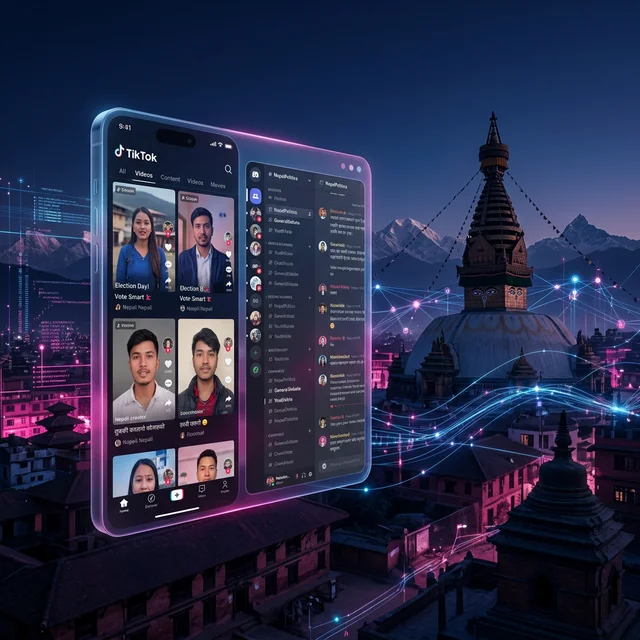
Nepal's 2026 Election: AI, Digital Warfare & Future Politics
Executive Strategic Assessment
The Convergence of Rage and Algorithms
As Nepal approaches the General Election scheduled for March 5, 2026, the nation finds itself at a historical inflection point where the mechanics of democracy are being fundamentally rewritten by the convergence of artificial intelligence, automated influence operations, and a radicalized youth demographic. The political landscape of early 2026 bears little resemblance to the electoral cycles of 2017 or 2022. The catalyst for this transformation—the “Gen Z Protests” of September 2025—did not merely topple the government of Prime Minister K.P. Sharma Oli; it dismantled the traditional axioms of Nepalese political campaigning.
This report offers a comprehensive analysis of the “phygital” (physical plus digital) campaigning ecosystem that has emerged from the ashes of the 2025 uprising. The analysis suggests that the upcoming election will be the first in Nepal’s history where the “digital battlefield” is not a supplementary theater but the primary domain of contestation. With internet penetration reaching 56% of individuals and cellular connections exceeding 109% of the population, the smartphone has replaced the party manifesto as the primary vector of political legitimacy.
Core Theses of the Report
The following strategic imperatives define the current electoral climate:
- The Automation of Influence: The 2026 cycle is characterized by the industrial-scale deployment of generative AI. From the weaponization of deepfakes targeting female leaders like Deputy Mayor Sunita Dangol to the sophisticated use of automated bot networks revealed by the Cyabra report, the information ecosystem has become a “hall of mirrors” where organic sentiment is indistinguishable from algorithmic manipulation.
- The Crisis of Technocratic Populism: The Rastriya Swatantra Party (RSP), once the vanguard of “digital democracy,” faces an existential identity crisis. Its recent decision to abandon app-based primary elections in favor of traditional candidate selection methods exposes the limitations of technocratic governance when confronted with the realities of political infiltration and rural patronage.
- The Bifurcation of the Electorate: A profound digital divide has created two distinct electorates. The urban voter in Kathmandu (80% connectivity) is engaged in a high-bandwidth war of memes and misinformation, while the rural voter in Karnali (14% connectivity) remains reliant on physical networks and traditional party machinery.
- The Youth Veto: The demographic weight of the 18–40 age cohort, combined with the “digital diaspora” of migrant workers, has established a de facto veto power over national politics. The violent rejection of the status quo in late 2025 proved that this demographic can no longer be managed through traditional co-optation strategies.
The Genesis of the Crisis: The September 2025 Uprising
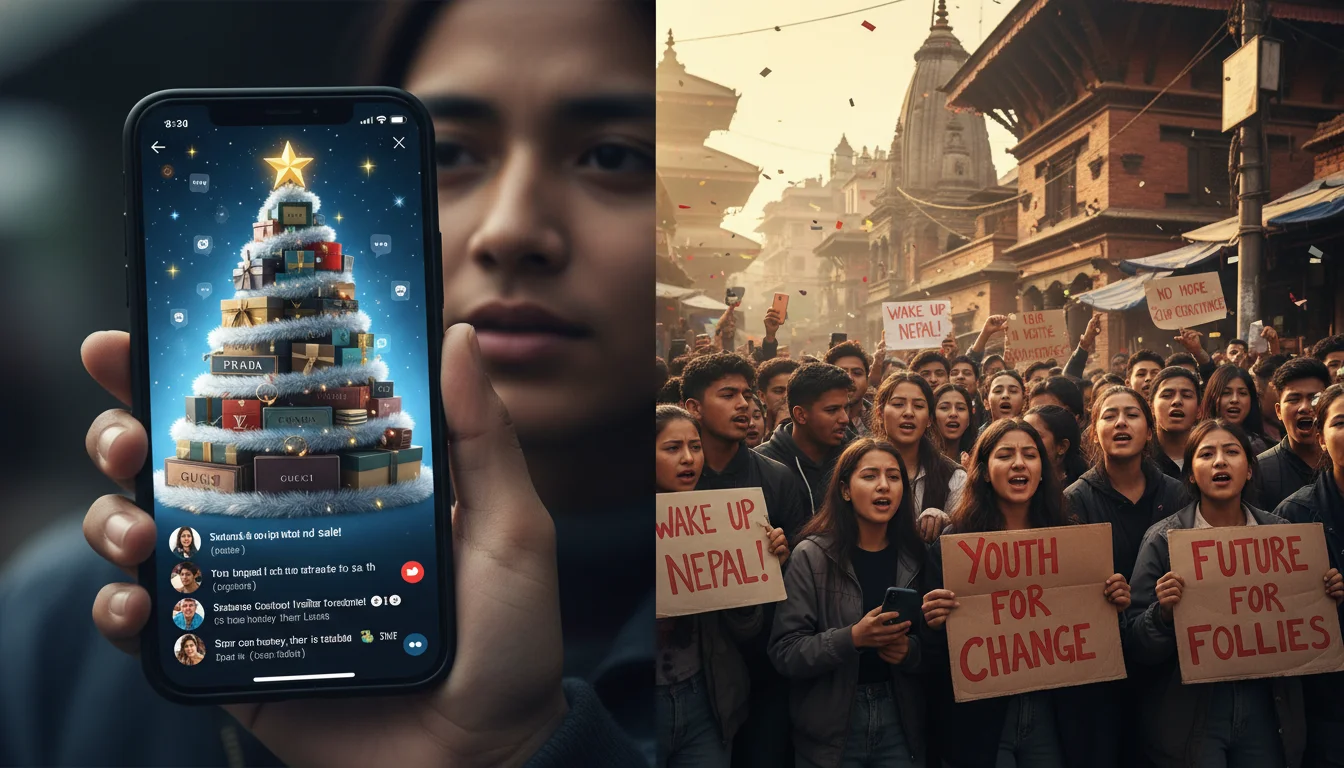
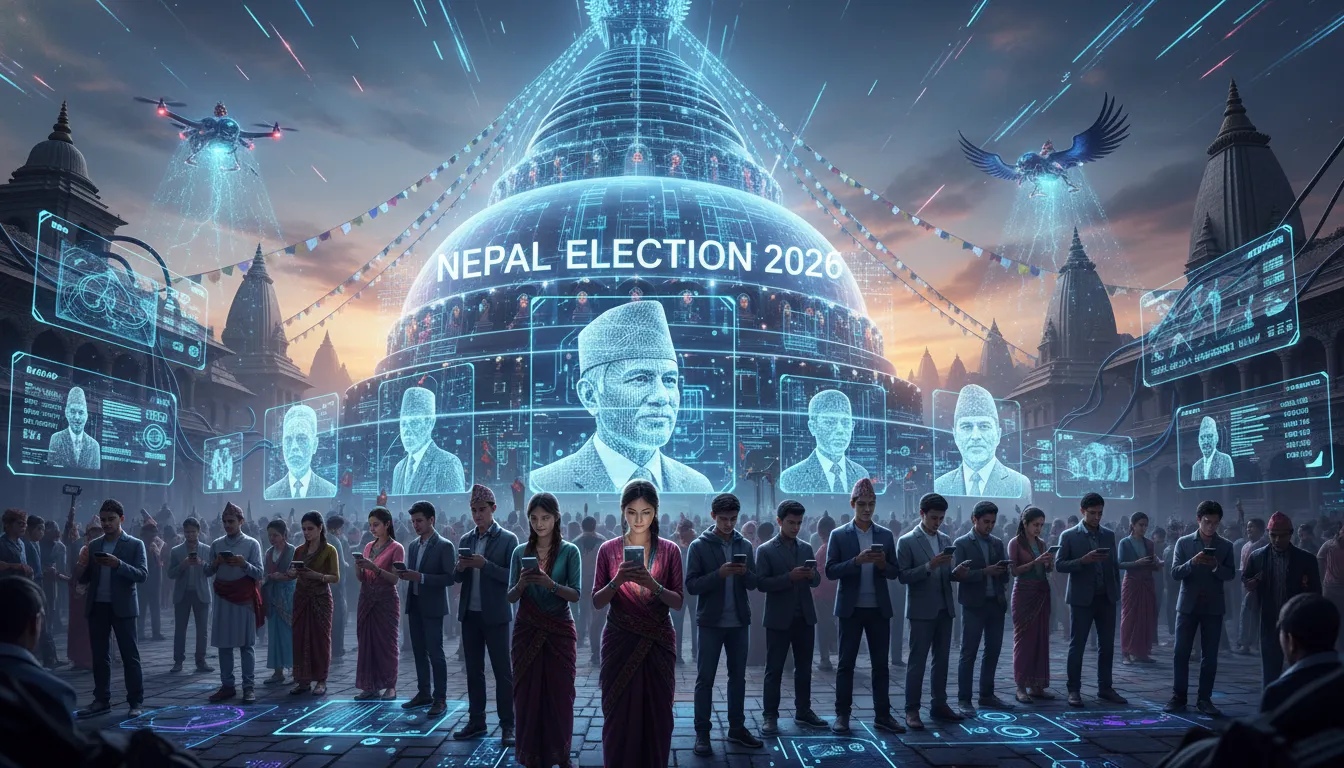
To understand the trajectory of the 2026 election, one must first reconstruct the seismic events of September 2025. These events serve as the “ground zero” for the current political atmosphere, establishing the grievances, the actors, and the tactics that will define the upcoming polls.
The “Christmas Tree” Catalyst
Revolutions in the digital age often begin with innocuous images that, when amplified by algorithms, become symbols of systemic rot. In Nepal, the spark was an Instagram post by Saugat Thapa, the son of a provincial minister, posing beside a Christmas tree constructed entirely of luxury-brand boxes. In a country where GDP per capita remains below $1,500 and inflation has eroded the purchasing power of the middle class, this image of conspicuous consumption by the political elite went viral.
It was not merely an image; it was a confirmation of the “kleptocratic consensus” that the youth believed governed Nepal. The image circulated rapidly on TikTok and WhatsApp, stripped of context but heavy with emotional resonance, becoming the visual banner for the “Enough is Enough” movement.
The Kinetic Escalation
The protests began as digital outrage but rapidly transitioned into kinetic violence, a shift that caught the security apparatus off guard.
- The Social Media Ban: In a fatal miscalculation, the Oli administration attempted to quell the unrest by imposing a blanket ban on social media platforms, including TikTok, Facebook, and WhatsApp. This move backfired catastrophically. Deprived of their digital vents, the youth poured into the streets.
- The Burning of Symbols: The violence was targeted and symbolic. Protesters did not just riot; they attacked the physical manifestations of state power. The Prime Minister’s Office—a 122-year-old palace—along with the Parliament building and the residences of party leaders, were set ablaze. The destruction of the “Singha Durbar” infrastructure signaled a total rejection of the political class.
- The Human Cost: The crackdown resulted in 74 deaths, including 19 protesters killed on September 8 alone. These deaths have become the “bloody shirt” of the 2026 campaign, with opposition parties and independent candidates framing the election as a referendum on state brutality.
The Interim Vacuum
The resignation of K.P. Sharma Oli and the appointment of former Chief Justice Sushila Karki as Interim Prime Minister created a unique political vacuum. The dissolution of the House of Representatives and the scheduling of elections for March 2026 reset the board. However, the psychological damage to the “Old Guard” parties (UML, Congress, Maoists) was immense. They entered the pre-election period not as incumbents or challengers, but as entities fighting for their right to exist in the eyes of a hostile generation.
The Digital Battlefield: Infrastructure and Demographics
The strategic environment of the 2026 election is defined by the capabilities and limitations of Nepal’s digital infrastructure. The campaign is being fought over a network that is simultaneously ubiquitous and deeply fractured.
The Infrastructure of Influence
Nepal’s telecommunications sector has matured to support high-intensity digital campaigning, but significant gaps remain that dictate a dual-track strategy for all parties.
| Metric | Statistic (Jan 2026 Est.) | Strategic Implication |
|---|---|---|
| Mobile Connections | 32.4 Million (109% of Pop.) | Saturation level coverage means SMS broadcasting and IVR (Interactive Voice Response) are the only universal campaign tools. |
| Internet Users | 16.6 Million (56% Penetration) | The “Digital Electorate” is a bare majority. 44% of the country is effectively “offline” regarding high-bandwidth propaganda. |
| Social Media Users | 14.8 Million (50% Penetration) | Social media is the “Public Square” for the decisive swing voters (youth), but irrelevant for the “fixed banks” of rural voters. |
| Urban Connectivity | ~79.3% (Kathmandu Valley) | Enables “First World” campaign tactics: Live streams, Zoom town halls, HD video deepfakes. |
| Rural Connectivity | ~14% (Karnali Province) | Requires “Third World” campaign tactics: Physical rallies, radio, wall paintings, door-to-door networks. |
The “Two Nepals” phenomenon is the central logistical challenge. A campaign manager in Kathmandu relies on algorithmic optimization of TikTok feeds, while a manager in Kalikot or Rolpa must rely on the physical mobilization of cadres. The danger for parties like the RSP is over-indexing on the former while neglecting the latter.
The Demographic “Youth Bulge”
The voter roll for 2026 includes approximately 18.9 million eligible citizens. The composition of this electorate is heavily skewed toward the youth.
- Gen Z (18–29): This cohort has known only the post-monarchy republic and is deeply disillusioned by its failure to deliver economic prosperity. They are the primary consumers of the “anti-system” narrative.
- The Digital Diaspora: Approximately 14% of the population works abroad, primarily in the Gulf, Malaysia, and Korea. These voters cannot cast ballots (absentee voting remains logistically difficult), but they are the financial and ideological engines of their families back home. A video watched by a migrant worker in Qatar is forwarded to their family group chat in Jhapa, influencing the votes of five to ten dependents. The “WhatsApp Election” is driven largely by this diaspora.
The AI Armaments: Generative Content and Algorithmic Influence
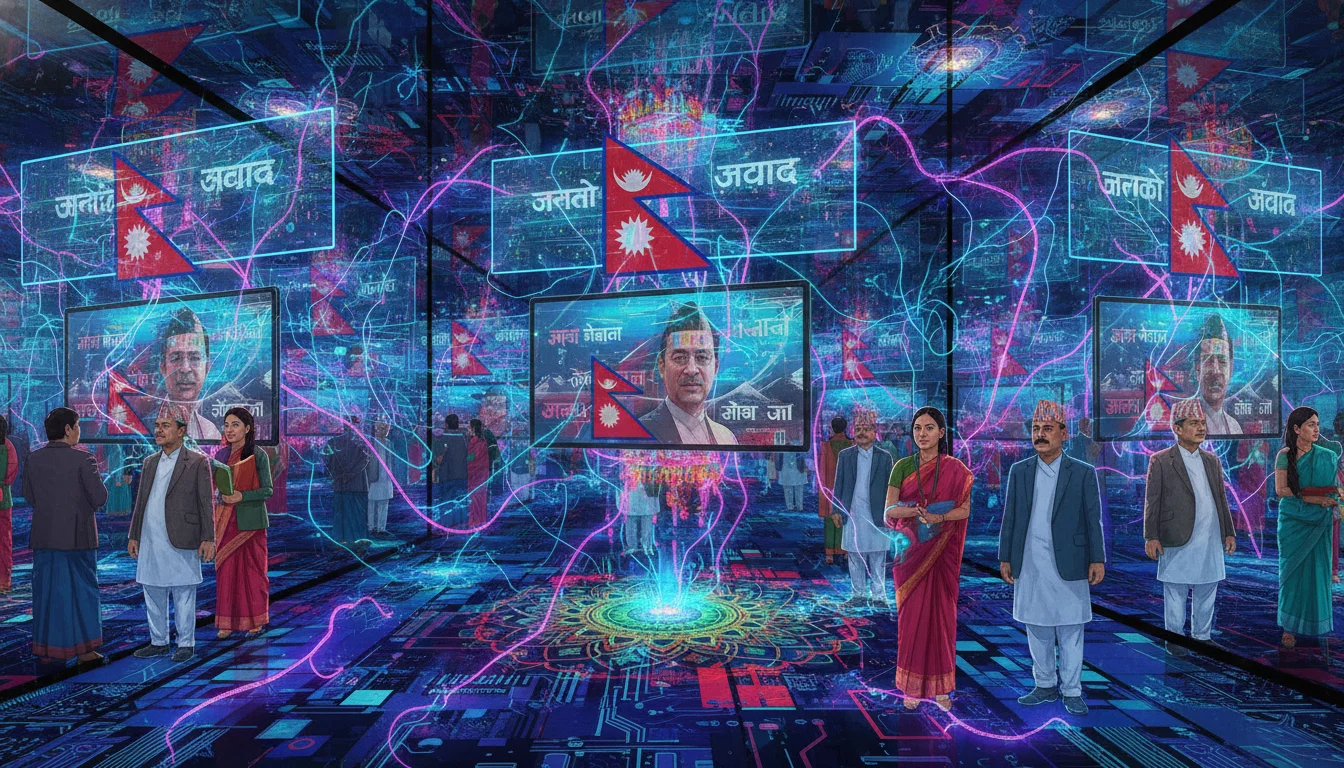
The 2026 election is distinguished by the weaponization of Artificial Intelligence. No longer the domain of sci-fi, AI tools have become the standard ammunition for political warfare in Nepal, lowering the cost of disinformation to near zero.
The Deepfake Epidemic: Gendered Political Violence
The most pernicious application of AI has been the targeted harassment of female politicians, creating a hostile environment that threatens to reverse gains in gender representation.
Case Study: The Sunita Dangol Incident
Kathmandu Deputy Mayor Sunita Dangol became the victim of a sophisticated “deepfake” campaign.
- The Mechanism: Perpetrators utilized readily available “nudify” apps and face-swapping algorithms to superimpose Dangol’s likeness onto pornographic material.
- The Distribution: The content was disseminated via encrypted channels on Messenger and WhatsApp, making it difficult for the Cyber Bureau to track the origin.
- The Strategic Intent: This was not random cyber-vandalism; it was a calculated attempt to delegitimize a rising female leader by attacking her through the lens of conservative morality.
It exploits the “purity culture” prevalent in parts of Nepalese society to render her politically radioactive.
- The Precedent: The incident mirrors similar attacks on Indian actress Rashmika Mandanna, indicating that regional bad actors are sharing techniques. The arrest of a suspect in Bajura demonstrates that the capability to produce such content has diffused from urban tech hubs to remote districts.
The Balen Shah Synthetic Media
Mayor Balen Shah has also been targeted by deepfake videos purporting to show him making controversial statements. For a populist leader whose authority is derived from “authenticity” and “speaking truth to power,” the existence of synthetic clips that mimic his cadence and voice undermines his primary asset. If voters cannot distinguish between the “Real Balen” and the “AI Balen,” his ability to mobilize the street is compromised.
Automated Influence: The Cyabra Report Controversy
The debate over the role of “bots” in the 2025 protests highlighted the fragility of the digital public sphere.
- The Findings: A report by the Israeli firm Cyabra analyzed the online discourse during the September protests and claimed that 34% of the profiles engaging with protest hashtags were inauthentic.
- The Implications: The report suggested that nearly one-third of the digital “rage” was manufactured. These accounts amplified hashtags like #NepalProtest and #SocialMediaBan, generating over 326 million potential views.
- The Local Pushback: Nepalese digital rights experts criticized the report, arguing that it conflated “youth coordination” with “bot behavior.” In a high-context culture like Nepal, authentic users often display repetitive behaviors (copy-pasting slogans, coordinated posting times) that algorithms might flag as inauthentic.
- The Consequence: Regardless of the truth, the narrative of “bot interference” has given political parties a pretext to dismiss genuine dissent as “foreign algorithms.” It has also incentivized all major parties to invest in their own “Cyber Circles” (organized digital wings) to counter-balance potential automated attacks.
Generative Propaganda
Beyond deepfakes, Generative AI is being used to flood the zone with synthetic propaganda.
- Visuals: AI image generators are producing hyper-stylized posters that depict candidates as heroic figures or opponents as demonic caricatures.
- Audio: AI-generated songs and jingles, customized for specific ethnic groups and languages (Maithili, Bhojpuri, Newari), are saturating TikTok feeds. The ability to clone the voice of a popular singer or leader allows for the mass production of “personalized” endorsements that never happened.
Party Strategies I: The Technocratic Challengers (RSP & Independents)
The Rastriya Swatantra Party (RSP), led by Rabi Lamichhane and bolstered by the alliance with Balen Shah, represents the “disruptor” faction. However, their strategy for 2026 reveals a tension between their digital ideals and the ruthless pragmatism required to win a general election.
The Unification of the “Outsiders”
The formal unification of the RSP with Kathmandu Mayor Balen Shah and the merger with Kulman Ghising’s patronage network (Ujyalo Nepal Party) has created a formidable “Super-Alliance.”
- Strategic Synergies: This merger combines RSP’s organizational structure with Balen’s immense personal popularity among the youth. Balen brings the “Lauro” (Walking Stick) legacy, although the fight for the symbol itself remains legally contentious with the Hamro Nepali Party.
- The “Gen Z Quota”: In a direct appeal to the protest demographic, the RSP has pledged a 27% reservation for Gen Z candidates in its proportional representation lists. This is a concrete policy designed to convert street rage into parliamentary seats.
The “Primary Election” Paradox
In a move that shocked its urban base, the RSP announced in January 2026 that it would abandon its app-based primary election system.
- The Original Promise: The RSP App was marketed as a tool for “Digital Democracy,” allowing verified members to vote directly for candidates. This was the party’s unique selling proposition (USP) against the nepotism of the Congress and UML.
- The Reversal: The party reverted to the traditional “recommendation method,” where district committees select candidates.
-
Analysis of the Pivot: This decision highlights the vulnerability of digital systems in high-stakes politics.
- Security Risks: The fear of rival parties (UML/Maoists) infiltrating the app with thousands of fake accounts to select weak candidates was likely deemed too high.
- The “Viral” Trap: App-based voting favors candidates with high social media followings but potentially low ground-game capability. By centralizing selection, the RSP leadership is prioritizing “winnability” over “digital purity.”
- Ranju Darshana’s Fall: The withdrawal of high-profile candidates like Ranju Darshana from the proportional list suggests internal friction between the “activist” wing and the “pragmatist” leadership.
The Digital Ecosystem
Despite the primary reversal, the RSP App remains a critical logistical tool. It is used for membership verification (over 241,000 members verified), donation collection, and disseminating talking points directly to cadres, bypassing the mainstream media.
Party Strategies II: The Digital Incumbents (UML & The Cyber Circle)
The CPN-UML, under the veteran leadership of K.P. Sharma Oli, has not ceded the digital ground to the youth parties. Instead, it has industrialized its online presence, treating the internet as a domain of warfare rather than just communication.
The “Cyber Circle” Doctrine
The UML has institutionalized its digital wing into the “Cyber Circle.” Unlike the loose volunteer networks of the RSP, the Cyber Circle operates with military discipline.
- Structure: It consists of a hierarchy of content creators, disseminators, and “defenders” tasked with swarming opposition narratives.
- Function: The Circle is deployed to amplify pro-UML hashtags and attack critics. In the 2026 cycle, their focus is on “narrative denial”—flooding platforms with content that questions the efficacy of the Gen Z protests or portrays the RSP as inexperienced amateurs.
The “Influencer Chairman”
K.P. Oli has cultivated a persona that transcends traditional politics. He was the first leader to unveil a manifesto digitally and maintains an active presence on TikTok (post-ban lifting) and Twitter.
- The “Ba” (Father) Brand: Oli’s digital content is curated to present him as the “Ba” (Father) of the nation—a figure of stability and wisdom amidst the chaos of youth rebellion. His tech-savviness is used to argue that “experience + technology” is superior to “youth + inexperience.”
- The “Agile” App: The UML utilizes internal apps (referenced in academic contexts as modeling efficient development like “Agile Beeswax”) to manage cadre deployment. This allows the central leadership to push talking points to the village level instantly, ensuring message discipline across the country.
Strategic Objectives
The UML’s strategy is “Digital Encirclement.” By dominating the algorithmic feeds with high volumes of content (both positive for UML and negative for opponents), they aim to create an “inevitability” about their return to power, leveraging their massive financial advantage to out-spend the RSP on ad placements and boosted posts.
Party Strategies III: The Analog Giants (Congress & Maoists)
The Nepali Congress (NC) and the CPN (Maoist Centre) face the most difficult path. Viewed by Gen Z as the architects of the current rot, they are struggling to bridge the gap between their analog legacy and the digital reality.
Nepali Congress: The Generational Civil War
The NC is paralyzed by an internal conflict between the “Old Guard” (Sher Bahadur Deuba) and the “Young Turks” (Gagan Thapa, Bishwa Prakash Sharma).
- The “Digital House”: Gagan Thapa has championed the “Digital House” initiative, an attempt to digitize the party’s membership and operations. The goal is to bring the party’s massive but disorganized base online.
- The Leadership Dispute: The struggle for control of the party—manifested in the suspension of Thapa and Sharma by the establishment faction—has spilled onto social media. The party is effectively running two campaigns: the official Deuba campaign (traditional, patronage-based) and the Thapa campaign (digital, reformist).
- Voter Outreach: The NC is aggressively targeting Gen Z with a pledge for 40% youth participation in committees, but their credibility is hampered by the visible infighting.
The Maoist Centre: The “Phygital” Awakening
The Maoist Centre, having lost its revolutionary luster, is attempting to pivot back to its roots while adopting digital tools.
- The “Tarai-Madhesh Awakening Campaign”: Launched in Jhapa, this campaign focuses on the Madhesh region. It blends the Maoists’ traditional strength—physical mobilization and protests—with digital broadcasting.
- The “Socialist Revolution” Narrative: The Maoists are using digital platforms to frame the election as a fight against “regressive forces” (monarchists and capitalists). However, their lack of a charismatic digital native leader (unlike Balen or Gagan Thapa) makes their content feel dated on platforms like TikTok, which favor individual authenticity over collective ideology.
Regulatory Frameworks and Failures
The rapid evolution of campaign technology has outpaced the regulatory capacity of the Nepalese state, creating a “Wild West” environment where rules exist on paper but are unenforceable in practice.
The National AI Policy 2025: A Paper Tiger?
The government approved the National AI Policy 2082 in August 2025.
- Ambitions: The policy aims to regulate AI usage, prevent deepfakes, and ensure data privacy. It establishes an “AI Governance Council” and mandates ethical guidelines for AI development.
- Realities: Critics argue the policy is a “paper tiger”. Nepal lacks the technical infrastructure and skilled manpower to enforce these regulations. There is no “algorithmic auditing” capability within the government to detect if a video is a deepfake or if a trend is bot-driven.
- Electoral Impact: In the context of the election, the policy is largely symbolic. By the time a violation is investigated and adjudicated, the viral damage is already done.
The Election Commission’s Struggle
The Election Commission of Nepal (ECN) has introduced the EIDC (Election Information Communication and Coordination Center) to monitor social media.
- The Code of Conduct: The ECN has banned the use of AI for misinformation and hate speech. However, the “No Not Again” campaign of 2022 showed the limits of ECN’s power. When a campaign is decentralized and anonymous, “banning” it is impossible.
- The Enforcement Gap: With 134,000 temporary police hired for physical security, the “Cyber Police” deployment remains minimal. The ratio of digital monitors to digital content is hopelessly skewed.
The Psychology of the Voter and the “Edit” Culture
The 2026 election is being fought in the cognitive domain of the voter. The psychology of the Nepalese electorate has been reshaped by the “Edit” culture of TikTok and Instagram Reels.
Context Collapse and the “Cool” Factor
In the era of short-form video, complex policy positions are flattened into 15-second “edits”—fast-paced montages set to trending music.
- The Metric: A candidate’s viability is increasingly judged by their “cool factor” in these edits. Balen Shah, with his sunglasses and rapper persona, fits this format perfectly.
- The Consequence: This favors populist rhetoric over substantive debate. A nuanced explanation of federal fiscal transfers creates zero engagement; a video of a leader shouting at a corrupt official goes viral instantly.
The Echo Chamber Effect
The algorithmic curation of content means that voters are increasingly living in mutually exclusive realities.
- The RSP Voter sees a feed dominated by videos of youth competence and old-party corruption.
- The UML Voter sees a feed dominated by images of Oli’s infrastructure projects and warnings about “anarchist” youth.
- The Result: Polarization is deepening. The “middle ground” of undecided voters is disappearing as algorithms push users toward the extremes to maximize engagement.
Security and Integrity: The Surveillance Dilemma
The intersection of digital campaigning and state security creates profound risks for the integrity of the election.
The Cyber Bureau’s Role
The Nepal Police Cyber Bureau has been deployed to monitor the election. While their mandate is to stop misinformation, there is a significant fear among civil society that this apparatus will be used for surveillance.
- The Precedent: The 2025 social media ban demonstrated the state’s willingness to censor digital speech to protect its interests.
- The Risk: “Monitoring” can easily slide into “Intimidation.” Independent candidates and activists fear that legitimate criticism of the interim government or the security forces will be flagged as “misinformation” or “cybercrime.”
Foreign Interference
The Cyabra report’s findings of “inauthentic behavior” raise the specter of foreign interference. In a geostrategically sensitive nation like Nepal, sandwiched between China and India, the digital space is a prime vector for external actors to shape the narrative. Whether through bot farms or funded propaganda, the “sovereignty” of the Nepalese digital space is under threat.
Scenarios for March 2026
Based on the current trajectory, three scenarios emerge for the upcoming election:
Scenario A: The “Digital Sweep” (High Probability)
The RSP/Balen alliance leverages the youth anger and superior digital strategy to secure a plurality of seats. The “Deepfake” attacks backfire, generating sympathy for the targeted candidates. The voting patterns show a massive divergence: urban centers go 70%+ for the new parties, while rural areas remain fragmented.
- Result: A hung parliament, but with the youth parties holding the balance of power.
Scenario B: The “Empire Strikes Back” (Medium Probability)
The UML’s “Cyber Circle” successfully floods the zone with negative narratives about the RSP’s inexperience. The cancellation of the RSP primary is weaponized to paint them as “just another party.” The rural vote, mobilized by physical patronage and untouched by the digital war, overwhelms the urban vote.
- Result: A return to a UML-led coalition, followed by immediate digital unrest.
Scenario C: The “Cyber-Chaos” (Low Probability but High Impact)
A massive, last-minute deepfake scandal (e.g., a fake video of a leader inciting violence) triggers real-world riots just days before the election. The ECN is forced to suspend polling in key districts. The legitimacy of the entire result is questioned, leading to a prolonged constitutional crisis.
Conclusion
The 2026 General Election in Nepal marks the transition from “door-to-door” to “device-to-device” politics. The “Algorithmic Ballot” has arrived. The parties that succeed will be those that can master the paradox of the age: using the artificial tools of AI to manufacture the feeling of authentic connection.
The “Gen Z Protests” of 2025 proved that the youth possess the power to disrupt the physical world through digital coordination. Now, the question is whether that disruptive energy can be translated into governance. The RSP’s retreat from digital primaries suggests that even the disruptors are finding that “democracy by app” is harder than it looks. Meanwhile, the incumbents are arming themselves with the very tools that sought to destroy them.
As the deepfakes proliferate and the bot armies march, the ultimate casualty may be the shared concept of truth itself. In the Algorithmic Republic, reality is just another edit.
Related Resources
- Digital Marketing Strategy Template for Nepali Businesses
- Google Ads Cost in Nepal: Complete Breakdown
- Facebook Ads vs TikTok Ads for Local Businesses
- Content Marketing Services in Nepal
Need Strategic Support?
If you want help turning these insights into an actionable growth plan, contact Arjan KC for consulting, campaign strategy, and team training.