How to Start a Career in SEO: A Step-by-Step Guide
People often ask me how to get into SEO when they have no marketing degree, no contacts and no experience. The good news is that SEO is one of the most open fields in digital marketing. There is no licence, no mandatory degree and no official certification. The bad news is that it is easy to waste months on tutorials without ever building real skill.
This guide gives you a step-by-step path that works for beginners in Nepal: what to learn, in what order, how to practise and how to turn practice into your first job.
About the author: I am Arjan KC, a digital marketing expert in Kathmandu and co-founder of Gurkha Technology. I plan and run SEO alongside paid, social, content and analytics work for clients, and I teach SEO in my university courses. Results from client work are published on our case studies page.
Step 1: Understand what SEO actually is
Google describes SEO as helping search engines understand your content and helping users find your site and decide whether to visit it. It is honest about the limits: “There are no secrets here that’ll automatically rank your site first in Google” (Google SEO Starter Guide).

That framing matters for your career. An SEO’s job is not to trick an algorithm. It is to make a website easier to crawl, more useful for the people searching and more trustworthy than the alternatives, then measure the result.
Step 2: Learn from primary sources first
Most SEO advice online is opinion. Start with the official documentation and you will know more than many people who call themselves experts.
- Google SEO Starter Guide: the foundations of crawling, indexing, titles, links and content.
- Google Search Essentials and spam policies: what Google allows and what gets sites penalised. The starter guide notes, for example, that keyword stuffing is against Google’s spam policies.
- Do you need an SEO?: Google’s own description of what good SEOs do, which doubles as a job description.
Once you know the official position, blogs and courses become much easier to judge.
Step 3: Learn the core skill areas
SEO work falls into a handful of areas. You need a working knowledge of all of them before you specialise.
| Skill area | What it covers |
|---|---|
| Research | Keyword research and search intent |
| On-page | Titles, headings, content structure, internal links and images |
| Technical | Crawling, indexing, site speed, mobile usability and structured data |
| Content | Helpful, original pages that show experience and E-E-A-T |
| Off-page | Earning links and mentions from other sites |
| Local | Google Business Profile, reviews and local citations |
| Measurement | Search Console, analytics and reporting |
My university course covers these in a single session on SEO and content architecture, followed by a full technical SEO audit toolkit. Both are free to read.
Step 4: Build your own practice website
This is the step most beginners skip, and it is the one that matters most. Reading about SEO without a site is like learning to drive from a book.
- Pick a small niche you care about: trekking routes, Nepali recipes, phone reviews, exam preparation or a local business you know.
- Launch a simple site on WordPress or a static site builder with your own domain.
- Connect Google Search Console and analytics on day one.
- Publish 10–20 genuinely useful pages targeting specific questions people search for.
- Keep a change log: what you changed, when and why.
Google says some changes take a few hours to show, others several months, and that you should usually wait a few weeks before judging whether a change helped (Google SEO Starter Guide). Your change log turns that waiting into evidence.
Step 5: Learn the free tools
You do not need expensive subscriptions to start:
- Google Search Console: queries, clicks, indexing and page experience
- Google Analytics 4: what visitors do after they arrive
- Bing Webmaster Tools: a second view of how a search engine sees your site
- Google Keyword Planner: search volume ranges and keyword ideas
- PageSpeed Insights: speed and Core Web Vitals
- A site crawler with a free tier: to find broken links, missing titles and redirect chains
Google also warns that it does not evaluate or endorse third-party SEO tools, and that those tools have no access to its internal ranking data (Google). Treat tool scores as hints, not truth.
Step 6: Learn the Nepal-specific details
If you plan to work for Nepali businesses, a few things set this market apart:
- Three ways of searching: English, Nepali in Devanagari and romanised Nepali. Keyword research needs to cover all three.
- Local SEO matters a lot. Many clients are clinics, schools, restaurants and shops in specific cities. Learn Google Business Profile well. My local SEO beginner’s guide for Nepal is a good place to start.
- Mobile first. Many of your users will search on phones, often on slower connections, so speed and simple layouts matter.
- Enquiries happen on chat. Many leads arrive on WhatsApp, Viber or phone calls, so learn to track those, not just form fills.
For the bigger picture of how SEO fits with other channels here, see my SEO in Nepal guide.
Step 7: Understand AI search without the hype
AI answers in search are changing how people click, and clients will ask about it. Google now lists optimizing for generative AI among the services SEOs provide, and advises checking that any “AEO” or “GEO” advice aligns with its official guidance (Google). In practice, the foundations still apply: crawlable pages, clear structure, original expertise and a trusted brand. Learn those well before chasing new acronyms.
Step 8: Get your first real experience
Once your own site has some traction, apply your skills to someone else’s:
- Volunteer or offer a low-cost audit to a local business, NGO or friend’s shop, in exchange for permission to use the work in your portfolio.
- Apply for internships at agencies and in-house marketing teams.
- Take small freelance tasks such as on-page fixes, Google Business Profile setup or content briefs.
Always get written permission before publishing anything about a client, and never claim results you cannot show.
Step 9: Build a portfolio that proves skill
Employers in Nepal increasingly hire on evidence. A strong beginner portfolio includes:
- Your practice site, with Search Console screenshots showing growth from a dated baseline.
- One full SEO audit of a real site, with prioritised recommendations.
- One keyword and content plan for a business.
- A short write-up of a mistake you made and how you fixed it.
Honest numbers matter more than big ones. Going from 0 to 300 monthly clicks on a site you built yourself, with screenshots, is far more convincing than a vague claim about “ranking clients on page one”.
Step 10: Apply for SEO jobs
Common entry-level titles include SEO intern, SEO executive, SEO content writer and digital marketing executive with SEO duties. Expect interview tasks such as auditing a page, writing a title and meta description, explaining why a page is not indexed or reading a Search Console report.
For realistic salary ranges in Nepal and what employers test, read my digital marketing career and salary guide. Once you have a couple of years of experience, my guide to becoming a remote global SEO specialist covers the next stage.
A six-month roadmap
- Month 1: read Google’s documentation, learn basic HTML and launch your site.
- Month 2: keyword research, on-page SEO and your first 10 pages.
- Month 3: technical SEO, Search Console and fixing what you find.
- Month 4: local SEO and your first outside project.
- Month 5: link earning, content updates and reporting.
- Month 6: finish your portfolio and start applying.
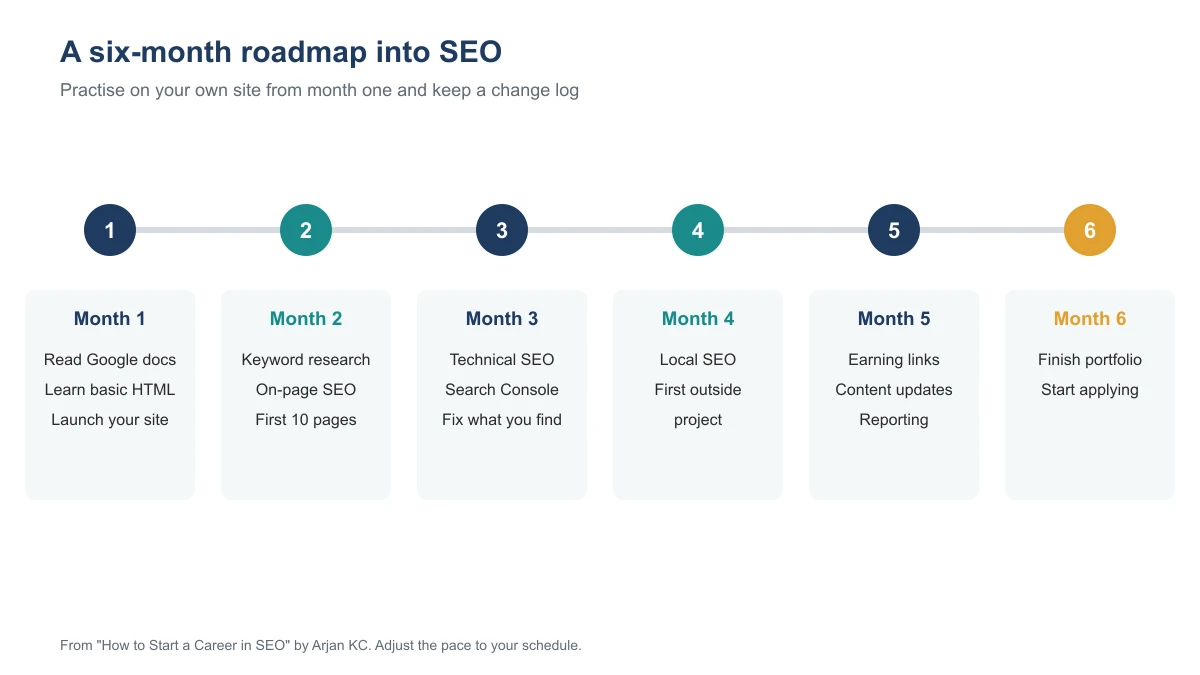
Roadmap: adjust the pace to your schedule, but keep practising on your own site from month one.
Ethics: what not to do
Google says no one can guarantee a number-one ranking and warns against anyone who claims a “special relationship” with Google. It also notes that unethical techniques can get a site demoted or removed from the index (Google). Do not promise rankings, buy links or copy content. A reputation for honest reporting will carry your career much further than any shortcut.
Sources
- Google Search Central, SEO Starter Guide
- Google Search Central, Do you need an SEO?


