Overcoming Graph API Deployment & Token Pain Points
Bridging the Graph API: Pain Points in Custom Content Deployment
The contemporary landscape of social media application programming interfaces represents a highly fragmented, tightly regulated, and technologically disparate ecosystem. For systems architects, automation engineers, and developers attempting to bridge local development environments with global social platforms, the concept of a unified, “write-once, publish-anywhere” deployment pipeline is a persistent illusion. Major platforms—including Meta (Facebook, Instagram, Threads), LinkedIn, X (formerly Twitter), TikTok, and YouTube—have diverged significantly in their architectural approaches to authentication, permission scopes, media ingestion, and state management.

Connecting local automation tools to these global platforms requires navigating a labyrinth of short-lived tokens, asynchronous container-based publishing flows, resumable chunked video uploads, strict rate limits, and complex webhook tunneling. This report provides an exhaustive analysis of the technical nuances involved in custom content deployment, dissecting the underlying architectures of major social network APIs and outlining the strategies required to maintain stable, resilient connections between local staging systems and global production feeds.
The Architecture of Authentication and Token Lifecycles
The foundational challenge of any API integration is establishing and maintaining a secure, authorized connection. While OAuth 2.0 has become the industry standard, its implementation across different platforms exhibits significant variance. The evolution of API security has profoundly impacted token longevity, refresh mechanisms, and local credential storage.
The Deprecation of Perpetual Access
Historically, developers relied on scopes such as offline_access to generate non-expiring tokens, allowing local automation scripts to run indefinitely in the background without requiring recurring user intervention. However, security paradigms have shifted dramatically in recent years. Platforms have systematically deprecated perpetual tokens to minimize the attack surface of compromised credentials, forcing developers to build active state management into their systems.
Meta, for example, completely removed the offline_access permission, replacing it with a rigid system of short-lived and long-lived access tokens. The standard procedure now requires an application to exchange a short-lived user token—valid for merely one to two hours—for a long-lived user token via the /oauth/access_token endpoint using the fb_exchange_token grant type. This long-lived user token, which remains valid for 60 days, must then be used to query the /accounts endpoint to retrieve a Page Access Token. While Page Access Tokens inherit the 60-day expiration, they can be programmatically refreshed if the user interacts with the application again, or via automated refresh HTTP calls prior to their expiration.
The second-order insight derived from this shift is that local environments must transition from utilizing static configuration files to deploying dynamic, stateful credential management systems. Automation tools cannot simply store a string in an environment variable; they must actively monitor token lifecycles, parse the exp (expiration) claims within JSON Web Tokens (JWTs), and execute refresh workflows before expiration to prevent silent pipeline failures. Furthermore, industry best practices dictate that these tokens must be encrypted at rest using algorithms such as AES-256-GCM, and only decrypted server-side at the exact moment an API call is dispatched.
Token Rotation Disparities Across Platforms
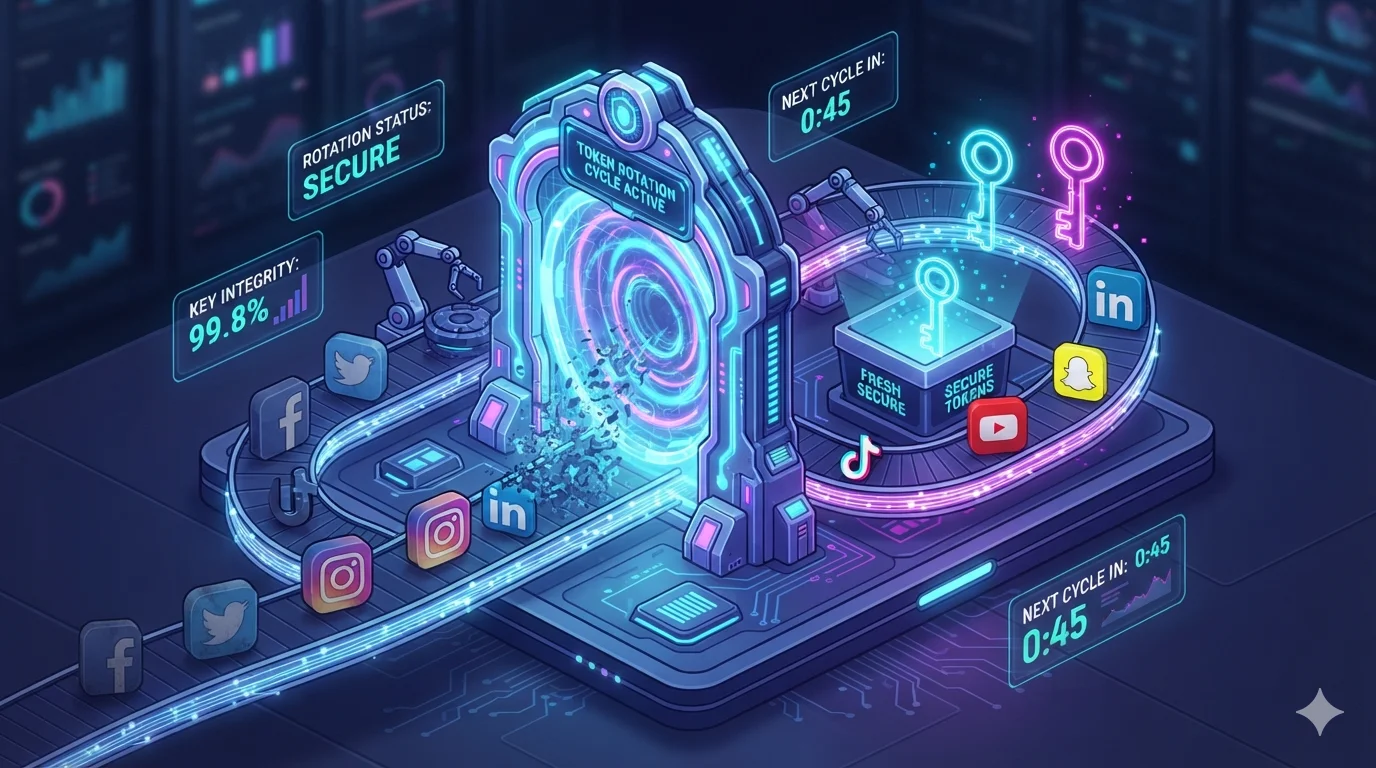
The requirements for maintaining active sessions vary drastically by platform, necessitating robust, cron-driven token rotation architectures tailored to each network’s specific idiosyncrasies.
| Platform | Authentication Standard | Standard Token Lifespan | Refresh Token Lifespan | Automated Refresh Protocol |
|---|---|---|---|---|
| Meta (Instagram/FB) | OAuth 2.0 | 60 days (Long-lived) | N/A (Tokens are extended) | Graph API refresh endpoint via HTTP GET |
| TikTok | OAuth 2.0 (PKCE) | 24 hours | 365 days | Standard refresh via grant_type=refresh_token |
| OAuth 2.0 / OpenID | 60 days | 365 days (Only for MDP Partners) | Manual re-authentication required for consumer apps | |
| X (Twitter) | OAuth 2.0 (PKCE) / 1.0a | 2 hours | 6 months | Refresh requires specific offline.access scope |
| YouTube | OAuth 2.0 | 1 hour | Indefinite (until revoked) | Standard Google Auth token exchange |
LinkedIn presents a unique architectural anomaly within this ecosystem. While LinkedIn issues 60-day access tokens, it explicitly denies programmatic refresh tokens to standard developer applications unless they have been formally approved as Marketing Developer Platform (MDP) partners. For custom local environments, internal agency tools, or bespoke automation scripts lacking this enterprise MDP status, the OAuth pipeline will catastrophically fail every 60 days.
Architecting a solution around this limitation requires deploying serverless re-authorization flows. A proven paradigm involves utilizing cloud-based event schedulers to trigger a weekly check of the token’s expires_at timestamp stored in a secure cloud vault, such as AWS Secrets Manager. If the token approaches within 14 days of expiration, the system dispatches an automated alert containing a pre-signed URL. Clicking this URL routes a human operator through a serverless function that initiates the three-legged OAuth code flow, captures the authorization redirect at a callback endpoint, exchanges the code for a new 60-day token via grant_type=authorization_code, and automatically updates the secure vault. This architecture reduces a highly disruptive, hard-coded failure into a streamlined maintenance task.
Conversely, X (formerly Twitter) introduces its own complexities heavily tied to its aggressive migration from API v1.1 to v2. For automated posting under the modern API, X requires OAuth 2.0 with Proof Key for Code Exchange (PKCE). Securing a refresh token on X is not a default behavior; it requires the developer to explicitly request the offline.access scope during the initial authorization URL generation. Failing to include this specific string in the scope array results in tokens that die permanently after two hours, breaking local automation pipelines instantly.
Navigating Granular Permission Scopes and App Review Horizons
Securing an access token is only the preliminary step; the token must carry the precise, granular permission scopes required for the intended operation. The modern social API architecture utilizes highly fragmented scopes to enforce the principle of least privilege, severely complicating the transition from local testing to global deployment due to rigorous platform review mechanisms.
The Fragmentation of Permission Scopes
A single missing scope can result in a generic HTTP 403 Forbidden error or an HTTP 401 Unauthorized error, which are frequently misdiagnosed by developers as invalid tokens rather than under-privileged ones. The exact string arrays required for basic content publishing reveal the complexity of cross-platform integration.
- For Meta’s Instagram Graph API, publishing requires the instagram_business_basic scope merely to fetch the target account IDs, followed by the instagram_business_content_publish scope to actually create and publish media containers. If the local system also intends to read comments or track post metrics, it must additionally secure pages_read_engagement and instagram_manage_comments.
- Threads, while owned by Meta, exists as a distinct API entity requiring threads_basic and threads_content_publish; an Instagram token cannot be used to post to Threads, necessitating parallel OAuth flows and token storage mechanisms for both platforms.
- X (Twitter) API v2 presents a particularly insidious scope trap for local developers building visual content pipelines. While basic text posting requires the tweet.write scope, uploading binary images or videos requires the distinct media.write scope. Native integrations in low-code automation tools often default to requesting only tweet.write. Consequently, when developers attempt to attach binary media payloads, the API rejects the request with a 403 Forbidden error. The solution requires explicitly passing the exact space-delimited string: tweet.read tweet.write users.read media.write offline.access.
- LinkedIn has completely overhauled its scope requirements in recent API versions. Modern authentication requires OpenID Connect scopes, specifically openid, profile, and email for basic identity verification, alongside w_member_social for publishing to personal profiles or w_organization_social for company pages. Furthermore, LinkedIn mandates that all API requests include a strict versioning header (e.g., LinkedIn-Version: 202602).
- TikTok’s Content Posting API requires video.upload and video.publish scopes for ingestion, with an optional video.list scope required to retrieve post-deployment analytics.
The Application Review Paradox
The third-order implication of strict permission scopes is the mandatory application review process. A local script interacting with the Graph API works flawlessly for the developer’s own administrative accounts. However, deploying it for client accounts, or building a cross-tenant architecture, triggers intense platform review mechanisms designed to prevent automated spam.
TikTok employs a highly restrictive dual-audit system that gates production access.
The initial “Upload” audit grants the application the ability to push files into a user’s TikTok inbox as a draft, effectively forcing the privacy level to SELF_ONLY. This requires the user to open the mobile application to manually publish the content. Only after an application passes a secondary, rigorous “Direct Post” audit can it utilize the video.publish scope to push video directly to the public feed with a PUBLIC_TO_EVERYONE flag. This review process typically spans two to six weeks, requiring extensive documentation of data handling practices.
Meta’s Review Paradox for Local Automation
Meta’s review process introduces a profound paradox for backend-only local automation tools. The review requires the submission of a screencast demonstrating the exact UI flow where an end-user grants the requested permission, alongside legal business verification. Developers building headless Node.js scripts or API-driven event pipelines must frequently build superficial mock user interfaces or staging environments solely to satisfy the visual requirements of Meta’s human reviewers, as they cannot submit a video of a terminal executing a cURL command.
Architectures of Media Ingestion: URLs, Binaries, and Chunking
The most technically demanding aspect of bridging local environments to social media APIs is the transmission of rich media. Social networks must process petabytes of incoming media daily, leading to the development of asynchronous, containerized, and chunk-based upload architectures explicitly designed to protect the platform’s infrastructure. These designs, however, shift the immense burden of state management, fault tolerance, and network reliability directly onto the local developer.
The Container-Based Asynchronous Model
Historically, APIs accepted a single synchronous HTTP POST request containing both the post text and a multipart binary payload. Meta has aggressively deprecated this approach for Instagram and Threads in favor of a two-step, container-based asynchronous model. This separation of media ingestion from publication allows Meta’s backend to process, transcode, and validate the media—checking H.264 codecs, scanning for copyright violations, and optimizing for dynamic bandwidth—without holding an HTTP connection open, which would otherwise lead to massive server-side connection exhaustion.
- 1. Container Creation: The local client initiates the process by sending a POST request to the media endpoint. Rather than passing a binary file, the payload typically contains an image URL or video URL, which must point to a publicly accessible HTTPS endpoint, along with the caption. Meta’s servers asynchronously fetch the media from the provided URL. This request immediately returns a creation ID. If the container is not published within 24 hours, it expires and is purged from Meta’s cache.
- 2. Status Polling: For video content, transcoding is not instantaneous. The local script cannot immediately publish the container. It must initiate a rigorous polling loop, sending GET requests to the container ID status field. The developer must implement exponential backoff, querying the endpoint every 30 to 60 seconds. The status will transition from IN_PROGRESS to FINISHED. If the script attempts to publish before the finished state is reached, the API throws an HTTP 400 error.
- 3. Publication: Once the polling loop confirms the finished state, a final POST request is sent to the media publish endpoint containing the creation ID, effectively pushing the content to the live feed.
If the content is a carousel, the architectural complexity multiplies. The local client must iterate through the media array, creating an individual container for every image or video and explicitly flagging each payload as a carousel item. The system must wait for all child containers to finish processing, construct a parent container with the media type CAROUSEL that references the comma-separated list of child IDs, and finally publish the parent container.
The URN-Based Direct Binary Upload
LinkedIn rejects the public URL fetching model, preferring direct binary uploads, but relies on a complex, three-step Uniform Resource Name (URN) resolution system.
- 1. Register the Upload: A POST request is sent to the assets endpoint. The payload must define the precise digital media recipe (e.g., feedshare-image or feedshare-video) and the owner’s URN. LinkedIn responds with a dedicated upload URL and a unique asset URN.
- 2. Binary PUT: The local client executes an HTTP PUT directly to the provided upload URL, sending the raw binary file as the request body. Critical to this step is setting the exact Content-Type header and including the Authorization Bearer token. Failure to define the MIME type accurately results in corrupt uploads that return 201 Created but fail to render.
- 3. Share Creation: Once the binary PUT request succeeds, the client sends a final POST request to the posts endpoint, embedding the asset URN in the media array alongside the text commentary.
Resumable and Chunked Upload Protocols
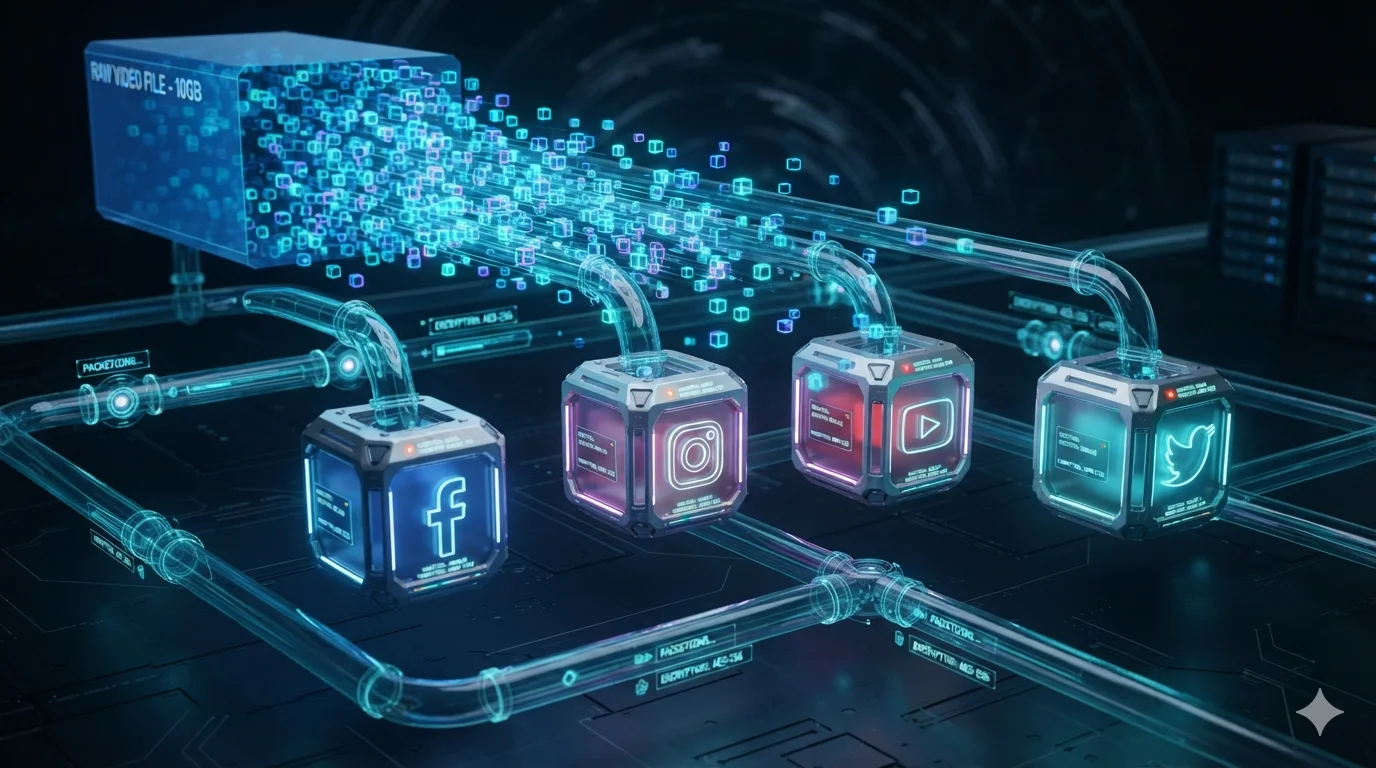
For massive video files—such as the 1GB limits permitted on TikTok, or lengthy YouTube uploads—standard HTTP POST requests are highly susceptible to packet loss and network interruptions. To guarantee delivery, local environments must utilize resumable, chunked upload protocols.
Meta’s Resumable Flow: When providing a public URL is not feasible (e.g., files generated locally on a secured machine without a public CDN), Instagram supports a resumable upload protocol.
- The client creates a container by POSTing to the media endpoint with the specific payload “upload_type”: “resumable”.
- Meta returns a container ID. The client then streams the raw video binary to a specific domain.
- This HTTP request requires precise header manipulation: Authorization, offset (or the exact byte offset if resuming a broken connection), and file size representing the total bytes of the file. Any discrepancy in the headers results in the connection terminating with a ProcessingFailedError.
X (Twitter) API Chunked Uploads: X requires a distinct three-phase upload sequence for any media exceeding 5MB. The pipeline requires an INIT command declaring the total byte size and media type, which returns a media ID. This is followed by an APPEND command where the file is uploaded in sequential chunks via multipart/form-data. Finally, a FINALIZE command tells X to stitch the chunks together and process the video. The resulting media ID is then attached to the standard tweet creation endpoint.
YouTube Data API v3 and Cloudflare tus: YouTube’s Data API relies on Google’s standard resumable media protocol. By requesting a resumable session URI, the client uploads the file in explicit chunks, which must mathematically be multiples of 256 KiB. The client dictates the chunk range using the Content-Range header. If a 503 Service Unavailable or network drop occurs, the client queries the session URI to determine precisely how many bytes were successfully committed and resumes uploading from the exact next byte without restarting.
Similarly, infrastructure APIs like Cloudflare Stream utilize the open-source tus protocol for resumable uploads, enforcing the same 256 KiB divisibility rule and requiring a minimum chunk size of 5 MB.
The critical architectural takeaway is that local automation tools cannot rely on simple HTTP clients to handle video distribution. They must integrate sophisticated upload managers capable of slicing binary buffers, dynamically calculating byte offsets, parsing network drops, and executing resume logic without corrupting the media stream.
Media Specifications and Formatting Anomalies
Local systems must relentlessly preprocess media to meet precise platform specifications before attempting an upload, as social APIs will aggressively reject non-compliant files, consuming API quota without yielding a post.
| Platform | Supported Formats | Max File Size | Duration Limits | Unique API Requirements & Constraints |
|---|---|---|---|---|
| Instagram Reels | MP4, MOV (H.264) | 1 GB | 3 sec to 15 min | Requires thumb_offset for cover frames. Aspect 9:16. |
| TikTok | MP4, MOV, WEBM, AVI | 1 GB | 3 sec to 10 min | Must query creator’s info for privacy levels before upload. |
| YouTube | MP4, AVI, MOV, etc. | 256 GB | 12 hours | Videos less than 60s with vertical aspect are auto-routed to Shorts. |
| X (Twitter) | MP4 (H.264), GIF, JPG | 512 MB (video) | 140 seconds | Requires media.write scope. 280 char text limit. |
| MP4, JPG, PNG | 200 MB (API) | 3 sec to 15 min | Carousel posts must be uploaded as single PDF documents. |
A highly disruptive anomaly exists within LinkedIn’s API regarding carousels. Unlike Instagram, which natively links multiple image containers via JSON arrays, LinkedIn’s API treats carousel posts as document uploads. Therefore, a local automation tool looking to cross-post a 5-image carousel must send five distinct image containers to Meta, but must programmatically stitch those same five images into a single, paginated PDF document before executing the URN upload flow for LinkedIn. This requires the local environment to maintain robust image processing and PDF generation libraries.
Maintaining State: Webhooks and Local-to-Global Tunnels
Because social media APIs are inherently asynchronous, relying purely on polling loops is inefficient, highly latency-prone, and rapidly consumes valuable rate-limit quotas.
Webhooks allow the global platform to push state changes (e.g., post.published, media.failed, or real-time incoming direct messages) back to the local architecture. However, routing a public HTTP POST request from Meta’s global infrastructure into a local development environment (which sits protected behind a NAT firewall or corporate router) introduces severe networking challenges.
Tunneling Architectures: ngrok vs. Cloudflare Tunnel
To bridge this local-to-global gap, developers rely on secure tunneling services. The choice of tunnel significantly dictates the efficiency of the development workflow.
- ngrok: Historically the default standard, ngrok provides an instant, secure HTTP tunnel, invoked via a simple command like ngrok http 3000. Its paramount advantage for API integration is its local web inspection interface, which captures every incoming webhook request, displaying full headers, JSON payloads, and the local server’s HTTP response. Crucially, it allows developers to “Replay” webhooks, meaning they can iteratively rewrite and debug their local event handlers without having to repeatedly trigger the live event on the actual social platform. However, ngrok’s free tier has become restrictive, assigning randomized subdomains upon every restart. This requires the developer to continually update the webhook callback URL and re-verify tokens (e.g., updating the IG_VERIFY_TOKEN logic) in the Meta or LinkedIn developer portals, adding massive friction to the testing cycle.
- Cloudflare Tunnel (cloudflared): Operating via an outbound-only connection to Cloudflare’s edge network, this architecture completely masks the local IP while bypassing inbound firewall restrictions. Its massive advantage for social API development is the provision of free, persistent custom domains. Initiated via commands like cloudflared tunnel run dev-localhost, a static URL (e.g., api-dev.yourdomain.com) remains routed directly to localhost:3000 indefinitely. This allows the webhook callback URL to remain static in the developer portal across machine restarts. The downside is the lack of built-in payload inspection and replay capabilities, requiring the developer to build complex logging directly into their local application to view payload structures.
The Meta Development Mode Paradox
A profound architectural frustration exists within Meta’s webhook ecosystem, widely referred to as the Development Mode Paradox. When testing a Facebook application locally, Meta allows test webhooks for standard Messenger events. However, Meta intentionally disables webhook delivery for Instagram products (such as DMs, comments, or story mentions) when an app is in “Development Mode”.
Therefore, a local developer attempting to build an automated Instagram DM response system via an ngrok tunnel will find that the webhook never fires, even when the Page and Instagram account are correctly linked, tokenized, and the IG_VERIFY_TOKEN endpoint returns a 200 OK. To receive actual Instagram webhooks, the application must pass App Review and be switched to “Live Mode”. This forces developers to utilize mock servers or manual HTTP POST tools (like Postman) to simulate Meta’s payload structures locally. They must blindly build their webhook handlers based on documentation, submit the app for review based on mocked data, and only discover integration bugs once the app is live.
Idempotency, Network Resilience, and Rate Limit Engineering
When a local environment dispatches a publish command to a global API, the network is fundamentally unreliable. The connection may drop, the API may return a 503 Service Unavailable, or a 504 Gateway Timeout may occur after the platform has actually initiated the post creation.
If the local automation script reacts to a timeout by blindly retrying the POST request, the outcome is catastrophic for social media management: duplicate posts flooding a brand’s timeline, severely damaging algorithmic reach and user trust.
The Criticality of the Idempotency-Key
To solve this, robust social API pipelines implement the concept of idempotency. An idempotent operation is one that can be applied multiple times without changing the result beyond the initial application. While HTTP PUT and DELETE are natively idempotent by RFC standards, HTTP POST (the universal standard for creating posts and uploading media) is not.
To force idempotency on POST requests, modern API architectures (and robust intermediary unified APIs) require an Idempotency-Key header. Before initiating a publish flow, the local application generates a unique UUIDv4 string representing the core business intent of the post, rather than the specific HTTP attempt.
HTTP
POST /v2/posts HTTP/1.1
Host: api.socialnetwork.com
Authorization: Bearer
When the global server receives the request, it scopes the Idempotency-Key to the specific tenant and operation.
- If it is a novel key, the server processes the post, caches the resulting JSON response (including the new Post ID), and returns a 201 Created.
- If the local client encounters a timeout and retries the exact same request with the exact same Idempotency-Key, the server detects the collision in its cache. Instead of creating a second post, it intercepts the request and simply returns the cached 201 Created response from the first attempt.
This architectural guarantee ensures that transient network failures and aggressive retry loops do not result in duplicate content side-effects. Proper implementation requires storing the Idempotency-Key in the local database before dispatching the API call, ensuring that even if the local server crashes and reboots, it resumes using the same key for the pending payload.
Quota Exhaustion and Rate Limit Backoffs
Resilience also dictates strict adherence to API rate limits, which are enforced with varying degrees of severity across platforms:
- Meta (Instagram): Enforces a limit of 200 API calls per hour per Instagram account, and a strict content publishing limit of 100 posts per rolling 24-hour window. Because the 200-call limit is shared across all applications connected to that specific account, a poorly written polling loop (e.g., checking video container status every 2 seconds instead of 30 seconds) can rapidly exhaust the quota, causing the actual publish step to fail with a 403 Rate Limit Exceeded error.
- YouTube Data API v3: Operates on a daily quota of 10,000 units per Google Cloud project. A single video upload consumes 1,600 units. This effectively hard-caps free-tier local applications to approximately 6 video uploads per day. Search operations consume 100 units, while simple read operations consume 1 unit. Any heavy automation requires aggressive caching and batching strategies to survive within this severely constrained quota.
- TikTok: Rate limits are generally capped at 15 to 25 videos per day per account. Crucially, this limit is enforced at the account level, not the application level; if a creator posts 10 videos manually via their phone, the API application can only push 5 to 15 more before hitting the ceiling.
- LinkedIn: The platform rigorously enforces rate limits via a Retry-After header. If a 429 Too Many Requests response is received, the local application must parse the Retry-After integer and actively suspend all queue processing for that duration. Ignoring this header and continuing to hammer the API can result in total application suspension and domain blacklisting.
Architectural Adaptations and the Rise of Unified APIs
Native platform APIs evolve at an astonishing and disruptive pace. Meta’s Graph API relies on a strict versioning schedule, introducing mandatory upgrades that yield frequent deprecations. For example, the transition to Graph API v25.0 and v26.0 in 2026 fully deprecated legacy Advantage+ structures, instantly breaking thousands of custom reporting and posting scripts. Similarly, X unexpectedly altered its media endpoint accessibility, shifting image uploads away from v1.1 endpoints and breaking integrations globally without prior warning. Furthermore, critical third-party data providers within the ecosystem, such as Proxycurl, have faced legal shutdowns, forcing developers to continuously rewrite data pipelines.
Maintaining direct, native integrations to five or more networks requires a dedicated engineering team solely focused on monitoring changelogs and rewriting endpoint logic. This reality has driven the rapid adoption of Unified Social Media APIs (e.g., Outstand, Zernio, Ayrshare, bundle.social).
These unified platforms architecturally abstract the underlying OAuth exchanges, 60-day token rotation cron jobs, asynchronous container polling, and chunked binary upload logic into a single, normalized REST endpoint. For a local environment wishing to post a video simultaneously to TikTok, Instagram Reels, and YouTube Shorts natively, a developer would have to write three distinct OAuth flows, manage three token lifecycles, write a resumable upload script for Meta, a chunked upload script for YouTube, and navigate TikTok’s sandbox privacy constraints.
By utilizing a unified API, the local environment simply submits a single POST request containing a publicly accessible video_url, the target caption, and an array of target platform IDs.
The unified API backend manages the heavy lifting: parallelizing the media downloads, executing the chunked binary uploads to the respective platform endpoints, handling HTTP 429 rate limit exponential backoffs, autonomously polling the asynchronous processing containers, and firing a single, standardized post.published webhook back to the local environment upon global completion.
Conclusion
Deploying custom content from local environments to global social networks is a highly sophisticated architectural endeavor that extends far beyond writing basic HTTP wrappers. A resilient, production-grade pipeline must treat authentication as a dynamic, stateful lifecycle, particularly focusing on the automated management of 60-day token expiration events through serverless interventions. It must abandon synchronous file uploads in favor of containerized, asynchronous, chunk-based binary processing routines equipped with robust status polling and MIME-type validation.
Furthermore, true integration necessitates secure local tunneling for webhook ingestion, overcoming platform-specific development mode restrictions through intelligent mocking. Above all, it absolutely mandates the implementation of Idempotency-Keys and queue-based rate limit management to protect against network-induced duplicate payloads and quota exhaustion. By comprehensively understanding the underlying mechanisms of Meta’s Graph API containerization, LinkedIn’s URN system, and the intricacies of OAuth 2.0 PKCE, systems architects can construct highly reliable automation engines capable of scaling across an increasingly fragmented and regulated digital landscape.