Founder to Systems Thinker: Scaling Your Startup
The Architect’s Transition: Scaling From Technical Founder to Systems Thinker

The genesis of almost every successful technology company, creative agency, or specialized consultancy is fundamentally rooted in the exceptional technical competence of its founder. Whether writing elegant, fault-tolerant code, designing high-converting visual assets, or engineering complex financial models, the founder’s capacity for raw execution serves as the enterprise’s initial competitive advantage. However, as an organization matures beyond its earliest stages, a profound structural paradox emerges: the precise technical behaviors that catalyzed the company’s early success become the primary constraints limiting its future scale. The transition from a technical founder to a systems thinker—from the individual who writes the code to the architect who builds the machine that does the work—represents one of the most perilous phases in a corporate lifecycle.
This transition is rarely a matter of simply acquiring new management techniques or deploying advanced enterprise software. It requires a fundamental psychological rewiring, the dismantling of deeply ingrained cognitive bottlenecks, and the deliberate construction of autonomous operational systems. When a business outgrows the personal management capacity of its founder, the organization must be radically re-architected. Failure to execute this architectural shift results in a phenomenon widely documented in organizational psychology as the “Founder’s Trap” or “Founder Bottleneck,” a state where growth plateaus, operational complexity multiplies, and the founder becomes the central processing unit through which all critical decisions must inevitably route.
The following analysis exhaustively examines the mechanics of this critical transition. By synthesizing organizational psychology, corporate lifecycle theory, systems thinking paradigms, and modern operational frameworks, this report provides a comprehensive blueprint for scaling from technical founder to systems leader. It explores the cognitive barriers that keep founders trapped in daily operations, the structural interventions required to safely distribute authority, the rigorous engineering of quality control pipelines, and the integration of artificial intelligence into traditional operational models. Furthermore, it examines real-world case studies of agencies and tech organizations that have successfully engineered their emancipation from founder dependency.
The Psychology of the Founder Bottleneck
The operational drag of a growing organization is almost always a lagging indicator of a psychological bottleneck deeply embedded within the founder’s mind. At the earliest stages of a startup, autocratic decision-making and direct, hands-on involvement are strategic features, not bugs. A ten-person company requires immense speed, agility, and the founder’s immediate judgment to discover product-market fit. However, as the organization scales—typically experiencing acute friction between 20 and 50 employees—this identical operational model introduces severe structural constraints. The founder unconsciously morphs from the organization’s architect into its central processor, stifling the very growth they seek to cultivate.
The Superman Syndrome and Urgency Addiction
This dynamic is frequently characterized as the “Superman Syndrome” or, in technology-driven firms, the “Hero CTO Syndrome.” Founders suffering from this condition step into every operational gap, write code late into the night to keep struggling projects afloat, and personally resolve critical client escalations. While this behavior generates immediate positive feedback loops—gratitude from the team, relief from clients, and a dopamine-driven sense of indispensability—it quietly undermines the organization’s structural integrity.
Every time a founder swoops in to save the day, they inadvertently teach the organization a dangerous lesson: upward escalation is significantly safer than independent judgment, and individual ownership is temporary. Consequently, the team learns to wait for instructions rather than developing independent problem-solving capabilities. The psychological cost for the founder is steep. The founder becomes addicted to the urgency of immediate problem-solving, finding comfort in tactical execution while aggressively avoiding the ambiguous, delayed-gratification work of strategic planning and system design. This “urgency addiction” often masks a deeper fear of losing control; the technical founder equates their self-worth and professional identity directly with their technical output. As a result, delegation feels like an unacceptable gamble with product quality, and training feels unacceptably slow.
The Five Non-Negotiable Identity Shifts
To break this cycle, the founder must undergo an identity transformation, effectively shedding the parts of their professional identity that got them to their current stage to make room for the executive they must become. Jason Swenk, an agency advisor, maps this evolution through five stages: Operator, Manager, Architect, CEO, and Owner, noting that most founders stall because they mistake management for architecture. This transformation can be categorized into five distinct identity shifts:
- From Doer (Operator) to Designer (Architect): Shifting value derivation from personal output to the output of the systemic engine. Stopping work on the assembly line to design the factory itself.
- From Dictator (Decision Hoarder) to Coach (Capacity Multiplier): Moving from being the single source of all answers to building a team capable of finding their own answers. Asking, “What do you recommend?” instead of issuing direct orders.
- From Manager (Task Supervisor) to Commander (Leading Leaders): Ceasing the micromanagement of individual contributors and focusing entirely on shaping the directors and executives who manage divisions.
- From Firefighter (Short-Term Hustle) to Strategist (Long-Term Vision): Trading the adrenaline of daily crisis management for the discipline of five-year horizon planning and macroeconomic anticipation.
- From Product Obsessive to Culture Architect: Recognizing that while the best product wins a battle, the best culture wins the war. Focusing on building the people who build the product.
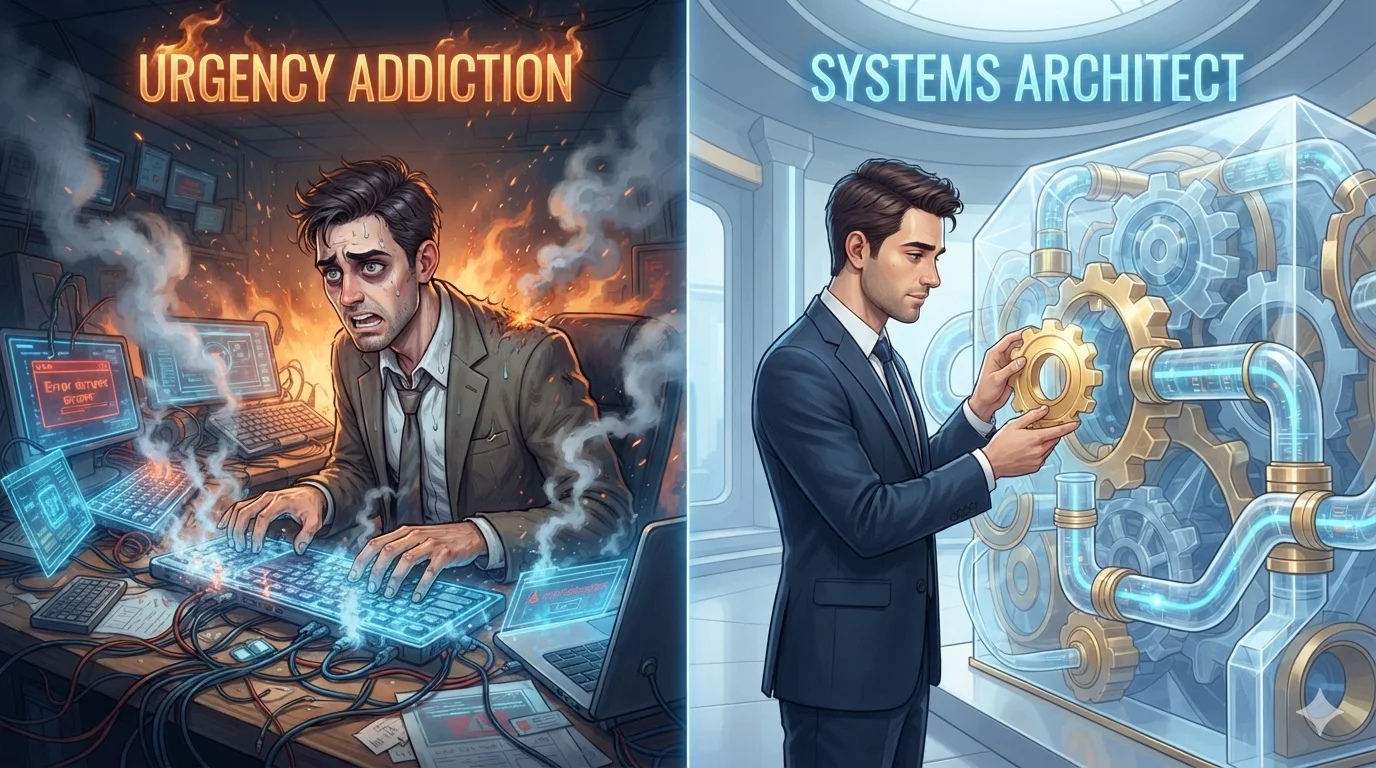
This cognitive rewiring is the absolute prerequisite for any structural change. As long as the founder believes that scaling is merely a matter of working harder individually, the organization remains artificially capped by the biological bandwidth of a single human being. The transition requires reframing the central operational question from “How do we solve this?” to “Who can do this?”, thereby converting scarce founder time into scalable organizational capability.
The Corporate Lifecycle and the Founder’s Trap
The transition from technical founder to systems leader does not occur in a vacuum; it is deeply embedded in the natural evolution of the corporation. Dr. Ichak Adizes’ Corporate Lifecycle model provides a highly robust framework for understanding the predictable stages an organization passes through, illuminating why the shift to systems thinking is structurally mandated at a specific inflection point.
The Ten Stages of Corporate Evolution
The Adizes model argues that organizations age and transition through distinct phases, each carrying normal problems, abnormal problems, and fatal anomalies. The ten stages are defined as follows:
- 1. Courtship: The initial ideation phase. The founders are dreaming without regard for future effects. Excitement is high, but tangible risk has not yet been taken.
- 2. Infancy: Active trading begins. The business is crisis-driven, lacking systems, and entirely dependent on the founder’s 16-hour days. The primary danger is infant mortality via cash flow failure.
- 3. Go-Go: Frantic, energetic growth. The company chases every opportunity, leading to a lack of focus. Quality suffers because the company is organized around people rather than functions.
- 4. Adolescence: The critical “second birth” of the organization. Professional management systems must replace the founder’s intuition. It is a period marked by intense conflict between entrepreneurial energy and administrative control.
- 5. Prime: The optimal state where flexibility and controllability meet. The organization can decentralize decision-making without abdicating control, driving simultaneous revenue and profit growth.
- 6. Stability: The firm is still effective and profitable but begins losing its leading-edge innovation. A sense of vulnerability creeps in as people stop taking risks.
- 7. Aristocracy: The entrepreneurial spirit is fully lost. Form takes precedence over function. The organization survives on momentum and may be asset-rich but cash-poor.
- 8. Early Bureaucracy: Paranoia sets in. Management focuses on finding out who caused problems rather than solving them. Internal witch hunts replace market focus.
- 9. Bureaucracy: The organization is entirely inward-focused, cumbersome, and disconnected from its environment, surviving only if artificially subsidized.
- 10. Death: Closure, bankruptcy, or liquidation for asset value.
The Pathology of the Founder’s Trap
It is at the zenith of the Go-Go stage that the technical founder’s execution-heavy approach violently breaks down. As operational complexity multiplies, the lack of formalized systems leads to severe errors. Employees become intensely frustrated by unclear responsibilities, overlapping jurisdictions, and fuzzy goals. When the peripatetic founder inevitably discovers an error, they tend to react by suddenly intervening, re-centralizing power, and disrupting all existing workflows.
After several repetitions of this cycle, a state of paralysis reigns; employees are unwilling to act decisively because they fear the founder’s erratic intervention.
When the founder attempts to solve these scaling issues by tightening their personal grip on operations rather than delegating, they plunge the organization into the Founder’s Trap. Symptoms of this trap include blind arrogance, a sustained inability to deliver quality, collapsing infrastructure, and a culture where high-performing recruits leave because they cannot effectively contribute under autocratic micromanagement. If the conflict between the founder’s entrepreneurial energy and the organization’s desperate need for administrative control is not resolved, the company will regress and suffer premature aging or outright failure.
Structuring for Emancipation: The Adizes Protocol
Escaping the Founder’s Trap and transitioning into Adolescence is widely considered the most difficult transition in the corporate lifecycle. Adizes warns that immediately hiring an external CEO to replace the founder usually fails. The company is completely custom-built around the founder’s personality, meaning the power structures and tasks are highly idiosyncratic; a traditional professional manager is therefore incompatible.
Instead, a deliberate, sequenced emancipation protocol is required:
- 1. Re-structure via Consultation: The founder must bring in an external consultant to redefine the mission and systematically restructure the organization based on functions rather than personalities. This prepares the company so that it can eventually be run by anyone, neutralizing the threat to the founder’s ego.
- 2. Appoint a Chief Operating Officer (COO): Once mutual trust is established through the restructuring process, the consultant (or a trusted internal leader) is appointed as COO, taking over daily operations while the founder retains the CEO title.
- 3. Establish an Executive Committee (EC): An EC is formed, chaired by the COO, encompassing all top managers. This fundamentally diffuses the founder’s central authority.
- 4. Implement the 48-Hour Rule: To manage the founder’s psychological addiction to control, strict rules of conduct are enforced. The EC must submit agendas to the founder 48 hours before meetings, and meeting minutes 48 hours after. The founder has the right to veto items during these specific windows. Decisions within the EC must be made by absolute consensus; if consensus fails, the decision defaults to the founder. Over time, as the EC proves its competence and the safety net remains unused, the founder naturally steps back, reading the agendas less frequently and allowing the system to govern itself.
Systems Thinking: Engineering the Machine
The structural reorganization prescribed by corporate lifecycle theory must be underpinned by a fundamental shift in how the founder perceives the business itself. This requires the adoption of systems thinking, a paradigm popularized by MIT’s Peter Senge, and the transition out of the technician trap, famously articulated by Michael E. Gerber in The E-Myth.
The Technician Trap and the Franchise Prototype
Gerber’s E-Myth posits that a vast majority of small businesses are started by technicians—such as software engineers, graphic designers, or financial analysts—who mistakenly believe that understanding the technical work of a business automatically equips them to run a business that does that technical work. The founder defaults to the role of the Technician (the doer), fatally neglecting the roles of the Manager (the planner and organizer) and the Entrepreneur (the visionary architect).
To scale beyond their own physical capacity, the founder must begin to view the business itself as the ultimate product. The goal is to build a franchise prototype (or a turnkey machine) consisting of repeatable, documented systems that deliver consistent results entirely independent of the founder’s personal involvement. This shifts the focus from completing technical tasks to designing the systems that complete those tasks.
Senge’s Fifth Discipline and the Learning Organization
Moving from a technician to a systems architect requires a cognitive framework that views the organization not as a series of isolated events or siloed departments, but as a complex, interconnected organism. Peter Senge, often regarded as the “Strategist of the Century,” identified systems thinking as the cornerstone of a learning organization—an entity capable of continuous adaptation, where feedback loops, delays, and underlying structures are leveraged for sustainable growth.
Senge outlined five core disciplines that an organization must cultivate to achieve this systemic awareness:
| Senge’s Five Disciplines | Operational Definition |
|---|---|
| Personal Mastery | The discipline of continually clarifying personal vision, focusing energies, and seeing reality objectively. It demands that individual growth aligns with organizational health. |
| Mental Models | Unearthing and challenging the deeply ingrained assumptions and generalizations that influence how leaders understand the world and take action. Changing mindsets to change systems. |
| Shared Vision | Building a sense of commitment in a group, developing shared images of the future, and outlining the principles and guiding practices to get there. |
| Team Learning | Transforming conversational and collective thinking skills, so that groups of people can reliably develop intelligence and ability greater than the sum of their individual members’ talents. |
| Systems Thinking | The “Fifth Discipline” that integrates the other four. It is a framework for seeing wholes, interrelationships, and patterns of change rather than static, isolated snapshots. |
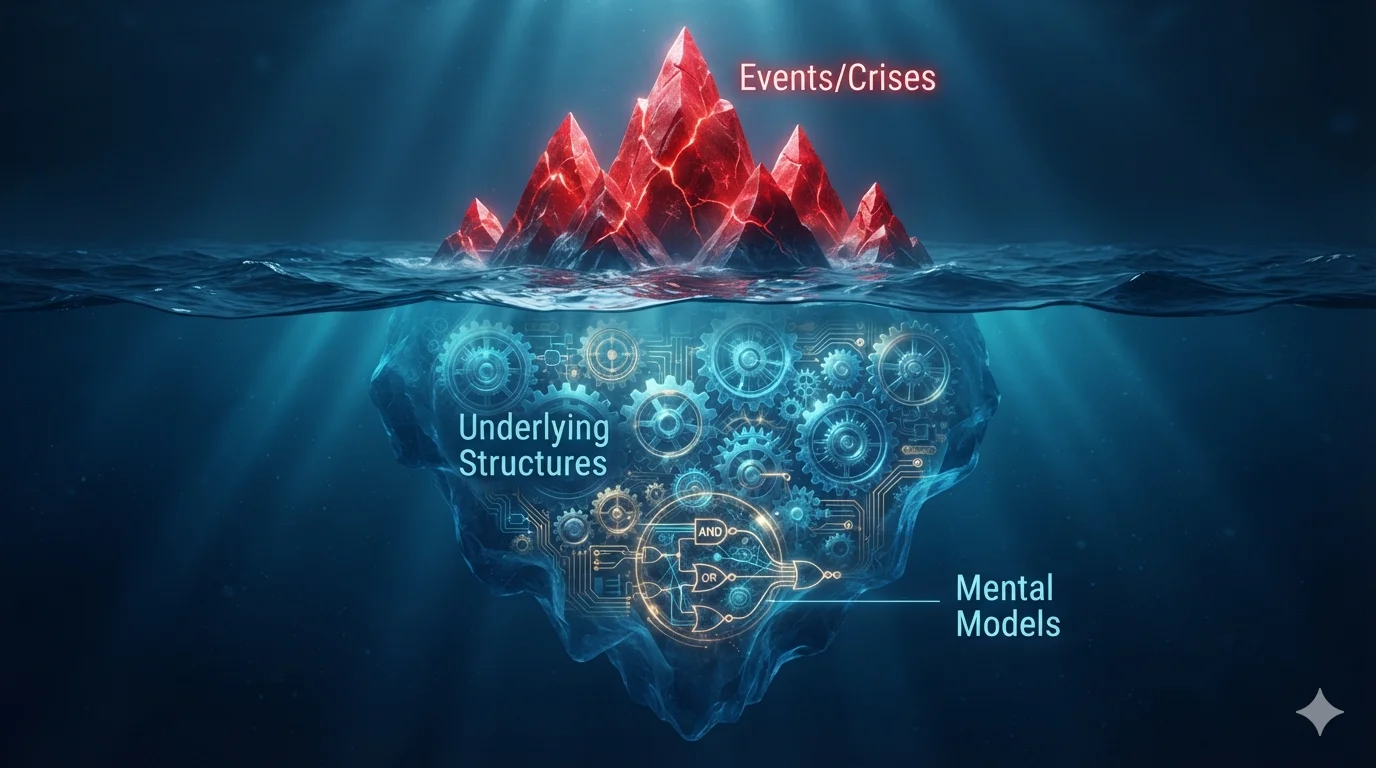
Systems thinking demands that the technical founder abandon linear, cause-and-effect assumptions. Senge utilizes the Iceberg Model to illustrate that visible events (the tip of the iceberg) are driven by underlying patterns, systemic structures, and mental models beneath the surface. Addressing surface-level symptoms through tactical firefighting ensures that problems will recur; true systemic intervention requires altering the underlying structure.
Furthermore, Senge’s 11 Laws of Systems Thinking provide the heuristics for this new operational paradigm:
| Senge’s Laws of Systems Thinking | Implications for the Scaling Founder |
|---|---|
| Today’s problems come from yesterday’s solutions. | Tactical, hasty fixes by a firefighting founder often create long-term structural debt. |
| The harder you push, the harder the system pushes back. | Attempting to force growth without building the necessary infrastructure results in organizational resistance and burnout. |
| Behavior grows better before it grows worse. | Short-term interventions may show temporary improvement before systemic flaws cause a massive collapse. |
| The easy way out usually leads back in. | Reverting to familiar technician habits (e.g., writing the code yourself) guarantees the founder remains the bottleneck. |
| The cure can be worse than the disease. | Adding layers of bureaucracy instead of streamlining systems can paralyze a Go-Go organization. |
| Faster is slower. | Scaling operations prematurely before stable underlying systems are built will ultimately decelerate the company. |
| Cause and effect are not closely related in time and space. | The root cause of a delivery failure may be a flawed onboarding process that occurred months prior. |
| Small changes can produce big results. | Identifying high-leverage points yields massive improvements in output, rather than relying on brute-force technical effort. |
| You can have your cake and eat it too, but not all at once. | True systemic optimization requires patience and an understanding of delayed gratification. |
| Dividing an elephant in half does not produce two small elephants. | A system must be understood in its entirety; optimizing a single department in isolation often breaks the broader workflow. |
| There is no blame. | The system and the people in it are interconnected; systemic failures are rarely the fault of a single individual’s incompetence. |
The AI-First E-Myth: Encoding Intent
While Gerber’s original E-Myth focused heavily on labor substitution—replacing the founder with other human employees who execute rigidly defined procedures—the rapid proliferation of Artificial Intelligence has radically altered this dynamic. In an AI-first environment, the nature of the technician trap has fundamentally evolved. Today, the modern technician is the founder who knows how to wire complex automations, expertly prompt Large Language Models (LLMs), and generate rapid outputs. This founder remains the central bottleneck precisely because they are armed with hyper-efficient tools that allow them to do the work of ten people, thereby masking the absence of a true organizational system.
If a technical founder simply automates tasks without delegating cognitive judgment, they build a highly fragile system that requires their constant tweaking and supervision. Systems in the modern era are no longer just static, step-by-step procedures; they are dynamic, autonomous agents. Therefore, the founder’s role must elevate from documenting what to do to encoding intent. The systems thinker must define the principles that govern AI decision-making when no human is watching, design bounded intelligence, detect assumption drift, and hold strict accountability for system-level outcomes. The shift is no longer just transferring manual labor to a junior developer; it is transferring cognitive bandwidth to an algorithmic framework, which requires a profoundly deeper level of strategic abstraction.
Operationalizing Autonomy Through Standard Operating Procedures
Philosophy and psychological reframing must eventually translate into concrete, highly resilient operational architecture.
For a technical founder, this means meticulously extracting their deep tribal knowledge and converting it into Standard Operating Procedures (SOPs) that guide both human employees and digital agents. The objective is to build a business where the operational rhythm holds under immense pressure without founder intervention.
The 20/80 Rule of Documentation
A frequent failure mode in transitioning founders is the attempt to document every conceivable process simultaneously. This approach invariably leads to bureaucratic paralysis, exhaustion, and the creation of outdated manuals that no one actually reads. Effective scaling relies on the 20/80 rule: identifying and documenting the 20% of core processes that yield 80% of the agency’s results. By analyzing task frequency versus business impact, agencies can prioritize workflows that carry the highest operational risk. Priority must be given to high-frequency, high-impact workflows, which typically include five core templates:
- Client Onboarding & Offboarding SOP: The highest operational risk phase that dictates long-term client retention. This standardizes setup, contract execution, and project preparation to ensure every client receives a uniform experience without founder management.
- Weekly Client Reporting SOP: A system that governs exactly which metrics to pull, where to source them, and the format for delivery. This proves ROI predictably and eliminates ad-hoc, time-wasting data requests.
- Content Approval SOP: Governs the internal and client-facing QA steps required for signing off on creative copy and designs, standardizing CMS uploads, alt-text generation, and keyword hierarchies.
- Paid Ad Campaign Launch SOP: A rigorous step-by-step template detailing critical validation steps (pixel installation, targeting exclusions, budget verification) before spending capital on platforms like Meta or Google Ads.
- New Hire Onboarding SOP: A 5-day playbook mapping out how to rapidly ramp up new team members, provision access credentials, and assign first tasks without requiring constant supervision from executive leadership.
The 8-Step Framework and the “Ghost Method”
Founders inherently resist writing SOPs because documentation feels tedious and non-productive compared to immediate technical execution. To circumvent this friction, modern agencies utilize a structured 8-step framework, heavily augmented by the “Ghost Method” (or Loom + AI workflow), which converts tribal knowledge into documented systems almost instantly:
- 1. Choose One Repeatable Process: Identify a single high-impact workflow to prevent overwhelm.
- 2. Record the Workflow (The “Ghost Method”): The founder (or subject matter expert) records their screen while performing the task exactly as they normally do, narrating their thought process out loud. This bypasses the “blank page problem” and captures the ugly, imperfect, but highly accurate reality of the workflow.
- 3. Break Actions Into Simple Steps (via AI): The video is transcribed, and the raw text is fed into an LLM (like ChatGPT) with a specific prompt to strip filler words and format the text into a structured SOP. The AI is instructed to ensure each step begins with an action verb (e.g., Click, Verify, Upload).
- 4. Add Screenshots and Context: The founder injects key screenshots from the video recording to visually support complex UI interactions, cropping out background noise to focus the reader’s eye.
- 5. Include Edge Cases and Exceptions: A critical component of a robust SOP is the inclusion of “If/Then” troubleshooting scenarios. By anticipating failure points (e.g., “If the client’s Meta Business Manager lacks access, send the Account Setup Request template”), the system empowers the assignee to resolve exceptions without halting the workflow to escalate to the founder.
- 6. Test the SOP With a New User: The documentation is handed to an employee unfamiliar with the process. Every point of confusion identifies a gap that must be refined.
- 7. Assign Ownership and Review Cycle: An outdated SOP is worse than no SOP. A specific team member must be assigned ownership of the document, responsible for updating screenshots if software interfaces change, governed by a mandatory 6-month review cycle.
- 8. Store SOPs Where Work Happens: SOPs buried in Google Drive folders are rarely used. They must be embedded directly inside the CRM or Project Management tool, appearing at the exact moment of task execution to guarantee adoption.
Delegating Technical Complexity and Enforcing Quality Control
For the technical founder—especially in precision-heavy fields like software development, enterprise architecture, or graphic design—the deepest anxiety surrounding delegation is the anticipated loss of quality control. The transition requires moving from executing the craft to engineering the Quality Assurance (QA) pipeline. Delegation must be treated with the exact same rigor and nuance as architectural software design.
The Technical Delegation Framework
Delegating complex technical tasks (to either junior staff or AI copilots) requires a structured decision matrix based on four distinct vectors: Verifiability, Stakes, Complexity, and Familiarity.
| Delegation Filter | Assessment Criteria | Operational Rule |
|---|---|---|
| Verifiability | Can the output be quickly validated through automated tests, type checking, or visual inspection? | High verifiability makes a task highly delegable. If the task has clear pass/fail criteria, delegate it. |
| Stakes | What is the business impact if an error slips through the cracks? | Low-stakes work (test scaffolding, internal draft copy) is perfect for delegation. High-stakes work (security architecture) requires human-in-the-loop oversight. |
| Complexity | Is the task deterministic and well-defined, or does it require deep systemic context? | Well-defined tasks are easily handed off. Tasks requiring architectural trade-offs or nuanced business logic demand the founder’s strategic oversight. |
| Familiarity | Does the founder understand the domain well enough to supervise the output? | If the founder cannot verify correctness because they lack domain understanding, they cannot delegate safely. This results in accepting code they cannot maintain. |
When evaluating whether to delegate to an AI agent, the return on investment (ROI) equation is critical: if the time spent on prompt engineering, providing context, and verifying the output is less than 70% of the manual coding time, the task should be delegated immediately.
Engineering QA and QC Pipelines
To scale quality without physical intervention, the founder must differentiate between Quality Assurance (QA) and Quality Control (QC) and build robust pipelines for both. Drawing from methodologies used in high-stakes environments, the distinctions are vital:
- Quality Assurance (QA) is proactive and process-oriented. It operates at the system level, asking, “Is the process likely to produce correct results consistently?” QA involves protocol design, workflow audits, and training to prevent errors from occurring.
- Quality Control (QC) is reactive and product-oriented. It asks, “Did the reviewer execute this specific document correctly?” QC is the active identification and correction of errors in the final output before delivery.
- Quality Testing and Process Auditing: Quality testing statistically samples completed work to validate that outcomes meet acceptable thresholds, while process auditing validates that the team actually followed the defined procedures.
For a software engineering agency, quality control must be tiered to drastically reduce the cognitive burden on senior reviewers. Tier 1 consists of Automated Validation: before human eyes ever review a pull request, the code must pass automated unit tests, integration tests, linters, security scanners, and type checkers. Tier 2 consists of Structural Review: senior developers conduct 5-10 minute reviews focusing purely on architecture, business logic, and security implications that automated tools cannot catch.
Similarly, in a graphic design or creative agency, QA systems rely heavily on absolute standardization to remove subjective debate. Brand style guides become the rigid blueprint for quality control, detailing exact color codes, typography, logo clear space, and grid systems. Verification checklists are mandated for visual hierarchy, layout balance, file format optimization, and WCAG accessibility standards (e.g., contrast ratios, touch targets, screen reader compatibility) before any asset is cleared for client delivery. By building rigorous QA checklists and integrating them into the final step of every SOP, the founder ensures that quality is enforced by the system, not by their own micromanagement.
The Transition in Practice: Real-World Agency Case Studies
The theoretical transition from technical operator to systems thinker is vividly illustrated by the real-world trajectories of growing agencies, tech startups, and global incubators. These case studies demonstrate that systemic architecture is the definitive variable separating stagnant operations from exponential scale.
Productizing Services and Modular Delivery
The traditional agency model is highly vulnerable to the Founder’s Trap, as bespoke client relationships and creative delivery naturally default to the founder’s desk. Nate Freedman, an agency owner, experienced this acutely. As he moved his agency upmarket to secure massive enterprise clients like Salesforce, he felt increasingly like an imposter trapped in a corporate grind with long sales cycles and high-maintenance demands. Realizing this bespoke model was unscalable and founder-dependent, Freedman made a radical pivot. He ditched high-ticket proposals and simplified his offer into a productized Managed Service Provider (MSP) model targeting $200K–$300K businesses.
By layering in automation, structured coaching experiences, and strict templates at a lower price point ($300 to $4,200/month), he scaled to over 100 monthly clients with minimal human resource bloat, proving that removing complexity is the ultimate growth lever.
Similarly, Weblogic, a web development agency, suffered from margin decay, scope creep, and chaotic timelines because the founder was deeply entrenched in reacting to client demands. The operational breakdown was not due to poor technical skill, but a fundamentally flawed operating model tied to the founder’s availability. By halting operations, stripping away distracting services, and shifting to modular, margin-safe delivery systems with strictly defined scopes and packaged pricing, the founder successfully rebuilt the agency. The result was a system capable of running itself, allowing the founder to step back from weekend admin and daily firefighting to focus on high-level strategy. Doneverse achieved similar results for its clients, taking solo founders who were burning hours on content creation and deploying automated growth systems that reclaimed their weekends and boosted revenue by 4-5x.
The Emergence of the Agentic Agency
The integration of AI is forcing a structural evolution from the traditional agency to the “Agentic Agency.” As demonstrated by E2M, a massive white-label agency serving hundreds of partners, simply giving existing employees AI tools (the “AI-first” model) only marginally increases speed without fundamentally altering the business structure. In an AI-first model, the org chart looks the same, but billable expectations quietly rise, leading to burnout.
To achieve true systemic scale, E2M utilized a “parallel build” approach. Because traditional delivery teams are incentivized by billable hours and ingrained in legacy workflows, they naturally resist and absorb disruptive automation. E2M isolated a separate, dedicated AI services team, divorcing them from daily billable expectations and tasking them solely with building autonomous agents. In this agentic model, traditional seats (e.g., front-end developers, standard WordPress builders, content writers) are entirely replaced by AI agents. The human roles elevate to directors who orchestrate the agents, ensuring that the agency scales exponentially through algorithmic leverage rather than linear headcount growth. Agencies like SynkrAI and Ayautomate are actively proving this model, replacing fragmented manual workflows with integrated API infrastructures, resulting in 70-95% reductions in manual task volume.
The Technical Co-Founder vs. Development Agency Dilemma
The necessity of systems thinking is also evident in how founders choose to build their initial products. The data indicates that recruiting a technical co-founder is incredibly difficult, with equity splits often nearing 50/50. While a technical co-founder is highly invested, they often fall into the Superman Syndrome. Conversely, utilizing a specialized development agency allows non-technical founders to rapidly deploy cloud-native monitoring systems, AI quotation engines, or EMR technologies without diluting equity. However, the agency model only works if the agency itself operates on rigorous systems thinking, meticulously documenting architectural decisions and trade-offs so that the product can eventually be handed off to an internal CTO once traction is proven.
Macro-Validation: Incubating Systems Thinkers in Emerging Ecosystems
The necessity of shifting from technical founder to systems leader is recognized globally, driving the creation of sophisticated accelerator and incubator ecosystems designed to force this maturation process. The transition is not isolated to Silicon Valley; it is a fundamental law of business physics applied worldwide.
In Scotland, the Techscaler ecosystem powered by CodeBase provides the institutional scaffolding for deep-tech founders to scale. Case studies of startups like RideScan (robotics), Aurora Avionics (aerospace), and Weeteq (AI power optimization) demonstrate that translating a PhD research project into a global commercial enterprise requires transitioning the founder from a pure researcher into an operational systems architect capable of handling international procurement and regulatory complexity.
In emerging markets like Nepal, organizations such as Nepal Communitere, Impact Hub Kathmandu, Idea Studio Nepal, and NEXT Venture Corp serve an identical macro-function. Nepal Communitere’s I3 (Innovate, Iterate, Incubate) program deliberately addresses the fact that many Nepali startups are born out of technical necessity or crisis but lack the organizational infrastructure to scale sustainably. The rigorous one-year I3 program forces technical founders to step back from the product and build transparent administrative frameworks, solid business plans, and scalable operational strategies before they are exposed to major venture capital.
Similarly, Idea Studio Nepal bridges the gap between academia and industry, pushing “ideators” to validate their ventures through structured mentorship, ensuring they build systems capable of absorbing capital. NEXT Venture Corp has evolved into a global fintech conglomerate operating across five countries by institutionalizing systems thinking internally, while simultaneously hosting the NEXT Growth Conclave to provide the mentorship required to guide local founders out of the Go-Go stage and into professionalized Adolescence. The influx of Private Equity and Venture Capital firms in Nepal further acts as a forcing function. These institutions require strict corporate governance, audited financials, and documented operational systems before deploying capital, definitively proving that systemic architecture is the prerequisite for institutional scale.
Conclusion: The Final Shift to Ownership
The architect’s transition from technical founder to systems thinker is the defining crucible of organizational growth. It is a journey that begins with the painful realization that a founder’s greatest asset—their unparalleled capacity for technical execution, brute-force work ethic, and crisis resolution—is the exact ceiling limiting the enterprise’s future. Escaping the “Superman Syndrome” and navigating out of the “Founder’s Trap” requires a violent departure from comfort. The founder must willingly relinquish the dopamine of daily problem-solving, dismantle the illusion of their own indispensability, and embrace the delayed gratification of systemic design.
By deeply internalizing the insights of the Adizes corporate lifecycle, implementing the holistic feedback loops of Peter Senge’s systems thinking, and adopting the franchise prototype mentality of the E-Myth, technical founders can systematically extract their localized genius. Through the rigorous 20/80 documentation of Standard Operating Procedures, the strategic delegation of complexity via automated QA pipelines, and the encoding of intent into modern AI agentic workflows, the founder builds a machine of immense, scalable leverage.
Ultimately, this transition is not merely about achieving operational efficiency or improving profit margins; it is about achieving finality in the founder’s evolution. The ultimate destination is the shift from CEO to Owner—a state where the business ceases to be a fragile extension of the founder’s ego or physical bandwidth, and instead becomes a resilient, autonomous entity capable of sustaining growth, interpreting complexity, and delivering excellence entirely independent of its creator.