Designing HITL Workflows for Agentic AI Systems
Architecting Human-in-the-Loop Workflows for High-Volume Asynchronous Systems

The Paradigm Shift to Agentic Event-Driven Architectures
The transition from reactive web services to autonomous, agentic event-driven systems represents a fundamental evolution in software architecture. Traditional event-driven architectures (EDA) were designed to react; they answer the question of what should happen when a specific event occurs, relying on static workflows encoded at design time and synchronous microservice calls. Agentic systems, however, are designed to decide and adapt. By integrating Large Language Models (LLMs) and machine learning heuristics directly into the event stream, these systems continuously sense events, reason over shared state, take actions, and learn from outcomes in real-time.
This shift to continuous decisioning transforms the underlying infrastructure. AI applications are no longer simple request-response loops where a user inputs a prompt and a UI displays the output. Instead, a single user intent triggers a massive distributed pipeline involving vector database retrievals, context ranking, policy evaluations, prompt assemblies, tool selections, and memory updates. Because all coordination flows through an event streaming backbone—such as Apache Kafka, Redis Streams, or Amazon MSK—there is no central call stack. Consequently, tracing and governance depend entirely on correlation identifiers carried on every event, transforming the audit log from a simple debugging tool into the absolute system of record.
While full autonomy maximizes throughput, deploying probabilistic AI in high-volume production introduces profound legal, ethical, and quality risks. In regulated industries such as finance, healthcare, and enterprise software, full autonomy is a severe compliance liability. To mitigate these risks, organizations must implement Human-in-the-Loop (HITL) control patterns. This creates an architecture where the system observes, decides, and acts, but selectively routes high-stakes decisions through human approval gates before environmental mutation occurs. Implementing these gates asynchronously, without dropping events or exhausting compute resources, requires highly specialized orchestration layers, staging environments, and cryptographically secure communication channels.
Orchestration Engines for Durable Asynchronous Execution
The defining characteristic of a HITL orchestrator is the ability to invoke a “wait” state”. When a workflow reaches a point requiring human review—such as a legal sign-off on a generated contract or an escalation of a customer refund—it must pause execution without consuming active compute resources. The orchestrator must persist the exact state of the workflow and remain addressable so that it can receive a resumption signal hours, days, or weeks later.
If developers attempt to build these pauses into standard serverless functions (like AWS Lambda) or tightly coupled microservices, the system inevitably succumbs to timeout limits, network partitions, and untraceable data loss. The solution is durable execution, a framework that externalizes state management and retry logic, allowing the AI workflow to be modular and distributed.
| Orchestration Engine | Wait State Mechanism | Architectural Strengths | Constraints and Operational Limits |
|---|---|---|---|
| AWS Step Functions | .waitForTaskToken | Pauses execution natively with zero compute charges while waiting. Generates a cryptographically secure token that can be embedded in Webhooks or API Gateway endpoints. | Hard payload limit of 256KB requires offloading large text chunks to Amazon S3. Maximum execution time is strictly limited to one year. |
| Temporal.io | workflow.wait_condition() | True unbounded durability utilizing history replay. Workflows are persisted to the server database and survive worker deployments. Allows native Python/TypeScript execution rather than JSON configurations. | Event history has a hard limit of 51,200 events or 50MB, requiring explicit Continue-As-New implementations for long-running loops. Code must be strictly deterministic. |
| Camunda (Zeebe) | BPMN Ad-Hoc Sub-Processes | Visual-first design bridges the gap between engineering and business stakeholders. Native human task modeling ensures agents operate within enterprise guardrails. | Less code-centric flexibility than Temporal. Requires a heavier enterprise deployment model, though it integrates deeply with legacy ERP systems. |
| Orkes Conductor | Microservices Polling/Wait | Pragmatic, lightweight architecture built on Redis/Postgres. Proven at massive scale (e.g., Netflix infrastructure handling 15–20% of US internet traffic). | Requires managing separate workers for task polling. Workflows are defined primarily in JSON, lacking the native type-safety of Temporal’s code-first approach. |

When designing the orchestration layer, preserving the AI’s reasoning context is critical. Because workers can crash mid-execution, orchestrators like Temporal rely on history replay to reconstruct state, meaning workflow code must be completely deterministic. Developers cannot use standard system clocks or random number generators; they must utilize framework-specific deterministic functions. Furthermore, since a resumed workflow might retry operations, all external API calls must be delegated to idempotent activities utilizing unique keys and check-before-act database semantics to prevent duplicate mutations.
Routing Topologies and Human-in-the-Loop Intervention Patterns
Human oversight cannot be a monolithic blanket policy. Subjecting every automated action to human review destroys the efficiency gains of the AI, creates massive organizational bottlenecks, and accelerates reviewer fatigue. Instead, oversight intensity must scale proportionately with decision risk.
The fundamental distinction governing HITL design is between irreversible and reversible actions. Reversible actions, such as updating an internal draft or adding metadata tags, can be easily rolled back. Irreversible actions, such as executing a financial transaction, modifying a production database, or publishing customer-facing content, cannot be undone without significant cost. Gates must be strictest around irreversible actions and lightest around reversible ones.
| Architectural Pattern | Operational Scenario | Implementation Mechanics |
|---|---|---|
| Approval Gate | High-risk, irreversible actions (e.g., deploying code, initiating large refunds). | The workflow halts completely. The proposed action is held in an isolated staging state. The system requires an explicit authorization from a designated human role before proceeding, enforced by timeout-based auto-rejections. |
| Escalation Ladder | Actions scaling in risk severity (e.g., financial thresholds). | Dynamic rule evaluation routes the workflow to progressively senior reviewers. If a primary reviewer SLA times out, the system automatically pings a backup handler to prevent bottlenecks. |
| Confidence-Based Routing | High-volume, routine workflows where only edge cases require human intervention. | The system automatically processes actions where AI confidence is high and routes low-confidence tasks to a human. This must rely on calibrated trust scores, combining heuristic risk checks with model probabilities. |
| Collaborative Drafting | High-stakes creative, legal, or analytical tasks requiring distinct human judgment. | The AI functions as a co-pilot generating a baseline draft. The human operator polishes, corrects, and assumes final ownership. This is vastly superior to simple approve/reject mechanisms for generative text. |
| Audit Trail with Lazy Review | Low-risk, high-volume tasks (e.g., internal document tagging). | Full automation is permitted. The agent executes in real-time but commits a comprehensive reasoning trace to an event log. Humans asynchronously sample the output to detect systemic policy drift. |
A critical architectural trap in confidence-based routing is relying exclusively on raw LLM confidence scores. Generative models measure linguistic certainty—the probability of the next token—not factual accuracy. An LLM can be 95 percent confident about a completely hallucinated answer. Empirical data demonstrates that utilizing raw confidence as the sole gating mechanism is highly dangerous; in some deployments, over 40 percent of all systemic errors occurred when the agent reported confidence above 0.90. Consequently, production architectures must utilize a two-signal approach: a trust score that aggregates semantic similarity and heuristic validation, alongside a risk score that flags specific problem categories regardless of the model’s self-reported certainty.
Meta-Engineering and Multi-Agent Adversarial Verification
In highly scaled environments where agents generate thousands of outputs per minute, manual human evaluations cannot keep pace. Relying solely on human reviewers creates latency and limits deployment speed. To bridge the gap between high-volume autonomous generation and the human review bottleneck, sophisticated architectures rely on multi-agent adversarial verification before the human is even alerted.
This paradigm is defined as a “meta-engineering harness.” It treats the software production pipeline as an ecosystem of role-specialized AI agents that independently implement, test, and verify outputs. The core principle of this architecture is strict context isolation between generation and validation.
The most common failure mode in multi-agent pipelines is allowing the Builder Agent to explain its reasoning to the Validator Agent. If the validator is exposed to the builder’s internal logic, the validator unconsciously adopts the builder’s framing, resulting in confirmation bias that obscures critical edge cases. To ensure rigorous validation, the pipeline must enforce informational boundaries.
The Builder Agent receives the original contract and generates the diff. This output is subsequently routed to a fresh, isolated Validator Agent—often utilizing a fast, inexpensive model for initial triage—that receives only the raw diff and the original evaluation rubric.
For complex software or analytical deployments, this verification layer is further subdivided. An Architect Agent reviews the diff for structural and design concerns; a Security Agent scans for vulnerabilities and authentication flaws; and a QA Agent evaluates edge case coverage. The outputs of these specialized reviewers are then aggregated into a single, prioritized review. Only when the artifact passes this automated adversarial gauntlet is the task token forwarded to the human editorial dashboard, ensuring that human cognitive effort is reserved for nuanced domain expertise rather than catching basic logical errors.
Database Architecture for Draft and Staging Environments
Before a human reviewer can evaluate an AI-generated artifact, that artifact must be securely persisted in a staging environment. Security compliance frameworks, specifically ISO 27001 Annex A 8.31, mandate the strict logical and physical separation of development, testing, and production environments. The core compliance requirement is the “One-Way Street” rule: untrusted or unverified code and content must never interact directly with live production data. AI agents must execute their modifications against a shadow state, generating a structured draft that remains isolated until the human validation gate opens.
In content management and transactional databases, handling the draft-to-publish lifecycle requires highly specific schema engineering. Traditional approaches often attempt to maintain two identical database tables—one for drafts and one for published content. While this enforces physical separation, it introduces massive technical debt. Any schema alteration requires synchronized duplication across both tables, and maintaining relational integrity becomes a nightmare when foreign keys must reference draft entities that do not yet exist in the live environment.
The superior architectural pattern utilizes a unified table structured to accommodate hierarchical states. In this model, a single table contains all standard business columns, accompanied by a status column (e.g., ‘draft’, ‘in_review’, ‘published’) and a nullable published_id column acting as a self-referencing foreign key.
Database Schema Strategy
| Strategy | Architectural Implementation | Operational Trade-offs and Benefits |
|---|---|---|
| Dual-Table Mirroring | Separate articles and draft_articles tables. Drafts are copied to the live table via batch operations upon approval. | Provides strict physical isolation and prevents accidental exposure. However, it violates the DRY principle, causing massive schema drift and complex ORM mapping. |
| Unified Status Table | A single table utilizing status and published_id columns to link a draft row to its corresponding live counterpart. | Eliminates schema drift and elegantly handles foreign keys. Requires disciplined query scoping (e.g., WHERE status=”published”) to prevent accidental draft exposure to the live application. |
| Configuration Table Pattern | A central workflow_states table utilizing JSONB columns for dynamic metadata, permitted transitions, and SLA timeouts. | Separates state logic from application code. Allows product managers to dynamically update transition rules without executing backend schema migrations. |
The single-table approach ensures relational integrity. When a user requests a live document, the application queries for status=”published”. When an AI agent modifies that document, it creates a new row with status=”draft” and points the published_id to the live record. Upon human approval, the orchestration engine merges the draft content into the live row, updates the status, and commits the transaction.
To govern the transitions between these database states, an enumerations or configuration table pattern is highly recommended. By storing workflow logic inside a workflow_states table—containing columns for the state name, permitted transitions, role-based permissions, and timeout metadata encoded as JSON—the system decouples approval logic from application code. This allows complex multi-stage approvals to be managed dynamically by the orchestration engine, ensuring that business rules live in data rather than in hardcoded application logic.
Editorial Dashboards and Specialized Annotation Platforms
The interface where the human reviewer interacts with the paused workflow is the critical nexus of the HITL architecture. Building custom web applications from scratch for every distinct approval workflow is inefficient. Consequently, enterprise teams rely on rapid application development platforms, headless Content Management Systems (CMS), and specialized Machine Learning annotation tools to serve as the editorial presentation layer.
For internal operational tooling, Retool provides an enterprise-grade infrastructure that allows engineering teams to rapidly deploy dashboards utilizing React-based components. Retool’s architecture is uniquely suited for HITL workflows because it natively supports distinct environments, audit logs, and granular Role-Based Access Control (RBAC). When an AI agent halts at an approval gate, it writes its proposed changes to the staging database. The Retool dashboard reads this staging data, presenting the human operator with a visual diff of the proposed changes. Modern platforms support Source Control integrations, enabling the dashboard configurations themselves to be version-controlled in Git, ensuring that changes to the approval application undergo the same pull-request scrutiny as traditional software.
For workflows centered around narrative content or legal documentation, Headless CMS platforms like Strapi and DatoCMS provide superior editorial ergonomics. These platforms natively implement multi-stage review workflows. In Strapi, the Draft and Publish features integrate tightly with a Review Workflows plugin, allowing administrators to define custom sequential stages (e.g., Draft, In Review, Approved, Published). These stages are bound to the RBAC system; an Author may have permission to move a document to “Ready for Review,” but only a SuperAdmin can advance it to “Published.” When a human approves a document, the CMS fires a webhook back to the durable orchestration engine (e.g., Temporal or Step Functions), signaling that the wait condition has been met and the workflow may resume its path to production.
However, when the HITL workflow is specifically designed to generate training data for ML models, evaluate LLM reasoning traces, or manage massive datasets, generic CMS tools are insufficient. This requires specialized Data Labeling and Annotation Platforms.
Annotation Platform
| Platform | Target Architecture and Primary Use Cases | Technical Strengths and Workflow Capabilities |
|---|---|---|
| Kili Technology | Enterprise AI teams focusing on collaboration, document intelligence, and LLM fine-tuning workflows. | Exceptional cross-functional collaboration UI connecting Subject Matter Experts (SMEs) with ML engineers. Deep SDK integration for standardized workflows, model-in-the-loop processing, and programmatic consensus scoring. |
| Label Studio | Open-source DIY environments requiring multi-modal support (text, image, audio) and custom ML pipeline integration. | Highly customizable interface. Supports model-assisted labeling where custom APIs pre-label data for human correction. Cost-effective but requires significant DevOps overhead to maintain. |
| Prodigy | NLP engineers requiring highly iterative, active-learning workflows driven by Python. | Python-native tool built by the creators of spaCy. Excels at active learning where the model scores uncertainty and routes only the most ambiguous items to human reviewers, drastically reducing labeling volume. |
The integration of Model-Assisted Labeling (MAL) within these platforms represents the cutting edge of HITL design. Instead of humans generating data from scratch, an existing model pre-labels the data, and the human annotator merely corrects it. In advanced setups like Prodigy, active learning algorithms score the uncertainty of the model’s predictions, selectively routing only the high-uncertainty edge cases to human experts. This drastically reduces the necessary labeling volume—often by 30 to 70 percent—while simultaneously capturing the critical reasoning traces and preference data required to fine-tune generative AI systems.
Defeating Automation Complacency through UI Design
The most insidious threat to the integrity of high-volume HITL systems is “automation complacency,” a documented cognitive phenomenon where human operators over-trust reliable automated systems and progressively reduce their vigilance. When an AI agent performs correctly the vast majority of the time, human reviewers develop fatigue. They shift from active critical analysis to passive monitoring, routinely “rubber-stamping” approvals without scrutinizing the underlying data. Complacency is not a result of laziness or lack of training; it is a predictable neurological adaptation to high-workload environments.
If a human reviewer approves an AI-generated configuration without actively validating the diff, the approval gate becomes mere security theater. To combat this, the editorial dashboard must be deliberately designed to enforce active cognitive engagement.
The dual-process theory of thought, popularized by Daniel Kahneman, illustrates that humans utilize a fast, automatic, subconscious mode (System 1) for repetitive tasks, and a slow, effortful, logical mode (System 2) for complex evaluations.
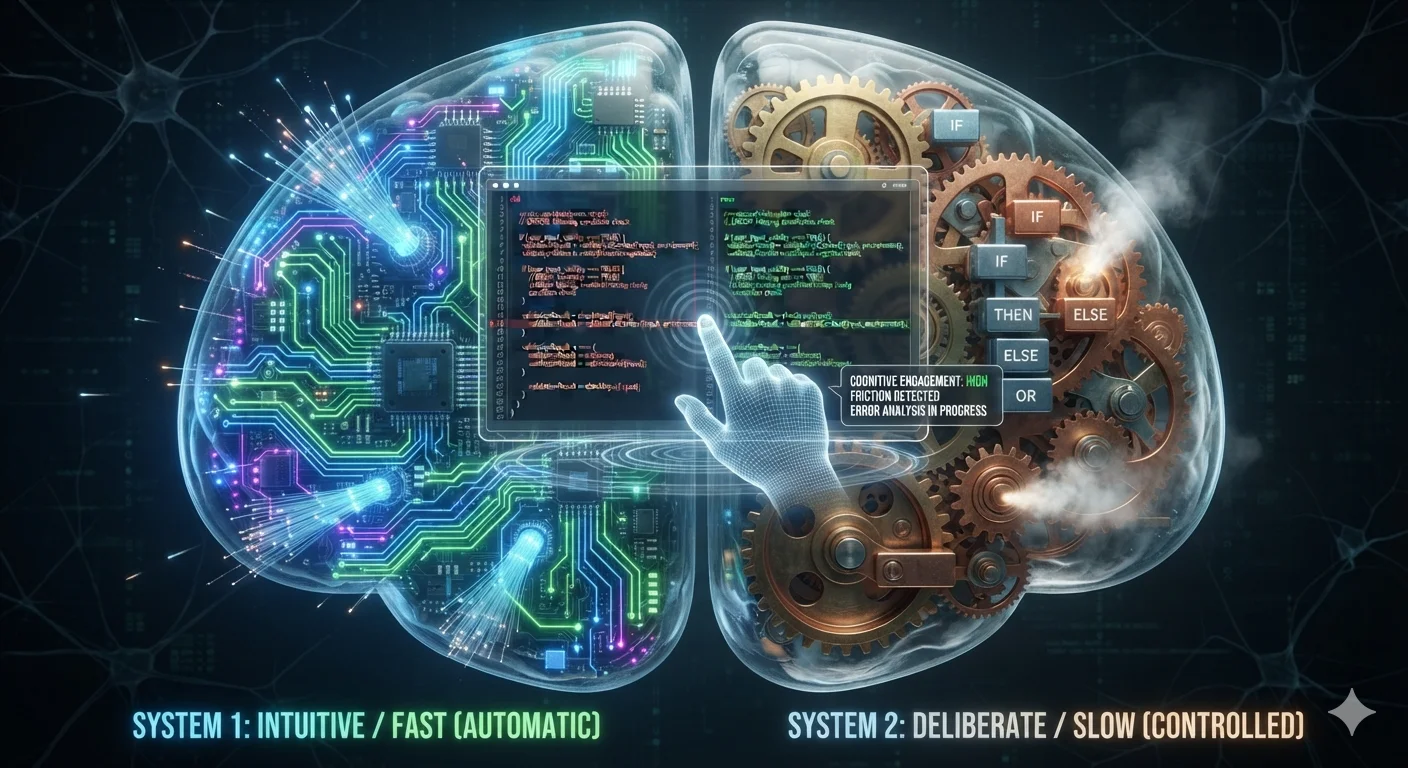
Standard approval interfaces, featuring large green “Approve” buttons and minimized context, inadvertently optimize for System 1 thinking. To force reviewers into System 2 thinking, the interface must introduce intentional friction.
One highly effective methodology adapted from century-old Japanese industrial safety practices is “Shisa Kanko,” or Point and Call. This practice requires operators to physically point at an indicator and vocalize its status, recruiting the motor cortex, visual focus, and auditory cortex to break the autopilot trance. In digital interfaces, this translates to interactive validation requirements. Rather than allowing a one-click approval, the UI should require the reviewer to select specific reasons for the approval from a dropdown, highlight the exact evidence in the source text, or manually type a confirmation phrase for the most sensitive actions. For narrative content, implementing a Text-to-Speech (TTS) check—forcing the reviewer to hear the AI-generated text read aloud—disrupts the brain’s tendency to visually skim and mentally auto-correct errors.
Furthermore, interfaces must effectively communicate uncertainty to prevent automation bias. Presenting AI output as an authoritative final result discourages questioning. Instead, outputs should be presented as editable drafts. The interface should surface calibrated confidence scores, original data source references, model limitations, and alternative predictions. By tracking inter-annotator agreement and the frequency of human interventions, system architects can measure complacency levels; if intervention rates drop near zero, it is a definitive signal that users are blindly trusting the system, indicating an urgent need to update policy guidelines and increase interface friction.
ChatOps Integration: Slack and Discord as Asynchronous Interfaces
While dedicated editorial dashboards are necessary for complex, multi-page document reviews, forcing human operators to log into a separate web portal for every minor operational approval introduces unacceptable friction. For high-velocity decisions—such as approving a temporary database access grant, authorizing a cloud deployment, or greenlighting a rapid customer support response—the approval mechanism must meet the user where they already work. This has driven the adoption of ChatOps, utilizing platforms like Slack and Discord as the primary interfaces for HITL intervention.
The architectural challenge of ChatOps lies in mapping the durable, stateful nature of a long-running orchestrator onto the ephemeral, stateless nature of a chat channel.
When the orchestration engine pauses, it fires an outbound webhook to an API gateway. This gateway constructs a highly structured message payload utilizing framework-specific tools like Slack’s Block Kit. A well-designed ChatOps request must be entirely self-contained. It must include headers showing urgency, section fields detailing service versions or requested changes, and interactive components—specifically, “Approve” and “Reject” buttons—embedded with the unique task token generated by the orchestrator. If the approver has to open a separate browser tab to read a GitHub diff or check a database status, the context is insufficient and delays the decision.
To maintain the integrity of the audit trail, the system must aggressively manage state mutation within the chat interface. Upon receiving a button-click callback, the application must immediately verify the user’s identity to ensure the requester is not approving their own request. Following authorization, the application must overwrite the original chat message, replacing the interactive buttons with a static text block indicating the decision outcome, the authorizing user, and the timestamp. This prevents the dangerous scenario of “dangling state,” where active buttons remain in the chat history and are accidentally clicked weeks later. The message serves as the channel notification, while a durable database store satisfies the compliance auditor.
Because chat platforms are fundamentally asynchronous, the architecture must also account for human unresponsiveness. If an approval message sits unanswered in a Slack channel for a predetermined period (e.g., 30 minutes), the orchestrator’s durable timer must fire. This executes a fallback path that automatically denies the request, updates the Slack message to read “Expired,” and potentially escalates the notification to a backup reviewer. An ambiguous request that hangs indefinitely undermines trust in the system and violates the principles of strict operational gating.
Cryptographic Security Protocols for Webhook Verification
Exposing an HTTP endpoint to the public internet to receive action callbacks from Slack or Discord introduces a massive attack vector. If the API gateway blindly accepts POST requests containing task tokens, a malicious actor who discovers the endpoint URL can spoof approval messages, bypassing the human gate entirely and injecting unauthorized actions into the core infrastructure. Relying on IP allowlisting is insufficient as a primary defense, as platform IP addresses frequently change and can be spoofed.
To secure the bidirectional communication between the ChatOps platform and the internal API, systems must implement rigorous cryptographic signature verification. While platforms utilize different cryptographic algorithms, the underlying principle is identical: the provider signs the raw HTTP request body using a shared secret or private key, and the receiving server must independently compute the signature and compare it against the provided header.
| ChatOps Platform | Signature Algorithm | Required Headers | Verification Mechanics |
|---|---|---|---|
| Slack | HMAC-SHA256 | X-Slack-Signature, X-Slack-Request-Timestamp | Concatenates v0:timestamp:raw_body. Hashes with the Signing Secret. Compares the resulting hex digest against the signature header. |
| Discord | Ed25519 (Asymmetric) | X-Signature-Ed25519, X-Signature-Timestamp | Concatenates the timestamp and raw body. Validates the signature using the application’s Public Key via a cryptographic library. |
| Generic/Paddle | HMAC-SHA256 | Paddle-Signature / X-Hub-Signature-256 | Hashes the concatenated timestamp and raw body with a specific endpoint secret key. |
Implementing these verification schemes requires meticulous attention to data handling. The application must capture the raw, unparsed request body exactly as it was transmitted over the wire. Any middleware that deserializes the JSON or alters whitespace will corrupt the byte sequence, causing the hash computation to fail and forcing developers to mistakenly disable the security check.
Furthermore, the verification process must defend against two specific exploits: replay attacks and timing side-channels. A replay attack occurs when an adversary intercepts a valid, signed payload and resends it to the server. To prevent this, the server must validate the timestamp header; if the timestamp differs from the server’s current time by more than a specified tolerance (typically 5 minutes), the request must be summarily rejected with a 401 Unauthorized error.
To defeat timing attacks, the final signature comparison must be executed using a constant-time comparison function. Using standard string equality operators allows an attacker to measure the microsecond differences in processing time when characters mismatch, enabling them to iteratively guess the correct signature byte-by-byte over the network.
Finally, webhook receivers must be engineered for idempotency. Platforms guarantee at-least-once delivery, meaning network turbulence may cause Slack or Discord to transmit the exact same approval callback multiple times. The application must track the event ID in a high-speed data store with a Time-To-Live (TTL) configuration. If a duplicate event ID is detected within the caching window, the server should acknowledge the request to the provider with a 200 OK but silently drop the payload, preventing double-executions of the same irreversible workflow.
Strategic Conclusions
The deployment of autonomous AI agents within enterprise networks represents a paradigm shift in software architecture. As systems evolve from executing deterministic code to reasoning over probabilistic models, the necessity for human oversight scales proportionally with the potential for catastrophic error. Designing an effective Human-in-the-Loop workflow is a highly complex, multi-disciplinary engineering challenge that spans orchestration infrastructure, database modeling, human psychology, and cryptographic security.
To successfully architect these high-volume asynchronous systems, engineering leadership should enforce the following structural paradigms. Standard serverless compute functions must be replaced with durable execution engines like Temporal or Step Functions to ensure workflow state is persisted indefinitely without compute overhead. Before any artifact reaches a human, it must pass through an automated meta-engineering harness where isolated Validator Agents conduct adversarial reviews against Builder Agent outputs.
When establishing staging environments, architects must maintain strict compliance with ISO 27001 by physically isolating drafted changes, utilizing a unified database table with status-based self-referencing foreign keys to avoid the technical debt of mirrored schemas. Furthermore, the editorial dashboards and ChatOps interfaces must be deliberately designed to defeat automation complacency. Utilizing principles like Shisa Kanko, interfaces must force reviewers into analytical System 2 thinking before executing irreversible actions.
Finally, all ChatOps callbacks must be treated as hostile until mathematically proven otherwise, enforcing strict timestamp tolerances, raw payload preservation, and constant-time comparison algorithms to secure the perimeter of the AI ecosystem.