Auditing BCP and DR Backups: RTO & RPO Strategies
Strategic Imperatives in Business Continuity: Aligning Recovery Objectives and Auditing Vendor Resilience
The discipline of Business Continuity Planning (BCP) and Disaster Recovery (DR) has evolved from a peripheral information technology function into a core pillar of corporate governance and enterprise risk management. As global digital infrastructures become increasingly interconnected, the systemic risks posed by cyber threats, hardware degradation, and supply chain disruptions have magnified exponentially. Modern organizations no longer operate in isolated technical silos; their operational resilience is inextricably linked to the stability, transparency, and technical competence of their third-party vendors and cloud service providers. Consequently, ensuring continuity requires substantially more than theoretical frameworks or baseline service level agreements. True resilience demands the empirical validation of recovery capabilities, rigorous risk management, and aggressive oversight of external dependencies.
This comprehensive research report examines the foundational metrics of disaster recovery, specifically dissecting the distinction and complex interplay between the Recovery Time Objective (RTO) and the Recovery Point Objective (RPO). Furthermore, it provides an exhaustive, methodical analysis of the frameworks required to audit a vendor’s automated backup schedules. Finally, it establishes a rigorous contractual and technical architecture for mandating and verifying periodic restoration tests within vendor ecosystems, ensuring that offline and immutable backups remain viable, secure, and deployable during high-stakes crisis scenarios.
The Architectural Foundations of Recovery Metrics
To architect a resilient infrastructure, an organization must first quantify its absolute tolerance for operational and data disruption. This quantification is achieved through a Business Impact Analysis (BIA), a structured methodology that identifies critical business functions, evaluates the operational, legal, and financial consequences of their interruption at increasing durations, and establishes precise recovery targets. The outputs of the BIA serve as the uncompromising design constraints for all subsequent IT investments, architectural decisions, and disaster recovery strategies. Organizations that bypass the BIA invariably misallocate resources—either overspending on redundant systems for non-essential functions or catastrophically underfunding the protection of mission-critical databases.
Recovery Point Objective (RPO) versus Recovery Time Objective (RTO)
The primary metrics governing data protection architectures and system availability guarantees are the Recovery Point Objective (RPO) and the Recovery Time Objective (RTO). While frequently discussed in tandem within business continuity planning, they measure distinctly different dimensions of a disruptive event: historical data loss and forward-looking operational downtime, respectively.
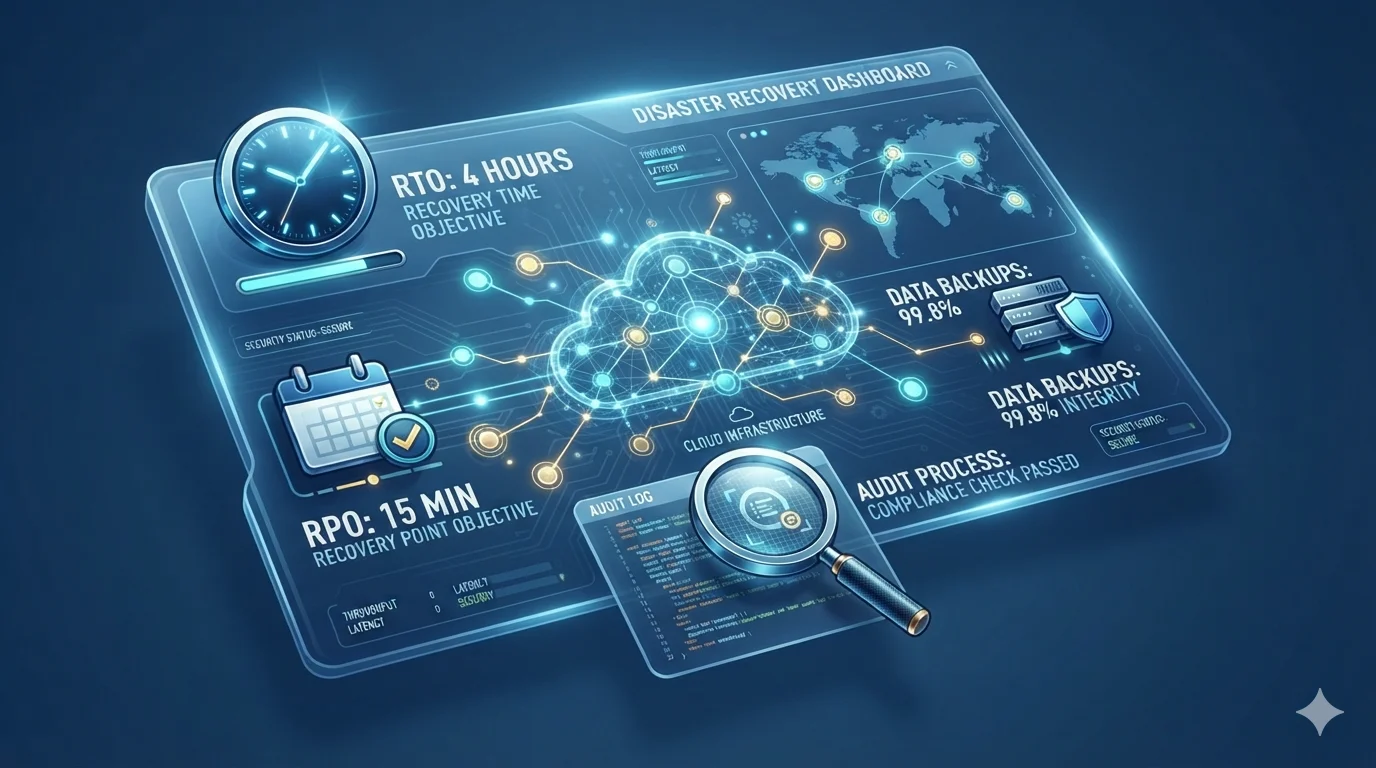
The Recovery Point Objective defines the maximum acceptable threshold for data loss, measured in time, prior to a disruptive incident. The RPO dictates the maximum sustainable data loss based on predefined backup schedules and enterprise data requirements. It forces the business to answer a fundamental question: How much historical data can the organization afford to lose before the loss inflicts unacceptable or irreparable harm? If a highly regulated financial institution sets an RPO of 15 minutes for its core transaction execution database, the underlying backup systems must capture, replicate, and secure data at least every 15 minutes. In the event of a catastrophic system failure occurring at 12:00 PM, the disaster recovery environment must be capable of restoring transactional data accurately up to 11:45 AM. The RPO directly dictates the technological approach to data storage, driving procurement decisions between inexpensive nightly tape backups, hourly virtual machine snapshots, or highly expensive Continuous Data Protection (CDP) and synchronous replication arrays.
Conversely, the Recovery Time Objective represents the maximum allowable duration required to restore critical IT systems, networks, and applications to a functional state following a declared disruption. The RTO forces the business to quantify how long it can survive without access to a specific application or service. If an e-commerce platform establishes an RTO of four hours, the information technology organization—or its designated Managed Service Provider (MSP)—must possess the infrastructure, personnel, and automated orchestration tools necessary to detect the failure, provision alternative compute resources, restore the operating system and applications from the RPO dataset, and successfully route user traffic to the secondary environment within that four-hour window.
| Metric Attribute | Recovery Point Objective (RPO) | Recovery Time Objective (RTO) |
|---|---|---|
| Primary Conceptual Focus | Data preservation, consistency, and historical integrity. | System availability, uptime, and resumption of future operations. |
| Measurement Timeline | Retrospective (Time elapsed before the disaster). | Prospective (Time elapsed after the disaster). |
| Technological Mitigation Strategies | Backup frequency, storage replication, immutable object locks, data vaulting. | Hot/warm standby sites, load balancing, automated hypervisor failover. |
| Direct Business Implication | Tolerance for permanent data loss and transaction unrecoverability. | Tolerance for operational downtime and service unavailability. |
| Primary Financial Cost Driver | High-performance storage capacity and network replication bandwidth. | Redundant compute infrastructure, licensing, and orchestration software. |
| Vendor Audit Artifact | Backup completion logs, synchronization status, replication lag metrics. | Failover test logs, incident response timestamps, infrastructure provisioning times. |
A common mistake in disaster recovery planning is the assumption that all data is equally important, leading organizations to apply a uniform RTO and RPO across the entire enterprise. This one-size-fits-all approach is highly inefficient. A customer-facing transaction database may require a near-zero RTO and a 1-hour RPO, whereas an internal human resources reporting tool or an archive of compliance records might easily tolerate a 72-hour RTO and a 24-hour RPO. The RTO and RPO must be explicitly mapped to data classification tiers to optimize infrastructure spending and recovery sequencing.
Maximum Tolerable Downtime (MTD) and Work Recovery Time (WRT)
A highly nuanced understanding of disaster recovery requires recognizing that the Recovery Time Objective does not exist in a vacuum; it is merely a subset of a broader, more critical metric known as Maximum Tolerable Downtime (MTD), which is alternatively referred to as Maximum Allowable Downtime (MAD). The MTD defines the absolute outer limit of time that a critical business function can be unavailable before the organization suffers existential financial, legal, or reputational destruction. The MTD represents the uncompromising ceiling that all technical and operational recovery efforts must respect.
However, restoring an information technology system (achieving the RTO) does not immediately equate to the restoration of business operations. A frequently overlooked and chronically miscalculated metric is Work Recovery Time (WRT). WRT accounts for the manual, human-driven effort required to return the business to a state of normal operation after the IT systems are brought back online. This duration includes catching up on operational backlogs, reconciling financial transactions that occurred during the outage window, re-entering data that was lost (representing the data lost within the RPO window), and verifying overall system integrity before releasing the application to end-users.
The fundamental mathematical relationship governing a successful, holistic recovery strategy is expressed as: RTO + WRT ≤ MTD.
If an organization miscalculates its WRT, it risks fundamentally breaching its MTD, even if the internal IT department or external cloud vendor successfully meets the contractual Service Level Agreement (SLA) for the RTO. For example, a hospital’s Business Impact Analysis may determine that its electronic patient records system has an MTD of 24 hours. If the IT department provisions the backup servers in 20 hours (RTO), the clinical and administrative staff only have 4 hours of WRT to manually input all patient vitals, medication administrations, and operational data recorded on paper during the 20-hour outage. If that manual data entry requires 10 hours, the MTD is breached, potentially violating regulatory mandates, degrading patient care, and triggering immense liability. Thus, senior leadership must constantly assess whether additional resources or compensating controls are required to compress the WRT and keep the total recovery cycle within the MTD.
The Evolving Threat Landscape and the Failures of Traditional Backups
The necessity for rigorous auditing and testing is starkly underscored by the historically high failure rates of traditional backup strategies. Industry statistics and post-incident forensic analyses reveal a deeply troubling reality regarding organizational preparedness: research indicates that approximately 26% of backup and disaster recovery strategies fail entirely during execution. Even more alarmingly, studies show that 58% of data backups fail to complete successfully, 60% of backup archives are incomplete, and 50% of all restoration attempts fail to return systems to a usable state.
Vectors of Backup and Restoration Failure
Backups and restoration operations fail for a multitude of technical and procedural reasons, spanning physical hardware limitations, network bottlenecks, and persistent human error.
Physical hardware limitations often manifest as an inability of the backup storage target to process high-velocity data ingest speeds, leading to scheduled job overlaps that eventually cause the entire backup scheduling system to crash. Network constraints and bandwidth limitations can similarly push backup jobs beyond their designated administrative windows, exposing critical data to periods of non-protection.
Furthermore, the phenomenon of “bit rot”—the silent, gradual degradation of magnetic or solid-state data on storage media over time—can render seemingly successful, mature backups entirely unreadable when accessed months or years later during a crisis. Complex IT environments also introduce integration failures; modern infrastructures span on-premises servers, private clouds, and Software-as-a-Service (SaaS) platforms, each requiring tailored backup methodologies. Applying legacy protocols to specialized environments routinely results in silent protection gaps.
Howewer, human error remains one of the most persistent vulnerabilities in business continuity. Misconfigured service accounts, the failure to add newly provisioned virtual machines to existing protection policies, the accidental modification of retention schedules, or simply forgetting to monitor automated job alerts routinely compromise an organization’s recovery posture.
The Ransomware Paradigm Shift and the 3-2-1-1-0 Rule
The proliferation of advanced, human-operated ransomware has fundamentally altered the parameters of disaster recovery. Cybercriminal syndicates operate with the explicit understanding that a victim possessing functional, accessible backups will refuse to pay the extortion demand. Consequently, modern ransomware variants actively seek out, corrupt, encrypt, or delete backup repositories, volume shadow copies, and disaster recovery replication targets before deploying their primary encryption payloads against production systems.
This grim reality renders traditional, network-attached backups highly vulnerable. If a vendor or internal IT team relies solely on legacy storage protocols like Server Message Block (SMB) or Network File System (NFS), lateral movement by an attacker will almost certainly result in the compromise of the recovery data alongside the primary data.
To mitigate this systemic risk, the cybersecurity and data protection industries have universally adopted and aggressively promoted the 3-2-1-1-0 Rule for data resilience. This framework mandates a highly diversified approach to storage media and geographic location:
- 3 copies of all critical data must be maintained (one primary production copy, and two backup copies).
- 2 different media types must be utilized (e.g., high-performance local disk arrays and cloud object storage) to protect against media-specific hardware failures.
- 1 copy must be stored entirely offsite or in an isolated geographic region to protect against regional natural disasters (e.g., floods, earthquakes).
- 1 copy must be stored offline (physically air-gapped) or on immutably locked storage.
- 0 errors must be confirmed during automated recovery verification and integrity testing.
Auditing Vendor Automated Backup Schedules: A Methodological Approach
As modern organizations aggressively migrate toward cloud computing, relying heavily on Managed Service Providers (MSPs) and SaaS platforms, the traditional perimeter of disaster recovery extends deep into third-party environments. The Shared Responsibility Model dictates that while the cloud provider ensures the availability of the infrastructure, the protection, classification, and recoverability of the data residing upon that infrastructure remains the ultimate responsibility of the customer. Organizations cannot simply abdicate responsibility for data protection to a vendor based on marketing claims; they must actively and rigorously audit the vendor’s backup architecture, scheduling cadence, and execution fidelity.
Standardized international frameworks, such as ISO/IEC 27001 and the American Institute of Certified Public Accountants (AICPA) Service Organization Control (SOC) 2 criteria, provide the foundational baselines for executing these vendor audits. Specifically, ISO 27001 Annex A Control 8.13 explicitly mandates that organizations maintain, protect, and regularly test backup copies of information against a formally documented policy aligned with business recovery needs. Similarly, the SOC 2 Trust Services Criteria for Availability dictate that environmental protections, backup processes, and recovery infrastructure must be deeply integrated and periodically tested to ensure operational resilience.
Defining the Audit Scope and Reviewing ISMS Policies
An effective vendor audit begins with the acquisition and critical analysis of the vendor’s documented Information Security Management System (ISMS) and specific Data Backup and Recovery Policy. A policy that relies on vague attestations is a primary risk indicator. The auditor must demand and verify a formalized, highly detailed strategy that delineates:
- Scope of Asset Coverage: The policy must explicitly catalog which assets are protected. This includes not just file servers and production databases, but also customer Personally Identifiable Information (PII), source code repositories, system state images, directory services, and critical infrastructure configurations.
- Scheduling Matrix: The exact frequency of full, differential, and incremental backups must be documented and cross-referenced against the contractual RPO agreed upon in the Master Service Agreement (MSA). If a vendor guarantees a 15-minute RPO for a financial ledger but the policy only mandates daily differential backups, the architecture is fundamentally incapable of meeting the SLA.
- Retention and Destruction Policies: The audit must confirm defined timelines for daily, weekly, and monthly snapshot retention. Furthermore, the policy must outline cryptographic or physical protocols for the secure, permanent destruction of data once the retention period naturally expires, a critical requirement for compliance with privacy frameworks like the General Data Protection Regulation (GDPR).
Verifying Automated Configuration and Job Execution
Manual backup processes are highly susceptible to human error, vacation schedules, and administrative oversight, introducing unacceptable gaps in data protection. The auditor must verify that the vendor utilizes highly automated, API-driven backup scheduling managed through a centralized console.
Evidence collection during this phase must move beyond policy reviews and mandate the delivery of technical artifacts. The auditing entity should formally request:
- Exported system logs or dashboard screenshots from the centralized backup management plane demonstrating job success, failure, and completion rates over a trailing 90-day period.
- Evidence of the alerting, monitoring, and incident response pipeline. The auditor must ask: If an automated backup job fails at 2:00 AM, does the system automatically generate a high-priority incident ticket via an integrated IT Service Management (ITSM) platform, and is a named on-call engineer held accountable for immediate remediation?
- Documentation of the Role-Based Access Control (RBAC) and identity management model governing the backup infrastructure. The management plane must be restricted to dedicated backup administrators enforcing Multi-Factor Authentication (MFA). These credentials must be physically and logically separated from standard domain administrator credentials to prevent lateral compromise during a directory services breach.
Evaluating Cryptography and Data Integrity Controls
Auditing a vendor’s schedule is entirely futile if the data being stored is mathematically corrupt, unreadable, or vulnerable to unauthorized interception. The vendor must provide irrefutable evidence of robust cryptographic controls and automated integrity checks.
| Control Area | Audit Requirement | Technological Standard |
|---|---|---|
| Encryption in Transit | Data must be encrypted while moving across networks to prevent packet sniffing and man-in-the-middle attacks. | TLS 1.2 or higher, utilizing AES-256 bit encryption. |
| Encryption at Rest | Data resting on storage media must be encrypted to prevent physical theft or unauthorized mounting of drives. | AES-256 encryption utilizing FIPS 140-3 validated cryptographic modules. |
| Key Management (KMS) | Cryptographic keys must be managed securely and segregated from the data they protect. | Keys must never be stored on the same infrastructure or within the same administrative domain as the backup data. |
| Data Immutability | Backups must be protected against malicious modification, deletion, or secondary encryption by ransomware. | WORM (Write-Once-Read-Many) configurations, Object Lock APIs, Air-gapped tape media. |
To combat bit rot and packet corruption, the vendor’s storage architecture must utilize continuous, cryptographic checksum validation. A checksum is a unique, fixed-length digital fingerprint generated from data using a specific algorithm (e.g., SHA-256).
For instance, enterprise cloud storage platforms like Amazon S3 calculate the checksum of a source object and validate it against the destination object upon writing; any mismatch immediately raises an alert. The auditor should confirm that the vendor’s backup software routinely executes these checksum verifications in the background (using operations like GetObject or HeadObject), automatically isolating and replacing corrupted blocks with healthy copies from redundant geographic storage arrays before data integrity is permanently compromised.
Regulatory Alignment: DORA, NIS2, and the Liability of Resilience
For organizations operating within, or supplying services to, the European market and the global financial sector, auditing vendor backups is no longer merely an IT best practice; it is a stringent, heavily enforced legal mandate. The regulatory landscape has shifted from passive guidelines to aggressive enforcement, characterized by the Digital Operational Resilience Act (DORA)—fully enforced across the EU in 2025—and the Network and Information Security (NIS2) Directive.
Under DORA, financial entities are legally obligated to oversee the cyber resilience of their Information and Communication Technology (ICT) vendors. DORA rests upon five core pillars, including strict requirements for ICT Risk Management, Incident Reporting, Digital Operational Resilience Testing, and rigorous Third-Party Risk Management. Financial institutions must verify that their vendors can demonstrably meet RTO and RPO targets, and they must provide a clean, traceable chain of evidence for every incident and test result to competent regulatory authorities upon request.
Similarly, the NIS2 Directive mandates that critical infrastructure and essential entities perform comprehensive supply chain risk assessments, including auditing software vendors and cloud providers. Incident reporting under NIS2 is exceptionally aggressive: organizations must issue an early warning within 24 hours of a major disruption, a detailed impact assessment within 72 hours, and a full forensic breakdown within one month. Crucially, NIS2 establishes personal liability for corporate officers; CEOs and CIOs who fail to oversee vendor resilience or approve adequate disaster recovery budgets can face temporary industry bans and massive corporate fines of up to €10 million or 2% of global turnover. Auditors must leverage these regulatory frameworks to force vendor compliance, demanding Software Bill of Materials (SBOM) for backup platforms and reviewing independent third-party vulnerability assessments as a condition of contract renewal.
Mandating Restoration Tests in Vendor Contracts and SLAs
The mere existence of a backup file provides a dangerous false sense of security if the restoration process itself remains untested. An untested disaster recovery plan is functionally equivalent to having no plan at all, as the complexity of modern infrastructure virtually guarantees that unforeseen dependencies will break during a crisis. When relying on a third-party vendor, an organization cannot leave recoverability to chance, trust, or best efforts; the obligation to perform periodic, successful restoration tests must be explicitly codified within the Service Level Agreement (SLA) and the overriding master contract.
Structuring the Disaster Recovery SLA
A robust Disaster Recovery SLA transforms the concept of recovery from a reactive, chaotic scramble into a managed, highly predictable, and quantifiable service. The contract must explicitly define the parameters of the service, the operational responsibilities of both the provider and the client, and the financial repercussions of failure.
Key operational and legal clauses that must be negotiated into the vendor contract include:
- Explicit RTO and RPO Guarantees: The SLA must document the precise Recovery Time Objective and Recovery Point Objective for each specific tier of data and application. These metrics must mathematically align with the client’s internal Business Impact Analysis.
- Definition of Downtime and Error Rates: Contractual ambiguity inherently favors the vendor. The contract must strictly and mathematically define what constitutes an “outage,” a “trigger event,” or “downtime.” For example, an SLA might define downtime as a scenario where a covered service experiences an error rate greater than 5% for valid requests over a period of 5 or more consecutive minutes.
- Mandatory Testing Frequencies and Methodologies: The SLA must legally compel the vendor to execute restoration tests at a predefined cadence. Highly critical, revenue-generating systems should be tested quarterly, while standard operational systems must be tested at least annually. The contract should clearly stipulate the required methodology for these tests (e.g., parallel testing versus full-interruption testing) to prevent the vendor from substituting a simple tabletop discussion for a technical infrastructure validation.
- The “Right to Audit” Clause: Organizations must retain the absolute contractual authority to independently verify the vendor’s compliance posture. This critical clause allows the client to spontaneously request raw test logs, review post-mortem reports of failed recovery exercises, or even dispatch independent third-party auditors to assess the vendor’s physical data centers and logical infrastructure configurations.
- Financial Credits, Remedies, and Penalties: If the vendor fails to meet the specified RTO/RPO during a live disaster, or if they fail to provide evidence of successful periodic testing, the SLA must enforce immediate service credits. Escalating penalty tiers are standard; for instance, severe breaches or extended downtime periods could mandate a financial credit returning 10%, 25%, or up to 50% of the monthly billing amount for the impacted services.
Software Escrow and Defined Exit Strategies
In scenarios where the vendor is providing a highly customized or proprietary SaaS application, standard data backups may be insufficient to ensure continuity if the vendor experiences a catastrophic business failure, sudden acquisition, or bankruptcy. To ensure true systemic resilience, the master contract should include a comprehensive software escrow agreement.
A software escrow mechanism places the vendor’s proprietary source code, software build instructions, deployment scripts, and vital architectural documentation into the secure, neutral custody of an independent third-party escrow agent. The SLA carefully defines specific “release conditions”—such as the vendor missing critical uptime SLAs for a prolonged period, declaring insolvency, or discontinuing support for the software. If a release condition is triggered, the escrow agent automatically releases the source code and operational documentation to the client, ensuring the business can maintain, patch, and run the software independently, thereby preserving continuity. Global regulators, particularly under the DORA framework, explicitly encourage such escrow arrangements to actively mitigate systemic concentration risk among financial institutions and critical infrastructure operators.
Additionally, the contract must mandate a defined, tested exit strategy. Vendors must be legally bound to provide extensive exit assistance, certify the secure cryptographic destruction of all client data upon termination of the relationship, and guarantee the complete export of all data assets in standard, open, non-proprietary formats to facilitate migration to alternative providers.
Verifying Periodic Restoration Tests and Crisis Usability
Once the contractual mandates are firmly established, the operational challenge transitions to verifying that the vendor is actually executing the required tests, and more importantly, that the restored data is genuinely consistent, uncorrupted, and usable in a live crisis. Reviewing a simple checkbox on an annual compliance form is grossly inadequate; true verification requires deep technical insight into the vendor’s testing methodology and validation architecture.
The Spectrum of Restoration Testing
When auditing a vendor’s testing regime, it is vital to assess the technical depth and realism of the exercises. Several testing typologies escalate in complexity and value:
| Testing Methodology | Description | Technical Validation Value | Operational Risk |
|---|---|---|---|
| Tabletop Exercises | Facilitated theoretical discussions where key personnel talk through a disruption scenario and validate communication paths. | None. Validates administrative policies and contact rosters, but provides zero proof of technical recoverability. | Zero. No impact on production systems. |
| Walkthrough & Simulation | Validating specific, isolated components of the DR plan (e.g., verifying a server boots in a sandbox) without impacting broader production environments. | Moderate. Proves individual systems can be restored, but ignores complex application interdependencies. | Very Low. |
| Parallel Testing | Restoring data and launching secondary systems concurrently with the primary production environment to execute data integrity checks. | High. Proves data usability and recovery timelines without risking disruption to live end-users. | Low. |
| Full Interruption Testing | Intentionally shutting down or failing over the primary production environment to force operations onto the secondary DR site. | Absolute. The only definitive proof that the entire orchestration engine, network routing, and data replication function within the defined RTO and MTD. | High. |
Carries the risk of causing an actual outage if the failover fails. Auditors should expect a mature vendor to utilize a combination of tabletop exercises for ongoing personnel training and automated parallel testing for frequent technical validation, reserving full interruption tests for annual or bi-annual deep architectural validations.
Automated Testing and Validation Pipelines
Modern cloud architectures enable the automated, continuous validation of recovery points, fundamentally changing how resilience is proven. Rather than relying on manual, resource-intensive, and infrequent restoration drills, advanced vendors deploy event-driven automation to continuously verify backup usability at scale.
For example, utilizing a framework like AWS Backup, a vendor can architect a fully automated, programmatic validation pipeline:
- Initiation: The backup engine successfully captures an incremental snapshot of a primary resource, such as an Amazon EC2 instance or an Amazon RDS database.
- Event Trigger: The completion of the backup job natively emits a system event via Amazon EventBridge.
- Execution: This event immediately triggers a serverless AWS Lambda function designed specifically for restore testing.
- Provisioning: The Lambda function issues an API call instructing the backup engine to restore the database into a secure, isolated Virtual Private Cloud (VPC) testing sandbox, entirely segregated from production.
- Validation: Once the infrastructure is provisioned, a secondary Lambda function connects to the newly restored database and executes a series of application-specific SELECT queries to verify table integrity, row counts, schema consistency, and referential constraints.
- Reporting and Cleanup: The script logs the total time taken (empirically validating the RTO capability), deletes the temporary infrastructure to optimize cloud costs, and writes the success or failure state to an immutable compliance audit log.
When verifying vendor tests, an auditor must move beyond verbal assurances and request the raw output logs from these automated pipelines. The documentation must clearly display the timestamp of the snapshot initiation, the timestamp of the completed restore, and the empirical validation output of the data consistency checks.
Mitigating Re-Infection: Secure Restoration and Malware Scanning
A profound and frequently catastrophic danger in modern disaster recovery is the inadvertent re-introduction of malware into a pristine recovery environment. Advanced ransomware operators frequently utilize extensive “dwell time”—lurking undetected within a victim’s network for weeks or months, harvesting credentials and mapping architecture, before finally detonating their encryption payloads. Consequently, executing a rollback to a backup taken three weeks prior may successfully restore a functional operating system, but it will almost certainly also restore the dormant malware triggers, backdoor accounts, and exfiltration tools, setting the stage for an immediate secondary attack upon recovery.
To combat this devastating cycle, the verification of a vendor’s recovery process must include a forensic analysis of their data sanitization protocols during the restoration phase. Industry-leading DR orchestration platforms (such as the Veeam Data Platform) employ automated, orchestrated sandbox environments, often referred to as DataLabs or Secure Restore functionalities, to ensure systemic hygiene.
Before a vendor moves recovered data back into the production network, the restoration pipeline must mandate an intermediary quarantine and scanning phase. The technical mechanics of this secure restore process involve:
- Isolated Mounting: Mounting the backup data disks directly to a heavily isolated, network-segmented mount server, ensuring the restored machine cannot communicate with the broader network.
- Heuristic and Signature Scanning: Automatically triggering updated, third-party antivirus engines (e.g., Microsoft Windows Defender, Symantec Protection Engine, ESET) and AI-driven YARA rules to aggressively scan the entire file system of the restored virtual machine.
- Threat Hunting: Hunting for known Indicators of Compromise (IoCs), encrypted file patterns, suspicious execution scripts, or dormant dual-use hacker utilities (e.g., Cobalt Strike payloads) mapped directly to the MITRE ATT&CK framework.
If the automated scan detects an infection or suspicious artifact, the orchestration software must adhere to strict, predefined administrative policies: either aborting the recovery entirely and flagging the backup as compromised, or proceeding to restore the virtual machine with all Virtual Network Interface Cards (vNICs) administratively disabled. This latter option allows security and forensic analysts to extract pristine data manually or analyze the malware without risking lateral spread across the recovered network.
When auditing a vendor, requesting documented proof of “Secure Restore” integrations or inline malware scanning during the recovery process is non-negotiable. It proves that the vendor understands that data recovery is no longer merely an IT storage function, but a highly sensitive, critical cybersecurity operation.
Reviewing Auditor Artifacts and Compliance Reports
Ultimately, verifying continuous vendor testing requires the intelligent consumption and analysis of third-party audit artifacts. An organization should, at minimum, annually request the vendor’s SOC 2 Type II report. Unlike a SOC 2 Type I report, which only assesses the theoretical design of security controls at a single, specific point in time, a Type II report rigorously evaluates the operating effectiveness of those controls over a prolonged period (typically a 6 to 12-month audit window).
The reviewing auditor should navigate directly to the Trust Services Criteria for Availability within the report and examine the external auditor’s commentary regarding the testing of the DR plan. A flawless SOC 2 report should contain absolutely no exceptions under criteria A1.2 (environmental protections and backup processes) and A1.3 (testing of recovery procedures). If the vendor’s external auditing firm noted exceptions such as “testing frequency was insufficient,” “documentation of test results was incomplete,” or “critical business functions were omitted from the test scope,” the contracting organization must immediately issue a formal Corrective and Preventive Action (CAPA) request to the vendor, demanding swift remediation and proof of compliance.
Furthermore, post-test documentation must demonstrate an active, continuous improvement lifecycle. Following any restoration exercise (or any real-world incident response), the vendor should systematically generate a formal Post-Incident Review (PIR). Drawing upon frameworks like the PICERL model (Preparation, Identification, Containment, Eradication, Recovery, Learning), the PIR must extensively document the root cause of any delays, identify exactly what worked and what failed against the established RTO/RPO targets, and outline specific, measurable remediation steps with designated owners and strict deadlines. The consistent presence of highly detailed, self-critical PIRs indicates a mature vendor that is genuinely committed to the continuous optimization of its resilience posture, rather than merely treating disaster recovery as a compliance checkbox.
Conclusion
The architecture of business continuity can no longer afford to be a static, heavily documented, but rarely executed set of theoretical policies collecting dust in an administrative binder. The critical metrics of Recovery Point Objective, Recovery Time Objective, Maximum Tolerable Downtime, and Work Recovery Time represent absolute, unforgiving constraints that govern an organization’s ability to survive catastrophic disruptions.
As corporate digital footprints expand exponentially into cloud infrastructures, interconnected software ecosystems, and third-party vendor platforms, the perimeter of enterprise risk management expands concurrently. Organizations must systematically abandon the dangerous assumption that a signed Service Level Agreement guarantees data recovery. Instead, they must deploy rigorous, technically exhaustive audit methodologies to actively verify vendor backup schedules, validate the cryptographic immutability of offline data, and contractually mandate aggressive, automated restoration testing.
By demanding uncompromising contractual accountability, enforcing the implementation of automated recovery validation pipelines, and integrating advanced cybersecurity threat-hunting directly into the restoration process, organizations transcend passive compliance. They forge a state of genuine, proactive operational resilience, ensuring that when a systemic crisis inevitably occurs, recovery is not merely a hopeful expectation, but a verifiable, deeply engineered certainty.