The Science of Stand-Up: Analyzing What Makes Us Laugh
The Architecture of Laughter: Deconstructing the Mechanics, Psychology, and Performative Art of Stand-Up Comedy
Stand-up comedy is widely perceived by the uninitiated as a spontaneous, conversational art form—a solitary individual standing before an audience, seemingly sharing off-the-cuff observations and serendipitous humor. In reality, a successful stand-up routine is a highly engineered, meticulously crafted architectural structure. It demands a precise synthesis of linguistic economy, psychological manipulation, cognitive pacing, and theatrical stagecraft. From the granular mechanics of a single setup-punchline pairing to the macro-structural sequencing of an hour-long theatrical special, the art form operates on rigid, identifiable frameworks that govern what succeeds in eliciting laughter and what inevitably fails.
Historically, stand-up comedy evolved from the highly structured, multi-disciplinary environments of late nineteenth-century popular entertainment. The lineage traces back to American Vaudeville, the stump-speech monologues of minstrel shows (which controversially relied on white actors in blackface perpetuating harmful racial stereotypes), dime museums, freak shows, and the English music halls. Early pioneers, such as humorist Mark Twain with his 1866 touring show, Artemus Ward, and Charlie Case, began isolating the comedic monologue from broader theatrical productions. Over the course of the twentieth century—particularly through the crucible of the Chitlin’ Circuit and the American Mafia-owned nightclubs of the 1930s to the 1950s—performers were forced to rely less on props, costumes, and musical accompaniment, and increasingly on pure verbal communication and persona.
This transition stripped the performance down to its barest essentials: a microphone, a performer, and an audience. Modern evolution saw the rise of dedicated comedy clubs in the 1970s, which served as vital training grounds for performers to refine material through immediate feedback. The medium has continued to adapt to technological shifts, transitioning from intimate club venues to globally televised specials, and even sustaining itself through the COVID-19 pandemic via Zoom performances, rooftops, and parking lot shows. Across all these eras and mediums, the fundamental requirement remains the same: the comedian must master the intricate psychological and mechanical systems that trigger human laughter.
The Psychological and Cognitive Foundations of Humor
Before deconstructing how a joke is built mechanically, it is necessary to examine why a joke functions on a neurological and psychological level. The success of a comedic routine relies entirely on the performer’s ability to manipulate the audience’s expectations, cognitive processing capacity, and emotional tension. Academic literature and contemporary humor researchers primarily point to several dominant theories of humor, which are consistently weaponized by professional comedians.
Incongruity, Relief, and Superiority Theories
In contemporary academic literature, three theories of humor appear repeatedly, forming the bedrock of comedic psychological manipulation.
The first and most predominant is the Incongruity Theory. This framework posits that humor arises from the perception of a mismatch, paradox, or absurdity. The comedian creates a logical expectation and subsequently shatters it with a sudden, unexpected twist. However, the joy of the joke lies not merely in the surprise, but in the cognitive resolution. The human brain catches the twist, resolves the mismatch, and rewards the listener with laughter. This cognitive resolution is what separates human humor from animalistic surprise; while a dog might tilt its head at a strange sound, it does not reinterpret absurdity for intellectual amusement. Confusion without this clarity and logical resolution yields no laughter; a muddled premise simply results in audience alienation.
The second foundational framework is Relief Theory, or release theory, which is largely attributed to the psychoanalytic perspectives of Sigmund Freud. This theory suggests that humor acts as a mechanism for releasing pent-up nervous energy and psychological tension. Stand-up comedians routinely build tension by discussing taboo, stressful, or highly charged societal subjects, only to provide a psychological release valve through the punchline. This affective process explains why jokes confronting uncomfortable subjects—such as trauma, sexual fiascos, or political anxiety—can elicit disproportionately large laughs; the laughter is the physical manifestation of psychological stress leaving the body.
The third is Superiority Theory, which dictates that humor derives from recognizing the misfortunes, flaws, or absurdities of others, thereby creating a momentary feeling of superiority and affective disposition in the audience. In modern stand-up, comedians often direct this superiority inward through self-deprecation, allowing the audience to feel superior to the performer, which fosters endearment and lowers defensive barriers.
The Benign Violation Theory (BVT)
An increasingly cited framework in modern comedy analysis, which attempts to synthesize and combine the older models, is the Benign Violation Theory. Propounded by researchers such as Peter McGraw, this theory dictates that humor occurs only when three specific conditions are met simultaneously:
- First, a situation must threaten one’s sense of how the world “ought to be,” constituting a violation of social norms, moral codes, or linguistic rules.
- Second, the threatening situation must be immediately appraised as benign, harmless, or acceptable by the observer.
- Third, the observer must be able to hold both the violation and the benign interpretation in their mind at the exact same time.
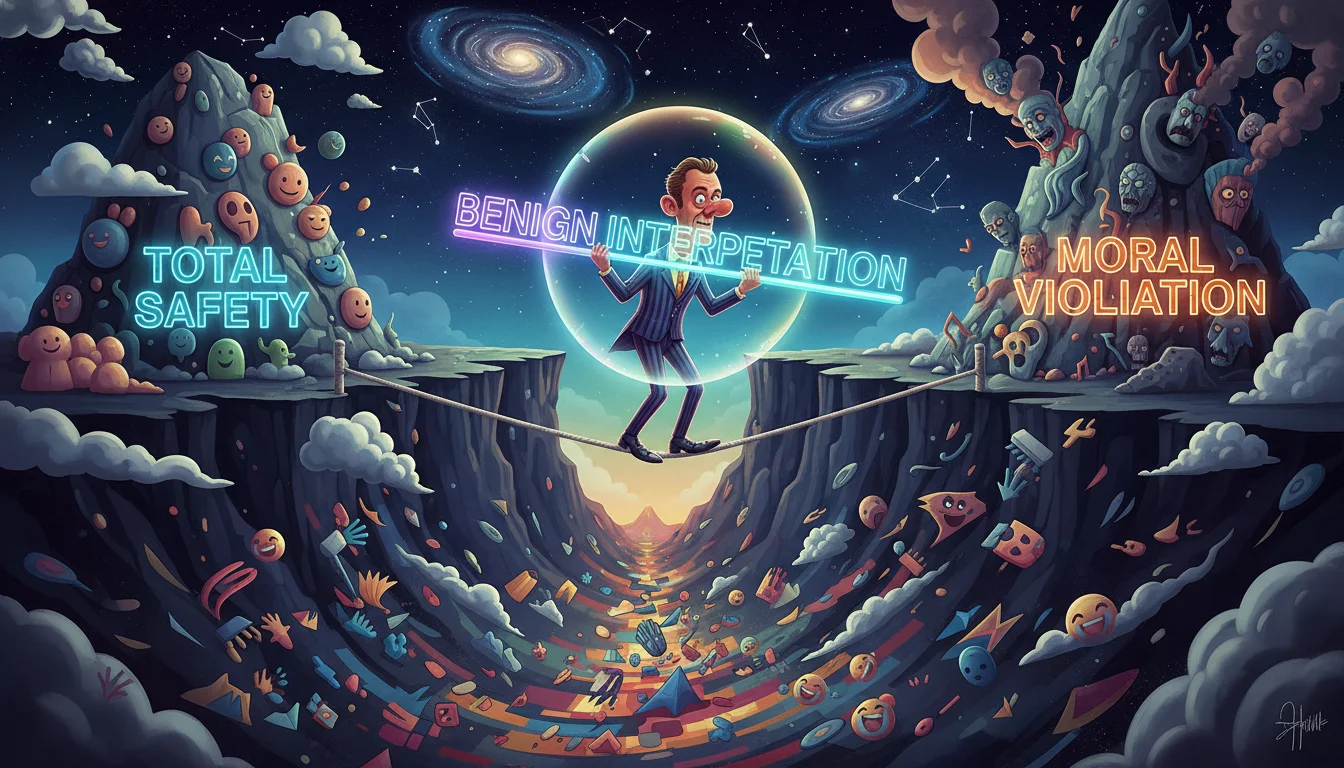
This theory perfectly maps the delicate tightrope professional comedians walk. If a joke is too benign, it is perceived as boring, safe, and predictable, often resulting in what the industry terms “hack” comedy. Conversely, if the violation is too severe, the audience feels genuine threat, disgust, or offense, and the joke fails to elicit laughter. The comedian’s primary role, therefore, is to construct a psychological safety net, allowing the audience to approach moral transgressions and societal taboos from a secure, non-threatening distance.
Cognitive Load and Orders of Intentionality
Laughter triggered by verbal storytelling requires complex mentalizing—the ability to understand multiple layers of intent and the mindstates of third parties. Research into the cognitive demand of jokes reveals a strict biological correlation between the levels of intentionality (understanding who thinks what about whom) and how funny a joke is perceived to be.
Jokes typically operate at three to five orders of intentionality. A comedian must track their own intent, the audience’s understanding of that intent, the perspective of a character within the joke, and that character’s perception of another character’s mindstate. Evolutionary anthropology indicates there is a firm biological limit to this mentalizing capability. The quality and perceived funniness of a joke peak at the fifth or sixth level of intentionality. Beyond this threshold, the cognitive load exceeds normal human constraints, causing the joke’s premise to collapse under its own weight, resulting in confusion. A comedian’s relentless pursuit of precise word choice and syllable economy is fundamentally an exercise in managing this cognitive load for the audience.
Mental Health, Resilience, and Liquid Modernity
Beyond mere entertainment, stand-up comedy functions as a profound therapeutic tool and a reflection of societal mental health.
Engaging in and performing stand-up comedy offers a powerful medium for reframing traumatic experiences, fostering social connectedness, and enhancing emotional resilience. It enables performers, particularly those with neurodiverse traits or lived experiences of psychological distress, to reclaim personal narratives and establish peer-supported communities. The CHIME framework (Connectedness, Hope, Identity, Meaning and Purpose, and Empowerment) is frequently utilized to evaluate how comedy interventions impact mental health recovery.
The stereotype of the “troubled comedian” stems from this dynamic; funny people often utilize humor to modulate social groups and cope with unhappiness. Modern documentary filmmaking and academic studies on “unhappy” stand-up comedy frame the art form as a reflection of liquid modernity—a response to the constant pressures, fears of failure, and complex personal issues inherent in contemporary society. The courage to perform and the honesty required to mine humor from loneliness or adversity strip away tedious self-pity, replacing it with empowering, communal laughter.
Micro-Architecture: The Mechanics of a Joke
A stand-up set is not a random sequence of funny thoughts; it is an architectural arrangement of specific linguistic structures. At the micro-level, the fundamental unit of stand-up comedy is the “bit” or the joke, which consists of highly codified components designed to exploit cognitive incongruity. Industry pedagogical systems, such as the Joke Prospector Writing System within the Greg Dean Method, formalize these technical components.
The Premise, the Setup, and the Punchline
The universal formula for a joke involves a premise, a point of view, and a twist. The process begins with the Premise, which establishes the foundational topic paired with a specific condition (such as a setting, situation, or personal viewpoint). A strong premise must instantly spark interest or emotion, creating acute anticipation from the audience for an explanation or solution. It often states the comedian’s emotional reaction directly in the setup. For example, establishing a lineage of being both Irish and Native American immediately invokes cultural stereotypes regarding alcohol, creating a premise that demands resolution.
The Setup is the mechanical device used to establish a false expectation in the minds of the audience. Its technical purpose is to purposefully misdirect the audience down a specific, logical path.
The Punchline is the payoff, the second part of the one-liner meant to get a laugh. It shatters the expectation built by the setup, revealing a new, unexpected, yet entirely compatible reality. If a joke fails before the punchline is delivered, it is often due to “telegraphing”—a technical failure where the setup inadvertently reveals too much information, allowing the audience to guess the punchline prematurely, thereby destroying the necessary surprise.
The Five Internal Mechanisms of Joke Structure
According to the technical frameworks utilized by comedy instructors to codify stand-up skills, the interplay between setup and punchline relies on five specific internal mechanisms. These mechanisms dictate exactly how incongruity is generated and resolved.
- 1. Target Assumption: The expected, obvious interpretation of the setup that deliberately misdirects the audience’s cognitive focus away from the punchline.
- 2. Connector: The central pivot point of all comedy. A single element (often an ambiguity, word, or concept) hidden within the setup that possesses at least two distinct interpretations.
- 3. Reinterpretation: The unexpected but logically compatible second meaning of the Connector. This is the technical mechanism that creates the surprise.
- 4. 1st Story: The initial mental scene or narrative generated in the audience’s imagination during the delivery of the setup.
- 5. 2nd Story: The sudden, shifting mental image forced upon the audience by the punchline, instantly replacing the 1st Story with a new reality.
Tags, Toppers, and the Rule of Three
A professional comedian rarely abandons a premise after a single punchline. To maximize their “LPMs” (Laughs Per Minute)—where 5 LPMs is considered the professional standard—comedians utilize “tags,” sometimes referred to as toppers. A tag is an additional punchline appended to the end of a completed joke (creating a Setup > Punchline > Tag structure). Tags are highly efficient because they do not require a new setup; they ride the established momentum of the original joke. Writers enhance jokes by applying specific humor heightening devices to their tags, such as exaggeration, anthropomorphizing objects, providing a fantasy outlet for frustration, or employing cinematic “cut forward to” imagery.
The most ubiquitous technical rhythm used in formatting these tags and punchlines is the “Rule of Three.” This structure relies on establishing a pattern and then immediately subverting it: establish, reinforce, surprise. The human brain requires a minimum of two data points to recognize a pattern and form an expectation. Therefore, the first two items in a comedic list build the Target Assumption, and the third item delivers the Reinterpretation. Comedy demands narrative economy; extending a list to four or five items unnecessarily dilutes the tension. The phonetic selection of words within this structure is vital. For instance, the sequence “Monday, Tuesday, Banana” functions effectively because “banana” introduces an absurd phonetic subversion, whereas “Monday, Tuesday, Norway” lacks the necessary comedic punch, demonstrating the vital importance of word choice—particularly words with hard consonant sounds like ‘k’ or ‘b’.
The Architecture of Callbacks
Another highly effective structural device is the callback. A callback is a reference to a joke, punchline, or premise that was established much earlier in the set. Callbacks consistently generate outsized laughter because they reward the audience for having paid attention, creating an “in-joke” that unifies the crowd.
For a callback to function effectively, the original reference must be highly specific and memorable. A vague setup like “I went to a restaurant” provides no anchor; a specific setup like “I went to a restaurant where the waiter pronounced every vegetable in French” creates a memorable hook. Furthermore, there must be a sufficient gap in time—often spanning many pages of material or even across multiple episodes in televised formats—to allow the audience to momentarily forget the joke. Bringing a joke back too quickly robs it of the necessary element of surprise, rendering it ineffective.
Macro-Architecture: Structuring the Comedy Routine
The transition from an open-mic beginner possessing a handful of isolated jokes to a headlining comedian requires mastering the macro-architecture of a routine. A set must be viewed as an intentional sequencing of material designed to control crowd energy and build trust over time.
Expanding Bits and the “Tight Five”
The foundational building block of a comedy career is the “tight five”—a flawlessly executed five-minute set that showcases a comedian’s strongest, most reliable material, complete with conversational transitions linking a distinct beginning, middle, and end. Open mics rarely offer more than five minutes, and industry bookers rarely watch submission tapes longer than this duration.
To expand isolated short jokes into a cohesive, longer routine, comedians must relentlessly mine their premises. Methodologies for expansion include exploring counter-arguments to their own premises (a technique frequently utilized to argue the audience into a specific viewpoint before hitting them with a counter-punchline), heightening the narrative stakes, or shifting the status dynamic by placing the punchline in the mouth of another character, such as a child.
The BCAs System of Set Construction
Comedians utilize grading systems, such as the ABCs, to evaluate the laugh-yield and overall quality of their material, with ‘A’ representing the absolute strongest jokes. However, when constructing the actual sequence of a routine, the most effective structural organization is the “BCAs” format.
- “B” Material (The Opener): Placed at the very beginning of the set. This material must be robust enough to immediately capture attention, establish the comedian’s persona, and prove competence to a cold, skeptical audience.
- “C” Material (The Middle): Placed in the center of the routine. The middle of a set is the optimal operational zone for narrative building, experimentation, and integrating slightly weaker or newly written material. At this stage, the audience is already engaged, and the comedian has built sufficient goodwill to take creative risks without losing the room.
- “A” Material (The Closer): Placed at the end. A set must always conclude with the comedian’s absolute strongest, highest-performing material. The closure leaves a lasting psychological imprint on the audience, dictating their final assessment of the performer and often calling back to earlier bits to provide narrative closure.
The structure of a routine is heavily influenced by the specific stylistic genre the comedian inhabits.
Different styles demand different cognitive skills and present unique areas for potential growth.
| Comedy Style | Skills Highlighted | Potential Growth Areas & Risks |
|---|---|---|
| Observational | Keen perception, finding humor in the mundane, strong writing, relatable delivery. | Risk of material feeling generic; may require the development of stronger act-outs to add dynamic range. |
| Anecdotal / Storytelling | Narrative structure, emotional range, vulnerability, building tension over extended periods. | Risk of self-indulgence; requires tightening of setups and trimming of unnecessary details to maintain LPMs. |
| One-Liner | Brevity, wordplay, precise timing, rapid transitions between disparate ideas. | Sets can feel disjointed without an underlying theme; requires strong stage presence to compensate for lack of narrative. |
| Character / Physical | Body control, acting ability, consistency in persona, visual storytelling. | Risk of relying solely on physicality without substantive writing; the character must maintain a clear point of view. |
| Dark Comedy | Navigating sensitive topics, finding humor in uncomfortable truths, extreme confidence. | High risk of alienating or offending the audience if the benign violation is miscalibrated. |
The Performative Dimension: Stagecraft, Timing, and Delivery
A perfectly engineered joke will inevitably fail if the performative execution is flawed. Stand-up comedy relies on a precise rhythm negotiated between the performer and the audience, requiring mastery over timing, physical presence, vocal modulation, and stagecraft.
The Power of Silence: Pregnant and Poignant Pauses
Timing is not merely about speaking; it is primarily about the strategic deployment of silence. The use of intentional silence is a critical differentiator between amateurs and experts.
The “pregnant pause” is a deliberate elongation of silence—often several seconds long—positioned directly before a punchline or during a moment of heightened narrative tension. This silence activates the audience’s imagination, forcing them to lean in and amplifying their cognitive anticipation, which drastically heightens the eventual psychological relief provided by the punchline. Conversely, the “poignant pause” is utilized after a powerful statement, serving as a pedestal to elevate the significance of the remark and isolate points of wisdom.
In advanced stagecraft, pauses are measured in heartbeats rather than seconds. Furthermore, skilled public speakers use the “ponder pause” to allow profound statements to sink in, or use silence as a clean alternative to verbal fillers like “ums” and “ahs,” which distract the audience and project insecurity. A performance lacking these pauses devolves into a breathless, unnatural monologue; the inclusion of silence transforms the set into a dialogue where the audience is an active, participating entity.
Microphone Technique and Stage Dominance
Advanced stagecraft involves total subconscious mastery over the physical tools of the medium, specifically the microphone and its accompanying stand. Proper mic technique ensures the comedian remains visually connected to the audience while avoiding technical distractions that can ruin comedic timing.
| Technical Element | Best Practices and Advanced Techniques | Common Mistakes to Avoid |
|---|---|---|
| Approach and Entry | Smile and make immediate eye contact while approaching the stage. Start talking as applause dies down, before the room goes completely silent. | Approaching stone-faced or waiting until the mic is perfectly adjusted before acknowledging the crowd. |
| Microphone Grip | Hold the handle. Keep the mic at a 45-degree angle, slightly below the mouth to ensure the audience can see the comedian’s facial expressions. | Cupping the grill of the microphone like a rapper (causes severe vocal distortion). Shoving the mic directly into the mouth (unsanitary and obscures the face). |
| Mic Stand Management | If removing the mic, lift from the thickest middle section. Immediately move the stand behind or to the side of the performance space. Check joint stability before the show. | Leaving the empty mic stand directly in front of the body, which creates a psychological and physical barrier between the performer and the crowd. |
| Cord Control | Loop the cord exactly once around the holding hand. This alleviates weight pressure on the connector and prevents the mic from cutting out if the cord is stepped on. | Playing with the cord nervously. Looping the cord multiple times, which becomes highly distracting when the comedian walks and drops the loops. |
| Vocal Dynamics | Move the mic closer when whispering for intimate effect; pull it completely away when shouting to prevent audio peaking. | Failing to adjust mic distance relative to volume, resulting in pierced eardrums or missed setups. |
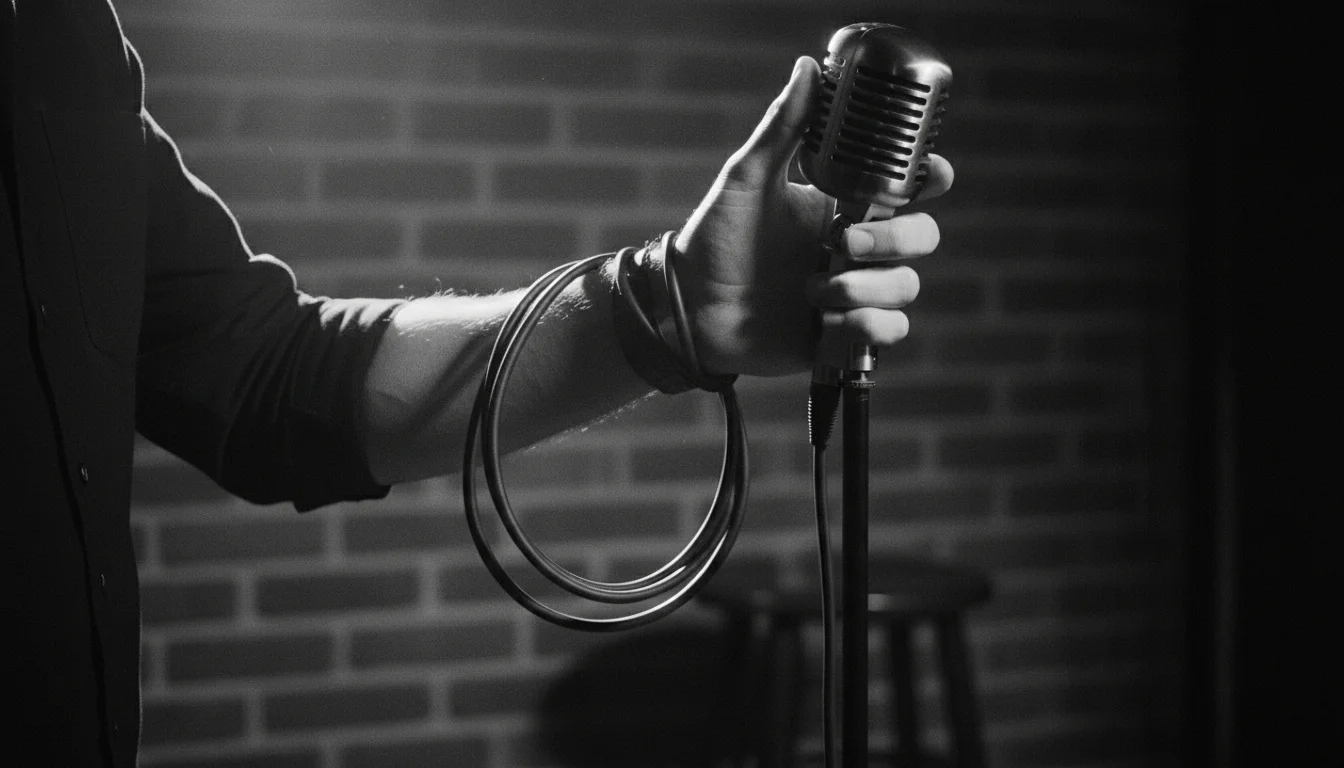
When technical failures occur—such as a cord dropping or a mic cutting out—advanced comedians fix the issue seamlessly without offering a running commentary to the audience, maintaining the illusion of total control.
Advanced Dynamics: Crowd Work and Authentic Persona
While tightly crafted jokes form the backbone of a set, the ability to inject unpredictability through crowd interaction and raw authenticity is what elevates a performer to the highest echelons of the industry.
The Mechanics of Crowd Work
Crowd work—the act of spontaneously interacting with the audience—was historically utilized merely to stall or add time to a set, but has evolved into a vital skill for generating highly engaging, post-worthy content. Effective crowd work is not random; it relies on acute observational skills, high emotional intelligence, and structural framing.
When engaging an audience member, the foundational rule is to obtain their name. Names act as comedic currency; integrating an audience member’s name into a callback later in the set creates a deeply personalized, localized inside joke that makes the entire room feel seen and engaged. Successful crowd work requires listening like a detective. The comedian must listen for the first unusual thing—a nervous laugh, a voice crack, an over-explanation—and treat those details as concrete “facts” to construct a new comedic premise.
Strategically, comedians must ask simple, binary questions (e.g., “Do you prefer concerts or sporting events?”) rather than broad inquiries (“What do you do for fun?”) to control the narrative direction and prevent the interaction from derailing. To avoid “locking up” during unscripted moments, experienced comedians utilize the “premise system” on the fly. By identifying a subject in the crowd and instantly attaching a negative opinion or an exaggerated consequence to it, the comedian can synthesize a joke out of any response, ensuring they always have an exit strategy back into their prepared material.
The primary pitfall of crowd work is crossing the line into mean-spiritedness. While audiences will enthusiastically side with a comedian destroying an aggressive heckler, they will rapidly turn against a performer who ruthlessly mocks an innocent attendee who is simply trying to enjoy the show. The objective is to tease the audience without alienating them, maintaining the delicate balance required by the Benign Violation Theory.
Forging an Authentic Persona
A stand-up routine is delivered not just by a person, but by a “persona.” A comedic persona is rarely a complete fabrication; rather, it is a highly concentrated, exaggerated distillation of the performer’s actual personality traits. Developing this persona requires years of stage time to understand the inherent friction between how the comedian perceives themselves and how the audience perceives them.
The most effective personas frequently exploit the performer’s “blind spots” or their physical and social flaws. Comedy thrives on self-awareness and vulnerability. For instance, humor can be consistently generated by adopting a low-status stance, or by allowing genuine negative emotions and annoyances to slip through a facade of manufactured positivity.
Above all, authenticity is paramount. Audiences are highly attuned to artifice; if a comedian is merely “chasing the laugh” through fabricated stories that lack emotional truth, the material will feel hollow and disconnected. The pursuit of authenticity dictates that a comedian’s routine must reflect their genuine worldview, anxieties, and observations. As noted by industry analysts, the difference between a beginner and a master often lies in the willingness to abandon the effort of pretending to be a generic “comedian” and simply be the most authentic, albeit magnified, version of oneself on stage. The awareness of one’s own awkwardness, and the recognition that all humans are driven by similar animalistic impulses, forms the basis of true relatability. Steve Martin’s observation regarding the French having a different word for everything is an example of an overly obvious, honest truth serving as the core of a comedic premise.
The Anatomy of Comedic Failure and “Hack” Material
Understanding what works in stand-up comedy inherently requires a rigorous analysis of what fails. Comedic failure—colloquially known in the industry as “bombing,” “dying,” or “eating it”—is an unavoidable reality of the profession.
Beginner Mistakes and Mechanical Failures
Novice comedians consistently fall victim to mechanical and procedural errors.
Driven by nerves, they frequently speed through their act, rattling off jokes to simply get through the script. This rushing tramples over the spaces where laughter should occur, effectively teaching the audience to remain quiet. A failure to properly memorize material leads to a reliance on filler words and notes, destroying the conversational illusion and crippling comedic timing. Beginners also suffer from poor stage presence, such as looking down at the floor rather than maintaining commanding eye contact. Furthermore, violating the unspoken rules of the venue—specifically, ignoring the one-minute warning light and doing more time than requested—disrupts the show’s flow and alienates the performer from bookers and peers.
The Trap of Hack Comedy
Material fails fundamentally when it becomes entirely predictable, violating the core tenet of Incongruity Theory. “Hack” comedy refers to premises, punchlines, or stylistic crutches that are obvious, overused, or blatantly stolen. It is characterized by intellectual laziness and a reliance on cliches rather than original thought.
Hack comedians rely on tired linguistic phrases to manage the room rather than relying on strong material. Starting a set with the ubiquitous, “How y’all doing tonight?” immediately signals a lack of originality to the audience. Using defensive or placating phrases like “This guy knows what I mean,” “Too soon?”, “Keep drinking,” or “Are there any [insert ethnicity] people here tonight?” exposes a comedian’s profound insecurity when their material fails to land organically. Announcing “That’s my time” or complaining about getting the light pulls back the curtain unnecessarily and ruins the suspension of disbelief.
Furthermore, relying on deeply saturated, overdone premises—such as colonoscopies, dating apps, or generic political grandstanding that takes a safe, universally agreeable stance to trigger “applause breaks” rather than actual laughter—results in routines that are utterly forgettable. Shock value for its own sake (e.g., unwarranted taboo subjects or offensive slurs) without a cleverly structured cognitive twist also falls into the realm of hack comedy, as it utilizes mere offense and discomfort as a cheap substitute for wit.
The Psychology of Bombing and Advanced Resilience
When professional comedians bomb, the failure is rarely due to a lack of preparation, but rather a miscalibration of the audience, the cultural context, or the timing. Interestingly, veteran comedians often develop a profound psychological resilience to bombing. Performers like Norm MacDonald famously found deep existential humor in the failure itself, recognizing the sheer absurdity of confidently executing a perfectly crafted joke only to be met with dead silence.
The hallmark of a master comedian is the ability to maintain control under extreme duress. Advanced performers are capable of generating laughs during the dreaded “Check Drop”—the moment at the end of a show when bills are distributed and audience energy plummets—by deploying quick, high-energy crowd work. True professionals can kill in highly undesirable venues, such as afternoon casino gigs or rodeos, and can seamlessly handle bizarre interruptions like a medical emergency in the crowd without losing control of the room.
Case Studies in Methodological Divergence
To fully synthesize how these mechanical, linguistic, and structural theories operate at the absolute highest echelons of the art form, it is highly instructive to examine the differing, heavily documented methodologies of historically significant comedians.
Jerry Seinfeld: Micro-Mechanics and Syllable Economy
Jerry Seinfeld’s methodology exemplifies the extreme micro-management of linguistic structure. Seinfeld approaches joke writing with the precision of a watchmaker or a musical composer. He writes entirely longhand on yellow legal pads using a specific clear-barrel blue Bic pen, deliberately avoiding the modern computer screen because he dislikes the pressure of the “flashing cursor” and wishes to control the tactile pace of his thought process.
Seinfeld’s famous, constantly evolving routine deconstructing the invention of the “Pop-Tart” provides a masterclass in structural evolution. He spent over two years refining a single, seemingly trivial observation into a polished routine. His process reveals strict architectural priorities:
- First, the opening line must be inherently funny to immediately seize the audience’s momentum; he achieves this by stating that as a child, the invention of the Pop-Tart “blew the back of his head off.”
- Second, Seinfeld focuses heavily on phonetics and specific imagery. He selects words that inherently sound amusing and paints absurd pictures. To contrast the novelty of the Pop-Tart, he describes the bleakness of 1960s breakfasts: frozen orange juice that had to be hacked at with an ice pick, and shredded wheat that felt like “wrapping your lips around a wood chipper.” He likens children swarming a Pop-Tart to “chimps” with “sticks” circling an obelisk in the dirt, choosing words with hard consonants for maximum impact.
- Third, he relentlessly edits for compression, shaving off individual syllables and counting letters to tighten the rhythm. The ultimate goal is to trigger “the roll,” a cascading psychological effect where the jokes are placed so close together that the audience cannot fully stop laughing before the next punchline hits.
- Finally, he ensures that the structural anchor is sound: the absolute biggest laugh must be rigorously positioned at the very end to maximize the closure of the bit.
George Carlin: Linguistic Deconstruction and The Database
Where Seinfeld focuses on observational minutiae and childhood nostalgia, the late George Carlin operated as a structural linguist and aggressive social commentator. Carlin’s comedy relied on the precise deconstruction of language itself, exposing societal hypocrisies and cultural shifts through the evolution of vocabulary.
Carlin’s celebrated routine on “soft language” systematically tracks how visceral, accurate terminology was incrementally diluted over decades into sterile euphemisms designed to hide human pain. He brilliantly maps how the direct phrase “shell shock” from World War I morphed into “battle fatigue,” then the multi-syllabic “operational exhaustion,” and finally the clinical, detached jargon of “post-traumatic stress disorder,” which he argued successfully buries the humanity of the condition entirely. He similarly deconstructed how “car crashes” became “automobile accidents,” and how a “dump” was rebranded as “environmental reclamation.” By utilizing conceptual and ontological metaphors, Carlin defamiliarized everyday language, forcing the audience to look objectively at the words they mindlessly consume.
To support this dense, highly intellectual style, Carlin maintained a fastidious, lifelong organizational system that rivaled an academic researcher. He did not rely on spontaneous stage inspiration; instead, he curated over 1,400 digital files and thousands of physical paper notes, categorized meticulously by theme and topic. When an idea struck from watching television or reading, he would write it down to create an initial cognitive pathway. He would return weeks later to rewrite and expand upon the note, repeatedly layering his observations and building deeper neurological paths until the argument was robust enough for stage presentation.
Stewart Lee and Andy Kaufman: Anti-Comedy and Metareference
At the furthest extreme of the comedic spectrum lies “anti-comedy”—a genre that deliberately subverts, deconstructs, and violates the established rules and structures of the art form itself. Practitioners of anti-comedy leverage the audience’s deep-seated, subconscious knowledge of standard joke architecture (setups, punchlines, the rule of three) and use that exact expectation against them to generate humor through discomfort.
Andy Kaufman pioneered this approach in the 1970s and 80s by blurring the lines between performer and character. Utilizing his “Foreign Man” persona, he deliberately employed awkward timing, intentional failure, and audience alienation to create a tension that refused to release in traditional ways, forcing the audience to laugh at the sheer audacity of the performance.
Decades later, British comedian Stewart Lee elevated this subversion through hyper-intellectual metacomedy. Lee’s performances consist of routine deconstructions occurring in real-time. Instead of telling a joke, his stage persona—an arrogant, embittered intellectual who views his own audience with palpable disdain—will painstakingly explain the mechanics of the joke he is actively refusing to tell. He has developed a “metareferential oeuvre” across specials like Stand-Up Comedian, 90’s Comedian, and 41st Best Stand-Up Ever, where the subject of the comedy is the comedy itself.
Lee frequently weaponizes the Rule of Three; rather than providing the expected subversion on the third beat, he will knowingly deconstruct the rule to the audience, or he will repeat a phrase excessively—sometimes dozens of times—pushing the audience through initial amusement, into deep boredom, into outright hostility, and finally into a state of hysterical, absurd surrender. For instance, in his famous “rap singers” bit on Stewart Lee’s Comedy Vehicle, he utilizes agonizing repetition, repeatedly stating variations of “the rap singers…”
“behind the multi-storey,” willfully refusing to advance the narrative or provide a punchline, turning the structural delay itself into the primary joke. Anti-comedy ultimately proves that as long as the underlying psychological principle of tension and release is managed, the actual vehicle for that tension does not need to conform to a traditional setup and punchline.
By mapping these divergent methodologies—from Seinfeld’s microscopic syllable manipulation to Carlin’s vast linguistic databases and Lee’s metareferential subversion—it becomes evident that mastering stand-up requires an absolute command over the psychological and structural boundaries of human communication. The solitary figure on stage is not merely talking; they are executing a rigorously tested, complex psychological blueprint designed to reliably manufacture incongruity and orchestrate human laughter.
To continue exploring this topic, read Building Your Digital Foundation: WordPress in Nepal, Beyond the Launch: Common Web Development Failures in Nepal, Your Comprehensive PPC Guide for Nepal: Mastering Paid Advertising, and Top SEO Mistakes Nepali Businesses Make (And How to Fix Them).