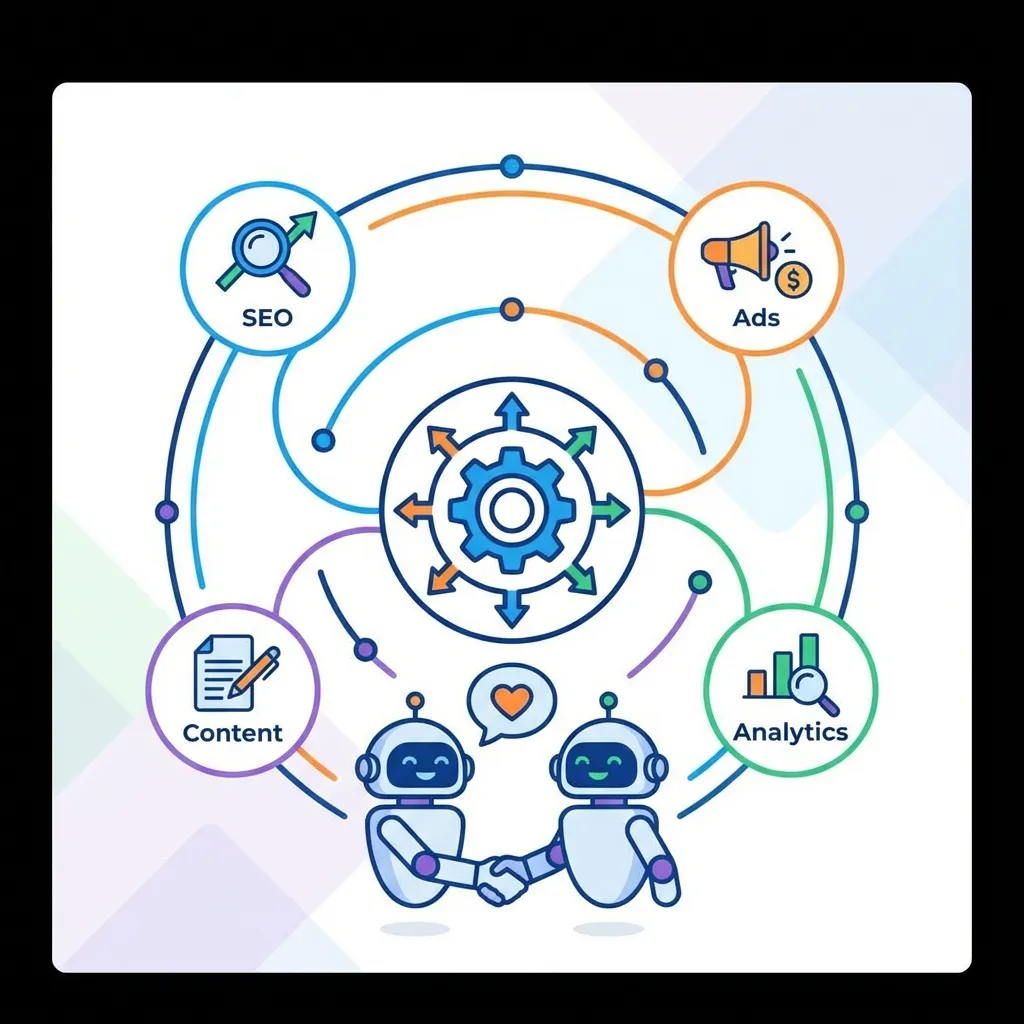
Session 24: A2 Finalization & Integrated Campaign Review
Block 4: Email Automation, Influencer Briefs, Analytics & Finalizing A2
View lecture slides: Session 24 Slides
Template: final A2 check against the Agency Content & A/B Test Matrix — dates, variables, and hypotheses all still aligned.
1-Hour Lecture (Theory & Strategy)
- The final agency test: can you present a campaign strategy (A1), content/creative system (A2), and technical audit (A3) as one coherent story, not three disconnected assignments?
- Integrated review framing: strategy (A1) sets the objective and budget → content/ads (A2) execute acquisition and retention → the SEO audit (A3) protects and compounds organic growth alongside paid spend.
- Recap the Phase 1 capstone pitch structure for format inspiration: Phase 1 Session 8 note.
- This is a review and consolidation session, not new theory — the goal is a clean, submission-ready package across all three assignments.
flowchart TD
    A1[A1: Strategy and Budget] --> EXEC[Execute Acquisition and Retention]
    A2[A2: Content / Ads / Email / A/B Tests] --> EXEC
    EXEC --> A3[A3: SEO Audit Protects Organic Growth]
    A1 --> REV[5-Min Integrated Review Deck]
    A2 --> REV
    A3 --> REV
    S23[S23 Analytics Report] --> REV
    REV --> SUB[Submit A1 + A2 + A3]
Figure 1: Integrated campaign review across A1, A2, and A3
Key Concepts in Depth
The capstone shows that the three assignments are one system:
| Assignment | Question it answers | Feeds into |
|---|---|---|
| A1 Campaign Strategy | Where is the problem, what is the objective, and what budget does it need? | Targets and budget for A2 and A3 |
| A2 Content & Execution | How do we attract, convert and retain people? | Traffic and leads measured in reports |
| A3 SEO Mini-Audit | How do we protect and compound organic growth? | Lowers long-run CAC; supports paid search relevance |
A coherent story uses the same numbers everywhere: the leak from Session 9, the CPL from Session 10, the test plan from Session 15, the fixes from Session 19 and the results from Session 23.
Answering the “fund only one” question: compare options on incremental results per rupee, time to impact, and risk. Quick technical fixes often win because they are cheap and make every other channel work better, but the argument must be made with numbers, not preference.
Final quality check across the package: consistent figures, consistent persona and brand voice, every KPI measurable, every claim compliant, and sources or assumptions labelled.
Worked Example: Pathshala Tutors (Running Case)
Integrated review: four slides
- A1: “Fixing the pricing-page leak plus NPR 25,000/month in Capture/Create/Compound/Retain delivers about 60 leads and 12 enrolments at a CAC of about NPR 2,083.”
- A2: “A four-pillar calendar, three tested ad angles, one micro-influencer, and three email flows move Sita from first ad to enrolment.”
- A3: “Three fixes this week — unblock course pages, compress the hero image, add negatives — recover about NPR 3,750 a month and let six pages rank.”
- Results: “October leads up 40% (30 → 42); next: shift NPR 3,000 to Search.”
“Fund only one” answer (with numbers):
| Option | Cost | Expected extra leads/month | Time to impact |
|---|---|---|---|
| A3 quick wins | About 1 day of work | ~7 (NPR 3,750 recovered ÷ NPR 500 CPL), plus organic leads from six unblocked pages | 2–6 weeks |
| More Meta spend (+NPR 5,000) | NPR 5,000/month | ~13–16 | 1–2 weeks |
| Full content programme (A2) | NPR 5,000/month + staff time | ~12 organic, growing | 3–6 months |
Recommendation: fund A3 quick wins first. They cost almost nothing, they make every paid rupee work harder, and the leads they recover keep arriving after the work is done.
1-Hour Lab (Agency Execution)
- Assemble your final A2 package: content calendar (Session 13) + ad copy/creative (Session 14) + A/B test plan (Session 15) + influencer/UGC plan (Session 16) + email automation flows (Session 21). Submit as one organized document/deck.
- Prepare a short (5-minute) integrated review: one slide summarizing A1’s objective/budget, one slide summarizing A2’s execution system, one slide summarizing A3’s top 3 priority fixes, and one slide with your Session 23 analytics report.
- Present to a partner or small group; be ready to answer: “If you only had budget to execute ONE of these three assignments next quarter, which would you fund first, and why?”
- Submit all three assignments (A1, A2, A3) if not already finalized, plus your integrated review deck.
Common Mistakes
- Presenting three separate assignments with different numbers, personas or goals.
- Introducing new, unsupported ideas in the capstone instead of consolidating.
- Answering “which would you fund?” with opinion instead of cost, impact and time.
- Submitting without a final consistency check across A1, A2 and A3.
Deliverable: Phase 2 Complete — A1, A2, A3 Submitted
Congratulations — you have completed the full 48-hour, 24-session MBA Digital Marketing course: from building a sandbox (Phase 1) to running it like an agency, with an audit-backed, budget-justified, multi-channel campaign package (Phase 2).
Summary
The final session consolidates A1 (strategy and budget), A2 (content and execution) and A3 (SEO audit) into one integrated story built on consistent numbers. The capstone tests whether you can defend investment choices with evidence: cost, expected impact, time to impact and risk.
Key Takeaways
- One client, one persona, one set of numbers across all assignments.
- Strategy sets targets, execution delivers them, and SEO compounds them.
- Defend choices with incremental impact per rupee.
- Consistency and compliance are part of the grade.
Review Questions
Short answer
- Explain how A1, A2 and A3 connect to each other.
- Name three criteria for choosing which initiative to fund first.
- What should you check for consistency before final submission?
Applied (case) questions
- For your own sandbox, answer: “If you could fund only one of A1, A2 or A3 next quarter, which would it be?” Support your answer with a cost and impact table.
- A client says SEO “takes too long” and wants all budget in ads. Using the integrated model, write a persuasive 150-word response.
Return to the Phase 2 Hub or the Phase 1 Syllabus for the full course map.