Learning Objectives
By the end of this chapter, you will be able to:
- Define what a business process is and its role in creating value.
- Identify the three key components of any business process.
- Provide examples of common business processes in areas like sales, finance, and HR.
- Explain why understanding and documenting business processes is crucial for organizational improvement.
What is a Business Process?
A business process is a collection of linked, structured activities or tasks performed by people or equipment which, in a specific sequence, produces a service or product for a particular customer or customers. It represents a fundamental building block of how a business operates and creates value.
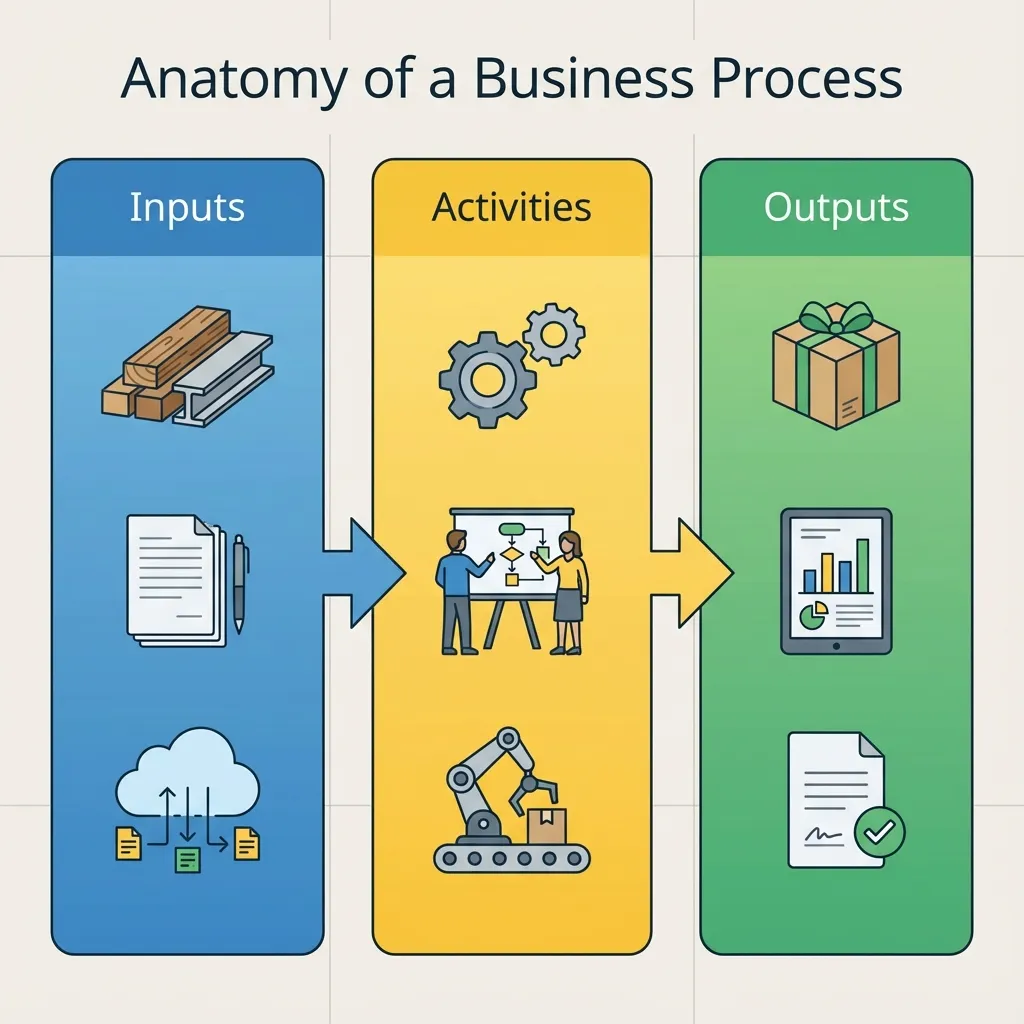 Figure 1: Business Process Flow
flowchart LR
    subgraph PROCESS["Business Process"]
        direction LR
        INPUT["📥 INPUTS\nMaterials, Data,\nResources"]
        ACTIVITY["⚙️ ACTIVITIES\nTransformation\nSteps"]
        OUTPUT["📤 OUTPUTS\nProducts,\nServices, Results"]
    end

    INPUT --> ACTIVITY
    ACTIVITY --> OUTPUT
    OUTPUT --> VALUE["💰 Customer Value"]

    style VALUE fill:#2d5016,color:#fff
Figure 2: The Three Components of a Business Process
Key Components of a Business Process
Every business process, regardless of its complexity, consists of three essential components:
- Inputs: The materials, data, or resources that are required to start the process. For example, in an order fulfillment process, the primary input is the customer’s order.
- Activities/Tasks: The series of steps that transform the inputs into the desired outputs. This can involve actions by people, machines, or software. For example, picking the items from the warehouse, packing them, and arranging for shipping.
- Outputs: The final product, service, or result that is delivered to the customer or another process. The output must provide value to the recipient. For example, the delivered package to the customer.
Examples of Business Processes Across Functional Areas
Business processes exist in every part of an organization:
- Sales & Marketing:
- Lead Generation: Identifying and attracting potential customers.
- Order Fulfillment: Processing a customer order from receipt to delivery.
- Finance & Accounting:
- Invoicing: Creating and sending bills to customers.
- Procurement: The process of acquiring goods or services, from identifying a need to making a payment (
procure-to-pay).
- Human Resources:
- Employee Onboarding: The process of integrating a new employee into the organization.
- Payroll Processing: Calculating and distributing employee salaries.
- Manufacturing & Operations:
- Product Assembly: Assembling components into a finished product.
- Quality Control: Inspecting products to ensure they meet required standards.
The Importance of Understanding Processes
Organizations cannot effectively manage what they do not understand. Documenting and analyzing business processes is crucial for several reasons:
- Identifying Inefficiencies: Finding bottlenecks, redundant steps, or areas of waste.
- Ensuring Consistency: Standardizing processes ensures that tasks are performed in the same way every time, leading to predictable quality and outcomes.
- Training Employees: Clearly defined processes are essential for effectively training new employees.
- Enabling Improvement: Once a process is understood and documented, it can be improved, re-engineered, or automated using Information Technology. This forms the basis for all process improvement initiatives.
Summary
A business process is a structured set of activities designed to produce a specific output for a customer. Composed of inputs, activities, and outputs, these processes are the fundamental mechanisms through which an organization creates value. Understanding, documenting, and analyzing these processes is the first and most critical step toward improving operational efficiency and effectiveness.
Key Takeaways
- A business process transforms inputs into valuable outputs.
- Processes are the building blocks of all organizational operations.
- Documenting processes is essential for consistency, training, and improvement.
- Every functional area of a business relies on a set of core processes.
Discussion Questions
- Choose a simple, everyday activity (like making a sandwich or doing laundry) and describe it as a business process, identifying its inputs, activities, and outputs.
- Why might a company with poorly defined business processes struggle to grow?
- How can two companies in the same industry have different business processes for the same function (e.g., hiring an employee)? What might be the advantages of one over the other?