M&A Integration Matrix: Consolidating Physical Operations
The M&A Integration Matrix: A Framework for Consolidating Physical Operations Post-Acquisition
Introduction to Post-Acquisition Dynamics and the Integration Imperative
The consolidation of commercial enterprises through mergers and acquisitions (M&A) represents one of the most prominent mechanisms for accelerating corporate growth, expanding into novel geographical markets, and achieving strategic renewal. However, the empirical record of M&A activity is characterized by a profound paradox: despite the sophisticated financial modeling and strategic rationale that precipitate these transactions, a vast majority fail to realize their anticipated economic value. Comprehensive industry analyses demonstrate that between 50% and 85% of all mergers and acquisitions ultimately fail or underperform, and up to 60% of significant mergers actively destroy shareholder value. While preliminary failures are occasionally attributed to pre-deal miscalculations—such as financial overvaluation, inadequate due diligence, or fundamentally flawed strategic logic—the most profound vulnerabilities typically materialize during the post-merger integration (PMI) phase.
Post-merger integration is an extraordinarily complex, enterprise-wide business process that requires the harmonization of disparate organizational structures, corporate cultures, administrative workflows, and, critically, physical operations. It unfolds in the aftermath of the deal closure as executives attempt to reconfigure the merging firms by redeploying, adding, or divesting resources, product lines, or entire business units to achieve the combination benefits initially promised to shareholders. Of all the dimensions involved in PMI, the integration of physical operations—encompassing manufacturing facilities, supply chain networks, distribution centers, and heavy capital equipment—represents one of the most capital-intensive, structurally rigid, and high-risk challenges in the integration lifecycle.
Unlike software ecosystems, intellectual property, or administrative procedures, physical assets are bound by geographical realities, logistical physics, long-term real estate lease structures, and stringent environmental regulations. Consequently, executing a seamless physical integration requires a highly sophisticated prescriptive framework that moves beyond rudimentary cost-cutting. It demands a nuanced approach to strategic interdependence, operational continuity, and capability transfer.
This comprehensive research report provides an exhaustive analysis of the M&A Integration Matrix, heavily informed by the seminal theoretical frameworks of scholars such as Haspeslagh and Jemison and Paul Shrivastava. By synthesizing these academic models with contemporary supply chain logistics, risk management protocols, and empirical case studies, this analysis elucidates the structural mechanisms through which acquiring entities can systematically consolidate physical operations. The ensuing discussion maps the multidimensional intersections of asset rationalization, network optimization, regulatory compliance, industrial symbiosis, and change management, ultimately yielding a strategic blueprint for maximizing synergy realization in the post-acquisition environment.
Epistemological and Theoretical Foundations of Post-Acquisition Integration
To navigate the immense complexities of physical consolidation, it is necessary to ground operational tactics in established organizational and integration theory. The academic literature demarcates integration into distinct typologies that govern how two discrete entities merge their respective resource bases, cultures, and physical infrastructures.
The Philosophy of Organizational Change in M&A
At its core, a merger or acquisition is an exercise in profound organizational change. The theoretical underpinnings of this change can be understood through the matrix developed by Burrell and Morgan, which distinguishes between the “sociology of radical change” and the “sociology of regulation”. When applied to the consolidation of physical operations, acquiring firms are perpetually caught between these two sociological forces. The consolidation of manufacturing plants and the liquidation of redundant physical assets represent a radical structural upheaval. Simultaneously, the firm must maintain operational continuity, adhere strictly to regulatory compliance, and ensure the uninterrupted flow of the supply chain—all of which require stringent regulation and control.
Furthermore, the integration process aligns with the process models of organizational change articulated by Van de Ven and Poole. Physical integration often follows a dialectic change process, where the opposing operational models of the acquirer and the target collide. This collision ideally results in a synthesis that is revolutionary, creating a newly optimized supply chain network. However, the typical breakdowns in this dialectic process—such as destructive conflict, power imbalances between the merging management teams, and irresolvable differences in manufacturing philosophies—are precisely what cause the high failure rates observed in cross-border M&A.
Shrivastava’s Dimensions of Integration
Paul Shrivastava established a foundational framework identifying that the primary hurdle in efficient M&A execution lies in the synchronization of multifaceted organizational components into a single functioning entity. Shrivastava conceptualizes post-acquisition integration across three distinct, yet deeply interdependent, levels:
- Procedural Integration: This level involves the homogenization and standardization of administrative systems, legal entities, accounting procedures, management control, and strategic business unit (SBU) operations. The primary objective is to create a common operational language and facilitate frictionless communication between the acquirer and the acquiree.
- Physical Integration: This dimension is the focal point of physical operations consolidation. It encompasses the tangible combination of product lines, production technologies, research and development (R&D) projects, plant facilities, heavy equipment, and real estate assets. Physical integration is directly concerned with the structural reconfiguration of the value chain, the sharing of tangible resources to create resource value, and the systematic elimination of redundant operational capacity.
- Managerial and Sociocultural Integration: This involves the complex alignment of organizational structures, the selection or transfer of executive leadership, the motivation of personnel, and the development of a unified corporate culture that can guide strategic decision-making in the newly merged entity.
Shrivastava notes that unrelated operations generally involve a minimum blend of resources and therefore require low post-acquisition integration, whereas related operations—where the acquirer and target operate in similar industries—often necessitate extremely high levels of physical integration to capture economies of scale.
The Haspeslagh and Jemison Integration Matrix
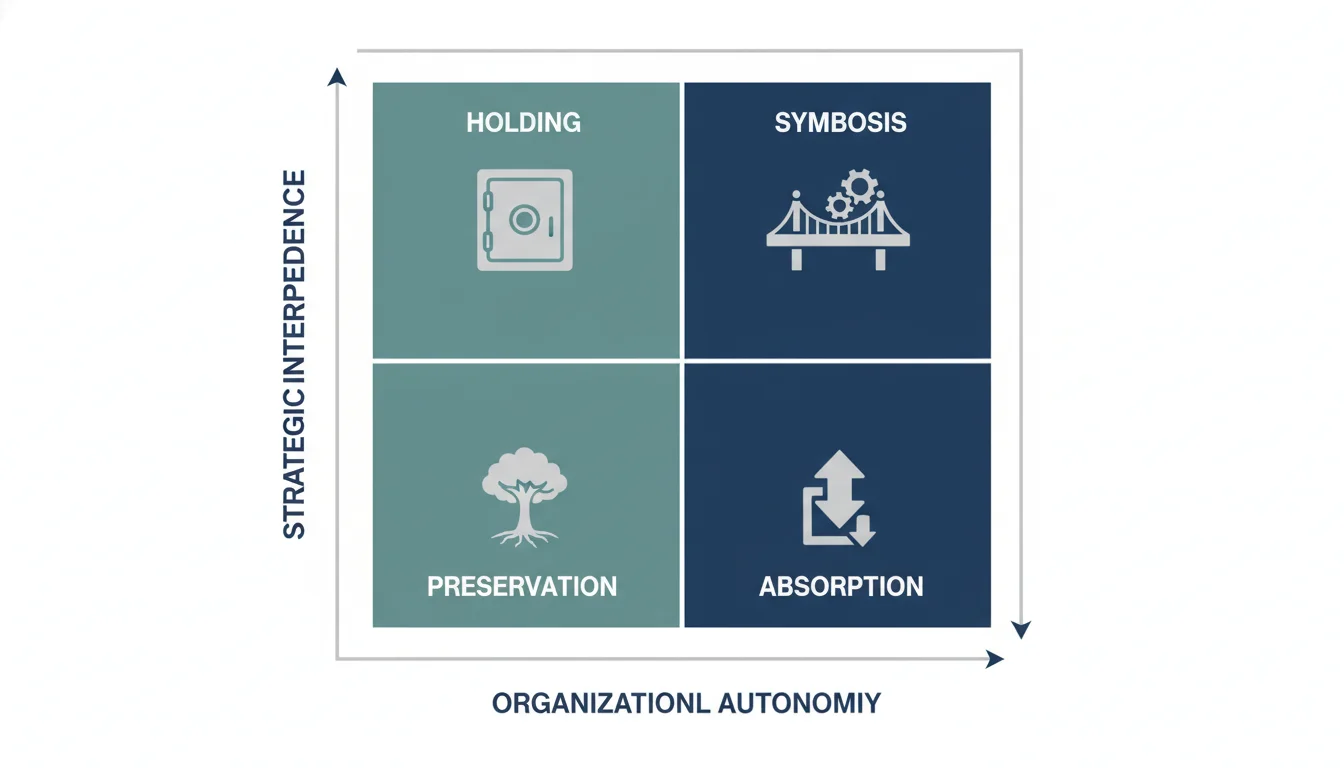
Building upon the necessity to align integration tactics with strategic intent, Philippe Haspeslagh and David Jemison developed a prescriptive framework known as the Acquisition Integration Approach (AIA) model, widely referred to as the M&A Integration Matrix. They argue that the success of an acquisition depends on the management’s ability to reconcile two conflicting needs. This matrix dictates the optimal integration strategy by evaluating the trade-off between these two critical dimensions:
- Need for Strategic Interdependence: The extent to which value creation and competitive advantage depend on the transfer of strategic capabilities, resource sharing, and operational combination between the two firms. High interdependence necessitates deep operational entanglement to unlock combination benefits, such as enhanced purchasing power, shared services, or manufacturing economies of scale.
- Need for Organizational Autonomy: The degree to which the target firm must remain independent to preserve its unique capabilities, corporate culture, and operational identity. If the target’s value is deeply embedded in its distinct operational agility, proprietary manufacturing processes, or localized customer relationships, heavy-handed integration may destroy the very asset that motivated the acquisition in the first place.
Plotting these two variables yields four distinct integration approaches that dictate the fate of the target’s physical operations:
| Integration Typology | Strategic Interdependence | Organizational Autonomy | Characteristics of Physical Operations Integration |
|---|---|---|---|
| Holding | Low | Low | No physical integration occurs. The target functions as an entirely independent portfolio asset. Capital allocation is centralized at the holding company level, but physical plants, logistics networks, and supply chains remain entirely separated. The primary motive is financial risk reduction. |
| Preservation | Low | High | Minimal physical integration. Operations are carefully ring-fenced to protect the target’s unique capabilities. Synergies are limited to selective engagement, while factories, production lines, and logistics networks remain highly autonomous. Intervention is usually limited to overarching financial controls. |
| Absorption | High | Low | Complete structural and physical consolidation. Target boundaries are dissolved. Redundant factories are aggressively closed, supply chains are merged, and physical assets are fully rationalized under the acquirer’s dominant operating model. This approach is highly disruptive and requires massive procedural and physical integration. |
| Symbiosis | High | High | Complex, phased integration. Both entities initially co-exist but gradually intertwine over time. |
Best practices in manufacturing are selectively transferred. Supply chains may be synchronized without necessarily closing all duplicate facilities, creating a highly resilient, dual-sourcing network that balances scale with flexibility.
Later scholarship has sought to refine and recast this typology to better reflect modern integration realities. For example, Ellis et al. and other researchers utilizing cluster analysis have proposed new integration styles such as “Reorientation” and “Intensive Care”.
Under a Reorientation acquisition, a financially healthy company is acquired, and integration is stratified; administrative and outward-facing functions (like sales and marketing) are highly coordinated to achieve exploitation gains, while core physical operations (production and development) are left independent to allow for exploration gains. This demonstrates that value capture and value creation can co-exist. Furthermore, the traditional “Holding” strategy has been re-labeled by some as “Intensive Care” to reflect a more active restructuring approach where the parent company aggressively intervenes to fix failing physical operations before allowing the subsidiary to operate autonomously.
The Structural Alignment of Physical Assets: Measuring Integration
The theoretical matrices dictate what integration approach should be taken, but realizing that approach requires aligning physical operations with the overarching corporate strategy. The activity-based view of strategy, originally championed by Michael Porter, indicates that strategic competitive advantage is sustained only when strategically relevant, cross-functional activities are meticulously tailored and optimized. Physical supply chains and manufacturing plants are the tangible manifestations of these activities.
This concept is further illuminated by the McKinsey 7S framework (Peters and Waterman, 1982), which posits that organizational effectiveness depends on the interplay of Strategy, Structure, Systems, Shared Values, Skills, Staff, and Style. In the context of M&A, physical integration directly targets the “Structure” and “Systems” components. If a firm’s strategy demands an “Absorption” integration to achieve cost leadership, the physical structure of the newly merged entity must be completely overhauled to eliminate redundancies.
Measuring the Extent of Physical Integration
While integration is widely accepted as the key driver of post-acquisition performance, quantifying the actual degree of physical integration has historically challenged researchers and practitioners. Early approaches relied on subjective Likert-scale questionnaires regarding perceived autonomy or centralization.
However, modern financial and operational analysis advocates for objective, quantitative measures of physical integration. As highlighted by Pablo and Kruse et al., true physical integration—such as the consolidation of property, plant, and equipment (PPE), production technologies, and product lines—leaves a distinct financial footprint.
Acquirers that actively seek to integrate and consolidate physical assets will typically exhibit two financial behaviors:
- Increased Physical Asset Expenditure: The acquirer incurs significant, additional capital expenditure to support the costly mechanical and structural aspects of physically integrating two distinct manufacturing systems (e.g., relocating heavy machinery, building out new consolidated infrastructure).
- Abnormal Revenues from Asset Disposals: As physical integration naturally uncovers redundancies, the acquirer liquidates redundant factories, real estate, and obsolete equipment, generating abnormal revenues from asset disposals.
By analyzing the pre- and post-acquisition ratios of expenditures and revenues from changes in physical assets, alongside changes in employment levels at specific physical nodes, corporate leaders can objectively measure the depth and speed of the physical integration process.
The Multidimensional Mechanics of Consolidating Physical Operations
When the integration matrix dictates a high need for strategic interdependence—necessitating either an Absorption or Symbiosis approach—organizations must initiate a rigorous physical integration process. This involves deconstructing and reconstructing the physical footprint of both the acquirer and the target. Research indicates that in the consumer and industrial products sectors, supply chain synergies alone account for an astonishing 50% to 60% of total M&A deal synergies.
Asset Rationalization and the Business Assets Matrix
The absolute foundational step in physical integration is the comprehensive audit, valuation, and mapping of all current state assets belonging to both entities. Physical assets encompass a vast array of resources, including manufacturing plants, distribution warehouses, raw material inventories, production machinery, vehicle fleets, IT hardware, capital equipment, and commercial real estate. Failure to properly evaluate and consolidate these assets leads to capital expenditure redundancies, overinvestments in maintenance, and highly inefficient capital and operating lease structures.
To combat this, integration management teams frequently utilize structured methodologies, such as the Stonewater Partners Business Assets Matrix, to systematically collate this data. This proprietary approach captures highly detailed operational parameters to highlight redundancies, deficiencies, and operational risks.
By plotting both entities’ assets within a centralized matrix, integration teams can objectively design a “future-state asset base” for the combined company. This complex design process includes:
- Identifying duplicate distribution centers serving overlapping geographic markets and selecting the optimal node for closure.
- Consolidating physical assets under a single legal entity to streamline tax liabilities and corporate ownership structures.
- Revising corporate real estate portfolios, establishing new office layouts, creating consolidated seating charts for merged corporate functions, and systematically liquidating or repurposing redundant assets.
The second-order economic effect of rigorous asset rationalization is the immediate release of tied-up capital. By liquidating redundant physical assets, selling off duplicate machinery, and subleasing unnecessary real estate, the newly merged entity can generate significant liquidity. This capital influx is often vital to offsetting the substantial upfront costs of the integration process itself.

Supply Chain Network Optimization
Acquiring a company almost always results in inheriting a supply chain that operates in parallel with the acquirer’s existing network. Leaving both networks “as-is” creates a deeply fragmented logistics topology characterized by duplicated plants, redundant distribution centers, and widespread inefficiencies. Therefore, the harmonization of procurement, production, and distribution is paramount to capturing economies of scale.
Upstream: Procurement, Sourcing, and Supplier Consolidation
Upstream physical integration begins with the rationalization of the supplier base. According to resource dependence theory, a fundamental relationship exists between a focal firm and its value chain partners; the firm relies heavily on suppliers for manufacturing capabilities, technologies, and raw materials that sustain daily operations.
When two companies merge, the post-M&A integration typically involves the consolidation of common suppliers. By merging procurement volumes, the combined entity can leverage significantly greater market power. This dynamic can be strategically managed using tools like Kraljic’s purchasing portfolio model, which categorizes suppliers based on logistical risk and financial importance. Post-merger, the combined firm’s purchasing volumes increase, potentially moving certain raw materials from the “routine” or “bottleneck” quadrants of the Kraljic matrix into the “leverage” quadrant, allowing the firm to demand bulk discounts and tighter service level agreements.
However, Möller et al. note that strategic supply management extends beyond the mere flow of components to include competence and knowledge flows. Organizations must be cautious not to over-consolidate; eliminating too many specialized suppliers in pursuit of cost savings can severely degrade the supply chain’s resilience against global disruptions.
Midstream: Manufacturing Plant Consolidation and Relocation
In the manufacturing phase, consolidation implies transitioning from a fragmented network of local plants to an optimized, highly utilized topology. This does not inherently mean centralizing all production into a single mega-facility. Instead, it may involve redefining the specific roles of individual locations—for instance, converting a legacy full-scale production plant into a specialized final assembly and distribution node, or establishing a hub-and-spoke model featuring a central core supplemented by smaller satellite facilities.
When the strategic decision is made to close an acquired plant and relocate its operations, the process demands granular engineering and operational oversight. Relocating a plant is a monumental logistical undertaking.
Best practices, as outlined by industrial relocation experts, dictate a highly phased approach to ensure business continuity:
Plant Relocation Execution Parameters
Key Activities and Strategic Considerations
- Pre-Move Auditing & Resource Management: Conduct exhaustive audits of all machinery, tools, and assets. Create a comprehensive library of resources including equipment IDs, mechanical/environmental requirements, drawings, manuals, and raw material inventories. This documentation must be available to all relocation engineers.
- Facility Selection & Preparation: Choose a receiving facility that accommodates not only current capacity but future production scaling. Ensure the infrastructure (IT systems, power grids, pneumatic lines, safety protocols) is fully prepared to match the incoming equipment needs.
- Logistics and Rigging Coordination: Identify specialized rigging, heavy transport needs, and specific timelines for machinery movement. Map current and future layout options to ensure seamless installation.
- Production Continuity Planning: Develop phased timelines to shift operations incrementally. Communicate the schedule to stakeholders and mitigate customer impact by building up substantial buffer inventories of finished goods and work-in-process materials prior to the move to accommodate the inevitable lack of resupply during transit.
- Human Capital Relocation: Determine the optimal options for relocating existing staff who possess critical institutional knowledge, or executing the hiring and training of new staff required at the receiving plant location.
Downstream: Warehousing, Logistics, and Distribution
The most immediate and easily measurable effects of physical consolidation are often realized in downstream warehousing. Operating a fragmented warehousing network inherently increases handling requirements, multiplies loading and unloading events, and dramatically elevates the risk of “unbalanced stocks”—a scenario where a company faces severe overstocks in some locations while simultaneously suffering stockouts in others.
Transitioning to a consolidated distribution network lowers unit handling costs and simplifies logistics planning. To architect this new network, modern firms increasingly rely on digital modeling tools and geographic information systems (GIS), such as anyLogistix software. These platforms create a “digital twin” of the end-to-end supply chain network. By inputting the locations of the supplier base, manufacturing facilities, warehouses, and the logistics network of both merging companies, supply chain architects can simulate multiple scenarios. They can empirically test what happens to total supply chain costs and customer service levels if an acquired warehouse is shuttered, or if the supply base for similar items is consolidated. This mathematical approach removes subjective bias, ensuring that physical integration decisions are driven by objective data regarding unit economics.
Value Creation Dynamics and Second-Order Economic Effects
The primary justification for the immense disruption inherent in physical consolidation is the realization of synergies. According to the AIA model, value creation in an acquisition is fundamentally enabled through resource sharing, combination benefits, the transfer of functional skills, and the transfer of general management skills.
Cost Synergies via Economies of Scale
Consolidation inherently breeds economies of scale. By funneling higher volumes of production through fewer, highly utilized facilities, the fixed overhead costs—such as facility leases, base utility loads, property taxes, and management salaries—are distributed across a significantly larger unit output. This dynamic drives down the marginal cost of production. Furthermore, a centralized inventory management system operating out of fewer, larger warehouses allows for a reduction in total safety stock requirements, freeing up working capital previously trapped in redundant inventory buffers.
Endogenous Product Portfolio Adjustments
Beyond raw operational cost-cutting, physical integration initiates profound second-order effects on the firm’s market offering. When two manufacturing entities combine under an “Absorption” model, the rationalization of product lines is almost inevitable.
Advanced economic research into the impacts of horizontal industrial mergers reveals the dynamics of “endogenous product portfolio choices”. When physical plants are merged and production technologies are combined, the merging parties frequently choose to offer fewer distinct products post-merger. This reduction is a direct consequence of eliminating overlapping Stock Keeping Units (SKUs) that cannibalize each other, and standardizing components to maximize manufacturing throughput on the newly consolidated production lines. While this greatly streamlines manufacturing operations and simplifies the supply chain, it can significantly alter consumer welfare dynamics, as reduced product variety and diminished market competition frequently follow heavy horizontal consolidation.
Industrial Symbiosis and Circular Economy Integration
A highly advanced, emerging paradigm within the “Symbiosis” integration model is the structuring of physical operations to support sustainability, the Circular Economy (CE), and Closed-Loop Supply Chains (CLSC). Unlike traditional forward supply chains that end at customer consumption, CLSCs include return processes to capture additional value and minimize environmental impact.
Post-merger integration presents a unique opportunity to build industrial symbiosis across the newly combined asset base. By integrating multiple supply chains of different products, the firm can identify by-product exchanges. For example, as demonstrated by companies like the Itelyum Group, the waste stream or physical by-products generated by one acquired manufacturing facility can be captured and utilized as raw material inputs for another facility within the group’s network. This model implements CE concretely through recycled products, responsible waste management, and the internal supply of virgin streams. In addition to these ecological benefits, simple logistical consolidation—such as reducing unnecessary transportation and maximizing freight capacity—has a direct, positive impact on the firm’s aggregate carbon footprint.
Navigating Frictions: Logistical, Technical, and Regulatory Risk Management
While the theoretical synergies of physical integration are highly compelling, the practical execution is saturated with risk. Consolidating physical operations is arguably the highest-risk maneuver in the PMI playbook because errors translate directly into halted production lines, missed customer deliveries, catastrophic revenue leakage, and regulatory sanctions.
Technical and Engineering Constraints
Transferring physical production from an acquired facility to an existing plant is fraught with complex technical barriers. Older manufacturing equipment may lack comprehensive architectural documentation or schematics, making its dismantling, transport, and reassembly at a new site highly unpredictable. Furthermore, moving production technology faces constraints regarding energy and media connections, floor load capacities, and local safety standards.
In highly regulated sectors such as pharmaceuticals, biotechnology, food and beverage, or medical device manufacturing, moving equipment effectively nullifies existing quality certifications. The newly consolidated production line must undergo rigorous, time-consuming re-validation procedures to ensure product safety and meet stringent regulatory standards before commercial production can resume. Failing to accurately forecast this validation timeline results in severe supply gaps.
Regulatory, Environmental, and Compliance Exposure
M&A transactions that involve the acquisition, consolidation, and subsequent closure of physical plants trigger a massive cascade of regulatory compliance obligations. If the adequacy of compliance programs has not been meticulously assessed prior to the merger, directors may find their newly consolidated entity severely out of compliance and facing crippling fines.
- Environmental Liabilities: Acquiring physical real estate exposes the buyer to pre-existing environmental contamination liabilities. If a consolidated factory is found to be in violation of emissions standards or hazardous waste disposal laws, the combined entity inherits the financial burden of environmental remediation. Specialized insurance instruments are often required to manage these unknown, long-tail liabilities.
- Permit Transfer Obligations: Environmental, Health, and Safety (EH&S) permits rarely transfer seamlessly. Closing an acquired plant and shifting its production volume to another facility may cause the receiving plant to exceed its currently permitted air or water emission thresholds, requiring a lengthy and highly scrutinized permit modification process.
- Data, Technology, and AI Regulations: As modern industrial manufacturing increasingly relies on Industry 4.0 standards, smart factories, IoT devices, and automation, consolidating IT systems and physical automation must comply with emerging legal frameworks. For instance, integration strategies involving the deployment of artificial intelligence algorithms in consolidated European facilities must strictly adhere to the AI Act.
Financial Structuring, Taxation, and Supply Chain Compliance
Alterations to the physical flow of goods fundamentally alter the firm’s financial architecture and tax exposure.
- Transfer Pricing Risks: Shifting production nodes across international borders reshapes intra-group commercial relationships.
This requires a complete reassessment of transfer pricing policies, which are frequently scrutinized by national financial administrations.
- VAT and Customs: Altering the physical supply chain changes the point of origin, delivery conditions, and destination of goods. This necessitates an immediate overhaul of Value Added Tax (VAT) and customs treatments to prevent stranded shipments at international borders or severe tax penalties.
- Real Estate and Lease Structuring: To manage physical scalability and mitigate the financial risk of owning an oversized facility during a macroeconomic downturn, firms must carefully analyze their real estate ownership models. Many entities opt for Sale & Leaseback arrangements—where land is sold to a commercial developer who builds a facility and rents it back to the company—to maintain capital fluidity while securing operational space. Furthermore, reviewing local leases to determine termination timing, notice requirements, and landlord consent triggered by integration is a vital early-stage task.
The Role of Information Systems and Technological Integration
In the modern era, physical integration cannot be decoupled from the integration of Information Systems (IS) and technology. Industry 4.0 marks a new epoch in industrial manufacturing where physical operations are inextricably blended with digital intelligence.
The physical integration of IS involves hardware consolidation, but more importantly, it requires the alignment of the core business applications that manage the physical supply chain. The alignment of Enterprise Resource Planning (ERP) systems, Customer Relationship Management (CRM) solutions, and General Ledger solutions is notoriously complex because these applications are often home-grown and heavily customized.
Integrating accounting systems and financial reporting into a single platform is essential for achieving operational transparency. Furthermore, smart factories powered by IoT-enabled devices rely on seamless machine-to-machine communication to provide instant feedback and enable predictive maintenance across the production floor. When two companies merge, harmonizing these disparate IT ecosystems is critical to enabling real-time data sharing, providing visibility into the newly consolidated supply chain, and ensuring that the physical movement of goods is accurately tracked financially. The application alignment process involves exhaustive business requirement collection, software development, data migration, and the eventual archiving and sunsetting of legacy applications.
Change Management and the Human Capital Element
Shrivastava’s framework correctly identifies that physical integration is bound to managerial and sociocultural integration. Closing an acquired plant implies mass layoffs, massive role changes, or highly complex workforce relocations. According to a Travelers study, nearly two-thirds of manufacturing executives reported employee resignations post-M&A, and nearly half experienced layoffs or office closures.
Integrating human resources entails significant labor market analysis. When establishing a newly consolidated production hub, the firm must ascertain whether the local labor market can support the required headcount, and whether the workforce possesses the necessary operational qualifications. Mismanaging this aspect leads to severe business interruptions, including worker strikes, loss of critical institutional knowledge, and intense legal friction with regional labor unions or European Works Councils. Additionally, heavy reliance on agency workers to fill sudden capacity gaps during a transition can attract punitive scrutiny from labor and tax administrations regarding corporate income tax assessments or VAT deductions.
To overcome the immense friction generated by physical upheaval, organizations must deploy rigorous change management principles. The first principle involves creating a compelling vision that communicates the strengths, weaknesses, and rationale for the change. The second principle is to actively “challenge the status quo” to minimize workforce complacency. Leaders must understand that changing how a supply chain operates physically is difficult, but changing how individuals execute their daily jobs is exponentially harder. Identifying the real, tangible impact of physical consolidation on each stakeholder group is the only way to mitigate the destructive conflict that typically derails M&A integration.
Empirical Application: Case Studies in Physical Operations Integration
The intersection of theoretical matrix models, technological integration, and practical risk management is best illustrated through empirical applications. Analyzing historical M&A events reveals how these dynamics unfold in reality.
1. The Whirlpool-Maytag Consolidation: Executing the Absorption Model
The acquisition of Maytag by Whirlpool Corporation represents a textbook execution of the Haspeslagh and Jemison “Absorption” model. Driven by intense macroeconomic cost pressures, a decline in revenues, and the threat of alternative buyouts (such as the involvement of Triton Acquisition Holding), Whirlpool’s strategic intent was to aggressively integrate Maytag’s operations. The goal was to generate massive cost synergies and leverage powerful combination benefits to protect profitability.
Whirlpool effectively dismantled the organizational autonomy of Maytag. Operating a sprawling, varied inventory across global markets with brands like KitchenAid, Amana, and Bauknecht, Whirlpool recognized that maintaining redundant supply chains was financially untenable. To execute this massive physical integration, Whirlpool utilized a Lead Logistics Provider (LLP) strategy, deeply integrating third-party logistics through Penske Logistics.
The physical integration required several distinct, highly aggressive tactical maneuvers:
- Network Consolidation: Whirlpool aggressively consolidated its Local Distribution Center networks. They co-located Maytag and Whirlpool operations within combined Regional Distribution Centers (RDC), physically bringing the disparate supply chains under one roof.
- Fleet and Routing Optimization: By pooling the immense physical freight volume of both companies, Whirlpool optimized its routing tools, executed multi-mode transportation selection, and determined the optimal combined fleet size.
- Product Line Rationalization: Following Shrivastava’s dimensions of physical integration, the consolidation extended to the product portfolio. Advanced economic studies of this specific merger demonstrated a definitive endogenous adjustment, where the total variety of appliances manufactured was strategically streamlined to maximize manufacturing throughput and offset consumer welfare harms.
This case underscores the raw, uncompromising efficiency of the Absorption approach. By rapidly collapsing the boundaries between the two firms’ supply chains, Whirlpool achieved significantly lower unit handling costs, improved product availability fill rates, and solidified its competitive global position. This global consolidation strategy was further mirrored in Whirlpool’s subsequent €1.1 billion acquisition of Indesit in EMEA and its integration with Hefei Sanyo in China to consolidate global production centers.
2. Medical Device Manufacturing: Regulated Plant Closures and Preservation
In stark contrast to consumer appliances, consolidating physical operations in the medical device sector carries acute regulatory dependencies. Following a merger, a global medical device manufacturer was tasked with closing two redundant production facilities to capture synergies.
Because medical devices operate under the highest levels of strict regulatory scrutiny concerning patient safety, the firm could not execute a rapid absorption. The physical integration required an exhaustive capacity planning exercise based on complex, and often incomplete, legacy data sets. To mitigate risk and ensure operational continuity, the firm had to sequence the plant shutdowns incrementally, carefully optimizing plant shutdowns for risk mitigation. Every piece of machinery moved required systematic re-validation. This case illustrates the “friction” introduced by regulatory environments, forcing a slower, more deliberate pacing of physical integration that leans toward a Symbiotic or Preservation approach until all compliance parameters can be guaranteed.
3. Industrial Manufacturing: Digital and Physical Symbiosis
A third case study involves a major industrial manufacturing firm executing a post-merger warehouse consolidation. The firm inherited a sprawling, highly inefficient distribution center featuring 17,000 pallet locations, 9,000 small parts bins, outdated vertical carousels, and unacceptably high labor requirements for unloading and re-palletizing material.
To realize the value of the merger, the firm pursued deep physical integration augmented by digital transformation.
They phased out the outdated physical infrastructure in favor of advanced warehouse automation. Simultaneously, to ensure operational confidence, they executed an ERP process re-set to restore inventory accuracy that had degraded post-merger. This highlights a critical evolution in modern PMI: physical consolidation is no longer just about merging square footage; it is about upgrading the technological backbone that manages the physical space to drive ultimate profitability.
Strategic Best Practices and Execution Frameworks
Given the historically high failure rates of M&A deals and the severe, immediate vulnerabilities of physical supply chains, corporate leadership must abandon ad-hoc planning in favor of highly structured execution frameworks. The integration of two companies is crucial for transformation, but integration is a component of, not a prerequisite to, transformation. The research delineates several critical best practices for executing physical consolidation, underscored by data showing that top-performing M&A organizations invest heavily in the integration process. According to a 2023 M&A Integration Survey, 78% of successful M&A organizations report spending 6% or more of the total deal value explicitly on the integration process, reflecting the immense financial commitment required to merge operations.
1. Day One Readiness and the Integration Management Office (IMO)
Successful integration demands that deep planning begins well before the deal legally closes. “Day One”—the very first official day of combined operations—must be characterized by uninterrupted continuity in sales motions, manufacturing, and logistics.
To govern this incredibly complex transition, organizations must establish a robust Integration Management Office (IMO) and Steering Committee. The IMO acts as the central nervous system of the merger, organizing cross-functional integration teams around specific value drivers and target operating models rather than traditional corporate silos. The IMO is fundamentally responsible for generating the holistic integration work plan—a master planning document detailing every physical move, software cutover, payroll setup, and regulatory filing, mapped against strict dependencies, due dates, and owners. Executive sponsors must empower the IMO with explicit decision-making authority to quickly resolve the inevitable bottlenecks that occur when moving heavy assets or consolidating multi-million-dollar supplier contracts.
2. Designing the Target Operating Model (TOM)
Before a single piece of machinery is unbolted or a warehouse lease terminated, the IMO must articulate the Target Operating Model (TOM). The TOM represents the optimized, future-state architecture of the integrated company.
Leaders must ask foundational, strategic questions during the pre-deal data collection phase:
- Will the integration require the physical relocation of employees and equipment?
- Are there liabilities (such as environmental contamination or pending litigation) that require certain acquired entities to be legally and physically isolated?
- Where are the tangible assets currently located, and what are the constraints to moving them?
Because reaching the final, highly optimized TOM on Day One is practically impossible, organizations must define interim operating models. This phased approach allows the supply chain to gradually absorb the shock of integration. For example, a company might initially consolidate regional freight routes while maintaining separate legacy ERP systems for the first 12 months, only migrating to a unified software platform once the physical inventory locations have been fully stabilized.
3. The Merger-Synergy-Alignment Process (MSAP)
The physical movement of assets cannot succeed without an accompanying strategy for the business processes that govern them. The alignment of culture, business processes, and physical operations frequently stalls, and gaps often remain long after the formal integration period officially ends. Frameworks like the six-stage Merger-Synergy-Alignment Process (MSAP) are utilized by healthcare and industrial operations leaders to bridge the gap between the theoretical deal synergies modeled in boardrooms and the on-the-ground reality of the factory floor. This process relies heavily on consistent communication cadence between key players—ensuring that operations, finance, and M&A leaders are perfectly synced throughout the multi-year integration timeline.
Conclusion
The consolidation of physical operations post-acquisition is an inherently disruptive, capital-intensive endeavor that lies at the exact intersection of strategic corporate ambition and grounded, logistical reality. As this comprehensive analysis demonstrates, navigating this immense complexity requires corporate leaders to abandon simplistic cost-cutting mentalities in favor of highly sophisticated, multidimensional integration frameworks.
The Haspeslagh and Jemison AIA matrix provides the requisite theoretical scaffolding, compelling executives to consciously decide between Absorption, Preservation, Symbiosis, or Holding based on the precise demands for strategic interdependence and operational autonomy. When applied directly to physical assets—as defined by Paul Shrivastava’s levels of physical, procedural, and sociocultural integration—this matrix dictates the aggressiveness with which supply chains, manufacturing plants, and global distribution networks are homogenized.
Yet, as evidenced by the myriad logistical, technical, and regulatory risks explored herein, a sound theoretical strategy is entirely insufficient without flawless tactical execution. The physical integration of two distinct companies introduces profound corporate vulnerabilities, ranging from equipment validation delays and hidden environmental liabilities to severe labor disputes, transfer pricing violations, and the degradation of supply chain resilience. Overcoming these formidable hurdles demands the early mobilization of an empowered Integration Management Office, the heavy financial investment in integration resources, the deployment of advanced digital supply chain modeling, and the rigorous execution of phased Target Operating Models.
Ultimately, post-merger integration is not merely the legal collision of two balance sheets; it is the physical, structural rewiring of how a combined enterprise sources raw materials, manufactures products, and delivers tangible value to the global market. By adhering to structured, empirically validated methodologies for physical consolidation, corporate leaders can systematically mitigate the historically high failure rates of M&A activity, ensuring that the theoretical synergies modeled during due diligence are successfully and permanently forged into the physical operations of the firm.