Follow-the-Sun Workflow: Guide to Global Operations
Operational Framework for Follow-the-Sun Global Digital Operations and Asynchronous Collaboration
Executive Overview
The globalization of digital operations, coupled with the rapid evolution of remote collaboration technologies, has fundamentally restructured the architectural possibilities of the modern digital marketing agency. At the vanguard of this structural evolution is the “Follow-the-Sun” (FTS) workflow model. Originally engineered by enterprise IT support centers and multinational customer service organizations to maintain continuous, twenty-four-hour operational uptime without subjecting personnel to the psychological and physiological degradation of night shifts, the FTS model has now been successfully adapted for high-velocity digital marketing and content production. For forward-thinking organizations—specifically, Braincast—the strategic implementation of an FTS framework offers a profound competitive advantage by effectively eradicating the temporal downtime inherent in localized, single-timezone operations.
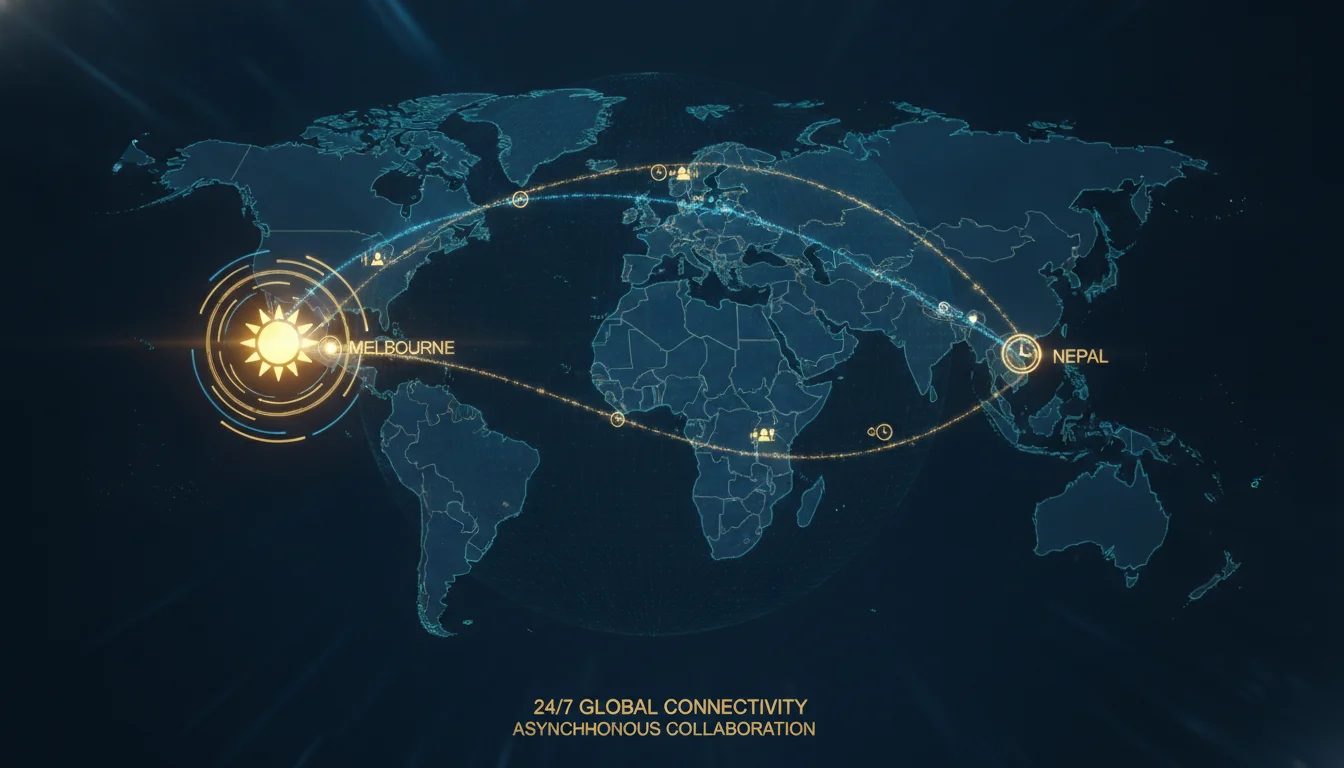
The operational thesis for Braincast relies on a highly calibrated division of labor across a specific geographic and temporal axis: the Melbourne-Lalitpur corridor. By structuring operations such that client-facing strategy, high-touch account sales, and localized outreach are anchored in the Australian market, while simultaneously routing rigorous data analysis, technical Search Engine Optimization (SEO), and intensive content production to the Nepalese market, Braincast can achieve a state of continuous operational momentum. In this paradigm, campaign development never idles. However, the viability of this bipartite architecture is entirely contingent upon the eradication of cross-border communication friction.
Achieving this requires a systemic departure from traditional, synchronous, meeting-heavy corporate cultures toward a stringent “asynchronous-first” paradigm. This transition must be underpinned by exhaustive knowledge documentation, formalized project handoff frameworks adopted from clinical and software engineering disciplines, and a highly nuanced psychological understanding of the cross-cultural dynamics governing the Australian and Nepalese workforces. The subsequent analysis provides a comprehensive, exhaustive blueprint for orchestrating distributed agency operations, mitigating cross-cultural friction, and establishing impenetrable handover protocols to ensure seamless, continuous productivity for Braincast across the Melbourne-Lalitpur operational corridor.
Theoretical Foundations of the Follow-the-Sun Workflow
The Evolution from Support to High-Velocity Production
The genesis of the Follow-the-Sun model lies in global customer service workflows, where customer requests and infrastructural issues were sequentially passed between regional offices—for example, from San Francisco to Sydney, and then to Paris—ensuring that businesses could meet the demands of a globalized economy around the clock. In its nascent stages, this model was exclusively accessible to monolithic corporations possessing the capital to construct and staff physical facilities across multiple continents. However, the proliferation of digital collaboration infrastructure has democratized the FTS methodology, enabling agile, mid-sized agencies to deploy these workflows to accelerate production cycles dramatically.
Within the context of a digital marketing agency, the FTS model transcends basic customer support; it serves as a relentless engine for technical execution and campaign deployment. Empirical evidence from agency implementations demonstrates that proprietary FTS workflows can yield a ninety percent reduction in campaign rollout times, a seventy-five percent increase in content output, and a fifty percent reduction in overall production costs. This extraordinary acceleration is achieved through a phenomenon defined in organizational sociology as “distributed agency.” Distributed agency occurs when the momentum of a complex project is sustained not by a centralized, monolithic institutional leader, but by a decentralized, carefully orchestrated network of autonomous operational pods that sequentially assume complete ownership of the workflow. By distributing the workload temporally, Braincast can ensure that when the Melbourne team concludes their workday, the Lalitpur team immediately absorbs the momentum, preventing the project from stagnating overnight.
The Imperative Shift to Asynchronous Operations
To fully realize the operational benefits of the FTS framework, an organization must aggressively decouple productivity from simultaneous human presence. Traditional synchronous communication paradigms—characterized by a reliance on real-time video meetings, the expectation of immediate instant messaging replies, and ad-hoc verbal problem-solving—create catastrophic bottlenecks within distributed teams. A synchronous culture inherently breeds a “Fear of Missing Out” (FOMO), wherein employees feel psychologically compelled to attend meetings at unreasonable local hours simply to retain project context, thereby negating the primary burnout-prevention benefit of the FTS model.
Conversely, an asynchronous-first operations model prioritizes absolute information persistence. In this ecosystem, all critical strategic decisions, campaign briefs, technical roadmaps, and status updates are codified within a Single Source of Truth (SSOT). By systematically removing the expectation of instantaneous responses, asynchronous communication grants team members the autonomy to process complex information deeply, engage in prolonged states of distraction-free “deep work,” and fundamentally transition the agency’s performance metrics from “hours logged at a desk” to “tangible outcomes achieved.” When the workflow literally follows the sun, a strategist in Melbourne can finalize a technical SEO audit brief, deposit the documentation into the SSOT, and disconnect for the evening, possessing the absolute certainty that the execution pod in Lalitpur will retrieve the brief, perform the technical implementations, and return the completed deliverables to the SSOT prior to the commencement of the Australian morning shift.
Architecting the Melbourne-Lalitpur Temporal Corridor
Temporal Mechanics and Overlap Synchronization
The specific geographical pairing of Melbourne, Australia (operating on Australian Eastern Standard Time, AEST, or Australian Eastern Daylight Time, AEDT), and Lalitpur, Nepal (operating on Nepal Time, NPT), presents a uniquely advantageous temporal overlay for Braincast’s FTS workflow. Local time in Melbourne is typically four hours and fifteen minutes ahead of Kathmandu/Lalitpur, expanding to five hours and fifteen minutes during the Australian Daylight Saving Time period. Nepal Time is uniquely offset by forty-five minutes from Coordinated Universal Time (UTC+5:45) and remains static year-round, as the nation does not observe daylight saving transitions.
This specific temporal differential is highly optimal because it provides both a substantial window for uninterrupted, asynchronous deep work and a dedicated, naturally occurring window for synchronous handovers. This avoids the severe temporal disconnects and mandatory graveyard shifts often associated with United States-Asia operational pairings.

| Operational Phase | Melbourne Local Time (AEST) | Lalitpur Local Time (NPT) | Workflow Dynamics and Focus Areas |
|---|---|---|---|
| Phase 1: Australian Deep Work | 9:00 AM - 1:15 PM | 4:45 AM - 9:00 AM (Offline) | Melbourne operates with total independence. Focus is directed toward high-stakes client meetings, strategic formulation, localized outreach, and reviewing the previous evening’s technical output from Lalitpur. |
| Phase 2: Synchronous Overlap | 1:15 PM - 5:00 PM | 9:00 AM - 12:45 PM | Both pods are simultaneously online. This represents the critical window for warm project handovers, agile sprint planning, resolution of complex technical roadblocks, and crucial cross-cultural relationship building. |
| Phase 3: Nepalese Deep Work | 5:00 PM - 9:00 PM (Offline) | 12:45 PM - 4:45 PM | Melbourne logs off. Lalitpur operates independently, focusing on uninterrupted technical SEO execution, exhaustive data analysis, backlink outreach preparation, and content production based on the afternoon handoff. |
This staggered operational window acts as a natural pressure valve for the agency. It permits the Melbourne team to interface with regional clients during the Australian morning, synthesize that client feedback by midday, and hand off precisely formulated executable tasks to the Lalitpur team just as the Nepalese workday commences. The Lalitpur team is then afforded the entire afternoon to execute these complex tasks without the distraction of sudden requests or interruptions from Australian account managers, ensuring that deliverables are staged and ready for Melbourne’s review the following morning.
Strategic Division of Labor for Braincast
To maximize the efficiency of this temporal corridor, Braincast must enforce a strict bifurcation of tasks based on their inherent requirements for client proximity, cultural nuance, and deep technical focus. Attempting to blend these responsibilities across both regions will inevitably result in operational friction and degraded quality.
The Melbourne Pod: Client-Facing Strategy and Relational Dynamics
The Australian team must act as the relational and strategic vanguard of Braincast.
Roles concentrated in this pod should encompass Account Executives (AEs), Strategic Marketing Directors, Client Services Managers, and Localized Outreach Coordinators. Their primary functional mandate involves conducting initial discovery calls, managing ongoing client expectations, interpreting subtle market nuances, leading creative strategy, and finalizing broad strategic roadmaps. Because this team operates in the exact temporal and cultural zone as the target client base, they completely eliminate the friction of scheduling conflicts and cultural misalignment that frequently plagues B2B sales and high-level client management. The Melbourne pod is responsible for translating complex client desires into structured, objective requirements that can be seamlessly handed over to the execution pod.
The Lalitpur Pod: Technical Execution, SEO, and Data Analytics
The Nepalese team functions as the primary operational engine of Braincast. Roles concentrated here should include Technical SEO Specialists, Data Analysts, Content Engineers, and specialized Campaign Managers. The execution of advanced technical SEO requires profound, uninterrupted cognitive focus that is easily shattered by the demands of client management. Outsourcing these specialized, execution-heavy roles to offshore specialists who perform these tasks daily yields demonstrably superior optimization results compared to attempting to build and maintain that granular expertise within a distracted in-house, client-facing team.
Specifically, Braincast should route the following highly specialized daily tasks to the Lalitpur pod, maximizing their afternoon period of deep, asynchronous work:
| Technical SEO & Data Task Category | Specific Lalitpur Pod Responsibilities | Operational Rationale |
|---|---|---|
| Technical Architecture | Schema markup implementation, hreflang tag configuration, XML sitemap management, and resolution of crawlability and indexability errors. | Requires specialized programming ability, uninterrupted focus, and minimal client interaction. |
| On-Page Optimization | Keyword research, search intent mapping, meta title and description optimization, internal linking architecture, and image alt-text management. | Process-driven and highly repetitive. Executable based on pre-defined strategic briefs without real-time Melbourne input. |
| Content Operations | Publishing and formatting blog content, updating legacy articles to maintain technical freshness, and managing the SEO content calendar. | Benefits from Lalitpur’s isolation; content staged in the evening is ready for final Australian review by morning. |
| Analytics & Outreach | Competitor monitoring, SERP (Search Engine Results Page) tracking, generation of performance dashboards, and backlink outreach preparation. | Data-heavy tasks that provide the empirical foundation for Melbourne’s client reporting meetings. |
Designing the Asynchronous-First Organizational Ecosystem
Establishing an asynchronous-first workflow within Braincast requires far more than an executive mandate to reduce meetings; it necessitates a comprehensive architectural redesign of the agency’s digital ecosystem. If Braincast attempts to execute a distributed FTS model while retaining synchronous habits, the organization will inevitably suffer from communication bottlenecks. For example, a Technical SEO specialist in Lalitpur may become blocked for hours awaiting clarification on a vague task description from an Account Manager in Melbourne who is currently asleep.
The Handbook-First Blueprint for Information Persistence
The foundational principle of asynchronous collaboration, successfully pioneered and modeled by fully remote enterprise organizations such as GitLab, is the doctrine that “if it is not documented, it does not exist”. GitLab exemplifies this documentation-first architecture by maintaining a public, universally accessible handbook that serves as the absolute single source of truth for all company operations, cultural guidelines, and technical workflows.
For the Braincast Melbourne-Lalitpur axis, implementing a similar “handbook-first” architecture is non-negotiable. Every strategic pivot, technical shortcut, client brand preference, and coding standard must be meticulously codified. The core organizational heuristic governing all internal communication must be: “How would I deliver this message, present this work, or move this project forward right now if no one else on my team or in my company were awake?”
By relying exclusively on transparent, centralized documentation, Braincast can foster a culture that replaces FOMO with JOMO (the Joy of Missing Out). A Data Analyst in Nepal does not need to attend a strategic planning meeting in Melbourne; they can seamlessly access the pre-meeting agenda, review the transcribed notes, and execute the resulting action items at their convenience, thereby preserving their cognitive bandwidth for complex data modeling.
Orchestrating the Technology Stack to Prevent Sprawl
The complexity and sheer variety of tasks required in a modern digital marketing agency demand a mosaic of interconnected digital platforms. However, without draconian communication governance, critical project information inevitably fragments across different applications, leading to disastrous context loss and project delays. Braincast must enforce a “zero trust” security model regarding ad-hoc communication, alongside a rigid, uncompromising protocol for tool utilization:
| Technological Layer | Designated Platform (Example) | Operational Mandate and Governance Rules |
|---|---|---|
| The Centralized SSOT | Notion, Confluence, or internal Wiki | Serves as the enduring, searchable knowledge base. Houses all Standard Operating Procedures (SOPs), brand identity guidelines, historical decision logs, onboarding materials, and the overarching agency handbook. |
| The Project Management Layer | ClickUp, Jira, or Monday.com | Functions as the rigid operational backbone. Every task must possess a clear assignee, a defined deadline, and comprehensively attached context. All updates, technical blockers, and clarifying questions must be posted directly within the specific task card. |
| The Asynchronous Video Layer | Loom, Zight | Vital for bridging the gap between flat text and rich real-time explanation. A Melbourne strategist can record a screen-share walking through a complex client SEO audit. The Lalitpur team can watch, pause, and rewind this recording at their convenience. |
| The Synchronous / Alert Layer | Slack, Microsoft Teams | Must be reserved exclusively for severe, time-sensitive escalations, casual team cultural bonding, and automated system notifications. |
Implementing Asynchronous Daily Standups
Traditional daily standup meetings consistently disrupt deep work, mandate presence, and are frequently impossible to schedule equitably across diverse global time zones. To maintain alignment without sacrificing productivity, Braincast must implement mandatory asynchronous daily standups. Utilizing integrated applications like Geekbot within Slack, or dedicated tracking templates within Notion, team members are required to log their daily updates at the beginning or end of their respective local shifts.
These structured updates require less than sixty seconds of effort per employee and revolve around a standardized three-question format:
- What did I achieve yesterday?
- What are my planned tasks for today?
- What specific obstacles or blockers are impeding my progress?
This methodology creates a permanent, searchable database of daily progress, establishes clear accountability, and allows managers in Melbourne to instantly identify and resolve blockers for the Lalitpur team the moment they log online, completely eliminating the need for a synchronous meeting.
Advanced Project Handover Frameworks
The most critical vulnerability within the entire Follow-the-Sun model is the transitional interface—the precise moment when work is passed between the Melbourne and Lalitpur pods. Poorly executed handoffs are the primary catalyst for project delays, duplicated efforts, gaping knowledge voids, and ultimate client dissatisfaction. To neutralize this risk, Braincast must eschew informal communication and implement highly rigorous, structured handoff protocols adopted from software engineering and high-stakes medical environments.
The Anatomy of a Handoff: The Warm vs. Cold Paradigm
Project handoffs exist on a qualitative spectrum ranging from “cold” to “warm,” and the distinction is critical for maintaining FTS velocity.
Cold Handoffs: A cold handoff occurs when a task, support ticket, or sales lead is simply reassigned to another individual via an automated system notification (e.g., changing an assignee in Jira) without any accompanying context or strategic briefing.
The receiving party is abruptly forced into the role of a forensic detective, expending valuable hours deciphering the history, intent, and nuances of the project before any actual productive work can commence. This destroys momentum.
Warm Handoffs
A warm handoff involves a deliberate, highly structured transfer of context, background information, strategic intent, and anticipated challenges. While a warm handoff in a traditional co-located environment might involve a brief face-to-face meeting, in an asynchronous FTS model, a warm handoff is achieved through exhaustive, structured documentation—often accompanied by an asynchronous Loom video—that provides the receiver with immediate, actionable clarity.
Interestingly, advanced research into Artificial Intelligence orchestration refers to this concept as “Natural Delegation” or “Intent-to-Capability Matching”. Just as multi-agent AI systems fail when they pass “cold” data without context, human teams stall when they receive directives without intent. A warm handoff ensures the receiver understands not just what to do, but why it matters and how it fits into the broader client strategy.
Adapting Clinical Protocols for Digital Handovers: SBAR and I-PASS
To standardize the warm handoff process across all departments, Braincast should adopt and adapt two specific frameworks originally designed for clinical patient transfers.
1. The SBAR Framework (For Micro-Handoffs and Escalations)
SBAR (Situation, Background, Assessment, Recommendation) is a highly effective cognitive aid designed to frame critical, time-sensitive conversations concisely. In a digital marketing context, if a Technical SEO specialist in Lalitpur encounters a critical issue during their deep work phase and needs to escalate it back to a Melbourne AE for the next morning, they must structure their update precisely according to the SBAR format:
- Situation: A concise, immediate statement of the core problem. (e.g., “The client’s primary staging site has experienced a sudden 40% drop in indexed pages overnight.”)
- Background: Pertinent historical context leading up to the situation. (e.g., “A site-wide architectural migration was pushed live yesterday. The new robots.txt file was updated, but canonical tags were altered during the deployment.”)
- Assessment: The specialist’s expert analysis of the data. (e.g., “I have identified that the external development team hardcoded non-trailing slash URLs into the canonicals, creating a catastrophic redirect loop for Googlebot.”)
- Recommendation: The specific, actionable request for the receiving team. (e.g., “Please urgently contact the client’s internal dev team during your morning hours to revert the canonical logic to the previous state. I have attached the corrected code block to this ticket.”)
This structured communication prevents rambling, ensures all necessary context is provided in a standardized format, and allows the Melbourne team to take immediate, decisive action upon waking up, rather than spending their morning trying to understand the problem.
2. The I-PASS Framework (For Macro-Handoffs and Client Onboarding)
For larger, more complex transitions—such as moving a qualified prospect from the Sales Development Representative (SDR) in Melbourne to an Account Executive (AE), or handing over a newly signed enterprise client to the Lalitpur SEO execution team—the I-PASS mnemonic provides comprehensive, fail-safe coverage:
- I - Illness Severity (Account Priority/Urgency): Designation of the client’s status (e.g., Tier 1 Enterprise, High Churn Risk, Routine Maintenance).
- P - Patient Summary (Client Context Summary): Comprehensive background of the client, overarching business objectives, target audience demographics, and specific digital marketing pain points discovered during sales.
- A - Action List (Strategic Deliverables): Explicit, itemized list of tasks required from the Lalitpur SEO team (e.g., “Execute full technical audit,” “Map search intent for top 50 priority keywords”), paired with rigid deadlines and designated assignees.
- S - Situation Awareness (Risk & Nuance Management): Critical subtleties about the client’s behavior (e.g., “The client CMO is highly sensitive to modifications in meta descriptions; ensure all localized copy is pre-approved by Melbourne before pushing to the staging environment”).
- S - Synthesis by Receiver (Mandatory Acknowledgment): The Lalitpur team lead replies asynchronously within the SSOT, actively summarizing the brief to prove comprehension, asking any clarifying questions, and confirming execution capacity.
Implementing the I-PASS methodology ensures that the offshore execution team receives the strategic “why” alongside the tactical “what,” effectively transforming them from mere task-takers into integrated, strategic partners.
The “Three-Pass” Gradual Transition Mechanism
In highly complex operational scenarios—such as Braincast taking over a massive, messy legacy digital marketing portfolio from a competitor, or migrating a new, large-scale codebase—a single handoff document, no matter how detailed, is insufficient. A phased, gradual transition—referred to in software engineering as a “three-pass” or multi-stage handoff—is required to prevent project stalling and mitigate risk.
- Phase 1: Shadowing (Observation): The incoming team (e.g., new Lalitpur data analysts) shadows the current process. They review all historical documentation, study architectural diagrams in the SSOT, and passively observe synchronous overlapping calls to absorb tacit knowledge without touching the live project.
- Phase 2: Co-development (Shared Accountability): Both the Melbourne and Lalitpur teams work on the project in parallel during a defined “dual-run” period. The Lalitpur team takes on low-risk, easily reversible tasks (e.g., formatting blog content, updating alt text, fixing minor broken links) to build confidence, while the Melbourne team oversees, reviews, and QA tests the work.
- Phase 3: Independent Delivery (Full Ownership): The Lalitpur team assumes absolute, independent ownership of the technical execution. The Melbourne team formally steps back, transitioning strictly into an advisory, QA, and client-facing capacity, relying entirely on defined SLA-based governance moving forward.
Service Level Agreements (SLAs) and Operational Level Agreements (OLAs)
To maintain strict accountability across a twelve-thousand-kilometer distance and multiple time zones, Braincast must establish internal Service Level Agreements (SLAs), often termed Operational Level Agreements (OLAs) when applied internally. These are contractually agreed-upon, system-enforced rules dictating precisely how quickly internal tickets, requests, and handoffs must be acknowledged, updated, and resolved.
For example, a Braincast OLA might mandate that any technical roadblock identified by the Lalitpur team during their afternoon shift must be formally acknowledged by the Melbourne team within two hours of Melbourne coming online the following morning. Conversely, Melbourne can operate with the guarantee that a routine content publishing task handed off at 5:00 PM AEST will be completed and ready for review by 9:00 AM AEST the next day. Defining these rigid metrics prevents the chaotic “digital scavenger hunt,” enforces accountability, and explicitly exposes operational bottlenecks before they ever impact the paying client.

Cross-Cultural Cohesion: Navigating Australia and Nepal
The ultimate success of Braincast’s cross-border digital agency relies as heavily on psychological and cultural cohesion as it does on technological infrastructure and handoff frameworks. The cultural paradigms governing the Australian and Nepalese workforces are distinctly divergent. Utilizing Geert Hofstede’s Cultural Dimensions Theory allows for a precise, objective analysis of these deeply ingrained differences, providing management with a roadmap for mitigating friction, fostering mutual respect, and building psychological safety across the organization.
Power Distance and Organizational Hierarchy
The Power Distance Index (PDI) measures how a society negotiates authority, hierarchy, and inequality.
- Nepal (High Power Distance): Nepali culture historically demonstrates a moderately high power distance, reflecting a deep societal respect for hierarchy, age, and authority. Nepalese workplaces often exhibit a top-down, bureaucratic management style where decisions tend to bottleneck at the executive level as a mechanism to avoid risk. Employees may feel intense hesitation to bypass a direct supervisor, challenge a senior manager’s idea, or speak out of turn. Formal greetings and strict adherence to reporting lines are common.
- Australia (Low Power Distance): In stark contrast, Australian workplaces are famously egalitarian, exhibiting low power distance. Organizational hierarchies are typically flat, communication is highly casual, and decision-making relies heavily on group consensus. Australian subordinates are explicitly expected to speak up, debate ideas, and challenge management directives directly if they perceive a flaw.
Operational Implication for Braincast: This divergence creates an immediate operational hazard.
If an Australian AE gives a flawed or technically impossible SEO directive, a Nepalese specialist might silently execute the flawed plan simply to show respect for the AE’s authority, leading to disastrous client outcomes. The Systemic Solution: Braincast must engineer processes that structurally democratize feedback. By implementing standardized, mandatory peer-review checklists or automated code reviews for every task, the agency removes the interpersonal, emotional element of critique. When providing corrective feedback is framed as a mandatory, systemic step in the workflow pipeline rather than a personal challenge to a superior’s authority, it successfully bypasses the cultural hesitation associated with high power distance.
Individualism vs. Collectivism
The Individualism versus Collectivism dimension explores whether people see themselves primarily as autonomous individuals or as integrated members of a close-knit group.
- Australia (Highly Individualistic): Australia scores high on individualism. The culture emphasizes personal autonomy, unique contributions, and individual achievement. Employees are frequently rewarded for taking independent initiative, standing out, and building a strong personal brand. However, this is uniquely tempered by the Australian concept of “Tall Poppy Syndrome,” a cultural tendency to actively criticize or “cut down” individuals who appear overly boastful, arrogant, or conspicuously successful.
- Nepal (Collectivist): Nepal is a strongly collectivist society (scoring roughly 30 on the Individualism Index). It values group harmony, the extended family unit, and collective responsibility. Identity is deeply rooted in the team, and workplace success is viewed as a shared, collective triumph rather than an individual victory.
Operational Implication for Braincast: An individualistic Australian manager might single out a specific Nepalese employee for highly public praise, which can cause severe embarrassment and discomfort for the collectivist employee who prefers shared recognition. Furthermore, a highly individualistic Australian team member may unintentionally appear aggressive, self-promoting, or overly competitive to their collectivist Nepalese colleagues, breeding mistrust. The Systemic Solution: Braincast’s management must focus on team-based KPIs and collective rewards. When reviewing the Lalitpur team, praise and constructive criticism should be directed at the pod’s overall operational performance. Building a strong, unified in-group identity (e.g., branding the entire cross-border team under a single, unified mission) leverages the inherent Nepalese strength in collectivist loyalty and long-term group orientation.
Communication Styles: Directness, High-Context, and “Saving Face”
Australian communication is predominantly low-context; it is direct, explicit, often blunt, and heavily values getting straight to the point to maximize efficiency. Conversely, Nepalese communication is high-context, prioritizing extreme diplomacy, indirectness, and, above all, the preservation of social harmony.
A critical component of this high-context Nepalese culture is the concept of “saving face.” Protecting one’s reputation, maintaining dignity, and avoiding public embarrassment is paramount. Consequently, Nepalese professionals will rarely deliver direct criticism, and crucially, they are highly hesitant to admit a lack of understanding in a public forum. If an Australian manager asks, “Do you understand this complex brief?”, the cultural default in Nepal is to nod and say yes in order to avoid disappointing the manager and losing face, even if the brief is entirely incomprehensible.
Operational Implication for Braincast: An Australian manager might mistake a Nepalese employee’s diplomatic indirectness for evasion or incompetence, while the Nepalese employee might view the Australian’s standard, blunt feedback as deeply aggressive, rude, and relationally destructive. Furthermore, minor non-verbal cues can create massive misunderstandings. For instance, the common South Asian “head bobble” (tilting the head side to side) is frequently used in Nepal to indicate agreement, acknowledgment, or a polite “yes.” An Australian, however, will almost universally interpret this gesture as a “no,” a sign of uncertainty, or aloofness.
The Systemic Solution: Feedback delivery must be carefully calibrated across the corridor. Australian managers must be trained to adopt the “feedback sandwich” method—providing positive context, followed by diplomatic constructive criticism, and concluding with positive reinforcement. Most importantly, to navigate the “saving face” dynamic, managers must strictly replace binary yes/no questions with open-ended synthesis requests (which aligns perfectly with the final “S” in the I-PASS handoff framework). Instead of asking, “Does this make sense?”, the manager should ask, “Can you walk me through the first three steps you will take to execute this campaign?” This technique ensures absolute comprehension without ever forcing the employee to admit confusion, thereby preserving their dignity and face.
Ultimately, the most effective way to bridge these deep cultural divides is to rely heavily on the asynchronous infrastructure established earlier. By relying on clearly defined ClickUp tasks, automated workflow triggers, and rigid SLAs, Braincast replaces cultural ambiguity with objective, algorithmic parity. When the SSOT dictates the deadline and the process, the burden of enforcement is removed from interpersonal dynamics, allowing the work to speak for itself.
Implementation Blueprint and Governance for Braincast
Transitioning Braincast to a fully optimized, culturally cohesive Follow-the-Sun model across the Melbourne-Lalitpur corridor is a complex change management exercise. It cannot be executed abruptly; it requires a disciplined, phased rollout.
Phase 1: Infrastructure Design and Knowledge Audit
Before hiring additional offshore staff or altering current schedules, Braincast must ruthlessly audit its current state. Management must assess how much tacit knowledge currently resides exclusively in the minds of the Australian team and begin the arduous process of migrating that knowledge into the Notion/Confluence SSOT. The exact technical SEO, data, and content tasks that will be delegated to Lalitpur must be explicitly defined. The ClickUp/Slack integration framework must be established, and the strict asynchronous communication protocols (e.g., expected response times, channel usage rules) must be published.
Phase 2: Pilot Handoffs and Shadowing
Initiate the “three-pass” transition model. Rather than abruptly handing off a major, high-revenue enterprise client, Braincast should begin by routing internal marketing tasks or low-tier, low-risk client deliverables through the new FTS corridor. The Lalitpur team should heavily shadow the Melbourne team during the four-hour synchronous overlap window. The organization must rigorously test the SBAR and I-PASS templates during this phase, actively gathering feedback to identify where communication friction still exists.
Phase 3: Gradual Separation and FTS Activation
Once the Lalitpur team has demonstrated consistent proficiency and the handoff templates are refined, the pods can begin working fully asynchronously. Braincast must strictly enforce the boundary that Melbourne does not interrupt Lalitpur’s afternoon deep work session, and Lalitpur relies on the SSOT rather than pinging Melbourne for answers. SLA tracking must be activated to measure internal time-to-resolution and track the overall reduction in campaign rollout times, proving the model’s efficacy.
Phase 4: Continuous Cultural and Operational Governance
Permanent governance frameworks must be established to monitor the ongoing health of the cross-border relationship. Braincast should track metrics such as asynchronous efficiency (e.g., participation rates in shared SSOT tools), sprint velocity, and defect rates in technical SEO execution. Cultural competency training must be incorporated into the onboarding process for all new hires, ensuring Australians understand the critical nature of “saving face” and Nepalese staff understand how to navigate egalitarian feedback structures.
Crucially, Braincast must maintain a highly visible awareness of local holidays and systemic events. Nepal observes over thirty significant public holidays (such as Dashain and Tihar), and Australia possesses its own distinct set of public holidays and cultural rhythms. A shared, integrated corporate calendar is vital to ensure that coverage gaps are anticipated, communicated, and managed well in advance, preventing any disruption to the client experience.
Final Strategic Synthesis
The orchestration of a Follow-the-Sun global digital operations framework across the Melbourne-Lalitpur corridor represents a highly sophisticated synthesis of temporal strategy, digital infrastructure, and cross-cultural organizational psychology. By meticulously exploiting the four-to-five-hour time zone differential, Braincast can construct a perpetual motion machine of digital productivity. In this model, Australian strategists consult intimately with clients and refine strategic briefs, subsequently passing those directives through rigorous, formalized I-PASS and SBAR clinical handoff protocols. A dedicated Nepalese technical pod receives these briefs and executes complex, data-heavy SEO and content production during uninterrupted deep-work sessions while Australia sleeps.
However, the collaboration technology and the geographic time zones serve merely as the foundation. The true operational differentiator for Braincast is the absolute, uncompromising organizational commitment to an asynchronous-first culture.
By prioritizing exhaustive, centralized documentation, systemically eliminating the reliance on disruptive synchronous meetings, and expertly navigating the deep nuances of Hofstede’s cultural dimensions with empathy and structured processes, Braincast insulates itself against the traditional friction, delays, and communication breakdowns that typically plague offshore delegation. The ultimate result is a highly resilient, infinitely scalable, and fiercely competitive digital operations framework capable of delivering elite, global-standard marketing outcomes at an unparalleled, continuous velocity.