Digital Marketing for Indian Event Management Report
Digital Marketing for Event Management Companies in India
1. Industry Overview
Brief Description of Event Management Companies in India
The event management industry in India represents a highly complex, multifaceted ecosystem that sits at the intersection of hospitality, corporate communication, logistics, and entertainment. Operating within a nation globally recognized for its profound cultural diversity and intrinsic affinity for grand celebrations, event management companies serve as the critical architectural framework that translates conceptual visions into tangible, immersive experiences. Historically, this sector was characterized by deep fragmentation, heavily reliant on unorganized networks of localized vendors, independent decorators, and family-run catering businesses. However, the contemporary landscape has undergone a radical professionalization and corporatization. Today, the industry functions as an essential pillar of the broader economy, directly employing over ten million individuals and indirectly sustaining the livelihoods of an additional fifty million across the supply chain.
The industry is structurally bifurcated into two primary operational domains: Business-to-Business (B2B) and Business-to-Consumer (B2C). The B2B segment is overwhelmingly driven by the Meetings, Incentives, Conferences, and Exhibitions (MICE) sector, which includes everything from high-stakes corporate training seminars and product launches to massive international summits and brand activation campaigns. Conversely, the B2C segment is dominated by the extraordinarily lucrative social events market. This encompasses the multi-billion-dollar Indian wedding industry, regional cultural festivals, live music concerts, and personal milestone celebrations. Furthermore, the post-pandemic paradigm has forced a convergence of these segments with digital technology, resulting in the rapid proliferation of hybrid and entirely virtual events that require specialized digital event management expertise.
Current Market Size, Growth, and Trends
The financial trajectory of the Indian event management landscape indicates robust, compounding growth, driven by aggressive physical infrastructure expansion and an unprecedented digital transformation. The core event and exhibition market in India was valued at USD 5.69 billion in 2025 and is projected to expand to USD 9.04 billion by the year 2031. This expansion represents a Compound Annual Growth Rate (CAGR) of 8.05%, fueled by rising corporate investments and a surging middle class with increasing disposable income for luxury social events.
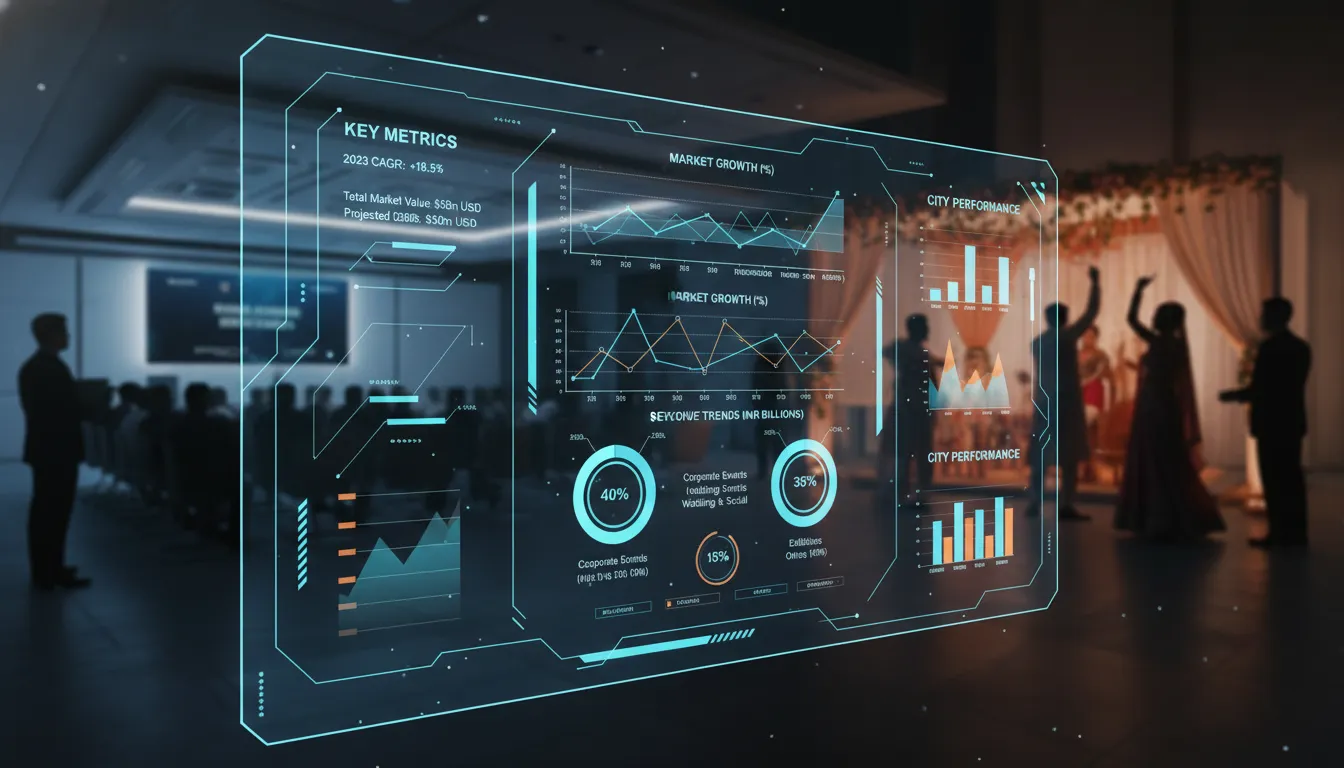
Simultaneously, the technological backend supporting these massive operations is experiencing hyper-growth. The Indian event management software market, which is absolutely critical for digital registration, automated ticketing, and real-time audience engagement, was valued at USD 372.3 million in 2025. This specialized sector is projected to surge to USD 1,533.5 million by 2034, registering a formidable CAGR of 16.52%. Furthermore, the viability of virtual and hybrid event models has been permanently cemented into corporate budgets. The Indian virtual events market generated an estimated USD 6.70 billion in 2024 and is expected to reach a staggering USD 31.41 billion by 2033, growing at an impressive 18.70% CAGR. Other macroeconomic projections estimate that the broader events industry market size, encompassing all direct and indirect economic impacts globally, will reach 2.08 trillion by 2030, with India capturing an increasingly significant percentage of that revenue.
| Market Segment | Base Year Value (USD) | Forecast Year Value (USD) | Projected CAGR | Primary Growth Drivers |
|---|---|---|---|---|
| Physical Events & Exhibitions | $5.69 Billion | $9.04 Billion | 8.05% | MICE promotion, corporate sector expansion, G20 infrastructure legacy utilization. |
| Event Management Software | $372.3 Million | $1,533.5 Million | 16.52% | Automation demand, rapid digitalization, integration of data analytics into event planning. |
| Virtual & Hybrid Events | $6.70 Billion | $31.41 Billion | 18.70% | AR/VR integration, corporate travel cost-saving mandates, global reach requirements. |
Several macroeconomic and technological trends are currently shaping this market trajectory. Foremost is the aggressive prioritization of the MICE industry by the Indian government. The Union Ministry of Tourism is actively establishing specialized city-level convention promotion bureaus beginning in 2026, aimed at elevating Indian cities into globally competitive MICE destinations. Leveraging massive new infrastructural assets such as Bharat Mandapam, Yashobhoomi, and the Jio World Centre in Mumbai, the government aims to double India’s share of the global MICE market by positioning business tourism at the forefront of the “Incredible India” campaign.
Another defining trend is the deep integration of immersive technologies and hybridization. Extended Reality (XR), Artificial Intelligence (AI), and Mixed Reality (MR) are transitioning from experimental novelties to standard client expectations. AI is now utilized for real-time networking matchmaking at conferences, while AR-enhanced venue walk-throughs and holographic keynotes are redefining corporate product launches. Finally, there is a pronounced shift toward sustainable and eco-smart events. Driven by strict corporate Environmental, Social, and Governance (ESG) mandates, leading event organizers are adopting zero-waste catering, digital and letterpress invitations, solar-powered lighting towers, and sustainable venue sourcing to minimize the carbon footprint of large-scale gatherings.
Key Challenges Faced by Businesses in this Industry
Despite the overwhelmingly positive growth projections, event management companies in India must navigate a labyrinth of severe operational, financial, and strategic hurdles that consistently threaten both profit margins and the quality of execution.
The most pervasive challenge is the severe seasonality of the industry and the resulting unpredictable cash flows. The Indian event ecosystem is heavily dictated by distinct seasonal cycles. The highly lucrative wedding season is heavily concentrated between October and February, while major corporate conferences and financial summits predominantly occur in the fourth and first quarters of the fiscal year. This feast-or-famine cycle creates severe cash flow bottlenecks, making year-round revenue generation and talent retention a primary challenge for agencies that rely solely on inbound referrals during peak seasons.
Furthermore, event planners are continuously squeezed between tightening client budgets and the demand for increasingly extravagant, “Instagrammable” experiences. Managing escalating costs across venue rentals, premium catering, and elaborate decor without compromising the experiential quality of the event requires aggressive vendor negotiation, meticulous financial forecasting, and strict resource prioritization. This financial strain is compounded by logistical volatility and infrastructure deficits. Last-minute venue cancellations, crowd mismanagement risks, and sudden power outages remain persistent threats within the Indian infrastructure landscape. With the rise of hybrid events, technical glitches have become a critical liability; severe technical failures, such as bandwidth throttling, audio latency, or streaming platform crashes, can instantaneously ruin an event’s reputation and result in breached corporate service level agreements.
Strategic challenges also plague the sector, most notably the systemic underutilization of first-party data. A fundamental flaw within many traditional, legacy event agencies is the failure to capture, analyze, and monetize the immense volume of data generated during an event. Millions of data points generated via digital ticketing, attendee engagement applications, session attendance tracking, and post-event feedback forms are frequently abandoned. This lack of data fluency prevents agencies from proving concrete, quantifiable Return on Investment (ROI) to their corporate sponsors, making it exceedingly difficult to secure repeat business or justify premium retainer fees.
Finally, the industry grapples with a fundamentally weak pool of skilled human capital capable of managing highly technical, modern digital events, requiring agencies to invest heavily in continuous internal training. Additionally, navigating India’s complex bureaucratic and legal landscape to secure multi-agency permissions, manage direct and indirect tax burdens, and acquire licenses for large-scale public events remains a significant operational bottleneck that strains agency resources. Recent proposed changes to audit independence rules in India also threaten to alter the corporate consulting landscape, restricting the types of non-audit services that major financial firms can provide, thereby creating both a challenge and an opportunity for specialized corporate event planners to fill the strategic consulting void.
2. Digital Landscape in India (Contextual to the Industry)
Internet & Social Media Usage Relevant to Event Management
India’s digital landscape has undergone an unprecedented democratization over the past five years, fundamentally altering the foundational mechanics of how event management companies must communicate with potential clients, distribute promotional content, and engage with attendees.
As of early 2024, the Indian digital ecosystem boasted over 751.5 million internet users, representing an overall internet penetration rate of 52.4% across the subcontinent. More critically for event marketers, the country recorded over 1.12 billion active cellular mobile connections, equating to 78% of the total population. This data confirms that India is a definitively “mobile-first” consumer base, powered by affordable smartphones and low-cost data plans that have pushed digital literacy far beyond urban centers into Tier 2 and Tier 3 cities. Consequently, any digital marketing or event registration asset that is not rigorously optimized for mobile viewing is effectively invisible to the majority of the market. The broader digital media spending landscape reflects this reality, with mobile platforms now commanding a massive 78% share of total digital ad spend in India, while desktop platforms have dwindled to a mere 22%.
Social media usage is equally pervasive and highly relevant to the events sector. As of early 2024, social media penetration stood at 32.2% of the population, equating to roughly 462 million active users. The demographics of these users align perfectly with the target audiences for both corporate brand activations and high-end social events. The median age in India is exceptionally young at 27.1 years. Millennials are the primary drivers of digital engagement, contributing to 52.3% of all social media conversations, closely followed by Gen Z at 28.4%. This youth-heavy, digitally native demographic dictates the current demand for visually spectacular, digitally integrated event experiences. They are the primary consumers of college cultural festivals, large-scale music concerts, and modern, aesthetic-driven weddings, and they utilize social media as their primary search engine for discovering vendors, venues, and event concepts.
Popular Platforms Among the Target Audience
The immense scale and fragmentation of the Indian digital audience necessitate a highly nuanced, platform-specific approach for event marketers seeking to capture attention and drive conversions.
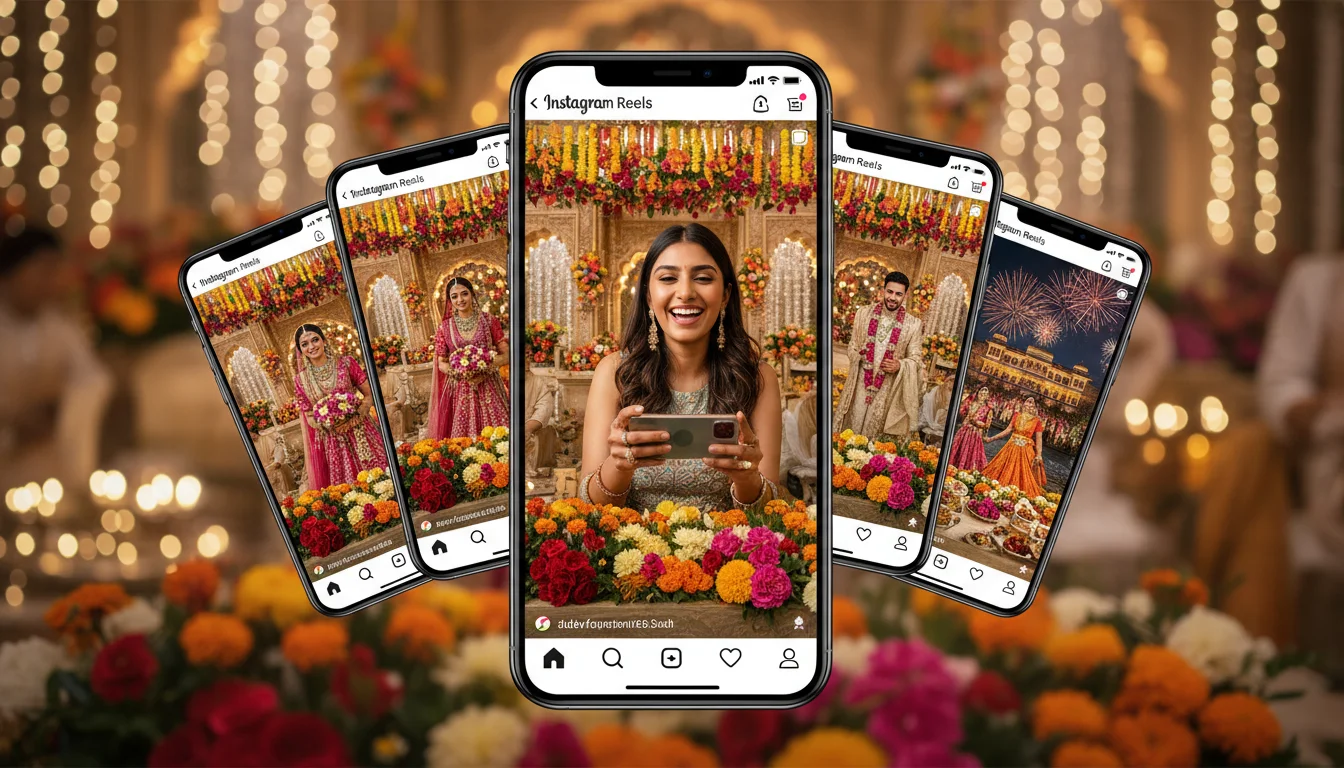
Instagram stands as the undisputed visual behemoth and the premier discovery engine for the social events sector, particularly for luxury weddings, private parties, and cultural festivals. The platform’s growth in India has been explosive; Meta’s planning tools revealed that Instagram’s potential ad reach in India increased by an astounding 58.1% (adding 133 million users) between January 2023 and January 2024. Features such as Instagram Reels and carefully curated Profile Grids act as dynamic, visual portfolios where users actively search for venue aesthetics, bridal fashion trends, decor inspiration, and behind-the-scenes event execution. YouTube commands equal dominance in the realm of long-form video consumption. With an astonishing 97% of connected Indians watching video content online, YouTube is critical for distributing longer event highlight reels, educational event planning webinars, and detailed venue walk-throughs.
While Instagram and YouTube drive discovery, WhatsApp functions as the conversational engine of the Indian digital economy. With over 500 million active users in the country, WhatsApp transcends traditional social media to operate as the primary communication and transaction utility. For event managers, leveraging the WhatsApp Business API is critical for distributing personalized event invitations, managing RSVP lists, automating digital ticketing delivery, and providing real-time customer service. The platform’s exceptionally high open rates make it an invaluable asset for building anticipation and streamlining the attendee journey from registration to post-event feedback.
For B2B event marketing, corporate event planners, and MICE organizers, LinkedIn is the essential channel for high-value lead generation. It is the optimal platform for targeting precise professional demographics, such as HR directors, marketing managers, and C-suite executives who control corporate event budgets. Facebook, while experiencing slower growth compared to Instagram, remains vital for hyper-local targeting, community building (such as localized brides-to-be groups), and reaching slightly older demographic segments who often hold the financial decision-making power for major family events.
Consumer Online Behavior Related to Event Management
Understanding the specific nuances of Indian online consumer behavior is critical for event agencies attempting to convert digital impressions into signed contracts and sold-out venues.
A monumental shift is occurring regarding linguistic preferences. English is no longer the default language of digital engagement in India; over 70% of internet users now prefer consuming content in regional vernacular languages. Event marketers are witnessing significantly higher engagement, click-through, and conversion rates when moving away from homogenous English promotions and instead utilizing colloquial language, local dialects, and vernacular video invites. This is particularly crucial when promoting regional cultural events, real estate launches, or local exhibitions in Tier 2 and Tier 3 cities.
Simultaneously, the “UPI Revolution” has fundamentally rewired the mechanics of event ticketing and vendor payment. The Unified Payments Interface (UPI) now accounts for over 75% of all online transactions in India. Consumers possess a highly diminished tolerance for complex checkout processes; they expect instantaneous, frictionless, mobile-optimized experiences utilizing QR codes and dynamic payment links. Furthermore, for high-ticket events, luxury planning services, or massive corporate retreat bookings, the integration of “Buy Now, Pay Later” (BNPL) and flexible EMI options is heavily swaying consumer decision-making and expanding the total addressable market.
Finally, Indian consumers exhibit highly skeptical, research-intensive online behavior prior to engaging an event planner. A striking 81% of consumers conduct exhaustive online research before committing to a vendor. Potential clients enter an “invisible funnel,” heavily scrutinizing Google reviews, browsing Instagram highlights for real-time behind-the-scenes footage, checking for geo-tagged venue posts, and reading local blog articles long before they ever fill out a contact form. If an event management company’s digital footprint appears outdated, lacks high-resolution visual proof of past successful events, or fails to rank on local search engines, the consumer silently abandons the inquiry and moves to a competitor without the agency ever knowing they lost a lead.
3. Digital Marketing Opportunities
How Digital Marketing Solves Key Industry Challenges
The integration of a sophisticated digital marketing architecture transforms the event management business model from a reactive, highly vulnerable, referral-dependent operation into a proactive, data-driven enterprise capable of scaling predictably.
Digital marketing directly combats the existential threat of seasonality. Traditional event planners suffer immense revenue drops during off-seasons. However, deploying an “always-on” Search Engine Optimization (SEO) and content marketing strategy captures high-intent client queries during their “planning phase,” which occurs months before the actual event execution. For example, a corporate client planning a massive March financial summit begins searching for local vendors and reading venue guides in November; similarly, a couple planning a December destination wedding initiates their digital search in June. By ranking for these specific search queries year-round, event companies intercept clients at the genesis of their journey, generating a predictable, staggered pipeline of leads that stabilizes cash flow regardless of the current season.
Furthermore, digital marketing mitigates the friction of strict budget constraints. Instead of wasting valuable capital on broad, untargetable traditional media like print advertisements or outdoor billboards, Pay-Per-Click (PPC) advertising and programmatic Meta Ads allow event planners to exercise extreme precision. Planners can target specific income brackets, hyper-local radii, exact job titles (e.g., “Chief Marketing Officer” for corporate launches), or specific life events (e.g., “Recently Engaged” status on Facebook). This precision targeting ensures that every rupee of the marketing budget is directed solely at qualified prospects, drastically lowering the Cost Per Acquisition (CPA) and maximizing measurable ROI.
Crucially, digital marketing infrastructure solves the chronic underutilization of event data. By routing all event interactions through digital ticketing platforms, custom mobile applications, and post-event automated email and WhatsApp sequences, organizers can harvest highly actionable first-party data. This data can be analyzed to understand exact attendee drop-off points in the registration funnel, measure engagement levels during specific hybrid event sessions, and create highly specific “Lookalike Audiences” for future digital ad campaigns. This allows agencies to definitively prove event ROI to corporate sponsors and dramatically improve the efficiency of future marketing efforts.
Best Strategies for Event Management Companies in India
To capitalize on the digital landscape, Indian event management companies must deploy a synchronized, multi-channel strategy that addresses the entire consumer journey from broad awareness to post-event advocacy.
- Hyper-Local SEO and Google Business Profile (GBP) Optimization: For the event management sector, geography is the primary determining factor in vendor selection.
Optimizing for local search is unequivocally the most cost-effective, high-yield lead generation strategy available. This requires claiming, verifying, and meticulously updating a Google Business Profile (GBP), ensuring absolute consistency in Name, Address, and Phone Number (NAP) data across all digital directories. Event planners must build a localized website architecture, creating dedicated landing pages optimized for specific services tied to specific cities or neighborhoods (e.g., establishing separate URLs for /corporate-event-planners-mumbai and /luxury-wedding-venues-bangalore). Incorporating localized schema markup for events ensures that upcoming public events or agency details appear directly in Google’s rich snippets.
2. Visual Storytelling via Short-Form Video (Instagram Reels & YouTube Shorts)
Event management is an inherently visual, experiential product; static images and generic promotional flyers are no longer sufficient to drive conversions. Marketing strategies must pivot heavily toward immersive, short-form video content. Agencies must utilize Instagram Reels and YouTube Shorts to showcase high-speed time-lapses of complex stage setups, highly emotional client testimonials, and authentic behind-the-scenes (BTS) footage demonstrating the team’s ability to handle logistical crises calmly. Implementing the “3-3-3 Rule” for Instagram—posting 3 feed posts per week (mixing educational, personal, and promotional content), 3 stories per day (real-time updates and polls), and dedicating time to 3 proactive engagement sessions per week—is a highly effective algorithm strategy that prevents content burnout while maintaining high visibility.
3. WhatsApp Marketing Automation and CRM Integration
Given India’s reliance on the platform, leveraging the WhatsApp Business API is non-negotiable for modern event marketing. Agencies must move beyond manual messaging and deploy automated broadcast lists to send dynamic ticketing updates, interactive polls to gauge attendee preferences, and AI-driven chatbots to handle routine, high-volume FAQs regarding venue directions, dress codes, or parking availability. When integrated directly with a Customer Relationship Management (CRM) system, leads captured via Facebook Ads can trigger an immediate, personalized WhatsApp follow-up. In a market where speed-to-lead dictates win rates, this automation drastically increases conversion percentages.
4. Influencer and Micro-Influencer Collaborations
The influencer marketing paradigm in India has shifted. Instead of relying solely on prohibitively expensive, national celebrity endorsements, event companies are achieving vastly superior ROI through strategic partnerships with regional micro and nano-influencers. For a regional cultural festival or localized corporate expo, partnering with local tech reviewers, community lifestyle bloggers, or regional YouTube personalities creates authentic, vernacular advocacy. These influencers possess deep cultural knowledge of their specific locales and command highly engaged, localized audiences, allowing event marketers to penetrate regional markets with high credibility and lower costs.
Local and Global Examples/Case Studies
Analyzing successful deployments of these strategies provides a practical blueprint for Indian event agencies.
Case Study 1: B2B Event Scaling via Digital Infrastructure - CII EXCON (HostIndia Events)
HostIndia Events was tasked with managing audience acquisition and complex registration logistics for CII EXCON, recognized as South Asia’s largest construction equipment event. Recognizing the impossibility of scaling manually, they deployed an integrated B2B digital marketing architecture. By utilizing highly targeted email marketing campaigns, sustained LinkedIn outreach targeting engineering and manufacturing executives, and custom-built, optimized registration landing pages, they successfully managed the immense data load and attendee flow across 10 distinct editions. This case study proves the absolute necessity of robust digital infrastructure in scaling massive, high-stakes industrial exhibitions and generating qualified B2B leads.
Case Study 2: B2C Brand Launch Velocity - Realme Flash Launch
When the electronics brand Realme entered the highly saturated and fiercely competitive Indian mobile market in 2018, they deliberately bypassed traditional, expensive on-ground launch events. Instead, they executed a highly orchestrated, digital-only “flash launch” strategy. By leveraging high-intensity digital hype, live-streamed unboxing events featuring targeted tech influencers, and aggressive digital amplification through a strategic partnership with Amazon, they created massive FOMO (Fear Of Missing Out) and purchasing urgency. Realme demonstrated that digital velocity, targeted influencer collaboration, and scarcity marketing can effectively outmaneuver the massive legacy budgets of entrenched competitors.
Case Study 3: Local SEO Turnaround - Indian Event Venue Optimization
A localized Indian event venue was suffering from poor physical foot traffic, declining corporate inquiries, and low brand visibility against regional competitors. To rectify this, the venue implemented a rigorous, highly focused Local SEO and Google Ads strategy. By aggressively optimizing their Google My Business listing, committing to publishing weekly SEO-optimized blogs and YouTube Shorts highlighting venue features, and running highly targeted Google Ads with a strong retargeting pixel, the transformation was rapid. The venue witnessed a 120% increase in physical foot traffic, a 200% surge in organic website visits, and began consistently generating 13 high-ticket, qualified leads per month, demonstrating the immediate, localized commercial impact of search visibility.
Case Study 4: Experiential Immersion and Omnichannel Marketing - Tanishq Rivaah
To launch their Rivaah bridal jewelry line, Tanishq executed a brilliant hybrid event strategy that seamlessly blended physical experiential marketing with massive digital amplification. They created a multi-sensory showroom launch featuring regional bridal styling zones, but the true success lay in the digital integration. By inviting regional fashion influencers to conduct live walk-throughs and utilizing high-quality digital storytelling that focused on the cultural nuances of different Indian states, the physical event became a content creation engine that dominated social media algorithms, effectively turning local attendees into organic digital brand ambassadors.
4. Competitive Analysis
Current Digital Presence of Top Event Businesses in India
The uppermost echelon of the Indian event management landscape is currently dominated by entrenched legacy heavyweights such as Wizcraft International Entertainment, Percept Limited, MAZE Events and Experiences, Brandwise, and Om Events. These tier-one agencies possess massive operational scale, handling national brand activations, managing massive proprietary intellectual properties (IPs), and executing large-scale government and diplomatic summits.
Wizcraft International positions itself heavily as a master of “experiential marketing” and holistic brand communication, relying heavily on its legacy portfolio and global network to attract massive corporate clients. Percept Limited, a colossal entertainment and media conglomerate, operates vast, highly lucrative IPs such as the Sunburn Festival (one of the world’s top live music festivals) and Bollyboom. The digital strategy of these legacy firms revolves around monetizing these massive hybrid IPs through integration with large-scale digital ticketing platforms, facilitating global digital broadcasting and live-streaming, and deploying high-budget, highly polished social media hype campaigns designed to engage millions of consumers simultaneously across the globe.
What They Are Doing Well
- Building Massive Digital Intellectual Properties (IPs): Legacy agencies excel at transcending the physical limitations of an event, transforming them into year-round, highly monetizable digital communities. Percept’s Sunburn is not merely a localized three-day festival; it operates as a continuous, high-engagement digital content engine that sustains deep brand relevance and generates ongoing revenue across YouTube, Spotify, and Instagram 365 days a year.
- High-End, Cinematic Video Production: The visual representation of their past events is uniformly premium. They possess the capital to utilize extensive drone coverage, high-end post-production editing, and A-list celebrity endorsements. This allows them to create digital portfolios that project absolute industry authority, premium quality, and an inability to fail, which is highly attractive to risk-averse corporate boards.
- Strategic Digital Partnerships and Aggregation: Top firms do not operate in digital isolation. They frequently forge strategic, deeply integrated partnerships with massive digital publishers, media conglomerates, and dominant ticketing aggregators (such as BookMyShow or Paytm Insider) to ensure maximum market visibility, extensive digital PR coverage, and frictionless transactions for their massive B2C events.
Gaps and Opportunities to Outperform Them
While the legacy giants completely dominate top-of-mind awareness for mega-events and multi-million dollar corporate accounts, their overarching digital architectures often reveal significant, exploitable gaps that agile, mid-sized, and highly specialized event planners can leverage to capture substantial market share.
1. Vulnerability in Long-Tail and Hyper-Local SEO: Massive agencies often focus their SEO resources entirely on broad, highly competitive vanity terms or rely purely on direct brand searches (e.g., a user directly searching for “Wizcraft”).
They frequently neglect the highly lucrative, high-intent long-tail keywords that drive actual localized conversions. An agile, smaller agency can easily outmaneuver a giant by creating dedicated, hyper-optimized landing pages that rank number one for highly specific queries like “affordable corporate offsite planner in Navi Mumbai” or “eco-friendly luxury wedding planner in Bangalore”.
2. Over-Reliance on English and Metro-Centric Content: The digital presence of many top agencies remains highly sanitized, corporate, and English-first. Given that over 70% of Indian internet users prefer regional languages, there is a massive, underserved opportunity to capture the booming Tier 2 and Tier 3 event markets. Specialized agencies can dominate these expanding regions by aggressively utilizing vernacular SEO, localized WhatsApp audio outreach, and deep partnerships with regional content creators.
3. Lack of Authentic, Educational Top-of-Funnel Content: Top agencies are excellent at showcasing the highly polished final product, but they rarely share the “how-to” or the granular details of the planning process. Mid-sized planners can build immense digital trust by demystifying the complex event planning process. Producing authentic, educational content—such as detailed budget breakdown guides, venue negotiation strategies, or comprehensive timeline checklists—captures users at the very top of the search funnel, establishing the agency as a helpful authority long before the client is ready to sign a contract.
4. Agility and Speed in Lead Response: Legacy agencies often suffer from bureaucratic bloat, routing digital inquiries through slow, multi-tiered corporate sales funnels. An emerging event planner utilizing instant WhatsApp automation, timezone-triggered lead forms, and immediate CRM-integrated customized responses can frequently capture a high-ticket client simply by being the first to reply with a coherent, personalized proposal. In the digital age, speed often outcompetes legacy reputation.
5. Regulatory Consulting Gaps in the Corporate Sector: As Indian audit rules undergo strict revisions, audit firms are increasingly restricted from providing non-audit consulting services to their existing corporate clients for extended cooling-off periods. This regulatory shift creates an emerging, highly profitable gap for specialized corporate event planners. They can position themselves via LinkedIn not merely as event logisticians, but as strategic corporate communication consultants capable of handling compliance-friendly corporate events, executive retreats, and stakeholder summits, directly filling the void left by restricted financial advisory firms.
5. Recommended Strategy for Event Management Companies in India
To effectively capture market share and maximize return on ad spend, Indian event management companies must abandon homogenous marketing strategies. Instead, they must deploy highly segmented, targeted campaigns that address the vastly different psychological motivations and logistical requirements of their B2B and B2C client bases.
Target Audience Personas
The Corporate Decision-Maker (B2B)
- Demographics: Age 35-55; HR Directors, Chief Marketing Officers, Executive Assistants; Predominantly located in major Metro IT/Financial hubs.
- Primary Motivations: Demonstrable ROI, flawless technical execution, precise brand alignment, measurable employee engagement, networking efficiency.
- Key Pain Points: Strict budget adherence, measurable lead generation (for trade shows), mitigating technical risks for hybrid setups, stakeholder alignment.
- Digital Behavior: Heavy reliance on LinkedIn for networking, searches for industry whitepapers, relies heavily on peer B2B reviews, consumes detailed PDF proposals.
The Milestone Celebrant (B2C)
- Demographics: Age 25-45; Engaged couples, parents of the couple, family heads; Located across Metro and rapidly expanding Tier 2/3 cities.
- Primary Motivations: High emotional resonance, aesthetic perfection, social status signaling, seamless and memorable guest experience.
- Key Pain Points: Complex family dynamics, vendor reliability and trustworthiness, staying within a personal budget, finding unique/unconventional venues.
- Digital Behavior: Extremely high Instagram and Pinterest usage, heavily swayed by visual portfolios and influencer trends, relies on local “near me” Google searches.
Recommended Channels and Campaign Types
For Corporate Events (MICE, Brand Activations, Corporate Offsites):
- LinkedIn Account-Based Marketing (ABM): LinkedIn is the primary battleground for B2B event acquisition. Agencies must deploy targeted InMail campaigns and sponsored content aimed directly at specific job titles within rapidly growing Indian sectors (such as IT, Pharmaceuticals, and Manufacturing). Content should heavily feature detailed case studies, emphasizing event ROI, scalable logistical capacity, and data-driven post-event reporting.
- High-Intent Google Search Ads (PPC): Corporate clients actively search when they have a mandate and a budget. Bidding on exact-match terms like “corporate event management agency for product launch Bangalore” or “annual general meeting event planners” ensures the agency intercepts companies at the precise moment of commercial intent.
- Long-Term Email Automation: Corporate sales cycles are notoriously long. Leads must be nurtured over a 6-12 month period. Implementing an automated email sequence that delivers quarterly industry trends, highlight reels of new corporate venues, and updates on new event technology (like XR or AI matchmaking) keeps the agency top-of-mind until the client’s annual event planning cycle triggers.
For Social Events (Luxury Weddings, Cultural Festivals, Private Galas):
- Instagram & Pinterest Visual Ecosystem: These platforms must serve as the primary interactive portfolio. Agencies should deploy Meta Ads (Facebook and Instagram) targeting specific life events and demographics (e.g., targeting the “Newly Engaged” demographic within a 50km radius of major Indian cities). Instagram highlights must be meticulously categorized by event type and aesthetic (e.g., Sangeet Setup, Floral Decor, Client Love, Haldi Ceremonies) to allow for rapid visual consumption.
- Local SEO & Vendor Directory Saturation: Ensure absolute dominance in local search results. This requires a perfectly optimized Google Business Profile and prominent, highly-reviewed placements on dominant Indian localized wedding and event directories such as Shaadidukaan and WedMeGood to capture high-intent local search traffic.
Content Ideas Specific to Event Management
Digital content must evolve from purely promotional braggadocio to highly educational, experiential, and trust-building narratives.
- Behind-The-Scenes (BTS) Reality Content: Audiences crave authenticity. Publishing time-lapse videos of a grueling 24-hour mandap setup, or a vlog demonstrating exactly how the planning team successfully managed a sudden logistical crisis (like a rainstorm during an outdoor corporate retreat) builds immense trust regarding the agency’s crisis management capabilities.
- Educational Guides & Checklists: Agencies must position themselves as thought leaders. Publishing highly optimized blogs and downloadable PDFs such as “The Ultimate 6-Month Corporate Offsite Checklist,” “How to Navigate Vendor Negotiations in Delhi,” or “Hidden Costs to Watch For When Booking a Heritage Venue in Rajasthan” serve as powerful lead magnets to collect valuable email addresses and WhatsApp numbers.
- Collaborative Venue Spotlights: Partner with highly sought-after local venues to create immersive video walkthroughs and review content. This strategy cross-pollinates audiences (sharing followers) and provides incredibly valuable, search-friendly content for clients currently evaluating locations.
Budget-Friendly Digital Marketing Approaches
For emerging or mid-sized Indian agencies operating without the massive advertising budgets of legacy firms, deploying low-cost, high-impact guerrilla digital tactics is essential for survival and growth.
- Google Business Profile Optimization (Zero Cost): Consistently uploading high-resolution photos, responding professionally to every single review (both positive and negative), and detailing specific services directly within the GBP is the highest-ROI free marketing activity available, directly influencing local search rankings.
- WhatsApp Business Optimization (Low Cost): Setting up a comprehensive WhatsApp business catalog and utilizing automated greeting and away messages allows a small team to capture and engage leads instantaneously, providing an enterprise-level customer service feel without the cost of expensive, complex CRM software.
- Free Directory Listings (Zero Cost): Maximizing detailed profiles on free-tier aggregators and B2B vendor directories builds critical initial backlinks, improves overall domain authority, and increases the surface area for client discovery.
- User-Generated Content (UGC) Amplification: Creating highly specific, custom event hashtags and actively incentivizing attendees to post photos and tag the agency. Reposting this UGC costs absolutely nothing but provides powerful, authentic social proof and facilitates massive organic reach expansion across attendees’ personal networks.
6. Keywords & SEO Opportunities
To capture significant digital market share in 2026 and beyond, event planners must fundamentally shift their SEO architecture from targeting generic, highly competitive single keywords to focusing on semantic, user-intent-driven queries. The Indian search behavior ecosystem is highly specific; it is characterized by extreme price-consciousness, bilingual phrasing (Hinglish), and a very strong local, geographic intent.
High-Intent Keywords for Ranking
High-intent keywords represent “bottom-of-the-funnel” queries.
When a user inputs these terms into a search engine, they have already secured budget approval, defined their need, and are actively seeking to hire a vendor immediately. Because of their high conversion potential, competition for these terms is fierce, necessitating robust on-page SEO, fast load times, and a strong, authoritative backlink profile.
Core Industry Services
Example Keywords: “wedding planner”, “event management”, “event organizer”
Est. Monthly Volume: 246,000 / 110,000 / 33,100
Search Intent & SEO Strategy: High competition. Target these via comprehensive homepage optimization, strong domain authority, and detailed core service pillar pages.
Commercial / Cost Modifiers
Example Keywords: “wedding planner cost”, “event management charges”, “affordable event planners”
Est. Monthly Volume: 5,400+
Search Intent & SEO Strategy: Extremely high commercial intent. Indian consumers search heavily for pricing. Agencies must create transparent, detailed “Pricing Guide” pages to capture and convert this specific traffic.
Specialized Event Niches
Example Keywords: “destination wedding planner”, “corporate event planner”, “birthday event planner”
Est. Monthly Volume: 3,600+
Search Intent & SEO Strategy: High intent for specialized services. Target by building highly dedicated, media-rich landing pages showcasing specific portfolios, relevant testimonials, and specific service breakdowns.
Long-Tail Keyword Opportunities (India-Specific)
Long-tail keywords are the lifeblood of a modern, sustainable SEO strategy. While they possess significantly lower individual search volumes, they boast vastly higher conversion rates (often up to 2.5x higher) because they represent highly specific, nuanced consumer needs. Furthermore, optimizing content for long-tail queries prepares the agency’s website for the rising dominance of Voice Search and Generative Engine Optimization (GEO) driven by AI, which inherently favor natural, conversational, and question-based phrasing.
-
Geo-Modified Queries (Hyper-Local): Indian consumers inherently search locally to reduce logistical friction.
- Strategic Examples: “best corporate event planners near me,” “corporate event management company in Chennai,” “luxury destination wedding venues in Bangalore”.
-
Venue and Capacity Specific Queries: Clients often have specific logistical constraints in mind before searching for a planner.
- Strategic Examples: “AC banquet hall with parking in [specific city area],” “1000 capacity outdoor wedding hall in [location]”.
-
Vernacular and Hinglish Nuances: A massive portion of the Indian audience mixes English vocabulary with regional phrasing. Ignoring these hybrid keywords leaves money on the table.
- Strategic Examples: “sangeet event organizer in Mumbai,” “budget me wedding planner,” “best stage decoration ideas for reception”.
-
Educational and Problem-Solving Queries: Capturing clients at the top of the funnel before they know they need an agency.
- Strategic Examples: “how to plan a corporate offsite in Goa,” “upcoming international business conference in India,” “complete checklist for destination wedding in Rajasthan”.
By directly answering these highly specific questions via comprehensive, well-structured blog posts and FAQ sections, event companies signal deep topical authority to search engines. This strategy not only captures niche traffic but drastically improves the overall domain ranking for broader, more competitive terms.
7. Implementation Roadmap
Executing a comprehensive digital transformation requires a highly disciplined, phased approach. Agencies must balance the immediate need for revenue generation and lead acquisition with the longer-term construction of sustainable, compounding digital assets.
Short-Term Quick Wins (1–3 Months)
The primary objective in the first quarter of implementation is plugging existing lead leakages, capturing existing local search demand, and establishing a highly professional digital storefront.
-
Month 1: Digital Audit, Infrastructure, and Local Foundation
- Conduct a rigorous technical SEO audit of the primary website. Ensure the site achieves a load speed of under 3 seconds and is strictly mobile-responsive, as mobile optimization is a critical ranking factor in India. Implement necessary schema markup for local businesses and specific events.
- Claim, verify, and exhaustively optimize the Google Business Profile (GBP). This includes uploading 20+ high-resolution images, ensuring strict NAP consistency, and seeding a strategy to collect client reviews.
- Set up the WhatsApp Business API. Configure automated welcome messages, away messages, and timezone-triggered lead capture forms to ensure absolutely zero delay in responding to inbound client inquiries.
-
Month 2: High-Intent Paid Acquisition and Retargeting
- Launch hyper-targeted Google Search Ads (PPC campaigns). Focus budget exclusively on bottom-funnel, high-intent commercial keywords (e.g., “hire corporate event planner [city]”) to generate immediate, qualified leads.
- Deploy Meta (Facebook/Instagram) retargeting pixels across the website. Begin running low-budget retargeting ad campaigns showing dynamic video testimonials or high-end portfolio reels specifically to users who visited the site but failed to convert.
-
Month 3: Social Proof and Directory Saturation
- Implement the “3-3-3” Instagram engagement strategy. Focus heavily on organizing existing, disorganized photo assets into clean, narrative-driven Highlight reels (e.g., Venues, Decor Setups, Client Love, Behind-the-Scenes).
- Systematically claim and optimize profiles on all major Indian event and wedding directories (Shaadidukaan, WedMeGood, Sulekha) to generate immediate referral traffic and build crucial early backlinks.
Long-Term Strategy (6–12 Months)
The focus in the second half of the year shifts away from paid acquisition and toward organic market dominance, systematically lowering Customer Acquisition Costs (CAC), and building unshakeable brand authority.
-
Months 4-6: Content Marketing, Semantic SEO, and Video Expansion
- Launch a robust, consistent content marketing engine targeting long-tail and educational keywords identified during the research phase (e.g., “Corporate Budgeting Tips in 2026,” “Top 10 Eco-Friendly Venues in [City]”). Publish consistently to steadily build domain authority and intercept top-of-funnel traffic.
- Begin producing and distributing long-form video content on YouTube. Create podcast-style interviews with popular local venue managers, or deep-dive videos explaining event planning logistics, designed to capture the massive Indian video-consumption market.
-
Months 7-9: CRM Automation and Advanced Data Activation
- Fully integrate a robust CRM system to manage the increasingly complex lead pipeline. Build and deploy automated email and WhatsApp nurture sequences that keep the agency top-of-mind for corporate clients over a prolonged 6-12 month buying cycle.
- Analyze the first-party data accumulated from the initial 6 months to refine ad targeting. Create highly accurate “Lookalike Audiences” on Meta platforms based on the exact digital profiles of clients who signed the highest-value contracts.
-
Months 10-12: Advanced Experiential Marketing, Hybrid Tech, and Optimization
- Begin integrating advanced tech elements into the digital marketing mix to differentiate from competitors. For example, offer high-value corporate clients 3D virtual walkthroughs of proposed event stage setups directly embedded on the website.
- Establish formalized, strategic partnerships with regional micro-influencers for coordinated mutual promotion leading into peak event seasons (e.g., Q4 for corporate, winter for weddings).
- Conduct a comprehensive 12-month ROI evaluation across all digital channels. Reallocate the marketing budget aggressively, shifting capital away from underperforming platforms and heavily toward the channels yielding the lowest Cost Per Acquisition (CPA) and highest lifetime client value.
8. Conclusion
Summary of Why Digital Marketing is Crucial for Event Management
The event management industry in India has irreversibly transitioned from an analog, highly localized, word-of-mouth sector into a sophisticated, highly competitive, digital-first ecosystem. With the core physical events market expanding aggressively toward USD 9.04 billion and virtual/hybrid formats becoming standard corporate expectations, relying on traditional networking and passive referrals is no longer a viable strategy for scaling operations or ensuring business survival.
A comprehensive digital marketing architecture is the only mechanism capable of solving the industry’s most deeply entrenched systemic challenges.
It neutralizes the crippling effects of unpredictable seasonality by utilizing advanced SEO and content marketing to capture client intent months before an event actually occurs, generating a steady, year-round pipeline. It optimizes tightening client budgets by replacing highly inefficient mass media advertising with hyper-targeted, highly measurable PPC and Meta advertising. Furthermore, by fully leveraging India’s mobile-first reality, the frictionless UPI infrastructure, and the absolute dominance of WhatsApp, sophisticated digital strategies reduce friction in the customer journey, efficiently turning passive online scrollers into confirmed attendees and high-ticket corporate clients. In 2026 and beyond, an event management company’s digital footprint—encompassing its search rankings, its dynamic visual portfolio, and its automated response infrastructure—is entirely indistinguishable from its actual brand reputation.
Strategic Call-to-Action
To successfully navigate this complex digital transition and capitalize on the massive, expanding Indian event market, event management companies must partner with dedicated technologists who deeply understand the nuances of digital architecture, performance-driven lead generation, and strategic brand positioning.
Gurkha Technology, a premier digital marketing and web development agency based in Nepal, represents the ideal, highly capable strategic partner for Indian and South Asian event businesses seeking this critical transformation. Specializing in high-performance, data-driven digital solutions, Gurkha Technology offers a comprehensive suite of services perfectly tailored to the unique demands of the event industry, including Advanced Semantic SEO, precise Google Ads management, high-conversion Meta advertising, and custom, mobile-optimized web development.
Their proven track record within the experiential, hospitality, and acquisition sectors stands as a testament to their capabilities. This is demonstrated through highly successful, visually driven social media branding campaigns for elite venues like Kings Lounge, as well as critical, large-scale lead generation and customer acquisition strategies executed for massive entities such as Nepal Airlines. By leveraging Gurkha Technology’s deep expertise in localized demographic targeting, meticulous conversion rate optimization, and the deployment of automated, high-speed lead funnels, event management companies can seamlessly transition from merely managing localized event logistics to completely dominating their regional digital market space. Establish definitive market leadership, stabilize year-round revenue streams, and ensure that your next event is a sold-out, high-ROI success by booking a comprehensive strategic consultation with Gurkha Technology today.
Related reading
- Explore all blog articles
- Digital Marketing Services in Nepal
- GA4 Key Events Tutorial: Tracking B2B Demo Forms with GTM
Nepal parallel: MICE, weddings, and adventure tourism
Nepal’s events and tourism sector markets on seasonality and permit logistics, not only venue glamour:
- Trekking windows — March–May and Sept–Nov campaigns need separate ad groups and creative (weather, visibility).
- Wedding season — Banquet halls in Kathmandu/Pokhara benefit from Meta carousel retargeting; Google Search captures “venue + date” intent.
- Visit Nepal narrative — Content tying sustainability and community tourism supports premium pricing.
See PPC case patterns for tourism and YouTube SEO in Nepal for video-led destinations.