2026 AI-Powered Fleet Management & Logistics Tech: Comprehensive Analysis of Telematics and Route Optimization APIs

The commercial transportation and enterprise logistics sectors have undergone a fundamental architectural shift by the year 2026. Driven by tightening freight margins, heightened environmental regulations, and the rapid maturation of artificial intelligence, fleet management has transitioned from reactive asset tracking to proactive, agentic operations. Artificial intelligence is no longer merely an analytical tool reserved for post-trip reporting; it functions as a centralized operational control mechanism capable of scheduling work, managing multi-dimensional constraints, and executing autonomous dispatch decisions in real-time. This shift is designed to free logistics workers from manual coordination tasks and rapidly accelerate enterprise decision-making.

Futuristic logistics hub at night, with autonomous trucks moving efficiently. Glowing data streams connect vehicles and control centers, representing AI optimization and global connectivity.

This report provides an exhaustive analysis of the 2026 fleet management and logistics technology landscape, focusing on the leading telematics platforms, enterprise-grade Transportation Management Systems (TMS), and the sophisticated route optimization Application Programming Interfaces (APIs) that power global supply chains. By synthesizing technical documentation, industry benchmarks, and platform architectures, this analysis examines the causal relationships between high-integrity data collection at the physical edge and the execution of hyper-optimized logistical networks.

The Macro-Technological Paradigms Defining 2026 Fleet Operations

The convergence of transportation management with broader supply chain execution has created an unprecedented demand for end-to-end orchestration and connected decision-making. Several macro-technological trends define the current operational baseline for enterprise fleets, moving the industry away from siloed software towards holistic, predictive ecosystems.

From Cloud Analytics to Edge AI Processing

Historically, vehicle telematics relied on transmitting raw data to centralized cloud servers for processing, which introduced latency and limited real-time intervention capabilities. In 2026, the paradigm has shifted decisively to edge computing. AI-powered dash cameras and telematics gateways now feature robust onboard processors capable of executing dozens of machine learning models simultaneously without relying on continuous cellular connectivity. This localized computational power enables instantaneous sensor fusion, a process that combines video feeds, audio inputs, telematics telemetry, GPS, and dual motion sensors (IMU) to detect complex risk events. For example, modern edge AI can recognize a vehicle break-in by identifying the sound of shattering glass, or it can confirm a low-severity collision by cross-referencing vibration data with brake noise, providing a level of granular context that legacy systems could not achieve.

The Convergence of TMS and FMIS Consolidation

Enterprise organizations are actively dismantling siloed software architectures by unifying their Fleet Management Information Systems (FMIS) with broader Transportation Management Systems (TMS). Leading platforms recognized in the 2026 Gartner Magic Quadrant for TMS, such as SAP Transportation Management (a Leader for 12 consecutive years) and Blue Yonder (a Leader for 19 consecutive times), exemplify this trend. SAP’s platform connects freight procurement, planning, execution, and settlement on a single network, addressing capacity constraints and cost volatility by aligning transportation decisions with broader supply chain objectives.

Simultaneously, at the fleet maintenance level, FMIS consolidation automates critical data pipelines. Platforms like Fleetio have set the industry standard for connected maintenance workflows, functioning as an operating system that leverages telematics data—such as odometer readings and diagnostic trouble codes (DTC)—to automatically trigger preventative maintenance schedules. This automated data flow cross-references fuel transactions with real-time GPS locations to flag suspicious activities, such as fuel purchases made far from a vehicle’s actual geographic location, while facilitating data-driven fleet rightsizing to identify underutilized assets.

The Integration of Digital Twins and Agentic AI

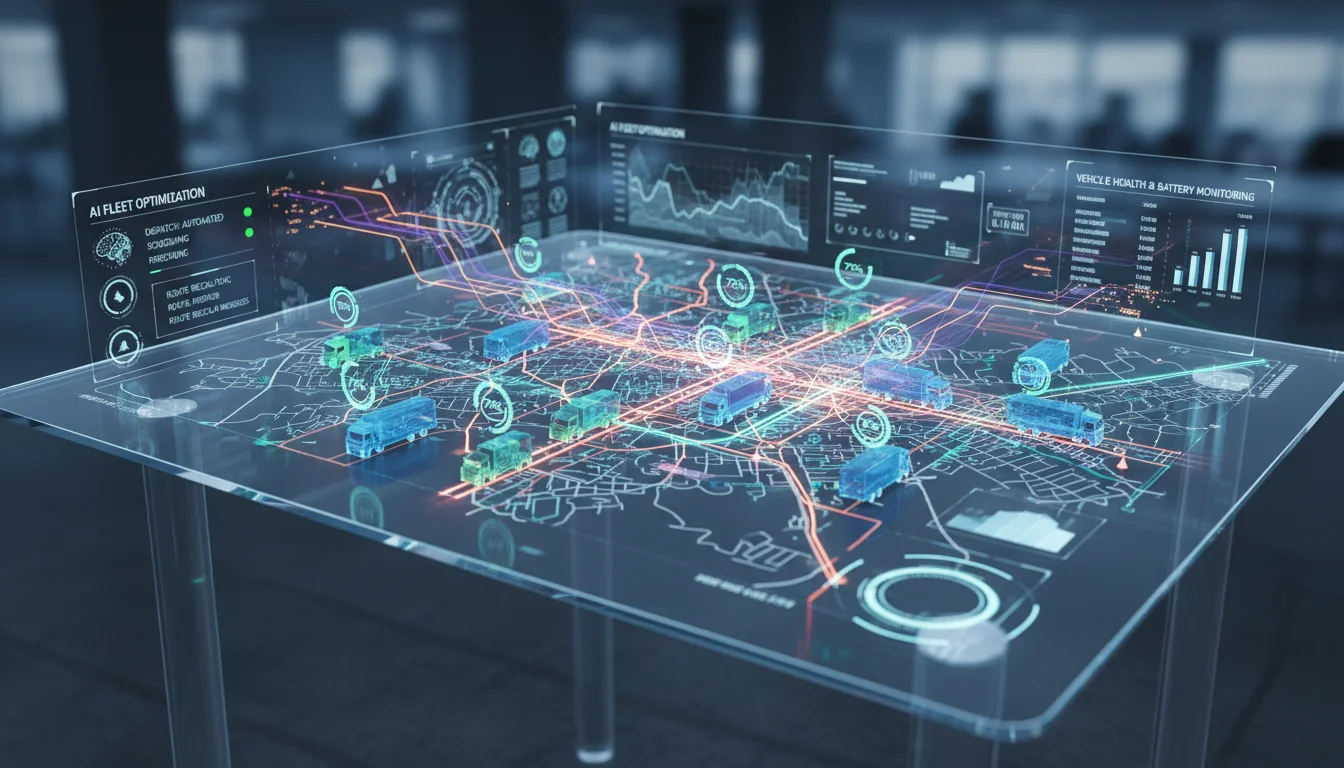
Telematics providers are increasingly leveraging digital twins—virtual, mathematical models of physical fleets powered by historical and live operational data. These models allow fleet strategists to simulate the operational and financial impacts of transitioning to Electric Vehicles (EVs) by assessing power availability, routing constraints, and payload impacts before committing to physical deployment. Concurrently, agentic AI has emerged to handle routine logistics administration. These AI agents automate complex tasks such as appointment scheduling, exception handling, freight procurement, and autonomous rerouting around weather or traffic disruptions, representing a definitive shift from reactive management to intelligent, predictive fleet operations.

A complex digital twin interface showing a virtual model of a fleet of trucks on a holographic map, with glowing data overlays indicating routes, EV battery levels, and AI agents automating dispatch and scheduling. Futuristic, high-tech aesthetic.

Comprehensive Analysis of 2026 Telematics Platforms

The 2026 telematics market is dominated by platforms that have evolved far beyond basic GPS tracking into comprehensive connected operations systems.

The distinction between these providers hinges on their specific core competencies: compliance rigor, safety edge-processing, automated dispatching capabilities, or sheer analytical data volume.

Samsara: The Dispatch and Safety Innovation Leader

Samsara has established itself as the premier solution for enterprises prioritizing advanced safety workflows and dynamic dispatching, boasting an industry-leading user satisfaction rate of 84% among fleet professionals. The platform derives its analytical power from an unparalleled data lake comprising 20 trillion data points across 90 billion miles of annual driving data, providing the foundation for highly accurate crash risk prediction and trend analysis.

Samsara’s architecture excels in high-volume urban dispatch scenarios, utilizing an AI engine capable of rapidly plotting up to 20 stops against live traffic and site conditions to optimize routes. On the safety front, Samsara differentiates itself through highly customizable, privacy-conscious AI dashcams that foster high driver adoption rates. Features include identity blurring for pedestrians and inward-facing cameras, customizable privacy mode configurations that disable video recording while maintaining AI event detection and audio alerts, and real-time in-cab coaching. Furthermore, Samsara’s unified platform provides seamless management of ELD compliance, driver workflows, and preventative maintenance insights without requiring users to manually sort data across multiple disparate dashboards. Customers utilizing Samsara frequently realize an 8x return on investment (ROI), characterized by longer vehicle lifespans and reduced vehicle downtime. However, user feedback indicates that Samsara’s asset pairing lacks some automation, occasionally requiring manual intervention, and the platform typically mandates a minimum three-year contract, which may deter smaller, budget-conscious operations.

Geotab: The Data Aggregator and Sustainability Pioneer

Geotab operates as the premier agnostic data aggregator in the telematics space, maintaining a massive install base of over 4.6 million connected vehicles worldwide. Its open-platform architecture and extensive Marketplace, featuring over 430 custom integrations, make it the preferred choice for enterprise fleets that require deep API access and complex Enterprise Resource Planning (ERP) integrations.

Geotab’s 2026 strategic offering is heavily focused on fuel optimization, predictive maintenance, and EV transition strategies. By utilizing machine learning models trained on vast historical datasets, Geotab Predict enables fleets to foresee operational bottlenecks and maintenance failures, providing AI-powered insights on fault code meanings, severity, and projected repair costs. The platform offers specialized modules for mixed-fleet management, tracking both internal combustion engine (ICE) metrics and EV battery states to optimize daily operational capabilities and benchmark efficiency. Its analytical depth is further demonstrated by advanced features such as AI-driven fuel level drop detection to combat siphoning, and customizable industry benchmarking. To support complex routing, Geotab seamlessly integrates with specialized routing software such as Appian for dynamic last-mile delivery, CoPilot (developed by Trimble) for truck-legal navigation avoiding bridges and weight limits, and Route4Me for high-volume logistics.

Motive: The Edge AI and Hardware Innovator

Motive (formerly KeepTruckin) has aggressively engineered its hardware to lead the edge AI telematics category, positioning itself as a direct competitor to Samsara for enterprise fleets. In 2026, the company launched the AI Dashcam Plus, a unified device powered by the Qualcomm Dragonwing QCS6490 processor. This hardware delivers three times the computational power of previous iterations, capable of running over 30 high-precision AI models simultaneously.

A critical technological differentiator for Motive is its implementation of stereo vision. By utilizing dual synchronized road-facing lenses, the hardware mimics human depth perception, radically improving the accuracy of Forward Collision Warnings and Lane Swerving alerts by precisely judging closing speeds and object distances. Motive integrates this advanced hardware with robust compliance hubs, automated AI coaching, and integrated timecards for simplified payroll. To eliminate the false positives that often plague AI cameras, Motive combines its AI detection with human review protocols, achieving a highly reliable safety monitoring ecosystem. Furthermore, Motive offers flexible driver privacy modes, allowing all cameras to be turned off while a vehicle is idling at a job site, or utilizing “Driver Privacy (AI On)” mode, which detects unsafe behaviors without storing driver-facing video in the cloud. The platform is frequently preferred by carriers seeking budget-friendly, highly accurate safety telematics with flexible month-to-month contract options, contrasting with the rigid terms of its competitors.

An interior view of a modern truck cab featuring an AI-powered dashcam with dual lenses, showing a holographic overlay of its stereo vision detecting a potential hazard on the road ahead. Data streams and safety alerts are visible, emphasizing advanced driver assistance and real-time coaching.

Verizon Connect: The Compliance and Asset Utilization Stalwart

Verizon Connect Reveal continues to be recognized as a leading comprehensive solution for strict compliance capabilities, expansive oversight, and highly reliable asset tracking. Featuring 30-second live pings and high-resolution map views integrated with Google Maps Street View, it provides granular, color-coded visibility into vehicle motion statuses across large fleets.

Verizon Connect heavily emphasizes big data predictive analytics, utilizing historical statistical modeling to forecast long-term operational risks. For example, the platform analyzes historic idling data and route schedules to project future fuel costs and engine wear, allowing fleet managers to anticipate which new job sites might become prohibitively costly. The platform is highly effective for organizations prioritizing strict ELD, DVIR, and IFTA compliance at scale. However, overall user sentiment is mixed; while the comprehensive add-ons and automated maintenance scheduling are praised, users frequently cite opaque pricing, billing issues, and poor customer service as significant drawbacks. Like Samsara, Verizon Connect typically requires a three-year minimum contract commitment.

Specialized and Niche Telematics Providers

  • Teletrac Navman TN360: Ranked highly for driver management, this platform utilizes natural language insights and excels in driver wellbeing through advanced fatigue management tools. Crucially, it offers flexible one-year initial contract terms, providing a middle ground for mid-sized fleets.
  • Azuga: Recognized specifically for its highly efficient route optimization capabilities and 30-to-59-second data refresh rates, Azuga caters to fleets focused heavily on minimizing travel time and fuel consumption.
  • RAM Tracking: Positioned as the best solution for improving driver safety in smaller operations, providing quick ROI without the overhead of massive enterprise systems.
  • Quartix: Best suited for micro-fleets and owner-operators focused exclusively on managing fuel costs, offering lower monthly fees (starting around $15.99) and shorter contract terms.
  • Spireon and Linxup: Spireon is optimized for mixed fleets containing diverse asset types, while Linxup is praised for transparent pricing structures, appealing to small businesses avoiding opaque enterprise negotiations.

Telematics Platforms Feature Comparison

Platform Core Market Strength Edge AI & Safety Hardware Enterprise API & Dispatch Contract Structure
Samsara Unified Operations & Dispatch 360-degree AI, Privacy blurring, Real-time coaching High (AI routing, 20-stop dynamic tracking) 3-year minimum
Geotab Custom Integrations & EV Data Go Focus Plus AI-Cam, Proactive risk detection High (430+ marketplace partners, Open API) Flexible/Partner-dependent
Motive Hardware Innovation (Stereo Vision) Qualcomm Dragonwing processor, Sensor fusion High (Customizable workflows, integrated timecards) Flexible / Month-to-Month available
Verizon Connect Compliance & Big Data Modeling Post-trip coaching, Risk scoring dashboards Medium (Built-in scheduling, compliance focus) 3-year minimum
Teletrac Navman Driver Wellbeing & Fatigue Real-time fatigue management alerts Medium (Natural language data insights) 1-year minimum

The Data Science of Road Safety and Driver Behavior Analytics

The implementation of sophisticated telematics hardware has generated unprecedented datasets regarding commercial road safety. In 2026, Motive released its AI Road Safety Report, analyzing 1.2 billion hours of commercial driving video across the United States, Mexico, and Canada to identify evolving collision patterns.

The data reveals that while overall traffic fatalities declined slightly in 2025, underlying road risk has not disappeared; rather, it has become more visible and quantifiable through AI driver behavior tracking. The analysis identified drowsy driving and aggressive driving (such as close following and harsh acceleration) as the strongest leading indicators and predictors of imminent collisions. Secondary behaviors, including smoking in the cab and cell phone distraction, also exponentially increase risk profiles.

Furthermore, the data science highlights the impact of macroeconomic and environmental factors on logistical safety. Shorter daylight hours, stormy weather, and heavier traffic volumes make fall and winter the most dangerous seasons for commercial collisions. Geopolitically, the report noted that 2025 tariff policies did not significantly reduce collision rates, as Mexico-U.S.

trade flows remained strong; instead, supply chain shifts pushed the density of commercial traffic—and the associated collision risk—further inland away from the immediate border zones. These insights underscore the necessity for fleet managers to utilize dynamic safety programs that adjust risk scoring based on seasonal weather, geographical trade shifts, and specific industry operating environments.

The Evolution of Enterprise Route Optimization APIs

While telematics systems track the physical execution and safety of a fleet, route optimization engines generate the theoretical blueprint for that execution. The underlying mathematics of routing involves solving complex variations of the Capacitated Vehicle Routing Problem (CVRP) and the Traveling Salesman Problem (TSP). Because these problems are NP-hard—meaning the computational complexity scales factorially as the number of delivery nodes and vehicles increases—solving them at an enterprise scale requires advanced heuristics, continuous machine learning, and live telematics control loops.

By 2026, the mapping and routing market has sharply bifurcated. Monolithic, legacy mapping providers are facing intense competition from API-first platforms that decouple the mathematical optimization engine from the user interface. This headless approach allows enterprise engineering teams to inject highly complex routing logic directly into their proprietary ERPs, TMS platforms, or custom logistics applications.

The Shift Away from Legacy Mapping Providers

Google Maps Platform and HERE Technologies have historically dominated geographic data services. However, their legacy architectures and pricing models are increasingly viewed as rigid constraints for complex supply chain logistics.

Google Maps Route Optimization API

Google Maps remains the undisputed leader in global data depth, Point of Interest (POI) coverage, and user familiarity. Its geocoding accuracy is unparalleled, and it offers generous entry-level developer incentives, such as a $200 monthly free credit. Furthermore, Google has integrated eco-friendly routing previews into its Routes API, calculating paths optimized for lower fuel consumption based on specific engine profiles (e.g., favoring highway routes for diesel engines and stop-and-go routes with regenerative braking opportunities for EVs).

However, Google’s API imposes severe technical and legal constraints on enterprise logistics. Its Distance Matrix API is limited to a 25x25 matrix size, severely restricting its utility for massive fleet calculations. For complex routing, the API offers poor support for custom objective functions and complex task sequencing. Critically, Google enforces strict Terms of Service regarding data caching (often restricted to a 30-day limit) and mandates that results must be displayed exclusively on Google Maps renderers. This vendor lock-in prevents businesses from building independent, reusable location databases or integrating the data seamlessly into non-Google proprietary interfaces.

HERE Technologies

Benefiting from a deep automotive heritage, initially built for the navigation systems inside BMW, Audi, and Mercedes-Benz vehicles, HERE Technologies provides exceptional truck routing capabilities. It accurately handles dimensional restrictions, hazmat classifications, and complex toll calculations, powering advanced driver assistance systems (ADAS) in over 63 million vehicles.

Despite these strengths, HERE’s strategic pivot toward software-defined vehicles has alienated some logistics and e-commerce product teams. At CES 2026, HERE doubled down on lane-level guidance and behavioral maneuvers for automated driving, reflecting an automotive focus rather than a pure logistical one. This has resulted in a complex, layered pricing model with documented annual price increases—most recently a 6% hike effective April 1, 2026, for new contracts and renewals. Furthermore, HERE strictly prohibits the building of reusable location databases through its API and applies aggressive throttling and rate limits during burst requests, forcing companies to continually query the API under heavy load, thereby inflating costs.

Mapbox

Mapbox serves as a powerful alternative for organizations prioritizing custom map design and developer tooling. Trusted by over 4 million developers, it offers high-performance location intelligence across diverse industries, from business intelligence to consumer apps. Like HERE, Mapbox is heavily investing in connected vehicles through ADAS SDKs. While highly customizable and reliable, Mapbox is tied to specific cloud platforms, which can limit the flexibility of enterprises requiring cloud-agnostic deployments, and its distance matrix sizes remain smaller compared to dedicated logistics optimization engines.

NextBillion.ai: Unrestricted Scale and Hyper-Customization

NextBillion.ai has disrupted the enterprise mapping space by creating a new market segment: Map Data as a Service (MDaaS). Rather than offering a rigid, one-size-fits-all solution, it provides highly permissive, API-first routing engines that lack the transactional latency and storage restrictions of legacy systems.

Technical Architecture and Capabilities

NextBillion.ai’s Route Optimization API handles massive scale, processing up to 4,000 tasks (locations) and 4,000 vehicles in a single HTTP POST request, far exceeding the 25x25 limits of legacy providers. The platform is designed to handle over 50 dynamic, real-world constraints simultaneously. Key operational objects within its API schema include:

  • Job and Shipment Objects: Defines pickup and delivery tasks, service durations, time windows, and task priorities.
  • Multi-Dimensional Vehicle Capacity: The algorithm ensures that the sum of shipments on a vehicle does not exceed its capacity across multiple dimensions simultaneously (e.g., cubic volume, weight in kilograms, and pallet count).
  • Skills and Relations Matching: Supports mandatory skill matching (e.g., ensuring hazardous materials are only assigned to certified drivers) and complex task sequencing via the in_direct_sequence parameter, which forces specific jobs to remain on the same route in a strict order.

Performance and Infrastructure

NextBillion.ai differentiates itself technically through its remarkable throughput—operating with 2 to 3 times lower latency and 10 to 20 times higher throughput compared to Google Maps and Mapbox. It achieves this speed while remaining entirely cloud-agnostic, available on AWS, Google Cloud, and Azure, with support for fully on-premise deployments to guarantee data sovereignty and compliance with SOC, GDPR, and ISO standards.

The platform allows developers to utilize custom cost matrices, overriding standard routing logic to prioritize proprietary metrics, such as specific road network rules or fleet-specific operational costs. Furthermore, it supports automated webhook-based job status notifications to track long-running optimization requests without continuous server polling. To facilitate this global infrastructure, NextBillion.ai maintains physical operations centers in the United States (Columbus, OH), Singapore, and India (Hyderabad). However, because it operates strictly as a headless backend engine, enterprises must utilize their own engineering teams to build the operational UI, dispatcher dashboards, and driver applications.

Route Optimization API Enterprise Comparison

Provider Architecture Focus API Limitations / Max Stops Custom Constraints Infrastructure Flexibility Pricing & Data Retention
NextBillion.ai API-First, Headless Engine 4,000 tasks / Large Matrices 50+, Multi-dimensional Cloud-agnostic, On-Premise available Flexible per-asset/order, unlimited storage
Google Maps API Standard Geographic Data 25x25 Distance Matrix Limited sequencing Google Cloud locked $200 credit, strict 30-day caching limit
HERE Maps Automotive & Trucking Volume/Plan dependent High (Hazmat, Weight, Tolls) Cloud-based SaaS 6% price hike in 2026, prohibits database building
Mapbox Custom Map Design & ADAS 25x25 Distance Matrix Medium customization Tied to specific clouds Volume-based, highly visual focus

Advanced Load Matching, Orchestration, and the Efficiency Paradox

While APIs calculate the most efficient path, logistics orchestration software is required to assign the correct cargo to the correct vehicle. In 2026, the dynamics of intelligent resource allocation have become deeply sophisticated, yet they reveal a significant operational paradox regarding human oversight.

Locus (DispatchIQ) and Intelligent Resource Allocation

For enterprises requiring full-stack orchestration rather than a headless API, Locus provides a high-volume, AI-driven dispatch platform that bridges the gap between routing mathematics and physical execution. Operating at a global scale across 30+ countries, Locus is trusted by over 360 enterprises and has optimized over 1.5 billion deliveries, generating more than $320 million in documented logistics savings.

The core of Locus’s platform is the DispatchIQ engine, which simultaneously processes between 180 and 280+ real-world constraints. Locus automates load matching through meticulous order-level attribute analysis. The system pairs shipments by evaluating vehicle capacity (weight and volume), service windows, vehicle compatibility (e.g., refrigeration), and drop density to minimize route redundancies. Locus accommodates human constraints by integrating driver shift windows, sick days, and rider preferences directly into the daily rostering engine.

Crucially, a routing algorithm is useless if the geographic coordinates of the delivery node are inaccurate.

Locus resolves this through a patent-protected geocoding engine that utilizes AI to distill and convert highly ambiguous addresses into precise coordinates. This capability is critical in the APAC and MEA regions, where standardized addressing infrastructure is often lacking, thereby eliminating misloads and reducing failed first delivery attempts. Furthermore, Locus provides true dynamic rerouting; when disruptions occur—such as sudden weather changes or traffic jams—the engine executes automatic resequencing across all affected routes, instantly updating driver applications and customer ETAs.

The Efficiency Paradox: Algorithms vs. Human Context

Despite the profound advancements in AI load-matching, a notable “Efficiency Paradox” has emerged in 2026, particularly among owner-operators and mid-sized freight networks. While digital freight matching platforms reduce initial load search times by an average of 34%, carriers relying purely on algorithmic dispatch have paradoxically experienced up to a 23% increase in unexpected detention hours compared to those utilizing human dispatchers.

This paradox occurs because load-matching algorithms optimize flawlessly for structured data (origin, destination, equipment type, rate, and timing) but possess profound blind spots regarding unstructured, contextual variables. Algorithms lack the industry immersion necessary to interpret nuanced human factors such as historical shipper behavior, broker reliability, or facility wait-time volatility. Consequently, data and industry feedback in 2026 indicate a growing preference for hybrid systems where AI handles the baseline mathematical optimization, but professional human dispatchers retain the authority to override algorithmic choices based on relational knowledge and complex contextual risk assessment.

Mid-Market and Specialized Last-Mile Routing Software

For organizations that lack the engineering resources to implement an API-first solution like NextBillion.ai or the high-volume scale to require Locus, the market supports several highly capable “out-of-the-box” routing platforms. These tools combine mathematical optimization with intuitive user interfaces and driver mobile applications:

  • Onfleet: Categorized as a premier tool for mid-market courier and last-mile delivery teams, Onfleet features powerful auto-dispatch capabilities and a highly rated mobile driver app. It is designed for fast deployment, allowing teams to become operational in days rather than months. It excels in complex operations that mix internal fleets with external delivery partners. However, Onfleet reaches operational limits quickly as geographic scale and order volumes grow into the enterprise tier, and its AI dynamic routing is considered only “partial” compared to platforms like Locus. Pricing starts at $599 per month.
  • Route4Me: A veteran platform dominating high-volume last-mile logistics, boasting 30 million optimized routes and 3 billion miles analyzed. Heavily integrated with telematics providers like Geotab, it automates route planning and enforces vehicle-specific road compliance. Route4Me is noted for cutting operational costs by 20-30% via route density maximization and idle-time reduction, making it ideal for rapidly scaling e-commerce providers.
  • OptimoRoute: Highly recommended for field sales and service businesses, OptimoRoute provides a powerful routing application with deep flexibility, allowing managers to set up complex schedules and routes tailored to mobile workforces.
  • Routific: Built specifically for low-to-mid volume local delivery businesses, Routific is celebrated for its clean user interface and highly efficient routes, consistently yielding up to 15% shorter driving distances than its direct competitors. It includes driver mobile apps, real-time GPS tracking, and automated customer email notifications on all its plans.
  • DispatchTrack: Recognized as the best solution for enterprise teams running planned delivery routes with scheduled time windows. It offers advanced last-mile delivery management with AI-driven scheduling and highly accurate ETA tracking.
  • Spoke Dispatch (formerly Circuit): Best suited for small businesses with simple routing needs, originating as a popular standalone app for single drivers.
  • Trueway Routing API: A notable specialized API available through API.market, Trueway finds the fastest routes using real road networks and live traffic, handling both single-destination and multi-stop planning. Its primary advantage is consolidated billing and authentication alongside other API subscriptions.

Predictive Fuel Forecasting and Fleet Rightsizing

With fuel costs comprising nearly 40% of total fleet operational expenses—a number that continues to rise annually—controlling consumption is an existential requirement for enterprise profitability. Consequently, sustainability tech and fuel tracking have transitioned from secondary compliance accessories to core routing parameters.

AI Algorithms and Quantum Optimization Models

Traditional model-based predictive approaches for fuel consumption require complex thermodynamic equations that struggle to adapt to dynamic, real-world variables. In 2026, the industry has widely adopted Machine Learning frameworks to forecast fuel use and optimize efficiency.

Advanced metaheuristic optimizers, such as the Modified Walrus Optimization (MWO) algorithm, are actively deployed to estimate parameters in both internal combustion engines (ICE) and the proton exchange membranes (PEM) of fuel cell-based electric vehicles. The MWO algorithm efficiently explores parameter spaces to identify the optimal set of system variables that minimize prediction errors. These machine learning models analyze historical repair records, live telematics telemetry, and geospatial route data to surface efficiency risks 20 to 45 days before physical symptoms or traditional diagnostics raise alarms.

Furthermore, simulation-driven predictive tools, such as BQP’s quantum optimization platform, transform raw operational data into forward-looking models. These platforms allow fleet managers to test strategies, forecast fuel outcomes, and optimize asset utilization before physical deployment, ensuring that small inefficiencies do not multiply into compounding financial losses across large fleets. A unified ML framework enables simultaneous dual-forecasting: accurately predicting both the energy consumption of a given route and the corresponding CO2 emissions, seamlessly accommodating diverse, mixed-fleet datasets. Modern Fleet Fuel Management Systems, such as Safee, leverage these insights to detect and prevent fuel misuse or theft, evaluating efficiency by route, driver, or vehicle type to optimize overall fleet performance.

Carbon Emission Optimization and Logistics ESG Compliance APIs

Global regulatory frameworks, including the Corporate Sustainability Reporting Directive (CSRD) in Europe and evolving SEC rules in the United States, have mandated stringent greenhouse gas (GHG) reporting. In response, enterprises are integrating specialized Carbon Emission Calculator APIs directly into their TMS and routing engines to turn scattered emissions data into actionable, audit-ready insights.

Leading Carbon Accounting APIs

  • BigMile: Recognized as a premier SaaS and API platform, BigMile provides robust carbon accounting software with an in-built emissions calculator. It allows logistics service providers and shippers to accurately calculate and report CO2e emissions across any transport mode, modeling carbon footprints to compare emission data across different supply chain scenarios.
  • Lune: Lune provides high-precision emission intelligence tailored specifically for logistics. Its calculation methodology is anchored to the industry-leading GLEC Framework and complies with ISO 14083 standards, ensuring calculations are report-ready and audited by the Smart Freight Centre. Lune’s API utilizes intelligent data gap-filling; if a customer inputs incomplete shipment data, Lune infers the exact vessel used, the actual distance traveled, and the fuel type to generate step-by-step, per-leg emission calculation breakdowns.
  • Searoutes: As an API-first platform, Searoutes specializes in providing rapid carbon estimations based on coordinates or route lines. It evaluates the environmental cost of a route prior to dispatch, analyzing factors such as the type of transportation (sea, road, rail, air), container type, and cargo tonnage to optimize chartering and maritime logistics.
  • EcoTransIT World: A long-standing, highly respected emissions calculator developed in Germany, functioning primarily as a web-based tool and API utilized by global carriers to measure transport emissions reliably.
  • FlyPix AI: While not a traditional carbon calculator, FlyPix AI represents the vanguard of environmental analytics by utilizing AI agents to conduct geospatial imagery analysis from satellite, aerial, and drone photos. This allows organizations to track physical environmental changes across large geographic areas, supporting broader decarbonization and energy tracking efforts beyond vehicle tailpipe emissions.

Strategic Conclusions and Future Outlook

The commercial fleet management and logistics technology landscape in 2026 is defined by a fundamental architectural shift away from retroactive data collection toward predictive, automated execution at the edge.

First, the implementation of high-compute processors directly within vehicle hardware, utilizing stereo vision and multi-sensor fusion, signifies that telematics is no longer merely about GPS ping rates.

Vehicles are now capable of localized, autonomous decision-making regarding safety, driver coaching, and risk mitigation, drastically reducing reliance on centralized cloud latency.

Second, the era of monolithic mapping software dictating logistics workflows has concluded. Enterprises demanding structural autonomy are increasingly adopting API-first engines like NextBillion.ai to compute massive, multi-constrained routing matrices while retaining complete sovereign control over their proprietary TMS interfaces and data storage. Concurrently, orchestration platforms like Locus remain indispensable for bridging the gap between raw mathematical output and physical dispatch realities, particularly in geographically complex markets where AI geocoding is paramount.

Finally, sustainability has transitioned from an optical compliance metric to a foundational routing constraint. Through advanced machine learning algorithms and specialized APIs, carbon output and fuel consumption are forecasted, optimized, and audited simultaneously with driver schedules and freight rates. For enterprise supply chains, competitive advantage now relies entirely on the seamless integration of high-fidelity physical telematics data with hyper-scalable, cloud-agnostic routing algorithms. Organizations that successfully fuse these technologies will achieve unprecedented operational resilience against market volatility, regulatory pressures, and the compounding costs of global logistics.