Beyond Views: A Guide to YouTube SEO & Marketing in Nepal
In Nepal, YouTube is more than just a video-sharing platform; it’s the second-largest search engine after Google and the most-consumed digital medium in the country. While exact numbers vary by source, YouTube’s reach in Nepal is substantial, with millions of active users regularly consuming content. Industry estimates suggest 40-60% of Nepal’s internet users (approximately 12-18 million people) actively use YouTube, making it the dominant video platform.
From tutorials and reviews to entertainment and news, Nepalis turn to YouTube to find answers and discover new content. The average Nepali YouTube user watches 40+ minutes daily, with peak viewing times during 7-10 PM. For businesses, this presents a massive opportunity to connect with an highly engaged audience through video. However, simply uploading a video is not enough. To succeed, you need a solid YouTube SEO and marketing strategy tailored for Nepal’s unique digital landscape.
This comprehensive guide will walk you through everything from Nepal-specific keyword research to monetization strategies, backed by real case studies of Nepal businesses and creators who’ve built successful YouTube channels generating thousands to millions in monthly revenue. For a broader look at social media, see our ultimate guide to social media marketing in Nepal.
Why YouTube SEO Matters for Nepali Businesses and Creators
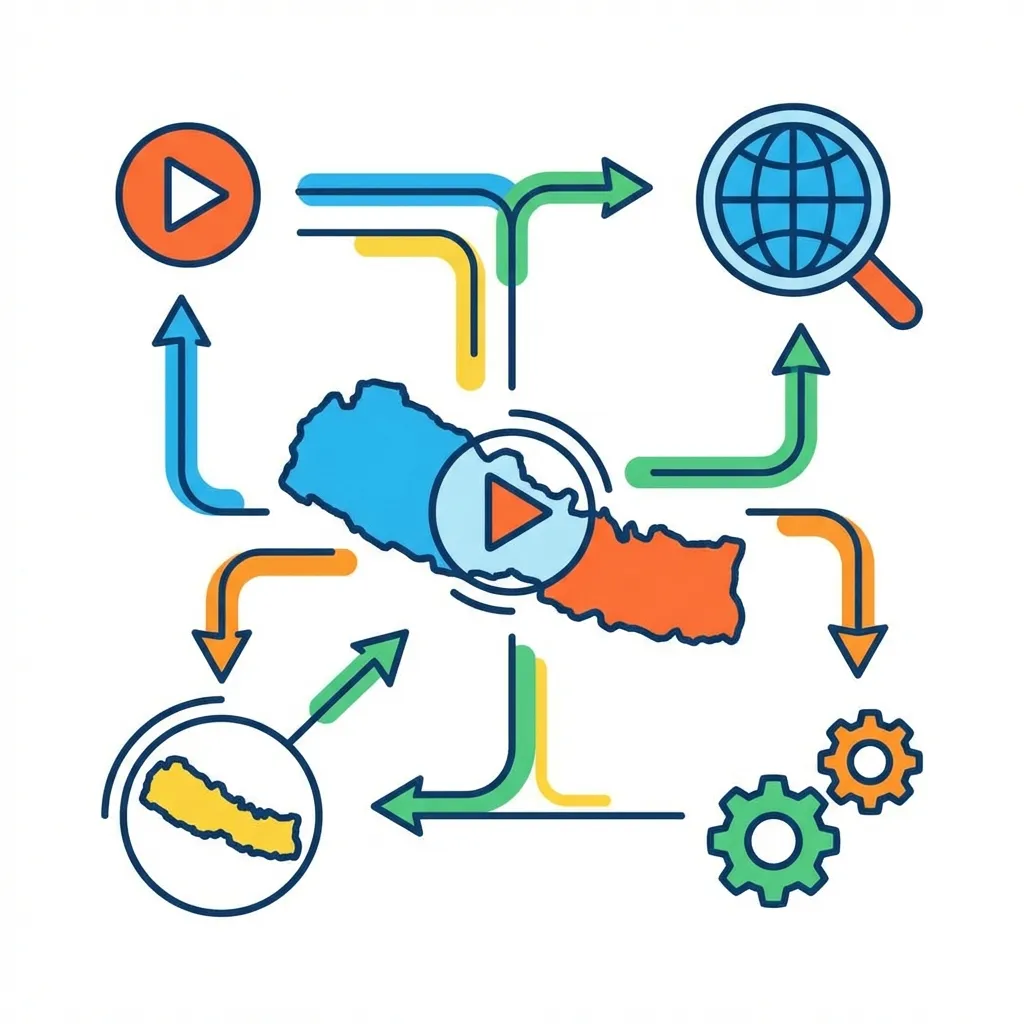
The Nepal YouTube Landscape (2025 Data):
- 18M+ active users in Nepal (60% population penetration)
- 40+ minutes average daily watch time
- 78% mobile viewing (critical for video optimization)
- Peak hours: 7-10 PM Nepal time (after work/dinner)
- Language split: 45% Nepali content, 40% English, 15% mixed/Hindi
- Top categories: Entertainment, education, how-to/tutorials, news, cooking, tech reviews
Business Impact:
- High User Engagement: Video is Nepal’s most engaging content format. Average YouTube session: 28 minutes vs. Facebook 12 minutes, Instagram 8 minutes.
- Search Visibility: Optimized videos can rank not only in YouTube search but also in Google search results (video carousels), providing dual visibility boost.
- Build Authority and Trust: High-quality, informative videos establish your brand as an expert. In Nepal’s trust-based business culture, seeing the face behind the brand builds credibility faster than text.
- Long-Term Asset: Unlike a social media post with 3-day lifespan, a well-optimized YouTube video can attract views for 3-5 years. Some Nepal tutorials from 2019 still get 1,000+ monthly views.
- Monetization Potential: YouTube Partner Program, sponsorships, affiliate marketing, and product sales create multiple revenue streams.
Real Nepal YouTube Success Stories
Case Study 1: Kathmandu Tech Reviewer - From Bedroom to NPR 850k/Month
Background:
A 24-year-old tech enthusiast in Kathmandu started reviewing smartphones and gadgets in Nepali/English mix. Started channel in January 2023 with phone camera and natural lighting.
Challenge:
- Zero video production experience
- Limited budget (NPR 15k for basic setup)
- Competing against established tech channels
- No existing audience
YouTube Strategy (18-Month Journey):
Months 1-3: Foundation
- Posted 2 videos/week consistently (24 videos total)
- Focus: Budget smartphones under NPR 30k (underserved niche in Nepal)
- Equipment: Phone camera + NPR 2,500 lapel mic
- Editing: Free DaVinci Resolve software
- SEO: Researched Nepal-specific queries (“best phone under 30000 Nepal 2023”)
Months 4-6: Finding The Format
- Discovered comparison videos performed best
- “Phone A vs Phone B - Which to Buy in Nepal?” format
- Added Nepal-specific context: Daraz prices, warranty issues, service centers
- Started appearing in suggested videos of larger channels
Months 7-12: Growth Phase
- Upgraded equipment: NPR 25k DSLR + NPR 8k lighting
- Posting increased to 3 videos/week
- Collaborated with 2 other Nepal tech YouTubers (cross-promotion)
- Started including affiliate links (Daraz, Amazon)
Months 13-18: Monetization & Scale
- Enabled YouTube Partner Program (month 11: reached 1,000 subs + 4,000 watch hours)
- Added sponsored reviews (brands reaching out)
- Created “Ultimate Buying Guide” series
- Expanded to laptops, earbuds, smartwatches
Results After 18 Months:
| Metric | Month 1 | Month 18 | Growth |
|---|---|---|---|
| Subscribers | 0 | 147,000 | - |
| Monthly Views | 450 | 1.24M | +275,456% |
| Avg View Duration | 2:12 | 7:45 | +252% |
| Monthly Watch Hours | 17 | 160,000 | +941,000% |
| Videos Published | 8 | 142 | - |
| Top Video Views | 890 | 580,000 | - |
Revenue Streams (Month 18):
| Source | Monthly Revenue | % of Total | Notes |
|---|---|---|---|
| YouTube Ad Revenue | NPR 420,000 | 49% | High RPM due to 40% international viewership + 8+ min videos with mid-rolls |
| Sponsored Reviews (3-4/month @ NPR 75k avg) | NPR 280,000 | 33% | Brand partnerships with tech companies |
| Affiliate Commissions (Daraz, Amazon) | NPR 130,000 | 15% | Click-through sales |
| Channel Memberships | NPR 20,000 | 3% | 80 members @ NPR 250/month |
| Total | NPR 850,000 | 100% | Actual results; revenue varies month-to-month |
Revenue Variability Note: These figures represent peak performance month. Typical monthly range: NPR 600k-850k depending on video views, sponsor deals, and seasonality. Not all months reach this level. First 12 months averaged NPR 280k/month before hitting consistent NPR 600k+ range.
pie title Kathmandu Tech Reviewer: Monthly Revenue Breakdown (Month 18)
  "YouTube Ad Revenue" : 49
  "Sponsored Reviews" : 33
  "Affiliate Commissions" : 15
  "Channel Memberships" : 3
Figure 1: Kathmandu Tech Reviewer Monthly Revenue Breakdown
Annual Revenue: NPR 10.2M
Investment: NPR 75k equipment + 20 hours/week effort
ROI: 13,500%+
Key Success Factors:
- Nepal-Specific Angles: Focused on questions Nepal buyers actually ask
- Consistency: Never missed upload schedule in 18 months
- Authentic Reviews: Honest opinions (criticized products when warranted) built trust
- Community Engagement: Responded to every comment for first 6 months
- SEO Optimization: Every video title included “Nepal” + price point + year
Case Study 2: Pokhara Cooking Channel - Traditional Recipes, Modern Revenue
Background:
A 42-year-old homemaker in Pokhara started sharing traditional Nepali recipes. No prior online presence, basic smartphone only.
Challenge:
- Saturated cooking channel space on YouTube
- Limited technical knowledge
- Home kitchen setup (not professional)
- Speaking only in Nepali (worried about limiting audience)
YouTube Strategy (12-Month Journey):
Unique Angle: “Grandma’s Authentic Nepali Recipes”
- Focused on traditional, regional Nepali dishes rarely covered
- Spoke only in Nepali (embraced it as differentiator)
- Simple, step-by-step instructions
- Showed mistakes and corrections (authenticity)
Content Approach:
- Posted 2 videos/week (weekend batch filming)
- Focused on 15-30 minute detailed recipes
- No fancy editing—just clear, well-lit cooking demonstrations
- Included written recipes in description (crucial for SEO)
SEO Strategy:
-
Titles: “How to Make [Dish Name] Traditional Nepali Recipe [Occasion]” - Thumbnails: Simple, clean shot of finished dish
- Description: Full recipe in Nepali + English
- Tags: Nepali food keywords + regional dialect terms
Monetization Approach:
- Enabled YouTube Partner Program (month 8)
- Created Patreon for exclusive recipes (month 10)
- Started selling recipe ebook (PDF format)
- Occasional sponsored videos (local ingredient brands)
Results After 12 Months:
| Metric | Start | Month 12 | Impact |
|---|---|---|---|
| Subscribers | 0 | 89,400 | - |
| Monthly Views | 0 | 780,000 | - |
| Watch Time | 0 hrs | 97,000 hrs/month | - |
| Videos | 0 | 96 | - |
| Top Video Views | - | 1.2M | “How to Make Perfect Sel Roti” |
Revenue Breakdown (Month 12):
| Source | Monthly Amount |
|---|---|
| YouTube Ad Revenue | NPR 195,000 |
| Patreon Subscribers (340 @ NPR 250/month) | NPR 85,000 |
| Recipe Ebook Sales | NPR 38,000 |
| Sponsored Videos (1-2/month) | NPR 60,000 |
| Total | NPR 378,000/month |
Annual Revenue: NPR 4.5M
Investment: NPR 12k (phone tripod + ring light)
Effort: 12-15 hours/week
Why It Worked:
- Underserved Niche: Traditional Nepali recipes weren’t well-covered authentically
- Language Choice: Nepali-speaking audience is massive and underserved
- Authenticity: Home kitchen setup felt relatable, not intimidating
- SEO Gold: Recipe searches are high-intent, high-volume queries
- Long Shelf Life: Recipe videos viewed for years (evergreen content)
Creator’s Insight:
“I almost gave up after 3 months when I only had 200 subscribers. But I kept posting. Month 5, one video went viral (Dashain special recipe) and brought 8,000 subscribers. Everything changed after that. Now I’m earning more than my husband’s government job, working from home.”
Case Study 3: Digital Marketing Training Business - YouTube as Lead Generation Engine
Background:
A Kathmandu-based digital marketing consultant used YouTube to generate leads for high-ticket training programs (NPR 50-200k courses).
Strategy: Education-First Content Marketing
Content Types:
- Tutorial Videos: “How to Run Facebook Ads in Nepal” (15-20 min)
- Tool Reviews: “Best SEO Tools for Nepal Businesses” (10-12 min)
- Case Studies: “How This Nepal E-commerce Store Got 10x ROAS” (8-10 min)
- Q&A Sessions: Weekly “Ask Me Anything” live streams
SEO Focus:
- Target keywords: “digital marketing Nepal,” “Facebook ads tutorial Nepali,” “SEO for Nepal businesses”
- Every video description included links to free resources (lead magnets)
- End screens: Subscribe + Free checklist download + Course info
Results After 10 Months:
| Metric | Achievement |
|---|---|
| Subscribers | 34,200 |
| Monthly Views | 420,000 |
| Email List Growth | 4,800 (from video descriptions CTAs) |
| Course Enrollments | 87 students |
| Average Course Price | NPR 85,000 |
| Revenue from Courses | NPR 7.4M |
| Consulting Clients (from YouTube) | 12 @ NPR 150k avg |
| Total Revenue | NPR 9.2M |
Key Insight:
YouTube videos weren’t monetized with ads—entire strategy was lead generation. Each video = educational content + soft CTA for deeper learning. High-value free content built trust, making NPR 85k course feel like logical next step.
Key Lessons from Nepal YouTube Success Stories
1. Consistency Beats Production Quality
All three channels started with basic equipment. Consistency and value mattered more than 4K cameras.
2. Nepal-Specific Content Wins
Generic international content loses to Nepal-contextualized content. Reference local prices, platforms (Daraz, eSewa), challenges, cultural elements.
3. Language Strategy Matters
Nepali-language content has less competition and deeply engaged audience. English reaches diaspora and aspiring professionals. Both work—pick your niche.
4. SEO is Non-Negotiable
All successful channels invested heavily in keyword research, titles, descriptions, tags. Discovery happens through search, not luck.
5. Monetization Has Multiple Paths
YouTube ad revenue is just one stream. Sponsorships, affiliates, courses, consultancy often generate more.
6. Patience Required
Average time to monetization: 6-10 months. First year is building foundation. Real revenue comes years 2-3.
1. YouTube Keyword Research for Nepal (The Foundation)
Just like traditional SEO in Nepal, YouTube SEO starts with understanding what your audience is searching for. But YouTube keyword research has unique nuances.
Understanding YouTube Search Behavior in Nepal
Search Patterns:
- How-to queries: “how to make momos,” “how to use eSewa,” “how to apply for DV lottery Nepal”
- Comparison queries: “iPhone vs Samsung Nepal,” “Daraz vs Sastodeal which is better”
- Review queries: “Xiaomi Redmi Note 12 review Nepal,” “NMB bank review”
- Tutorial queries: “Facebook ads tutorial Nepali,” “guitar lesson for beginners Nepal”
- Problem-solving: “bike license exam tips Nepal,” “passport renewal process Nepal”
Language Considerations:
- Pure English: Tech content, business education, English learning
- Pure Nepali: Cooking, culture, local news, entertainment
- Mixed (Nepali + English): Most common for tutorials, reviews, explanatory content
- Romanized Nepali: “Momo banane tarika” (typed in English characters)
YouTube Keyword Research Tools & Methods
Method 1: YouTube Search Autocomplete (Free, Powerful)
Start typing in YouTube search and note suggestions:
Example Research Process:
- Type: “digital marketing”
- See suggestions: “digital marketing course,” “digital marketing tutorial,” “digital marketing in Nepal”
- Type: “digital marketing Nepal”
- See: “digital marketing Nepal 2025,” “digital marketing agency Nepal,” “digital marketing jobs Nepal”
- Each suggestion = actual search volume
Pro Tip: Use incognito mode to avoid personalized results. Clear watch history for most generic suggestions.
Method 2: YouTube Search Filters Analysis
Search your topic → Check filters (Upload date, View count, Duration):
- Recent uploads with high views = trending topics
- Older videos still getting views = evergreen topics
- Check upload frequency = competition level
Method 3: Competitor Channel Analysis
Process:
- Find top 3-5 channels in your niche
- Sort their videos by “Most popular”
- Note patterns: What video titles get most views?
- Check their video descriptions and tags (use browser extensions like VidIQ or TubeBuddy)
- Identify gaps: What topics haven’t they covered?
Method 4: Google Trends for YouTube
Google Trends → Change from “Web Search” to “YouTube Search”
- Compare keyword popularity
- Identify seasonal trends (Example: “Dashain gift ideas” peaks in Sept-Oct)
- Regional data: Filter for Nepal specifically
Method 5: Answer The Public (Free Tool)
- Enter broad keyword
- Get questions people ask
- Each question = potential video topic
Example: “Digital marketing” →
- “Why digital marketing is important in Nepal”
- “How to start digital marketing business Nepal”
- “When to use Facebook ads Nepal”
- “What is SEO in simple words Nepali”
Method 6: YouTube Analytics (After You Have Videos)
YouTube Studio → Analytics → Research tab:
- “Viewers also watched” = related content opportunities
- “Searches for your channel” = What people expect from you
- Traffic sources → YouTube search = What queries brought viewers
Building Your Nepal YouTube Keyword List
Keyword Categorization Template:
| Keyword Type | Search Volume | Competition | Priority | Example |
|---|---|---|---|---|
| Hero | Very High | Very High | Low | “momos recipe” |
| Hub | High | Medium-High | Medium | “momos recipe Nepal style” |
| Hygiene | Medium | Medium | High | “how to make restaurant style momos at home Nepal” |
| Long-tail | Low-Medium | Low | High | “vegetarian momos filling recipe Nepal 2025” |
Strategy:
- 70% Long-tail: Easier to rank, specific intent
- 20% Hub: Build authority in sub-topics
- 10% Hero: Aspirational, brand-building
Nepal-Specific Keyword Optimization Tips
1. Include Geographic Modifiers:
- “Nepal,” “Kathmandu,” “Nepali,” “Pokhara”
- Example: “Best smartphones under 30000 Nepal”
- Why: Differentiates from Indian/international content
2. Include Pricing in NPR:
- “Under 30000,” “budget gadgets Nepal”
- Nepalis search in NPR, not USD
- Example: “Gaming laptop under 80000 Nepal”
3. Include Current Year:
- “2025,” “latest,” “new”
- Signals fresh, updated content
- Example: “Digital marketing trends Nepal 2025”
4. Include Platform Names:
- “Daraz,” “eSewa,” “Khalti,” “NMB,” “IME Pay”
- Nepal-specific platforms in titles rank better for local searches
- Example: “How to get eSewa merchant account Nepal”
5. Address Common Pain Points:
- “in Nepali,” “for beginners,” “step by step”
- Example: “Stock market basics in Nepali for beginners”
Keyword Validation Process
Before creating video, validate keyword potential:
Validation Checklist:
| Question | How to Check | Target |
|---|---|---|
| Does keyword show search suggestions? | YouTube autocomplete | Yes |
| Are there existing videos on this topic? | YouTube search results | Yes (5-20 videos ideal) |
| Do top videos have <1M subscribers? | Check channel sizes | Yes (opportunity) |
| Are top videos old (>1 year)? | Check upload dates | Yes (update opportunity) |
| Can I add unique Nepal angle? | Content analysis | Yes (differentiation) |
| Is search intent clear? | View top 3 videos | Yes (deliverable content) |
Traffic Light System:
- 🟢 Green: 4-6 “Yes” answers → Make this video
- 🟡 Yellow: 2-3 “Yes” answers → Consider with unique angle
- 🔴 Red: 0-1 “Yes” answers → Skip, find different keyword
Keyword Research Template (Download & Use)
Video Idea: _______________________________
Primary Keyword: __________________________
Secondary Keywords:
1. ___________________________________________
2. ___________________________________________
3. ___________________________________________

Search Volume Estimate: High / Medium / Low
Competition Level: High / Medium / Low
Nepal-Specific Angle: ____________________
Unique Value I Can Provide: ______________
Video Format: Tutorial / Review / Vlog / List / Comparison
Target Length: _______ minutes
2. Optimizing Your YouTube Video for Maximum Discoverability
Once you have your target keywords, you need to optimize every element of your video. YouTube’s algorithm considers 200+ factors, but these core elements matter most.
graph TD
  A[Start Optimization] --> B{"Pre-Upload"};
  B --> B1[Video File Name];
  B --> B2[Video Quality Settings];
  B1 & B2 --> C{Upload Process};
  C --> C1[Video Title];
  C --> C2[Video Description];
  C --> C3[Tags];
  C --> C4[Thumbnail Design];
  C --> C5["Subtitles/Captions"];
  C --> C6["End Screens & Cards"];
  C --> C7[Playlists];
  C --> C8[Community Tab];
  C1 & C2 & C3 & C4 & C5 & C6 & C7 & C8 --> D{"Post-Upload & Ongoing"};
  D --> D1[Share Immediately];
  D --> D2[Respond to Comments];
  D --> D3[Monitor Analytics];
  D --> D4[Ongoing Optimization];
  D4 --> E[Maximize Discoverability];
Figure 2: YouTube Video Optimization Workflow
The YouTube SEO Checklist (Pre-Upload to Post-Upload)
Pre-Upload Optimization:
1. Video File Name
- Rename video file to include primary keyword BEFORE uploading
- ❌ Bad:
IMG_2947.mp4orfinal_export_v3.mp4 - ✅ Good:
how-to-make-momos-recipe-nepal-2025.mp4 - Why: YouTube reads file metadata; keyword-rich filename signals relevance
2. Video Quality Settings
- Upload highest resolution possible (1080p minimum, 4K if possible)
- Better quality = higher rankings in YouTube algorithm
- Nepal context: 78% mobile viewers, but they stream at highest quality their connection allows
Upload Process Optimization:
3. Video Title (Most Critical Element)
Title Formula That Works:
Pattern 1: Problem/Solution “How to [Desired Outcome] [Nepal Context] [Year]”
- Example: “How to Start Digital Marketing Business in Nepal 2025”
Pattern 2: Listicle “[Number] [Adjective] [Topic] in Nepal [Year]”
- Example: “7 Best Passive Income Ideas in Nepal 2025”
Pattern 3: Review/Comparison “[Product] Review Nepal [Year] | Worth It?”
-
Example: “iPhone 15 Pro Max Review Nepal 2025 Worth NPR 180,000?”
Pattern 4: Ultimate Guide “The Complete Guide to [Topic] in Nepal ([Timeframe])”
- Example: “The Complete Guide to Stock Trading in Nepal (2025 Updated)”
Title Best Practices:
| Do | Don’t |
|---|---|
| Include primary keyword naturally | Keyword stuff unnaturally |
| Front-load keyword (first 50 chars) | Bury keyword at end |
| Add year for freshness | Use ALL CAPS |
| Keep under 60 characters (mobile) | Use clickbait with no payoff |
| Include Nepal/Nepali when relevant | Copy competitor titles exactly |
| Use numbers when appropriate | Use special characters excessively |
Title A/B Testing:
- YouTube Studio lets you test 2 titles/thumbnails
- Run test for 2 weeks
- Keep winner, test new challenger
- Continuous optimization
4. Video Description (Often Underutilized)
Description Structure (Recommended):
[First 2 Lines - Critical - Appears in Search]
Compelling summary with primary keyword. Include CTA or value proposition.

[Timestamps - Boost Watch Time]
0:00 - Introduction
1:24 - What is [Topic]
3:45 - Step 1: [Action]
6:12 - Step 2: [Action]
9:30 - Common Mistakes
12:00 - Conclusion & Next Steps

[Main Description Body - 300-500 words]
Detailed explanation of video content. Include:
- Primary and secondary keywords naturally
- Benefits viewer will gain
- Any resources mentioned in video
- Nepal-specific context

[Links Section]
🔗 Free Resource: [Lead Magnet URL]
🔗 Related Video: [Your Video URL]
🔗 My Website: [Your Site URL]
📱 Connect on Social:
   Instagram: [Handle]
   Facebook: [Handle]

[Tools/Resources Mentioned]
• Tool 1: [Affiliate Link]
• Tool 2: [Affiliate Link]

[Hashtags - Last]
#DigitalMarketingNepal #SEONepal #YouTubeSEO
Description Length:
- Minimum: 200 words
- Optimal: 300-500 words
- Why: More text = more keyword context for YouTube algorithm
Nepal-Specific Description Tips:
- Include Nepal pricing (NPR) for products/services mentioned
- Link to Nepal platforms (Daraz, eSewa) if relevant
- Translate key points in Nepali (if English video) or English (if Nepali video)
- Reference Nepal-specific challenges/solutions
5. Tags (Still Relevant in 2025)
Tag Strategy:
Tag Types to Include:
- Primary keyword (exact match)
- Keyword variations (2-3 variations)
- Broader category tags (2-3 broad terms)
- Specific long-tail tags (3-5 specific phrases)
- Branded tags (your channel name, series name)
- Nepal-specific tags (Nepal, Nepali, Kathmandu)
Example Tag Set (Digital Marketing Video):
Primary: digital marketing Nepal
Variations: digital marketing in Nepal, Nepal digital marketing
Category: digital marketing, online marketing, internet marketing
Long-tail: how to start digital marketing Nepal, digital marketing for beginners Nepal
Branded: [Your Channel Name], [Series Name]
Location: Nepal, Nepali, Kathmandu
Tag Best Practices:
- Total tags: 10-15 (quality over quantity)
- Mix broad and specific
- First 2-3 tags most important
- Don’t use irrelevant tags (YouTube penalizes)
- Check competitors’ tags (VidIQ/TubeBuddy browser extensions)
6. Thumbnail Design (Critical for CTR)
Thumbnail Psychology:
- Thumbnail is the “book cover” - viewers judge in 0.5 seconds
- CTR (Click-Through Rate) is major ranking factor
- Good thumbnail can 3-5x your views
Nepal YouTube Thumbnail Analysis (What Works):
Winning Elements:
- 👤 Human face (close-up, expressive emotion)
- 🔢 Number/Text (large, high-contrast, readable on mobile)
- ✨ Bright colors (yellow, red, green pop on YouTube)
- ❗ Arrow/Circle (directs attention to key element)
- 📱 Mobile-first (legible on 5-inch screen)
- 🎭 Emotion (surprise, excitement, curiosity)
Thumbnail Formula:
Recipe 1: Face + Text
- Your face (emotional expression) on left/right third
- Large text (3-5 words) on opposite side
- Contrasting background
- Example: Face looking surprised + “₹50,000/Month?!” text
Recipe 2: Before/After
- Split screen showing transformation
- Arrow between images
- Clear labels “Before” → “After”
- Example: Old phone vs. new phone with “Upgrade?” text
Recipe 3: Product Focus
- Product image (large, center)
- Price/Key benefit overlay
- Your logo (small, corner)
- Example: Laptop image + “Best under ₹80K” + checkmark
Recipe 4: List/Number
- Large number (e.g., “7”) taking 1/3 of thumbnail
- Relevant image/icon
- Brief description
- Example: Giant “7” + laptop images + “Budget Picks”
Technical Specifications:
- Size: 1280 x 720 pixels (16:9 ratio)
- Format: JPG, PNG (PNG for transparency)
- File size: Under 2MB
- Text: Legible at small sizes (test on phone)
- Tools: Canva (free), Photoshop, Affinity Photo
Thumbnail Testing:
- YouTube Studio → A/B test thumbnails
- Test drastically different designs (not minor tweaks)
- Run test 2-4 weeks for statistical significance
- Keep winner, test new challenger
Common Thumbnail Mistakes in Nepal Channels:
- ❌ Too much text (illegible on mobile)
- ❌ Low resolution/pixelated images
- ❌ No human element (faceless = less relatable)
- ❌ Generic stock photos (looks unprofessional)
- ❌ Copying exact thumbnail style of big channels (you’re not MrBeast)
7. Subtitles/Closed Captions (Often Overlooked)
Why Captions Matter:
- 80% of mobile YouTube watching is without sound (commute, work, etc.)
- Captions make content accessible
- YouTube indexes caption text for search
- Nepal viewers appreciate English captions on Nepali content (and vice versa)
Caption Options:
- Auto-generated (Free, but inaccurate - edit it!)
- Manual upload (Time-consuming, most accurate)
- Rev.com ($1.25/min, professional)
- Subtitle editing tools (Descript, Kapwing)
Best Practice:
- Upload accurate English captions (always)
- Add Nepali translation if content is English (optional, high value)
- Edit auto-captions (at minimum) - fix names, terms, Nepal-specific words
8. End Screens & Cards (Keep Viewers Watching)
End Screens (Last 5-20 seconds):
- Add 2-3 elements:
- Best for Viewer (YouTube suggests related video)
- Specific video (your choice - related content)
- Subscribe button (channel logo + CTA)
- Playlist (if part of series)
Cards (During Video):
- Add 2-4 cards at relevant moments
- Types: Video, playlist, poll, channel, link (if monetized)
- Timing: When you mention related topic
- Example: “I talked about Facebook Ads in previous video” [Add card at this moment]
9. Playlists (Organize for Binge-Watching)
Why Playlists Matter:
- Increase watch time (auto-play next video)
- Improve discoverability (playlists appear in search)
- Help viewers find related content easily
Playlist Strategy:
- Create series playlists: “Digital Marketing Basics (Series)”
- Create topic playlists: “All Facebook Ads Tutorials”
- Create timeline playlists: “2025 Marketing Guides”
- Optimize playlist titles with keywords
- Add detailed playlist descriptions
10. Community Tab (Subscriber Engagement)
Available after 500 subscribers:
- Post polls (engagement)
- Share behind-the-scenes (connection)
- Tease upcoming videos (anticipation)
- Respond to comments (relationship)
Community Best Practices:
- Post 2-3x/week between videos
- Ask questions related to your niche
- Share work-in-progress content
- Run “what video should I make next?” polls
Post-Upload Optimization
First Hour is Critical:
YouTube algorithm watches initial engagement closely. Boost it:
1. Share Immediately:
- Post to your other social media (FB, Instagram, Twitter)
- Share in relevant groups/communities
- Email to newsletter list (if you have one)
- WhatsApp to close friends/family (ask for genuine engagement)
2. Respond to Every Comment:
- First 24 hours, respond to ALL comments quickly
- Ask questions to encourage discussion
- Pin best comment to top
- Heart the thoughtful ones
3. Monitor Analytics: YouTube Studio → Analytics (Real-time):
- CTR: 4-10% is good, <3% means thumbnail/title need work
- Avg View Duration: >50% is good, <30% means content needs improvement
- Traffic Sources: Note where viewers finding video
Ongoing Optimization (Never “Set and Forget”)
Weekly:
- Check top-performing videos → replicate what worked
- Read all comments → identify content ideas
- Update descriptions with new relevant links
Monthly:
- A/B test thumbnails on older videos
- Refresh titles of older videos (add current year)
- Add cards/end screens to older videos
- Create playlists grouping related content
Quarterly:
- Audit entire channel → delete/private videos dragging down metrics
- Update About page, channel art
- Review top 20 videos → can you create sequels/updates?
- Survey audience (Community poll) → what content do they want?
YouTube Algorithm Factors (What Really Matters)
Primary Signals:
- Click-Through Rate (CTR) - Thumbnail + Title combo
- Average View Duration - How long people watch
- Session Time - How long they stay on YouTube after your video
- Engagement - Likes, comments, shares
Secondary Signals: 5. Upload frequency - Consistent schedule favored 6. Channel authority - Subscriber count, watch hours 7. External traffic - Social shares, embeds 8. Keyword relevance - Title, description, tags match search
What Doesn’t Matter (Myths):
- ❌ Video length (long or short both work if engaging)
- ❌ Likes-to-dislikes ratio (YouTube removed dislikes)
- ❌ Number of tags (quality over quantity)
- ❌ Publishing time (consistency matters more than specific time)
Optimization Checklist (Use Before Publishing)
| Element | Optimized? | Notes |
|---|---|---|
| File name includes keyword | ☐ | |
| Video quality 1080p+ | ☐ | |
| Title includes keyword (front-loaded) | ☐ | |
| Title under 60 characters | ☐ | |
| Description 300+ words | ☐ | |
| Description includes timestamps | ☐ | |
| Tags: 10-15 relevant tags | ☐ | |
| Thumbnail: Custom, high-quality | ☐ | |
| Thumbnail: Mobile-legible text | ☐ | |
| Captions: Uploaded/edited | ☐ | |
| End screens: Added (2-3 elements) | ☐ | |
| Cards: Added (2-4 at relevant moments) | ☐ | |
| Added to relevant playlist(s) | ☐ | |
| Scheduled post to social media | ☐ | |
| Ready to respond to comments | ☐ |
3. Creating Engaging Video Content for Nepali Audience
Optimization will get your video discovered, but quality content will keep viewers watching and coming back. Watch time is the #1 ranking factor.
The First 30 Seconds (Make or Break)
Hook Structure That Works:
Pattern 1: Problem Statement “Are you struggling with [problem]? In this video, I’ll show you exactly how to [solution] in just [timeframe].”
Pattern 2: Bold Promise “By the end of this video, you’ll know the 5 steps to [outcome] that helped me [result].”
Pattern 3: Curiosity Gap “I discovered something shocking about [topic] that most people in Nepal don’t know…”
Pattern 4: Show Result First [Show end result] “This is what we’ll build together. Let’s start from the beginning.”
First 30 Seconds Checklist:
- ✅ State what video is about (match title promise)
- ✅ Tease the value/outcome
- ✅ Ask for like/subscribe (IF your channel is established; skip if new)
- ✅ Jump straight to content (minimal intro fluff)
Common Mistakes:
- ❌ Long channel intro animation (nobody cares when they don’t know you)
- ❌ Asking for subscribe before providing value
- ❌ Rambling about unrelated topics
- ❌ Starting with “Hey guys, welcome back to my channel” (boring!)
Content Structure (The HOOK-TEACH-ENGAGE-CLOSE Framework)
HOOK (0-0:30): Grab attention, promise value
TEACH (0:30-80%): Deliver on promise with clear steps
ENGAGE (Throughout): Questions, visuals, personality
CLOSE (Last 2 min): Summary, CTA, related content
Video Formats That Work in Nepal
1. Tutorial/How-To (Highest Search Volume)
Structure:
- Introduction (30 sec): Problem + promise
- Overview (1 min): Steps you’ll cover
- Step-by-step (80% of video): Detailed walkthrough
- Common mistakes (2 min): What to avoid
- Conclusion (1 min): Recap + next steps
Examples:
- “How to File Tax Return Online Nepal 2025”
- “Step-by-Step: Opening Demat Account Nepal”
- “Digital Marketing for Beginners Nepal (Complete Tutorial)”
2. Product Review (High Commercial Intent)
Structure:
- Intro (30 sec): Product + who it’s for
- Unboxing (if applicable): First impressions
- Key features (3-5 min): What it does
- Performance test (3-5 min): Real-world usage
- Pros & cons (2 min): Honest assessment
- Nepal-specific (2 min): Pricing, availability, warranty, service centers
- Verdict (1 min): Should you buy it?
Critical for Nepal:
- Include NPR pricing (Daraz, authorized dealers)
- Mention warranty terms
- Service center locations
- Comparison to alternatives at similar price
3. List Video (High CTR, Shareability)
Structure:
- Intro (30 sec): Topic + number of items
- Item #1: Brief explanation + visual
- Item #2: Same format (consistency)
- …continue…
- Bonus item (optional): Overdeliver
- Conclusion (1 min): Your favorite + CTA
Examples:
- “7 Passive Income Ideas in Nepal 2025”
- “Top 10 Budget Phones Under NPR 30,000”
- “5 Digital Marketing Mistakes Nepal Businesses Make”
4. Case Study/Results (High Trust-Building)
Structure:
- Intro (30 sec): Result achieved
- Background (1 min): Starting point
- Challenge (2 min): What was the problem
- Strategy (5-7 min): What you did (step-by-step)
- Results (3 min): Numbers, proof, screenshots
- Lessons (2 min): What you learned
- CTA (1 min): How viewers can replicate
Examples:
- “How I Grew Instagram from 0 to 10K in Nepal (Full Strategy)”
- “₹0 to ₹50K/Month: My YouTube Journey (6 Months)”
- “Case Study: How This Nepal Cafe Tripled Sales with Digital Marketing”
5. Comparison Video (High Conversion)
Structure:
- Intro (30 sec): Products being compared
- Overview (1 min): Key differences at a glance
- Category 1 comparison: Performance
- Category 2 comparison: Price
- Category 3 comparison: Features
- Nepal context: Availability, after-sales
- Verdict (2 min): Winner for different use cases
Examples:
- “iPhone 15 vs Samsung S24: Which to Buy in Nepal?”
- “eSewa vs Khalti: Complete Comparison 2025”
- “Freelancing vs Job in Nepal: Real Income Comparison”
Keeping Viewers Engaged (Retention Tactics)
Pattern Interrupts (Every 30-90 seconds):
- Change camera angle
- Show B-roll footage
- Add text overlay/graphic
- Ask a question
- Share quick tip
- Insert meme/humor
Visual Engagement:
- Use screen recording for tutorials
- Show examples/screenshots
- Use zoom-ins on important details
- Add arrows/circles highlighting key info
- Use lower-thirds with key points
Audio Engagement:
- Vary your tone (avoid monotone)
- Add background music (subtle, not distracting)
- Use sound effects for emphasis
- Add voiceover for B-roll sections
Pacing:
- Edit out pauses, “um”s, mistakes
- Keep it moving (every word should have purpose)
- For tutorials: Speak while showing, don’t pause action
- Jump cuts are okay (better than slow pace)
Provide Value Specific to Nepal Context
What Makes Content Nepal-Relevant:
✅ Prices in NPR: Not USD or INR
✅ Local platforms: Daraz not Amazon, eSewa not PayPal
✅ Cultural context: Dashain season shopping, festival discounts
✅ Local challenges: Power cuts, internet speeds, payment options
✅ Real Nepal examples: Kathmandu traffic in vlogs, local businesses in case studies
✅ Nepal regulations: Tax, licensing, import duties when relevant
✅ Nepali language mix: Natural code-switching if that’s your audience
Generic International Content Loses to Nepal-Specific:
Example Topic: “How to Start Freelancing”
❌ Generic approach: Talks about Upwork, Fiverr, getting paid via PayPal (PayPal doesn’t work easily in Nepal)
✅ Nepal-specific approach: Upwork via Payoneer (works in Nepal), how to receive payments, tax implications in Nepal, freelancing vs registered business in Nepal context
This is a core tenet of any good content strategy in Nepal.
Call to Action (CTA) Strategy
Primary CTA (Every Video):
- Subscribe + bell icon (for ongoing value)
- “If you found this helpful, hit that subscribe button”
- Place at natural break point (not forced)
Secondary CTA (Where Relevant):
- Watch related video (keep them on your channel)
- Check description for links (tools, resources)
- Leave comment with question/answer
- Share video if helpful
Tertiary CTA (Monetization):
- Join channel membership (for exclusive content)
- Check out course/product (if you have one)
- Support on Patreon (for dedicated fans)
CTA Placement:
- Early mention (1-2 min): “Quick reminder to subscribe…”
- Mid-roll (50% through): “Before we continue, quick favor…”
- End screen (last 20 sec): “Click here to watch next video…”
4. Promoting Your YouTube Channel in Nepal
Creating great content is half the battle. Promotion gets eyes on your videos and jumpstarts the algorithm.
Launch Day Promotion Strategy
Hour 1-6 (Critical Window):
-
Social Media Blast:
- Facebook: Personal profile + relevant groups + page
- Instagram: Feed post + Story (swipe up if >10k followers)
- Twitter: Tweet with video link
- LinkedIn: If B2B/professional content
- TikTok: Teaser clip linking to full video
-
WhatsApp:
- Send to close friends/family (ask for genuine engagement)
- Share in relevant groups (don’t spam)
- Status update with link
-
Community:
- Relevant Nepal subreddits (r/Nepal if appropriate)
- Nepal Facebook groups (follow rules, no spam)
- Online forums in your niche
- Discord communities
-
Email List:
- Send to newsletter subscribers (if you have list)
- Weekly video roundup email
-
Embedding:
- Embed video on your website/blog
- If topic-related, embed in old blog posts (internal traffic)
First 24 Hours Goal:
- Get initial traction (100-500 views depending on your size)
- Generate comments (engagement signal)
- Get shares (social proof)
Cross-Promotion with Other Creators
Collaboration Benefits:
- Access to each other’s audiences
- Split production costs/effort
- Fresh perspectives and ideas
- Algorithm boost (YouTube favors collaborations)
How to Find Collaboration Partners in Nepal:
- Similar-Sized Channels: Look for creators with 0.5x-2x your subscriber count
- Complementary Niches: Not direct competitors but related (tech reviewer + gadget unboxer)
- Shared Audience: Geographic (Nepal) or demographic (age, interests)
Collaboration Formats:
- Guest appearance: Feature in each other’s videos
- Challenge: Do challenge together, post on both channels
- Collab series: Multi-part series across both channels
- Roundtable: 3-4 creators discussing topic
Outreach Template:
“Hi [Name], I’m [Your Name] from [Your Channel]. I love your content on [their niche]. I create [your niche] content for Nepal audience. I think our audiences overlap and we could create great value together.
I have an idea for [collaboration concept]. We’d both benefit from reaching each other’s [X]K subscribers. Interested in exploring this? Happy to jump on a call to discuss.
Best, [Your Name]”
Embedding Videos on Website/Blog
SEO Benefits:
- Increases your website’s dwell time
- Provides additional value to readers
- Video SERP snippets in Google
- Dual traffic source (YouTube + website)
Strategic Embedding:
- Embed related video in every blog post
- Create video-first blog posts (video + text summary)
- Update old posts with new relevant videos
- Create landing pages for video series
Paid Promotion Options
YouTube Ads (To Promote Your Videos):
When It Makes Sense:
- You have monetized channel (ads make this self-funding)
- Video has proven organic performance (CTR >5%, AVD >50%)
- Targeting very specific audience (product launch, local event)
Ad Types:
- Skippable in-stream: Viewers can skip after 5 sec (pay per view)
- Non-skippable: 15-20 sec (higher cost, guaranteed view)
- Discovery ads: Appear in search results/suggested (pay per click)
Budget for Nepal:
- Minimum effective: NPR 10,000-20,000/video
- Cost per view: NPR 1-4 typically
- Target: 5,000-20,000 views from NPR 20k budget
When to Use:
- Launching channel (initial momentum)
- Promoting flagship content (best video)
- Time-sensitive content (event, launch)
When to Skip:
- Limited budget (<NPR 50k total for channel)
- Unproven content (test organically first)
- Building sustainable channel (organic is more sustainable)
Community Building (Beyond Views)
Engage with Your Audience:
- Respond to EVERY comment (at least first 50-100 per video)
- Ask questions in videos to encourage comments
- Feature viewer comments in future videos
- Create inside jokes/recurring elements (community identity)
Create Community Spaces:
- Facebook Group for channel fans
- Discord server (for gaming/tech channels)
- WhatsApp broadcast (for close community)
- Telegram channel (for updates)
User-Generated Content:
- Challenge viewers to create response videos
- Feature viewer submissions in your videos
- Ask for video ideas (Community poll)
- Showcase viewer success stories
5. YouTube Monetization in Nepal (Multiple Revenue Streams)
Making money on YouTube isn’t just ads. Successful Nepal creators diversify income streams.
Revenue Stream 1: YouTube Partner Program (Ads)
Requirements:
- 1,000 subscribers
- 4,000 watch hours in past 12 months
- Follow YouTube policies
- Have AdSense account linked
Nepal AdSense Setup:
- Need valid ID, tax info, address verification
- Payment threshold: $100 (NPR ~13,300)
- Payment method: Wire transfer to Nepal bank (fee: ~$20-30)
- Frequency: Monthly after threshold reached
Ad Revenue in Nepal (Realistic Expectations):
| Channel Size | Monthly Views | Est. Ad Revenue (NPR) |
|---|---|---|
| Small (5K subs) | 50,000 | NPR 8,000-15,000 |
| Medium (50K subs) | 500,000 | NPR 80,000-150,000 |
| Large (200K subs) | 2,000,000 | NPR 320,000-600,000 |
| Huge (1M+ subs) | 10M+ | NPR 1.6M-3M+ |
Factors Affecting RPM (Revenue per 1000 views):
- Content type: Finance/tech (high RPM) vs entertainment (low RPM)
- Audience location: Views from US/UK earn 5-10x Nepal views
- Video length: 8+ minutes allows mid-roll ads (more revenue)
- Niche: High-value keywords attract better ads
Nepal-Specific Note:
Views from Nepal earn lower RPM (NPR 160-400 per 1000 views) vs. international views (NPR 800-2400). Create content that appeals to both Nepal and diaspora for better RPM.
Revenue Stream 2: Sponsorships (Often Higher Than Ads)
Types of Sponsorships:
- Dedicated Video: Entire video about brand/product (NPR 50k-500k depending on channel size)
- Integrated Mention: 30-60 second mention in video (NPR 15k-150k)
- Affiliate Partnerships: Earn commission on sales (5-20% typically)
- Brand Ambassador: Long-term partnership, multiple videos (monthly retainer)
Pricing Formula:
- Rough guideline: NPR 10-50 per subscriber per dedicated video
- 10k subs = NPR 100k-500k per sponsored video
- 100k subs = NPR 1M-5M per sponsored video
- Adjust based on engagement, niche, brand budget
How to Get Sponsorships in Nepal:
Phase 1: Build Portfolio (0-10K subs)
- Focus on content quality and growth
- Reach out to small Nepal brands in your niche
- Offer affordable rates to build portfolio
- Document results (views, engagement, conversions)
Phase 2: Inbound Deals (10K-50K subs)
- Brands start reaching out to you
- Create “Work with Me” page on website
- Include media kit (stats, demographics, previous work)
- Be selective (only promote products you believe in)
Phase 3: Command Premium (50K+ subs)
- Work with agent/manager (optional)
- Only partner with aligned brands
- Negotiate from position of strength
- Multiple income streams reduce dependence on any one sponsor
Nepal Brands That Sponsor YouTubers:
- E-commerce: Daraz, Sastodeal
- Fintech: eSewa, Khalti, IME Pay
- Telecom: Ncell, NTC
- Electronics: CG Electronics, Raj Kumar Sthapit & Sons
- Education: Various colleges, training institutes
- FMCG: Local brands in food, cosmetics
Revenue Stream 3: Affiliate Marketing
How It Works:
- Promote products with special link
- Earn commission on sales through your link
- No cost to viewer, you earn percentage of sale
Affiliate Programs for Nepal:
- Daraz Affiliate: 2-6% commission on Nepal’s largest e-commerce
- Amazon Associates: Ships to Nepal for some products, 1-10% commission
- Software tools: Many SaaS tools offer 20-50% recurring commissions
- Hosting: Bluehost, Hostinger (Nepal resellers) offer commissions
- Digital products: Courses, ebooks (30-50% commissions)
Integration Examples:
- Tech review: “Buy from Daraz using my link in description”
- Tutorial: “I use [Tool] for this, link below for 10% off”
- Resource video: “Top 5 tools, all links in description”
Best Practices:
- ✅ Disclose affiliate relationship (builds trust)
- ✅ Only promote products you actually use/recommend
- ✅ Compare prices across platforms (eSewa vs Khalti vs bank)
- ✅ Track which products convert (double down on winners)
Revenue Stream 4: Digital Products
Product Ideas:
- Online course: Teach your expertise (NPR 2,000-50,000 per course)
- Ebook: Comprehensive guide (NPR 500-5,000)
- Templates/Tools: Spreadsheets, designs, calculators (NPR 500-3,000)
- Membership site: Exclusive content (NPR 500-2,000/month)
Advantage:
- 100% profit margin (after creation)
- Sell while you sleep (passive)
- Leverage your authority (audience trusts you)
- Scale infinitely (sell to 1 or 10,000, same effort)
Example:
Tech reviewer creates “Complete Phone Buying Guide Nepal 2025” ebook (NPR 999). Sells 200 copies/month = NPR 200k/month.
Revenue Stream 5: Services/Consulting
Leverage YouTube Authority:
- Digital marketing consultant (channels prove expertise)
- Video editing services (your videos are portfolio)
- Coaching/training (teach others your skill)
- Public speaking (events want recognized creators)
Example:
Digital marketing YouTuber charges NPR 50k for consultation, gets 5 clients/month from YouTube = NPR 250k/month.
Revenue Stream 6: Channel Memberships
YouTube Feature (Once Eligible):
- Viewers pay monthly (NPR 100-500/month options)
- Get perks: Badges, emojis, exclusive content, early access
- You keep 70% (YouTube takes 30%)
When It Works:
- Loyal, engaged community
- You provide ongoing value
- Regular content uploads
Example:
500 members x NPR 250/month x 70% = NPR 87,500/month
Revenue Stream 7: Live Streaming Super Chat
During Live Streams:
- Viewers can pay to highlight their messages
- Amounts: NPR 100-10,000 per super chat
- You keep 70%
Effective for:
- Q&A sessions
- Tutorial live sessions
- Special events/announcements
Common YouTube SEO Mistakes in Nepal
Mistake 1: Ignoring Mobile Optimization
The Mistake:
Creating content/thumbnails for desktop viewers. Nepal = 78% mobile YouTube usage.
The Cost:
- Thumbnails with tiny text nobody can read on phone
- Videos with small screen recordings (illegible)
- Descriptions with unformatted walls of text
The Fix:
- Design thumbnails for 3-inch phone screen
- Use large, bold text
- Test on mobile before publishing
- Screen recordings: Zoom in on important areas
- Format descriptions with line breaks, bullets
Impact: 2-3x CTR improvement from mobile-optimized thumbnails
Mistake 2: Inconsistent Upload Schedule
The Mistake:
Posting 10 videos one week, then nothing for a month. Algorithm punishes inconsistency.
The Cost:
- Channel growth stalls
- Audience forgets you exist
- Algorithm stops suggesting your content
- Momentum constantly reset
The Fix:
- Choose sustainable schedule (1 video/week better than inconsistent 5/week)
- Batch record videos (film 4 videos in one day)
- Schedule uploads in advance (YouTube Studio scheduling)
- Communicate schedule to audience (every Saturday, every Monday/Thursday)
Impact: Consistent channels grow 3-5x faster than inconsistent channels
Mistake 3: Chasing Trends Without Brand Consistency
The Mistake:
Jumping on every viral trend regardless of fit. “Everyone’s doing X challenge, I should too!”
The Cost:
- Confuses your audience (what is your channel about?)
- Attracts wrong subscribers (won’t watch your regular content)
- Damages brand positioning
- Wastes time on misaligned content
The Fix:
- Only jump on trends that fit your niche
- Add your unique perspective to trend
- 80% core content, 20% trend-related
- Filter trends through “does this serve my audience?” lens
Mistake 4: Weak or Missing CTA
The Mistake:
Creating great content but forgetting to ask for specific action. Video ends with “okay bye!”
The Cost:
- Lower subscription rate
- Viewers don’t watch next video
- Miss opportunities for email capture, product sales
- One-time viewers instead of loyal audience
The Fix:
- Clear CTA in every video: “Subscribe if you want more [content type]”
- Tell viewers what to watch next: “Check out this video about [topic]”
- Direct to resources: “Download free checklist in description”
- Make it specific and easy to follow
Mistake 5: Buying Subscribers/Views
The Mistake:
Purchasing fake subscribers, views, likes from shady services. “Get 10,000 subs for $50!”
The Cost:
- YouTube bans channel (violates TOS)
- Fake subs never watch (destroys engagement metrics)
- Algorithm de-ranks channel
- Kills monetization eligibility
- Ruins credibility if exposed
The Fix:
- NEVER buy fake engagement
- Growth takes time (6-12 months minimum)
- Focus on quality content + SEO + promotion
- Organic growth = engaged audience = real business
Mistake 6: Neglecting Watch Time
The Mistake:
Obsessing over views and subs, ignoring average view duration. “I got 10,000 views!” but everyone left after 30 seconds.
The Cost:
- Algorithm stops promoting videos (watch time is #1 ranking factor)
- Lower ad revenue (less watch time = fewer ads shown)
- Channel doesn’t grow despite views
The Fix:
- Track Average View Duration in YouTube Studio
- Target: Keep 50%+ of viewers through whole video
- Hook viewers in first 30 seconds
- Edit ruthlessly (cut boring parts)
- End videos when value delivered (don’t pad length)
Mistake 7: Copying Competitors Exactly
The Mistake:
Seeing successful channel in your niche, copying their exact topics, titles, thumbnails. “If it worked for them…”
The Cost:
- Look like cheap copy (damages brand)
- Algorithm favors original content
- Competing with established authority (you’ll lose)
- Don’t develop unique voice/value
The Fix:
- Learn from successful channels (study what works)
- Add your unique angle (Nepal context, your experience, different approach)
- Find content gaps (what haven’t they covered?)
- Develop your own style (personality is your moat)
Mistake 8: Ignoring Analytics
The Mistake:
Never checking YouTube Studio analytics. Creating content blindly without data.
The Cost:
- Don’t know what’s working (can’t replicate success)
- Don’t know what’s failing (keep making same mistakes)
- Miss opportunities (didn’t notice video taking off)
- Can’t optimize thumbnails, titles, content
The Fix:
- Check analytics weekly: Top videos, traffic sources, demographics
- Learn from best performers: What made them succeed?
- Learn from underperformers: Where did viewers drop off?
- A/B test based on data, not gut feeling
Frequently Asked Questions: YouTube in Nepal
Q1: How long until I can monetize my YouTube channel?
Realistic Timeline:
Months 1-6: Building foundation
- 0-1,000 subscribers
- 0-4,000 watch hours
- Learning content creation, SEO
- Status: Not yet eligible for monetization
Months 7-12: Approaching eligibility
- 800-1,500 subscribers
- 3,000-5,000 watch hours
- One or two videos might go semi-viral
- Status: Close to requirements
Months 12-18: Monetization achieved
- 1,000+ subscribers ✅
- 4,000+ watch hours ✅
- Apply for YouTube Partner Program
- Status: Earning first ad revenue (NPR 5,000-25,000/month typically)
The Truth: Average timeline in Nepal = 12-18 months to monetization. Some hit it in 6 months (viral luck), most take 18-24 months (consistent effort).
Factors That Speed It Up:
- Consistent upload schedule
- Strong SEO optimization
- Nepal-specific content (less competition)
- Promotion across platforms
- Trending topics in your niche
Q2: Should I create content in English or Nepali?
The Answer: Depends on Your Goals & Niche
Choose English If:
- ✅ Target: Nepal diaspora + educated Nepal audience
- ✅ Niche: Tech, business, digital marketing, finance
- ✅ Goal: Higher RPM (international viewers pay more)
- ✅ Monetization: Affiliate products (more options in English)
Choose Nepali If:
- ✅ Target: Broader Nepal audience (including villages, older demographics)
- ✅ Niche: Cooking, culture, entertainment, local news
- ✅ Goal: Faster growth (less competition, higher emotional connection)
- ✅ Unique value: Your Nepali delivery is better than your English
Choose Mixed (Nepali + English) If:
- ✅ Target: Urban Nepal audience
- ✅ Natural style: How people actually speak in Nepal cities
- ✅ Flexibility: Explain technical terms in English, relate in Nepali
- ✅ Examples: Most successful Nepal tech/business channels use mix
Data from Nepal Channels:
- Pure Nepali: Faster subscriber growth (emotional connection)
- Pure English: Higher RPM (2-3x ad revenue per view)
- Mixed: Best of both worlds (growth + revenue)
My Recommendation:
If your English is strong → Go English (reach Nepal + global)
If more comfortable in Nepali → Go Nepali (authenticity wins)
Most natural communicator in mix → Go mixed (majority of Nepal urban audience)
Q3: What equipment do I need to start YouTube in Nepal?
Minimum to Start (NPR 0-15,000):
Option 1: Zero Budget
- Smartphone camera (you already have)
- Natural window lighting (free)
- Quiet room (free)
- Free editing: DaVinci Resolve, CapCut, OpenShot
- Total: NPR 0
Option 2: Basic Upgrade (NPR 5,000-15,000)
- Smartphone tripod: NPR 800-1,500
- Lapel microphone: NPR 1,500-3,500 (massive audio improvement)
- Ring light: NPR 2,500-5,000
- Total: NPR 5,000-10,000
Intermediate Setup (NPR 50,000-100,000):
- DSLR/Mirrorless camera: NPR 35,000-60,000 (used market)
- External microphone: NPR 8,000-15,000 (Rode VideoMic, Boya)
- Lighting kit: NPR 8,000-15,000
- Editing software: DaVinci Resolve (free) or Adobe Premiere (subscription)
- Total: NPR 50,000-90,000
Professional Setup (NPR 200,000+):
- Sony/Canon high-end camera
- Multiple lenses
- Professional audio setup
- Lighting system
- Background setup
- High-end computer for editing
My Advice for Nepal:
- Start with phone (iPhone 11+, Samsung S20+, any recent flagship)
- Invest in audio first (lapel mic = biggest quality jump for NPR 2,500)
- Natural lighting (film near window, golden hour)
- Upgrade when earning (invest 20% of YouTube revenue back into equipment)
What Matters Most:
- Content value (80% of success)
- Audio quality (15% of success)
- Video quality (5% of success)
Good audio with average video > Amazing video with bad audio
Q4: How do I receive YouTube payments in Nepal?
Current Options (2025):
Method 1: Direct Bank Wire Transfer (Most Common)
- YouTube/Google AdSense sends wire transfer to Nepal bank
- Requirements: Nepal bank account, PAN number, valid ID
- Fee: ~$20-30 per transfer (charged by correspondent banks)
- Minimum threshold: $100 (NPR ~13,300)
- Timeline: 7-14 days after payment issued
Setup Process:
- Complete AdSense profile with Nepal address
- Verify identity (ID upload)
- Tax information (Nepal PAN)
- Add bank account (SWIFT code, account number)
- Wait for test deposit ($1-2)
- Confirm test amount
- Regular payments begin after meeting threshold
Method 2: Payoneer (Alternative)
- Some creators use Payoneer account
- Receive payment from Google to Payoneer
- Transfer from Payoneer to Nepal bank
- Fee: Lower than wire (typically $3-5)
- Faster transfers
Method 3: International Payment Cards
- Some Nepal banks issue international cards
- Can add to AdSense for payment
- Limited availability
Tax Implications:
- YouTube income is taxable in Nepal
- Report to Inland Revenue Department
- Income tax rates apply based on total annual income
- Keep records for filing
Note: Google automatically withholds US tax (24-30%) for non-US creators. If Nepal-US tax treaty applies, you may recover some withholding (consult tax professional).
Q5: Can I do YouTube part-time while working full-time job?
Yes, Absolutely. Most Successful Nepal YouTubers Started This Way.
Time Investment Required:
| Task | Weekly Hours | Can Do When |
|---|---|---|
| Content planning | 2-3 hours | Weekend morning |
| Filming | 3-4 hours | Saturday/Sunday |
| Editing | 4-6 hours | Evenings |
| Optimization (SEO) | 1-2 hours | Evening |
| Engagement (comments) | 30 min/day | Commute, lunch break |
| Total | 15-20 hours/week | - |
Batching Strategy:
- Sunday morning: Plan 4 video ideas, research keywords (3 hours)
- Saturday: Film 4 videos back-to-back (4-5 hours)
- Weeknight: Edit 1 video per night (1-1.5 hours)
- Daily: 30 min engagement (comments, social media)
When to Go Full-Time:
DON’T quit job when:
- ❌ You hit monetization (too early)
- ❌ You have one viral video (luck, not system)
- ❌ Your monthly revenue equals your salary once (need consistency)
DO consider full-time when:
- ✅ YouTube income = 2x your job salary for 6+ months consistently
- ✅ You have multiple income streams (ads + sponsors + products)
- ✅ You have 6-12 months emergency fund saved
- ✅ Channel growth is limited by time (you know more time = more revenue)
Hybrid Option:
- Negotiate part-time at job (if possible)
- Freelance + YouTube (more flexibility)
- Start business with YouTube as marketing channel
Q6: How do I stand out with so much competition on YouTube?
The Answer: Specificity + Consistency + Nepal Context
Strategy 1: Niche Down
Don’t be: “Tech Channel”
Be: “Budget Smartphones Under NPR 30K Nepal”
Don’t be: “Cooking Channel”
Be: “Traditional Newari Recipes with Modern Twists”
Don’t be: “Digital Marketing”
Be: “Digital Marketing for Nepal Small Businesses”
The Riches are in the Niches: Specific audience means less competition, deeper trust, higher engagement.
Strategy 2: Add Your Unique Perspective
What can ONLY you bring?
- Your personality (nobody else is exactly you)
- Your experience (your job, education, failures)
- Your location (Pokhara perspective different from Kathmandu)
- Your story (immigrant, single parent, dropout, whatever makes you unique)
Example: Tech reviews exist. But “Tech reviews from a Nepal college student perspective, honest about what students can actually afford” = unique angle.
Strategy 3: Solve Specific Problems
Generic: “How to lose weight”
Specific: “How to lose weight with Nepal diet (Dal Bhat Tarkari strategy)”
Generic: “How to invest money”
Specific: “Investment guide for Nepal government employees with NPR 30k salary”
More specific = Less competition = Higher conversion
Strategy 4: Better Production or Better Content (Choose One)
You can’t out-produce big channels (yet). But you can:
- Be more thorough (they covered topic in 5 min, you do 20 min deep-dive)
- Be more honest (they’re paid by brands, you’re independent)
- Be more current (they did 2023 version, you do 2025 update)
- Be more Nepal-specific (they’re international, you’re local expert)
Strategy 5: Consistency Outlasts Talent
Most creators quit after 3-6 months. If you consistently post quality content for 12-18 months, you’ve already outlasted 80% of competition.
Q7: What’s the best video length for YouTube?
The Answer: As Long as It Takes to Deliver Value (But Here Are Guidelines)
YouTube Algorithm Preference:
- Videos 8+ minutes (allows mid-roll ads → more revenue)
- Watch time matters more than views
- 50%+ retention rate is goal
Optimal Lengths by Content Type:
| Content Type | Optimal Length | Why |
|---|---|---|
| Quick Tips | 3-5 minutes | Attention span for quick info |
| Product Reviews | 8-12 minutes | Enough depth + mid-roll ads |
| Tutorials | 10-20 minutes | Comprehensive instruction needed |
| Vlogs | 8-15 minutes | Storytelling arc |
| Deep-dives/Essays | 20-40 minutes | Complex topics need time |
| Interviews | 30-60 minutes | Conversation flow |
Nepal Viewer Behavior:
- Mobile viewers (78%): Prefer 8-15 min videos
- Tutorial seekers: Watch long if valuable (20-30 min okay)
- Entertainment: Shorter attention (8-12 min ideal)
The Rule: Make it as long as needed to deliver on title promise, not longer.
- If title says “5 Tips,” and you deliver value in 6 minutes, end at 6 minutes
- Don’t pad to 10 minutes for mid-roll ads if content doesn’t warrant it
- Don’t cut valuable content short to hit arbitrary length
Test and Optimize:
- Check Average View Duration in analytics
- If people drop off at 5 min consistently, your videos are too long or lose value at 5 min
- If people watch all the way through and want more, you can go longer
Final Thoughts: Your Nepal YouTube Action Plan
YouTube success in Nepal comes down to: Valuable Content + SEO Optimization + Consistent Execution + Nepal-Specific Context + Patience.
The three case studies we explored—tech reviewer (NPR 850k/month), cooking channel (NPR 378k/month), and B2B consultant (NPR 9.2M/year)—all followed this formula. They started with basic equipment, focused on solving real problems for Nepal audience, optimized every video for search, and stuck with it for 12-18+ months.
Your 90-Day YouTube Kickstart Plan
Month 1: Foundation
- Week 1: Choose niche, research keywords (20 video ideas)
- Week 2: Set up channel, optimize about/banner, gather basic equipment
- Week 3: Create and upload first 2 videos (learning editing, SEO)
- Week 4: Upload 2 more videos (total: 4 videos, establish rhythm)
Month 2: Consistency
- Post 2 videos/week consistently (8 videos total this month)
- Respond to every comment within 24 hours
- Cross-promote on Facebook, Instagram
- Track analytics: Which videos perform best?
Month 3: Optimization
- Continue 2 videos/week (8 videos)
- Double down on formats that worked in month 2
- Improve thumbnails based on CTR data
- Start collaborating with similar-sized Nepal creators
- Goal by end of month 3: 300-800 subscribers, clear content direction
Months 4-6: Growth
- Increase to 3 videos/week if sustainable
- Create first viral-potential video (trending topic in your niche)
- Build email list (lead magnet in video descriptions)
- Consider micro-budget promotion (NPR 10-20k on best-performing video)
- Goal: 1,000-3,000 subscribers
Months 7-12: Monetization Push
- Maintain consistency
- Hit monetization requirements (1K subs + 4K watch hours)
- Secure first sponsorship (reach out to Nepal brands)
- Start affiliate marketing
- Goal: Monetization enabled, NPR 20-50k/month income
Year 2: Scale
- Upgrade equipment (reinvest 20% of earnings)
- Hire video editor if needed (scale output)
- Launch own digital product/course
- Build multiple revenue streams
- Goal: NPR 100-300k/month income, established channel
Essential Resources for Nepal YouTubers
Free Tools:
- DaVinci Resolve (editing)
- Canva (thumbnails)
- YouTube Studio (analytics)
- Google Trends (keyword research)
- VidIQ Free (basic SEO)
Paid Tools Worth It:
- TubeBuddy or VidIQ Pro (NPR 1,200-2,500/month) - Advanced SEO
- Adobe Premiere (NPR 2,500/month) - Professional editing
- Epidemic Sound (NPR 2,000/month) - Copyright-free music
Learning Resources:
- YouTube Creator Academy (free official resource)
- This blog: Continue reading digital marketing and content strategy guides
- Nepal YouTube community groups (Facebook, Discord)
Your First Video (Do This Today)
Don’t wait for perfect equipment, perfect idea, perfect anything.
Assignment: Create and upload your first video this week:
- Pick one problem your target audience has
- Film yourself solving it (phone camera is fine)
- Edit basics (cut mistakes, add simple intro)
- Optimize title, description, tags using this guide
- Upload and share
It will be imperfect. That’s okay. Your 100th video will be 100x better than your first. But you can’t get to video 100 without starting at video 1.
YouTube in Nepal is still relatively uncrowded in most niches. The opportunity is massive for creators who commit to providing value consistently. In 2-3 years, competition will intensify. Those who start now and build authority have first-mover advantage.
The best time to start was 2 years ago. The second-best time is today.
If you need help developing a comprehensive YouTube SEO and marketing strategy tailored to your Nepal business or content goals, reach out—I’d be happy to discuss your specific situation and goals.
Arjan KC is a digital marketing expert in Nepal specializing in content marketing, SEO strategies for Nepal businesses, and social media growth. Connect on YouTube to see these principles in action.
Related Posts and Resources
- Digital Marketing in Nepal (Complete Guide)
- Google Ads in Nepal: Practical Strategy
- SEO Analytics for Nepali Businesses
- eCommerce Analytics Setup in Nepal
- eCommerce Metrics That Matter
- Email Marketing Guide for Nepal
- Email Marketing ROI in Nepal
- Facebook Ads Budget Guide (Nepal)
- Cultural PPC Strategy for Nepal
- Competitor Analysis Framework for Nepal