WordPress vs. Shopify for E-commerce in Nepal: Which One Wins in 2026?
So, you want to sell products online in Nepal.
Maybe it’s clothing, maybe it’s electronics. The first decision you make—Platform—will determine your headaches for the next 3 years.
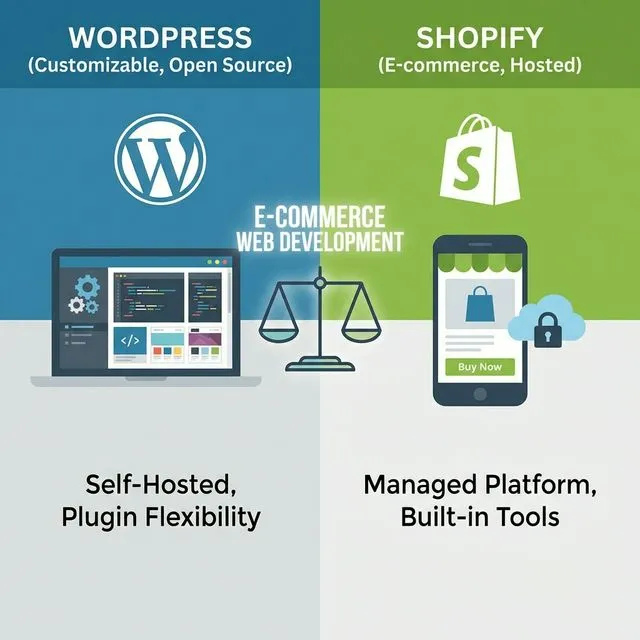
The two giants are WordPress (WooCommerce) and Shopify.
Globally, Shopify is winning. But in Nepal? The story is completely different. Here is the brutally honest comparison for 2026.
1. The Cost Reality (It’s Not Even Close)
Shopify (The “Rent” Model)
- Monthly Fee: Starts at $29/month (approx Rs. 4,000). That is Rs. 48,000 per year just to keep the shop open.
- Transaction Fees: Shopify takes 2.0% of every sale unless you use their payments (which doesn’t work in Nepal). So, you pay Rs. 20 on every Rs. 1,000 sale to Shopify + the gateway fee.
- Plugins (Apps): Want an upsell popup? $9/mo. Want a review import? $15/mo. Costs stack up fast.
WordPress + WooCommerce (The “Own” Model)
- Software Cost: FREE. (Open Source).
- Hosting: You need good hosting (Cloudways/DigitalOcean recommended). Cost: Rs. 15,000 - Rs. 25,000 per year.
- Transaction Fees: 0%. WordPress takes nothing. You only keep what the payment gateway charges.
- Verdict: For a Nepali startup with tight margins, WordPress creates significantly more profit.
2. Payment Gateways (The “eSewa” Factor)
This is the dealbreaker for most.
WordPress
- Ease: There are free and paid plugins for eSewa, Khalti, Fonepay, and IME Pay. You install the plugin, enter your Merchant ID, and you are live in 10 minutes.
- Flexibility: You can also add “Cash on Delivery” (COD) with custom conditions (e.g., “Extra Rs. 100 for COD outside Valley”).
Shopify
- Challenge: Shopify does not natively support eSewa or Khalti.
- Workaround: You have to use “Manual Payment Methods” (asking customers to send a screenshot of payment) OR hire a developer to build a custom API integration (Expensive: Rs. 50k+).
- Verdict: WordPress wins by a mile for seamless Nepali payments.
3. Ease of Use (Can you manage it?)
Shopify
- Pros: It is idiot-proof. You don’t need to know what a “server” or “plugin update” is. It just works. The dashboard is beautiful.
- Cons: You cannot change the checkout page code. Customization is limited to the theme settings.
WordPress
- Pros: Infinite customization. You can change every pixel.
- Cons: It requires maintenance. Plugins conflict. Updates break things. You need a technical partner or agency to manage it.
4. Dropshipping vs. Inventory
- Dropshipping: If you are dropshipping products from AliExpress or US suppliers to a global audience, Shopify is better. Its apps (Oberlo/DSers) are superior.
- Inventory (Local Stock): If you hold stock in New Road or Putalisadak, WordPress is better. You can manage inventory without paying monthly app fees.
Conclusion: Which One for You?
Choose Shopify If:
- You are targeting international customers (US/Europe/Australia) and accepting payments via Stripe/PayPal.
- You have a budget of Rs. 1 Lakh/year specifically for platform fees.
- You hate technical maintenance and just want to focus on marketing.
Choose WordPress (WooCommerce) If:
- Your primary customers are in Nepal using eSewa/Khalti.
- You want to avoid monthly subscription fees (Capital Expenditure model).
- You want full control over your SEO and data.
For 90% of Nepali businesses starting out, WordPress (WooCommerce) is the smarter financial success choice in 2026.
You might also be interested in
- Website Development Cost in Nepal
- How to Accept International Payments
- Best Hosting for Small Business