How to Sell Online Courses Without Udemy: Best Platforms Compared (2026)
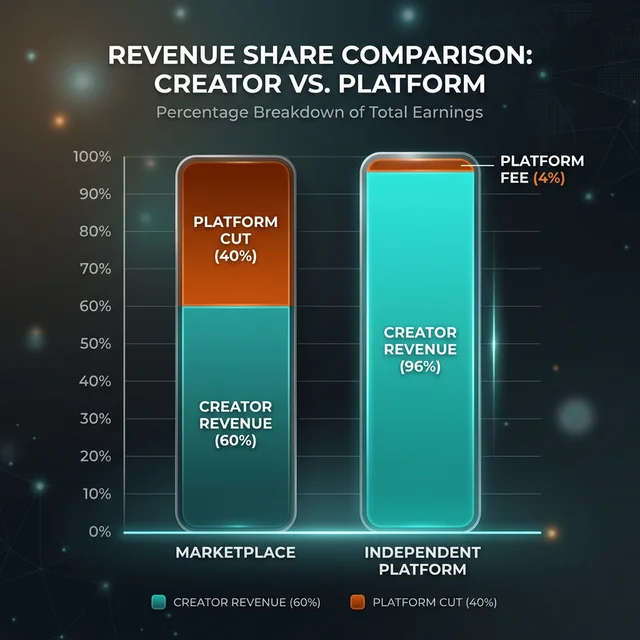
Udemy’s marketplace has one real advantage: discoverability. New creators can publish a course and reach students who find it through Udemy’s search.
The cost of that discoverability: Udemy controls your pricing (it regularly prices your $197 course at $14.99 during promotions), takes 50–75% of revenue from organically discovered sales, and does not allow you to access your students’ email addresses.
You are building Udemy’s asset, not yours.

Selling online courses independently — on platforms like Teachable, Kajabi, Thinkific, or Podia — means building an audience you own, setting prices that reflect the value you deliver, and keeping 90–97% of every sale.
This guide compares the best platforms for selling courses without Udemy in 2026, with pricing, feature breakdowns, and clear recommendations by creator type.
Table of Contents
- Why Independent Course Platforms Beat Udemy
- Platform Comparison: Quick Reference
- Teachable
- Thinkific
- Kajabi
- Podia
- Systeme.io
- Gumroad
- How to Market Your Course Without a Marketplace
- Which Platform Should You Choose?
Why Independent Course Platforms Beat Udemy
Revenue Comparison
| Scenario | Udemy | Independent Platform |
|---|---|---|
| Course price | $14.99 (after promotion) | $197 (you control) |
| Your revenue cut | 25–50% | 93–97% |
| Revenue per sale | $3.75–$7.50 | $182–$191 |
| 100 sales/month | $375–$750 | $18,200–$19,100 |
| Student data | None (Udemy owns it) | Full email list |
| Repeat sales | Difficult | Email list owned |
The revenue difference is not marginal — it is structural. A small audience buying a $197 course on your own platform generates more revenue than a large Udemy catalog with thousands of students.
mindmap
  root("(Course Ownership"))
      Udemy Owns
          Student Relationships
          Pricing Decisions
          Course Discoverability
          Revenue Terms
      Independent Platform Owns
          Student Email Addresses
          All Pricing Decisions
          Brand & Course Experience
          Revenue (less platform fees)
Figure 1: Udemy vs. Independent Platform Ownership
What You Own vs What Udemy Owns
On Udemy, they own:
- Your student relationships (email addresses)
- Your pricing (they can discount your course without your approval)
- Your course discoverability (algorithm controls who sees your course)
- Your revenue terms (they can change commission at any time)
On your own platform, you own:
- Every student email address
- All pricing decisions
- Your brand and course experience
- Your revenue — minus platform fees (3–10%)
Platform Comparison: Quick Reference
| Platform | Starting Price | Transaction Fee | Best For |
|---|---|---|---|
| Teachable | Free | 10% (free tier) | Beginners, simple courses |
| Thinkific | Free | None | Beginners, no transaction fees |
| Kajabi | $149/month | None | All-in-one creators |
| Podia | $39/month | None | Creators wanting simple all-in-one |
| Systeme.io | Free | None | Budget creators wanting full stack |
| Gumroad | Free | 10% flat fee | Digital products + simple courses |
Teachable
Best for: New course creators who want a polished, easy-to-use platform with no upfront investment.
Teachable is the most widely used independent course platform — known for its clean student experience, intuitive course builder, and large ecosystem of resources for course creators.
What Teachable Does Well
Course builder is intuitive. Upload videos, add quizzes, create assignments, and organize modules and lessons in a drag-and-drop interface. No technical skills required.
Professional sales pages. Teachable’s sales page builder produces clean, conversion-optimized pages that can be customized to match your brand.
Advanced quiz and completion certificates. Teachable supports graded quizzes, completion gates (students must complete previous content before unlocking the next), and automated certificate issuance on course completion.
Affiliate program. Built-in affiliate management lets you recruit partners to promote your course in exchange for a commission you define.
Student experience is polished. The student-facing learning interface is clean and mobile-optimized. Students track progress clearly and can resume lessons from any device.
Teachable Limitations
Free plan charges transaction fees. A 10% transaction fee on the free plan significantly reduces margins for lower-priced courses. At a $97 course price, you keep $87.30 per sale — still far better than Udemy, but the fee disappears on paid plans.
Email marketing requires a third-party tool. Teachable does not include email marketing. You need ConvertKit, ActiveCampaign, or Mailchimp for student nurture sequences and promotional campaigns.
Teachable Pricing
| Plan | Monthly Price | Transaction Fee | Key Features |
|---|---|---|---|
| Free | $0 | 10% | Unlimited students, 1 course |
| Basic | $39/month | 5% | Unlimited courses, custom domain |
| Pro | $119/month | None | Graded quizzes, advanced reporting |
| Business | $299/month | None | 20 admin seats, advanced customization |
Verdict: Best starting platform for new course creators. The free plan is genuinely functional for validating your first course. Upgrade to Basic ($39/month) once revenue consistently covers the cost.
Rating: 8.5/10
Thinkific
Best for: Course creators who want a free or low-cost platform with no transaction fees on any plan.
Thinkific’s most significant differentiator: no transaction fees on any plan, including the free tier. Every dollar you earn from course sales is yours (minus payment processing at ~2.9% + 30¢).
What Thinkific Does Well
No transaction fees on free plan. Unlike Teachable’s 10% free tier fee, Thinkific takes no cut of your revenue on any plan.
Communities feature. Thinkific includes a student community feature where course participants can discuss content, share progress, and connect — without requiring a separate community tool.
Drip content scheduling. Release course content on a schedule rather than all at once — a proven engagement strategy that keeps students progressing through modules rather than binge-watching and forgetting.
Student surveys and feedback tools. Built-in student surveys collect feedback at completion, helping you improve course quality based on actual student experience.
Thinkific Limitations
Less polished than Teachable. The student experience and editor interface are functional but slightly less refined than Teachable’s.
Marketing tools require integration. Like Teachable, Thinkific requires a third-party email marketing tool for promotional campaigns.
Thinkific Pricing
| Plan | Price/Month | Transaction Fee | Courses |
|---|---|---|---|
| Free | $0 | None | 1 course |
| Basic | $49/month | None | 5 courses |
| Start | $99/month | None | Unlimited |
| Grow | $199/month | None | Unlimited + advanced features |
Verdict: Best free option for creators who want zero transaction fees. Ideal for creators validating their first course before committing to a paid platform.
Rating: 8/10
Kajabi
Best for: Established course creators who want one platform to handle courses, email marketing, communities, websites, and landing pages.
Kajabi is the premium all-in-one creator platform. Instead of assembling separate tools for courses (Teachable), email (ConvertKit), community (Circle), and landing pages (ClickFunnels), Kajabi handles all of it from one dashboard.
What Kajabi Does Well
Genuinely all-in-one. Courses, digital products, memberships, podcasts, communities, email marketing, funnels, and landing pages under one subscription. Kajabi eliminates the integration complexity of a multi-tool stack.
Email and automation are built in. Kajabi includes a full email marketing system — broadcasts, automated pipelines (sequences), segmentation, and behavioral triggers. No ConvertKit subscription needed.
Course experience is premium. The student learning portal is polished, mobile-optimized, and supports video, audio, PDF, quizzes, and worksheets. Students rate the Kajabi learning experience highly.
Pipeline (funnel) builder. Kajabi includes a visual funnel builder for creating opt-in → sales page → checkout sequences without third-party tools.
Analytics are comprehensive. Revenue by product, student engagement rates, email open rates, funnel conversion rates, and subscriber growth — all in one dashboard.
Kajabi Limitations
Price is high for beginners. At $149/month for the Basic plan (limited to 3 products and 1,000 customers), Kajabi is expensive for creators who have not yet validated their first course.
Overkill for simple course delivery. If you just want to host and sell a course without email automation and community, you are paying for features you do not need.
Kajabi Pricing
| Plan | Price/Month | Products | Customers |
|---|---|---|---|
| Basic | $149/month | 3 | 1,000 |
| Growth | $199/month | 15 | 25,000 |
| Pro | $399/month | 100 | 100,000 |
Annual billing saves approximately 20%.
Verdict: The best all-in-one platform for creators ready to invest in a professional business infrastructure. Cost-effective once you are generating $3,000+/month from your courses and want to consolidate tools.
Rating: 9/10 (for established creators), 6/10 (for beginners)
Podia
Best for: Creators who want a simple all-in-one platform at a lower price than Kajabi.
Podia covers courses, digital downloads, memberships, and email marketing without the complexity or price premium of Kajabi. It is positioned as the creator-friendly alternative to Kajabi’s more enterprise-oriented experience.
Podia Pricing
| Plan | Price/Month | Transaction Fee | Features |
|---|---|---|---|
| Free | $0 | 10% | 1 download, basic email |
| Mover | $39/month | None | Courses, downloads, email |
| Shaker | $89/month | None | + Affiliates, memberships |
Verdict: The best mid-tier all-in-one option. If Kajabi is too expensive and you want more than Teachable alone, Podia Mover at $39/month includes courses + email marketing + digital downloads — a high-value combination.
Rating: 8/10
Systeme.io
Best for: Budget-conscious creators who want courses, email, sales funnels, and memberships at zero or near-zero cost.
Systeme.io’s free plan includes: 1 course, 1 membership site, 3 sales funnels, unlimited email to 2,000 contacts, and unlimited storage. That is a complete course business infrastructure at no cost.
The Unlimited plan at $97/month removes all limits across all features — competing with Kajabi Growth at $199/month at roughly half the price.
Systeme.io Pricing:
| Plan | Price | Contacts | Courses |
|---|---|---|---|
| Free | $0 | 2,000 | 1 |
| Startup | $27/month | 5,000 | 5 |
| Webinar | $47/month | 10,000 | 20 |
| Unlimited | $97/month | Unlimited | Unlimited |
Verdict: The best value all-in-one platform for creators starting from zero. The free plan is genuinely functional; the Unlimited plan beats Kajabi on price by 50%.
Rating: 9/10 (for value)
Gumroad
Best for: Creators selling simple courses, PDFs, templates, and digital products without needing a full course hosting platform.
Gumroad is not a traditional course platform — it is a digital product storefront that handles payment, delivery, and basic content access. It is simpler than Teachable or Thinkific but also faster to set up.
Gumroad charges a flat 10% transaction fee on all sales (no monthly subscription). For high-volume sellers, this becomes expensive relative to capped monthly fees.
Best use case for Gumroad courses: Short courses, workshop recordings, mini-courses, or educational products where the learning experience is less important than the content delivery.
Rating: 7/10 (for simple courses)
How to Market Your Course Without a Marketplace
Leaving Udemy means leaving their discovery engine. You are responsible for generating your own traffic. These channels work consistently for independent course creators:
mindmap
  root("(Marketing Your Course"))
      Email List
          Free Mini-Course
          Checklists/Guides
          Webinars
          Nurture Sequences
      YouTube
          Educational Videos
          Build Trust & Expertise
          Consistent Sales
      LinkedIn
          Professional Audience
          Long-form Posts
          B2B Courses
      Affiliate Partnerships
          Recruit Bloggers/Educators
          30-50% Commission
          Engaged Email Lists
Figure 2: Key Marketing Channels for Independent Course Creators
Email List (Highest Converting)
Every email you collect from a course landing page, lead magnet download, or webinar sign-up is a direct line to a potential buyer. Email consistently converts course sales at 2–5%, compared to social media’s 0.1–0.5%.
How to build an email list before launch:
- Publish a free mini-course, checklist, or guide related to your course topic
- Promote the free resource on social media, LinkedIn, and in your email signature
- Collect emails via a landing page (use ConvertKit, Mailchimp, or Systeme.io)
- Nurture subscribers with valuable content leading toward the course launch
YouTube (Organic Discovery)
YouTube is the second-largest search engine. Creating free educational videos on your course topic builds trust, demonstrates expertise, and channels viewers toward your paid course.
A single well-performing YouTube video can drive consistent course sales for years after publication.
LinkedIn (For Professional/B2B Courses)
If your course serves professionals — marketers, founders, salespeople, consultants — LinkedIn is the highest-converting social channel. Long-form posts combining personal story with professional insight routinely reach 5,000–50,000 views organically.
Affiliate Partnerships
Recruit course creators, bloggers, and educators in adjacent niches to promote your course in exchange for a 30–50% commission. Teachable, Kajabi, Thinkific, and Podia all include affiliate program features.
A single well-placed affiliate partner with an engaged email list can generate 50–100 course sales in a single promotion.
Which Platform Should You Choose?
First course, validating the concept:
→ Thinkific Free (no transaction fees) or Systeme.io Free (includes email + funnel). Test whether the course sells before investing in a paid platform.
Selling an established course, want clean experience:
→ Teachable Basic ($39/month) or Thinkific Basic ($49/month). Both eliminate transaction fees and provide professional course delivery.
Want everything in one platform (course + email + community):
→ Kajabi Growth ($199/month) for creators generating $5,000+/month from courses. Systeme.io Unlimited ($97/month) for creators who want comparable features at half the price.
Simple digital products alongside courses:
→ Podia Mover ($39/month) or Gumroad for creators selling course + PDF + template bundles without needing full course platform features.
Related Guides
- Best Platforms to Sell Digital Products Globally in 2026
- How to Start a Digital Marketing Agency in 2026: Complete Playbook
- ClickFunnels vs Systeme.io vs Kartra: Best Funnel Builder in 2026
- Best Email Marketing Software for Startups in 2026
Related Posts and Resources
- Start an Online Business in Nepal
- eCommerce SEO Guide for Nepal
- eCommerce Analytics Guide for Nepal
- eCommerce Metrics Guide
- Common eCommerce Challenges in Nepal
- eSewa vs Khalti for Businesses
- WordPress vs Shopify in Nepal
- Best Platforms to Sell Digital Products
- Best Platforms for Online Courses
- Digital Marketing in Nepal (Complete Guide)