Scale Your Landscaping Business: From Side Hustle to Six Figures
The Paradigm Shift: Defining the Enterprise Transition
The global landscaping and lawn care industry operates as a massively fragmented market characterized by low barriers to entry and exceedingly high barriers to scale. The transition from a seasonal side hustle—typically initiated with a single push mower and a passenger vehicle—into a formalized, six-figure commercial enterprise requires a profound operational and psychological paradigm shift. Scaling a landscaping business is not merely a function of acquiring more trucks or hiring more laborers; it is the strategic implementation of repeatable systems capable of absorbing growth without sacrificing service quality, client retention, or profit margins.
The most common failure point for emerging landscaping companies is the transition phase where the founder becomes completely consumed by day-to-day operations. In this bottleneck, the owner-operator acts simultaneously as the lead salesperson, field scheduler, quality control inspector, and primary laborer. This approach functions adequately when servicing twenty residential properties, but attempting to apply the same methodology to two hundred properties inevitably results in catastrophic operational failure. True scaling occurs only when a business increases its revenue at a faster velocity than its costs, thereby systematically improving net profitability.
Growth, if left unchecked and unmanaged, can actually be detrimental to a service business. As companies organically acquire more referrals, they often reflexively hire more workers and expand operations using what industry analysts term “pseudo-processes”. Pseudo-processes are informal, undocumented workflows that exist solely in the minds of the owner or early employees. For example, if account managers store property details or gate codes in personal memos rather than a centralized database, the departure of that employee results in an immediate loss of institutional knowledge, jeopardizing the client relationship. Consequently, the foundation of a six-figure enterprise must be built upon rigid, documented processes, strict financial management, and a formalized corporate architecture.
Corporate Formalization and Legal Architecture
The absolute prerequisite for scaling is the establishment of a formal legal entity. Operating informally permanently restricts a landscaping venture from accessing lucrative commercial maintenance contracts, securing business loans, and shielding the owner’s personal assets from corporate liability. Treating the venture as a formal business from the first day of operations is the critical differentiator between a hobbyist and a professional contractor.
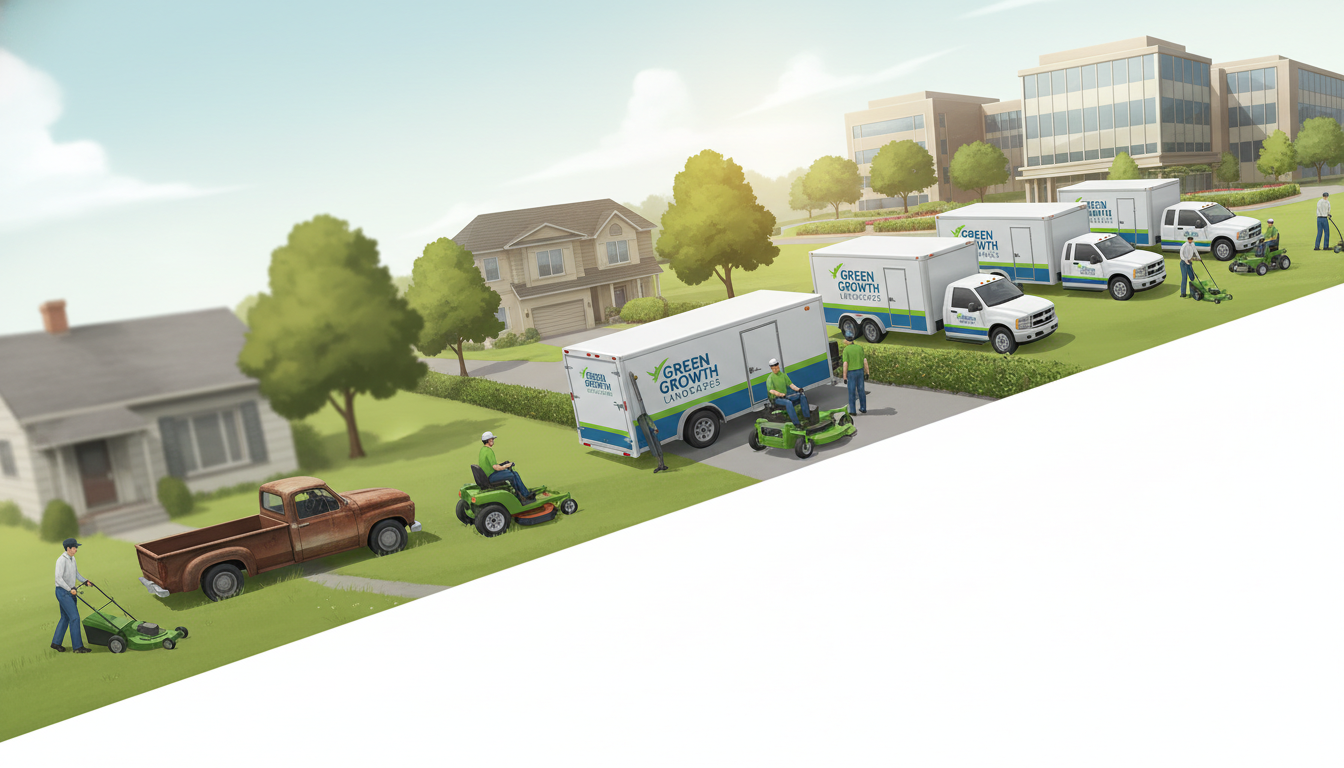
The legal mechanisms for formalization vary by jurisdiction, yet the underlying strategic imperatives remain identical across global markets. In mature economies such as the United States, this process typically involves registering a Limited Liability Company or an S-Corporation, followed by securing an Employer Identification Number (EIN) to strictly separate personal and business finances.

Emerging markets, which are experiencing rapid urbanization and a corresponding boom in commercial and residential real estate development, offer a parallel regulatory framework that highlights the universality of corporate compliance. In Nepal, for instance, the real estate market is expanding rapidly, driving a massive demand for professional landscaping and facility maintenance services in urban centers like Kathmandu. To capture this market, a Nepalese landscaping business must navigate the Companies Act of 2006 to register as a Private Limited Company through the Office of the Company Registrar (OCR). This requires the drafting of a Memorandum of Association (MOA), which defines the company’s core objectives, and Articles of Association (AOA), which dictate internal governance.
For smaller, hyper-local operators in Nepal, initial registration can be executed at the municipal Ward Office, followed by securing a Permanent Account Number (PAN) from the Inland Revenue Department. However, to scale into a six-figure enterprise capable of bidding on corporate or government tenders—such as the annual maintenance contracts (AMCs) frequently issued for embassy grounds or large commercial complexes—full corporate registration, VAT clearance, and stringent tax compliance are absolute prerequisites. Furthermore, international entities seeking to enter emerging markets must navigate additional layers of compliance, such as Nepal’s Foreign Investment and Technology Transfer Act (FITTA), which regulates minimum investment thresholds and sector-specific restrictions.
Occupational Licensing and Regulatory Compliance
A significant operational hurdle that separates formal enterprises from informal operators is the acquisition of occupational licenses. Licensing acts as an artificial barrier to entry, shielding legitimate, compliant enterprises from low-cost, unqualified competitors while protecting the firm from severe legal liabilities, fines, and operational shutdowns.
General Landscaping and Contracting Licenses
In the United States, licensing requirements are highly fragmented and dictate the precise scope of services a firm may legally provide. Some states, such as Texas and Wisconsin, exempt basic lawn maintenance from state-level licensing. Conversely, states like Alabama enforce stringent oversight, requiring a Horticulture Professional Services license simply to advertise as a landscaping contractor. This Alabama license covers landscape design, planting, tree surgery, and ornamental pest control, and costs $175 annually, mandating that the business employ a certified operator who has passed specific category examinations.
In heavily regulated markets like California, the requirements scale with the financial value of the project. The California Contractors State License Board (CSLB) requires a C-27 Landscaping Contractor license for any project exceeding $1,000 in value. Obtaining a C-27 license requires the applicant to demonstrate four years of verifiable journeyman-level experience, pass rigorous examinations covering trade skills and construction law, and secure a $25,000 surety bond ($100,000 for LLCs).
Agricultural, Horticultural, and Pesticide Regulations
The application of chemicals, specifically fertilizers and pesticides, universally triggers maximum regulatory scrutiny regardless of the geographical market. Scaling a landscaping business to incorporate high-margin turf management or pest control services requires specialized chemical handling certifications.
In the United States, this involves securing a Commercial Pesticide Applicator license, which dictates strict protocols for the storage, application, and disposal of controlled substances. The regulatory landscape in developing nations is equally stringent. In Nepal, the agricultural and horticultural sectors are governed by the Plant Quarantine and Pesticide Management Center (PQPMC), operating under the Ministry of Agriculture and Livestock Development. Any landscaping firm wishing to offer commercial pest control must navigate the PQPMC’s online Pesticide Management Information System (PQMIS) to apply for a commercial license. Furthermore, the Nepalese government mandates that operators complete specific training courses on the handling of lethal pesticides before a license is granted, as outlined in the 2081 regulatory directives.
Additionally, the procurement and installation of flora are heavily regulated to prevent the spread of invasive species and botanical diseases. Under Nepal’s Nursery Management Act of 2000 (2057 BS), any commercial entity sourcing or cultivating plants for landscaping must ensure their facilities and stock are periodically authenticated by government nursery inspectors. The Act explicitly prohibits the sale or distribution of unlisted saplings and mandates that all botanical assets be guaranteed free from dangerous diseases and pests before deployment in a commercial or residential landscape.
Risk Management and Insurance Architecture
A business plan constructed solely on optimistic growth projections is highly vulnerable; a single workplace accident or property damage claim can force an underinsured company into immediate insolvency. A comprehensive risk management portfolio is non-negotiable for an enterprise operating heavy machinery on third-party properties.
General Liability
Protects the firm against third-party bodily injury or property damage claims resulting from field operations.
Often a mandatory prerequisite for securing commercial contracts or vendor approvals. California mandates a $1 million minimum aggregate limit for licensed LLCs.
Workers’ Compensation
Covers medical expenses and lost wages for employees injured on the job, mitigating the risk of devastating civil lawsuits.
State thresholds vary drastically.
Alabama requires coverage for firms with five or more employees, while California requires it for firms with just one employee (or even zero for licensed LLCs). Rushing the onboarding of field laborers without verifying coverage leads to immense financial exposure.
Commercial Auto
Protects the fleet of trucks and trailers utilized for daily transport against collision, theft, and liability.
Personal auto insurance universally excludes coverage for vehicles used in commercial capacities.
Tools and Equipment
Provides replacement cost coverage for high-value mobile assets (e.g., zero-turn mowers, excavators) against theft or catastrophic damage.
Vital for maintaining operational continuity, as equipment theft is a pervasive issue in the landscaping industry.
4. Financial Modeling: Transitioning from Guesswork to Data-Driven Profitability
The evolution into a six-figure landscaping enterprise is fundamentally an exercise in advanced financial literacy. A pervasive operational flaw among landscaping business owners is a bias toward field operations coupled with a stark aversion to backend accounting and financial analysis. Attempting to scale without granular, real-time financial visibility is the primary catalyst for enterprise failure.
Industry consulting data reveals a systemic underestimation of operating costs within the landscaping sector. It is common for contractors to underestimate total job costs by at least 1% and labor hour costs by a minimum of $0.50. While these margins appear negligible at a micro level, at an enterprise scale, the macroeconomic impact is devastating. For a landscaping firm generating $6 million in annual revenue, these seemingly minor miscalculations translate to nearly $100,000 in unrealized net profits annually. Correcting this requires the implementation of religious metric tracking, specifically focusing on gross profit margin by service type, equipment utilization rates, customer acquisition cost (CAC), and customer lifetime value (LTV).
4.1 Job Costing: The Profitability Engine
Job costing is the rigorous accounting practice of tracking all direct and indirect expenses associated with a specific project, and comparing those cumulative costs against the generated revenue to determine the true profit margin. Without accurate job costing, contractors operate blindly, unable to discern which services are subsidizing unprofitable ventures. A comprehensive job costing framework must capture every micro-expense:
- Direct Labor: The exact crew time spent on the specific job site.
- Materials and Supplies: Flora, mulch, fertilizer, and hardscape materials, which must be tracked at actual purchase costs and updated quarterly to reflect inflation.
- Equipment Costs: Fuel consumption, routine maintenance allocations, and asset depreciation.
- Subcontractor and Ancillary Fees: Payments to specialized subcontractors, municipal permit fees, and disposal or dump fees.
- Overhead Allocation: The fractional cost of back-office operations, executive salaries, facility rent, and insurance applied proportionally to the specific job.
Firms that scale successfully utilize this data to aggressively market their most lucrative services (e.g., high-margin turf management or specialized hardscaping) while strategically abandoning or repricing unprofitable service lines.
4.2 Calculating the Loaded Billable Hourly Rate
Pricing services based on “gut feelings” or simply mirroring the rates of local competitors is a fatal operational error. A competitor’s pricing model provides no insight into their overhead structure or whether they are actually operating profitably; adopting their rates often means adopting their financial deficits. The establishment of a baseline billable hourly rate requires strict adherence to a specific mathematical formula:
- Annual Labor Cost: This extends far beyond base hourly wages to include payroll taxes, workers’ compensation premiums, health benefits, and paid time off.
- Base Labor Rate: Calculated by dividing the Annual Labor Cost by the total Billable Hours. This step is critical, as it must account for unproductive, unbillable time such as driving between sites, loading equipment, and maintenance downtime.
- Loaded Rate: The Base Labor Rate plus the Overhead Per Hour (total annual indirect costs divided by total annual billable hours).
- Final Billable Hourly Rate: The Loaded Rate plus the Target Profit Margin Percentage.
4.3 The Critical Distinction: Markup vs. Margin
A pervasive financial error in the contracting space is confusing markup with profit margin. Markup is the percentage added to the base cost to arrive at a final price, whereas margin is the actual profit expressed as a percentage of that final sale price.
For example, applying a 15% markup to a project with a baseline cost of $1,000 results in a final price of $1,150, yielding a $150 gross profit. However, $150 divided by the final price of $1,150 yields a net profit margin of only 13%. At an enterprise scale, this 2% mathematical discrepancy results in massive capital leakage, leaving tens of thousands of dollars on the table annually. For residential maintenance, a 10% to 20% net profit margin serves as a healthy baseline, while complex commercial or design-build projects require significantly higher margins to offset the increased operational risk and capital outlay.
5. Pricing Architecture and Revenue Maximization Strategies
Scaling a landscaping business requires deploying varying pricing architectures depending on the nature of the work. Applying a monolithic pricing strategy across diverse service lines limits revenue capture and introduces unnecessary risk.
Pricing Architecture
-
Hourly Pricing
- Operational Application: Unpredictable tasks, minor repairs, initial property cleanups, and service calls.
- Strategic Advantages: Ensures fair compensation for actual labor expended; entirely protects the firm against scope creep and unexpected site delays.
- Inherent Risks: Caps potential profit maximization; inadvertently penalizes operational efficiency, as faster crews generate less total revenue for the firm.
-
Flat-Rate / Project-Based
- Operational Application: Standardized recurring maintenance, lawn mowing, and large-scale design-build installations.
- Strategic Advantages: Simplifies customer invoicing and eliminates billing surprises; highly lucrative for well-trained, highly efficient crews.
- Inherent Risks: Requires exact, data-driven estimation; underestimating labor or materials leads to direct margin erosion and unrecoverable losses.
-
Tiered / Package Pricing
- Operational Application: Annual Maintenance Contracts (AMCs) offering basic, standard, or premium service tiers.
- Strategic Advantages: Leverages psychological anchoring; empowers customer choice while naturally driving upsells and increasing average order value.
- Inherent Risks: Requires strict monitoring of service delivery to ensure premium tiers remain profitable and do not consume disproportionate resources.
-
Cost-Plus
- Operational Application: Highly customized projects with volatile material costs, such as custom pergolas or specialized botanical installations.
- Strategic Advantages: Guarantees exact profitability through total transparency and a fixed percentage markup over actual costs.
- Inherent Risks: Can cause friction or disputes with clients if raw material costs unexpectedly surge during the procurement phase.
Commercial landscaping maintenance costs typically range from $0.10 to $0.30 per square foot monthly, while large-scale commercial installation projects can range anywhere from $50,000 to over $500,000. By utilizing flat-rate Annual Maintenance Contracts (AMCs) for these commercial properties, a landscaping firm guarantees predictable, recurring revenue, which is essential for surviving the cash flow troughs associated with seasonal dips.
6. Human Capital Dynamics and Labor Market Constraints
In the field service industry, human capital is simultaneously the primary revenue driver and the largest operational bottleneck. The ability to recruit, train, and retain reliable labor dictates the precise velocity at which a landscaping business can scale.
6.1 Escaping the “Wage Cycle” Trap
Many early-stage landscaping operators fall victim to the “wage cycle.” Operating under the assumption that they cannot afford premium wages, owners hire low-skill, low-reliability workers. This results in poor on-site efficiency, frequent equipment damage, and low customer satisfaction. These operational failures compress profit margins, ultimately ensuring that the company truly cannot afford better talent. Breaking this cycle requires a strategic pricing adjustment to fund competitive hourly wages. Premium wages attract premium talent, drastically reducing turnover and associated training costs while elevating service quality, which in turn justifies higher billing rates to the end consumer. Furthermore, flexible scheduling, continuous training stipends, and structured recognition programs are critical non-monetary tools for retaining top performers in a highly competitive labor market.
6.2 Macroeconomic Labor Shifts and Statutory Wage Compliance
The landscaping industry is uniquely vulnerable to macroeconomic labor shifts.
In the United States, competition for skilled tradespeople is fierce, driving up hourly wages across the green industry. The labor dynamic in emerging markets presents a different, yet equally challenging, set of variables.
In Nepal, the agricultural and landscaping labor market has been severely disrupted by the mass out-migration of working-age men seeking lucrative opportunities in the Gulf states and India. An estimated 49% of rural families have parents working overseas, creating a massive vacuum of skilled and semi-skilled labor domestically. This exodus has led to the abandonment of arable land and a heavy reliance on contracted and temporary workforces to maintain urban green spaces and commercial properties in cities like Kathmandu and Lalitpur.
Simultaneously, landscaping operators must navigate the financial implications of statutory minimum wage increases. Failure to dynamically adjust pricing models in response to minimum wage hikes instantly erodes net margins. For instance, the Nepalese government recently revised its national minimum wage, effective July 17, 2025 (fiscal year 2082/83).
| Fiscal Year (Nepal) | Monthly Minimum Wage (NPR) | Hourly Wage Structure (NPR) | Macroeconomic Implications |
|---|---|---|---|
| 2021/2022 | 15,000 | N/A | Established baseline for post-pandemic labor recovery. |
| 2023/2024 | 17,300 | N/A | Incremental adjustment failing to match regional inflation. |
| 2025/2026 | 19,550 | 101 (Basic: 63 + Allowance: 38) | Represents a 12.98% mandatory increase in baseline labor costs. Landscaping firms must immediately recalculate their loaded labor rates and update AMCs to absorb this cost shock. |

Capital Expenditure (CapEx), Fleet Management, and Asset Utilization
Generating a six-figure revenue stream necessitates graduating from residential-grade tools to commercial-grade equipment. This capital expenditure (CapEx) must be viewed strictly through the lens of asset utilization and return on investment (ROI).
The Core Commercial Fleet
A scalable operation requires highly reliable, heavy-duty machinery capable of enduring daily, rigorous use across diverse terrain. The foundational equipment list includes:
- Heavy-Duty Transport: A 3/4-ton or 1/2-ton truck equipped with a commercial trailer is essential for hauling heavy machinery, bulk mulch, fertilizer, and debris.
- Turf Management Assets: Commercial zero-turn mowers and stand-on mowers cover significantly more acreage in less time than push variants, drastically improving crew efficiency and maximizing revenue per hour.
- Precision and Cleanup Tools: High-torque commercial string trimmers, edgers, backpack blowers, and aerators are mandatory for delivering a professional finish.
- Seasonal Adaptations: In climates subject to heavy winters, integrating snowblowers and plows transforms a highly seasonal landscaping business into a year-round revenue generator.
Asset Management and Strategic Procurement
Equipment downtime directly equates to lost billable hours. Neglecting routine maintenance on mowers or transport vehicles results in service delays, tarnished customer reputations, and costly emergency repairs or premature asset replacement. Successful enterprises utilize digital equipment tracking to monitor depreciation, schedule preventative maintenance, and calculate exact equipment utilization rates.
Furthermore, a critical financial decision for growing firms is analyzing the cost-benefit ratio of buying versus renting specialized equipment. For high-frequency tasks, outright ownership minimizes long-term costs. However, for specific, low-frequency hardscaping jobs or site grading, renting heavy machinery (e.g., skid steers or mini-excavators) preserves liquid capital and eliminates the burden of long-term storage and maintenance.
Technological Infrastructure: Field Service Management (FSM)
The single greatest catalyst for scaling a landscaping business from a disorganized side hustle to a high-efficiency enterprise is the implementation of specialized Field Service Management (FSM) software. Attempting to manage hundreds of clients, schedule multiple crews, and process invoices using whiteboards, spreadsheets, and decentralized text messages guarantees dispatch errors, unbilled revenue, and operational chaos.
The FSM Software Ecosystem
The market offers an array of platforms tailored specifically to the green industry, each suited to different stages of corporate maturity.
| Software Platform | Target Audience & Maturity Stage | Core Competencies and Features | Deployment Timeline |
|---|---|---|---|
| Jobber | Startups, Solo-operators, and Small Teams. | User-friendly CRM, basic quoting, automated scheduling, drag-and-drop dispatch, and client communication portals. | 1-2 weeks; highly intuitive onboarding process. |
| LMN (Landscape Management Network) | Mid-size to Enterprise firms; Design-Build specialists. | Industry-specific estimating templates, robust job costing, budget tracking, and extensive contractor-built frameworks. | 2-4 weeks; requires dedicated financial input. |
| Aspire | Large Enterprise ($3M+ annual revenue). | Integrated end-to-end business operations, advanced multi-branch reporting, deep analytics, and complex route optimization. | 4-8 weeks; custom implementation and rigorous training. |
| Service Autopilot | Fast-growing firms focused heavily on marketing and automation. | High-level marketing automation, integrated CRM, scalable architecture for aggressive expansion. | Moderate to High complexity; steep learning curve. |
AI-Driven Route Optimization and Telematics
Fuel costs and unbillable “windshield time” (the time crews spend driving between properties) heavily dilute profitability. Modern FSM software utilizes AI-driven route optimization to geographically cluster jobs, taking into account traffic patterns, crew skillsets, and precise time windows. Implementing dynamic routing algorithms can save operators up to 2 to 3 hours of drive time daily, drastically lowering fuel consumption and allowing crews to service additional properties per day without expanding the workforce. This capability transforms a logistical nightmare into a streamlined, highly profitable operational flow.
Payment Gateways and Cash Flow Velocity
Cash flow velocity—the speed at which a company converts performed labor into liquid capital—is a vital metric for a growing business. FSM software accelerates accounts receivable through automated invoicing and integrated payment processing, allowing field workers to charge clients directly on-site immediately upon job completion.
In developing digital economies like Nepal, integrating local digital wallets is crucial for minimizing friction in the transaction process. The integration of dominant regional gateways—specifically eSewa and Khalti, which together process up to 80% of Nepal’s digital transactions—allows clients to settle invoices instantly via mobile applications. Providing these localized, seamless payment APIs ensures stable cash flow and completely eliminates the administrative burden of chasing physical checks or coordinating cash collections.
Technologically, integrating platforms like eSewa into a company’s web portal or scheduling app involves a standardized API workflow. The client application initiates the payment by sending credentials and a callback URL to the SDK; upon successful authentication and sufficient balance confirmation, the transaction is processed, and a proof of payment is routed back to the merchant’s server. Crucially, these platforms offer T+1 (next day) settlement to the merchant’s linked bank account, guaranteeing rapid liquidity for payroll and operational expenses.
Marketing, Customer Acquisition, and Niche Specialization
Scaling a business involves a strategic transition from accepting any available work to selectively curating an ideal client portfolio. The most profitable landscaping companies actively decline work that falls outside their established operational model.
Defining the Ideal Customer Profile (ICP)
Attempting to service highly dispersed, low-budget residential properties simultaneously with high-demand commercial contracts strains operational efficiency and confuses brand positioning. A formalized ICP focuses the company’s marketing efforts. For example, an ICP might dictate targeting strictly residential properties valued above $300,000 within a tight geographic radius, or alternatively, focusing exclusively on commercial properties requiring high-margin weekly maintenance under annual contracts. Establishing this niche enables the firm to standardize its equipment fleet, streamline employee training, and maximize route density.
Multi-Channel Marketing Strategies
While grassroots methods—such as aggressive door- knocking, leaving door hangers, and leveraging hyper-local neighborhood networks—are highly effective for gaining initial traction and building baseline route density, scaling into a six-figure entity requires a robust digital footprint.
- Local SEO and Google Business Profiles: Optimizing local search visibility ensures the company captures high-intent customers actively searching for landscaping services. This organic strategy drastically reduces the Customer Acquisition Cost (CAC) and eliminates a heavy reliance on expensive pay-per-click advertising.
- Social Media Marketing (SMM): Visual platforms like Instagram, Facebook, and TikTok serve as dynamic digital portfolios.
High-quality, before-and-after project photos serve as powerful social proof. The deployment of strategic SMM allows local businesses to build brand authority and generate inbound leads at a fraction of the cost of traditional print or radio media. In markets like Nepal, where platforms like Facebook and TikTok dominate digital communication, utilizing these channels is essential for capturing both residential and corporate clients.
- Customer Retention Strategies: It is statistically significantly cheaper to retain an existing client than to acquire a new one. Implementing proactive communication, regular quality check-ins, and automated service reminders builds long-term loyalty, reduces churn, and guarantees recurring revenue.
Climate Volatility and Operational Resilience
Unlike controlled indoor environments, field service operations are at the absolute mercy of the climate. The ability to forecast, adapt to, and financially mitigate weather disruptions is a hallmark of a mature enterprise.
Seasonal Shifts and Revenue Smoothing
In temperate climates, the primary growing season is finite (e.g., April to October in the Midwestern United States). To sustain a full-time workforce and maintain cash flow through the dormant winter months, landscaping firms must aggressively diversify. This often involves pivoting operations to snow and ice management, installing holiday lighting, or focusing on heavy hardscaping projects that are less dependent on vegetative growth.
Climate Volatility: The Monsoon Paradigm
In regions heavily influenced by intense seasonal weather systems, climate volatility poses a severe, existential operational threat. Nepal presents a stark case study in managing these meteorological extremes. The agricultural and landscaping sectors in the Himalayas are highly dependent on the summer monsoon, which historically dictates planting and maintenance schedules.
However, climate change has rendered these precipitation patterns increasingly erratic. Operators now face extreme pre-monsoon droughts that delay planting schedules and stunt turf growth, followed closely by devastating late-season floods and landslides that wash away topsoil, destroy newly installed hardscapes, and inundate standing flora. This volatility disproportionately impacts marginalized agricultural workers and places an immense gendered burden on rural women who make up a significant portion of the agricultural labor force.
For commercial landscaping and nursery management businesses operating in such environments, these shifts necessitate the adoption of highly resilient infrastructure. This includes investing in advanced greenhouse technologies, constructing elevated terracing, engineering robust drainage systems, and integrating drought-resistant or flood-tolerant ornamental species into their design portfolios. Software solutions play a pivotal role in mitigating these disruptions; robust CRM systems allow operators to swiftly communicate scheduling changes to clients when unpredictable weather halts field operations, thereby preserving customer trust and managing expectations.
Case Studies in Scaling: Real-World Enterprise Success
The theoretical frameworks, financial models, and operational strategies discussed above are validated by numerous industry success stories of entrepreneurs who scaled rapidly through systematic execution.
Jacob Peffer provides a prime example of aggressive, highly controlled scaling. Starting with a single truck and a Jeep Liberty, Peffer scaled his firm, GreenerConcepts, to a $1 million enterprise in just four years by the age of 24. His exponential growth was not accidental; it was driven by a deep commitment to operational coachability, the implementation of structured meeting frameworks, and the strategic hiring of a dedicated operations manager. By delegating daily logistics to a capable manager, Peffer freed himself to focus exclusively on visionary growth, high-level commercial sales, and corporate culture.
Similarly, Dylan Brannon transformed a start-up operation into a million-dollar business by front-loading his administrative and legal foundation. Before acquiring heavy equipment or soliciting his first client, Brannon secured his LLC, commercial insurance, and professional branding. By investing heavily in continuous education, attending industry events like the GIE Expo, and refining advanced sales tactics, he successfully transitioned from small residential debris cleanups to landing massive commercial contracts valued upwards of $22,000. This illustrates the absolute power of elevated brand positioning and aggressive niche targeting.
For other operators, achieving the six-figure milestone is accomplished through sheer route density and disciplined recurring service. Startups targeting 50 recurring weekly accounts at $50 per cut can swiftly generate $75,000 in baseline revenue. By utilizing the remaining operational bandwidth for high-margin, one-off enhancements like mulch installation, aeration, and seasonal cleanups, these firms can confidently surpass the $100,000 threshold within their first or second year of operation. The success of operators like Tab and Trey Pawley, who efficiently manage over 185 properties per week utilizing identically configured, highly optimized truck-and-trailer setups for both commercial and residential routes, further proves that standardized equipment and dense routing are the keys to massive volume.
Strategic Synthesis
Transforming a landscaping side hustle into a highly profitable, six-figure commercial operation is an exercise in extreme operational discipline, financial rigor, and strategic delegation. It requires the business owner to transition fundamentally from a technician working in the business to an executive working on the business.
Success dictates a strict adherence to formal corporate compliance, occupational licensing, and comprehensive risk management, ensuring the entity is legally protected and capable of securing lucrative commercial contracts. Financial solvency relies on the total abandonment of arbitrary pricing in favor of data-driven job costing and loaded-rate calculations that protect profit margins against rising labor minimums and material costs. The integration of modern Field Service Management software is no longer a luxury but an absolute necessity for optimizing route density, automating administrative workflows, and accelerating cash flow through digital payment gateways. Finally, a business must precisely define its ideal customer profile and possess the operational confidence to reject non-aligned work, thereby preserving the quality, efficiency, and brand reputation that command premium market rates. By internalizing and executing these frameworks, a landscaping operator guarantees not just rapid top-line growth, but highly resilient, long-term enterprise scalability.