Eschatology & Middle East War: US-Iran Conflict Analysis
Eschatological Convergence and the Geopolitics of the Middle East War: A Strategic Analysis
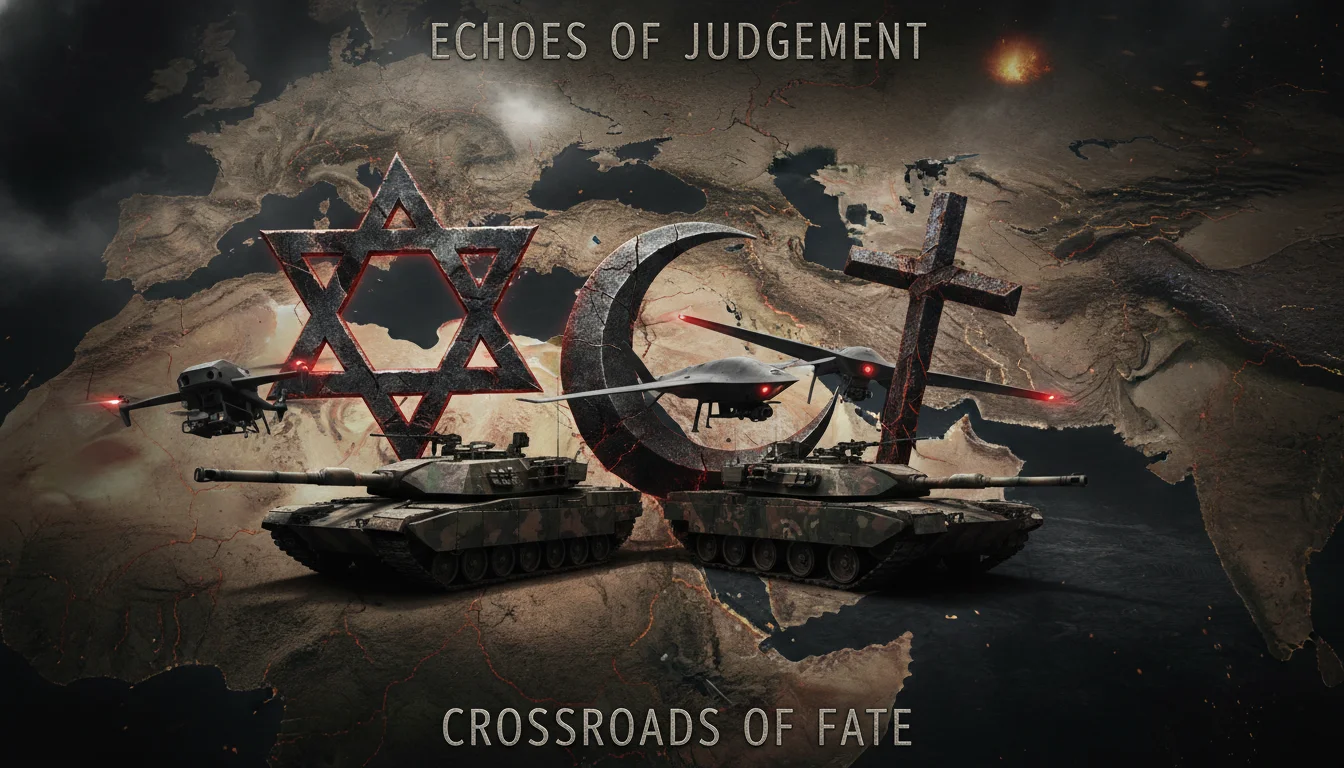
The Paradigm Shift in Modern Geopolitics and Strategic Forecasting
The contemporary global security architecture is currently undergoing a structural and irreversible rupture. Driven by the escalating, multi-front war involving the United States, the State of Israel, and the Islamic Republic of Iran, the international order is shifting away from the post-Cold War consensus. Traditional geopolitical frameworks—which rely almost exclusively on the paradigms of secular realpolitik, neorealism, resource competition, and deterrence theory—are proving fundamentally inadequate for forecasting the trajectory of this conflict. These conventional models operate on the assumption that state actors are primarily rational utility maximizers seeking self-preservation, economic growth, and the maintenance of the geopolitical status quo. However, to accurately comprehend the unfolding reality in the Middle East and its cascading global implications, the analytical lens must undergo a radical shift toward the most potent, yet frequently overlooked, driver of transnational mobilization: religious eschatology.
Eschatologies—theological doctrines concerning the “end times,” the ultimate destiny of humanity, and the final judgment of the world—are not merely passive belief systems relegated to the private sphere of faith. In the context of the current global conflict, they function as active, operational scripts. These prophetic narratives dictate grand strategy, coordinate disparate geopolitical actors across vast distances, and compel nations toward military commitments that appear entirely irrational from a secular, economic standpoint.
This report provides an exhaustive strategic analysis of the conflict through the framework of “Eschatological Convergence.” This phenomenon occurs when the apocalyptic narratives of Judaism, Christianity, Islam, and Orthodox Christianity intersect on specific geographic and temporal nodes. Rather than canceling each other out, these competing eschatologies overlap on key prophetic milestones, producing a self-fulfilling cycle of regional destabilization, territorial expansion, and global systemic restructuring. By analyzing the military realities, the game-theoretic mechanics of religious motivation, and the specific prophetic timelines driving the key actors, this report forecasts the trajectory of the war and the profound transformations expected over the next two to four years.
The Tactical Reality and Strategic Quagmire of the United States-Iran Conflict
The Inevitability of United States Ground Deployment
Following a highly classified briefing provided to the Senate Armed Services Committee, Senator Richard Blumenthal issued a stark, public warning regarding the trajectory of the campaign, which has been colloquially dubbed “Operation Epic Fury”. Emerging from the closed-door session “dissatisfied and angry”—a sentiment he claimed was unparalleled in his fifteen years in the Senate—Blumenthal confirmed that the United States appears to be on a direct and unavoidable path toward deploying American ground troops in the Islamic Republic of Iran to achieve its opaque military objectives.
The human and material costs of the initial phases of this joint US-Israeli campaign have already been severe and point toward a grinding war of attrition. To date, the conflict has resulted in over 1,200 fatalities, including the targeted elimination of high-level Iranian leadership such as Ayatollah Ali Khamenei. Within the first ten days of the active campaign, the Pentagon reported to international media that approximately 140 US service members were wounded, with eight killed in action and several remaining severely injured in the Gulf region.
The prospect of a US ground invasion implies severe domestic and international repercussions that threaten the core stability of the American state. Iran is a territorially vast, mountainous nation with a population deeply conditioned for resistance. A sustained occupational or pacification force in such terrain would exhaust the current volunteer military apparatus. Strategic models strongly indicate that this would necessitate a resumption of the national draft. Implementing conscription in the highly polarized political climate of contemporary America is poised to trigger profound domestic unrest, mass protests, and potential civil conflict, functionally paralyzing the nation’s domestic stability while it attempts to project power abroad. Furthermore, the operational environment is heavily internationalized; intelligence indicates that Russia is actively supporting Iran with critical intelligence and asymmetric capabilities, while China is also suspected of providing logistical and technological assistance, thereby neutralizing traditional American advantages.
Iran’s Strategic Posture and Asymmetric Readiness
Rather than capitulating to American shock-and-awe tactics or signaling a desire for de-escalation, the Iranian leadership has explicitly welcomed the escalation. Iranian Foreign Minister Abbas Araghchi has struck a defiant, highly confident tone across international media networks, publicly stating that Tehran is fully prepared for a US ground invasion. When questioned directly in interviews about the fear of American troops entering Iranian territory, Araghchi dismissed the premise, stating, “No, we are waiting for them,” and warning that such an invasion would culminate in a “big disaster” for the United States. Araghchi further noted that the initial Western strategy had already faltered, declaring, “Plan A for a clean rapid military victory failed, Mr. President. Your Plan B will be an even bigger failure”.
Iran has explicitly rejected any backchannel ceasefire negotiations, demonstrating a strategic patience rooted in its geographic advantages and an ideological readiness for prolonged warfare. Tehran’s confidence is not mere rhetoric; it is bolstered by decades of meticulous preparation for exactly this scenario. Operating under a doctrine of asymmetric warfare, Iran has heavily fortified its military infrastructure, including the stockpiling of tens of thousands of drones in subterranean mountain facilities designed to withstand conventional aerial bombardment. Recent escalations have seen Iran deploy ballistic missiles equipped with cluster bomb warheads, marking a significant escalation in theater-level lethality. The tactical reality suggests that the United States is being drawn into a highly sophisticated geographic, logistical, and demographic trap, one that conventional military superiority cannot easily dismantle.
Crucially, the conflict is expected to remain localized in its use of ultimate force; current models and expert predictions assert that neither the United States nor Israel will deploy tactical nuclear weapons in this theater. The deterrent to nuclear use is not merely moral or geopolitical, but highly practical: the radioactive fallout from a nuclear strike on Iranian facilities would travel east-southeast, directly impacting critical regional actors including southern Afghanistan, Pakistan, northern India, and Nepal. The subsequent environmental and diplomatic catastrophe would irrevocably draw South Asia—a region already fraught with nuclear-armed tensions between India and Pakistan—into a global conflagration, a risk threshold that all actors currently view as unacceptably high.
The Mathematics of Motivation: A Game-Theoretic Approach to Warfare
To understand why actors willingly enter conflicts that guarantee massive casualties, economic ruin, and the high probability of state collapse, one must discard standard rational-actor models and apply the Universal Law of Game Theory as it pertains to ideological and eschatological conflict.
Modern military doctrine often operates on the flawed assumption that victory is mathematically assured by mass—the sheer volume of troops, the size of the defense budget, the tonnage of munitions, and the technological sophistication of weaponry. However, when filtered through the lens of mathematical game theory as applied to human conflict, success is determined by three interacting variables: Mass, Energy, and Coordination.
The Core Variables: Mass, Energy, and Coordination
In this game-theoretic framework, the factors are weighted drastically differently, revealing the vulnerabilities of purely secular military superpowers:
| Game Theory Variable | Definition in Geopolitical Conflict | Relative Strategic Importance | Example in Current Conflict |
|---|---|---|---|
| Mass | Troop counts, GDP, conventional munitions, advanced fighter jets, and total military-industrial output. | Baseline (1x) | US carrier strike groups; Israel’s Iron Dome; NATO defense budgets; sheer demographic size. |
| Energy | Ideological fanaticism, messianic zeal, willingness to endure massive casualties and economic collapse, focus, and psychological readiness. | Moderate (2x) | Iran’s endurance of decades of sanctions; accelerationist settler movements; martyrdom complexes. |
| Coordination | Transnational synchronization, frictionless teamwork, and unity of purpose achieved without centralized, vulnerable command structures. | Maximum (4x) | Evangelical lobbying perfectly aligning with Orthodox Jewish expansionism; transnational militia integration. |
Secular states excel at aggregating Mass. They can appropriate funds, build advanced stealth aircraft, and deploy massive carrier strike groups. However, secular states generally suffer from low Energy (citizens are largely unwilling to die for abstract geopolitical goals or economic interests) and poor Coordination (bureaucratic friction, competing domestic interests, and the difficulty of maintaining secrecy).
Religious eschatology functions as the ultimate, overriding engine for both Energy and Coordination. It generates limitless psychological endurance (Energy) because the actors believe they are executing a divine mandate where earthly death is rewarded and suffering is a necessary precursor to redemption. More importantly, eschatology provides an overarching “script” that allows highly disparate, geographically separated, and even politically opposed groups to coordinate their actions seamlessly without the need for centralized communications that can be intercepted or destroyed (Coordination). This unconscious coordination through shared prophetic frameworks allows for secrecy, plausible deniability, and frictionless cooperation that secular alliances can rarely achieve.
The Schneersohn Precedent: Eschatological Coordination in Practice
A historical microcosm of this phenomenon—demonstrating how eschatological Coordination overrides overwhelming Mass and secular political boundaries—is the remarkable rescue of Rabbi Yosef Yitzchak Schneersohn, the sixth Lubavitcher Rebbe, during the outbreak of World War II.
In 1939, as the Nazi blitzkrieg devastated Poland, the Rebbe was trapped in occupied Warsaw during heavy bombardments. From a purely secular, geopolitical standpoint, the extraction of a single Hasidic rabbi from the center of the Nazi war machine should have been impossible. However, an unprecedented, highly coordinated international effort was mobilized involving actors who were, in many cases, mortal enemies.
American secular Jewish lawyers, utilizing their proximity to the White House, successfully lobbied the neutral US State Department to intervene. The US government, driven by this relentless domestic pressure, utilized its diplomatic leverage to pressure Nazi diplomats and, reputedly, Admiral Wilhelm Canaris, the head of the German Abwehr. Ultimately, Major Ernst Bloch, a highly decorated Wehrmacht officer of Jewish descent (classified as a Mischling under Nazi racial laws), was assigned to lead a specialized unit into the war zone specifically to locate and extract the Rebbe, securing his safe passage through Berlin to Riga, and ultimately to New York in March 1940.
The reasoning behind this extraordinary expenditure of political capital and military risk was fundamentally eschatological. The nascent Chabad leadership in the United States viewed the Rebbe’s survival not merely as a humanitarian imperative, but as an absolute spiritual necessity for the continuation of their movement and their messianic lineage. They successfully convinced secular actors that the Rebbe held a position akin to the Pope in Orthodox Judaism, thereby generating a massive, transnational lobbying and operational network. This intense religious imperative (Energy) enabled a level of international synergy (Coordination) that bypassed conventional political logic and wartime hostilities.
Today, this exact mechanism of script-driven coordination is operating on a global scale, driving the Middle East toward systemic war. Competing eschatological groups are unconsciously coordinating to bring about the destruction of the current geopolitical order to usher in their respective messianic ages.
The Theopolitics of Jerusalem, Al-Aqsa, and the Third Temple Project
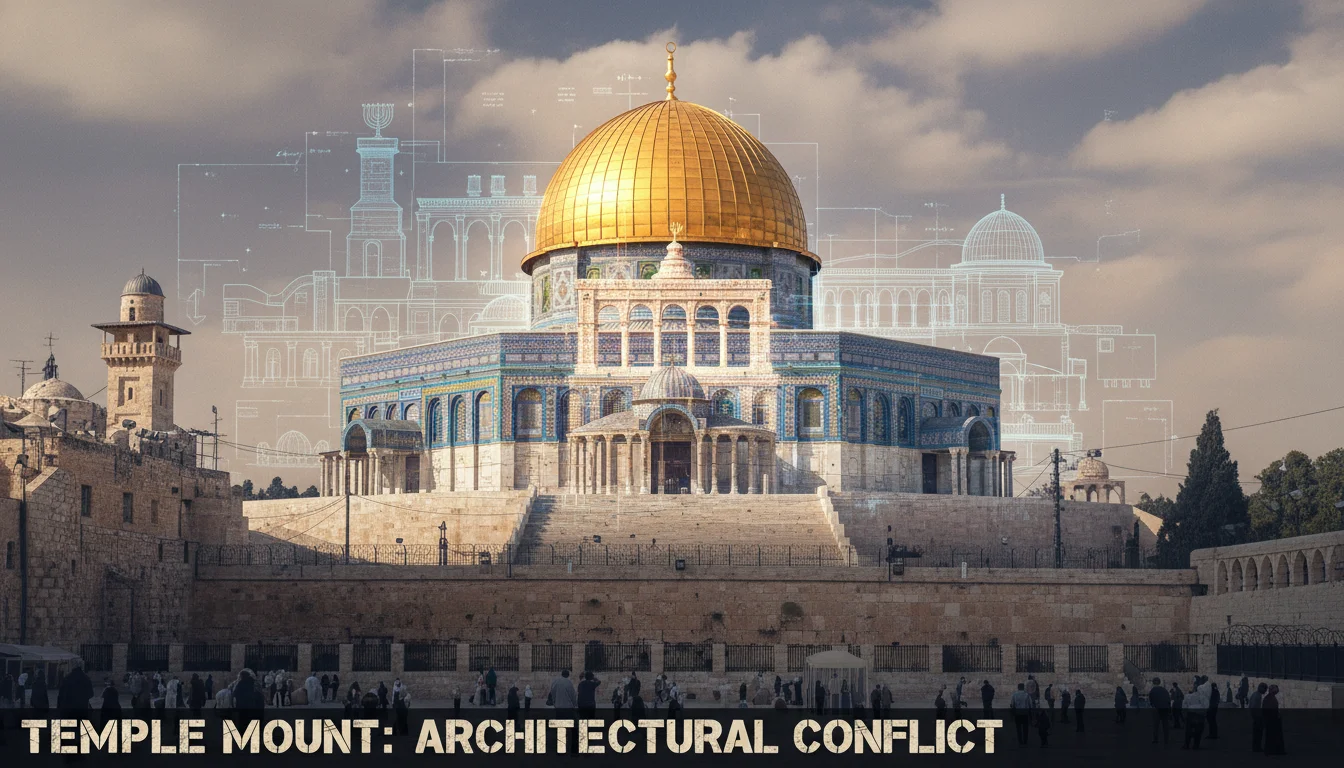
At the geographic and theological epicenter of the current eschatological convergence is Jerusalem, specifically the 35-acre elevated plaza in the Old City known to Jews as the Temple Mount and to Muslims as Haram al-Sharif, housing the Al-Aqsa Mosque compound. This specific plot of land is arguably the most combustible religious site globally, serving as the physical focal point where competing prophetic timelines violently collide.
Messianic Zionism, Accelerationism, and the Destruction of Al-Aqsa
In Orthodox Judaism, the Temple Mount is revered as the spiritual epicenter of the faith, the location of the First and Second Holy Temples, the latter of which was destroyed by the Roman Empire under Titus in 70 CE. For nearly two millennia, Jewish eschatology has anticipated the rebuilding of a Third Temple on this exact site, an event inextricably linked to the arrival of the Messiah, the ingathering of the exiles, and the dawn of a redemptive, utopian age.
Traditionally, mainstream rabbinic authority held a passive view of this prophecy, maintaining that the Third Temple would descend from heaven or be built only upon the explicit arrival of the Messiah. However, the modern era has seen the explosive growth of a transnational “Third Temple movement” and the proliferation of “Messianic Zionism”. This movement has introduced a highly volatile, interventionist doctrine known as “accelerationism.”
Accelerationists believe that human intervention is not only permitted but actively required to hasten the Messianic era. This necessitates the physical construction of the Third Temple on the Temple Mount. However, this project faces an insurmountable architectural and geopolitical obstacle: the site has been continuously occupied by Muslim sites of worship for over 1,300 years, specifically the Dome of the Rock and the Al-Aqsa Mosque (Islam’s third-holiest shrine, commemorating the Prophet Muhammad’s night journey to heaven).
The construction of the Third Temple is structurally impossible without the demolition, destruction, or catastrophic displacement of these Islamic structures. The strategic modeling of the current conflict, based on the laws of eschatological convergence, predicts that the destruction of the Al-Aqsa Mosque is an inevitable near-term outcome (projected within 2 to 4 years), orchestrated to clear the path for the Third Temple. The friction generated by this theological imperative is the primary engine of the current war. The Palestinian militant group Hamas explicitly cited the growing incursions of religious Jews into the compound and the aggressive machinations of the Third Temple movement as the primary motivation for its October 7 attack, which it deliberately named “Al-Aqsa Storm”. Following this attack, Temple activists utilized digital platforms to encourage even greater numbers of adherents to ascend the Mount, actively seeking to trigger the final confrontation.
The Convergence with Christian Zionism and Dispensationalism
The Jewish imperative to rebuild the Temple, which would otherwise be constrained by Israel’s limited demographic Mass, is exponentially amplified by its convergence with Christian Zionism, an ideology that currently dominates American Middle East policy.
Christian Zionism is deeply rooted in Protestant theological history, tracing its intellectual lineage back to the prophetic calculations of figures like Isaac Newton, who devoted significant portions of his life to decoding the Books of Daniel and Revelation. This theology was systematically codified in the 19th and 20th centuries through “dispensationalism,” popularized widely by the Scofield Reference Bible. This doctrine mandates a strict, literal interpretation of biblical prophecy, asserting that the Jewish people must return to the biblical land of Israel, claim total sovereignty over Jerusalem, and rebuild the Third Temple to trigger the end-times sequence. This sequence culminates in the Second Coming of Jesus Christ, the Rapture of true believers, and the ultimate, apocalyptic battle of Armageddon.
This creates a profound theological paradox. Christian Zionists and Orthodox Jews fundamentally disagree on the ultimate identity of the Messiah. Christian dispensationalist eschatology predicts that the Jewish Messiah, whom the rebuilt Temple is designed to welcome, will ultimately be revealed to the world as the Antichrist. Despite this terminal contradiction regarding the final outcome, their short-term geopolitical and territorial objectives are perfectly aligned.
This convergence creates a frictionless alliance where immense American evangelical political power, vast financial capital, and unparalleled military support are deployed unequivocally to support maximalist Israeli territorial ambitions and the Third Temple project, bypassing traditional diplomatic caution.
The Greater Israel Project and Regional Balkanization
The geopolitical corollary to the rebuilding of the Third Temple is the realization of the “Greater Israel” project (Eretz Yisrael Hashlema). This concept advocates for the territorial expansion of the State of Israel far beyond its internationally recognized 1967 borders, extending to its maximal biblical boundaries. These boundaries, as interpreted from scriptural promises, extend from the “River of Egypt” (the Nile) to the Euphrates River in Iraq, encompassing vast swaths of modern-day Palestine, Lebanon, Syria, Jordan, and Saudi Arabia.
The realization of Greater Israel inherently requires the radical destabilization, balkanization, or total collapse of surrounding Arab states. The ongoing war, therefore, must be analyzed not merely as a defensive posture against Iranian proxies or a localized counter-insurgency operation, but as a systemic reshaping of Middle Eastern borders to fulfill territorial mandates inscribed in antiquity.
Furthermore, the demographic viability of an expanded Greater Israel relies on a secondary prophetic convergence: a predicted, massive rise in global anti-Semitism. In eschatological frameworks, severe persecution in the diaspora is viewed as a necessary, divinely orchestrated mechanism to force the remaining Jewish populations worldwide to abandon their host nations and return to the expanded Israeli state, thereby consolidating its demographic integrity and fulfilling the prophetic “ingathering of the exiles.”
The Islamic Axis, the Persian Reawakening, and the War of Gog and Magog
Standing in direct opposition to this Judeo-Christian eschatological alliance is the Islamic world, currently spearheaded and militarized by the Shia theocracy of the Islamic Republic of Iran. To understand Iranian grand strategy, one must recognize that their military posture is not solely a reaction to US sanctions or disputes over nuclear enrichment; it is deeply entrenched in the Islamic anticipation of the end times, the arrival of the Mahdi (the guided one), and the final war against the Dajjal (the false messiah or Antichrist).
Sunni and Shia Eschatological Overlaps regarding Jerusalem
While Sunni and Shia Islam differ significantly in jurisprudence, historical lineage, and political authority, their eschatologies converge powerfully regarding the ultimate liberation of Jerusalem. Al-Aqsa is sacred to all Muslims. The threatened destruction of this site by Third Temple accelerationists serves as the ultimate “red line.” It is the single geopolitical event capable of bridging the historic Sunni-Shia divide, unifying disparate Islamic factions against a common civilizational threat, and transcending the sectarian conflicts that Western intelligence agencies have long manipulated to maintain regional balance and hegemony.
For the Supreme Leader and the Shia clerical establishment in Tehran, the establishment of the State of Israel and the projection of American military power in the Middle East are viewed not merely as geopolitical irritants, but as literal manifestations of cosmic arrogance and absolute evil. Iran’s grand strategy—executed relentlessly through the Quds Force and the transnational “Axis of Resistance”—is designed to exhaust American imperial resources through asymmetric bleeding. The objective is to hollow out Western influence, making the region structurally prepared for the return of the 12th Imam, who, according to Shia eschatology, will lead the believers in the final battle for justice.
Historical Precedents: The Persian Conquest of Jerusalem
The current alliance structures and geographic focal points find a profound historical echo in the geopolitical realities of the 7th century. Academic research, notably the extensive analysis by historians Ben Abrahamson and Joseph Katz, highlights the Persian conquest of Jerusalem in 614 CE. In this pivotal historical event, the Sassanid Persian Empire, allied with Jewish rebels seeking liberation from oppressive Christian rule, wrested control of the Holy City from the Byzantine Empire.
In a fascinating historical inversion detailed in this research, early narratives reveal that the Prophet Muhammad was viewed sympathetically by some Jewish communities as a messianic figure restoring monotheistic control over the Holy Land against the trinitarian Byzantines. The text notes that because Muhammad taught followers to recognize the God of Abraham and possessed knowledge of Mosaic history, he commanded an alliance to unite in faith against the Roman/Byzantine occupiers.
Today, the geopolitical roles have rotated, but the core actors—Persia (modern Iran), the West (the ideological successors to Rome/Byzantium), and the Jewish state—remain locked in an existential struggle over the exact same sacred geography. The predicted outcome of the current war indicates a profound, world-historic rise in Persian identity and influence. Following a forecasted US military defeat, driven by unbearable casualties and domestic collapse, a strategic withdrawal of American forces from the region is anticipated. In this vacuum, Iran is expected to emerge as the undisputed regional superpower, fulfilling its ancient imperial ambitions under an Islamic guise.
This Persian reawakening sets the geopolitical stage for the ultimate prophetic conflict detailed across Abrahamic texts: the War of Gog and Magog. This is envisioned as a final apocalyptic struggle involving a massive coalition of nations—led prominently by Persia and allied with regional powerhouses like Russia—converging against the expanded State of Israel in a battle that will force divine intervention.
Orthodox Christianity, the “Third Rome,” and the Subversion of NATO
While the Middle East burns, a parallel and deeply interconnected eschatological drama is unfolding in Eastern Europe, the Caucasus, and the Black Sea region, driven by Russian Orthodox mysticism and imperial ambition. The ongoing conflict in Ukraine and Russia’s broader confrontation with the NATO alliance cannot be fully understood outside the theological doctrine of “Moscow as the Third Rome”.
The Legacy of Byzantium and the Katechon
In 1453, a watershed moment in global history occurred when the Ottoman Empire, under the command of Sultan Mehmed II, breached the Theodosian walls and conquered Constantinople (modern-day Istanbul). This marked the final, catastrophic fall of the Byzantine Empire—the “Second Rome” and the historical, spiritual center of Eastern Orthodox Christianity.
Following this civilizational trauma, Russian clerics, beginning notably with the monk Philotheus of Pskov in the early 16th century, formulated a potent theological doctrine: the first Rome fell to heresy (Catholicism), the second Rome (Constantinople) fell to the infidel (the Ottomans) as punishment for attempting to reconcile with the Pope at the Council of Florence, and therefore, the mantle of defending true, uncorrupted Christianity had passed definitively to Moscow—the “Third Rome”.
Within this framework, Russia perceives itself not merely as a conventional nation-state seeking secure borders, but as the Katechon—a theological concept derived from Pauline epistles referring to the “restrainer” that prevents the global triumph of the Antichrist. Russian political and religious ideology increasingly identifies this Antichrist system with Western secular liberalism, materialism, and unipolar Anglo-American hegemony.
The Anticipated Defeat of Turkey and the Restoration of Constantinople
Within this Russian Orthodox eschatological framework—popularized by influential modern mystics like Elder Paisios of Mount Athos—there exists an enduring and deeply embedded prophecy predicting a final, apocalyptic war between Russia and Turkey. The prophecy dictates that Turkey will align completely with Western powers (NATO) and provoke a conflict, resulting in a devastating and decisive Russian victory. The ultimate, prophesied prize of this victory is the physical restoration of Constantinople to Greek Orthodox control and the reconsecration of the Hagia Sophia as a Christian cathedral.
This prophecy exerts a tangible influence on contemporary Russian grand strategy. By entangling the West in a massive, resource-draining proxy war in Ukraine (particularly the strategic maneuvering around the port city of Odessa), Russia aims to exhaust Western military stockpiles and destabilize NATO’s southeastern flank. The current geopolitical alignment between Russia and Iran, while highly beneficial tactically for bypassing Western sanctions and sharing advanced military technology (such as drone manufacturing), is fundamentally a marriage of convenience leading up to the Gog and Magog conflict. Ultimately, the realization of the “Third Rome” paradigm requires the systemic dismantling of NATO, the defeat of Turkey, and the collapse of European power structures, solidifying a divinely ordered Eurasian sphere of influence stretching from Lisbon to Vladivostok.
The Decline of Anglo-American Protestant and Catholic Power
In inverse proportion to the prophesied rise of Orthodox Russia and Shia Iran is the forecasted, terminal collapse of Anglo-American power. Western civilization, historically underpinned by Catholic and Protestant moral and institutional frameworks, is perceived by its geopolitical adversaries as suffering from late-stage civilizational decay.
The structural pillars of American imperial power are fracturing.
The weaponization of the US dollar through unprecedented sanctions has accelerated global de-dollarization efforts, undermining the economic bedrock of US hegemony. Concurrently, the heavy attrition of prolonged overseas wars, combined with internal demographic fracturing and the impending domestic crisis triggered by a potential military draft, point toward a systemic internal collapse or severe civil conflict within the United States.
Catholic eschatology, which envisions the Church as the “City of God” working toward a messianic age, also anticipates massive global upheavals. Some interpretations suggest that the fall of secular Anglo-American power is a necessary precursor to restoring traditional Catholic moral dominance over global affairs.
Similarly, China, which currently stands as a primary strategic rival to the United States, is also expected to face a precipitous decline in global geopolitical influence over the medium term. Viewed through these dominant eschatological lenses, China is a profoundly secular, materialist, and “godless” society. As the global conflict increasingly assumes a religious and spiritual character, secular states lacking profound eschatological “Energy” are predicted to fall out of alignment with the religiously energized blocs shaping the new world order, suffering internal collapse as their purely economic rationales for state cohesion fail under the pressure of global systemic shock.
Pax Judea: Technology, Surveillance, and the “Mark of the Beast”
As the United States rapidly declines and the Greater Israel project expands its territorial and geopolitical footprint, the resulting global power vacuum is predicted to be filled by “Pax Judea.” This concept envisions a highly centralized, unipolar global governance structure ideologically and geographically centered in Jerusalem. What distinguishes the forecasted Pax Judea from historical empires is its total reliance on absolute, pervasive technological dominance, a reality that fulfills the darkest warnings of Christian eschatology regarding the “Mark of the Beast” detailed in the Book of Revelation.
The Digital Infrastructure of Absolute Control
The infrastructure required for this global control system is not a futuristic fantasy; it is currently being beta-tested and deployed worldwide under the guise of bureaucratic convenience, public health, and national security. It involves an integrated nexus of Artificial Intelligence surveillance, biometric identification, and the total abolition of physical currency. Furthermore, groups such as the Freemasons are cited in the lecture frameworks as working within the Christian Zionist paradigm to actively implement this Pax Judea system, emphasizing elite technological control and total surveillance over humanity as a prerequisite for their version of a perfected society.
- Digital Identity and Biometrics: Governments worldwide, including the United Kingdom, are increasingly pushing for mandatory digital IDs as a prerequisite to participate in the formal economy, work, or access government services. Simultaneously, mega-corporate entities like Amazon are normalizing biometric payment systems, such as palm scanners in retail environments, directly linking a citizen’s physical biology to their financial ledgers.
- The Cashless Society and UBI: The aggressive global transition toward Central Bank Digital Currencies (CBDCs) and cashless societies eliminates the possibility of anonymous commerce. This grants centralized authorities absolute, real-time visibility over all human transactions. Coupled with growing economic instability that will necessitate proposals for Universal Basic Income (UBI), the state achieves total, unmitigated leverage over the individual’s basic survival.
- AI Surveillance and Algorithmic Compliance: Omnipresent AI monitoring, utilizing facial recognition and predictive behavioral algorithms, ensures that compliance with the dominant political or theological ideology can be seamlessly and automatically enforced.
The Convergence of Transhumanism and Biblical Prophecy
To Christian theologians, eschatologists, and accelerationists, these developments are not merely secular technological trends to be debated on privacy grounds; they represent the literal, physical manifestation of the “Mark of the Beast”—an inescapable system where “no one can buy or sell unless he has the mark”.
Within the framework of eschatological convergence, Pax Judea utilizes this techno-authoritarian apparatus to establish a frictionless global society. By centralizing economic access and biometric control, the emerging governance structure can instantly suppress dissent, monitor the fragmented global population, and enforce absolute compliance across the newly established Greater Israel and its tributary states.
-
Biometric Financial Access
Modern Technological Equivalent: Amazon One palm scanners, subdermal RFID chips, facial recognition.
Prophetic/Eschatological Corollary: “Mark on the right hand or forehead” required for participation in society.
-
Total Transactional Visibility
Modern Technological Equivalent: Cashless societies, Central Bank Digital Currencies (CBDC), digital wallets.
Prophetic/Eschatological Corollary: “No one can buy or sell without the mark” (Economic excommunication).
-
Algorithmic Social Control
Modern Technological Equivalent: AI facial recognition networks, predictive policing, social credit systems.
Prophetic/Eschatological Corollary: The omnipresent, all-seeing “image of the Beast” demanding worship/compliance.
-
Absolute Economic Dependence
Modern Technological Equivalent: Universal Basic Income (UBI) linked exclusively to digital ID compliance.
Prophetic/Eschatological Corollary: Submission to the Antichrist’s global governance architecture.
The Economic Hemorrhage: The Collapse of the GCC and Global Contagion
The geopolitical restructuring driven by these intense religious narratives will not occur in a vacuum; it will inflict catastrophic collateral damage on the global economy, with the epicenter of the financial shockwave localized in the Gulf Cooperation Council (GCC) states.
The Severe Vulnerability of Gulf Economies
The GCC states—comprising Saudi Arabia, the United Arab Emirates, Qatar, Bahrain, Kuwait, and Oman—have spent decades attempting to diversify their economies away from total reliance on fossil fuels. They have invested trillions of dollars in transforming their nations into global hubs for tourism, luxury real estate, international aviation, and logistics. However, this entire paradigm of economic modernization is critically dependent on a perception of regional stability, the safety of shipping lanes, and the uninterrupted flow of global capital and hydrocarbons.
The escalation of the US-Iran war shatters this paradigm completely. Economic models from Oxford Economics and Chatham House demonstrate that even a short, contained conflict severely contracts regional GDP, damaging tourism and halting domestic activity. However, the predicted scenario—a protracted war involving a US ground invasion—ensures the full activation of Iran’s asymmetric regional assets. Iran’s stated strategy explicitly involves dispersing the costs of the war by systematically targeting energy infrastructure, shipping routes, and aviation networks across the Gulf to pressure Washington to halt its offensive.
The Strait of Hormuz and Global Macroeconomic Shock
The ultimate economic weapon in this conflict is the closure or severe disruption of the Strait of Hormuz, a critical maritime chokepoint through which approximately one-fifth of total global oil consumption passes daily. The removal of this immense supply from the global market would constitute a macroeconomic shock without modern precedent. We are already witnessing preliminary, severe disruptions, with entities like QatarEnergy halting massive LNG production due to navigation risks in the Gulf.
If the United States executes a strategic withdrawal from the region after sustaining unbearable casualties in a protracted ground war, the security umbrella that has protected the GCC for decades immediately evaporates. The resulting collapse in Gulf oil revenues, combined with massive capital flight, the destruction of infrastructure, and emergency military spending, will plunge the GCC into severe, irrecoverable fiscal distress.
This economic collapse serves a vital dual purpose in the eschatological timeline. First, it permanently neuters the primary Arab geopolitical and economic resistance to Israeli expansionism, thereby facilitating the territorial acquisition required for the Greater Israel project. Second, it triggers a catastrophic global depression that accelerates the decline of the US dollar, breaks the back of Western financial hegemony, and creates the desperate global conditions necessary for populations to willingly accept the authoritarian stability offered by the Pax Judea system.
Geopolitical Spillover into South Asia
The destabilization of the Middle East possesses severe, immediate contagion risks for South Asia, a region already balancing on the edge of extreme geopolitical instability. A collapse in Gulf economic stability disproportionately and devastatingly affects nations like India, Pakistan, and Nepal. These nations rely heavily on massive remittance flows from millions of their citizens working as migrant labor in the GCC, as well as imported hydrocarbons to fuel their massive populations. The abrupt cessation of these remittance flows would trigger immediate domestic economic crises in these South Asian nations.
Furthermore, the geopolitical realignment resulting from the war creates a highly combustible scenario.
Pakistan, driven by domestic pressure and historic military ties, may move closer to a Saudi-Turkish military axis, bringing its nuclear arsenal into the broader Sunni calculus. Conversely, India, navigating its strategic partnerships, is increasingly viewed as aligning with American and Israeli interests. This polarization risks dragging the South Asian subcontinent directly into the broader eschatological conflict, ensuring that the ripples of the Middle East war reshape the security architecture of the entire Eastern Hemisphere.
Conclusion and Timeline of Strategic Predictions
The exhaustive analysis of the current and impending war involving the US, Israel, and Iran confirms that traditional, secular geopolitical models are insufficient for strategic forecasting in this era. The conflict is not an anomaly of failed diplomacy or a standard dispute over resource allocation; it is the physical, violent manifestation of intersecting, deeply held religious eschatologies.
Over the next two to four years, the strategic landscape will be defined by the Law of Eschatological Convergence. The high-energy, highly coordinated actions of Messianic Zionists, Christian Evangelicals, Shia accelerationists, and Orthodox Russian mystics are driving the region toward a series of unavoidable, systemic geopolitical shocks. Based on the data, historical precedents, and the specific prophetic scripts guiding the actors, the following timeline of predictions is established:
Forecasted Timeline
-
Current / Immediate
Strategic Event / Prediction: The United States will deploy ground troops into Iran, triggering massive asymmetric casualties, necessitating a national draft, and sparking severe domestic civil unrest.
Underlying Eschatological Driver: The Christian Zionist mandate to protect Israel converging with Shia anticipation of holy war against the ‘Great Satan’.
-
Near Future (2-4 years)
Strategic Event / Prediction: The Al-Aqsa Mosque will be destroyed or catastrophically compromised.
Underlying Eschatological Driver: The accelerationist requirement to clear the Temple Mount for the construction of the Jewish Third Temple.
-
Near Future
Strategic Event / Prediction: GCC economies will experience systemic collapse due to infrastructure targeting and the closure of the Strait of Hormuz. Turkey and Saudi Arabia will suffer severe losses.
Underlying Eschatological Driver: The removal of regional Arab opposition to facilitate territorial expansion; the destabilization of the global economy.
-
Near Future
Strategic Event / Prediction: Following a US withdrawal, Iran will rise as the undisputed regional superpower, experiencing an intense Persian reawakening.
Underlying Eschatological Driver: The structural preparation for the apocalyptic War of Gog and Magog, fulfilling Islamic and Judeo-Christian prophecies.
-
Near Future
Strategic Event / Prediction: Israel will significantly expand its territory (Greater Israel project) and lay the groundwork for Pax Judea (a one-world governance structure).
Underlying Eschatological Driver: The convergence of Messianic Zionism and Christian dispensationalism, utilizing global anti-Semitism to force diaspora return.
-
Near Future
Strategic Event / Prediction: Russia will defeat Turkey, resulting in the restoration of Greek Orthodox control over Constantinople (Istanbul) and the fracturing of NATO.
Underlying Eschatological Driver: The fulfillment of the “Third Rome” doctrine and Elder Paisios’s prophecies regarding the defeat of the West.
-
Short-to-Medium Term
Strategic Event / Prediction: The initiation of the War of Gog and Magog, a massive, multi-nation conflict involving Russia, Persia, Israel, and allied actors.
Underlying Eschatological Driver: The ultimate climax of Abrahamic eschatology requiring direct divine intervention.
-
Medium Term
Strategic Event / Prediction: The terminal decline of the United States and China as global superpowers, driven by internal conflict, economic collapse, and a lack of eschatological “Energy.”
Underlying Eschatological Driver: The fall of secular, materialist systems to make way for religiously motivated, technology-driven global governance (Pax Judea / Mark of the Beast system).
To navigate the coming decade, state actors, intelligence agencies, and strategic planners must discard the illusion that these conflicts are fundamentally about land, democracy, or economic resources. They are, at their core, wars of cosmic narrative. The actors involved are operating on divine mandates, and the conflict will not conclude until the scripts of their respective prophecies have been fully enacted upon the global stage.