Online Group Movie Watching Guide 2026: Best Watch Party Tools

Online Group Movie Watching Guide 2026: Best Watch Party Tools
The paradigm of media consumption has undergone a fundamental and irreversible transformation, shifting from localized, physical co-viewing within traditional living spaces to geographically distributed, synchronized digital co-presence. By the year 2026, the technological ecosystem facilitating online watch parties has matured into a highly complex intersection of third-party software applications, proprietary operating system integrations, open-source streaming frameworks, and stringent digital rights management (DRM) protocols. While the initial surge of virtual watch parties was largely catalyzed by global necessity and physical isolation, it has since solidified into a permanent behavioral fixture. This digital co-presence serves as critical infrastructure for maintaining long-distance relationships, fostering dispersed digital communities, and driving engagement within the broader creator economy.
This comprehensive report provides an exhaustive analysis of the technological mechanisms, market dynamics, regional constraints, and sociological implications of synchronized online movie watching. By examining the calculated retreat of first-party native synchronization features, the subsequent proliferation of third-party browser extensions (such as Teleparty and Flickcall), the rise of spatial virtual theaters (Scener, Kast), the proprietary hardware lock-ins enforced by Apple and Google, and the “grey market” DRM circumvention techniques prevalent on communication platforms like Discord, this analysis maps the current state and the future trajectory of digital co-viewing.
Part I: The Calculated Retreat of First-Party Native Synchronization
A critical structural turning point in the synchronized streaming market occurred in early 2024, triggering a cascade of secondary market developments that define the 2026 landscape. During this period, major first-party streaming providers systematically decommissioned their native watch party functionalities. Amazon Prime Video officially removed its highly utilized native Watch Party feature on April 2, 2024, leaving a vast user base suddenly searching for external alternatives to maintain their established digital movie nights. Concurrently, Disney+ deprecated its integrated GroupWatch feature, and Sling TV—which had previously stood as an outlier in the live television broadcasting space for supporting native co-viewing—also shut down its iteration in early 2024.
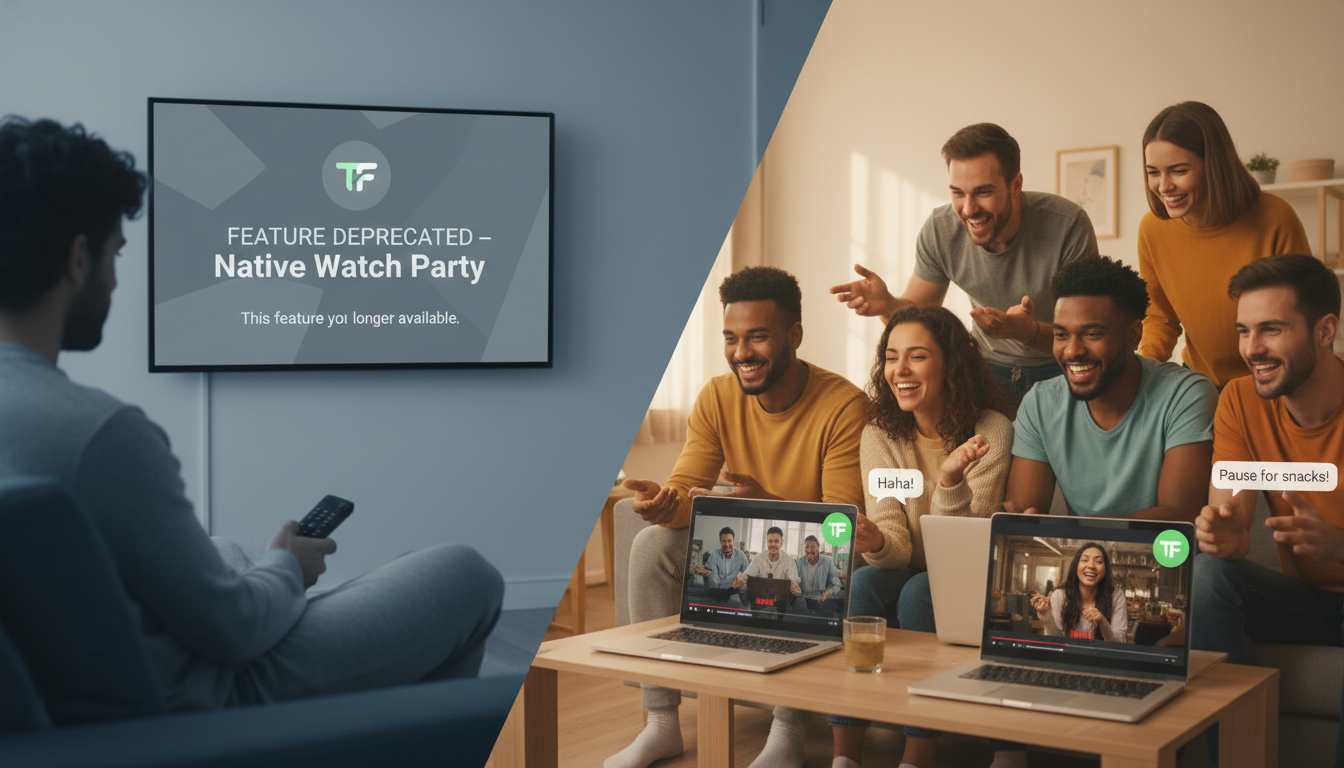
The systematic removal of these features across disparate platforms suggests a fundamental economic and engineering calculation by streaming giants. The cost of maintaining bespoke, low-latency synchronization architecture, optimizing it across highly fragmented global server networks, and providing dedicated customer support for complex edge cases ultimately outweighed the direct, measurable revenue generated by the feature itself. Instead, the streaming industry tacitly executed a strategic pivot: offloading the immense technological burden of temporal synchronization to a burgeoning ecosystem of third-party developers.
By relying on browser extensions and external applications to bridge the experiential gap, platforms like Netflix, Disney+, and Amazon avoid the overhead of continuous feature maintenance while continuing to reap the primary economic benefit of digital watch parties: enforced multi-user subscription requirements. Because nearly all compliant third-party synchronization tools dictate that every single participant must possess an active, authenticated account for the underlying streaming service to access the encrypted video feed, the existence of these external platforms acts as an uncompensated, highly effective acquisition and retention funnel for the streaming giants. If a user without a Netflix subscription is invited to a Teleparty, the software itself acts as a paywall, driving a potential new subscription to Netflix purely to facilitate the social interaction.
Part II: Architectural Typologies of Co-Viewing Platforms
The Browser Extension Model: DOM Manipulation and Event Syncing
The most ubiquitous method for synchronized viewing relies on browser extensions. These lightweight software modules manipulate the Document Object Model (DOM) of the user’s web browser, injecting proprietary synchronization scripts and communication overlays directly on top of the native web players of streaming services.
Teleparty (formerly Netflix Party)
Teleparty stands as the unequivocal pioneer and market leader in this specific category, boasting a user base that exceeds 20 million active participants. Rebranded from Netflix Party in its version 2.0.0 update to accurately reflect its aggressive expansion beyond a single host platform, Teleparty currently operates on version 5.5.2 as of early 2026. The architectural framework functions seamlessly across Google Chrome, Microsoft Edge, Safari, and Opera, utilizing a centralized server model to continuously ping and reconcile playback timestamps between the designated host and their guests.
To monetize its massive infrastructure costs and user base, Teleparty has meticulously stratified its market approach into a highly optimized freemium model. The free tier supports nine major streaming platforms, including Netflix, YouTube, Disney+, Max, Hulu, Amazon Prime Video, Pluto TV, Tubi, and Spotify. It provides fundamental video state synchronization and a basic text chat overlay. To extract capital from its most dedicated users, the developer introduced Teleparty Premium. This subscription tier is priced at $6.95 per month, or it can be purchased via an annual plan for $49.95, which effectively reduces the monthly cost to $4.16. A seven-day free trial is offered exclusively to users who commit to the annual billing cycle, and a Google account is strictly required to authenticate the upgrade.
Teleparty Premium unlocks hosting capabilities for over ten additional, specialized streaming services—such as Crunchyroll, Paramount+, Funimation, Apple TV, and ESPN+. Furthermore, it introduces highly requested quality-of-life features, including integrated audio and video chat functionalities, custom name colors, premium display badges, and animated GIF integration within the chat interface. Crucially, Teleparty’s growth strategy relies on a frictionless guest experience: while a Premium subscription is strictly required to host a watch party on restricted platforms like Crunchyroll or Apple TV, guest participants can join these premium-hosted sessions using the entirely free version of the extension without needing their own premium plan. Teleparty has also expanded into the mobile application ecosystem with dedicated software for Android (via the Google Play Store) and iOS (via the Apple App Store), though mobile compatibility currently remains restricted to core platforms like Netflix, Disney+, Hulu, and HBO Max.
Flickcall
Flickcall represents a technologically distinct approach within the browser extension paradigm. While it mirrors Teleparty’s basic functionality of DOM manipulation, Flickcall initially differentiated itself by integrating video calling natively into the browser interface, positioning itself to consumers simply as “Teleparty with video call”.
Furthermore, Flickcall employs a highly localized data routing strategy designed to optimize latency and address growing consumer privacy concerns. To minimize the delay inherent in global server pinging, Flickcall utilizes peer-to-peer (P2P) connections wherever network topology allows. Personal chat logs and live video web-camera streams are transmitted directly between participating users rather than being routed through centralized corporate servers. The system only falls back to server-based routing when direct P2P connections fail due to strict firewall protocols or asymmetric NAT (Network Address Translation) configurations.
Like its competitors, Flickcall operates on a freemium model. The free plan offers watch party support across all its compatible streaming platforms and includes unlimited text chat, but restricts users to a maximum of 30 minutes of video chat per week. The premium plan lifts this restriction, offering unlimited video communication. The platform has focused heavily on the Asian and Indian subcontinent markets, offering deep integration with regional Over-The-Top (OTT) platforms such as JioHotstar, Zee5, SonyLIV, and JioCinema (the latter added in version update 8.5.0). Flickcall also features unique engineering solutions for specific content types; for example, it fully supports live sports broadcasts on Hotstar, such as the Indian Premier League (IPL) cricket matches, though it intelligently disables its “smart mic” feature for these broadcasts, recognizing that live terrestrial feeds cannot be paused by individual users without breaking the broadcast state.
Additionally, Flickcall explicitly supports robust binge-watching architectures, allowing synchronized groups to transition seamlessly to subsequent television episodes without the friction of generating and distributing new party URLs.
Standalone Applications, Spatial Co-Viewing, and the Virtual Theater
Contrasting the lightweight, browser-dependent extension model, platforms like Scener and Kast attempt to simulate the spatial, physical environment of a living room or a cinematic theater, prioritizing heavy, persistent communication overlays and standalone application environments.
Scener
Scener frames its user experience as a “virtual theater,” offering a synchronized viewing pane that is entirely wrapped within robust, persistent communication tools, including integrated video, voice, and text chat. Scener is specifically optimized for larger-scale events rather than intimate gatherings. Its proprietary “host mode” architecture allows a central figure to broadcast their synchronized playback state to a massive audience, making it the preferred tool for community managers, digital influencers, and public, ticketed watch parties.
Operating Scener requires users to navigate a steeper onboarding funnel; individuals must create a dedicated Scener account in addition to maintaining their individual streaming platform logins. This adds a layer of initial friction but allows the platform to foster a more persistent social identity and community ecosystem. Scener is compatible with Chrome browsers on Windows and macOS, and has limited compatibility with select smart television browsers. However, unlike Teleparty, its mobile application is strictly limited to iOS devices, alienating the Android market. Furthermore, due to the heavy integration of simultaneous video and audio feeds, Scener demands significantly higher bandwidth stability than purely text-based extension alternatives.
Kast
Rising from the intellectual property and conceptual ashes of the defunct platform “Rabbit,” Kast operates as a versatile, multi-platform application available across desktop, mobile, and web interfaces. Kast distinguishes itself structurally by moving away from strict reliance on streaming platform APIs and the fragile nature of DOM manipulation. Instead, Kast utilizes highly robust screen-sharing protocols and Picture-in-Picture (PiP) mechanisms. This foundational difference allows users to host watch parties for virtually any content displayed on their computer screens, effectively bypassing the specific platform integration limitations and API breakage issues faced by Teleparty and Flickcall.
In recent years, Kast has strategically pivoted its marketing and feature development toward the burgeoning “Creator Economy.” It actively markets its platform to online content creators, educators, and streamers who are aiming to transition passive followers into highly engaged “superfans.” Kast facilitates this by providing tools for live Q&A sessions, fan nights, interactive tutorials, and behind-the-scenes premieres. By framing co-viewing as a definitive tool for audience monetization and long-term community retention, Kast expands its utility far beyond private social circles. Kast Premium, offered at $6.49 per month (with a 23% discount for annual billing), removes all platform advertisements and unlocks high-definition streaming capabilities. Premium users can select bitrates allowing for 1080p, 720p, or 480p resolutions at up to 5Mbps. The premium tier also permits users with high-end computational hardware to simultaneously stream high-definition video content and their web-camera feeds, while unlocking an exclusive library of animated reactions and GIF integrations within the chat interface.
Mobile-First Ecosystems and Application-Level DRM: Rave
Rave approaches digital synchronization through a heavily mobile-first lens, catering predominantly to younger demographics that consume media exclusively on smartphones and tablets (iOS and Android), while expanding to Windows and Mac environments via standalone executable (.EXE) files. Rave seamlessly integrates with Netflix, Disney+, Amazon Prime Video, HBO Max, YouTube, Vimeo, and, uniquely, Google Drive. The Google Drive integration is particularly vital, as it allows users to synchronize independent, uploaded video files globally, facilitating watch parties for independent films, home videos, or legally ambiguous downloaded content.
The technological mechanism underlying Rave’s standalone application is highly notable within the software engineering community. Unlike browser extensions that manipulate existing web players provided by the streaming services, Rave operates its own internal video player on mobile devices. To accomplish this while maintaining strict Digital Rights Management (DRM) compliance with litigious entities like Netflix, Rave utilizes ExoPlayer—an application-level media player developed by Google for Android.
Network traffic analysis and packet sniffing conducted by independent developers indicate that Rave’s internal player facilitates the direct, secure exchange of Widevine DRM certificates between the user’s mobile device and the official Netflix license servers. This confirms that Rave successfully brokered backend legal and technical agreements to stream secure, encrypted media directly within its proprietary application environment, a feat rarely achieved by independent, third-party developers. Furthermore, Rave heavily gamifies the social experience with “RaveDJ,” an automated, artificial intelligence-driven tool that allows users to create and synchronize automated music mashups, transitioning the app from a passive viewing utility to an interactive entertainment hub. The platform supports multiple localizations, including English, Russian, Turkish, Spanish, Portuguese, and Indonesian, and monetizes its free user base through an integrated merchandise shop and internal advertisements.
Web-Native and Asynchronous Rooms: Watch2Gether
Watch2Gether provides a highly accessible, web-native, asynchronous room architecture. Recognizing that mandatory account creation is the primary point of user drop-off, Watch2Gether allows any user to generate a fully functional watch room instantly without registering an account. However, to conserve server storage and bandwidth, these unregistered, temporary rooms are automatically purged from the database after 24 hours of inactivity. Permanent rooms and playlist preservation require the creation of a free user account. Watch2Gether natively embeds open-source and easily accessible media APIs, seamlessly synchronizing YouTube, Dailymotion, Vimeo, and SoundCloud directly within the browser tab.
However, major DRM-protected platforms like Netflix, Disney+, and Amazon Prime strictly prohibit their media players from being embedded within standard HTML iframes on external websites to prevent piracy and data scraping. To circumvent this rigid limitation and compete with Teleparty, Watch2Gether deployed the “W2gSync” system. W2gSync requires participants to install a dedicated browser extension (supported on Chrome, Firefox, Edge, and notably, the Kiwi browser on Android, which is one of the few mobile browsers that supports standard Chrome extensions). The W2gSync extension detects the external streaming site window open in another tab, intercepts the playback state data, and coordinates the pause/play timing with the central Watch2Gether room via WebSockets. This hybrid approach allows the platform to maintain its lightweight, server-side web interface while extending functionality to rigid, walled-garden streaming services. The platform relies heavily on ad-supported revenue, though it offers premium upgrades to remove viewer limits and interface advertisements.
Platform
Architectural Typology
Supported Platforms (Highlights)
Monetization Strategy
Distinctive Feature / Technology
Teleparty
Browser Extension / Mobile App
Netflix, Disney+, Hulu, Max, Prime, Crunchyroll
Freemium ($49.95/yr Premium)
20M+ user base; rapid AVOD patch deployment
Flickcall
Browser Extension
Netflix, Prime, Hotstar, JioCinema, Zee5
Freemium (Premium unlocks unlimited video)
P2P routing; deep Indian OTT integration
Scener
Browser Extension
Netflix, Max, Hulu, Prime
Freemium
Virtual theater UX; Host broadcasting mode
Kast
Standalone App / Web
Any screen-shared desktop content
Freemium ($6.49/mo Premium)
Creator-focused community tools; PiP overlay
Rave
Mobile App / Desktop.EXE
Netflix, Prime, Disney+, Google Drive
Merchandise / Ads
Native ExoPlayer integration; Widevine DRM exchange; RaveDJ
Watch2Gether
Web Application / Hybrid Sync
YouTube, Vimeo, Netflix (via W2gSync)
Ad-supported / Premium
Frictionless, no-registration 24-hour asynchronous rooms
Part III: The AVOD Synchronization Crisis: A Third-Order Market Insight
A highly nuanced technical crisis facing the synchronized viewing industry throughout 2025 and 2026 has been the rapid, industry-wide proliferation of Ad-Supported Video on Demand (AVOD) tiers by major streaming giants. Services like Netflix, Disney+, Amazon Prime Video, Hulu, and Paramount+ have heavily incentivized consumers to adopt cheaper, ad-supported subscription plans to boost their Average Revenue Per User (ARPU) through advertising yields.
AVOD introduces a catastrophic mathematical variable to the fragile logic of media synchronization: dynamic, programmatic ad insertion. When multiple users watch a synchronized stream on an ad-supported tier, the streaming platform’s server dynamically serves advertisements based on individual user data profiles, geographic location, algorithmic bidding, and demographic targeting.
Consequently, within a single Teleparty session, User A might receive a 30-second unskippable ad for an automobile, User B might receive a 15-second ad for a local restaurant, and User C, who pays for a premium ad-free tier, receives no advertisement at all. This individualized programmatic delivery instantly shatters the temporal synchronization state of the viewing party.
Third-party developers have been forced into an aggressive, ongoing technological arms race to rectify this structural incompatibility. Teleparty’s extensive release notes throughout versions 5.0.0 to 5.1.8 meticulously document persistent, complex engineering efforts required to deploy “bug fixes and improvements for Amazon Prime Video, Disney+ (ad-based plans), Fubo, Youtube TV, and JioHotstar”. The technical resolution requires the browser extension to continuously monitor the proprietary DOM states of ad overlays, calculate the precise temporal delta between all users’ video timelines, and forcefully initiate a pausing state on users who finish their ad breaks early. The system must effectively hold these users in a suspended stasis until the final participant’s ad concludes, before programmatically triggering the “play” function simultaneously.
Updates such as version 5.1.4 (addressing HBO Max and Hulu ad-based plans) and version 5.1.8 (patching Amazon and Paramount ad-based synchronization) reveal that streaming platforms frequently update their ad-delivery DOM structures, breaking Teleparty’s code and requiring constant vigilance and rapid deployment from the development team. Similarly, Flickcall’s version 8.4.1 explicitly outlines added support for third-party shows with advertisements on Amazon Prime Video and ad-based plans on HBO Max. This fragile, continuous cat-and-mouse workaround highlights the fundamental friction between the highly individualized monetization strategies of corporate streaming platforms and the communal, synchronous desires of end consumers.
Part IV: Ecosystem Lock-In: Operating System and Enterprise Integration
To circumvent the inherent friction, installation requirements, and API fragility of third-party extensions, major technology conglomerates have leveraged their dominant market positions to integrate co-viewing directly into the fabric of their operating systems and unified communication suites.
Apple SharePlay: The Walled Garden Approach
Introduced fundamentally with iOS 15.1 and heavily expanded in subsequent iterations, Apple’s SharePlay weaves media synchronization deeply into the native FaceTime communication framework. The system is highly optimized for frictionless initiation within the closed Apple hardware ecosystem. Utilizing the NameDrop protocol introduced in iOS 17, users can trigger a SharePlay session instantly simply by utilizing Near Field Communication (NFC) and holding two updated iPhone devices in close physical proximity. SharePlay supports synchronized video, shared playback controls, and automatic audio ducking during conversation across compatible applications such as Apple TV+, Hulu, Max, Disney+, Paramount+, and ESPN+.
However, Apple’s approach acutely highlights the strategic limitations of walled garden ecosystems. SharePlay explicitly lacks compatibility with market titans Netflix and Amazon Prime Video, severely limiting its utility for general consumers who rely on those platforms for primary entertainment. Furthermore, while Apple has attempted to bridge the cross-platform divide by allowing Android and Windows users to join FaceTime SharePlay sessions via web links executed on Google Chrome or Microsoft Edge, severe operational limitations remain. Non-Apple participants can successfully join the video and audio call via the web browser, but they are frequently blocked from utilizing the actual SharePlay screen synchronization or media viewing tools, effectively rendering the cross-platform functionality entirely useless for actual movie nights. The system remains exclusionary; as noted by users transitioning between ecosystems, the artificial limits placed on Android participants within Apple Music and Apple TV SharePlay sessions generate significant consumer frustration. Additionally, all participants, regardless of their hardware or operating system, are still required to hold active, individual subscriptions to the streaming service being utilized to pass the DRM checks.
Google Meet and YouTube Live Sharing
Alphabet Inc. has leveraged its dominant position in enterprise communication and centralized video hosting to build a native co-viewing ecosystem via Google Meet. On Android devices, users engaged in a Google Meet video call can initiate a “Live Sharing” session that bridges directly to the YouTube application. In a highly strategic move designed to incentivize subscription upgrades, Google mandates that the individual initiating the co-viewing session must possess an active, paid YouTube Premium membership. However, once the session is initialized by the Premium host, guest participants can join the call and view the synchronized, ad-free content without requiring their own Premium accounts.
For enterprise and high-level organizational users, Google Meet pushes the boundaries of co-viewing into the realm of professional broadcasting. Users on advanced Workspace tiers—including Enterprise Starter, Enterprise Standard, Enterprise Plus, Education Plus, the Teaching and Learning Upgrade, Workspace Individual Subscribers, and Google One 2TB subscribers—can directly push their meeting content and shared screens to a public or unlisted YouTube Live Stream. This blurs the lines between private synchronized viewing and public broadcasting, allowing educators, corporate entities, and large organizations to bypass third-party platforms entirely.
Part V: The “Grey Market” of Co-Viewing: Discord, Community Broadcasting, and the DRM Wars
While applications like Teleparty and Google Meet operate in a compliant, parallel track alongside streaming services, Discord represents the undeniable epicenter of the “grey market” for media synchronization. Discord functions as a persistent, low-latency communication hub where users rely heavily on the “Go Live” screen-sharing feature to broadcast media directly from their desktop environments to friends residing in private voice channels.
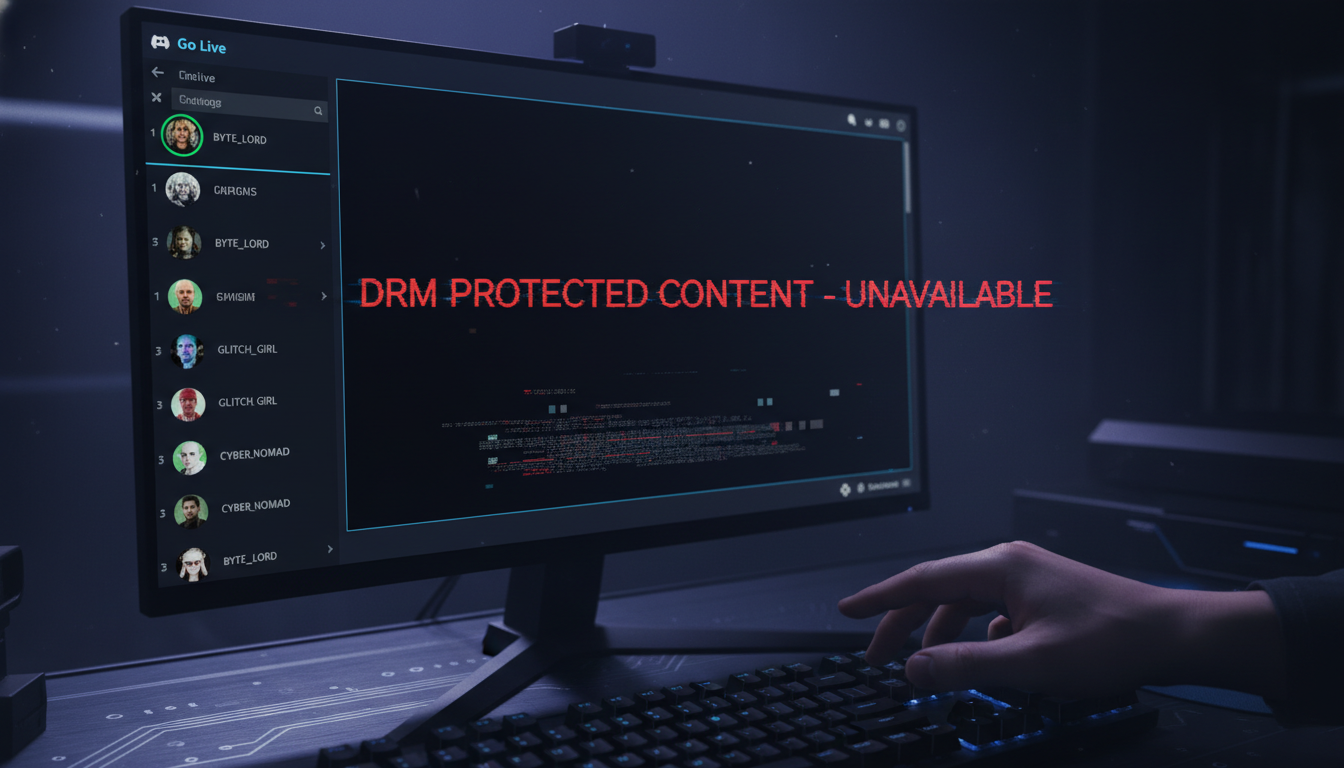
This methodology operates via direct localized screen capture rather than algorithmic API synchronization. Consequently, only the broadcasting host requires a paid streaming subscription, while all viewers in the voice channel can watch the resulting feed entirely for free. This fundamentally and flagrantly violates the multi-user licensing agreements and terms of service of all major streaming platforms. To combat this widespread piracy vector, streaming services deploy robust High-bandwidth Digital Content Protection (HDCP) and Widevine DRM encryption protocols. When a user attempts to capture a native Netflix, Disney+, or Prime Video browser window using Discord’s screen-capture hook, the DRM software immediately detects the unauthorized recording attempt and renders the video output as a pure black screen, allowing only the underlying audio track to pass through to the viewers.
This has sparked an ongoing, sophisticated technological battle between corporate DRM engineers and resourceful end-users. Consumers frequently circumvent these DRM black screens by navigating into their web browser settings and disabling hardware acceleration. This specific toggle forces the browser to render video frames using the system’s central processing unit (CPU) rather than the graphics processing unit (GPU), effectively bypassing the GPU-level secure hardware pathways where HDCP encryption natively operates. More advanced users route their browser displays through intermediary broadcasting software, utilizing OBS (Open Broadcaster Software) Virtual Camera outputs to strip DRM flags and transcode the visual data before feeding the raw visual feed into Discord as a standard webcam input, entirely bypassing Discord’s application-detection protocols. Furthermore, anonymous forums reveal a heavy reliance on illicit, offshore streaming networks (such as 123Movies and Bilibili) that inherently lack Widevine DRM entirely, allowing for completely frictionless, albeit illegal, screen-sharing over Discord.
Discord heavily monetizes the intense consumer demand for high-quality screen sharing, capitalizing on its role as the premier co-viewing platform for the gaming and technical community. The base application rigidly restricts free users to streaming at a modest 720p resolution and 30 frames per second (fps). To achieve cinematic visual fidelity, users must subscribe to Discord Nitro ($9.99 monthly), which unlocks premium 1080p and 4K streaming capabilities at a fluid 60fps.
Alternatively, Discord brilliantly gamifies this constraint through its “Server Boosting” economy. If a community collectively pools financial resources to purchase “Boosts” for a specific server, all members within that server gain upgraded streaming capacities, transforming co-viewing into a communal financial goal.
- Level 1 (2 Boosts): Upgrades all server members to 720p/60fps streaming, expands emoji slots from 50 to 100, provides 24 soundboard slots, and sets audio quality to 128 Kbps.
- Level 2 (7 Boosts): Upgrades streaming to 1080p/60fps, expands emoji slots to 150, provides 36 soundboard slots, raises audio quality to 256 Kbps, and increases the file upload limit to 50MB for all members.
- Level 3 (14 Boosts): Maximizes audio bandwidth at an audiophile-grade 384 Kbps while maintaining 1080p/60fps visual fidelity, provides 250 custom emoji slots, 60 soundboard slots, expands upload limits to 100MB, and allows the server to generate a custom vanity URL.
The deep integration of pirated media consumption and social identity on Discord is not without severe regulatory and privacy risks.
In early 2026, Discord was forced to abruptly postpone a highly controversial global rollout of a mandatory age-verification system. Slated for March 2026, the draconian system would have required users to undergo biometric facial scanning or upload government identification documents to prove adult status. The indefinite delay to late 2026 was precipitated by severe user backlash regarding data privacy and corporate overreach, exacerbated by a catastrophic recent security breach involving a third-party vendor that resulted in the exposure of government ID photos belonging to up to 70,000 Discord users. This incident underscores the inherent privacy vulnerabilities in highly centralized, synchronized social platforms that act as arbiters of both communication and media consumption.
Discord Server Tier
Boosts Required
Audio Bitrate
Go Live Stream Quality
Notable Additional Perks
Base Level
0
96 Kbps
720p at 30fps
50 Emojis, 8 Soundboard Slots
Level 1
2
128 Kbps
720p at 60fps
100 Emojis, 24 Soundboard Slots
Level 2
7
256 Kbps
1080p at 60fps
150 Emojis, 50MB Upload Limit
Level 3
14
384 Kbps
1080p at 60fps (High Bitrate)
250 Emojis, Custom Vanity URL, 100MB Upload
Part VI: Geographic Disparities and Licensing Constraints: A Case Study of Nepal
The digital co-viewing ecosystem is heavily dependent on the uniformity of global intellectual property licensing. When attempting to synchronize media across international borders—a primary use case for long-distance relationships and distributed families—the primary point of failure is regional availability. If a cinematic property is licensed to Netflix in the United States but licensed to an independent provider in South Asia, international watch parties utilizing platforms like Teleparty or Flickcall will instantly fail to synchronize, as the software cannot locate matching title IDs across the disparate regional databases.
The sovereign digital landscape of Nepal serves as an excellent, highly illustrative case study of these complex geopolitical streaming realities. Major regional entertainment titans, most notably Disney+ Hotstar (which controls the exclusive streaming rights to vast catalogs of Bollywood cinema, Marvel cinematic properties, and culturally critical live sports like ICC Cricket), are strictly geo-blocked within Nepalese territory due to rigid licensing and distribution agreements forged primarily for the Indian domestic market.
To participate in regional cultural co-viewing, Nepalese consumers are systematically forced into the Virtual Private Network (VPN) economy. Users heavily utilize premium services like PureVPN, NordVPN, and Surfshark to mask their localized Nepalese IP addresses and tunnel their internet traffic through secure, encrypted servers located within India. Once the geographic blockade is successfully bypassed via the VPN tunnel, users can pair the unblocked Hotstar application with browser extensions like Flickcall. Flickcall has strategically cornered this demographic by providing dedicated, robust support for Indian OTTs like JioCinema, Hotstar, and Zee5, successfully facilitating transnational regional watch parties that would otherwise be impossible. Similarly, the Teleparty Android application explicitly integrated native support for JioHotstar Live precisely to allow synchronized viewing of the 2026 ICC Men’s T20 World Cup, highlighting how the intense demand for high-value live sports serves as a primary driver for the adoption of synchronization software in emerging digital markets.
Domestically, the Nepalese streaming and Internet Protocol Television (IPTV) ecosystem has rapidly modernized to cater to digital demands and retain capital within the national borders. NetTV Nepal, which underwent a major corporate consolidation with Prabhu Group to become PrabhuTV, stands as the premier digital television provider in the nation. NetTV provides a robust, multi-platform mobile and web application allowing users to view over 200 live channels. This includes vital local news and entertainment entities like Kantipur TV HD, Nepal TV, Himalaya TV, and AP1 HD, alongside international broadcasts. However, local app infrastructure sometimes struggles with load balancing; the standalone Kantipur TV application suffers from poor user ratings (averaging 1.5 stars) due to chronic failures in loading live video feeds, driving consumers toward centralized aggregators like NetTV.
To mitigate the intense engineering requirement for real-time live synchronization, NetTV has heavily integrated Catch-up TV and Digital Video Recording (DVR) functionalities directly into their Electronic Program Guide (EPG). This feature allows distributed Nepalese families to watch local broadcasts asynchronously, circumventing the need for third-party sync extensions. Furthermore, major Internet Service Providers (ISPs) like Worldlink have aggressively bundled traditional broadband internet access with advanced television packages, offering the “NetTV Premium package CinePlus OTT”. For a deeply subsidized promotional rate (Rs. 50/month, reduced from the standard Rs. 200/month), consumers gain frictionless access to vast libraries of local Nepali blockbusters (via Merocinema) and Hollywood properties (via Lionsgate). By centralizing the entertainment hub at the ISP level, Nepalese telecommunications companies are actively attempting to curb consumer reliance on illegal, pirated IPTV networks and third-party global streaming giants.
For users seeking alternatives to corporate-controlled platforms, the open-source and independent IPTV ecosystem remains highly active. Tools such as IPTVnator (an open-source, cross-platform player supporting m3u playlists), VidGrid (a multiviewer supporting YouTube, Twitch, and m3u8 playlists), and IPTV RestreamHub (a specialized solution combining proxy connections with synchronized Watch2Gether-style viewing) provide highly technical users with the ability to construct their own synchronized viewing environments devoid of commercial oversight and subscription fees.
Platform / Tool
Primary Use Case
Regional Focus / Accessibility
Key Technological Feature
Disney+ Hotstar
Premium regional OTT (Bollywood, Cricket)
India (Geo-blocked in Nepal; requires VPN)
Live sports broadcasting integration
PureVPN / NordVPN
IP masking and geographic tunneling
Global (Crucial for Nepalese access to Indian OTTs)
High-speed encrypted server nodes
NetTV Nepal (PrabhuTV)
Domestic IPTV and Live Broadcasting
Nepal domestic market
200+ channels, deep DVR integration
Worldlink CinePlus OTT
Bundled ISP entertainment package
Nepal domestic market
Subsidized pricing (Rs. 50/mo), Merocinema
IPTV RestreamHub
Open-source synchronized viewing
Global / Independent
Combines Watch2Gether sync with m3u proxying
Part VII: Sociological Implications and the Architecture of Digital Intimacy
Moving beyond the strict technical and architectural mechanisms, the widespread, normalized adoption of digital watch parties reflects a profound evolution in how human beings manufacture and maintain intimacy across vast physical distances. Anthropological and sociological insights gleaned from digital communities in 2025 and 2026 reveal that synchronous media consumption functions not merely as an entertainment vector, but as a direct psychological surrogate for physical proximity in long-distance relationships (LDRs) and dispersed familial units.
The sociological impact is starkly evident in the deeply ingrained rituals that users developed to cope with technological limitations prior to the stabilization of platforms like Teleparty, or when forced to navigate incompatible geo-blocked platforms. Users on community forums heavily document their reliance on the manual “countdown method.” In this ritual, participants utilize a secondary voice channel (such as a standard phone call or Discord server), pause their respective local video files or streams precisely at an identical, agreed-upon timestamp (e.g., exactly at the 5-second mark), count down aloud from three, and manually press the spacebar or play button simultaneously. If desynchronization occurs due to buffering or unequal bandwidth speeds, the entire ritual must be halted, a new timestamp negotiated, and the process repeated. This highly manual, friction-heavy process emphasizes a crucial sociological reality: the core value derived from the activity is not solely the cinematic media being consumed, but the psychological awareness of a simultaneous, shared temporal experience.
As technology matures and users migrate toward reliable synchronization tools like Teleparty or the local file-syncing program Syncplay, the emphasis of the interaction shifts from managing the media state to interpreting the metadata of social reaction. The integration of spatial audio over Discord, the transmission of ambient background noise through open microphones, and the visual feedback of customized, animated emoji reactions on platforms like Teleparty and Kast functionally replace the physical, non-verbal cues of sharing a physical couch. Users frequently report establishing highly rigid scheduling frameworks—such as the “First Sunday Rule“—to ensure temporal alignment across complex global timezones, utilizing the scheduled synchronized stream as an anchor point to enforce regular digital rendezvous.
However, this digitization of social interaction introduces unique forms of psychological friction. The inherent latency of VoIP (Voice over Internet Protocol) calls, the micro-stutters caused by unequal broadband speeds between international routing nodes, and the profound alienation of encountering a DRM-induced black screen severely disrupt the cognitive suspension of disbelief.
When the technology functions seamlessly, the interface vanishes, allowing genuine human connection to take precedence; when the technology fails, errors out, or blocks content due to licensing, it violently shatters the illusion of proximity, acutely reminding the participants of the physical isolation and distance separating them.
Part VIII: Strategic Trajectory and Final Assessment
The landscape of synchronized online media consumption in 2026 is ultimately defined by an unyielding paradox: the intense consumer desire for seamless, frictionless communal experiences is consistently obstructed by the individualized, fiercely protective, and profit-driven architectures of the global streaming industry.
The strategic, coordinated withdrawal of first-party synchronization features (such as Amazon’s native Watch Party and Disney’s GroupWatch) was not an abandonment of the co-viewing concept by corporate entities. Rather, it represented a highly calculated outsourcing maneuver to the third-party market. By allowing independent entities like Teleparty, Flickcall, Watch2Gether, and Scener to shoulder the immense computational, engineering, and customer-support overhead of synchronization, major streaming platforms continue to enjoy increased user retention, benefit from the network effects of social viewing, and enforce strict multi-account subscription requirements without expending any internal capital or developmental resources.
Moving forward into the late 2020s, three distinct, highly disruptive trajectories will shape the market dynamics of digital co-presence:
-
The Premiumization of the Periphery
As the core logic of video synchronization becomes increasingly commoditized and easily replicated, third-party developers will inevitably lock high-bandwidth and highly socially expressive features—such as integrated video chatting, advanced audio routing, high-definition bitrates, picture-in-picture functionalities, and custom animated reactions—behind rigid subscription paywalls. Kast Premium ($6.49/month), Teleparty Premium ($49.95/year), and Flickcall’s video-chat time limits all actively exhibit this exact monetization vector, transitioning the concept of the “watch party” from a free, open utility to a monetized, premium social club.
-
The AVOD Friction Escalation
The aggressive corporate push toward Ad-Supported Video on Demand (AVOD) will continue to critically threaten the stability of synchronized viewing. As streaming giants deploy increasingly sophisticated, highly individualized, and programmatic dynamic ad insertions, third-party extensions will struggle to maintain seamless temporal synchronization across a diverse user base. This will inevitably lead to extended, frustrating pause-states for users who are forced to wait in stasis for their peers’ localized, unskippable advertisements to conclude, generating significant friction and degrading the user experience.
-
The Persistent Evasion via Screen Capture and the DRM Arms Race
Due to the rigid and unforgiving nature of regional licensing fragmentation—perfectly exemplified by the geo-blocking of crucial platforms like Disney+ Hotstar in emerging markets like Nepal—a highly significant portion of the global user base will continue to reject compliant third-party apps in favor of “grey market” screen-sharing methods on platforms like Discord. Consequently, the technological arms race between corporate DRM implementations (Widevine, HDCP) and consumer circumvention tools (browser hardware acceleration toggles, OBS virtual cameras, illegal streaming repositories) will intensify indefinitely, driving the continued gamification of raw streaming quality through tiered subscription mechanisms like Discord Nitro and Server Boosting.
Ultimately, the digital watch party has transcended its origins as a temporary stopgap measure for pandemic isolation, solidifying itself as a foundational pillar of modern digital socialization and relationship maintenance. Its future architectural evolution will be dictated not merely by the underlying cinematic content it delivers, but by the ongoing, fiercely contested negotiations between copyright enforcement protocols, proprietary operating system walled gardens, and the fundamental human desire for uninterrupted digital intimacy.