Nepal School Software: Prices, Features & ERP Solutions
The Digital Metamorphosis of Nepal’s Educational Infrastructure: An Exhaustive Analysis of School Management Software, Pricing Ecosystems, and Regulatory Compliance
Introduction: The Macroeconomic and Structural Transformation of Nepalese Education

The educational landscape in Nepal, an ecosystem comprising more than 30,000 schools ranging from foundational pre-schools to higher secondary institutions and universities, is presently undergoing a profound and irreversible digital metamorphosis. Historically, this sector has been characterized by highly localized, analog administrative silos, manual paper-based record-keeping, and geographically constrained oversight. However, driven by a confluence of catalytic events—most notably the infrastructural shock of the global COVID-19 pandemic and the structural political shift toward a decentralized, federalized governance model—the integration of advanced digital management frameworks is no longer a peripheral luxury but an operational imperative.
On a global scale, the school management software market is experiencing explosive growth, projected to expand to $42.58 billion by 2030 at a compound annual growth rate (CAGR) of 15.5%. This global expansion is fueled by increasing investments in digital education infrastructure, the rising demand for remote learning support, and an enhanced focus on administrative automation. Indicators from regions like the European Union, where 30% of internet users participated in online education in 2023, highlight the universal momentum of this shift. Nepal represents a fascinating, highly localized microcosm of this global trend. The integration of School Management Software (SMS), Educational Enterprise Resource Planning (ERP), and Management Information Systems (MIS) within the Nepalese context is uniquely shaped by challenging topographical realities, emerging telecommunications infrastructure, and strict governmental directives.
As educational institutions across the Kathmandu Valley and the broader provinces grapple with complex logistical challenges—ranging from ensuring transparent fee collection and mapping student performance to maintaining government compliance and facilitating seamless parental communication—the demand for localized, robust, and economically viable software solutions has surged. The transition is fundamentally reshaping how knowledge is delivered, how institutions are governed, and how financial accountability is enforced across the nation. This comprehensive report provides an exhaustive, peer-level analysis of the School Management Software market in Nepal. By evaluating the stringent regulatory environment, examining the architectural imperatives of modern school ERPs, profiling the dominant and emerging software vendors, and dissecting the diverse pricing models prevalent in the market, this analysis delivers deep, second- and third-order insights into the technological trajectory of Nepal’s educational sector.
The Regulatory Matrix and Financial Compliance Frameworks
The procurement and adoption of school management software in Nepal are not driven solely by an administrative desire for operational efficiency; they are heavily dictated by stringent state regulations, complex financial compliance mandates, and national educational frameworks. Any viable software solution attempting to operate within the Nepalese market must possess the architectural elasticity to seamlessly interface with these rigid structural demands.
Institutional School Fee Determination and Financial Transparency
Private, or “institutional,” schools in Nepal play a critical role in the national education system but operate under strict government scrutiny regarding their fee structures. Historically, questions surrounding sudden fee hikes, ambiguous charges, and the protection of parents’ financial rights have generated significant societal friction. To address this, the Government of Nepal introduced the Institutional School Fee Determination and Standards Directive, 2072, which establishes a highly specific, legally binding cost-sharing structure that schools must adhere to when determining monthly tuition and annual fees.
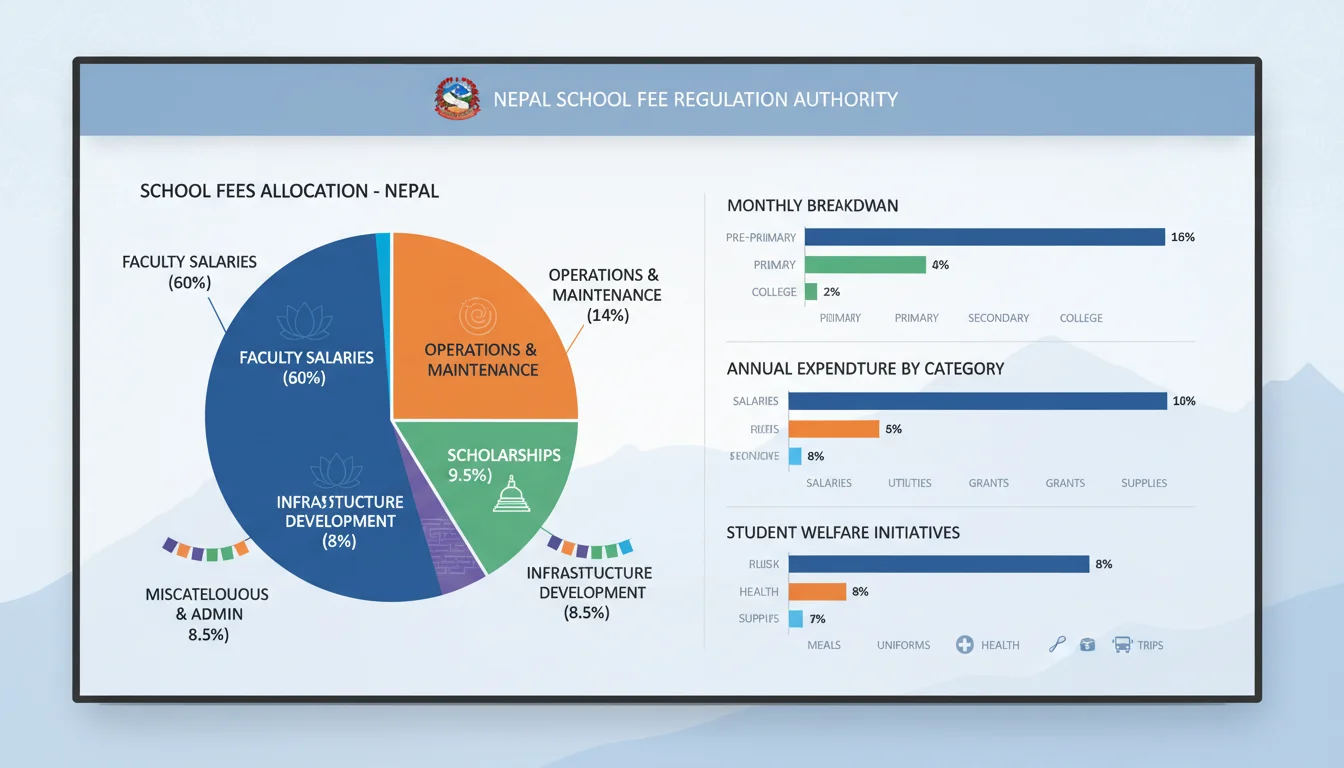
The directive mandates absolute transparency and requires schools to allocate their total operational budget across strictly defined financial brackets. A compliant school management ERP must feature an advanced accounting and fee management module capable of automatically distributing collected revenues into these predetermined categories:
- Faculty and Staff Compensation: 60% - Teacher and staff salaries, employment benefits, and personnel welfare.
- Financial Obligations and Operations: 14% - Facility rent, bank interest, loan repayments, and recurring financial obligations.
- Scholarships and Mandatory Contributions: 9.5% - Provision of student scholarships and mandatory educational sector contributions.
- Institutional Development and Returns: 9.5% - Long-term institutional development, infrastructure investment, and approved investment returns.
- Academic Development and Resources: 7% - Funding for laboratories, libraries, learning resources, and extracurricular physical assets.
Furthermore, the government explicitly restricts the categories under which fees can be collected to approved headings such as Monthly Tuition Fees (for teaching and staff salaries), Annual Fees (for sports and building maintenance), and one-time Admission Fees. Consequently, software lacking a highly granular, customizable chart of accounts places private institutions at severe regulatory risk. An ERP in Nepal cannot simply generate a generic invoice; it must algorithmically prove that the revenue generated aligns with the exact percentages dictated by the Directive, 2072.
Inland Revenue Department (IRD) Compliance and the Digital Service Tax
Beyond educational directives, fiscal compliance with the Inland Revenue Department (IRD) serves as a critical operational bottleneck for software viability. Advanced ERP systems operating in Nepal, such as InSchoolERP, explicitly anchor their market value on being “fully aligned with Inland Revenue Department (IRD) guidelines”. In practical software architecture terms, IRD compliance requires the ERP to maintain materialized views of fields specifically formatted for continuous synchronization with state revenue servers. The software must generate legally sound tax invoice templates, maintain duplicate invoice logs, and ensure immutable records of sales and purchase books. Crucially, the system must accommodate the native Nepali calendar (Bikram Sambat) within its core database architecture to ensure that fiscal year reporting seamlessly matches the Government of Nepal’s financial tracking timelines. Systems that fail to secure IRD certification for e-billing are fundamentally unviable for large-scale institutional operations.
Simultaneously, the software providers themselves are navigating a shifting tax landscape. The Digital Service Tax 2081 Procedure has instituted a broad, technology-agnostic approach to taxing digital services. Under this framework, a 2% Digital Service Tax (DST) is levied on digital services—including cloud computing, software updates, and mobile applications—delivered to Nepalese consumers if the provider’s annual gross transaction value exceeds NPR 3 million. A transaction is captured under this tax if the consumer is in Nepal, uses a Nepalese IP address, pays via a Nepali bank or payment service provider, or receives an invoice at a Nepali address. This procedure profoundly impacts the pricing models of foreign ERP providers (such as Indian platforms expanding into Kathmandu), as the compliance burden and taxation costs are inevitably integrated into the subscription fees charged to local schools.
Macro-Governance: EMIS Integration and Decentralized Management
At the macro-administrative level, the Government of Nepal, supported by international bodies such as the World Bank, UNICEF, and the Global Partnership for Education, relies heavily on the Integrated Educational Management Information System (IEMIS). Under the monumental shift initiated by the School Sector Development Plan (SSDP) and the subsequent School Education Sector Plan (SESP) 2022-2032, the governance, planning, and management of basic and secondary education have been decentralized to the municipal and local government levels.
This decentralization requires local municipalities to utilize IEMIS data for critical resource allocation, school grant management, and equity indexing. However, the utilization of IEMIS for local planning remains highly inconsistent due to severe capacity disparities, particularly in rural and disadvantaged regions, which undermines the national vision of data-driven service delivery. To bridge this gap, modern Nepalese school software platforms are increasingly expected to feature automated data export and validation modules that format institutional data to perfectly match the government’s IEMIS upload requirements. Providers like Digital Nepal explicitly engineer their platforms to support government EMIS reporting, aiming to alleviate the administrative burden on school principals who must otherwise manually aggregate this data.
The drive toward digital governance extends beyond mere enrollment tracking to the qualitative improvement of pedagogical delivery.
The “Coach Digital Nepal” initiative, launched in 2024 by the Government of Nepal in partnership with the World Bank, exemplifies this trend. This initiative deployed a mobile-based coaching platform to support ongoing teacher professional development nationwide, aligning directly with the priorities of the Center for Education and Human Resource Development (CEHRD). The system was meticulously designed for use in low-connectivity environments, featuring full offline functionality to allow coaches to record evidence of classroom practice and deliver real-time feedback across rural districts. This governmental push establishes a clear technological precedent: any private school management software hoping to achieve national scale in Nepal must possess robust offline-first capabilities.
Pedagogical Shifts and Curriculum Integration Architecture
A software platform is ultimately only as effective as its alignment with the prevailing pedagogical philosophy. Nepal has recently undergone a significant structural shift in foundational education, implementing an Integrated Curriculum for basic level grades (Grades 1-3). Moving away from isolated, rigid subject silos, the new curriculum framework focuses on four interdisciplinary thematic learning areas: Our Surroundings, English, Nepali, and Mathematics. Subjects that were previously distinct, such as science, health, physical education, and creative arts, are now organically integrated into these broader themes.
This paradigm shift forces a radical redesign of the traditional gradebook modules within school ERPs. Software that hardcodes traditional numeric, subject-specific grading matrices is rapidly becoming obsolete. Modern platforms must support Continuous Assessment Systems (CAS) that evaluate students based on qualitative rubrics and thematic milestones rather than discrete percentage scores. Providers like e-School have adapted to this reality, explicitly highlighting “Continuous Assessment & Rubrics” alongside “Customized Report Cards and Certificates” as core features in their standard tiers. Similarly, Digital Nepal incorporates Grade/CAS Management modules designed to interface directly with the Ministry of Education’s new reporting standards.
Core Functional Imperatives of Modern Nepalese School ERPs
Through an analysis of the features offered by the leading providers, a distinct “Nepalese Software Architecture” emerges. This architecture is defined not by generic global features, but by specific localized constraints and infrastructural realities.
Offline Capabilities and Infrastructural Resilience
Nepal’s topography—characterized by the Himalayas, deep valleys, and remote rural settlements—presents significant challenges to continuous internet connectivity. While elite urban schools in Kathmandu demand purely cloud-based solutions, institutions in semi-urban and rural municipalities require hybrid architectures. A critical competitive differentiator among local vendors is their approach to offline capabilities.
InPro School, operating out of Damauli, Tanahun, explicitly leverages its “Full offline sync” capability as a primary competitive advantage. The system is engineered so that its desktop application can function fully during extended internet blackouts, asynchronously synchronizing with central cloud servers once connectivity is restored. This contrasts with the market leader, Veda, which is noted in competitor analyses to offer only “Partial offline” functionality limited to specific features like attendance, homework, and schedules. The ability to maintain complete operational continuity without broadband is a vital survival mechanism for software in Nepal.
Localized FinTech Integration
The penetration of traditional international credit cards in Nepal is relatively low compared to the ubiquitous adoption of mobile digital wallets. Consequently, native integration with local payment gateways is a non-negotiable feature for school finance modules. Leading platforms, including InPro School, e-School, and Veda, advertise deep API integrations with dominant local providers such as eSewa, Khalti, and ConnectIPS. This integration enables parents to settle monthly tuition, transportation dues, and miscellaneous fines directly from their mobile devices, drastically reducing the physical security risks of cash-handling at the school finance office while eliminating manual reconciliation errors.
Hardware Ecosystems: Biometrics and Smart RFID
The digitalization of student physical presence has evolved far beyond manual roll-calls. Top-tier systems tightly integrate their software with physical hardware security. Providers like Paathshala EMIS and e-School rely heavily on biometric synchronization (such as ZKTeco devices) to track student and staff attendance.
Paathshala takes this hardware integration further through its implementation of multi-purpose Smart RFID Identity Cards. These cards act as the physical key to the entire software ecosystem, functioning as an automated tool for instant contactless attendance, secure access control to campus facilities, quick library book issuance, and even cashless digital payments at school canteens. By mapping the physical activity of the student directly to the digital ERP in real-time, the school creates an unbroken chain of custody and an automated data trail.

Human Capital and Asset Logistics
Managing a school involves complex human resource and logistical challenges that parallel corporate enterprise management. Nepalese ERPs have expanded to include comprehensive HR and asset tracking. For example, systems like e-School provide “Payroll Management with GON (Government of Nepal) Rules,” ensuring that tax deductions and leave management align with federal employment law.
On the asset side, schools must manage significant capital, from IT equipment to physical library volumes. While international platforms like Frontline ERP specialize heavily in 1:1 distribution models for K-12 IT asset management (tracking devices down to specific room numbers via digital audits), local platforms like Digital Nepal and e-School natively incorporate barcode-driven library management and inventory modules. This simplifies the tracking of borrowed resources and automates the billing of late fees directly to the student’s central financial account.
Transportation Tracking
Managing fleets of school buses navigating the notoriously congested traffic of cities like Kathmandu requires precise logistical oversight. Paathshala EMIS, Veda, e-School, and Dynamic ERP all feature integrated vehicle tracking and transportation management systems. Veda allows parents to track bus attendance directly from their mobile app, receiving instant push notifications if a student misses the bus. Crucially, this logistical data ties directly into the billing engine, allowing schools to execute “Transportation & Route Wises Fee Management,” automating the complex task of charging different rates based on exact student geographical zones.
Comprehensive Vendor Profiling: The Ecosystem Contenders
The Nepalese school software market is a highly contested arena, featuring dominant indigenous market leaders, aggressive freemium disruptors, highly localized regional challengers, and imported foreign solutions seeking cross-border expansion.
Veda (Ingrails Pvt. Ltd.)
Veda stands as the undisputed market leader in the Nepalese EdTech sector. Conceptualized by Ingrails Pvt. Ltd., the platform boasts an expansive client base of over 1,300 schools, colleges, and pre-schools across 45 cities, serving prestigious institutions such as Rato Bangla School, St. Xavier’s School, and Malpi International School. Veda represents a holistic ecosystem approach to institutional management.
Architectural Capabilities:
Veda’s product suite is highly modular, encompassing Veda Academics, Veda Billing, Veda Finance, Veda Inventory, Veda Attendance, and specialized mobile applications for students, parents, and school founders. The platform solidified its market dominance during the COVID-19 pandemic by providing highly robust e-learning tools, successfully integrating Zoom for online classes, deploying automated attendance tracking, and facilitating subjective and objective examinations with advanced annotation features.
Administratively, Veda’s billing engine is exceptionally sophisticated, allowing for the creation of complex fee group structures. Administrators can define “Monthly Fees,” “Additional Fees,” and “Yearly Fees,” leveraging an “is recurring” logic toggle that automatically populates student invoices based on whether a fee (like tuition) repeats monthly, or (like an ID card) is a one-time charge.
Market Positioning:
While Veda is the industry standard, competitor analyses highlight potential vulnerabilities, notably its reliance on partial offline capabilities and the lack of explicit Service Level Agreement (SLA) response times compared to smaller, more agile competitors.
Paathshala EMIS
Paathshala EMIS represents the most disruptive economic force currently operating within the Nepalese market.
With over 14 years of operational experience and a client base exceeding 1,200 institutions, Paathshala has effectively inverted the traditional Software-as-a-Service (SaaS) business model through a brilliant localized strategy.
The “Freemium Hardware Lock-In” Strategy:
Paathshala provides its entire comprehensive software package—including professional software installation, annual cloud hosting, mobile applications for all stakeholders, a customized school website, real-time GPS vehicle tracking, and even physical ZKTeco biometric attendance machines—absolutely free of charge.
The monetization mechanism is entirely reliant on the mandatory purchase of its Smart RFID Student ID Cards. Because these physical cards act as the operational key to the entire digital ecosystem (powering attendance, library issuance, and digital payments), the institution transfers the operational expenditure of the software directly to the students via standard annual ID card fees. This strategy aggressively eliminates the primary barrier to entry for underfunded Nepalese schools—high upfront software licensing and recurring server costs—ensuring rapid, widespread adoption and creating massive switching costs that guarantee long-term client retention.
3. Digital Nepal (Digital School)
Digital Nepal positions itself as a highly secure, technologically robust, and government-compliant institutional tool. Operating as an ISO 9001:2015 certified entity, the company emphasizes data security through end-to-end encryption and a centralized Java-based architecture.
Architectural Capabilities:
Digital Nepal is explicitly tailored to interface seamlessly with government mandates, supporting automated EMIS reporting, CAS grading, and MoEST-compliant lesson planning. Its module density is immense, covering granular operational details such as leave application approvals, daily lesson plan syllabi, hostel management, bank transaction logging, and reception desk management. It provides a comprehensive mobile application ecosystem for founders, teachers, parents, students, and even transport drivers.
4. e-School (e-Zone International)
e-School takes a granular, highly structured approach to SaaS pricing, mirroring the tiered feature scaling seen in global enterprise software. It targets institutions that prefer a predictable, linear scaling of capabilities as their student body grows.
Feature Scaling and Capabilities:
- Quick Start Tier: Focuses on the bare essentials—basic student information, timetables, online homework assignment, and standard grade books.
- Lite Tier: Introduces vital communication and financial tools, including SMS integration, fee collection, eSewa/Khalti online payments, and biometric staff synchronization.
- Standard Tier: Upgrades the system to a full educational ERP, adding transportation route management, a comprehensive Learning Management System (LMS), customized report cards, and library barcode tracking.
- Enterprise Tier: Geared toward massive institutions, offering GoN-compliant payroll, Azure private cloud hosting, online admission CRM, and complex budget tracking controls.
5. InPro School
Operating regionally out of Damauli, Tanahun, InPro School markets itself as the technologically superior alternative for regions requiring high operational resilience and rapid support.
Competitive Differentiators:
InPro School aggressively contrasts itself against market leaders by emphasizing deep international compliance, holding ISO/IEC 27001 certification and GDPR compliance alongside strict adherence to Nepal Data Privacy laws. Its primary technological advantage is its “Full offline sync” capability, ensuring zero data loss and continuous operation during power and broadband blackouts. Furthermore, InPro offers highly aggressive service level agreements, promising deployment in under 24 hours and technical support response times of less than 2 hours, presenting itself as a highly agile, customer-centric alternative.
6. Vedmarg ERP
Vedmarg is a prominent Indian educational ERP that has aggressively targeted the Kathmandu market, leveraging its scale to offer profound module density at disruptive price points. Trusted by over 980 organizations, Vedmarg provides a suite of over 80 powerful modules.
Market Positioning:
The system covers immense ground, from day-book accounting and fee defaulter tracking to the automated generation of unlimited types of certificates and ID cards. Vedmarg competes primarily on extreme affordability and value density. By offering a comprehensive Pro Plan at roughly ₹12,999 annually and an Enterprise customized solution at ₹19,999 annually, Vedmarg’s flat-fee pricing severely undercuts the per-student SaaS models favored by some local competitors. The primary hurdle for such foreign entities remains navigating Nepal’s Digital Service Tax and ensuring localized adaptations such as Bikram Sambat calendar integration.
7. InSchoolERP
InSchoolERP focuses its value proposition heavily on higher-tier governmental compliance and modular flexibility. It distinguishes itself by being seamlessly integrated with University Grants Commission (UGC) standards, making it highly suitable for higher secondary schools, technical colleges, and universities, rather than just basic K-12 institutions. As previously analyzed, its strict algorithmic adherence to Inland Revenue Department (IRD) taxation logic forms the bedrock of its financial modules.
8. Pathami ERP
Addressing the profound socioeconomic disparities in the Nepalese educational sector, Pathami ERP targets the absolute base of the economic pyramid. Pathami provides a 100% free ERP solution with zero license fees for essential features. By offering core operational modules—including admission management, student fee billing, examination management, and staff role assignment—at absolutely no cost, Pathami provides a critical digitization lifeline for rural, underfunded public schools that cannot participate in Paathshala’s RFID hardware model or afford subscription-based cloud platforms.
9. Smart School (Code Logic Technologies)
Developed by Code Logic Technologies, Smart School boasts a user base exceeding 6,000 and focuses heavily on iOS/Android mobility and parental engagement. The platform acts as a “Centralized Communication Hub,” intentionally designed to eliminate the fragmentation of multiple messaging apps. A unique aspect of its market positioning is its appeal to the Nepalese diaspora; the app explicitly advertises the ability for parents working abroad to monitor fee structures, track payment history, and maintain real-time access to attendance records and exam results, bridging the geographical gap through digital transparency.
10. Emerging Competitors: eAcademy Nepal and Dynamic ERP
Competitor analysis reports reveal a vibrant secondary market. Dynamic ERP differentiates itself by focusing heavily on deep corporate ERP features like GPS logistics, HR, and payroll integration. Meanwhile, eAcademy Nepal represents the bleeding edge of the market, positioning its comprehensive modules as explicitly “AI-driven,” indicating a forward-looking technological trajectory toward automation and predictive analytics. SchoolPro, by Digi Technology, highlights its CCE-based (Continuous and Comprehensive Evaluation) examination module, aligning closely with modern pedagogical rubrics.
Exhaustive Economic Analysis of Pricing Models
The pricing models deployed by these software vendors are not merely financial details; they reflect fundamentally different philosophies regarding software valuation, institutional psychology, and the balance between capital expenditure (CAPEX) and operational expenditure (OPEX). The market is broadly divided into four distinct economic models:
| Pricing Model Classification | Economic Mechanism | Key Proponents | Strategic Implications for Schools |
|---|---|---|---|
| Flat-Fee Annual Licensing | A set recurring price regardless of the size of the student population. | CodePex (NPR 1,65,000), Vedmarg (₹12,000) | Highly beneficial for large, rapidly growing institutions. Provides excellent revenue predictability, as the average cost per student drops as enrollment scales. |
| Per-Student Subscription | Variable monthly or annual pricing scaled directly to the active user count. | e-School ($1-$3/month/student), Veda (Starting at $500 minimum) | Presents a very low barrier to entry for small academies. However, it acts as a “success penalty” as schools grow, rapidly extracting capital from expanding institutions. |
| One-Time Perpetual License | A single upfront capital expenditure for lifetime access, usually supplemented by minor annual maintenance fees. | Digital Nepal ($278 starting price) | Deeply appeals to traditional Nepalese business psychology, which strongly prefers owning capital assets over perpetual renting. Carries a risk of stagnant updates. |
| Hardware-Tethered Freemium | The software ecosystem is provided entirely free; recurring revenue is extracted exclusively via mandatory proprietary hardware purchases. | Paathshala EMIS (Free software, Paid Smart RFID Cards) | A masterclass in local market fit. It shifts the severe cost burden from the institution’s overhead directly to the parent/student via standard ID card fees, virtually guaranteeing mass adoption. |
The long-term mathematical reality of these differing models is stark.
A structural projection provided by CodePex illustrates the financial divergence between Per-Student models and Flat-Fee models over a four-year period for a growing institution.
Four-Year ERP Cost Projection (Scaling from 750 to 1,050 Students)
| Academic Year | Student Count | Traditional Per-Student Model (Estimated @ ₹300/student) | CodePex Flat-Fee Model |
|---|---|---|---|
| 2026-27 | 750 | ₹3,00,000 (Includes ₹75,000 setup fee) | ₹1,65,000 (Zero setup fee) |
| 2027-28 | 850 (+100) | ₹2,55,000 | ₹1,65,000 |
| 2028-29 | 950 (+100) | ₹2,85,000 | ₹1,65,000 |
| 2029-30 | 1,050 (+100) | ₹3,15,000 | ₹1,65,000 |
This projection highlights how per-user SaaS models, while appearing cheap initially, compound exponentially. Conversely, flat-fee models and hardware-tethered freemium models offer institutions highly predictable, easily manageable overhead costs, a critical factor for schools operating on the tight margins mandated by the 2072 Fee Directive.
Furthermore, implementation and consulting costs can severely inflate initial procurement budgets. For instance, e-School charges a professional implementation fee calculated as an additional 1/3 of the total agreed amount, with senior consultant fees running at $100 per day. Advanced support SLAs (Gold, Platinum) add 50% to 100% surcharges on regular support fees, turning a seemingly inexpensive per-student software into a major capital project.
Sociological Friction, Grassroots Sentiment, and Market Barriers
While the macro-level view of the Nepalese EdTech sector demonstrates rapid innovation and widespread adoption, an analysis of grassroots socio-educational sentiment—particularly visible in raw, unfiltered forums such as Reddit—reveals deep structural friction between the technical capabilities of the software and the harsh realities of the prevailing educational culture.
The Innovation Paradox and the “Nepali Veda Loop”
There exists a profound, almost cynical disconnect between the advanced capabilities of systems like Veda (which offer continuous performance analytics, interactive learning materials, and detailed progress tracking) and the deeply entrenched culture of rote learning prevalent in Nepal. Students report that despite the digital overlay of modern mobile apps, the core educational standard remains archaic.
In university and higher-secondary settings, success still relies heavily on memorizing standard pages of notes available at local stationery shops, rather than utilizing the software’s collaborative or practical tracking features. The phrase “Nepali Veda Loop,” coined by students, encapsulates a deep frustration that the digitization of education has merely digitized the existing bureaucracy, failing to fundamentally reform the pedagogical approach toward problem-solving, critical thinking, and real-world practical knowledge. The software meticulously tracks grades, but the grades themselves are derived from an educational system that students view as fundamentally flawed and geared toward political networking rather than academic excellence.
Monopolistic Moats and Developer Demotivation
The overwhelming market dominance established by platform giants like Veda, Paathshala, and Digital Nepal has created highly fortified monopolistic moats that actively discourage indigenous indie software startups. Independent developers cite severe demotivation when attempting to architect new school applications, noting that the incumbent platforms already offer highly stable, feature-dense ecosystems. The switching costs for a school to migrate its complex historical data, retrain its staff, and re-onboard thousands of parents to a new application are immensely high, virtually locking out new entrants unless they can offer a radically disruptive pricing model (like Paathshala’s RFID strategy) or target a highly specific, underserved niche (like InPro School’s full offline functionality in rural areas).
The Resistance to E-Learning Monetization
Platforms attempting to expand their business models beyond institutional ERP B2B licensing into direct-to-consumer (B2C) online courses face significant cultural and economic resistance. The Nepalese market exhibits a profound reluctance to invest capital in paid online learning platforms. Industry surveys suggest that 40-60% of potential Nepalese learners are highly reluctant to purchase paid courses because they directly compare the local offerings against the vast, high-quality, and entirely free educational resources available globally on platforms like YouTube.
For an EdTech platform to successfully monetize e-learning content in Nepal, it cannot simply offer generic video lectures. It must provide tangible, un-replicable local value, such as direct pathways to local internships, accredited certifications recognized by the MoEST, or highly localized corporate networking opportunities that free international platforms cannot replicate.
Strategic Projections and the Future of Nepalese EdTech
The trajectory of the School Management Software market in Nepal is clear, pointing toward deeper integration, heightened automation, and stricter regulatory compliance. Based on current technological vectors and market dynamics, several strategic projections can be formulated regarding the future of this ecosystem.
-
The Extinction of Isolated Analog Systems
The era of localized, offline-only, desktop-bound software (such as legacy Visual Basic applications or complex Excel-macro systems) is definitively concluding. The societal demand for real-time parental communication via native iOS and Android applications, combined with the government’s strict requirement for automated EMIS data compliance and IRD-audited tax billing, dictates that all viable future systems must be inherently cloud-native. However, recognizing Nepal’s geographic constraints, the most successful platforms will be those that master asynchronous, hybrid-offline synchronization, ensuring that rural schools are not penalized for infrastructural deficits.
-
Deep Convergence of FinTech and EdTech
The integration of Nepalese FinTech infrastructure (eSewa, Khalti, ConnectIPS, fonePay) into EdTech billing modules is currently the most significant driver of administrative efficiency. Moving forward, it is highly probable that software providers will deepen these financial integrations. This convergence could soon encompass integrated digital lending options for parents struggling with tuition fees, automated micro-insurance policies for students dynamically tied to their enrollment status, and the implementation of automated recurring billing mandates processed directly through the national banking switch, entirely eliminating manual fee collection.
-
The Advent of Predictive Artificial Intelligence
While currently nascent within the Nepalese market, competitor analysis reports highlighting platforms like eAcademy Nepal as “AI-driven” signal the next major technological evolution. The future of Nepalese school ERPs will involve a shift from passive data recording to active predictive analytics. By leveraging historical grading trends, attendance patterns, and behavioral logs, AI algorithms will be able to automatically identify students statistically at risk of failing or dropping out, allowing educators to deploy early pedagogical interventions. Furthermore, AI tools will be crucial in automating the complex generation of qualitative CAS rubrics required by the MoEST’s Grades 1-3 Integrated Curriculum, relieving teachers of an immense and highly subjective administrative burden.
-
The Proliferation of Hardware-as-a-Service Lock-In
Paathshala EMIS’s model of providing extensive free software subsidized entirely by the sale of proprietary Smart RFID cards represents the most economically formidable business model currently operating in the country. Because the RFID card is intrinsically tied to physical campus security, biometric attendance, and digital canteen payments, the switching cost for an institution is practically insurmountable—abandoning the software requires replacing the physical ID cards of every student and potentially overhauling the biometric hardware infrastructure itself. Competing software firms will likely study and attempt to replicate this “hardware-as-a-service” lock-in model to secure long-term, unshakeable client retention.
Conclusion
The market for School Management Software in Nepal has rapidly and decisively matured from a fragmented ecosystem of basic digital ledgers into a highly sophisticated, compliance-driven, and intensely competitive industry. The leading platforms—whether they are comprehensive ecosystem giants like Veda, ingenious freemium hardware disruptors like Paathshala EMIS, government-aligned fortresses like Digital Nepal, or agile, offline-capable regional challengers like InPro School—have engineered complex software architectures that specifically cater to the unique topographical, financial, and regulatory realities of the Nepalese state.
For educational institutions navigating this complex procurement landscape, the selection of an ERP system can no longer be based on superficial feature checklists or basic aesthetic preferences. It requires a profound strategic alignment with the school’s long-term financial philosophy, demanding a thorough evaluation of the long-term mathematical realities of OPEX-heavy per-student subscriptions versus CAPEX-heavy flat-fee licenses. It requires an honest assessment of local infrastructural limitations, necessitating robust hybrid-offline synchronization capabilities.
Most critically, it requires absolute assurance of rigid regulatory compliance regarding Inland Revenue Department tax billing procedures and Ministry of Education IEMIS reporting mandates. Furthermore, software providers and educational stakeholders alike must recognize a fundamental sociological truth: while these platforms have successfully digitized administrative workflows and bureaucratic accounting, the broader challenge of genuine pedagogical transformation remains largely unaddressed. To fully realize the transformative promise of EdTech in Nepal, these software ecosystems must strive to bridge the gap between mere administrative efficiency and actual academic enhancement. They must help guide the nation past the entrenched culture of rote memorization, fostering a new era of data-driven, interactive, and critically engaged learning. As the federalization of the nation deepens and the Government of Nepal enforces ever-stricter fiscal and educational standards across its municipalities, the school ERP is transitioning from a convenient tool for administrators into the very foundational digital infrastructure upon which Nepal’s educational future will be built.