Indian Furniture Digital Marketing: Market Trends & Growth
Industry Overview
The Indian furniture industry is currently undergoing a profound and rapid structural transformation, evolving from a highly fragmented, geographically localized market dominated by unorganized carpenters into a consolidated, globally integrated, and technologically advanced sector. This metamorphosis is fundamentally driven by a confluence of macroeconomic and demographic factors, including rapid urbanization, the continuous expansion of middle-class demographics, rising disposable incomes, and significant government investments in residential and commercial infrastructure. Historically characterized by neighborhood stores and independent artisans, the market is now increasingly dominated by organized retail chains, specialty franchise stores, and digital-first e-commerce platforms. This shift is altering how furniture is manufactured, marketed, and consumed across the subcontinent, necessitating highly sophisticated digital strategies for businesses aiming to capture and retain modern consumer demand.
The current market size, ongoing expansion, and projected growth of the Indian furniture sector indicate an exceptionally lucrative commercial landscape. Estimates for the base year 2024 value the domestic market between $22 billion and $27.25 billion, positioning India as the fourth-largest furniture market globally and the second-largest in the Asia-Pacific region, trailing only China. By 2025, the market is expected to reach an estimated valuation ranging from $25.38 billion to $30.6 billion. Long-term forecasts are overwhelmingly optimistic; projections for the period between 2031 and 2034 suggest the market could expand to anywhere between $44.30 billion and $72.11 billion. This trajectory is driven by compound annual growth rates (CAGR) ranging from 6.38% to a robust 11.4%, depending on the specific analytical model.
- Estimated Market Value: $22.00 Billion - $27.25 Billion
- Base Year Market Value: $25.38 Billion - $30.60 Billion
- Projected Market Value: $44.30 Billion - $72.11 Billion
- Compound Annual Growth Rate (CAGR): 6.38% - 11.4%
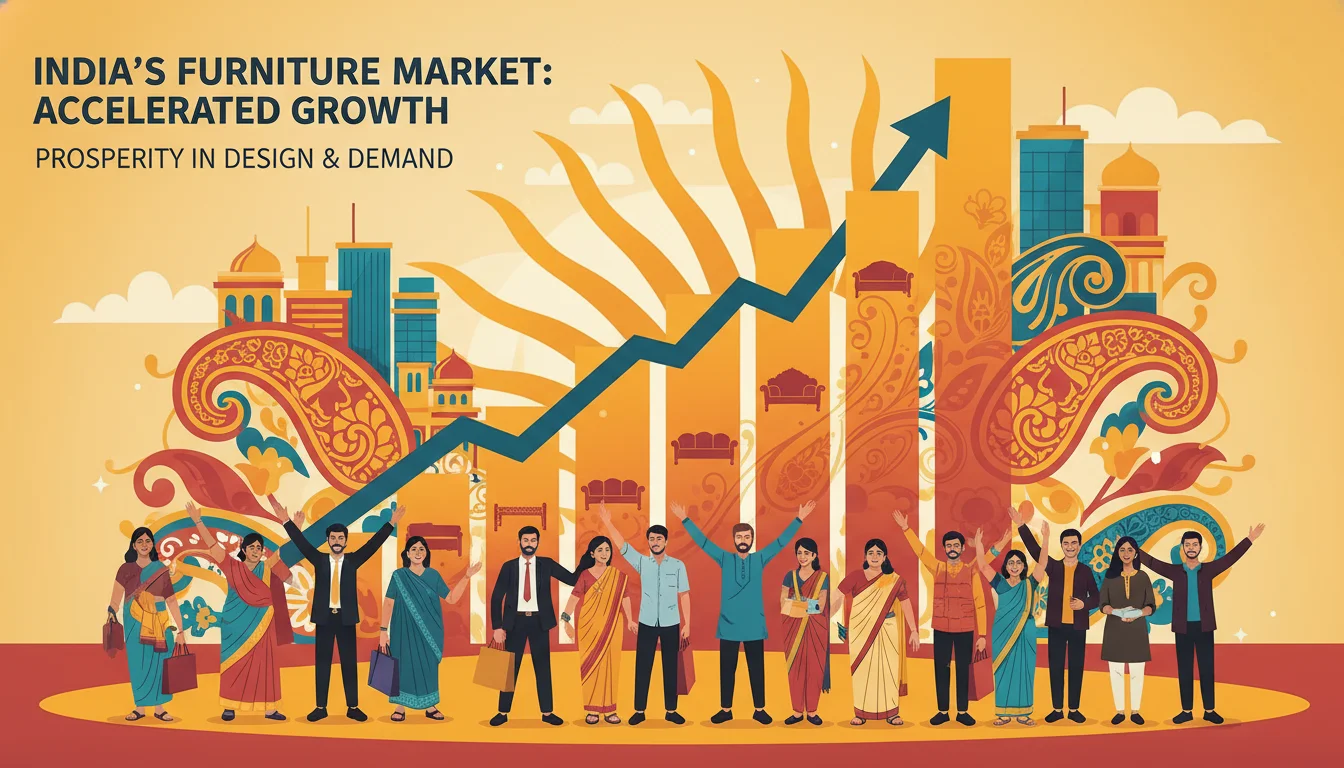
Material preferences within the Indian market exhibit a heavy and enduring bias toward wood, which commands a dominant 57.35% to 59.8% share of the overall market in 2025. This preference is deeply rooted in cultural significance, aesthetic versatility, and the widespread domestic availability of conventional solid woods—such as Sheesham and Teak, sourced heavily from manufacturing hubs like Saharanpur and Jodhpur—as well as cost-effective engineered alternatives. The residential end-use sector represents the largest consumer segment, capturing approximately 70.6% of the market share. This dominance is propelled by rising homeownership, investments in home interiors, and a cultural affinity for well-furnished living spaces. Conversely, the office furniture segment, while currently smaller, is recording the fastest growth at an estimated 11.65% CAGR through 2031, fueled by the stabilization of hybrid work models, massive corporate institutional procurement, and the expansion of IT infrastructure.

From a regional perspective, North India dominates the geographic landscape, accounting for an estimated 33.2% to 42.1% share of national consumption. This is heavily influenced by expansive real estate development, high consumer purchasing power, and rapid urbanization in the Delhi-NCR region, Noida, Chandigarh, and Gurugram. Concurrently, South India and West India are experiencing rapid growth, capturing significant market shares driven by the expansion of commercial infrastructure and urban population growth in metropolitan centers such as Bengaluru, Hyderabad, Chennai, Mumbai, Ahmedabad, and Pune. Beyond domestic consumption, India has also emerged as a growing export powerhouse. The country exported furniture worth approximately $2.9 billion in FY 2023, with major destinations including the United States, Germany, and the United Kingdom, indicating a global appetite for Indian craftsmanship and traditional carved furniture.
Despite this robust macroeconomic growth, furniture businesses in India face severe, systemic operational challenges that threaten profit margins and scalability. A primary constraint is the volatility and availability of raw materials. The industry suffers from inadequate domestic availability of certified wood, forcing a reliance on imports. However, high import duties on raw materials, including timber and premium fabrics, significantly compress profit margins and lower global export competitiveness. Furthermore, the industry grapples with cumbersome regulatory environments and infrastructural deficits. These include manual compliance processes, delays in customs clearance, and a lack of a cohesive national furniture policy that unifies regulations across forestry, metals, and textiles. Environmental and quality standards also present a looming hurdle; there is a severe lack of testing infrastructure for formaldehyde emissions (E0 standards), and the impending implementation of the Bureau of Indian Standards (BIS) Furniture Quality Control Order (QCO), effective in 2026, will mandate ISI certification for key product categories. This regulation will drastically raise quality and compliance thresholds, likely forcing many unorganized players out of the market and accelerating industry consolidation. Compounding these systemic issues is intense competition and supply chain fragility. While the organized sector is growing, highly fragmented unorganized players continue to dominate regional pockets, leading to extreme consumer price sensitivity and challenging established brands to differentiate themselves through superior design, digital presence, and seamless omnichannel customer experiences.
Digital Landscape in India (Contextual to the Industry)
The digital landscape in India has fundamentally restructured consumer behavior, creating a paradigm where digital discovery invariably precedes physical purchase. The widespread proliferation of affordable smartphones and high-speed internet has democratized access to global interior design inspiration, previously restricted to metropolitan elites. Consequently, the customer journey for furniture—a high-ticket, highly tactile product category—has evolved into a complex, non-linear omnichannel experience. Consumers no longer rely solely on physical showroom visits to initiate their buying journey. Instead, they conduct exhaustive online research, compare material specifications across multiple e-commerce platforms, consume visual lifestyle content on social media, and scrutinize peer reviews before making a purchasing decision.
The post-pandemic era significantly catalyzed this digital adoption within the furniture sector. Confinement to residences spurred a profound interest in home upgrades, transitioning furniture from a purely functional necessity into a bold statement of individuality, comfort, and psychological well-being. Search engine trends indicate a growing consumer demand for seamless digital experiences and instant gratification. Google Trends data reveals a staggering 215% surge in search interest for “instant delivery” across Indian retail sectors between 2021 and 2022, indicating that consumers increasingly expect rapid fulfillment and transparent logistics, even for bulky and logistically complex items like furniture. Furthermore, there is a pronounced fusion of nostalgia and modern aspiration in consumer search behavior. Global search data from 2024 revealed a 320% spike in aesthetic trends like “Coastal Granddaughter,” reflecting a broader cultural embrace of slow living, mindfulness, and minimalist aesthetics propagated on visual platforms. Concurrently, surges in searches for AI optimization tools indicate a consumer base that balances a longing for traditional comfort with a desire for cutting-edge technological integration.
Social media platforms serve as the primary inspirational engines and top-of-funnel acquisition channels for furniture discovery in India. Instagram and Pinterest are highly influential, operating as immersive digital catalogs where consumers curate design ideas, explore color palettes, and discover emerging direct-to-consumer brands. The highly visual nature of these platforms aligns perfectly with the aesthetic demands of furniture marketing, allowing brands to showcase product placements in aspirational, fully styled living spaces rather than against sterile white backgrounds. YouTube is equally critical, functioning as an educational hub where consumers seek detailed product reviews, modular assembly tutorials, and comprehensive home tour videos. Video content is essential for demonstrating the functionality of space-saving furniture, which is in high demand among urban populations living in compact apartments.
Furthermore, WhatsApp has emerged as an indispensable communication and commerce channel in the Indian retail ecosystem. With a massive, highly engaged user base, WhatsApp Business allows furniture retailers to bridge the gap between digital convenience and the need for high-touch, personalized customer service. Brands utilize the platform to share interactive product catalogs, conduct virtual showroom consultations via video call, send automated transactional updates (such as order confirmations and delivery tracking), and resolve customer service queries in real-time. This direct line of communication is vital in a high-involvement category where trust and transparency are paramount.
The democratization of e-commerce has also reshaped regional demand dynamics.
Digital channels have enabled consumers in Tier 2 and Tier 3 cities to access diverse, premium furniture options that were previously available only in major metropolitan markets, thereby expanding the addressable market for organized brands. However, the inability to physically interact with the furniture—to test the firmness of a sofa or the finish of a dining table—remains a significant psychological barrier to online conversion. To mitigate this, advanced digital technologies such as Augmented Reality (AR) and Virtual Reality (VR) are being rapidly integrated into the digital landscape. AR applications allow consumers to visualize precisely how a specific piece of furniture will look and fit in their exact living space using their smartphone cameras. This immersive technology drastically reduces purchase anxiety, improves confidence, and significantly lowers costly return rates. The modern Indian furniture consumer demands a seamless integration of aesthetic digital inspiration, interactive technological visualization, and highly efficient physical fulfillment.
Digital Marketing Opportunities
Digital marketing provides powerful, highly measurable mechanisms to circumvent the traditional operational and geographic challenges faced by the Indian furniture industry. By leveraging data-driven strategies, manufacturers, exporters, and retailers can expand their geographic reach without the prohibitive capital expenditure required to establish physical showrooms in every target city. Digital channels allow for precise audience segmentation, enabling brands to target specific demographic and psychographic profiles—such as young IT professionals seeking modular apartment furniture in Bengaluru, or affluent homeowners looking for premium solid wood pieces in Delhi—thereby optimizing customer acquisition costs and maximizing return on marketing investment.
Search Engine Optimization (SEO)
Search Engine Optimization (SEO) represents the foundational pillar of digital marketing for furniture brands. Because the consumer journey almost universally begins with a search query, ranking prominently for high-intent keywords is critical for capturing market share. Local SEO is particularly powerful for businesses operating physical showrooms. By rigorously optimizing Google Business Profiles, furniture stores can dominate “near me” searches, driving highly qualified, ready-to-buy foot traffic directly to their retail locations. Advanced technical SEO ensures that extensive e-commerce catalogs are easily crawled, indexed, and understood by search engines. This allows individual product pages to rank for specific, highly profitable long-tail queries, such as “ergonomic office chair for sciatica pain” or “teak wood space-saving dining table online”.
Social media advertising and organic content creation
Social media advertising and organic content creation offer unparalleled opportunities for visual storytelling and brand building. Platforms like Instagram, Facebook, and Pinterest allow brands to move beyond static product imagery to dynamic, engaging lifestyle content. Short-form video formats, such as Instagram Reels and YouTube Shorts, are highly effective for demonstrating the functionality of modular furniture, showcasing the meticulous craftsmanship behind solid wood pieces, or presenting rapid, visually satisfying room transformations. Furthermore, advanced advertising ecosystems, such as Performance Max campaigns utilizing Google’s AI-driven algorithms, allow furniture brands to automate and optimize ad placements across Search, Display, YouTube, and Gmail simultaneously. This ensures the brand remains visible across the entire digital ecosystem, capturing consumer intent wherever it manifests.
Influencer marketing
Influencer marketing has matured into a vital channel for establishing brand trust, social proof, and aesthetic credibility. Collaborating with prominent home decor, architecture, and interior design influencers in India—such as Sonika Khurana Sethi, Ridhi Khosla Jalan, Grishma Shah, Mohammad Salman, and Utsav Kamboj—allows furniture brands to tap into highly engaged, niche audiences. These influencers provide authentic social proof by integrating the brand’s furniture into their own homes or professional design projects. Their endorsements resonate far more deeply than traditional corporate advertising, offering followers practical design hacks, layout ideas, and material usage suggestions. This strategy is particularly effective for launching new collections, building brand prestige, or demonstrating the versatility of specific furniture lines in real-world settings.
Real-world case studies
Real-world case studies demonstrate the profound, measurable impact of these digital strategies within the furniture sector. For instance, a local Bengaluru-based furniture manufacturer specializing in premium recliners and sofas successfully transformed its limited market presence into a pan-India operation by strategically launching on Amazon. By utilizing extensive market research, comprehensive listing optimization with high-quality creatives, and robust SEO-rich copy, the brand achieved ₹1 crore in sales within just eight months of launch, effectively bypassing traditional geographic limitations. Similarly, Royal Oak, a leading Indian furniture brand, significantly scaled its business by leveraging Google Shopping integrations through Adobe Commerce, allowing them to showcase visual product ads directly in search results, thereby capturing high-intent shoppers both locally and across their 10-country export network.
On a localized level, traditional manufacturers are achieving breakthroughs by modernizing their marketing tech stacks. In Mumbai, a manufacturer integrated VR showrooms alongside advanced technical SEO practices, resulting in a dramatic increase in conversion rates by allowing customers to virtually experience products before purchasing. In Jaipur, a traditional furniture brand modernized its approach by launching an exclusive e-commerce portal coupled with retargeting ads, resulting in higher profit margins and stronger direct-to-consumer ties. Globally, digital interventions show similar efficacy; Casa Bella Furniture in the UK achieved a remarkable 60% year-over-year growth and a 42% increase in transactions by deploying a combined approach of Google Shopping, Text Advertising, Display, and Remarketing. These examples underscore that targeted digital interventions, when executed correctly, directly correlate with exponential revenue growth and market expansion.
Competitive Analysis
The digital competitive landscape of the Indian furniture market is fiercely contested, characterized by a dynamic mix of established global retail giants, agile digital-first direct-to-consumer startups, and legacy domestic manufacturers rapidly transitioning to omnichannel models. A comprehensive competitive analysis reveals distinct strategic advantages, massive traffic volumes, and notable operational vulnerabilities among the top market players.
| Competitor | Business Model & Presence | Monthly Digital Traffic (Estimated) | Key Digital Strengths |
|---|---|---|---|
| Pepperfry | Online Marketplace / Omnichannel | 1.85 Million Visits | Massive catalog variety, aggressive digital performance marketing, widespread brand recognition. |
| WoodenStreet | Direct-to-Consumer / Omnichannel | 1.41 Million Visits | Customization options, extensive network of 100+ experience stores, strong organic SEO content, in-house interior design services. |
| Home Centre | Omnichannel Retail | 1.06 Million Visits | Strong physical mall presence integrated with digital loyalty programs, broad home decor ecosystem. |
| Urban Ladder | Premium Online Retail | ~783,000 Visits | Minimalist urban design aesthetics, curated digital catalog, strong initial brand positioning among upper-middle-class buyers. |
| IKEA India | Global Retailer / Expanding Digital | 194 Million (Global) | Unmatched affordability, iconic global brand equity, advanced AR app capabilities, massive experiential megastores. |
| Godrej Interio | Legacy Manufacturer / Omnichannel | Unlisted (Revenue: $1.9B) | Deeply trusted legacy brand, dominance in B2B and institutional office furniture, focus on ergonomics. |
What the Top Players are Doing Well:
WoodenStreet has masterfully executed an omnichannel strategy that directly addresses the Indian consumer’s need for tactile reassurance. By combining a highly functional e-commerce platform with over 100 physical “experience stores” across 23 cities, they successfully bridge the gap between digital convenience and physical verification. Their digital presence is bolstered by an exceptionally strong content marketing strategy, including detailed buying guides, interior design trend alerts, and extensive YouTube tutorials that capture high volumes of informational search intent. Furthermore, they offer full home interior design services, positioning themselves as a comprehensive lifestyle solution rather than a mere commodity vendor.
IKEA leverages its colossal global brand equity to dominate the affordability and contemporary design segments. Their entry into India was highly anticipated, evidenced by the 40,000 shoppers who arrived on the opening day of their Hyderabad megastore. IKEA utilizes highly sophisticated digital marketing campaigns characterized by emotional storytelling, humor, and interactive AR tools that allow consumers to place virtual furniture in their homes, reducing friction in the buying process.
Pepperfry, functioning primarily as a vast marketplace model, offers immense variety across all price points.
Gaps and Opportunities to Outperform Them:
Despite their massive traffic volumes and ubiquitous brand visibility, the leading furniture giants suffer from severe operational and customer service deficiencies that present highly lucrative opportunities for agile, customer-centric competitors. An analysis of independent consumer review platforms, such as Trustpilot, reveals systemic pain points. Customers frequently report abhorrent after-sales service, significant delivery delays with zero proactive communication, unresponsive customer support, and the delivery of damaged or defective products by major brands like Pepperfry and Urban Ladder. The sheer scale of these marketplace models often leads to a severe disconnect in quality control and last-mile logistics, eroding customer trust.
Furthermore, digital analytics indicate potential vulnerabilities in user engagement and website experience. For instance, Pepperfry experiences a strikingly high bounce rate of 73.74%, suggesting that while their advertising successfully drives initial clicks, the website architecture, product relevance, or aggressive pop-up strategies fail to retain a significant majority of visitors.
Emerging brands and local manufacturers can exploit these massive gaps by implementing a hyper-focused, customer-first digital strategy. First, by prioritizing Local SEO and localized digital marketing, smaller brands can dominate search visibility in Tier 2 and Tier 3 cities where national giants have thinner physical footprints or longer delivery lead times. Second, by leveraging the WhatsApp Business API for highly responsive, transparent customer support and proactive delivery tracking, new entrants can easily surpass the poor communication standards of the incumbents, building immense local loyalty. Finally, by focusing intensely on niche segments—such as 100% solid wood craftsmanship, highly customized modular units, or specialized ergonomic support—and communicating this quality through immersive, high-fidelity video content and user-generated social proof, smaller players can command premium pricing and bypass the margin-destroying discount wars waged by the larger marketplaces.
Recommended Strategy for Furniture Businesses in India
To succeed in this highly competitive, consolidating environment, furniture businesses must deploy a nuanced, omnichannel digital strategy that deeply understands the psychological drivers, cultural preferences, and practical constraints of the Indian consumer. This strategy must transcend basic digital advertising to create an immersive, trust-building digital ecosystem that guides the user from inspiration to installation.
Audience Personas
Effective digital marketing requires moving beyond generic demographic targeting to understand the precise psychographics, pain points, and aspirations of the target buyer. The Indian online furniture market is primarily driven by two distinct consumer archetypes:
| Persona | Demographics & Economics | Psychographics & Preferences | Buying Behavior & Digital Habits |
|---|---|---|---|
| The Urban Professional | Age 28-40, residing in Tier 1 or major metropolitan areas. Budget: INR 15,000 - 30,000 per major item. | Seeks modern, minimalist, and space-saving furniture. Values aesthetics that reflect personal identity, career success, and social status. Highly tech-savvy and environmentally conscious. | Conducts extensive online research, comparing specifications, materials, and peer reviews. Prefers e-commerce convenience but highly values AR tools for visualization. Receptive to targeted, aesthetically pleasing social media ads. |
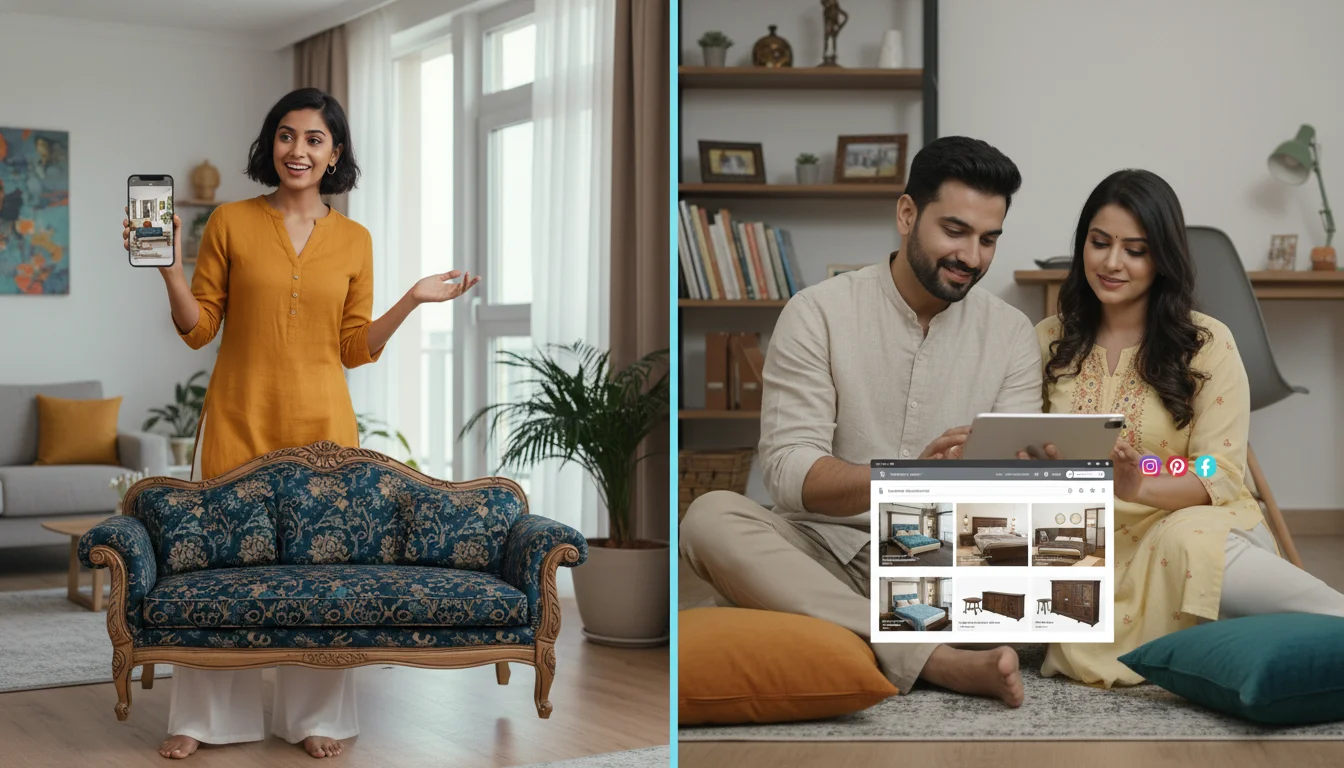
| The Newly Married Couple | Age 25-35, transitioning to independent living, often in compact 1BHK/2BHK urban apartments. | Prioritizes multifunctional, modular furniture (e.g., sofa-cum-beds, expandable dining tables, hydraulic storage beds). Extremely value-conscious but unwilling to compromise on contemporary design and durability. | Heavily influenced by Instagram home decor trends and Pinterest mood boards. Seeks comprehensive room solutions rather than isolated pieces. Values social proof, influencer endorsements, and flexible EMI payment options. |
Recommended Channels and Campaign Types
A multi-channel approach is absolutely necessary to capture consumers at different, distinct stages of the purchasing funnel.
The foundation of the strategy must be built on Search Engine Optimization (SEO) and Local Search. Utilizing and fully optimizing Google Business Profiles is paramount for driving foot traffic to physical showrooms. This involves rigorous profile management, including uploading high-resolution imagery of the showroom, maintaining accurate inventory attributes, and actively managing customer reviews to build local prominence and trust. Concurrently, traditional technical SEO should focus on optimizing the e-commerce platform’s architecture to ensure product and category pages rank highly for transactional queries.
WhatsApp Marketing is an indispensable channel in the Indian retail context, serving seamlessly as both a marketing engine and a customer relationship management (CRM) tool. Utilizing the WhatsApp Business API allows brands to deploy interactive product catalogs directly into the chat interface, enabling users to browse without leaving their preferred app. Campaign types should include automated cart abandonment reminders with time-sensitive discount offers, personalized post-sale support and assembly instructions, and segmented broadcast lists promoting festive discounts (e.g., Diwali or Dhanteras sales) using pre-approved interactive message templates. This channel effectively neutralizes the severe customer service deficits observed in larger competitors, fostering long-term loyalty.
Visual Social Media (Instagram and Pinterest) serves as the primary inspiration hub. Campaigns on these platforms should focus on visually rich storytelling rather than aggressive direct-response sales tactics. Utilizing Instagram Reels and carousel posts allows brands to demonstrate the functionality of space-saving furniture or the intricate, traditional craftsmanship of solid wood pieces in an engaging format. Furthermore, influencer collaborations are critical on these platforms to provide authentic social proof and styling inspiration, integrating the products into aspirational lifestyle narratives.
Content Ideas Specific to Furniture Businesses
Content must bridge the gap between digital browsing and physical assurance, providing the necessary information to overcome the inability to touch and feel the product.
First, Home Tour and Styling Videos are highly effective. Collaborating with micro-influencers or highly satisfied customers to showcase the brand’s furniture styled within real Indian homes provides relatable context and authentic aesthetic inspiration. Second, Educational and DIY Content builds deep brand authority. Creating comprehensive buying guides detailing the differences between Sheesham, Teak, and engineered wood, explaining the benefits of BIFMA certified ergonomic chairs, or offering tips on maintaining leather upholstery positions the brand as a trusted expert rather than just a vendor. Third, Functional Demonstration Videos are essential for modular furniture. Short-form videos (Reels/Shorts/TikToks) that demonstrate a sofa transforming into a bed, or an expandable dining table operating smoothly, directly address the functional needs of consumers living in compact urban spaces. Finally, integrating Augmented Reality (AR) Visualizers into the content strategy allows users to project 3D models of the furniture into their own living rooms via their smartphone screens, drastically reducing hesitation and accelerating the conversion process.
Budget-Friendly Digital Marketing Approaches
For emerging brands, regional startups, or local manufacturers operating with constrained marketing budgets, several high-impact, low-cost strategies can be effectively deployed. User-Generated Content (UGC) is a powerful, essentially cost-free marketing asset. Encouraging existing customers to share photos of their newly furnished rooms on social media—perhaps in exchange for minor future discounts or entry into a giveaway—generates highly authentic promotional material that resonates with peer groups. Google Business Profile Optimization is entirely free and yields massive returns in local search visibility; consistently updating the profile with weekly posts, new inventory photos, answering Q&As, and adding UPI payment attributes ensures high local ranking without continuous advertising spend. Finally, focusing intensely on Long-Tail SEO targeting highly specific, localized search queries (e.g., “custom modular kitchen design in Pune” or “solid wood study table in Ahmedabad”) is far less competitive and less expensive than bidding on broad national terms, yielding a much higher conversion rate from highly intent-driven traffic.
Keywords & SEO Opportunities
A robust SEO strategy for the Indian furniture market must distinctly categorize user search intent, clearly separating users who are looking for broad inspiration from those who have their credit cards ready to purchase.
By strategically targeting both informational and transactional keywords, brands can guide consumers efficiently through the entire digital funnel.
High-Intent Transactional Keywords
-
“buy sofa set online” / “best dining table in glass”
Estimated Search Volume: High (e.g., “sofa set” = 550,000 SV)
Intent & Strategic Value: Direct, high purchase intent. Landing pages must feature clear pricing, high-quality images, seamless checkout UI, and trust signals (warranties/reviews).
-
“patio furniture” / “outdoor furniture”
Estimated Search Volume: 450,000 - 550,000 SV
Intent & Strategic Value: Seasonal/Lifestyle purchase intent. Optimize category pages with aspirational lifestyle imagery and detailed weather-resistance specifications.
-
“wooden furniture” / “wood furniture”
Estimated Search Volume: 165,000 SV
Intent & Strategic Value: Material-specific transactional intent. Capitalize on the ~60% market preference for wood by highlighting material authenticity, wood types (Teak/Sheesham), and craftsmanship.
-
“bookshelves” / “dressing table” / “kitchen cabinet”
Estimated Search Volume: 550,000 - 823,000 SV
Intent & Strategic Value: Item-specific transactional queries. Require highly detailed product descriptions, exact dimensions, modularity features, and clear delivery timelines.
Long-Tail and Local Keyword Opportunities (India-Specific)
-
Location-Based (Local SEO)
Examples (India Context): “best wooden furniture near me”, “furniture store in [City]”, “custom wardrobe design in Bangalore”
Application & Implementation: Essential for driving physical foot traffic. Integrate these terms seamlessly into Google Business Profiles, localized landing pages, and meta descriptions.
-
Material & Quality Specific
Examples (India Context): “best teak wood furniture online”, “100% solid sheesham wood bed with storage”
Application & Implementation: Targets highly discerning buyers willing to pay a premium. Use in detailed product descriptions, emphasizing durability, lifetime termite resistance, and aesthetic richness.
-
Problem-Solving / Functional
Examples (India Context): “space saving dining table for small apartments”, “ergonomic office chair for sciatica pain”
Application & Implementation: Highly effective for capturing the Urban Professional demographic. Address specific pain points directly in blog content, product titles, and feature lists.
-
Informational / Educational
Examples (India Context): “how to maintain leather sofa”, “teak wood vs engineered wood furniture pros and cons”
Application & Implementation: Top-of-funnel attraction. Create comprehensive blog posts or YouTube videos. Builds brand authority and captures users in the early research phase before they commit to a brand.
To effectively execute this keyword strategy, businesses should utilize the ICE (Impact, Confidence, Ease) scoring model to prioritize content creation. This involves focusing initial efforts on long-tail local keywords that offer the highest probability of ranking and driving immediate revenue, with the least resistance from national mega-brands. Furthermore, the strategic use of negative keywords in paid campaigns (e.g., excluding “cheap” or “free” if selling premium luxury furniture) ensures marketing budgets are not wasted on unqualified traffic.
Implementation Roadmap
To seamlessly transition from theoretical strategy to operational execution, furniture businesses must adopt a strictly phased implementation roadmap. This structured approach ensures that foundational digital infrastructure is solidified before scaling up to advanced marketing tactics and automated technological ecosystems.
Phase 1: Short-Term Quick Wins (Month 1 – 3)
The immediate objective in the first quarter is to establish absolute technical digital hygiene, capture existing local search demand, and initiate direct, frictionless communication channels with potential buyers.
1. Technical SEO Audit and E-Commerce Optimization:
The digital storefront must be structurally sound and technically flawless. Initiate a comprehensive technical SEO audit to identify and resolve crawl errors, site speed bottlenecks, and broken links that penalize rankings. Mobile responsiveness is hyper-critical, given India’s overwhelming smartphone-first internet usage. Product pages must be rigorously optimized with structured data (schema markup) to enable rich snippets in search results, displaying prices, star ratings, and stock availability directly on Google’s search page to increase click-through rates. Meta titles and descriptions must be completely rewritten to incorporate the high-intent transactional keywords identified in the research phase.
2. Local SEO and Google Business Profile Mastery:
For businesses operating physical showrooms, dominating local search is the fastest, most cost-effective path to immediate revenue. Claim, verify, and exhaustively populate the Google Business Profile. This includes adding high-resolution, professionally lit photos of the showroom interior, exterior signage, and key product lines. Ensure all attributes (hours of operation, exact location pin, contact details, UPI payment acceptance) are impeccably accurate. Implement a systematic, automated process to solicit reviews from satisfied customers immediately post-delivery, and assign staff to actively respond to all reviews and Q&A inquiries to boost the crucial prominence ranking factor.
3. WhatsApp Business Integration:
Establish a verified WhatsApp Business account to serve as the primary, immediate conduit for customer interaction. Set up the interactive digital catalog feature, allowing users to browse inventory, view pricing, and ask questions about specific items directly within the chat interface. Implement basic automated responses for frequently asked questions regarding business hours, location mapping, and standard delivery timelines. This immediate responsiveness directly addresses and capitalizes on the widespread consumer frustration with the poor communication standards of larger national competitors.
4. Targeted Performance Marketing (PPC):
While organic SEO builds authority over time, Pay-Per-Click (PPC) advertising generates immediate, highly qualified leads. Launch highly targeted Google Search campaigns bidding exclusively on specific, high-intent local keywords (e.g., “buy modular kitchen in [City]”). Concurrently, utilize Google Shopping ads to display product images and pricing directly at the top of search results, capturing users at the exact moment of high purchase intent, replicating the success of brands like Royal Oak and Casa Bella.
Phase 2: Long-Term Scaling and Advanced Strategies (Month 6 – 12)
With the foundational elements generating consistent traffic and leads, the focus in the second half of the year shifts to aggressive brand building, advanced technological integration, and maximizing customer lifetime value and retention.
1. Comprehensive Content and Inbound Marketing:
Transition from basic product listings to becoming a recognized, authoritative voice in interior design. Launch a comprehensive lifestyle blog and a dedicated YouTube channel focusing on home styling tips, material education (e.g., solid wood vs. engineered wood deep dives), and space-saving architectural hacks for compact urban apartments. This informational content captures massive volumes of top-of-funnel traffic and builds immense brand trust, nurturing prospects for months until they are ready to make a high-ticket purchase.
2. Influencer Partnerships and Visual Storytelling:
Scale social media presence by moving completely beyond static images. Implement a robust, high-frequency Instagram Reels and Pinterest strategy showcasing rapid product transformations, assembly timelapses, and functional demonstrations. Strategically collaborate with established Indian home decor influencers to feature the brand’s furniture in actual, lived-in residential settings. These partnerships generate authentic social proof, drive high-quality referral traffic, and provide a vast repository of User-Generated Content that can be repurposed across other paid marketing channels.
3. Advanced WhatsApp API Automation and CRM Integration:
Upgrade from the standard WhatsApp Business App to the enterprise-grade WhatsApp Business API. Integrate this API deeply with the backend Customer Relationship Management (CRM) system and e-commerce platform. This allows for the deployment of sophisticated, AI-driven chatbots capable of qualifying leads, providing real-time dynamic delivery tracking, and executing highly effective automated cart abandonment recovery campaigns. Utilize WhatsApp-approved marketing message templates to send highly segmented promotional broadcasts during peak Indian festive seasons, ensuring compliance and avoiding spam filters.
4. Technological Integration (AR/VR and Data Analytics):
Directly address the tactile barrier of online furniture shopping by integrating Augmented Reality (AR) visualizers into the e-commerce platform and mobile apps.
Allowing customers to view accurate 3D models of furniture in their own living spaces via smartphone cameras dramatically increases conversion rates, builds immense buyer confidence, and significantly reduces the logistical nightmare of high return rates. Furthermore, deploy advanced enterprise data analytics to meticulously monitor customer behavior, website heatmaps, and purchasing patterns. This data enables hyper-personalized product recommendations and highly efficient, dynamically generated retargeting campaigns.
Conclusion
The Indian furniture industry stands at a critical, highly lucrative inflection point. The traditional reliance on physical showrooms, localized word-of-mouth, and static print advertising is no longer sufficient to sustain growth or defend market share in an increasingly digital, consolidated, and fiercely competitive marketplace. The modern Indian consumer—empowered by ubiquitous internet access and influenced by global design trends—demands a frictionless, deeply engaging omnichannel experience. They expect a journey that seamlessly blends the aspirational, aesthetic discovery of social media, the technical convenience of augmented reality and robust e-commerce, and the personalized, immediate communication of chat platforms like WhatsApp.
Digital marketing is no longer merely an optional promotional tool or a supplementary channel for furniture businesses; it is the fundamental architectural requirement for survival, scalability, and market dominance. It provides the precise mechanism to circumvent systemic industry challenges—such as prohibitive commercial real estate costs, geographic limitations, and fragmented supply chains—by creating expansive, highly optimized virtual showrooms accessible to millions. By deploying targeted, intent-driven SEO, businesses can intercept high-value buyers at the exact moment they are searching for solutions. Through immersive visual storytelling, AR integration, and strategic influencer collaborations, brands can build immense trust and aesthetic authority, overcoming the traditional need to physically touch the product. Furthermore, by exploiting the severe customer service vulnerabilities of incumbent mega-brands through localized, hyper-responsive digital communication, emerging furniture businesses can rapidly carve out highly profitable, fiercely loyal market shares.
Executing this sophisticated, multi-layered digital strategy requires specialized, cross-disciplinary expertise, deep technological capability, and a highly nuanced understanding of the South Asian digital consumer psychology. Gurkha Technology, a leading digital marketing and technical development agency based in Nepal, is uniquely positioned to architect and execute this comprehensive digital transformation for Indian furniture businesses.
Gurkha Technology offers an exhaustive suite of services precisely aligned with the strategic imperatives outlined in this report. Their deep expertise in advanced Search Engine Optimization (SEO) ensures that furniture brands achieve unshakeable dominance in both broad e-commerce transactional queries and highly targeted, foot-traffic-driving local searches. Through sophisticated Advertising Management—including the deployment of AI-driven Google Performance Max campaigns and highly targeted Meta advertising—they optimize conversion rates, reduce customer acquisition costs, and maximize return on ad spend. Beyond purely promotional marketing, their technical division excels in robust E-commerce Development and seamless UI/UX design, ensuring that complex, multi-variant furniture catalogs are presented through fast, immersive, and exceptionally user-friendly digital storefronts. Furthermore, their dedicated Branding and Design consulting services guarantee the development of a strong, consistent brand voice that deeply resonates with the aesthetic sensibilities of the modern, upwardly mobile Indian consumer. By partnering with Gurkha Technology, furniture businesses can successfully bridge the gap between traditional manufacturing craftsmanship and modern digital dominance, transforming ambitious operational visions into measurable, scalable, and enduring commercial success.