Indian B2B Digital Marketing: Research & Trends Report 2024
Digital Marketing for B2B Businesses in India
Industry Overview
The business-to-business (B2B) ecosystem in India is currently undergoing a period of profound structural and operational transformation, driven by rapid digitalization, evolving supply chain demands, and unprecedented internet penetration across the subcontinent. The foundational architecture of Indian B2B trade, which historically relied heavily on fragmented offline networks, localized trade expos, and deeply entrenched personal relationships, is rapidly migrating toward sophisticated digital platforms and omni-channel frameworks. This evolution has been catalyzed by advancements in technology, the proliferation of smartphones, and pivotal government initiatives such as the “Digital India” and “Make in India” campaigns, which have collectively laid the groundwork for robust digital trade infrastructure.
Current market projections underscore the sheer velocity and scale of this transition. The Indian B2B e-commerce sector alone is projected to reach a market valuation of $200 billion by the year 2025, expanding at a compound annual growth rate (CAGR) exceeding 20%. Looking further ahead into the decade, the broader business-to-business e-commerce landscape in India, which generated revenues of $1,197.2 billion in 2023, is forecasted to generate a staggering $4,709.1 billion in revenue by 2030, charting an aggressive CAGR of 21.6% from 2024 to 2030. Within this massive expansion, the intermediary-oriented deployment model currently stands as both the largest revenue-generating segment and the most lucrative, fastest-growing sector in the nation. Simultaneously, the global B2B e-commerce market structure remains highly fragmented, projected to accelerate at a CAGR of 15.2% to reach $11,158.3 billion globally between 2024 and 2028, highlighting the interconnected nature of India’s domestic growth with global demand paradigms.
A central driver of this domestic market expansion is the accelerated adoption of digital technologies by Micro, Small, and Medium Enterprises (MSMEs). By 2025, over 60 million MSMEs in India are expected to deeply integrate B2B digital platforms into their operational frameworks. Recent market analyses indicate that over 70% of Indian MSMEs have already adopted some form of online sales channel. The tangible benefits of this digital pivot are substantial; businesses utilizing full-stack B2B e-commerce platforms have experienced 35% faster order processing and revenue multipliers of 2.5x compared to their offline counterparts, alongside a reported 40% reduction in customer acquisition costs. This digital adoption is heavily concentrated in foundational sectors such as manufacturing, agriculture, and fast-moving consumer goods (FMCG), which currently dominate platform utilization rates. Furthermore, India’s B2B digital exports through online marketplaces are forecasted to grow by 30% annually, catalyzed by increasing cross-border demand across emerging regions like the Middle East, Africa, and Southeast Asia. To complement this digital growth, the B2B physical events market, which remains critical for initial networking and trust-building, is correspondingly expanding, estimated to grow from $0.60 billion in 2025 to $1.04 billion by 2030 at a CAGR of 11.72%.
Despite these formidable growth trajectories, the industry grapples with severe infrastructural, regulatory, and operational challenges that complicate the digital marketing landscape. A major physical impediment is supply chain and logistics friction. Managing last-mile delivery, reverse logistics, and overall supply chain efficiency across India’s vast and diverse geographical terrain remains difficult, resulting in delayed deliveries for up to 20% of orders during peak commercial seasons. These logistical bottlenecks directly impact brand reputation, increasing operational costs and reducing overall customer satisfaction.
Compounding these physical bottlenecks are acute financial constraints and payment inefficiencies. Deteriorating payment behavior and liquidity crunches within the Indian corporate sector have led to severe operational disruptions across various industries. Currently, over 56% to 70% of B2B transactions involve overdue invoices, with financial settlements typically arriving more than a month past the agreed terms, which themselves have been relaxed to an average of 47 to 60 days from invoicing. This environment of leniency, driven by customer-side liquidity constraints and internal payment process inefficiencies, has resulted in a significant surge in bad debts. Companies are currently facing write-offs as high as 5% to 10% of total B2B invoices, posing real, existential threats to the financial health of MSMEs operating with tight margins or limited financial buffers. Consequently, 72% of Indian companies expect an increase in B2B customer insolvencies in the near term, straining the financial resilience of the corporate sector.
Furthermore, the rapid digitalization of the sector has introduced severe cybersecurity and data privacy concerns. The incidence of reported cyber fraud cases in Indian e-commerce has grown exponentially, rising from 26,121 cases in 2019 to an alarming 1,556,764 cases in 2023, with over 740,957 cases reported in just the first four months of 2024. This exponential rise in cyberattacks and data breaches demands that B2B enterprises invest heavily in AI-driven fraud detection, secure payment gateways, and strict compliance with emerging consumer data protection laws to maintain institutional trust. Within corporate structures, digitalization also creates internal friction, particularly the lack of alignment between marketing and sales functions. Sales departments often remain focused on traditional personal selling, while marketing teams pivot toward digital media communications, creating organizational tension that hampers the cohesive execution of the customer journey. Digital marketing in this complex context is not merely a mechanism for lead generation; it is a vital strategic imperative designed to establish corporate credibility, streamline customer acquisition, fortify cybersecurity perceptions, and build the requisite trust needed to secure financially stable, long-term clientele.
Digital Landscape in India (Contextual to the Industry)
The digital environment contextual to Indian B2B operations is highly mobile-centric, increasingly driven by artificial intelligence, and characterized by a rapidly shortening, self-directed buyer journey. Understanding this landscape requires a granular examination of how internet penetration, device preference, and platform utilization intersect with evolving B2B procurement behaviors.
Internet and Device Usage Relevant to B2B Businesses
In the current fiscal landscape, mobile platforms absolutely dominate India’s digital advertising and media consumption ecosystem. In FY25, mobile devices accounted for 78% of total digital media expenditures, maintaining the same dominant share as the previous year. This sustained mobile dominance dictates that B2B digital marketing strategies must be engineered with a strict mobile-first philosophy, ensuring that websites, procurement portals, and content formats are seamlessly navigable on smartphone screens. The smartphone has become the primary device for content consumption, commerce, and initial user engagement. Conversely, desktop platforms maintain a resilient and highly stable 22% share of digital media spend. This figure is disproportionately relevant to the B2B sector, as desktop usage remains critical for complex decision-making, professional services procurement, deep-dive technical research, and the consumption of long-form analytical content, whitepapers, and detailed product documentation.
Popular Platforms Among the Target Audience
The social media and digital platform landscape in India presents a vast, multifaceted surface area for B2B engagement. The core social media user base is heavily distributed across massive digital networks, requiring B2B marketers to adopt an omni-channel approach.
- Facebook: Indian User Base (Approximate) 622.9 Million. Strategic Relevance to B2B Operations: Community building, localized targeting, top-of-funnel brand awareness, and reading peer reviews.
- YouTube: Indian User Base (Approximate) 462.0 Million. Strategic Relevance to B2B Operations: Dominant platform for long-form video, technical product demonstrations, and localized vernacular content.
- Instagram: Indian User Base (Approximate) 442.8 Million. Strategic Relevance to B2B Operations: Employer branding, corporate culture showcasing, and short-form video engagement (Reels).
- LinkedIn: Indian User Base (Approximate) 160.5 Million. Strategic Relevance to B2B Operations: Primary hub for B2B lead generation, executive thought leadership, and professional networking.
- WhatsApp: Indian User Base (Approximate) > 95% of Smartphone Users. Strategic Relevance to B2B Operations: Critical for lower-funnel communication, direct sales conversations, and automated lead nurturing.
LinkedIn remains the undisputed primary channel for B2B marketers globally and in India, with significant engagement metrics that cannot be ignored.
Globally, nearly 70% of LinkedIn users engage with brand content at least once a week, and text-based posts currently drive the highest engagement rates on the platform, significantly outperforming user-generated content. Furthermore, comments and post impressions on LinkedIn have surged, making it an increasingly active digital environment. Notably, 33.4% of global LinkedIn users fall within the 25 to 34-year-old demographic, indicating that millennial decision-makers are currently dictating a vast portion of B2B procurement processes. Concurrently, short-form video is achieving unprecedented traction across all platforms; with nearly 139 million Instagram Reels watched globally every minute, short videos have become a powerful medium for distilling complex B2B value propositions into digestible, highly engaging formats. While Facebook and Instagram are traditionally viewed as B2C channels, 40% of consumers use Facebook and 34% use YouTube specifically for reading reviews, a behavior that translates directly into the B2B vendor evaluation process.
Consumer Online Behavior Related to B2B Businesses
B2B buyer behavior in India, mirroring global macroeconomic shifts, has fundamentally evolved. The traditional, linear sales funnel managed exclusively by account executives has been entirely replaced by a self-directed, digitally native research process. Recent data from comprehensive global studies involving millions of interactions indicates that B2B buying cycles are compressing. The average cycle length dropped from 11.3 months in 2024 to 10.1 months in 2025. This compression is largely driven by persistent macroeconomic uncertainty, forcing organizations to move faster to secure budgets before they disappear or to respond rapidly to shifting business conditions.
Concurrently, buyers are contacting sellers significantly later in their cognitive journey, but earlier relative to the shortened chronological cycle. The point of first contact (POFC) between buyers and sellers has shifted from 69% of the journey in 2023 and 2024 to 61% in 2025, which translates to buyers contacting sellers roughly six to seven weeks sooner. However, this does not mean sales representatives have more influence. An estimated 57% to 70% of B2B buyers complete their deep research independently before ever initiating contact with a sales representative. During this critical “dark funnel” phase, buyers rely heavily on peer recommendations, user reviews, digital case studies, and corporate thought leadership to validate their choices.
The integration of artificial intelligence into this research phase is nearly universal. A staggering 94% of B2B buyers report utilizing Large Language Models (LLMs) and artificial intelligence tools during their buying journey to analyze sentiment in customer reviews, compare vendor documentation, and process complex technical information. Consequently, major decisions are locked in before the seller is even aware of the opportunity; 95% of the time, the winning vendor is already positioned on the buyer’s “Day One shortlist,” and four out of five deals (80%) are awarded to the “pre-contact favorite” that the buyer contacts first. Nearly 80% of all seller conversations are now buyer-initiated, fundamentally shifting the power dynamic toward the purchaser.
Despite a strong preference among 75% of B2B buyers for a rep-free, self-service digital purchasing experience, data suggests that purely self-service transactions often result in a higher likelihood of post-purchase regret. Therefore, the modern Indian B2B buyer demands a highly sophisticated hybrid paradigm: deep digital self-service capabilities for product discovery, streamlined configuration, and contextual recommendations, seamlessly integrated with crucial human touchpoints to aid complex decision-making and negotiations. Tools like digital sales rooms exemplify this synergy, creating collaborative environments where buyers and sellers can interact efficiently.
Regional and cultural nuances further complicate this behavioral landscape. Across India’s diverse regions, socioeconomic factors heavily influence procurement behavior. For instance, consumers and businesses in North India often associate brands with corporate status, driving a higher share of branded searches. Conversely, buyers in South India view brands strictly as markers of functional quality and technical reliability. The ultimate decision driver across all regions, however, remains institutional trust. In a landscape fraught with financial instability and cyber risk, the sentiment “I feel safe signing a contract with them” continues to rank as the number one driver for B2B procurement for the third consecutive year, surpassing pure cost considerations. This requires winning brands to make the buying process easier and faster by leveraging AI to reduce friction while heavily investing in brand reputation, reach, and advocacy to drive buyer confidence.
Digital Marketing Opportunities
The formidable challenges inherent in the Indian B2B market—such as rising customer acquisition costs, fractured institutional trust, complex supply chain logistics, and elongated payment cycles—present distinct, high-yield opportunities for enterprises that deploy highly targeted, data-driven digital marketing architectures. Digital transformation is no longer a peripheral strategy; it is the central nervous system of modern B2B revenue generation.
Solving Key Challenges through Digital Interventions
Digital marketing serves as a direct, measurable antidote to the primary challenges of the B2B sector. To combat precipitously rising Customer Acquisition Costs (CAC), enterprises are pivoting away from broad-spectrum, untargeted advertising toward Account-Based Marketing (ABM) and deep intent-based targeting. By utilizing data enrichment and semantic keyword analysis, companies can focus their marketing budgets exclusively on accounts demonstrating active buying signals, significantly lowering the cost per lead (CPL) and improving marketing return on investment (ROMI).
Furthermore, to address the profound trust deficit and mitigate the severe risks associated with payment delays and bad debt, B2B digital marketing leverages the mechanics of transparency and social proof. Distributing highly detailed, data-backed case studies, authentic client testimonials, and forward-looking industry research serves to digitally pre-qualify leads. This content strategy attracts sophisticated, financially stable enterprise clients who value transparent, long-term partnerships over short-term, risky transactional savings, thereby stabilizing the financial health of the vendor. To mitigate logistical and supply chain challenges, marketers are utilizing digital tracking, automated customer updates via messaging platforms, and transparent digital communication to manage customer expectations, effectively reducing the friction and dissatisfaction caused by delivery delays.
Best Strategies for B2B Businesses in India
- Synergistic Integration of SEO and Paid Media: The most successful B2B growth trajectories in the current market demonstrate a masterful, synergistic integration of organic Search Engine Optimization (SEO) and paid search campaigns. Brands that harmonize these efforts achieve significantly faster and more sustainable revenue growth than those operating them in silos. Paid search and targeted ads secure immediate, top-of-page visibility for high-intent, bottom-of-funnel search queries, capturing immediate demand. Concurrently, long-form, research-backed SEO content builds the deep topical authority necessary to dominate the broader awareness and consideration phases, capturing the 70% of the buyer journey that occurs anonymously before sales contact.
- The Dominance of WhatsApp as a Primary Pipeline Tool: In the Indian market, where over 95% of smartphone users rely on WhatsApp for daily communication, the platform has transcended casual messaging to become a premier, high-conversion B2B marketing engine. Integrating the WhatsApp Business API with Customer Relationship Management (CRM) systems allows B2B marketers to deploy automated lead qualification sequences, deliver interactive product demonstrations, and share rich media such as PDF proposals and voice notes directly to a decision-maker’s mobile device. Case studies explicitly indicate that executing multi-touch appointment setting and managing B2B sales pipelines through WhatsApp improves conversion rates by up to 28%. Features like interactive buttons, quick replies, and automated chat assignments ensure no query is left unanswered, drastically reducing friction in the lead nurturing phase and bypassing the saturated clutter of traditional corporate email inboxes.
- B2B Influencer and Community-Led Marketing: Influencer marketing is definitively no longer restricted to B2C consumer goods; it has matured into a vital component of the B2B marketing arsenal.
Recent surveys indicate that nearly two-thirds of B2B buyers directly referenced industry influencers during their most recent purchase evaluation. In India, collaborating with industry-specific thought leaders, technical consultants, and subject matter experts on platforms like LinkedIn and YouTube generates unparalleled credibility. Prominent Indian B2B influencers like Vivek Bindra (3.7M followers), Aashna Malani (3.2M followers), and specialized creators like the ‘E-commerce Doctor’ command massive engagement rates and possess the authority to sway procurement decisions. Furthermore, globally recognized figures like Neil Patel and Dave Gerhardt demonstrate how data-driven, practical insights shared via LinkedIn and podcasts can build immense institutional authority. Community-led growth—fostering owned networks on platforms like Telegram or LinkedIn Groups where professionals can exchange knowledge—further establishes the brand as a central, trusted facilitator without requiring massive, continuous ad spend.
Vernacular Optimization for Tier 2 and Tier 3 Penetration:
As digital penetration deepens into India’s Tier 2 and Tier 3 cities, optimizing digital content in regional languages (such as Hindi, Tamil, Bengali, and Marathi) represents a massive, largely untapped opportunity. A significant portion of procurement managers, manufacturing facility owners, and SME founders in these emerging regional hubs are vastly more receptive to local-language content. Developing vernacular SEO strategies, translating technical landing pages, and investing in regional voice-search optimization allows brands to directly capture market share that English-only competitors willfully forfeit. The future of this space includes real-time translation for customer support, AI-powered regional content generation, and vernacular voice commerce.
Local and Global Examples and Case Studies
Zoho’s Product-Led Growth (PLG) Dominance:
Competing against heavily funded global SaaS giants like Salesforce and Microsoft, Chennai-based Zoho captured the domestic MSME market through a deeply integrated, bottom-up product strategy. By building an extensive, affordable suite of over 50 integrated applications and offering a generous freemium model, they eliminated initial adoption barriers. Critically, they invested heavily in localized customer education through initiatives like Zoho University and extensive regional partner networks. This built immense trust and reduced friction, establishing Zoho as the default, trusted operating system for cost-sensitive Indian businesses, achieving iconic bootstrapped status.
Infosys and Knowledge Marketing:
To differentiate in a highly saturated, commoditized global IT services market, Infosys utilized “knowledge marketing.” By producing forward-looking, highly technical research on macroeconomic trends, cloud computing, and artificial intelligence through the Infosys Knowledge Institute, they bypassed traditional promotional advertising. This thought-leadership approach successfully established premium market positioning and global trust, justifying their pricing models against massive multinational competitors.
Moglix’s AI-Driven Supply Chain Digitization:
Operating in the complex industrial sector, Moglix leveraged generative AI and Google Cloud’s Vertex AI to revolutionize industrial product supply. By implementing AI-powered chatbots and OCR data extraction from complex PDFs, they improved their sourcing team’s efficiency by an astounding 4X. They generated 500 orders over three months at minimal cost through a Vertex AI-powered chatbot and improved operational efficiency by 50%, demonstrating the immense power of technological integration in B2B marketing and customer experience optimization.
Viral Indian Influencer Campaigns:
While skewing slightly toward D2C, the mechanics of campaigns like Ghar Magic Soap and Dorco razors demonstrate the sheer power of the Indian influencer ecosystem. Ghar Magic Soap utilized dozens of micro-influencers to generate 25 million combined views and a 300% spike in website traffic, bypassing expensive celebrity endorsements. Similarly, Dorco hired 105 influencers simultaneously upon entering the Indian market, generating over 10 million combined reach almost overnight, proving that coordinated, multi-tiered creator coalitions can instantly establish brand awareness and trust in a new market.
Competitive Analysis
A rigorous analysis of top-tier B2B enterprises and marketing agencies in India reveals a distinct bifurcation between legacy players who rely on massive directory dominance and modern disruptors who leverage data transparency, artificial intelligence, and sophisticated, full-funnel digital ecosystems.
Current Digital Presence of Top B2B Businesses in India
Legacy Directory Platforms: IndiaMART
As a foundational pillar of Indian B2B commerce, IndiaMART’s digital strategy revolves around massive directory scale, search engine dominance, and ubiquitous user accessibility. With a digital footprint spanning 29 years, their core value proposition hinges on “Empowering Business Connections” through a massive directory of verified seller badges and extensive categorization. What they do well: IndiaMART excels at hyper-localization and platform accessibility. They maintain a robust multi-channel presence, seamlessly integrating their desktop site with a highly utilized mobile application. They masterfully capture high-volume, lower-tier regional search queries by offering localized interfaces (e.g., “IndiaMART in Hindi”) for specific items like industrial machinery, medical equipment, and raw textiles. Furthermore, their integration of adjacent B2B solutions, such as accounting software and logistics support (“Ship With IndiaMART”), creates a highly sticky digital ecosystem that retains users long-term.
Modern Tech-Forward Platforms: Moglix and Zetwerk
Operating primarily in the industrial, manufacturing, and strategic sourcing sectors, companies like Moglix and Zetwerk represent the modern, tech-forward B2B enterprise. What they do well: These platforms heavily integrate digital transformation and data analytics into their core marketing messages. Moglix successfully positions itself against consumer giants like Amazon and Walmart by offering deep B2B-specific flexibility, customized supply chain financing, and tailored procurement strategies. Their digital presence is bolstered by highly technical, narrative-driven case studies highlighting supply chain efficiency and omni-channel B2B strategies, proving their capability to large enterprises. Zetwerk projects a highly sophisticated, data-driven brand identity focused heavily on transparency and efficiency. They utilize data-centric content to highlight how their platform reduces lead times by 30% and operational costs by 18%, utilizing advanced algorithms to match suppliers and buyers. Their digital assets emphasize global sourcing strategies, supply chain resilience, and the utilization of advanced analytics tools, appealing directly to enterprise-level procurement officers.
The Indian SaaS Ecosystem
India has cultivated a globally recognized SaaS ecosystem, with companies leveraging robust digital marketing to scale rapidly.
| SaaS Enterprise | Headquarters | Primary Product/Focus | Digital Marketing Strength |
|---|---|---|---|
| Zoho | Chennai | Zoho One / Zoho CRM | Massive product-led growth, freemium models, and extensive localized educational content (Zoho University). |
| Freshworks | Chennai | Freshdesk | High-intent SEO targeting comparison keywords, strong technical content marketing. |
| Chargebee | Chennai | Revenue & Subscription Management | Deep integration with global fintech content, specialized SaaS invoicing solutions. |
| Atlassian (India Ops) | Bengaluru | Jira / Confluence | Community-led growth, deep developer ecosystems, and technical thought leadership. |
Top B2B Digital Marketing Agencies in India
To execute these complex strategies, a highly specialized ecosystem of B2B digital marketing agencies has emerged in India.
| Agency Name | Primary Focus | Best Suited For |
|---|---|---|
| The Smarketers | Full-Funnel B2B Marketing | Enterprise ABM, aligning marketing with pipeline revenue, award-winning ITSMA Account-Based Marketing. |
| PROHED | Performance & ROI | Tech, SaaS, and Manufacturing scaling, driving measurable sales outcomes. |
| TripleDart | SaaS SEO & High-Intent Search | Concentrated focus on SaaS, Fintech, and AI, driving organic growth through specialized keyword clusters. |
| EZ Rankings | B2B SEO & Digital Presence | Manufacturing, logistics, and industrial supply chains, focusing on high-intent search terms and technical SEO. |
| iProspect India | Global Media & Search | Enterprise tech and large-scale search engine visibility. |
Gaps and Opportunities to Outperform Them
While these industry giants command significant market share, a critical analysis of their digital footprints reveals actionable, highly lucrative gaps for emerging competitors to exploit:
- Over-reliance on Broad “Head” Keywords: Many large directories and legacy SaaS players focus almost exclusively on high-volume, generic keywords (e.g., “industrial supplies” or “CRM software”). This creates intense competition at the top of the funnel but leaves a massive, highly profitable void in the “long-tail” search landscape. Emerging businesses can significantly outperform these giants by targeting highly specific, low-competition, high-intent queries (e.g., “affordable precision CNC machining in Pune”) where the giants lack dedicated landing pages.
Fragmented Full-Funnel Marketing: Many B2B agencies and companies excel at top-of-funnel (TOFU) demand generation—driving traffic and capturing email addresses—but completely fail to orchestrate a seamless transition to bottom-of-funnel (BOFU) sales enablement. Establishing a cohesive narrative that tracks a prospect from initial awareness through to pipeline revenue, rather than stopping at vanity metrics like Marketing Qualified Leads (MQLs), presents a major competitive advantage. Agencies that can tie their work directly to revenue, like The Smarketers, demonstrate how lucrative this full-funnel approach is.
Lack of Hyper-Personalized Human Touchpoints: As B2B commerce becomes increasingly automated with chatbots and self-service portals, the emotional component of the purchase is often neglected. Competitors can outperform highly automated, rigid platforms by blending efficient digital self-service tools with dedicated, highly personalized consultation capabilities, ensuring buyers feel safe and supported when executing high-value, complex contracts.
Recommended Strategy for B2B Businesses in India
To successfully navigate the complex, rapidly evolving Indian B2B landscape in 2025 and beyond, organizations must decisively abandon linear, single-channel marketing in favor of a cohesive, multi-touch digital ecosystem that surrounds the buyer throughout their compressed decision cycle.
Target Audience Persona
The modern Indian B2B buying committee is decentralized, highly skeptical of traditional sales tactics, and digitally native. Strategies must address two distinct but overlapping persona archetypes within an organization:
- The Millennial Researcher (Age 25-35): Often occupying roles such as procurement specialist, technical lead, or operations manager. They are tasked with initial vendor discovery, deep technical evaluation, and shortlisting. They consume technical blogs, engage actively on LinkedIn, demand transparent pricing structures, heavily utilize AI/LLMs to compare features, and show a strong preference for self-service digital experiences without speaking to a sales rep.
- The Executive Decision Maker (Age 40-55): The traditional CXO, Regional Director, or SME Founder. They rely on concise executive summaries, peer recommendations within their industry network, and financial stability markers (demonstrable ROI, CAC reductions). They demand highly personalized, high-trust consultations before providing final financial sign-off. Regional variations are critical here; an executive in North India may be swayed by brand prestige and corporate status, while a Southern Indian executive indexes heavily on functional quality, technical specifications, and post-sales support.
Recommended Channels and Campaign Types
The cornerstone of a successful B2B strategy is establishing a “multi-touch memory loop” that builds brand familiarity and trust across disparate digital platforms.
A critical component of this is the orchestration of outbound sequences. While the debate between Cold Email and LinkedIn outreach is pervasive, data indicates that single-channel outreach yields rapidly diminishing returns. LinkedIn InMail boasts significantly higher average response rates (18% to 25%) compared to traditional cold email (3% to 5%), making it exceptional for high-value engagement and trust-building. However, cold email remains superior for sheer volume and scale. Crucially, when technical deliverability and domain warmup are managed correctly, cold email response rates can surge to an impressive 8% to 15%, crushing standard outreach metrics. Therefore, the most effective strategy does not choose between the two. Combining highly personalized LinkedIn outreach (which builds facial recognition and trust) with technically sound cold email campaigns (which provide scale and detailed value propositions), and following up with phone or WhatsApp contact, creates a powerful parallel system. Data explicitly shows that multichannel sequences utilizing three or more channels deliver 287% more responses than a single-channel approach.
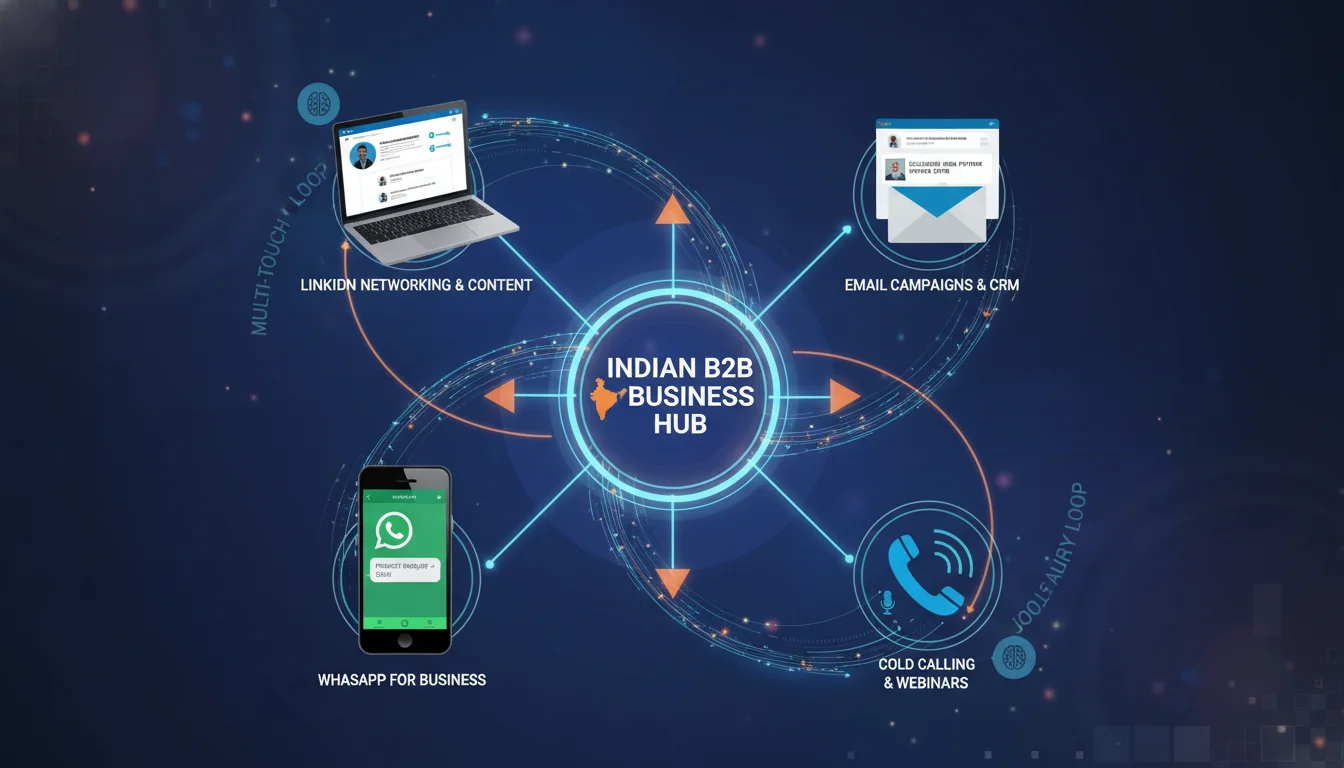
Once engagement is initiated, WhatsApp conversational marketing must take over. WhatsApp should serve as the primary conduit for lower-funnel engagement and lead nurturing. Once a lead opts in, automated WhatsApp flows, interactive buttons, and the delivery of rich media (PDF proposals, product videos, voice notes) should be deployed to nurture the prospect, schedule technical demos, and maintain real-time responsiveness, thereby drastically shortening the sales cycle and increasing conversions.
Content Ideas Specific to B2B Businesses in India
Content architecture must pivot sharply from broad, superficial promotional material to deep, utility-driven knowledge assets that aid the buyer’s independent research process.
- Data-Backed Case Studies and Whitepapers: Enterprises must produce detailed, narrative-driven analyses of how their product or service tangibly improved operational efficiencies, mitigated supply chain risks, or reduced costs for comparable Indian businesses. Highlighting specific metrics builds the requisite trust.
- Interactive Demos and ROI Calculators: To satisfy the “Millennial Researcher,” companies must provide interactive tools that allow the prospect to self-qualify, calculate potential financial returns, and interact with the product ecosystem independently, reducing the friction of requesting a demo.
- Vernacular Explainer Videos: Utilizing YouTube to distribute short-form, technically accurate video content in regional languages (Hindi, Tamil, Marathi) addresses specific industrial pain points prevalent in Tier 2 and Tier 3 manufacturing hubs, capturing an audience ignored by English-only campaigns.
Budget-Friendly Digital Marketing Approaches
For MSMEs and organizations operating with constrained marketing budgets, prioritizing high-yield, low-cost digital tactics is essential to compete with well-funded incumbents:
- Organic Local SEO and Search Optimization: Optimizing Google Business Profiles for regional visibility, maintaining structured and accurate contact data, and generating authentic regional client reviews ensures visibility when local buyers search for proximity-based B2B solutions. Basic website optimization for speed and mobile responsiveness is non-negotiable.
- Micro-Influencer Collaborations: Instead of contracting prohibitively expensive macro-influencers or celebrities, partnering with niche industry experts, regional technical consultants, and mid-tier LinkedIn thought leaders provides highly targeted credibility at a fraction of the cost.
- Community-Led Growth and Free Tools: Building owned communities (via LinkedIn Groups or specialized WhatsApp/Telegram channels) where industry professionals can exchange knowledge establishes the brand as a central, trusted facilitator. Utilizing accessible tools like Canva for creative assets, Zoho for basic CRM functionality, or WATI for WhatsApp automation allows single-person marketing teams to punch significantly above their weight class.
Keywords & SEO Opportunities
A defining, ubiquitous error in traditional B2B SEO strategy is the relentless pursuit of high-volume “head” terms that project the illusion of massive web traffic but fundamentally fail to generate qualified pipeline revenue. In 2025, search algorithms, AI-overviews, and user behaviors heavily reward contextual relevance, semantic depth, and precise search intent over mere keyword density.
High-Intent Keywords for Ranking
High-intent keywords signal that the searcher has progressed beyond the educational awareness phase and is actively evaluating solutions and preparing to make a financial commitment. For B2B companies, especially in specialized sectors like SaaS, manufacturing, and logistics, capturing these queries is critical because, while the search volume is lower, the competition is more manageable and the conversion probability is exponentially higher.
A highly strategic approach involves intent-layer analysis, meticulously categorizing keywords by the buyer’s cognitive phase within the sales funnel:
- Consideration Phase: Targeting “features-related keywords” that highlight specific product capabilities, aligning with users searching for exact functional solutions rather than generic software.
- Decision Phase: Capitalizing on “comparison and alternative keywords” (e.g., “[Competitor Name] alternatives in India” or “ vs for MSMEs”).
This strategy allows emerging brands to highlight their unique value propositions directly against entrenched, well-known giants, siphoning highly qualified, dissatisfied prospects away from market leaders.
Long-Tail Keyword Opportunities (India-Specific)
Long-tail keywords are hyper-focused queries, typically exceeding three or four words, that precisely match a user’s highly specific business problem or operational nuance. While they attract lower gross search volume, they reflect deep commercial intent and clarity, translating directly to higher conversion rates.
- For B2B SaaS: Rather than fighting enterprise giants like HubSpot or Salesforce for the incredibly broad keyword “project management tool,” a highly targeted, lucrative long-tail approach would involve optimizing for “affordable project management software for remote construction teams in India” or “CRM for real estate agencies with WhatsApp API integration”.
- For Manufacturing & Logistics: Instead of targeting generic terms like “steel suppliers” or “marketing software,” Indian manufacturers and B2B service providers should target granular phrases like “custom precision CNC machining services in Pune,” “JIT procurement of steel TMT bars for Kolkata real estate,” or “best marketing software for small manufacturing companies”.
- Question-Based Queries: Incorporating “how to,” “why,” and “what is” frameworks into extensive FAQ sections, technical blogs, and pillar pages captures decision-makers researching specific compliance or operational hurdles. Examples include, “How does cybersecurity software protect Indian MSMEs against data breaches?” or “What are the best global sourcing strategies for precision components?”.
Furthermore, the implementation of semantic clustering is vital. Grouping these numerous long-tail variations into comprehensive “topic clusters” anchored by a central, authoritative pillar page signals deep topical authority to both search engines and AI models, creating an interconnected web of content that dominates specific B2B niches. The research process must prioritize the intersection of volume, difficulty, and intent—the opportunity score—rather than chasing volume alone.
Implementation Roadmap
Transitioning from theoretical marketing strategy to tangible market dominance requires a meticulously phased, data-driven implementation roadmap. Success heavily hinges on establishing unshakeable foundational technical infrastructure before deploying aggressive, multi-channel growth tactics.
Short-Term Quick Wins (Month 1 to 3)
The immediate objective in the first quarter is to eliminate technical friction, optimize existing digital assets, establish robust outbound infrastructure, and identify immediate competitive vulnerabilities.
First, technical SEO and domain infrastructure must be addressed. Organizations must conduct a comprehensive technical audit of site speed, mobile responsiveness, and core web vitals, rectifying technical debt immediately. Simultaneously, a rigorous domain warm-up process for outbound email infrastructure must be initiated. Implementing proper email authentication protocols (SPF, DKIM, DMARC) is paramount to ensure future campaigns do not trigger aggressive spam filters; without this, cold email strategies are rendered entirely ineffective, regardless of the quality of the copywriting. Addressing cybersecurity infrastructure and ensuring data privacy compliance is also critical in this phase to build institutional trust.
Second, organizations must focus on asset optimization and local SEO. Optimizing Google Business Profiles for regional visibility, ensuring all NAP (Name, Address, Phone) data is consistent, and actively soliciting client reviews provides immediate localized visibility. Concurrently, a full audit of existing website content ensures high-intent, long-tail keywords are naturally integrated into metadata, headers, and primary service pages.
Third, CRM and WhatsApp integration must be executed. Deploying the WhatsApp Business API and integrating it directly with the existing CRM platform allows for immediate improvements in lead response times. Configuring automated “opt-in” flows and basic chatbot routing for immediate query resolution sets the stage for advanced conversational marketing. Finally, utilizing advanced SEO platforms to conduct an initial competitive gap analysis will identify precise keyword and content gaps where major competitors hold vulnerabilities, mapping these directly to content briefs for the upcoming quarter.
Long-Term Strategy (Month 6 to 12)
The secondary phase transitions into scaling content production, orchestrating complex multi-channel sequences, integrating influencer marketing, and applying rigorous performance benchmarking to ensure continuous optimization.
During this phase, the multi-channel sequence rollout begins. Organizations will launch parallel outbound campaigns, synchronizing personalized LinkedIn connection requests with highly targeted, deliverability-optimized cold emails, culminating in WhatsApp follow-ups for engaged prospects. This intricate orchestration establishes the critical multi-touch memory loop necessary to break through executive clutter.
Simultaneously, content authority and vernacular expansion take center stage. Marketing teams will begin publishing deep, data-driven topic clusters, prioritizing the creation of original industry research, whitepapers, and comprehensive, metric-driven case studies. To penetrate Tier 2 and Tier 3 markets effectively, top-performing content must be translated and culturally optimized into key regional languages like Hindi and Tamil. As the content engine scales, the focus shifts toward high-value enterprise accounts using Account-Based Marketing (ABM) strategies, personalizing the entire digital experience for decision-makers at specific target companies. Partnerships with B2B micro-influencers and industry thought leaders will be initiated to co-create content, host specialized webinars, and externally validate the brand’s technical expertise.
Crucially, this phase demands continuous benchmarking and optimization against established 2025 B2B industry standards to evaluate success objectively. Organizations must rigorously monitor their overall B2B website conversion rate, striving to hit or exceed the 1.8% average benchmark (with 3% considered good and 5%+ considered great). Email campaign efficacy must be tracked against the current B2B industry average open rate of 43.46% and an average click rate of 2.09%. Furthermore, marketing and sales leaders must collaboratively analyze the progression from Marketing Qualified Lead (MQL) to Sales Qualified Lead (SQL). In sectors like B2B SaaS, this conversion rate should hover between 13% and 40%, while Industrial and Manufacturing SaaS should aim for 16% to 18%, and Fintech between 11% and 19%. By tracking Customer Acquisition Cost (CAC) against these precise conversion metrics, organizations can continuously optimize the channels that yield the highest quality enterprise clientele.
Conclusion
The comprehensive digitization of the business-to-business sector in India is no longer an impending future trend; it is the fundamental, inescapable reality of the current market. As the traditional buyer journey radically compresses and the vast majority of vendor evaluation occurs anonymously via digital self-service channels and artificial intelligence models, an organization’s digital footprint serves as its primary, most vital sales apparatus. A sophisticated, fully integrated digital marketing strategy—one that harmonizes high-intent semantic SEO, deeply orchestrated multi-channel outbound sequencing, localized vernacular content, and highly responsive WhatsApp integration—is the sole mechanism capable of navigating the complex terrain of rising acquisition costs, logistical hurdles, and the paramount need for institutional trust. B2B enterprises that fail to architect and invest in these sophisticated digital ecosystems will inevitably and rapidly surrender market share to tech-forward competitors capable of engaging modern, decentralized, and highly skeptical buying committees.
To capitalize on these rapidly evolving market dynamics and execute these complex strategies effectively, organizations must partner with agencies possessing deep specialized, regional, and technical B2B expertise. Gurkha Technology, a premier digital marketing company operating in the region, is uniquely positioned to engineer these precise business transformations. With extensive, proven experience in crafting data-driven SEO strategies, orchestrating complex social media and search campaigns, and developing bespoke, full-funnel digital marketing architectures, Gurkha Technology empowers B2B businesses to fully optimize their digital presence. By leveraging the strategic, high-level consulting services of Gurkha Technology alongside the comprehensive, practical upskilling capabilities of their Digital Gurkha platform, B2B enterprises can systematically bridge the gap between their current operational state and sustainable, long-term digital revenue generation in the Indian market.