Digital Marketing for Indian IT: Report, Trends & Growth 2024
Industry Overview
The Indian Information Technology (IT) and Business Process Outsourcing (BPO) sector currently occupies a critical inflection point within the global economic landscape. Historically recognized as the premier destination for labor arbitrage, cost-effective backend services, and generalized offshore development, the industry is undergoing a profound structural and philosophical transformation. The contemporary Indian IT market is shifting rapidly toward high-value, intellectual property-driven solutions that encompass artificial intelligence (AI), advanced cloud architecture, machine learning, and complex digital transformation consulting. This evolution is necessitated by changing global demands and the rapid democratization of fundamental coding and IT maintenance tasks.
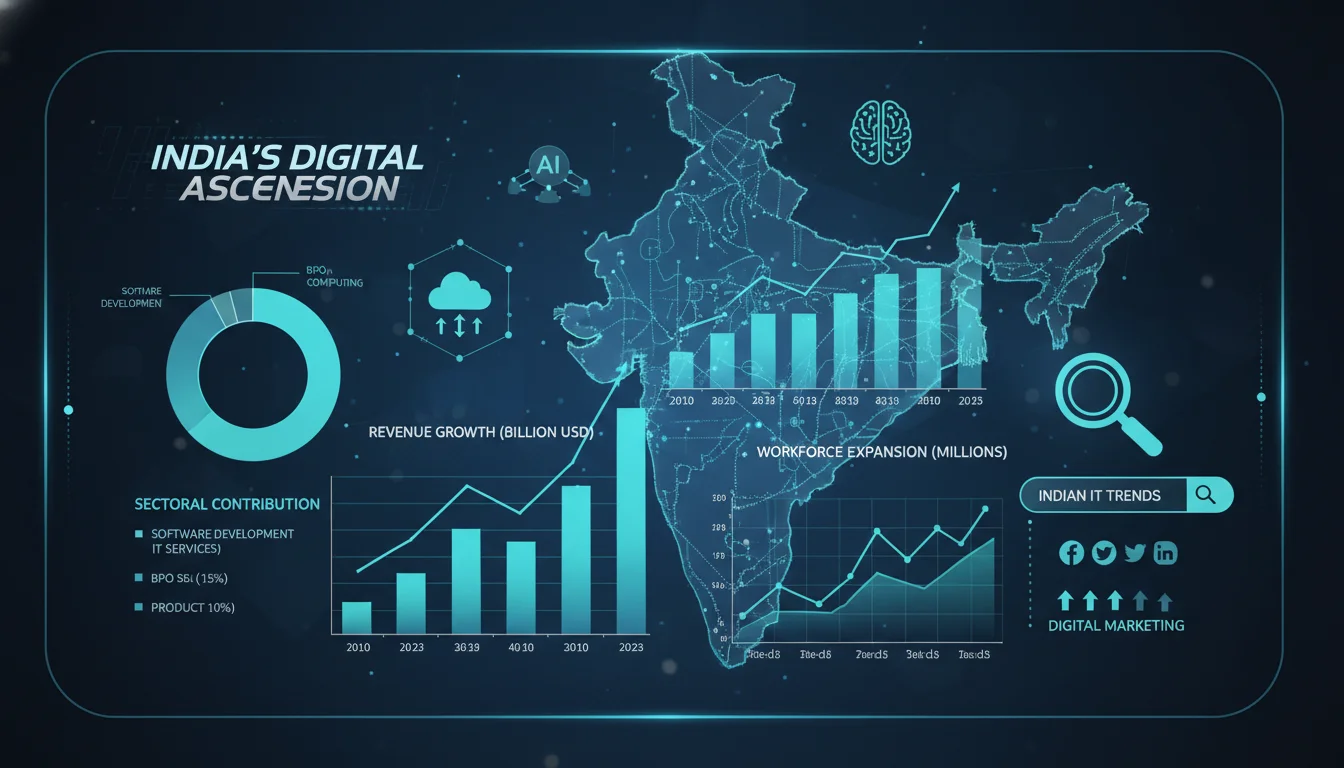
An analysis of current market size, growth projections, and financial trends highlights the sheer scale and momentum of this transition. The software market within India is projected to reach USD 18.4 billion by the end of the calendar year 2025, representing a robust year-over-year growth of 21.9% compared to the previous year. When evaluating the broader IT services market, valuations are expected to climb from USD 37.03 billion in 2025 to a projected USD 57.13 billion by the year 2030. The comprehensive IT and BPO services ecosystem is forecast to expand by an additional USD 214.8 billion from 2024 to 2029, accelerating at a highly competitive Compound Annual Growth Rate (CAGR) of 12.3%. Looking further ahead, the macroeconomic IT sector is projected to reach an unprecedented valuation of USD 350 billion by 2026, contributing an estimated 10% to the national gross domestic product of India.
This explosive financial growth is heavily segmented, indicating where specific marketing efforts must be directed. Application development and deployment (AD&D) software is expanding at a striking 31.2% CAGR, while cloud and platform services commanded a dominant 33.2% revenue share of the market in 2024. The AI market within India alone is expected to reach USD 28.8 billion by 2025, growing at an extraordinary 45% CAGR, largely driven by the expansion of Global Capability Centers (GCCs). Furthermore, niche verticals such as Managed Security Services are expanding at a 10.8% CAGR, underscoring the rising prioritization of comprehensive cybersecurity frameworks within a decentralized global digital economy.
Despite these overwhelmingly positive financial trajectories, the Indian IT ecosystem faces several systemic headwinds and key challenges that mandate an immediate strategic reboot in operational and go-to-market frameworks. The first major structural headwind is the intensification of global competition. The longstanding dominance of the Indian IT sector is being aggressively challenged by emerging technology hubs in Southeast Asia, Eastern Europe, and Latin America. These regions are courting global outsourcing deals with comparable technical proficiency and highly competitive pricing models, effectively eroding India’s traditional geographic and economic monopoly.
Compounding this issue is a fundamental shift in client expectations coupled with severe margin pressures. Modern corporate enterprises no longer seek mere service delivery or augmented staff; they demand rapid, highly customized, AI-integrated business solutions that directly impact their bottom line. Concurrently, there remains a comparatively low emphasis on domestic innovation among mid-tier firms, with a predominant focus still resting on traditional outsourcing rather than the creation of proprietary intellectual property (IP) or software-as-a-service (SaaS) products. This dynamic compresses profit margins and commoditizes their service offerings.
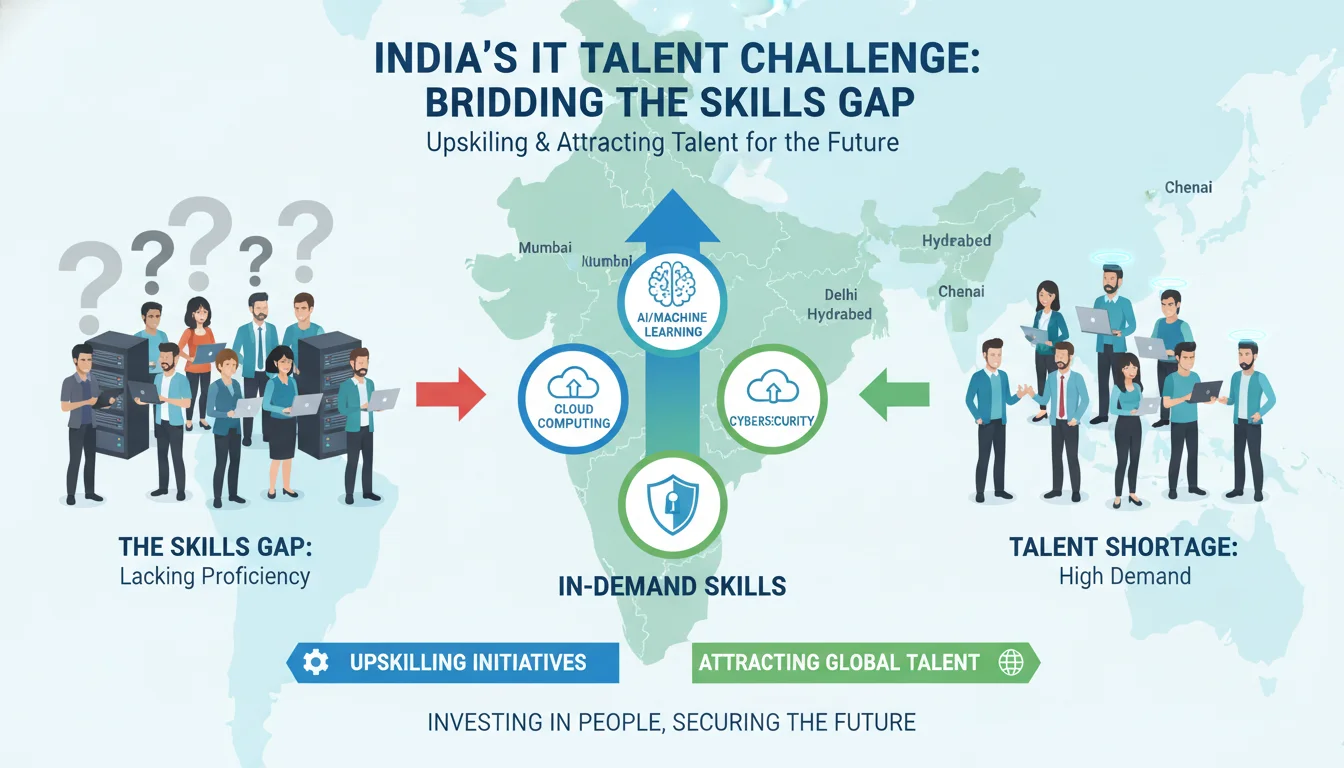
Furthermore, the industry is grappling with an acute talent shortage and a widening skills gap. The rapid acceleration of generative AI, cloud computing, and advanced cybersecurity protocols has vastly outpaced traditional educational curricula in the region. Consequently, IT companies face a critical shortage of specialized, senior-level talent. This dictates that a significant secondary function of any IT company’s digital market presence must involve robust employer branding to attract, recruit, and retain top-tier engineering talent.
The threat matrix is further complicated by escalating cybersecurity vulnerabilities and complex regulatory compliance requirements. As global supply chains digitize, cybersecurity threats have become increasingly sophisticated, with India projected to spend USD 3.5 billion on cybersecurity in 2025 alone to mitigate these operational risks. IT firms must constantly demonstrate stringent compliance and unimpeachable data security protocols to highly regulated international clients. Finally, analysts point to an overreliance on Global Capability Centers (GCCs) and American digital infrastructure. While GCCs generate immense employment, the domestic startup culture and independent data center capacity remain relatively weak compared to the dependence on foreign-owned entities, posing long-term strategic vulnerabilities for indigenous tech growth.
Digital Landscape in India (Contextual to the Industry)
To construct a highly effective, modern digital marketing architecture, it is essential to first analyze the digital consumption behaviors, connectivity metrics, and platform preferences of the Indian demographic, contextualized specifically for the business-to-business (B2B) technology sector. As of early 2024, India recorded an astonishing 751.5 million internet users, translating to an internet penetration rate of 52.4% of the total population. The digital media spending and consumption landscape has witnessed a definitive structural shift, with mobile platforms now commanding a dominant 78% share of total digital media expenditures, relegating traditional desktop consumption to a mere 22%.
Social media adoption is similarly expansive and pervasive, with 462 million active users comprising 32.2% of the national population. While these macroeconomic metrics predominantly reflect broader business-to-consumer (B2C) and general consumer behaviors, they exert a profound and unavoidable influence on B2B marketing strategies. The ubiquity of high-speed mobile connectivity—driven by highly affordable smartphones, plummeting data costs, and the aggressive national rollout of 5G infrastructure—means that enterprise decision-makers, procurement officers, and Chief Technology Officers (CTOs) are consuming industry intelligence, evaluating vendors, and reading thought leadership content continuously via their mobile devices, often outside of traditional working hours.
Platform popularity among the target B2B audience exhibits a dual nature. Professional networking platforms, predominantly LinkedIn, remain the absolute cornerstone for direct B2B lead generation, corporate brand building, and talent acquisition within the IT sector. However, the ad reach of platforms traditionally viewed as consumer-centric cannot be ignored. Meta’s platforms (Facebook and Instagram) maintain significant reach, each capturing around 25% of the total population, and Facebook’s ad reach in India is equivalent to 48.8% of the local internet user base. IT companies are increasingly leveraging these platforms not for direct enterprise sales, but for extensive employer branding, corporate culture dissemination, and retargeting campaigns that keep their brand top-of-mind during long B2B procurement cycles. Furthermore, the consumption of video content has surged, making YouTube a critical search engine and educational platform for technical product demonstrations, architectural explainers, and executive interviews.
The consumer online behavior related to IT procurement has undergone a massive psychological evolution. The traditional heuristic that B2B procurement is a purely logical, price-driven exercise conducted by a single rational actor has been fundamentally debunked. B2B decision-makers in the IT sector are human operators heavily influenced by cognitive biases, emotional factors, and brand perception. Modern B2B marketing must synthesize standard firmographic data—such as company size, annual revenue, and industry sector—with profound psychographic insights. Psychographic segmentation analyzes interests, opinions, overarching business goals, and corporate values, such as the increasing demand for sustainability and Environmental, Social, and Governance (ESG) compliance in IT supply chains.
The contemporary B2B technology buyer undertakes a highly fragmented, non-linear, multi-touchpoint journey. Research indicates that today’s procurement committees and executive buyers research across six to eight distinct digital touchpoints before making a definitive vendor decision. They are becoming increasingly selective regarding digital engagement, vastly preferring self-directed research through peer reviews, detailed digital case studies, third-party technical validations, and localized content before ever initiating contact with a sales representative. Consequently, outdated metrics such as pure page views or raw impressions are yielding to the necessity of high-intent behavioral tracking, where the objective is to capture the user precisely when their search intent transitions from broad informational research to acute transactional evaluation.
Digital Marketing Opportunities
Digital marketing for IT companies transcends mere lead generation; it serves as the primary strategic mechanism for overcoming the sector’s structural challenges identified previously. By deploying highly targeted digital interventions, IT firms can directly address the existential threats of global competition, talent scarcity, and shifting client demands.
To combat the threat of commoditization and intense global competition, a robust digital footprint establishes localized authority and unparalleled thought leadership, differentiating an IT firm based on its unique intellectual capital and problem-solving methodologies rather than reverting to a race-to-the-bottom hourly billing competition. To address the severe talent shortage, sophisticated employer branding campaigns—which communicate corporate culture, highlight extensive reskilling programs, and showcase technological innovation—must be continuously deployed across social channels to attract the scarce engineering talent necessary for growth.
The digital marketing landscape for IT enterprises in 2025 and 2026 is characterized by several high-leverage strategies and emerging paradigms. The most profound shift is the ubiquitous integration of Artificial Intelligence (AI) in marketing operations. AI is revolutionizing B2B marketing by automating routine analytical tasks, hyper-personalizing content delivery at an unprecedented scale, and utilizing predictive analytics to identify accounts that are actively in a buying cycle. This transitions seamlessly into the dominance of Account-Based Marketing (ABM). ABM has evolved from a niche tactical experiment to the central, non-negotiable framework for enterprise IT marketing. By utilizing complex intent data, IP recognition, and first-party identity graphs, IT firms treat high-value target accounts as individual markets, orchestrating highly personalized content across email, social media, and programmatic advertising.
Video storytelling and ephemeral content represent another massive opportunity. The “consumerization” of B2B marketing necessitates the strategic use of high-quality video formats. Short-form, highly engaging video content—ranging from technical explainer animations to employee-generated “day-in-the-life” content—humanizes the corporate brand and effectively communicates deeply complex software architectures to non-technical stakeholders who control the budget. Furthermore, as global data privacy regulations tighten and the industry transitions fully into the cookieless era, IT companies are pivoting heavily toward first-party data acquisition strategies. This involves developing gated, high-value technical whitepapers, proprietary industry reports, and interactive digital tools (such as ROI calculators or cloud migration assessment quizzes) to capture high-intent leads natively.
The efficacy of these methodologies is not theoretical; it is validated by extensive market outcomes and robust case studies from both global titans and agile Indian startups.
A prime example of global enterprise success utilizing localized digital strategy is Microsoft India. Utilizing LinkedIn’s advanced targeting and clean room technology, Microsoft deployed a localized “Brand-to-Demand” ABM strategy aimed specifically at the Indian mid-market segment. This campaign successfully influenced over 8,000 corporate decision-makers and cultivated a multi-million-dollar sales pipeline by moving away from generic global messaging. Similarly, Salesforce India recognized that their global brand campaigns failed to resonate with domestic Indian mid-market enterprises. They launched highly personalized regional campaigns on LinkedIn, combined with organic employee advocacy initiatives. This strategy resulted in a 170% growth in their share of the feed compared to key competitors, organically reaching an audience of 2.3 million professionals.
Beyond the mega-corporations, mid-sized firms and startups have demonstrated explosive growth through digital interventions. An emerging B2B Software-as-a-Service (SaaS) tech startup faced critically low visibility and an inability to rank for their core services. By engaging a specialized digital marketing agency to overhaul their technical Search Engine Optimization (SEO), heavily optimize high-intent BOFU (Bottom of the Funnel) keywords, and build authoritative industry backlinks, the firm secured top search engine rankings within a six-month window, resulting in a staggering 300% surge in highly qualified organic traffic. In another instance, a B2B software enterprise suffering from poor lead generation implemented a comprehensive content marketing matrix. They utilized deeply technical whitepapers and specialized articles aligned with automated, AI-driven email sequences. Within six months, their qualified lead volume increased by 200%, firmly establishing the firm as a definitive thought leader in their specific vertical and shortening their average sales cycle. Other notable global ABM successes include Snowflake driving $50 million in pipeline through blended digital and premium direct mail, and Adobe increasing average deal sizes by 60% through AI-led personalization for Fortune 500 accounts.
Competitive Analysis
An examination of the current digital presence of the top IT companies in India—often colloquially referred to as the “Big Six,” comprising Tata Consultancy Services (TCS), Infosys, Wipro, HCLTech, Cognizant, and Tech Mahindra—reveals a landscape of immense financial resources coupled with surprisingly rigid marketing execution. These entities utilize massive, global digital ecosystems to market highly complex enterprise solutions, leveraging their sheer scale, historical legacy, and vast global delivery networks.
Currently, their digital strategies are almost entirely dominated by the narrative of artificial intelligence integration and enterprise transformation. For instance, Cognizant, Infosys, TCS, and Wipro have recently positioned themselves via extensive digital PR as “Frontier Firms.” By deploying Microsoft Copilot and agentic AI across their enterprise frameworks, their marketing heavily promotes their unique capability to fundamentally redesign client workflows around human-agent collaboration. What they do exceptionally well is leverage their size to produce macro-economic research reports, host massive global technology summits, and secure vast amounts of traditional business media coverage. Furthermore, these organizations are strategically utilizing their “invisible architecture”—the backend algorithms, big data, and cloud platforms they develop—to promote powerful narratives around environmental sustainability and ESG compliance, which have become critical, non-negotiable purchasing criteria for massive European and North American enterprises. HCLTech, in particular, has leveraged digital marketing to highlight its software application portfolio and data management services, allowing it to capture smaller-scale, budget-friendly IT transformation projects to offset broader macroeconomic pressures.
However, despite possessing marketing budgets that eclipse the revenue of smaller firms, the digital marketing execution of these Tier-1 IT companies exhibits significant, systemic vulnerabilities that agile mid-tier IT firms and innovative startups can strategically exploit. An extensive analysis of the marketing strategies deployed by these giants reveals several critical gaps and lucrative opportunities for outperformance:
- The most glaring vulnerability is an overreliance on excessive technical jargon. The messaging promulgated by top IT firms regarding AI and digital transformation is frequently overly technical, esoteric, and dense. This approach actively alienates non-technical business leaders (such as CEOs, CFOs, and HR Directors) who ultimately control the procurement budgets. These stakeholders are strictly focused on business outcomes, risk mitigation, ROI, and productivity improvements, rather than algorithmic specifications or backend architecture.
- Secondly, these massive firms suffer from significant employer brand vulnerabilities. During periods of macroeconomic restructuring, mass layoffs, and talent transformation, the employer brand perception of massive IT firms often suffers immense damage in the digital public square. There is a distinct failure to consistently and authentically communicate reskilling initiatives, employee welfare, and individual career growth across social channels, leading to high attrition rates and negative sentiment on employer review platforms.
- Thirdly, their distribution strategy relies on a monolithic platform approach. The giants rely almost exclusively on professional networks like LinkedIn and high-profile global tech conferences. While this is undeniably effective for engaging incumbent C-suite executives, this monolithic approach severely limits their reach among younger technical prodigies, mid-level managers, and progressive decision-makers who utilize alternative digital communities, developer forums, video platforms, and interactive digital environments.

- Finally, while Tier-1 firms utilize Account-Based Marketing, the execution frequently lacks genuine depth.
The personalization at the enterprise level is rarely granular enough to resonate with the specific daily pain points of highly specialized roles within target organizations. Additionally, thematic cross-case results indicate a prevalence of “greenwashing” in their sustainability marketing—making broad, unsubstantiated claims about environmental impact—which savvy buyers and procurement algorithms increasingly recognize and reject.
Competitive Vector
In the highly competitive IT landscape, mid-tier firms and startups can strategically differentiate themselves from Tier 1 “Big Six” IT Firms by contrasting their approaches across several key dimensions:
Messaging Tone
Tier 1 “Big Six” IT Firms: Dense, highly technical, focused on technological capabilities and broad transformation.
Mid-Tier / Startup Opportunity: Human-centric, focused entirely on simplified business outcomes, clear ROI, and specific pain points.
Employer Branding
Tier 1 “Big Six” IT Firms: Corporate, sterile, vulnerable during restructuring phases.
Mid-Tier / Startup Opportunity: Authentic, employee-generated content, transparent culture, emphasizing rapid career growth.
ABM Execution
Tier 1 “Big Six” IT Firms: Broad, sector-wide targeting with superficial personalization.
Mid-Tier / Startup Opportunity: Hyper-granular, role-specific personalization addressing the exact KPIs of the individual decision-maker.
Content Formats
Tier 1 “Big Six” IT Firms: Lengthy whitepapers, traditional webinars, static corporate reports.
Mid-Tier / Startup Opportunity: Short-form video, interactive ROI calculators, dynamic product tours, engaging visual storytelling.
Agility
Tier 1 “Big Six” IT Firms: Slow to adapt to emerging digital trends; heavy bureaucratic approval processes.
Mid-Tier / Startup Opportunity: Rapid deployment of ephemeral content, quick adaptation to platform algorithm changes, aggressive niche SEO.
By actively avoiding technical obfuscation, focusing relentlessly on human-centric business outcomes, adopting agile multi-channel content strategies, and executing hyper-personalized, role-specific ABM, mid-sized IT firms can effectively bypass the marketing dominance of the industry giants.
Recommended Strategy for IT Companies in India
To capture market share and drive sustained revenue in this hyper-competitive environment, IT companies must abandon generic lead generation tactics and deploy a highly targeted, budget-efficient, and outcome-oriented digital strategy that recognizes the complexity of the modern B2B buying committee.
A robust strategy requires the meticulous delineation of distinct buyer personas. This goes far beyond basic demographics; it requires deep psychographic behavioral modeling to understand the internal motivations, career anxieties, and operational goals of the individuals making the purchasing decisions. In the B2B IT space, the buying committee is typically split into distinct archetypes.
The first persona is the Economic Decision Maker (e.g., CEO, CFO, VP of Operations). Demographically, they are typically aged 45–60, located in major global economic hubs (New York, London, Dubai) or domestic metropolitan centers (Mumbai, Bangalore, Pune). Psychographically, they are driven by risk mitigation, operational efficiency, cost reduction, and measurable return on investment. They are highly skeptical of technological buzzwords and care only about how software impacts the balance sheet. Their content preferences skew heavily toward executive summaries, definitive ROI calculators, financial case studies, and macro-trend analyses that prove business value.
The second critical persona is the Technical Evaluator (e.g., CTO, CIO, VP of Engineering, Lead Architect). Demographically aged 35–55, they are highly educated in computer science or systems architecture. Psychographically, they are motivated by system interoperability, strict cybersecurity resilience, infinite scalability, and developer experience. Their primary fear is vendor lock-in, technical debt, and catastrophic system failure. Their content preferences are strictly technical: comprehensive whitepapers, open API documentation, deep-dive architectural webinars, active GitHub repositories, and unfiltered peer reviews on platforms like G2 or Capterra.
To reach these personas, the recommended channels and campaign types must form a highly orchestrated omnichannel approach. Advanced LinkedIn Account-Based Marketing (ABM) is the absolute priority. IT firms must move beyond generic sponsored posts and utilize LinkedIn’s Advanced Insights, coupled with CRM integrations (like HubSpot or Salesforce), to identify specific companies exhibiting buyer intent. By serving targeted, role-specific ads directly to the buying committee within those accounts, firms can achieve outsized ROI, maintaining a low ad frequency but exceptionally high relevance.
This must be paired with an aggressive Search Engine Optimization (SEO) and Content Marketing architecture. IT firms should develop a “Topic Cluster” model on their corporate website. This involves creating exhaustive, authoritative pillar pages on broad topics (e.g., “Enterprise Cloud Migration”) surrounded by dozens of highly specific, long-tail blog posts that capture highly targeted, bottom-of-the-funnel search traffic. Furthermore, particularly for mid-tier firms and startups, Founder-Led Social Content is vital. The personal brand of the founders generates immense trust; consistent sharing of industry insights, technical learnings, and transparent behind-the-scenes company culture on LinkedIn is a high-ROI, low-cost mechanism to build immediate market authority.
Content ideas specific to the IT industry must cut through the noise. Firms should focus on “Before and After” Transformation Narratives—visual and data-backed case studies detailing exactly how the IT company solved a specific bottleneck for a client, complete with hard metrics (e.g., “Reduced server latency by 42%, leading to a $2M increase in client e-commerce revenue”). Content must focus on Simplifying Complex Technology, translating dense concepts (like LLM integration or DevOps pipelines) into accessible business language. Finally, a dedicated Culture and Employer Branding Series featuring employee spotlight videos and transparent discussions about corporate culture is essential to win the talent war.
For Indian IT startups and mid-sized firms, budget-friendly digital marketing approaches are critical for survival, as rising Customer Acquisition Costs (CAC) rapidly erode margins. Scaling IT companies must avoid the fatal trap of spending heavily on broad brand awareness before achieving product-market fit or establishing a predictable sales pipeline. During the Pre-Seed or Early Stage (with minimal budgets), the focus must be entirely on founder-led organic LinkedIn content, aggressive community building in specialized forums (e.g., GitHub, niche Discord servers, Reddit), and building ultra-fast technical landing pages optimized for search engines. Startups should strictly avoid hiring full-service PR agencies or running expensive paid brand campaigns at this stage. As the firm reaches the Seed or Growth Stage, the budget should shift toward establishing foundational technical SEO, producing high-quality technical blog content, and running highly constrained performance marketing tests (such as retargeting website visitors on LinkedIn) to capture existing demand efficiently.
Keywords & SEO Opportunities
In the highly lucrative B2B IT sector, raw traffic volume is a dangerous vanity metric; search intent is the ultimate currency. An IT consulting firm does not need ten thousand casual readers; it needs ten qualified enterprise buyers. Therefore, the SEO strategy must meticulously align with the psychological stages of the procurement cycle.
Search algorithms, including Google’s evolving AI Overviews, now deeply analyze user behavior patterns, click-through rates, and satisfaction signals to categorize search intent into four distinct phases. Informational intent drives early-stage research (e.g., “What is a headless CMS?”). Navigational intent occurs when a user searches for a known entity (e.g., “Infosys career portal”). Commercial intent represents the solution evaluation phase (e.g., “AWS vs Azure for mid-sized business”). Finally, Transactional or High-Intent queries indicate the user is ready to engage, evaluate a specific vendor, or make a purchase.
High-intent keywords for ranking deliver exponentially higher revenue per visitor because they capture users at the exact moment of decision. These queries universally contain commercial modifiers such as hire, pricing, agency, services, company, developer, quote, or location-specific terms. The strategic imperative is to build highly optimized “Bottom of the Funnel” (BOFU) service pages for these terms that feature immediate value delivery, prominent trust signals (certifications, enterprise client logos), and frictionless conversion paths.
Search Intent Category
Service Procurement
IT Industry High-Intent Keyword Examples: “hire dedicated software developers”, “IT consulting services near me”, “enterprise cybersecurity firm”
Psychological Indicator / User Status: The prospect has secured an approved budget and is actively seeking a vendor.
Solution Specific
IT Industry High-Intent Keyword Examples: “cloud migration services pricing”, “custom ERP software development company”, “Salesforce implementation partner”
Psychological Indicator / User Status: The prospect knows the exact technical solution required and is evaluating providers.
Comparative / Evaluative
IT Industry High-Intent Keyword Examples: “top SaaS development agencies in India”, “best managed IT service providers”
Psychological Indicator / User Status: The prospect is curating a shortlist for formal Requests for Proposal (RFPs).
While targeting high-intent head terms is essential, the reality of the search demand curve dictates that long-tail keyword opportunities are where mid-sized firms can truly dominate. Long-tail keywords are specific, multi-word search phrases that account for over 90% of all web searches.
While their individual search volumes are significantly lower, their collective volume is massive, and crucially, they face exponentially lower competition from the “Big Six,” making them far easier to rank for and highly lucrative. Furthermore, with the rapid rise of voice search and conversational AI engines, users are increasingly utilizing natural, complex sentences to find highly specific solutions.
A targeted, India-specific long-tail strategy involves systematically combining core service offerings with geo-modifiers, niche industry applications, or specific technology stacks.
Keyword Pattern Structure
India-Specific Long-Tail Examples (Forecasted for 2025/2026)
-
- “custom software development services in Pune”, “cybersecurity consulting firms in Bangalore”, “SEO services in Jaipur”
- [Industry Niche] + “fintech mobile app development company in India”, “healthcare ERP implementation services”, “B2B supply chain management software developers”
-
- “hire senior Flutter developer in Noida”, “certified Salesforce consultant in Mumbai”, “React Native app development agency India”
- [Modifier] + “affordable enterprise web development services”, “award-winning UI/UX design agency for startups”
To execute this effectively, advanced SEO professionals utilize Regular Expressions (Regex) within Google Search Console. Regex allows marketers to filter vast datasets of search queries, isolating those containing three or more words to precisely track the performance of these highly lucrative long-tail variations and identify emerging, hyper-specific search trends before competitors do. Furthermore, IT firms must optimize for “zero-click” searches by structuring content with clear headings and concise answers to dominate Featured Snippets and “People Also Ask” (PAA) sections, which are increasingly populated by AI Overviews.
Implementation Roadmap
To transition from abstract strategy to rigorous execution, IT companies must follow a structured, phased implementation roadmap. This roadmap prioritizes rapid revenue generation and technical hygiene in the short term, while simultaneously building long-term, compounding digital assets that ensure sustainable market dominance.
Phase 1: Short-Term Quick Wins (Months 1–3)
The primary objective in the first quarter is to capture existing market demand, ruthlessly optimize current digital assets, plug any leaking sales funnels, and establish the flawless technological foundation required for scalable growth.
The immediate priority is a comprehensive Technical SEO and Infrastructure Audit. Development teams must resolve critical website architecture issues that impede search engine crawling. This includes dramatically improving Core Web Vitals (specifically site loading speed and mobile responsiveness) and implementing advanced schema markup for local businesses and specific IT services to ensure maximum visibility in modern search algorithms. Concurrently, the marketing team must execute High-Intent Page Optimization. This involves revamping all existing service pages and landing pages. Marketers must integrate stark, clear calls-to-action (CTAs), place verified client testimonials and trust badges immediately above the fold, and seamlessly weave in the high-intent BOFU keywords identified during the research phase.
Within this initial window, the firm must also Activate Founder-Led Content. The organization should institute a rigorous, non-negotiable process wherein the C-suite and technical founders post consistently on LinkedIn. By focusing on authentic thought leadership, contrarian industry commentary, and deep technical insights, the leadership team begins building immediate organic authority without ad spend. To generate immediate pipeline, the firm should Deploy Targeted PPC and Retargeting campaigns. Launch highly constrained, budget-capped Google Ads campaigns targeting strictly bottom-of-the-funnel commercial keywords (e.g., “hire react native developers”). Simultaneously, implement a LinkedIn retargeting pixel to serve specialized case study ads to users who have previously visited the company’s specific service pages, ensuring no high-intent prospect is lost.
Phase 2: Long-Term Strategy and Authority Building (Months 6–12)
Once the technical foundation is secure and initial lead flow is established, the organizational focus shifts entirely to aggressive scaling, massive content proliferation, and sophisticated, enterprise-level account targeting.
The core of this phase is to Scale the Content Architecture. The marketing department must begin publishing exhaustive, technically rigorous long-form blog posts, whitepapers, and proprietary data reports targeting long-tail informational and comparative keywords. The architecture must utilize heavily interlinked “Topic Clusters“—where a massive pillar page is supported by dozens of niche sub-topics—to signal absolute topical authority to search engines and AI models.
Simultaneously, the sales and marketing teams must align to Operationalize Account-Based Marketing (ABM). The firm must transition away from broad, generic ad targeting toward surgical precision. Leadership should identify 50 to 100 absolute “dream” enterprise accounts. Marketing will then create highly personalized, unique digital content hubs for these specific companies and utilize LinkedIn’s advanced B2B targeting to serve customized ads directly and exclusively to the buying committee members within those exact accounts.
To support this, the firm must invest heavily in Video and Multimedia Integration. Producing high-quality video content to supplement written material is no longer optional. This includes detailed technical walkthroughs of software products, high-production-value client video testimonials, and live, interactive webinars discussing future tech trends (such as the integration of Generative AI in legacy systems). Finally, the firm must execute a sustained Digital PR and Link Earning campaign. Enhancing domain authority requires actively earning high-quality backlinks from reputable, global industry publications. This involves distributing highly newsworthy press releases regarding new technological capabilities, strategic executive hires, or the findings of proprietary, industry-specific research reports.
Conclusion
The Indian IT sector’s ongoing transition from a volume-based, low-cost outsourcing model to a value-driven, IP-centric global innovation hub necessitates a complete and irreversible recalibration of how these firms present themselves to the global market. In a contemporary era where basic technological proficiency is viewed merely as a baseline expectation and global competition is intensely fierce, the battle for high-value enterprise contracts, lucrative margins, and elite engineering talent is won and lost entirely on the digital frontier.
A sophisticated, deeply integrated digital marketing strategy—anchored firmly in psychological buyer personas, intent-driven SEO, high-precision Account-Based Marketing, and authentic thought leadership—is no longer a discretionary expenditure or a secondary function of the sales team; it is an absolute operational imperative for survival and growth. IT firms that persistently rely on outdated, jargon-heavy, and broad-spectrum marketing tactics will face rapidly diminishing returns, unsustainably escalating customer acquisition costs, and severe, irreversible degradation of their employer brand.
To execute a digital strategy of this required magnitude and technical complexity without dangerously inflating internal overhead, IT companies in India should strongly consider nearshoring their digital marketing operations to specialized agencies within the immediate subcontinent region. In recent years, Nepal has rapidly emerged as a highly strategic, exceptionally capable outsourcing destination for complex digital services. It offers a unique, powerful confluence of advantages: extreme cost-effectiveness (with minimum wages substantially lower than regional peers, allowing for massive budget efficiency and scalable marketing operations), a highly skilled, technologically proficient workforce where nearly 60% of professionals are highly comfortable with advanced IT functions, and absolute time-zone synergy with India.
In this highly competitive landscape, partnering with a premier, specialized digital marketing and technology firm such as Gurkha Technology provides a distinct, measurable competitive advantage. Based in Nepal, Gurkha Technology offers a comprehensive, enterprise-grade suite of services perfectly aligned with the exact needs of scaling IT companies.
This ensures that the IT firm’s digital storefront is not merely aesthetically pleasing, but architecturally sound, rapidly fast, and ruthlessly optimized for lead conversion. They provide premium, localized web hosting solutions with servers physically located in Nepal, guaranteeing 3-5x faster loading times for regional subcontinent visitors, ensuring strict data sovereignty, and providing relentless 24/7 technical support within the shared Nepal Standard Time (NPT) zone. Finally, reflecting their deep, native understanding of the IT ecosystem, they offer high-level strategic consultation on core system architecture, remote work infrastructure implementation, and vital cybersecurity endpoint protection, ensuring that an IT firm’s bold marketing claims are unequivocally backed by robust, secure technical realities.
By systematically leveraging the advanced capabilities, regional advantages, and technical depth of Gurkha Technology, IT companies in India can confidently deploy world-class, multi-channel digital marketing campaigns. These campaigns will reliably drive predictable, scalable revenue, firmly establish unshakeable global authority, and permanently secure their position at the absolute forefront of the ongoing technological revolution.