Google Ads, GBP & Maps: Integrated Local SEO Guide 2026
A Definitive Guide to Integrating Google Ads, Google Business Profile Optimization, and Google Maps Visibility in 2026

The commercial landscape of local search engine optimization (SEO) and paid digital advertising has undergone a paradigm shift. In 2026, the artificial intelligence architecture underlying Google’s search algorithms has fundamentally transformed how local businesses achieve visibility. The traditional separation between organic local search, represented by the Google Business Profile (GBP), and paid local visibility, executed through Google Ads, has dissolved. Today, these platforms operate as a unified, highly integrated ecosystem where organic data structures directly inform paid algorithmic targeting. Maximizing Google Maps visibility requires a sophisticated understanding of localized entity authority, behavioral signals, algorithmic predictive targeting, and the intricate regulatory frameworks governing international ad spend in emerging markets such as Nepal.
This comprehensive report provides a definitive blueprint and step-by-step process for optimizing a Google Business Profile, integrating it seamlessly with Google Ads, and deploying advanced local search advertising strategies. The analysis synthesizes the latest algorithmic updates, including the integration of Google’s Gemini AI and the conversational “Ask Maps” feature, while providing detailed methodologies for local search campaigns, Performance Max (PMax) deployment, offline conversion tracking, and navigating restrictive foreign exchange regulations for advertising billing.
The Algorithmic Evolution of Local Search and Ask Maps
The mechanics of Google Maps visibility are no longer strictly dictated by traditional geographic proximity and basic keyword matching. In 2026, local ranking algorithms are heavily weighted toward entity coherence, semantic relevance, and AI-driven conversational intelligence. The introduction of “Ask Maps,” powered by Google’s Gemini AI, allows users to execute highly nuanced, conversational queries that bypass traditional keyword interfaces entirely. Rather than searching for a broad term like “cafe,” a user might ask the map interface to identify “a quiet place for a client lunch with fast Wi-Fi and a vegan menu”.
To populate accurate results for these complex queries, the AI does not merely scan the business title or generic categories. It synthesizes review sentiment to understand the “vibe” of an establishment, analyzes visual proof via advanced computer vision to verify amenities, and cross-references data coherence across the business’s website, third-party directories, and the Google Business Profile itself. If the digital identity is not coherent across every channel Google touches, the entity is algorithmically demoted. Consequently, the hierarchy of local search visibility factors has been rebalanced to reflect this AI-first reality.
- Google Business Profile Signals: 32%. Primary category selection, accurate Name, Address, and Phone (NAP), keyword-rich descriptions, and comprehensively completed attributes.
- Review Signals: 20%. Sustained review velocity, total volume, owner response rates, and the presence of specific keywords or semantic themes within the customer review text.
- On-Page & Schema Signals: 15%. LocalBusiness structured data markup, mobile site speed (under three seconds), exact-match local keyword alignment, and entity authority.
- Behavioral Signals: 9%. Dwell time on profile, click-through rates, direction requests, and direct calls generated from the local pack interface.
- Link & Citation Signals: 14%. Consistent NAP across high-authority global and localized directories, and geographically relevant backlink profiles.
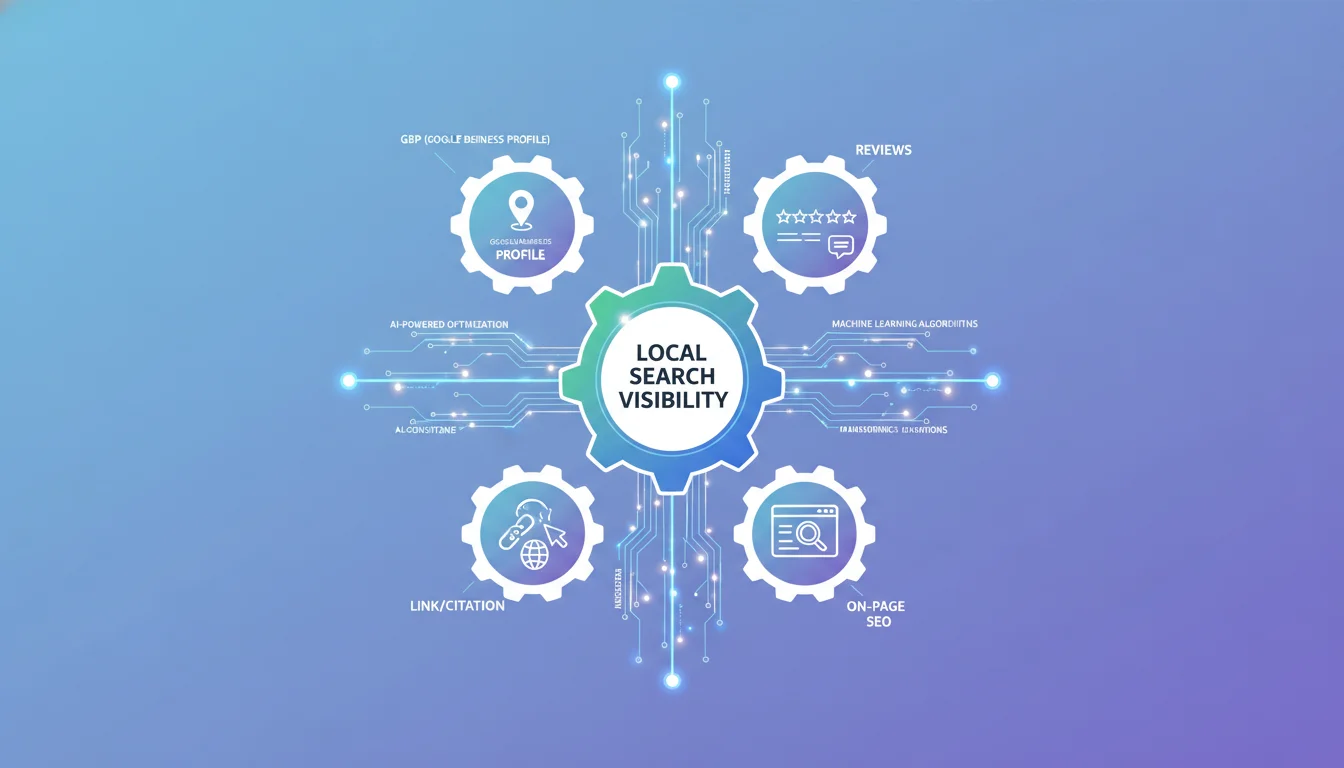
The convergence of these signals dictates a business’s organic prominence. However, even perfectly optimized organic profiles may face rigid distance limitations, as Google strictly filters results based on the searcher’s exact physical coordinates at the time of the query. To overcome these proximity filters and capture high-intent localized demand outside of a strict organic radius, businesses must deploy Google Ads utilizing Location Assets to create Promoted Pins and local search ads directly within the Maps interface. The resulting strategy must therefore be bipartite: establishing indisputable semantic authority through rigorous organic GBP optimization, followed by forcing spatial visibility through highly targeted Google Ads.
Step-by-Step Organic Google Business Profile Optimization
The Google Business Profile acts as the central node of a business’s local digital identity. In the era of AI-driven search, treating the GBP merely as a static directory listing is a critical strategic failure. It must be managed as a dynamic, data-rich entity that constantly feeds information to Google’s knowledge graph.
Establishing Entity Naming and Category Architecture
The optimization process begins with the business name. While Google’s guidelines prohibit keyword stuffing in the business title, algorithmic realities demonstrate that an exact match business name provides a massive ranking advantage on Google Maps. Sophisticated SEO practitioners often advise businesses to legally file a “Doing Business As” (DBA) for their highest-volume service combined with their city, creating a legally compliant entity name that perfectly matches user intent (e.g., “Kathmandu Emergency Plumbers” rather than just “Smith & Sons”). In highly competitive metropolitan areas, creating legitimately distinct profiles for separate service lines or physical locations provides more real estate in the Map Pack, provided these are structured correctly to avoid automated suspension.
Following the naming convention, category selection is the single most influential ranking factor for Google Maps organic visibility. Precision is paramount. A business must select the most specific category that accurately describes its core operational offering. A dental practice focusing on pediatric care should select “Pediatric Dentist” rather than the broader “Dentist,” just as a specific culinary establishment should select “Mexican Restaurant” rather than a generic “Restaurant”. Broad categories, while seemingly offering higher overall search volume, dilute semantic relevance and confuse AI classifiers, resulting in suppressed rankings for specific, high-intent queries. Following the primary category, businesses are permitted to add up to nine secondary categories to capture tangential service lines, which must be selected with equal rigorousness.
The “Services” tab, historically an underutilized feature, now serves as a direct, powerful SEO mechanism. Businesses must manually input all services offered, utilizing keyword-rich nomenclature. In 2026, Google’s AI crawlers actively cross-reference a business’s website “Services” pages with the GBP “Services” tab to verify domain expertise and factual consistency. If the services listed on the website do not match the structured data on the GBP, the entity’s authority score may be penalized for data incoherence.
Engineering Descriptions and Ask Maps Attributes
The business description allows for 750 characters to communicate the unique value proposition to potential customers. However, the approach to drafting this text has shifted fundamentally. It is no longer sufficient to write generic, superlative marketing copy. The description must be formatted as a structured, factual statement containing specific location markers, service details, and numeric data. This declarative formatting enables the Gemini AI to extract discrete facts to answer conversational queries. Businesses are advised to audit AI-generated descriptions provided by the dashboard’s “Suggest Description” tool, ensuring that AI-generated copy is manually refined and never left on autopilot.
Attributes play an equally critical, if not superior, role in AI search visibility. Features such as “outdoor seating,” “wheelchair accessible,” “free Wi-Fi,” or “women-owned” must be explicitly toggled in the dashboard. If a user queries Gemini for a restaurant that “accepts dogs,” the AI absolutely cannot recommend a location unless the specific pet-friendly attribute is verified within the structured data of the profile.
Winning visibility in Ask Maps requires proactive auditing; businesses must routinely test conversational queries related to their niche within the Maps application to observe whether their business appears, what the AI says about the business, and whether the attributes surfaced accurately represent the current operation.
Visual Search Dominance and Immersive Media
Google heavily prioritizes visual fidelity, utilizing computer vision AI to “read” and categorize images for niche searches. Higher-fidelity visuals currently receive a direct algorithmic prominence boost in the local pack, meaning professional lighting and high-resolution photography directly influence ranking. Best practices dictate the strict avoidance of stock photography, which the algorithm’s computer vision models easily identify and devalue as inauthentic. Instead, businesses must provide authentic representation through specific “action shots” of services being rendered, products being manufactured on the premises, or finished project outcomes (such as a plated dish or a newly installed roof).
Furthermore, the 2026 Maps layout heavily favors immersive media.
Businesses are encouraged to invest in 360-degree panoramic photos to enable augmented reality (AR) walkthroughs of their physical spaces. Soliciting customers to take short, vertical video clips during their visit feeds directly into Google’s immersive mobile Maps layout, significantly enhancing user engagement and behavioral dwell-time ranking signals. To maintain a competitive edge and signal ongoing operational vitality, profiles should be updated with three or more new photos or profile “Updates” weekly. Algorithmic data indicates that profiles possessing over 100 high-quality photos consistently outrank those with fewer than 10 in highly competitive markets.
Review Velocity and Sentiment Programming
The raw quantity of reviews is now vastly less impactful than the velocity and semantic sentiment of those reviews. A business with 150 reviews that consistently acquires 30 new reviews monthly will mathematically outperform a competitor with 400 stagnant reviews acquiring only two per month. The algorithm rewards sustained momentum, interpreting a steady influx of reviews as evidence of ongoing operational relevance. Consequently, businesses must build automated, systemic processes that generate reviews consistently without pause. Interestingly, achieving a perfect 5.0-star rating is not required to rank highly; an average of 4.5 stars or higher, combined with at least 20 recent reviews and active owner engagement, is entirely sufficient for maximum algorithmic benefit.
More importantly, the textual content within the reviews serves as the primary “source of truth” for the Ask Maps Gemini AI. The AI treats customer statements as verified facts. Therefore, businesses must engineer their review solicitation processes to encourage customers to mention specific amenities, staff names, location details, and detailed project outcomes. For example, guiding a customer to leave a review stating, “The vegan gluten-free options were great,” directly programs the AI to surface that business for subsequent dietary-specific queries. Every review, whether positive or negative, requires a response from the owner within 24 hours. The owner’s response should strategically incorporate targeted local keywords and reiterate service details, further reinforcing the semantic relevance of the profile for indexing. Additionally, businesses must establish Q&A monitoring, setting alerts so that any questions posed by the public on the profile are answered immediately, utilizing keyword-rich responses.
The Video Verification Gauntlet: A Step-by-Step Process
The acquisition of a verified Google Business Profile establishes the core trust signals required for AI Overviews and Maps prominence. Verification confirms legitimacy through documented evidence of an operating presence. However, the traditional, easily manipulated postcard verification method has been largely deprecated. In its place, Google has implemented a stringent, live video verification protocol that serves as a massive hurdle for many small businesses. This has introduced significant friction, particularly for service-area businesses operating without a public storefront or those in developing regions facing technical constraints.
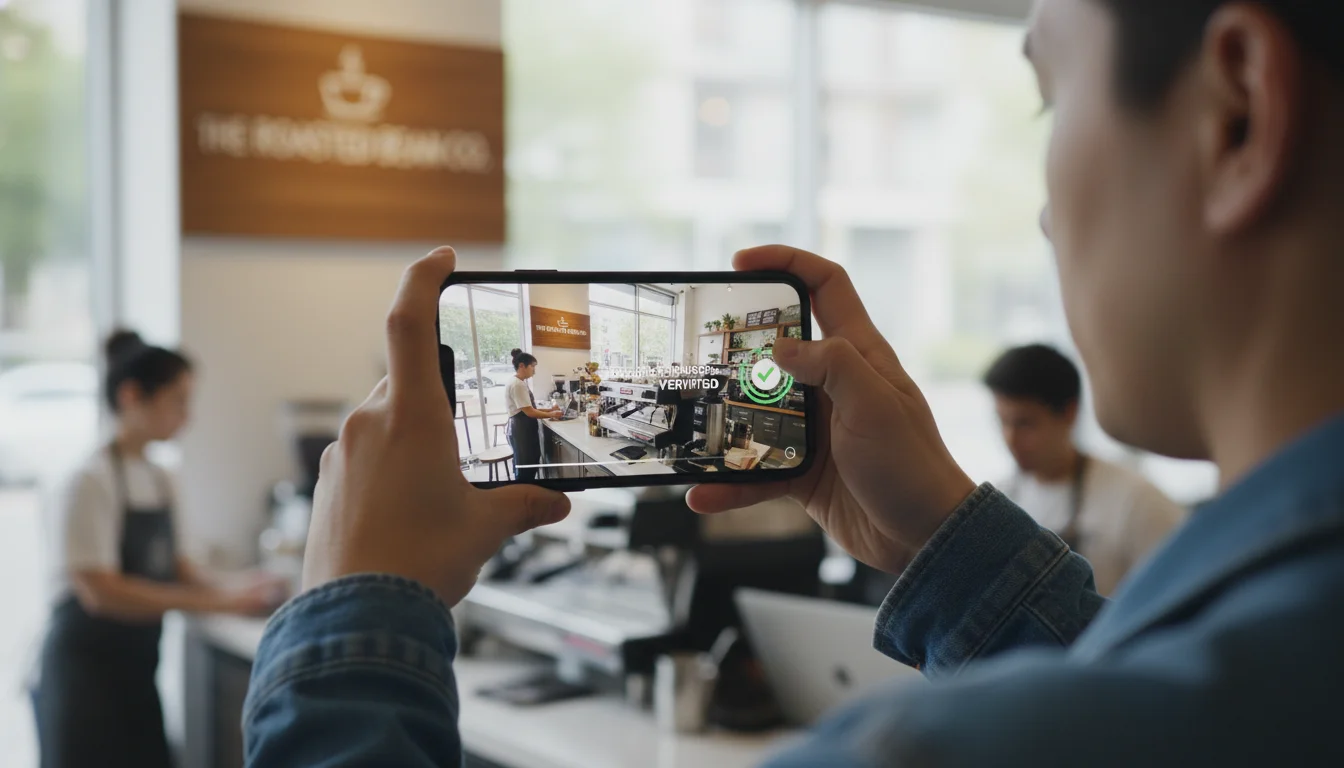
To pass the continuous-shot video verification process without triggering automated rejections, strict choreographic adherence is required. The process must be planned meticulously before the recording button is pressed.
- Preparation and Technical Settings: The individual executing the verification must navigate to the GBP dashboard on a mobile device, ensuring that the device’s location services (GPS) are explicitly enabled so Google’s systems can confirm the exact latitude and longitude of the recording. The video resolution should be lowered to keep the final file size under the 74-megabyte limit, and the total recording time must remain under two minutes to prevent server upload timeouts, which are a notorious issue with the platform.
- Geographic Proof: The video must commence outdoors, capturing permanent street signage, adjacent businesses, or recognizable local landmarks to verify the geographical context of the location.
- Exterior Branding and The “Elevator Hack”: The camera must smoothly pan to the business’s exterior, displaying permanent, affixed signage matching the exact name registered on the GBP. If the business is located within a multi-story office complex, the operator should utilize the “elevator hack,” beginning the video at the building’s exterior directory, recording the journey up the elevator, and ending at the specific suite door.
- Operational Evidence: Moving seamlessly indoors without cutting the feed, the video must showcase the workspace, current inventory, branded company vehicles, or the specific specialized equipment used to render the stated services.
- Proof of Management Authorization: Finally, the operator must demonstrate exclusive administrative access to prove they are an authorized representative of the entity. This is achieved by using keys to unlock restricted storage areas, successfully logging into point-of-sale (POS) systems, accessing staff-only kitchens, or opening a cash register. The display of sensitive customer data, employee faces, bank statements, or social security numbers must be strictly avoided, as this triggers privacy-related algorithmic rejections.
For service-area businesses—such as mobile locksmiths or emergency plumbers—who operate out of a home residence and travel to customers, the protocol requires demonstrating the branded service vehicle, tools of the trade, and marketing collateral stored at the residential base. Crucially, the registered base of operations must not exceed a standard two-hour driving radius from the outer boundary of the targeted service area, and the use of virtual offices, co-working desks, or P.O. boxes will result in immediate algorithmic suspension. If technical errors persist after multiple flawless attempts, businesses are advised to access the specialized Google verification troubleshooter tool to submit formal business registration documents manually.
On-Page Local SEO and the Citation Architecture
Establishing local prominence requires extending optimization efforts far beyond Google’s proprietary ecosystem. A holistic Local SEO strategy relies heavily on localized website architecture and external citation building. These external signals act as corroborating evidence, validating the claims made within the Google Business Profile.
Semantic On-Page Optimization
A well-optimized website acts as the verification ledger for the GBP.
While it is technically possible to gain some visibility without a website, Google uses the connected website to “double-check” facts in 2026; without a site, a business’s “Prominence” score is artificially capped. To rank highly in local map packs, the website must utilize exact-match local keywords within its title tags, meta descriptions, header tags (H1, H2), and URL slugs. For instance, a digital marketing agency operating in the Kathmandu Valley should explicitly target localized phrases such as “Digital Marketing Services in Lalitpur” rather than broad, highly competitive national terms. The inclusion of localized content referencing specific geographical landmarks (e.g., “Located near Patan Durbar Square”) helps ground the website’s geographic relevance in the eyes of search crawlers.
Furthermore, businesses servicing multiple distinct municipalities or districts must construct dedicated, unique location pages for each target area. If a contractor serves fifteen cities, the website requires fifteen distinct location pages, each featuring unique, highly relevant content regarding the specific services offered in that exact geography, complete with a deeply embedded Google Maps API specific to that location. Copy-and-paste templates where only the city name is swapped out are heavily penalized by modern search algorithms.
Technical performance is a direct, undeniable ranking factor. Mobile-friendliness is paramount, as the vast majority of local intent searches are executed on mobile devices. Page load speeds must be ruthlessly optimized to load in under three seconds; bloated sites with uncompressed images and cheap hosting suffer severe ranking penalties. The implementation of LocalBusiness schema markup into the website’s HTML header is mandatory. This structured data explicitly communicates the business’s precise Name, Address, and Phone number (NAP), alongside operating hours and geographic coordinates, directly to search engine crawlers in a universally standardized format, eliminating any semantic ambiguity.
Citation Building and Directory Synchronization
Search algorithms measure a business’s offline prominence by analyzing the consistency of its NAP data across the broader internet. Inconsistent citations—such as an old phone number listed on a regional directory or a slightly misspelled street address—create conflicting data points that erode entity trust and directly suppress Maps rankings. A robust citation strategy requires simultaneous listing on both high-authority international platforms and hyper-local niche directories.
Tier 1 International Ecosystems
Prominent Platforms: Apple Business Connect, Bing Maps, Facebook, Yelp, TripAdvisor, LinkedIn.
Strategic Value: Provides foundational domain authority, passing massive PageRank, and validates the business across dominant mobile and desktop operating systems.
Global Navigation Databases
Prominent Platforms: Foursquare, OpenStreetMap, TomTom, Here.
Strategic Value: Feeds underlying spatial data to automotive navigation systems, ride-sharing applications, and secondary map interfaces, solidifying spatial reality.
Regional Directories (Nepal Example)
Prominent Platforms: YellowPagesNepal.com, DirectoryKathmandu.com, NepalYP.com, B2Bmap.com.
Strategic Value: Generates highly localized backlinks and contextual relevance specific to metropolitan markets like Kathmandu, Pokhara, and Lalitpur.
Listing optimization on local directories is highly effective in emerging digital markets such as Nepal, because local SEO competition within the region remains relatively undeveloped compared to saturated Western markets. Securing accurate NAP listings on platforms like YellowPagesNepal or utilizing .np domain extensions creates immediate, undisputed spatial authority for businesses operating in those provinces.
Technical Integration: Bridging GBP and Google Ads
While organic optimization establishes baseline visibility, securing guaranteed prominence—especially for highly competitive commercial queries or dominating a specific geographic radius—requires paid amplification. The absolute prerequisite for running local search ads and Promoted Pins on Google Maps is the technical integration of the verified Google Business Profile with the Google Ads account. This linkage allows the ad delivery system to pull real-time location data, reviews, and images directly into the advertisement.
The integration is facilitated through the implementation of “Location Assets” (the modernized nomenclature for what were formerly known as Location Extensions). The procedural workflow for establishing this vital data bridge involves the following precise steps:
- Access Asset Management: The administrator must log into the Google Ads dashboard, navigate to the primary “Campaigns” menu on the left-hand rail, access the “Assets” dropdown within the section menu, and select the master “Assets” interface.
- Initiate Location Linkage: Click the blue creation button (represented by a plus icon) and select the specific “Location asset” option from the resulting menu.
- Domain Discovery: The system will automatically suggest a domain based on the ad account’s history, or the advertiser can manually enter the root domain of the business to prompt Google to scan its vast database for corresponding Business Profiles.
- Profile Selection: The advertiser narrows the search parameters by selecting specific countries via the pencil icon configuration tool, identifies the exact business entity from the populated list, ensures the preview matches the intended physical location, and clicks “Select” followed by “Continue”.
- Manager Account Linking (Alternative Workflow): Alternatively, if the advertiser actively manages the GBP via the exact same Google email infrastructure used for the Ads account, they may bypass the domain search by choosing “Link to a Business Profile Manager account I know.” They then select the managed account from the dropdown menu and apply business name or label filters if they are operating a complex chain or multi-location franchise.
- Approval Verification: Finally, the connection request must be explicitly approved. The administrator must navigate to the GBP dashboard in Google Search, access the three-dot “Business Profile settings” menu, click on “Linked accounts,” head over to the “Requests” tab, and formally accept the connection between Google Ads and the GBP.
Once synchronized, the ad account gains the powerful capacity to inject physical location data, live customer review ratings, and dynamic map routing directly into standard search and map-based advertisements.
Mastering Google Maps Ads: Promoted Pins and Bid Adjustments
With the architectural bridge connected, advertisers can deploy specialized paid strategies directly onto the Google Maps interface. Advertising on Maps is an exceptionally high-intent placement strategy designed to capture users at the exact moment they are actively navigating or researching local geographies.
The Mechanics of Promoted Pins
Promoted Pins appear as visually distinct, branded markers (often utilizing the business’s custom logo) directly on the map interface, breaking the visual monotony of standard organic red pins and drawing the user’s eye. When a user interacts with a Promoted Pin, an expanded local listing emerges, featuring direct engagement features such as click-to-call functionality, immediate direction routing, and website navigation links. This interface dramatically reduces friction in the customer journey, accelerating the transition from digital discovery to physical foot traffic and bridging the online-to-offline sales gap.
Crucially, advertisers do not create a standalone “Maps Campaign” to trigger these pins. Instead, they must enable Location Assets on standard Search or Performance Max campaigns and apply aggressive Location Bid Adjustments.
Strategic Location Bid Adjustments
A bid adjustment is a percentage increase or decrease applied to a base bid, allowing an advertiser to show ads more or less frequently based on the searcher’s precise physical location. Google Ads permits location bid adjustments ranging from a severe 90% decrease (-90%) to a massive 900% increase (+900%) relative to the base bid.
For example, consider a brick-and-mortar retail store in Kathmandu utilizing manual bidding with a base maximum Cost-Per-Click (CPC) of $2.00 for a specific keyword. To aggressively capture users physically located within a highly relevant one-kilometer radius of the physical storefront, the advertiser accesses the “Locations” targeting menu and applies a +200% location bid adjustment. When a mobile user standing inside that targeted radius searches for the product, the system calculates the localized bid as $2.00 + ($2.00 x 200%) = $6.00. This aggressive spatial bidding forces the Promoted Pin to outrank both organic listings and competing advertisers who are bidding broadly across the entire city, ensuring absolute visibility precisely where it matters most.
Campaign Architectures: Performance Max vs. Search Ads
The most consequential structural decision in localized Google advertising is the choice between deploying traditional Search campaigns and Performance Max (PMax) campaigns. Performance Max has fully deprecated older automated formats like Smart Shopping and Local Campaigns, positioning itself as Google’s default, AI-driven omnibus solution for 2026. However, the choice depends entirely on the business model and conversion goals.
Search Campaigns: The Architecture of Precision
Search ads represent the traditional “pull” marketing strategy. They operate strictly on high-intent keyword matching.
An advertiser supplies explicit terms (e.g., “emergency AC repair San Jose” or “best momo shop in Kathmandu”), and the text advertisement appears solely when those exact phrases are queried by the user.
The primary advantage of Search Campaigns is absolute control over intent, keyword targeting, exact ad copy, and the crucial ability to apply negative keyword exclusions to prevent wasted spend on irrelevant searches. They do not require complex creative visual assets, relying entirely on compelling copywriting. This architecture is the gold standard for direct-response lead generation, particularly for local service businesses (plumbers, electricians, legal professionals) where consumer intent is urgent, highly specific, and fundamentally text-based. For service businesses looking for absolute pay-per-lead certainty, Google Guaranteed Local Service Ads (LSAs) also exist outside the standard CPC model, charging businesses only when a valid phone call is generated from a verified profile.
Performance Max: The Architecture of Discovery
Performance Max relies on a fundamentally different “predictive” goal-based framework. It completely abandons manual keyword targeting. Instead, the advertiser establishes a conversion goal (e.g., “Local Store Visits”) and uploads an “Asset Group” comprising a vast matrix of text headlines, descriptions, high-resolution images, and YouTube video creatives. For retail businesses, this also involves connecting a meticulously formatted Google Merchant Center feed containing detailed product attributes (Titles, Brand, Price, MPN, GTIN). Google’s machine learning AI takes these assets and dynamically mixes them to generate native ad formats deployed simultaneously across the entirety of Google’s inventory: Search, Display, YouTube, Gmail, Discover feeds, and Google Maps.
The advantage of PMax is unprecedented scale. It acts as an automated customer acquisition machine, leveraging Google’s massive data sets to find prospective buyers long before they execute a formal search query. It is the ideal architecture for e-commerce operations, large multi-location retail brands, and businesses focused on aggressive market expansion.
Implementing PMax for Local Store Goals
To configure a PMax campaign explicitly designed to drive local map visibility and physical foot traffic, the setup must be rigorously structured:
- Objective Definition: Begin by selecting “Local Store Visits and Promotions” as the primary campaign objective within the setup wizard.
- Location Asset Synchronization: Ensure the Google Business Profile is accurately linked via the Assets menu, establishing the geographic centers for all ad delivery.
- Bidding Strategy Formulation: Select a bidding algorithm focused on maximizing conversion value, ensuring the system prioritizes individuals whose behavioral history suggests they are most likely to physically visit the location and make a purchase.
- Asset Group Assembly: Upload highly engaging, localized creative assets. Generic stock imagery will devastate a PMax campaign’s performance. Visuals must authentically showcase the physical storefront, local staff, and specific products available at that location.
- Audience Signals Integration: To accelerate the AI’s learning phase and prevent it from wasting budget on broad audiences, input robust “Audience Signals.” This involves uploading first-party data (past customer email lists), identifying competitor websites to create custom intent segments, and defining strict demographic parameters. These signals direct the algorithm toward the ideal customer profile before it begins its broader exploratory targeting.
A significant, well-documented risk with Performance Max in 2026 is the cannibalization of brand traffic. Because PMax spans all networks and aggressively seeks conversions, it has a tendency to claim credit for branded search terms that would have otherwise converted organically or through much cheaper, traditional Search campaigns. To counter this, sophisticated digital strategists deploy hybrid structures: running precise exact-match Search campaigns alongside PMax, while utilizing negative keyword lists and brand exclusions to force the PMax algorithm to hunt strictly for net-new customer acquisition.
Advanced Conversion Tracking and Offline Attribution
Optimizing local ad spend necessitates the meticulous tracking of offline attribution. If an advertiser cannot measure the physical actions resulting from a digital click, the AI algorithms powering Smart Bidding (Target CPA, Target ROAS) operate blindly. In 2026, Google Ads tracks specific “Local Actions” inherently linked to the GBP integration, providing baseline behavioral metrics:
- Clicks to Call: The number of times users click the “Call” button while interacting with the ad.
- Direction Requests: Engagements initiating Google Maps navigation routing to the physical address.
- Website Visits: Clicks routed specifically from the local ad interface to the domain.
- Menu Views/Orders: Vertical-specific actions for the hospitality sector indicating high purchase intent.
More profoundly, businesses with substantial physical foot traffic (e.g., auto dealerships, large retail chains, grocery stores) can utilize Store Visit Conversions. This proprietary measurement tool utilizes anonymized, aggregated statistics derived from millions of users who have opted into Google Location History on their mobile devices. The algorithm extrapolates physical visits to the store by linking an individual’s smartphone GPS location data back to their prior engagement with a Google Ad.
However, the automated nature of Store Visit tracking requires careful, cynical oversight by the advertiser. Google has implemented systems that auto-enable Store Visits for eligible accounts and assign default, “modeled” conversion values (for instance, arbitrarily assigning a flat $220 value to a physical visit, regardless of whether that specific individual purchased anything). These modeled conversions inject assumed, theoretical value into the data stream. If this inflated data flows back into a ROAS (Return on Ad Spend) bidding strategy, it can artificially make a poorly performing campaign look highly profitable, prompting the AI to spend more budget on low-quality traffic. Advanced advertisers must manually edit these conversion action settings, replacing default values with accurate figures derived from their own historically proven in-store closing rates and average order values. Furthermore, relying entirely on platform tracking is dangerous; with iOS updates and cookie restrictions fragmenting data, advertisers must implement enhanced conversions and connect backend CRM (Customer Relationship Management) offline sales data to capture the 30-40% of conversions that standard pixels miss.
The Macroeconomic Context: Funding Digital Campaigns in Nepal
Executing these advanced Google Ads strategies requires a fluid, unrestricted billing infrastructure. However, operating within emerging markets such as Nepal introduces severe macroeconomic and regulatory constraints dictated by the nation’s restrictive foreign exchange policies. The Nepal Rastra Bank (NRB) exercises tight capital controls over all foreign currency outflows to protect the nation’s foreign exchange reserves, historically limiting the ability of local digital marketing agencies and freelancers to deploy capital on international advertising platforms.
The Evolution of the “Dollar Card” Framework
Historically, standard Nepalese Rupee (NPR) debit and credit cards were functionally useless for international online payments, making direct participation in the global digital economy impossible for most citizens. In 2021, the NRB introduced a landmark amendment permitting Class A commercial banks and Class B development banks to issue Prepaid Foreign Currency Cards (colloquially termed “Dollar Cards”).
This initial framework allowed any Nepalese individual, firm, or company equipped with an updated KYC (Know Your Customer) form and a PAN (Permanent Account Number) card to obtain a single prepaid card. However, this card was strictly limited to a maximum transaction volume of USD 500 per fiscal year. While this facilitated basic digital access for purchasing web domains or software subscriptions, the $500 annual limit crippled digital marketing agencies attempting to run scalable Google Ads campaigns for local businesses.
To put this in perspective, benchmark data from 2026 indicates that the average Cost Per Click (CPC) in Nepal varies wildly by industry competition. E-commerce queries (e.g., “Online shoes Nepal”) command a low CPC of Rs. 8 to Rs. 25, while highly competitive queries in the education sector (e.g., “IELTS classes Kathmandu”) demand Rs. 80 to Rs. 250 per click. At these rates, a $500 annual budget is routinely exhausted within a matter of weeks by a single moderately aggressive campaign. This hard ceiling forced advertising agencies to rely on informal, legally precarious international payment channels—such as utilizing relatives abroad to pay invoices—to sustain their clients’ digital presence.
The 2026 NRB Policy Revisions: Strategic Divergence
Recognizing the economic bottlenecks strangling the domestic digital economy, and following heavy lobbying by entities such as the Advertising Association of Nepal and the CAN Federation, the NRB introduced critical amendments in 2026 through the Unified Circular 2081. This circular created a tiered foreign exchange limit based on specific industry classifications.
| Entity Classification | Annual Forex Limit | Regulatory Scope and Context |
|---|---|---|
| General Individuals & Standard Retail Businesses | USD 500 | Maintained from the 2021 framework. |
Limited to basic e-commerce, software subscriptions, and minor online purchases.
IT Sector & Software Entities
USD 3,000
A significant expansion targeted at boosting the information technology sector. Permitted explicitly for the purchase of software, cloud infrastructure, and IT-related services.
Service Exporters (IT Entities)
USD 5,000
Granted to technology firms that verifiably export services and generate foreign exchange inflows, incentivizing global digital trade.
Individual IT Freelancers (Foreign Income Earners)
Up to USD 25,000
Freelancers with documented foreign income remitted through formal banking channels can utilize up to $25,000 annually for digital services, matching their inbound revenue.
Operational Implications for Google Ads Management
While the expansion of limits for the IT sector has been widely celebrated, it introduces operational complexities and legal ambiguities for digital marketing agencies running Google Ads. The regulatory language explicitly permits the $3,000 limit for “software and IT-related services”. However, the classification of direct digital advertising spend (Google Ads, Meta Ads) versus backend software infrastructure (cloud hosting) frequently falls into regulatory grey areas, sparking ongoing debates over tax overlap and legal compliance.
Because advertising agencies act as intermediaries, routing ad spend on behalf of diverse local clients (restaurants, real estate firms, educational institutions), utilizing a single agency dollar card rapidly exhausts even the newly expanded $3,000 or $5,000 limits. Consequently, structural workarounds remain entirely necessary for sustained operations in 2026.
Best practices for digital marketers operating within these constraints dictate decentralizing the billing infrastructure:
- Client-Owned Billing: Agencies must require individual local business clients to procure their own USD 500 ECOM Dollar Cards from institutions like Global IME Bank or NMB Bank. The process is streamlined; clients can apply directly via mobile applications like Global Smart+, uploading their PAN certificate digitally for rapid approval.
- Account Segregation: The client’s distinct dollar card is inputted directly into their segregated, individually owned Google Ads account.
- Manager Account Oversight: The agency then utilizes a Google Ads Manager Account to link to and oversee the client’s account. This allows the agency to execute the complex technical optimization—such as PMax deployment, negative keyword sculpturing, and location bid adjustments—without acting as the financial conduit that triggers forex limits.
- Forex Documentation and AML Compliance: To ensure strict compliance with NRB Anti-Money Laundering (AML) regulations and capital flight monitoring, all Google Ads billing profiles must precisely match the PAN and KYC data associated with the underlying bank-issued dollar card. Furthermore, banks closely monitor transaction metadata; utilizing dollar cards for unauthorized capital transfers, such as repeated payments to cryptocurrency exchanges, is a criminal offense flagged by the Financial Information Unit (FIU) of Nepal, resulting in card seizure and legal penalties. Digital marketers must ensure their clients’ cards are used strictly for their intended advertising purposes.
Strategic Synthesis
Achieving dominance in Google Maps visibility in 2026 is an exercise in multi-disciplinary synchronization. A local business cannot rely on isolated tactics; the modern digital ecosystem demands deep, structural integration.
The foundation must be laid with a rigorously optimized, continuously updated, and video-verified Google Business Profile. This profile must utilize high-fidelity 360-degree imagery, highly specific primary categories, and structured, fact-laden text designed explicitly for ingestion by the Gemini AI and the Ask Maps conversational interface. This organic entity must be fortified by localized on-page SEO schema on a high-speed website, and corroborated by consistent NAP citations across both global navigation databases and regional directories specific to the operational market.
Simultaneously, this organic entity must be programmatically linked to Google Ads via Location Assets. This vital data bridge transforms the GBP from a static directory listing into a highly dynamic advertising asset. Advertisers must then intelligently bifurcate their paid strategy: deploying precise, intent-driven Search campaigns utilizing aggressive Location Bid Adjustments to secure Promoted Pins for immediate conversions, while simultaneously configuring Performance Max campaigns engineered with robust audience signals to drive predictive, omni-channel foot traffic.
Finally, the execution of these sophisticated digital architectures must be tightly managed against local macroeconomic realities. In restricted foreign exchange environments like Nepal, strategic structural decisions regarding billing segregation, dollar card procurement, and strict adherence to NRB compliance are just as critical to sustained digital visibility as the machine learning algorithms powering the advertisements themselves. Organizations that master this intricate synthesis of AI optimization, algorithmic bidding strategies, and financial regulatory navigation will capture an outsized, highly profitable share of localized commercial intent.