Framework: The Google Ads Efficiency Model
Many businesses in Nepal use Google Ads, but few operate it with true efficiency. They get stuck in a cycle of launching campaigns, seeing some results, and then watching costs creep up. The key to breaking this cycle is to move from being a reactive advertiser to an architect of efficiency.
The Google Ads Efficiency Model is a repeatable framework designed to do just that. It’s a system built on three pillars that work together to drive down your blended Cost Per Acquisition (CPA) and maximize your return on ad spend. If you’re wondering why Google Ads campaigns often fail in Nepal, adopting this model is the solution.
Pillar 1: The SKAG-to-Intent-Cluster Evolution
The foundation of a great account structure has evolved. Understanding this evolution is the first step.
Phase 1: Start with SKAGs (Single Keyword Ad Groups)
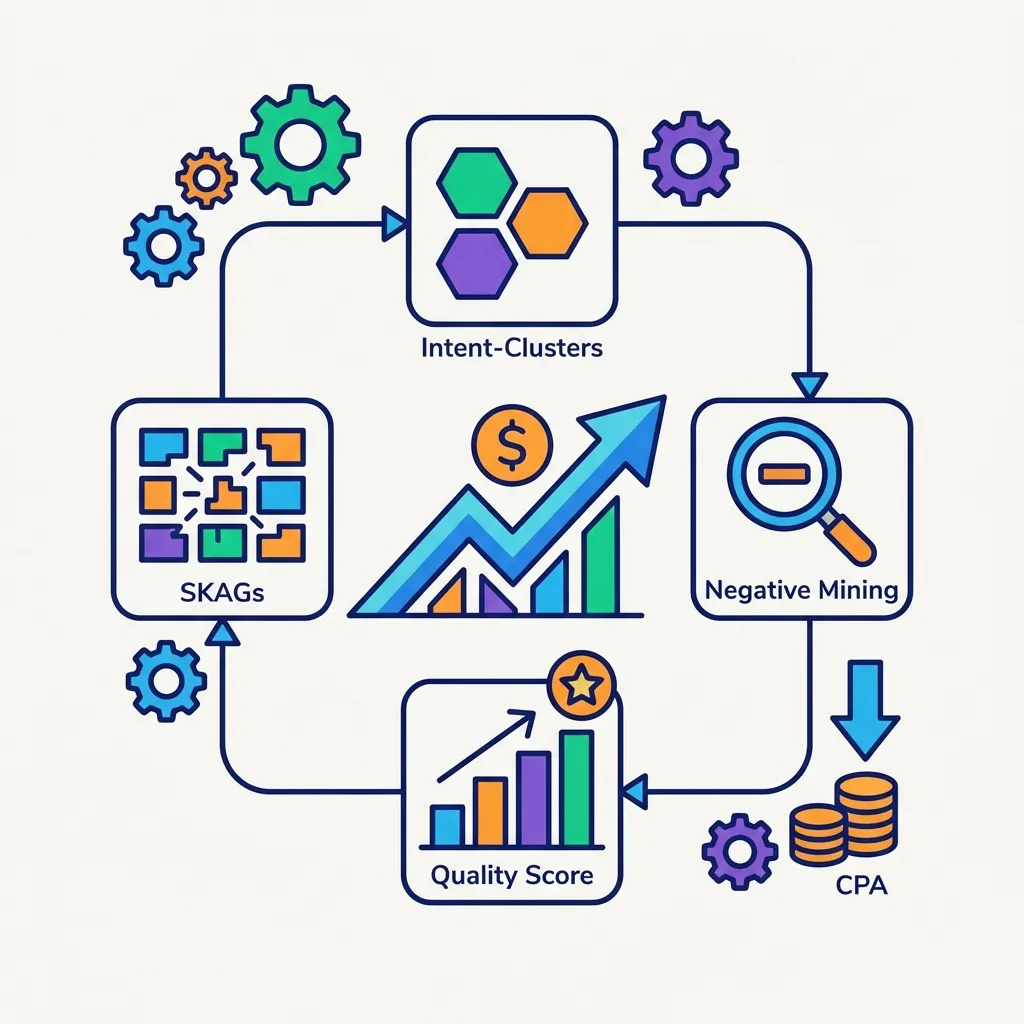
For years, SKAGs were the gold standard. The structure is simple: one ad group contains one keyword, which links to one highly specific ad and landing page. This approach is excellent for achieving maximum initial relevance and a high Quality Score because the message match is perfect.
Phase 2: Evolve to Intent-Clusters
While effective, pure SKAGs become incredibly cumbersome at scale. Furthermore, Google’s algorithm has become much better at understanding intent. The modern, more efficient approach is to use Intent-Clusters.
An Intent-Cluster is an ad group that contains a small, tightly-themed group of keywords that all share the exact same user intent. For example:
-
Keyword 1:
buy trekking shoes nepal -
Keyword 2:
trekking shoes online price -
Keyword 3:
best store for trekking shoes
All three keywords show a clear commercial intent to purchase trekking shoes. By grouping them, you can:
- Simplify Management: Drastically reduce the number of ad groups.
- Aggregate Data: Pool performance data, which helps Google’s automated bidding strategies learn faster and more effectively.
- Align with Google’s AI: Work with Google’s intent-matching capabilities, not against them.
Pillar 2: Proactive & Aggressive Negative Mining
This is the single most important activity for eliminating wasted ad spend. The goal is to stop paying for clicks that will never convert. This is a key part of any PPC audit.
- The Search Terms Report is Your Goldmine: On a weekly basis, you must analyze the Search Terms Report to see the actual queries that triggered your ads.
-
Mine for Two Types of Negatives:
- Irrelevant Queries: These are obvious non-fits. If you sell premium coffee and your ad shows for “cheap coffee beans,” you add “cheap” as a negative keyword immediately.
- Cross-Contamination Queries: This is more advanced. A user searches for “digital marketing course free,” and it triggers an ad in your “digital marketing services” campaign. The query is relevant to your business, but not to that campaign. You should add “free” and “course” as negative keywords to that specific campaign to force such traffic to a more relevant campaign (or to no campaign at all).
- Build Shared Negative Lists: Create and apply account-wide negative keyword lists for terms you never want to show up for, such as “jobs,” “careers,” “reviews,” or competitor names. This is your first line of defense.
Pillar 3: Relentless Quality Score (QS) Uplift
Quality Score is Google’s rating of the quality and relevance of your keywords and ads. A high QS is the key to a lower Cost Per Click (CPC). A lower CPC directly leads to a lower CPA.
Focus on its three core components:
- Ad Relevance: Ensure your ad copy is tightly themed to the keywords in the ad group. Use the keywords directly in your headlines and descriptions. The evolution to Intent-Clusters makes this easier to manage than with thousands of SKAGs.
-
Expected CTR (Click-Through Rate):
- Continuously A/B test your ad copy. Always be testing a new headline or description.
- Use compelling, action-oriented Calls-to-Action (CTAs).
- Utilize every relevant ad extension (sitelinks, callouts, structured snippets, image extensions). Extensions make your ad bigger and more clickable.
-
Landing Page Experience:
- Message Match: Your landing page must be a seamless continuation of your ad’s promise.
- Optimize for Speed and Mobile: This is critical in Nepal. A slow or clunky mobile page will destroy your QS.
- For more on this, see our guide to landing page best practices in Nepal.
The Result: A Lower Blended CPA
Your blended CPA is your total ad spend divided by your total conversions. These three pillars work in concert to drive it down:
- Intent-Clusters improve relevance and data for smart bidding.
- Negative Mining stops budget leakage on irrelevant clicks.
- QS Uplift lowers the cost of every single click you pay for.
The combined effect is a powerful, systematic reduction in your cost to acquire a customer.
graph TD
    P1["Pillar 1: SKAG-to-Intent-Cluster Evolution"] --> I1("Improved Relevance & Data for Smart Bidding");
    P2["Pillar 2: Proactive Negative Mining"] --> I2(Eliminates Budget Leakage);
    P3["Pillar 3: Relentless Quality Score Uplift"] --> I3(Lowers Cost Per Click);

    I1 & I2 & I3 --> CPA[Lower Blended CPA];

    style P1 fill:#f9f,stroke:#333,stroke-width:2px
    style P2 fill:#ccf,stroke:#333,stroke-width:2px
    style P3 fill:#cfc,stroke:#333,stroke-width:2px
    style CPA fill:#fcc,stroke:#333,stroke-width:2px,font-weight:bold
Figure 2: The Google Ads Efficiency Model Pillars and Impact
Ready to Build Your Efficiency Model?
Implementing this framework requires discipline and a strategic mindset. It’s the difference between just “running ads” and engineering a high-performance lead generation machine. Avoid common PPC mistakes.
If you’re ready to move to the next level of Google Ads management, I offer PPC consulting services to help you implement this efficiency model in your business. Let’s connect and turn your ad spend into a true growth engine.
Related Posts and Resources
- Digital Marketing in Nepal (Complete Guide)
- Google Ads in Nepal: Practical Strategy
- SEO Analytics for Nepali Businesses
- eCommerce Analytics Setup in Nepal
- eCommerce Metrics That Matter
- Email Marketing Guide for Nepal
- Email Marketing ROI in Nepal
- Facebook Ads Budget Guide (Nepal)
- Cultural PPC Strategy for Nepal
- Competitor Analysis Framework for Nepal \n\n## Visual Summaries\n
graph TD
    A[SKAGs (Single Keyword Ad Groups)] --> B{Key Traits};
    B --> B1("1 Keyword:1 Ad:1 LP");
    B --> B2(High Initial QS);
    B --> B3(Cumbersome at Scale);

    A -- "Evolve To" --> C["Intent-Clusters"];
    C --> D{Key Traits};
    D --> D1("Tightly-themed Keywords");
    D --> D2(Same User Intent);
    D --> D3(Simplified Mgmt);
    D --> D4(Aggregated Data);
    D --> D5(Aligns with Google AI);

    style A fill:#f9f,stroke:#333,stroke-width:2px
    style C fill:#ccf,stroke:#333,stroke-width:2px
Figure 1: SKAG to Intent-Cluster Evolution