Gamification 101: Engaging Nepali Students without Expensive Technology
Why can a student focus on PUBG Mobile for 4 hours straight but fall asleep after 10 minutes of a Science lecture?
It’s not because PUB-G has better graphics than your whiteboard. It’s because games have immediate feedback loops.
- Do something good? +100 Points.
- Complete a mission? Level Up.
- Fail? Try Again.
School, on the other hand, often feels like:
- Do something good? Wait 3 months for exam results.
- Fail? You are bad at this forever.
We can fix this. And we don’t need iPads to do it.
The Low-Tech Leaderboard
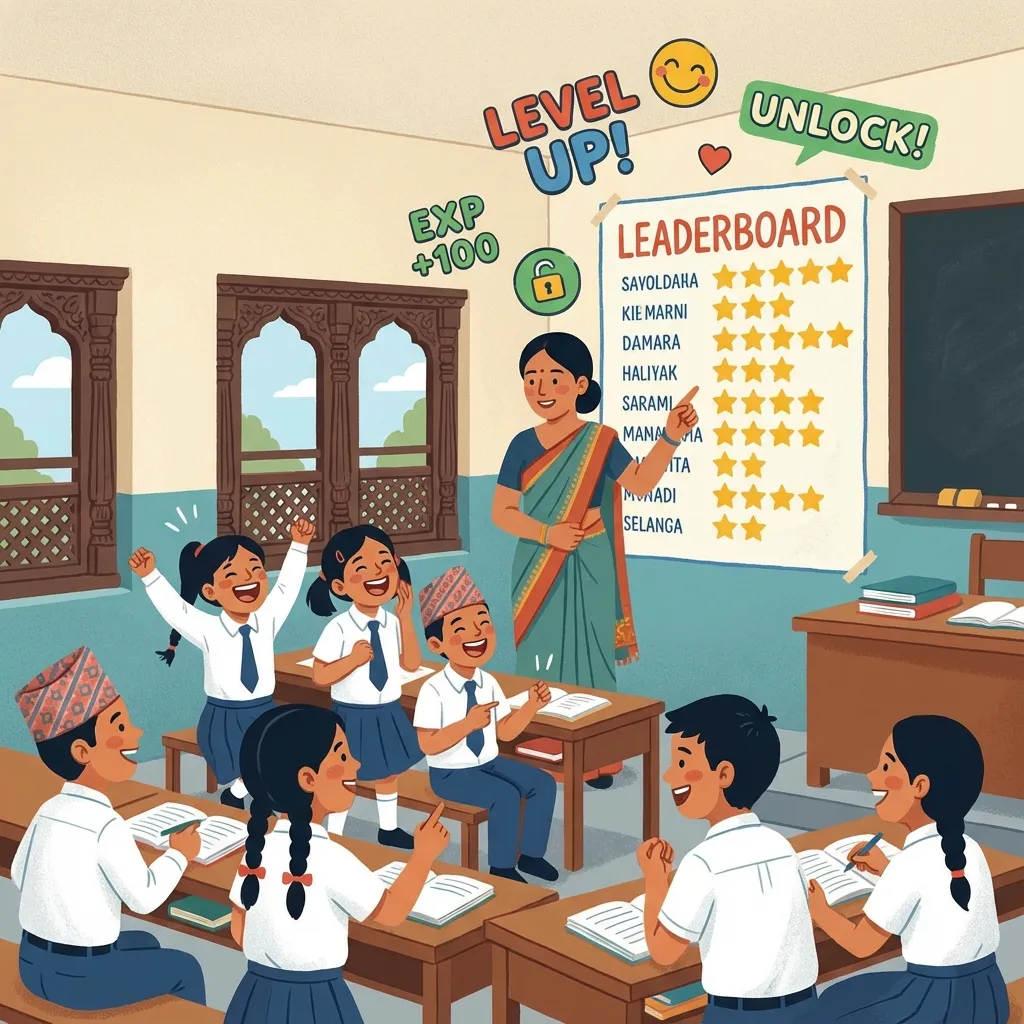
Buy a large chart paper. Draw a grid. Write every student’s name. This is your “Server.”
The Rules of the Game
-
XP (Experience Points): Don’t give “marks.” Give XP.
- Homework on time: +50 XP.
- Helping a friend: +20 XP.
- Asking a good question: +10 XP.
-
Levels:
- 0-500 XP: Novice
- 500-1000 XP: Apprentice
- 1000+ XP: Master
- Perks: At Level 5, you can sit wherever you want. At Level 10, you can skip one homework assignment.
Why This Works in Nepal
In our culture, we love competition. But traditional classrooms make competition scary (Pass/Fail). Gamification makes competition fun (High Score).
It changes the psychology of the student. Instead of thinking, “I have to do this boring homework,” they think, “I need 50 more XP to reach Level 5.”
Tools for the “Teacher Developer”
If you have a projector and internet, try Kahoot! or Quizizz. They turn quizzes into a game show. The energy in the room will change instantly.
If you have no electricity, use the chart paper. Use stickers. Use vocal sound effects when someone gets an answer right.
The Goal
The goal isn’t to turn school into a game. The goal is to acknowledge that learning is hard work, and we process hard work better when we feel like we are making progress.
Don’t just teach. Be the Game Master.
Related Posts and Resources
- Low-Tech, High-Impact Teaching in Nepal
- Coding for Teachers in Nepal
- Data-Driven Grading for Educators
- Open-Source Schools in Nepal
- Cyber Hygiene for Students and Teachers
- Flipped Classroom in Nepal
- CS Unplugged Activities in Nepal
- School Wi-Fi Budget Planning
- AI-Based Assessment in Nepal
- Digital Marketing in Nepal (Complete Guide)