Best Accounting Software for Freelance Developers 2026
Best Automated Invoicing and Accounting Software for Freelance Developers in 2026

The Shifting Financial Paradigm for Independent Software Engineers
The financial operational landscape for freelance software developers has undergone a profound structural transformation by the year 2026. Historically, independent software engineers and technical consultants were forced to adapt their workflows to accounting software that was fundamentally designed for traditional retail, manufacturing, or service businesses. These legacy financial systems prioritized inventory management, point-of-sale hardware integrations, and complex organizational payroll hierarchies. Such features offer little to no value to the solo developer or micro-agency whose primary deployable assets are time, intellectual property, and version-controlled code commits. A freelance developer’s operational demands differ fundamentally from those of a standard small business owner. Their workflow is inherently fragmented across issue trackers, version control repositories, and integrated development environments (IDEs). Consequently, financial administration—such as generating invoices, reconciling bank feeds, and managing cross-border tax liabilities—is often viewed as a high-friction context switch that severely disrupts the deep, focused work required for complex software engineering.
The current paradigm demonstrates a sharp bifurcation in the accounting software market. On one end of the spectrum, massive software-as-a-service (SaaS) platforms have integrated deeper application programming interfaces (APIs), automated workflows, and developer-centric capabilities to capture the high-value technology freelancer demographic. On the other end, a robust, highly technical ecosystem of headless financial infrastructure, plain text accounting tools, and offline-first self-hosted applications has emerged. This secondary ecosystem satisfies the developer’s inherent desire for absolute data ownership, minimal latency, cryptographic security, and zero vendor lock-in.
Navigating this complex landscape requires a comprehensive understanding of how specific software architectures align with a developer’s distinct operational scale. A solo developer engaged in a handful of high-ticket, long-term enterprise consulting contracts annually requires an entirely different financial stack than a freelance developer managing dozens of smaller, concurrent hourly projects across international borders. Furthermore, the global regulatory environment has grown increasingly complex. The implementation of stringent global digital tax regulations, most notably the European Union’s Value Added Tax in the Digital Age (ViDA) initiative taking effect in 2026, has shifted the burden of real-time tax compliance directly onto the shoulders of independent digital service providers.
The subsequent analysis provides an exhaustive, granular examination of the automated invoicing and accounting software ecosystem available to freelance developers in 2026. This report categorizes these solutions by their architectural paradigms, underlying technical capabilities, API extensibility, and capacity for global financial scalability, providing a strategic framework for developers to optimize their financial operations.
Evaluating Commercial SaaS Accounting: The API-First Imperative
For freelance developers scaling their operations into small agencies, or those requiring seamless collaboration with certified public accountants, traditional commercial accounting platforms remain the most reliable choice for maintaining rigorous double-entry compliance and generating audit-ready financial statements. However, the true utility of these platforms for a software developer hinges entirely on their API extensibility, the robustness of their developer documentation, and their ability to automate tedious reconciliation tasks.
Zoho Books has rapidly emerged as a dominant force and a highly preferred platform for developers seeking deep programmatic control over their financial operations. The platform’s fundamental advantage lies in its API-first design methodology and its robust, native support for international commerce. Zoho Books provides a comprehensive, REST-compliant API that enforces predictable resource URLs and utilizes modern OAuth 2.0 protocols for secure authorization. The documentation explicitly details endpoints for managing the entire invoice lifecycle. Through the API, developers can programmatically create invoices, submit them for managerial approval, generate and distribute secure payment links, and automate complex recurring billing cycles.
The unparalleled power of Zoho Books for a developer lies within its internal scripting and automation ecosystem. Through the use of custom Deluge scripts, webhooks, and custom schedulers, developers can execute intricate business logic directly within the accounting platform’s environment. For instance, a developer can easily configure a webhook that triggers an external serverless function (such as an AWS Lambda or Cloudflare Worker) to automatically provision a new cloud staging environment the moment a client’s initial retainer invoice is marked as paid via the API. Furthermore, Zoho Books natively resolves the multi-currency ledger issues that severely plague its competitors. It provides real-time foreign exchange rate updates and unified financial reporting for international transactions, which is critical for developers serving a global client base. For developers operating within tight bootstrapping budget constraints, Zoho Books also offers a highly capable free tier designed for businesses with low annual revenue, making it a strategically sound, risk-free entry point.
Conversely, FreshBooks has maintained a strong reputation as an intuitive, non-accountant-friendly platform that excels in rigorous accounting features and client-facing aesthetics. In 2026, its pricing architecture is structured across multiple tiers to capture developers at various stages of their freelance journey. The Lite plan, positioned at an introductory rate of $6.90 per month under promotional pricing (standard $23.00), restricts users to five active clients. This serves as an artificial ceiling for high-volume freelancers but suffices perfectly for senior developers engaged in exclusive, long-term enterprise contracts. Scaling to the Plus plan at $12.90 per month (standard $43.00) expands this limit to fifty clients and introduces indispensable features such as double-entry accounting reports, bank reconciliation, and automatic expense receipt data capture.
Despite its highly polished user interface and excellent mobile application experience, freelance developers operating across international borders frequently encounter severe architectural limitations within FreshBooks. The platform robustly supports multi-currency invoicing, allowing a developer to bill a client in Euros or Yen, but it fundamentally lacks true multi-currency accounting on the underlying ledger level. This architectural flaw results in fragmented balance sheets, forcing the developer to manage separate ledgers for different currencies and requiring highly manual, error-prone foreign exchange reconciliation at the end of each reporting period. Additionally, long-term users have frequently cited scaling costs—such as the $20 per month add-on for Advanced Payments or the $11 per user per month fee for team members—and a historical removal of seamless integrations with deeper enterprise resource planning tools as significant points of operational friction.
Wave Financial represents a third distinct commercial paradigm.
Historically, Wave dominated the market as the premier, unquestioned free accounting software for freelancers. However, the platform executed a significant strategic shift in its monetization model between late 2024 and 2025. While the Starter plan remains free and allows for unlimited invoicing, basic bookkeeping, and access to core reports like profit and loss statements, Wave now aggressively gates advanced automation behind its Pro plan, which is priced at $19 per month. Advanced features—such as automated bank transaction categorization, optical character recognition (OCR) receipt capture, and automated late payment reminders—are now exclusive to the paid tier.
Wave utilizes Plaid for establishing bank connections, providing a generally stable data feed, though it restricts live customer support to paid users or those purchasing specific add-ons. For developers requiring specialized assistance, Wave has introduced “Wave Advisors,” offering professional bookkeeping support starting at $149 per month or one-on-one accounting coaching starting at a $229 one-time fee. While Wave remains significantly more cost-effective than standard enterprise tools like QuickBooks Online, it offers limited advanced customizability and lacks the deep, accessible developer API found in Zoho Books, making it less suitable for engineers who require complex programmatic integrations.
Commercial Platform
Zoho Books
- Architectural Strengths: True multi-currency ledgers, global tax compliance
- API & Developer Extensibility: Deep REST API, Webhooks, Deluge custom scripting, Blueprints
- 2026 Pricing Baseline (USD): Free tier available; standard scaling
- Primary Limitations for Freelance Developers: Steeper learning curve for initial UI configuration
FreshBooks
- Architectural Strengths: Highly intuitive UI, exceptional client portal, automated receipts
- API & Developer Extensibility: Standard REST API, robust third-party integrations
- 2026 Pricing Baseline (USD): Lite: $6.90/mo (promo), Plus: $12.90/mo
- Primary Limitations for Freelance Developers: Lacks unified multi-currency accounting ledgers
Wave
- Architectural Strengths: Cost-effective fundamental double-entry bookkeeping
- API & Developer Extensibility: Limited programmatic access without third-party middleware
- 2026 Pricing Baseline (USD): Starter: $0, Pro: $19/mo
- Primary Limitations for Freelance Developers: Advanced automation locked behind Pro tier
The Convergence of Workflow and Billing: All-in-One Freelance Platforms
As the freelance economy has matured, a distinct category of software has evolved to address the specific lifecycle of service-based professionals. These platforms actively position themselves not merely as accounting tools, but as holistic “client flow” operating systems. By combining proposal generation, contract execution, project management, and automated invoicing into a single, unified interface, these platforms aim to eliminate the necessity of maintaining multiple disparate SaaS subscriptions. For a freelance developer, this consolidation minimizes the administrative overhead of stringing together specialized applications, allowing them to manage a client from initial inquiry to final payment within a single ecosystem.
Hello Bonsai currently leads this category by explicitly targeting the specific workflows of digital creatives, agencies, and software engineers. The platform fundamentally alters the standard billing paradigm by linking granular time-tracking directly to legally binding contractual obligations. Bonsai implements a methodology that can be described as “commit-based invoicing” or workflow-integrated billing. When a developer tracks billable hours against a specific coding project, Bonsai automatically calculates the financial totals based on the pre-negotiated contracted rate and generates a dynamic invoice without requiring any manual data entry. This tightly integrated system heavily mitigates scope creep, which is a pervasive, profit-destroying issue in freelance software development where clients slowly consume more hours than a standard retainer covers.
The platform provides highly specialized, legally vetted templates specifically tailored for the software industry. These include comprehensive Software Maintenance Agreements, Web Development Proposals, and detailed Statements of Work (SOW) designed for complex backend architectures. By consolidating these critical documents, developers can force clients into a highly standardized, frictionless pipeline. A prospective client reviews the proposal in a dedicated, white-labeled client portal, digitally signs the development contract utilizing built-in e-signature capabilities, and seamlessly transitions into the active billing phase where automated retainers and milestone payments are processed. Bonsai integrates smoothly with external payment gateways like Stripe and PayPal, while also allowing synchronization with deeper backend accounting tools like QuickBooks Online and Xero for end-of-year tax preparation. While Bonsai’s pricing—beginning around $21 per month for the Starter plan when billed annually—represents a premium over basic bare-bones invoicing tools, the consolidation of CRM, digital signatures, and automated invoicing generally offsets the substantial cost of maintaining separate subscriptions for those respective services.
Other platforms operating within this consolidated space, such as HoneyBook and Plutio, offer similar integrated workflows with different target demographics and pricing models. HoneyBook excels exceptionally well in managing the entire client inquiry-to-booking flow, providing unparalleled client communication tracking. However, it is historically favored by event professionals, photographers, and generic service providers rather than deeply technical software developers. Plutio offers a highly compelling flat-rate pricing model at $19 per month, which embeds unlimited invoicing directly into its robust project management interface. This positions Plutio as a highly integrated, cost-effective alternative for developers who deeply despise SaaS seat-based pricing or arbitrary client-limit tiers.
Headless Invoicing and the API-First Payment Infrastructure Layer
For the highly technical solo developer, out-of-the-box SaaS graphical user interfaces (GUIs) often feel overly constrained, bloated, or misaligned with their specific operational logic. This demographic frequently opts for headless invoicing infrastructure—platforms that provide extraordinarily powerful backend payment processing and invoicing APIs, leaving the frontend presentation layer and workflow orchestration entirely to the developer to build.
Stripe Invoicing is undeniably the most prominent player in this specific domain. Acting as a natural extension of the broader Stripe payments ecosystem, it provides an exhaustive suite of developer tools, including comprehensive SDKs across all major programming languages, automated recurring billing logic, and highly advanced global tax automation. A developer can leverage Stripe’s infrastructure to programmatically store customer payment details securely, calculate complex metered usage-based billing (for example, automatically charging a SaaS client based on the exact number of API calls their deployed application executes), and automatically handle intricate tax registration and VAT compliance based solely on the customer’s geographic location via IP or billing address.
However, developer sentiment regarding Stripe as a standalone invoicing tool is highly polarized across platforms like Hacker News and Reddit. The primary, recurring critique revolves around the platform’s cost architecture and its bare-bones client experience. Stripe charges variable fees simply for utilizing the invoicing software layer, often taking 0.4% to 0.5% per paid invoice. This fee is levied in addition to standard credit card processing fees, which can easily reach 2.9% plus a fixed fee per transaction. For a freelance developer billing a $30,000 custom software milestone, surrendering hundreds of dollars to payment processing and invoice generation feels structurally inefficient and highly punitive.
Consequently, many developers view Stripe’s raw, out-of-the-box invoice generation as too generic for premium client-facing use without building a custom frontend interface on top of it. This introduces massive developmental overhead for tasks that SaaS tools handle natively, such as managing subscription downgrades, handling prorated cancellations, issuing customized notifications, and historically archiving user data for compliance purposes. Furthermore, developers have expressed legitimate anxiety over the platform’s strict, automated Know Your Customer (KYC) algorithms. These systems can occasionally freeze accounts automatically if a sudden spike in high-ticket international invoices triggers an algorithmic risk threshold, temporarily paralyzing a developer’s cash flow.
To bypass the UI constraints of Stripe while maintaining programmatic control, developers are increasingly turning to unified API aggregators like Unified.to. This service provides a single, normalized API capable of reading and writing financial data across 41+ different accounting platforms in real-time, eliminating the maintenance burden of updating individual API integrations. Similarly, open-source projects like Bigcapital provide a completely headless accounting system. By running a headless double-entry ledger via API, a developer can build custom internal dashboards tailored exactly to their unique performance metrics. They can use the API to organize transactions flawlessly while simultaneously utilizing zero-fee bank wires or Automated Clearing House (ACH) transfers to bypass credit card processing networks and their associated fees entirely.
Invoice Automation and Accounts Payable for Scaling Developer Agencies
As a solo freelance developer scales their operations, they frequently transition from an individual contributor into a micro-agency model.
This transition inevitably involves hiring specialized subcontractors, purchasing external APIs, and managing complex vendor relationships. At this stage, the simple generation of outbound invoices (Accounts Receivable) is no longer sufficient; the developer must implement robust Accounts Payable (AP) and invoice automation software to manage inbound liabilities.
The market for AP automation has matured significantly by 2026, offering solutions tailored to various scales of operation. Rillion stands out for its fast, flexible, AI-powered invoice automation, explicitly boasting AI-backed multi-entity management capabilities. This is particularly advantageous for a developer who may have incorporated separate legal entities for their consulting work and their proprietary SaaS products. Tipalti offers another highly regarded solution, focusing heavily on simplifying global AP and payments. For a developer paying subcontractors in Eastern Europe, South America, and Southeast Asia, Tipalti’s ability to automate international disbursements while managing local tax compliance is invaluable.
Other notable platforms address specific scaling niches. Order.co provides end-to-end procurement and AP automation, while Quadient AP Automation is optimized for mid-market companies requiring Purchase Order (PO) matching and approval routing without incurring enterprise-tier pricing. Tailride offers an innovative “inbox-first” invoice capture system tailored for SMBs, seamlessly intercepting vendor invoices as they arrive via email. For developers who have already adopted modern corporate card infrastructures, Brex and Ramp provide unified spend management systems that integrate invoice processing directly into their existing financial stack, allowing for intuitive, highly automated AP workflows. At the highest end of the spectrum, platforms like Basware and HighRadius cater to large enterprises requiring complex procurement cycles, e-invoicing networks, and touchless AP processing driven by advanced AI exception handling. While overkill for a solo developer, understanding this trajectory is critical for engineers architecting the financial infrastructure of their rapidly growing agencies.
| AP Automation Platform | Target Demographic | Core Differentiating Capability |
|---|---|---|
| Rillion | Scaling Agencies / Mid-Market | AI-backed multi-entity management, fast invoice capture |
| Tipalti | Global Operations | Simplification of global payments and cross-border AP |
| Quadient AP | Mid-Market | PO matching and complex approval routing |
| Brex / Ramp | Modern Startups / Agencies | Unified corporate spend management integrated with AP |
Data Sovereignty: The Renaissance of Self-Hosted and Open-Source Solutions
A significant and highly vocal subset of the freelance developer community harbors a deep, philosophical opposition to cloud lock-in, subscription bloat, and the monetization of their financial data by third-party corporations. This sentiment has fueled a massive renaissance in open-source and self-hosted invoicing applications throughout 2025 and 2026. Developers frequently note that the majority of commercial SaaS platforms cost between $20 and $40 per month and are aggressively packed with enterprise features that a solo developer will never utilize.
Invoice Ninja has firmly established itself as the premier enterprise-grade open-source alternative to proprietary giants like FreshBooks and QuickBooks. Trusted by hundreds of thousands of users, it provides a level of feature parity that is astounding for an open-source project. Its capabilities include highly customizable invoice designs, project Kanban boards, timed tasks, multi-company support, and professional client portal generation. From a technical perspective, Invoice Ninja is highly appealing because it allows developers to self-host the application on their own virtual private servers using Docker, guaranteeing absolute, unquestionable data sovereignty. For those who prefer a managed experience without the maintenance burden, the hosted version remains aggressively priced at approximately $140 annually, a fraction of the cost of premium commercial alternatives. The platform’s open architecture allows for deep integration via middleware like Zapier, n8n, and Make, enabling developers to tie their invoicing directly into their custom deployment pipelines.
However, self-hosting complex PHP/Laravel applications comes with inherent, sometimes severe maintenance burdens. Users must vigilantly manage Docker image updates, database migrations, and occasional breaking changes during major version upgrades. Competing platforms like Akaunting have faced intense criticism within developer forums for pushing buggy updates that break core functionality, a catastrophic risk when dealing with financial records and hundreds of active invoices.
In direct response to the fragility and maintenance overhead of complex self-hosted web applications, a newer movement of “offline-first” and SQLite-based invoicing tools has gained massive traction. Applications like Invoice Builder and Invoicerr have been built specifically for tech freelancers who demand absolute minimalism and speed. Invoice Builder, for instance, is a fully offline-first application utilizing a highly portable local SQLite database. It generates EU-compliant PDFs without requiring cloud accounts, recurring subscriptions, or invasive telemetry. Packaged as native desktop applications for macOS, Linux, and Windows, or deployable via simple, stateless Docker containers, these tools represent a fierce backlash against bloated web software. They satisfy the core, fundamental requirement of a solo developer: generating a professional PDF to track who has not paid, while storing the financial data locally in a highly portable format like JSON or XLSX.
Plain Text Accounting: Treating Financial Ledgers as Source Code
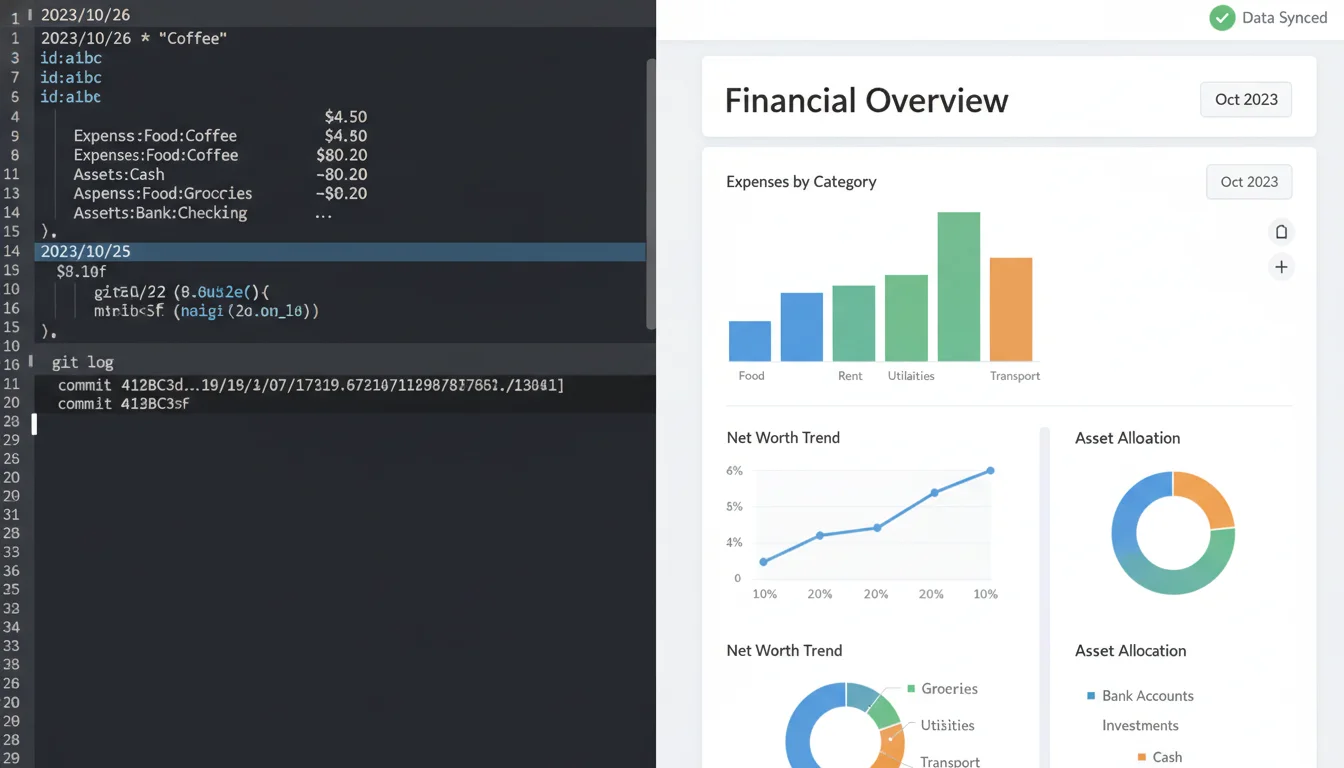
Perhaps the most fascinating architectural divergence in developer accounting is the persistent, cult-like dedication to Plain Text Accounting (PTA). PTA entirely rejects graphical user interfaces, proprietary database schemas, and API dependencies, treating financial data exactly like source code. In this paradigm, every transaction, invoice, asset, and expense is recorded in simple, human-readable text files using a highly strict double-entry syntax.
The dominant execution engines in this space are hledger, beancount, and the original Ledger. The advantages of PTA for a software developer are profound. Because the ledger is nothing more than a standard text file, it can be seamlessly integrated into standard version control systems like Git. This provides an immutable, cryptographically hashed audit trail for every financial change ever made, an incredibly powerful feature for tax compliance and historical auditing. A developer can use standard commands like git blame to see exactly when an expense category was altered, or use continuous integration pipelines to automatically parse the text files and generate localized HTML balance sheets and profit-and-loss statements upon every new commit to the repository.
hledger is frequently praised for its robust command-line interface, which completely separates the accounting engine from the daily workflow. Developers are not forced into a specific UI; they can write custom Python or bash scripts to parse CSV outputs exported from their bank, automatically transform the data into hledger syntax, and append it to their master ledger file. beancount enforces a stricter syntax and requires specific Python libraries to run, but is highly regarded for its developer tooling, including a dedicated VSCode extension and a powerful visualization frontend called fava. Fava allows developers to query their plain text ledger through a beautiful, locally hosted web interface, bridging the gap between command-line efficiency and graphical analysis. Newer projects like Paisa.fyi are also emerging to provide modern GUIs on top of these text-based engines. Furthermore, tools like Tackler allow developers to include audit trail data directly into generated reports, embedding the Git commit ID and a cryptographic checksum of the used transactions to prove absolute data integrity.
The primary friction point of Plain Text Accounting is the exceedingly steep initial learning curve and the distinct lack of automated, real-time bank feeds out-of-the-box. Developers must engineer their own ingestion pipelines or rely on open-source parsers to translate bank statements into ledger formats. However, for those who master it, PTA eliminates vendor lock-in entirely. The developer’s financial history will remain readable and compilable decades into the future, completely immune to the pricing changes, server outages, or corporate acquisitions that inevitably plague commercial SaaS platforms.
Time Tracking as Execution: Bridging the Gap Between IDE and Invoice
For freelance developers who bill hourly, or those who rely on highly granular project tracking to determine the profitability of fixed-bid contracts, accurate time tracking is the absolute foundation of invoicing. Traditional time-tracking software is heavily flawed; it requires the developer to constantly switch contexts—opening a web browser, finding the correct client project, and clicking a timer. This seemingly minor interruption severely disrupts the fragile state of “deep work” required for complex software engineering and algorithmic problem-solving.
To solve this critical operational flaw, developers are increasingly adopting productivity workspaces that integrate time tracking directly into their engineering workflows.
Super Productivity has emerged as a premier open-source developer tool in this space. It seamlessly syncs with GitHub, GitLab, and Jira using official APIs to ensure the real-time synchronization of issues, bugs, and pull requests. Rather than manually entering task descriptions into a separate invoicing tool, a developer simply selects a GitHub issue within Super Productivity. The software then automatically tracks the time spent and links it directly to the ticket, establishing a perfect audit trail for client billing. The software utilizes a strict offline-first architecture, meaning data remains locally controlled, and features native JSON or CSV exports that can be directly piped into invoicing systems. Its keyboard-first design and vim-style shortcuts allow engineers to track billable hours without ever breaking flow to touch a mouse.
Locu represents a similar paradigm, engineered specifically as a lightning-fast execution layer for knowledge workers. It integrates deeply with modern developer tools like Linear and Jira, automatically pulling context and syncing status updates to Slack to prevent external interruptions during active focus sessions. Built heavily around science-backed Ultradian cycles and Pomodoro intervals, Locu automatically tracks time during these deep work sessions. It features blazingly fast interactions (under 50ms) and an app blocker to automatically suppress distracting applications on macOS. The resulting data provides exportable insights and highly accurate timesheets that are perfect for generating invoices.
By embedding time tracking into the actual execution of code rather than treating it as a post-hoc administrative chore, these tools drastically reduce the incidence of unbilled hours—a pervasive and silent leak in the freelance developer’s revenue stream. Furthermore, platforms like Unito provide enterprise-grade middleware synchronization, allowing developers to create flawless bidirectional syncs between code repositories like GitHub and project management tools like Trello, Asana, or ClickUp. This ensures that client-facing project boards accurately reflect the real-time status of code commits without requiring the developer to perform manual double-entry, streamlining the communication required before an invoice is issued.
The Complexity of Global Tax Compliance and Multi-Currency Operations
The complexity of freelance accounting scales exponentially the moment a developer accepts their first international client. Cross-border digital service delivery requires navigating highly volatile foreign exchange rates, exorbitant international wire fees, and an increasingly aggressive, fragmented global digital tax landscape.
As of January 1, 2026, the European Union has moved further into the operational phase of the VAT in the Digital Age (ViDA) reform agenda. This sweeping legislation shifts global tax authorities toward much stronger enforcement, refined liability rules, and the systemic exchange of transaction data between tax authorities. The focus is now on enhanced digital reporting and reinforced platform rules designed to aggressively reduce VAT leakage in the digital economy. While non-EU digital service providers (DSPs) generally do not face entirely new registration requirements directly from these 2026 changes, the operational risk of detection, reassessment, and highly punitive retrospective enforcement has skyrocketed as tax authorities now algorithmically cross-check VAT and GST filings against commercial platform data. A freelance developer sitting in India or the United States, providing SaaS architecture consulting to a firm in Germany, must accurately determine whether they are liable for VAT, and if so, at what specific regional rate.
Traditional, legacy accounting software like FreshBooks and QuickBooks records basic VAT liabilities but falls completely short in actively managing real-time exposure monitoring across thousands of global jurisdictions. Consequently, developers operating at scale are moving away from manual calculation and integrating dedicated tax compliance engines directly into their billing stack. Kintsugi represents the vanguard of this movement, utilizing an AI-driven global compliance automation platform. It connects directly to billing and accounting systems via no-code integrations to monitor economic and physical nexus thresholds in real-time. It automatically calculates complex VAT/GST rules based on cross-border scenarios, product categories, and jurisdictional thresholds, effectively eliminating the operational risk of non-compliance. Similarly, platforms like Quaderno offer cloud-based global tax compliance highly favored by digital entrepreneurs for its ability to instantly calculate local tax rates across 12,000 jurisdictions without requiring a dedicated, full-time finance team. For larger mid-market agencies, tools like Avalara and Vertex provide comprehensive global coverage.
For developers who operate essentially as micro-multinationals, platforms like Deel provide an overarching, highly automated solution. Deel acts as an Employer of Record (EOR) and a comprehensive global payroll provider, completely absorbing the legal liability of contractor compliance, tax documentation, and adherence to localized labor laws. By funneling all international client contracts through Deel, the freelance developer guarantees compliance. Deel’s 2026 updates have further refined this process, introducing advanced L2 analytics for HR reviews, seamless Snowflake integration for syncing goal progress via SQL queries, and highly automated multi-currency invoicing. While utilizing an EOR introduces platform fees that must be carefully negotiated into the client’s billable rate, the eradication of legal and tax liability is often worth the premium for high-earning developers.
Borderless Banking and Payment Routing Integrations
Managing the actual cross-border flow of fiat currency is equally critical to maintaining profitability. To avoid the 1% to 3% fees routinely imposed by credit card processors like Stripe and PayPal, independent developers are heavily leveraging borderless banking platforms like Wise (formerly TransferWise) and Payoneer.
The seamless integration of these alternative payment rails into the developer’s core accounting software is paramount to reducing administrative friction. Wise offers direct API and Open Banking integrations into major platforms like Zoho Books, Xero, QuickBooks, and FreeAgent. A developer can invoice a client in British Pounds from Zoho Books, receive the funds into a localized UK Wise account (allowing the client to utilize a free local bank transfer rather than a costly international wire), and have that transaction automatically synced and reconciled in their home currency ledger without any manual intervention.
Payoneer offers similar, deep integration with platforms like Zoho Books. Developers can quickly configure Payoneer as their primary payment gateway directly within the Zoho Books settings by pasting their Payoneer Customer ID and Connection Key. This allows developers to embed secure payment links directly into their invoices, providing clients the option to pay via local methods in over 190 countries, while the developer receives the funds in multiple currencies directly into their Payoneer account.
| Payment / Tax Challenge | Traditional Software Limitation | 2026 Optimized Developer Solution |
|---|---|---|
| Foreign Exchange Reconciliation | Fragmented ledgers, manual exchange rate entry (e.g., FreshBooks) | True multi-currency accounting with live bank feeds (Zoho Books, Xero) |
| Cross-Border Payment Fees | High Stripe/Credit Card processing fees (up to 3%) | Wise / Payoneer API / Open Banking integration for local bank routing |
| Global VAT / GST Tracking | Static tax rate application without nexus monitoring | AI-driven continuous compliance monitoring (Kintsugi, Quaderno) |
| International Legal Compliance | Freelancer assumes total legal and tax liability | Global Employer of Record platforms handling compliance (Deel) |
Micro-SaaS and the Minimalist Invoicing Movement
In stark contrast to the massive feature sets of global platforms like Deel or Zoho Books, a highly vocal segment of the developer community advocates for absolute minimalism. This has led to the proliferation of micro-SaaS invoicing tools designed explicitly for the solo developer who relies on a handful of high-ticket consulting contracts per year.
Tools like Sidepay and Onigiri embody this minimalist ethos. Sidepay, for example, offers a radically simple $20-per-year pricing model. It explicitly strips away all CRM features, team management capabilities, and enterprise bloat. Its sole focus is allowing a developer to create an invoice in seconds, dispatch it via email with automated reminders, and track paid/unpaid statuses on a brutally simple dashboard. The appeal lies in the lack of lock-in; users can export their invoices at any time, and the platform guarantees no weird pricing tiers or upsells.
However, the monetization models of these ultra-minimalist tools are frequently debated within developer communities like Hacker News. While a “pay-once” or ultra-low annual fee is highly attractive to the consumer, technical peers often question the long-term sustainability of such platforms. A service operating on a $20/year model requires a constant, massive influx of new user sign-ups simply to cover recurring server, database, and email delivery costs. Consequently, many developers are hesitant to trust their financial documentation to a micro-SaaS that may sunset within a year due to unprofitability.
Despite this risk, for developers who handle their actual accounting via an external CPA and merely need a mechanism to generate professional PDFs and collect payments, these minimalist tools provide a highly refreshing alternative to the bloat of traditional SaaS accounting suites.
Strategic Architectural Recommendations
The optimal automated invoicing and accounting software for a freelance developer in 2026 cannot be defined by a single, monolithic application. The ecosystem has specialized to such a degree that the “best” solution is highly contextual, dependent entirely on the developer’s operational scale, technical philosophy, and specific client demographic.
The analysis reveals three distinct, highly optimized financial architectures for freelance software developers:
The High-Volume International Agency Stack
For a developer handling multiple international clients, subcontracting work to other engineers across borders, and grossing significant revenue, the absolute necessity of rigorous compliance supersedes the desire for minimalist tools.
- Core Ledger: Zoho Books. Its true multi-currency ledger, robust API, and custom Deluge scripting capabilities provide the programmatic flexibility required to automate complex operational flows and reconcile international bank feeds flawlessly.
- Payment Rails: Wise and Payoneer integrations. These platforms facilitate zero-friction, low-cost cross-border payments by providing localized bank details, entirely bypassing exorbitant international credit card processing fees.
- Tax Compliance: Kintsugi or Quaderno, integrated directly via API. These platforms ensure real-time, automated compliance with the stringent 2026 EU ViDA mandates and state-level economic nexus thresholds, mitigating the massive risk of audit penalties.
The Client-Centric Workflow Stack
For the developer who primarily takes on bespoke web development or application design projects and struggles consistently with scope creep and delayed payments, the focus must be on tightly controlling the client pipeline from inception to settlement.
- Operating System: Hello Bonsai. By unifying the initial proposal, digital contract signing, and automated invoicing system, the developer projects a highly professional, agency-tier image. Most importantly, the ability to tie time-tracking directly to contracted commit deliverables ensures that absolutely no billable hour goes un-invoiced.
- Tracking Engine: Super Productivity or Locu. Utilizing official GitHub, GitLab, or Linear API integrations to seamlessly log deep work sessions allows the developer to track billable time without ever breaking their coding flow, seamlessly exporting this data for billing.
The Sovereign Developer Stack
Designed specifically for the privacy-conscious, highly technical solo developer who philosophically refuses to surrender their financial data to cloud platforms or pay escalating monthly SaaS subscriptions.
- Invoicing Engine: Invoice Ninja (self-hosted via Docker) for robust, feature-rich PDF generation and automated reminders, or Invoice Builder (SQLite) for a strictly offline, localized approach that requires zero cloud dependency.
- Core Ledger: Plain Text Accounting using hledger or beancount. By treating financial ledgers as strict source code, the developer achieves the ultimate immutable audit trail via Git version control. This ensures total data portability, cryptographic integrity via tools like Tackler, and zero vendor lock-in for the entirety of their career.
The landscape of 2026 dictates that software developers must treat their financial accounting with the exact same architectural rigor they apply to their software engineering projects. By strategically selecting tools that offer deep APIs, respect data sovereignty, and natively understand the complex mechanics of cross-border digital commerce, a freelance developer can entirely automate the administrative burden of invoicing. This systematic elimination of friction allows them to remain focused on their core competency: deploying high-value, scalable code.
Related reading
- Explore all blog articles
- About Arjan KC
-
[Enterprise Password Managers for Remote Teams 2026 Analysis](/blog/enterprise-password-managers-remote-teams/) - Indian Beauty Market: Digital Marketing Trends Report 2025