Email Marketing Software Comparison Guide 2026
The 2026 Email Marketing Software Landscape: Strategic Evaluation and Capability Analysis

The digital marketing ecosystem in 2026 is characterized by a definitive shift away from batch-and-blast promotional strategies toward highly orchestrated, artificial intelligence-driven omnichannel communications. With the global email user base projected to reach up to 4.9 billion by the end of 2028, and current usage already exceeding 4.6 billion, the inbox remains the most critical venue for capturing outsized return on investment. Despite the proliferation of alternative communication channels such as artificial intelligence assistants and social commerce, email continues to be the foundational pillar of digital strategy, with 75% of marketers planning to maintain or increase their email marketing investment in 2026. For small business owners in regions including the United States, United Kingdom, Canada, and Australia, 53% report that email marketing is their most frequent strategy for acquiring and retaining customers.
However, the technological requirements for operating effectively within this space have matured exponentially. Modern organizations are no longer evaluating email service providers merely on template design or basic scheduling capabilities. Instead, procurement decisions are driven by sophisticated criteria including predictive analytics, multi-channel journey orchestration, identity resolution, enterprise-grade deliverability compliance, and highly nuanced pricing architectures that dictate total cost of ownership at scale. As the market consolidates and technological capabilities converge, selecting the correct platform requires aligning a vendor’s underlying data architecture with the specific lifecycle, sales motion, and transactional volume of the deploying organization. This comprehensive report evaluates the 2026 email marketing software market, analyzing the leading platforms across capability tiers, infrastructure performance, economic scalability, spatial analytics, and strategic ecosystem integration.
Market Segmentation and Architectural Positioning
The email marketing sector is highly segmented, with platforms engineering their data schemas and workflow engines to serve distinct operational models. The distinction between a generalized marketing suite and a specialized industry tool dictates the ceiling of a marketing team’s operational maturity. Organizations must evaluate platforms not based on generalized feature checklists, but on structural alignment with their specific go-to-market motions.
The Foundational Tier: Small to Medium Businesses and Startups
Mailchimp remains a dominant legacy force in this category, widely adopted for its clean user experience, comprehensive template library, and an all-in-one approach that includes basic website building and social media posting. It is frequently cited as the optimal choice for teams seeking a reliable system to launch campaigns quickly without a significant learning curve. However, market analysis indicates that Mailchimp’s architecture relies heavily on tag-based data management rather than deep relational objects, which severely limits complex segmentation as a business scales. Furthermore, its basic automation capabilities are often viewed as restrictive when pushed beyond simple autoresponders, with many advanced analytics and segmentation features gated behind premium tiers.
MailerLite has emerged as the premier alternative for fundamental email marketing, consistently praised for its modern drag-and-drop builder, clean interface, and lack of unnecessary bloat. It provides interactive content blocks directly within the email interface, alongside a website builder and marketing forms that can be matched to web pages. While it lacks the deep multi-channel capabilities of enterprise platforms, MailerLite provides robust fundamental tools, making it the optimal choice for organizations prioritizing design, simplicity, and budget control over complex data orchestration.
For organizations seeking aggressive cost control without sacrificing fundamental automation, Moosend and Brevo (formerly Sendinblue) serve as highly competitive foundational tools. Moosend is frequently noted for providing enterprise-level automation workflows at entry-level pricing, punching well above its weight class for small businesses. Brevo, conversely, separates itself by offering a unified Customer Relationship Management (CRM) interface alongside email marketing, allowing small businesses to centralize short message service (SMS), WhatsApp, and transactional email routing within a single, budget-friendly hub. Constant Contact also maintains a strong presence in this foundational tier, particularly favored by event-driven businesses and nonprofits due to its built-in event management and ticketing integrations.
The E-commerce and Retail Specialization
Retail and direct-to-consumer brands operate on a high-frequency, high-intent data model. Platforms serving this sector must feature native, deep-data integrations with e-commerce engines like Shopify, WooCommerce, and BigCommerce, enabling the ingestion of real-time catalog data, purchase histories, and granular browsing behavior.
Klaviyo is the undisputed leader in the e-commerce sector. Its architectural advantage lies in its purpose-built e-commerce data schema, which seamlessly syncs with product catalogs to power highly converting abandoned cart, browse abandonment, and post-purchase replenishment flows. Klaviyo’s native ability to track Customer Lifetime Value and attribute revenue to specific campaigns provides retail marketers with immediate, actionable return on investment metrics. The platform excels at sending personalized, behavior-triggered messages based on precise user actions across the digital storefront. However, this specialization comes at a premium cost, and the platform is distinctly unsuitable for business-to-business organizations with long, sales-driven life cycles.
Omnisend serves as Klaviyo’s primary competitor in the e-commerce space, often functioning as a more accessible and cost-effective alternative with ready-made workflows specifically for online stores. Omnisend differentiates itself through a heavier emphasis on native omnichannel routing, allowing marketers to build single automation workflows that split paths between email, SMS, and push notifications based on real-time customer engagement. Drip is another notable competitor in this space, recognized for strong e-commerce integrations and behavioral targeting, though it generally caters to a slightly more advanced technical user.
The Creator Economy and Digital Monetization
The rise of the creator economy has birthed a sub-category of email platforms designed specifically around audience growth, paid subscriptions, and digital product delivery, fundamentally differing from traditional lead-generation tools. These platforms prioritize content delivery and audience monetization over traditional sales pipeline management.
Kit (formerly ConvertKit) and beehiiv dominate this space. Kit is engineered for bloggers, podcasters, and independent creators, offering visual workflow builders that utilize tagging to track deep subscriber engagement. Its strategic differentiator is the inclusion of a Creator Network, which facilitates cross-promotion and audience sharing among independent creators, alongside a Sponsor Network to drive monetization through brand partnerships. Beehiiv focuses heavily on the newsletter monetization model, offering native referral programs, one-click subscriptions, and built-in ad network opportunities directly within the platform. AWeber also maintains a strong foothold among bloggers and small creators, recently augmenting its platform with artificial intelligence-powered content creation tools.
Business-to-Business Automation and Mid-Market Convergence
For business-to-business organizations, the marketing motion is inextricably linked to the sales pipeline. The buying cycle is long, requiring sophisticated lead scoring, deep behavioral tracking, and seamless handoffs to human sales representatives.
ActiveCampaign is widely recognized as the standard for complex marketing automation in the mid-market space. The platform features an industry-leading visual automation builder equipped with conditional logic, split testing within workflows, and over 250 customizable templates. ActiveCampaign’s native capabilities, which include deal pipelines, lead scoring algorithms, and sales automation, eliminate the need for a fragmented technology stack for many mid-sized organizations. The platform is engineered to connect the entire customer journey from initial lead capture to final sales conversion, making it the optimal choice for service-based businesses tying email directly into CRM workflows.
HubSpot Marketing Hub represents the premier all-in-one inbound marketing suite.
It excels when an organization wishes to standardize its entire front-office operation—marketing, sales, and customer service—on a single, unified database. HubSpot provides superior journey-based targeting, robust conversation tracking, and deep pipeline attribution. While its email marketing and automation tools are powerful, its e-commerce logic is noticeably shallower than Klaviyo’s; HubSpot is ultimately built to nurture leads through a staged sales funnel rather than trigger rapid retail conversions.
GetResponse occupies a unique position bridging marketing automation and digital product sales. It distinguishes itself by being one of the few platforms to offer built-in webinar hosting, alongside advanced conversion funnels and artificial intelligence-powered online course builders. This makes GetResponse particularly attractive for course creators and organizations utilizing live video events as primary lead generation mechanisms.
Deliverability Infrastructure and Inbox Placement Constraints
The most sophisticated automation strategy is entirely negated if the underlying infrastructure fails to successfully route messages to the recipient’s primary inbox. In 2026, the deliverability landscape is highly regulated, dictated by the strict authentication protocols enforced by major Internet Service Providers and mailbox providers. The margin for error regarding sender reputation has never been narrower.
Global Provider Benchmarks and Statistical Realities
Global average email deliverability currently rests at 83.1%, indicating that nearly one in six marketing emails disappears or is misrouted globally. Of the failed deliveries, approximately 10.5% are routed to spam folders despite legitimate sender intent, while 6.4% disappear entirely without a trace. Furthermore, 61% of email marketers report that achieving inbox placement is becoming progressively more difficult.
Deliverability performance is highly contingent upon the receiving provider. Google maintains the most sophisticated filtering algorithms, resulting in an industry-leading 95.54% overall deliverability rate for legitimate bulk senders. However, nuance is required: only 57.8% of these messages land in the primary inbox, with 37.74% routed to the Promotions tab. Microsoft (encompassing Outlook and Hotmail) exhibits greater volatility, with aggregate placement rates reported between 75.6% and 91.33% depending on the testing methodology and sender reputation, presenting distinct targeting challenges. Legacy providers such as Yahoo and AOL demonstrate lower baseline deliverability, averaging 81.33% and 76% respectively.
Regional variations also heavily influence infrastructure performance. Senders operating within the United Kingdom and Australia experience exceptional average deliverability rates of 98.8% and 98.7% respectively. Germany also maintains a high standard at 97.8%. Conversely, the United States averages 84.6%, while regions such as India present significant delivery challenges, averaging just 69.8%.
Platform-Specific Deliverability Performance
The technological architecture, shared Internet Protocol (IP) pool management, and internal compliance policies of the email marketing software directly impact sender reputation. Bi-annual testing of major platforms reveals significant disparities in infrastructure quality.
ActiveCampaign consistently leads the industry, achieving an average deliverability rate of 93.4% to 94.2% across recent evaluation periods. This performance is sustained by a dedicated internal deliverability team, stringent list hygiene rules, and advanced reporting features such as “BotSense,” which filters out automated bot clicks to provide accurate engagement data for Pro and Enterprise users. MailerLite follows closely, securing high marks with a 94.41% average across historical testing cycles, largely due to its strict account approval process which inherently filters out low-quality senders that could damage shared IP pools.
Constant Contact also maintains excellent infrastructure, averaging between 88% and 91.7%, and frequently achieving 100% placement across Microsoft and Yahoo inboxes during isolated testing rounds. GetResponse and Moosend similarly perform well, with rates of 90.9% and 90.1% respectively. Conversely, platforms such as AWeber (83.1%), HubSpot (ranging historically from 77.7% to 79.8%), and Benchmark (47.1%) have demonstrated higher volatility and lower placement rates in independent testing, highlighting the necessity of dedicated deliverability monitoring when operating on these networks.
-
- ActiveCampaign
- 93.4% - 94.2% - Dedicated deliverability team, BotSense click filtering
-
- MailerLite
- 92.7% - 94.41% - Strict account approval protecting shared IP reputation
-
- Constant Contact
- 88.0% - 91.7% - High historical placement rates in Microsoft/Yahoo
-
- GetResponse
- 90.9% - Strong automatic suppression handling
-
- HubSpot
- 77.7% - 79.8% - Higher historical volatility in shared pools
-
- Benchmark
- 47.1% - Significant historical struggles with Microsoft inboxes
The Authentication Imperative
The technical baseline for operating in 2026 mandates absolute adherence to domain authentication protocols. Major inbox providers now strictly require bulk senders to enforce Sender Policy Framework (SPF), DomainKeys Identified Mail (DKIM), and Domain-based Message Authentication, Reporting, and Conformance (DMARC) alignment. Failure to properly configure these records results in immediate throttling or domain blacklisting.
Despite these mandates, global compliance remains critically low. Data indicates that 85.7% of general domains lack strict DMARC enforcement, and only 33.4% of top websites maintain valid records. Consequently, platforms that natively support guided authentication wizards and automated suppression handling for bounces and complaints—such as ActiveCampaign and GetResponse—provide a significant operational advantage by mitigating the risk of domain spoofing and preserving sender reputation. Furthermore, inbox providers now weigh engagement signals—such as open rates, reply velocity, and click-through rates—as primary indicators of sender health, shifting the burden of deliverability from mere technical setup to ongoing content relevance. Maintaining a clean list and sending consistent content are recognized as the top boosters for maintaining rates between the ideal 95% and 99% threshold.
Pricing Architectures and Scalability Economics
Contact-Based versus Volume-Based Billing
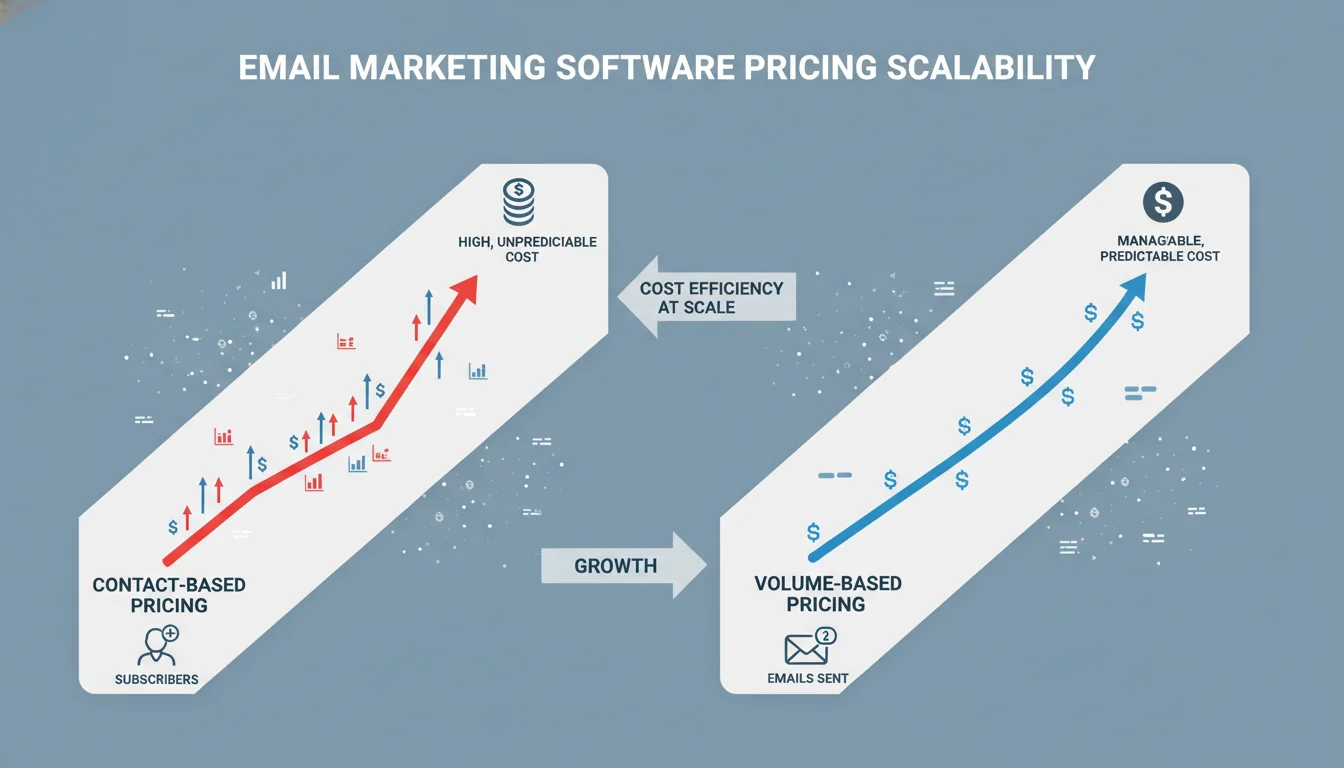
The market is bifurcated into two primary billing architectures: contact-based (subscriber-centric) and volume-based (send-centric).
The majority of industry leaders—including Mailchimp, Klaviyo, ActiveCampaign, and HubSpot—utilize a contact-based model. In this structure, the monthly fee is dictated by the maximum number of email addresses stored within the database, regardless of how frequently those addresses are messaged. This model introduces significant hidden costs through differing contact counting methodologies. Klaviyo charges strictly for “active profiles”—contacts that are eligible to receive marketing communications. Mailchimp and ActiveCampaign (for accounts created post-2025), however, charge for all contacts housed within the system, including unsubscribed, unconfirmed, and bounced addresses. This mechanism penalizes organizations that utilize the email platform as a broader CRM or data repository, forcing marketing teams to ruthlessly and continuously purge inactive contacts to avoid exponential budget inflation.
A disruptive alternative is the volume-based model, championed by platforms like Brevo and Mailjet. Under this architecture, the organization is billed based solely on the total number of emails dispatched per month; the size of the contact database is functionally unlimited. This model encourages massive data hoarding, allowing marketers to maintain immense historical databases for potential future activation or cross-channel ad retargeting without incurring a monthly financial penalty.
Comparative Pricing Analysis: Entry to Mid-Market Scale
At the entry-level (1,000 subscribers), pricing remains relatively compressed, allowing startups to select platforms based on feature preference rather than severe budget constraints.
However, as databases scale to 10,000 subscribers, the divergence between premium e-commerce tools and volume-based platforms becomes highly pronounced.
| Platform | Pricing Model | Monthly Cost: 1,000 Subscribers | Monthly Cost: 10,000 Subscribers | Key Inclusions/Limitations at 10k |
|---|---|---|---|---|
| Brevo | Volume (Pay per email) | $8.08 - $17 | $29 | Unlimited contacts; capped at 20,000 emails/mo |
| MailerLite | Contact-Based | $10 - $15 | $73 | Unlimited emails; dynamic content blocks |
| Omnisend | Contact-Based | $16 - $20 | $132 | Multichannel workflows; SMS integration |
| GetResponse | Contact-Based | $15 - $19 | $79 | Sales funnels; unlimited automation |
| Mailchimp | Contact-Based (Total) | $13 | $96 - $110 | Basic automation; strict send limits |
| Klaviyo | Contact-Based (Active) | $20 - $30 | $150 | Advanced e-commerce predictive modeling |
| ActiveCampaign | Contact-Based (Total) | $15 - $19 | $189 | Deep CRM; conditional workflows |
| HubSpot | Contact-Based | $10 - $20 | $302 | Full inbound suite; CRM ecosystem |
Cost Projections at Enterprise Scale (100,000+ Profiles)
The economic impact of architectural choices is magnified at the enterprise level. For a mid-market retailer managing 100,000 active profiles, Klaviyo’s pricing scales to a minimum of $500 per month just for its Customer Data Platform layer, while standard marketing plans scale to $720 per month for email-only, or $1,440+ depending on SMS usage and total active profile counts. Mailchimp’s Standard plan for 100,000 contacts requires customized budgeting but generally exceeds $800 per month, bringing with it strict limitations on monthly send volume (capped at 12 times the contact limit). ActiveCampaign requires custom enterprise quoting at the 100,000-contact threshold, indicating a shift toward high-touch, premium account management, though its lower-tier plans for 50,000 contacts already approach $759 per month. Kit (ConvertKit) offers its Creator plan for 100,000 subscribers at $679 per month, or $879 for the Pro tier, which includes advanced subscriber scoring and unlimited users.
In stark contrast, organizations utilizing volume-based platforms experience radically different economics. If a business with 100,000 contacts sends only one newsletter per month (100,000 total sends), utilizing Brevo’s Standard plan costs approximately $129 per month—a fraction of the cost of subscriber-based competitors. Even at a high frequency of sending one email per day to 100,000 contacts (3,000,000 monthly sends), Brevo’s volume-based pricing equates to roughly $606 per month, demonstrating immense scalability for high-volume, broad-reach marketing strategies. Similarly, EmailOctopus offers a highly transparent, scalable model, pricing a 100,000-subscriber tier at $345 per month, which includes an allowance of 1,000,000 email sends and unlimited automation steps.
Platform Usability, Implementation Friction, and Customer Support
Beyond pricing and technical infrastructure, the operational viability of a platform is dictated by its user interface and the quality of its support ecosystem. Complex tools that require extensive training elongate the time-to-value for marketing teams.
Peer Review and Usability Metrics
Aggregation of peer reviews and usability metrics from independent platforms like G2 in 2026 reveals clear leaders in user satisfaction. Sender.net and Moosend consistently share the highest usability rating in the industry at 9.2 , significantly outpacing the category average of 8.7. Users frequently cite the speed of campaign setup and intuitive design interfaces as primary drivers of satisfaction for these platforms. Intuit Mailchimp, Constant Contact, GetResponse, and Zoho Campaigns all share a respectable usability rating of 8.6, though reviewers occasionally note limitations in design flexibility or overwhelming navigation menus as platforms scale their feature sets.
Implementation timelines vary drastically. Platforms like Moosend advertise implementations that can be completed in a single day for basic setups, whereas enterprise tools like Salesforce Marketing Cloud or Adobe Journey Optimizer require specialized integration partners and timelines extending from three to five months.
Customer Support Infrastructures
The accessibility of vendor support during critical sending periods is a major differentiator. In 2026, real-time Live Chat has become the preferred support medium. Industry data indicates that 41% of customers prefer using live chat compared to other service channels due to its immediacy, and platforms processing these interactions boast an 87% positive customer satisfaction rating. Furthermore, 63% of high-value digital consumers report higher loyalty to companies offering robust live chat experiences. Platforms like MailerLite align with this trend, offering 24/7 Live Chat on their advanced tiers to ensure global support continuity.
Traditional 24/7 phone support is increasingly rare and is generally treated as a premium enterprise feature. AWeber is a notable exception, offering phone support even on its free and entry-level tiers, providing a distinct advantage for small businesses prioritizing direct verbal communication during crisis management. Mailchimp provides phone access on its higher-priced Premium and Standard tiers, while platforms like Brevo restrict dedicated phone support and Customer Success Managers to their custom-quoted Enterprise and Professional plans.
Advanced Automation and Omnichannel Orchestration
The maturation of email marketing software has transitioned platforms from linear autoresponders into complex, multi-dimensional orchestration engines. In 2026, the baseline expectation for any mid-market or enterprise tool includes visual, drag-and-drop journey builders capable of executing multi-step workflows based on conditional logic, behavioral triggers, and real-time data ingestion.
Platforms are increasingly erasing the boundaries between email and other digital channels. Advanced systems such as ActiveCampaign, Omnisend, and Braze allow marketers to design singular customer journeys that seamlessly pivot between email, SMS, WhatsApp, and push notifications. For example, a cart abandonment flow can be engineered to initially trigger a low-cost email; if the email remains unopened after a defined interval, the system automatically pivots to deliver a high-urgency SMS or rich-media mobile push notification based on the user’s historical channel preference. This interconnected routing requires platforms to maintain real-time state management of the user across all devices. ActiveCampaign excels in this regard, offering multi-step customer journeys with sophisticated lead scoring and predictive actions built directly into the workflow builder.
Artificial Intelligence, Predictive Analytics, and Spatial Telemetry
Artificial Intelligence has moved beyond simple generative copywriting assistants to become the core predictive engine driving lifecycle marketing. AI capabilities are now deeply embedded into audience segmentation, content recommendation, and send-time optimization matrices.
Predictive Modeling and Lifecycle Intelligence
Klaviyo utilizes predictive analytics to automatically calculate a customer’s expected date of next purchase and assigns mathematically derived churn risk probabilities. This allows retail marketers to trigger preemptive win-back campaigns automatically before a customer formally lapses from the buying cycle. ActiveCampaign and HubSpot leverage machine learning algorithms to analyze individual contact engagement history, dynamically optimizing email delivery times to align with the specific hour each recipient is most statistically likely to open their inbox, shifting delivery from a broadcast model to a highly individualized cadence.
Furthermore, enterprise platforms like Adobe Journey Optimizer utilize AI Agent Orchestrators —suites of autonomous agents that analyze real-time Customer Data Platform streams to suggest optimal content combinations and dynamic frequency controls, thereby mitigating list fatigue and protecting domain reputation from excessive sending.
Spatial Analytics and Behavioral Heatmapping
Understanding exactly how a user navigates the architecture of an email is critical for conversion rate optimization. While traditional metrics track aggregate clicks, advanced platforms and specialized add-ons provide spatial analytics via click-based heatmaps that overlay engagement data directly onto the email design.
Tools such as Email on Acid provide analytics that overlay click percentages, differentiating between unique and total clicks across desktop and mobile environments. Mailchimp features a native Click Map integration that visually displays where recipients clicked inside a campaign, enabling comparative analysis of link-level percentages. Platforms like Emma and SendX utilize color-coded heat maps to indicate high-activity “hot spots” and ignored “cold zones.” This spatial telemetry allows marketers to iteratively refine template layouts, optimizing the placement of primary and secondary calls-to-action based on empirical user interaction rather than aesthetic assumption.
Experimentation Frameworks: A/B vs. Multivariate Testing
Continuous optimization is reliant on rigorous testing frameworks.
While basic A/B testing is ubiquitous across nearly all platforms, achieving advanced optimization requires Multivariate Testing capabilities.
A/B testing, also known as split testing, is restrictive by design; it isolates a single variable—such as comparing Subject Line A against Subject Line B, or testing two distinct call-to-action button colors—to determine a clear, incremental winner. It is highly effective for smaller audiences or startup organizations as it achieves statistical significance quickly and delivers straightforward, actionable insights. Most foundational platforms, including MailerLite and GetResponse, offer robust A/B testing tools.
Multivariate Testing, conversely, evaluates multiple variables and their interacting effects simultaneously. An MVT campaign can concurrently test different combinations of subject lines, hero images, and body copy text to identify the absolute optimal composite email. Because MVT reveals how different elements perform together in complex, real-world scenarios, it accelerates the understanding of audience preferences. However, because MVT generates an exponential number of variations, it requires massive traffic volumes to yield mathematically reliable insights and avoid false positives. Consequently, MVT capabilities are generally reserved for premium tiers of high-volume or enterprise platforms. Mailchimp restricts MVT to its highest-priced Premium plan, while dedicated enterprise platforms like Braze, Adobe Marketo Engage, and specialized solutions like Moosend and Knock offer built-in multivariate testing with statistical significance tracking.
Enterprise Data Ecosystems and CDP Integration
At the enterprise level, email marketing is rarely executed in isolation; it functions as the activation layer of a broader, interconnected data ecosystem. The strategic decision at this tier is whether to adopt a “best-of-breed” modular stack or an “all-in-one” unified platform. The architecture chosen dictates the organization’s ability to orchestrate cross-channel experiences and manage complex data governance.
The Salesforce Marketing Cloud Paradigm
Salesforce Marketing Cloud is engineered for massive scale and complex organizational governance. Its architecture is deeply intertwined with Salesforce Data Cloud, offering identity stitching, unified profile management, consent tracking, and calculated insights across the enterprise. The platform relies on advanced SQL capabilities and relational data modeling, meaning marketers possess virtually unlimited flexibility in audience segmentation, provided they have the technical proficiency to manage complex data queries.
SFMC’s visual Journey Builder facilitates immense omnichannel coordination across email, mobile applications, SMS, and advertising networks, incorporating multi-step event triggers and channel pivoting. It is the premier choice for large organizations where deep integration with the Salesforce ecosystem (Sales Cloud, Service Cloud) is a strategic imperative. However, its steep learning curve, reliance on external multi-touch attribution tools like Marketing Cloud Intelligence (Datorama), and high total cost of ownership require dedicated marketing operations teams and expert implementation consulting.
The Adobe Experience Cloud Ecosystem
Adobe offers a bifurcated approach to enterprise marketing, catering separately to complex B2B sales cycles and high-velocity B2C consumer engagement.
Adobe Marketo Engage is the gold standard for B2B enterprises managing long, complex lead lifecycles. It provides unparalleled capabilities in custom lead scoring, Account-Based Marketing, and revenue cycle analytics. Its Smart Campaigns excel at B2B nurturing, but its architecture is less optimized for rapid, real-time B2C omnichannel experiences, and it relies heavily on list-based segmentation.
To address the real-time B2C market, Adobe Journey Optimizer was developed natively atop the Adobe Experience Platform. AJO functions as a true enterprise Customer Data Platform activation engine, utilizing event streaming to trigger highly individualized, real-time omnichannel messages across email, SMS, application push notifications, and web properties. AJO is highly favored by global brands requiring split-second personalization at an immense scale, supported by powerful web personalization capabilities and AI-driven content optimization.
Braze and Mobile-First Orchestration
Braze represents a modern, developer-friendly alternative within the enterprise space, originally designed for mobile-first consumer applications. Its architecture excels at processing massive streams of real-time behavioral data via SDKs and native integrations with modern data warehouses like Snowflake, Segment, and mParticle.
Braze’s Canvas Flow orchestration tool enables sophisticated multi-channel flows incorporating conditional branching, A/B/multivariate testing, holdout groups, and AI-powered intelligence to automatically route messages through the highest-converting channel. It is uniquely suited for media companies, fast-growing consumer applications, and enterprises prioritizing best-in-class push notification capabilities, rich media support, and deep linking alongside high-volume email.
HubSpot Enterprise Alignment
HubSpot Enterprise offers a stark contrast to the complexity of Salesforce and Adobe. It champions usability, time-to-value, and a unified data model. By unifying the CRM, Content Management System, and marketing automation onto a single, intuitive codebase, HubSpot eliminates the integration friction that frequently plagues fragmented enterprise stacks.
While it may lack the hyper-complex SQL querying of Salesforce Marketing Cloud or the deep real-time event streaming architectures of Braze and AJO, HubSpot’s accessible interface, predictive lead scoring, and comprehensive lifecycle reporting make it highly attractive for mid-market and enterprise B2B organizations seeking operational agility over extreme customization. Its out-of-the-box dashboards provide clean, solid attribution tracking without the need for extensive developer dependency.
Strategic Conclusions and Procurement Recommendations
The evaluation of the 2026 email marketing software landscape reveals that basic technological parity exists among foundational features; the true differentiation occurs in underlying data architecture, scalability economics, spatial analytics, and enterprise ecosystem alignment. Procurement strategies should bypass generic feature comparisons and instead focus on structural synergy with the organization’s core business model.
First , marketing operations leaders must align platform pricing architecture with their audience strategy. Organizations prioritizing aggressive top-of-funnel lead generation, or those seeking to maintain massive historical databases for future retargeting, should strongly favor volume-based platforms such as Brevo or EmailOctopus. This mitigates the exponential cost penalties associated with storing inactive contacts. Conversely, organizations operating with highly curated, high-intent audiences will extract maximum ROI from the deep intelligence and active-profile counting models of platforms like Klaviyo or ActiveCampaign.
Second , the data schema of the software must match the sales motion. Direct-to-consumer and e-commerce brands require platforms with deep, native retail integrations and predictive purchasing analytics to drive rapid conversions, making Klaviyo and Omnisend the logical choices. Business-to-business organizations must prioritize robust CRM alignment, pipeline attribution, and complex lead scoring capabilities, pointing toward HubSpot, ActiveCampaign, or Adobe Marketo Engage.
Third , organizations must prioritize deliverability infrastructure as a primary selection criterion. Software features are rendered irrelevant if messages fail to reach the inbox. Evaluating platforms based on historical deliverability excellence—such as ActiveCampaign or MailerLite—and ensuring robust internal compliance with DMARC, SPF, and DKIM protocols is necessary to survive the increasingly stringent filtering algorithms of major inbox providers.
Finally , for global enterprises, the choice between Salesforce Marketing Cloud, Adobe Experience Cloud, and Braze rests on the necessity for rigid omnichannel governance versus agile, mobile-first event streaming. However, organizations seeking rapid deployment and high cross-departmental adoption should consider the unified approach of HubSpot Enterprise to minimize implementation friction and maximize immediate business impact. Ultimately, the optimal email marketing platform functions not merely as a broadcasting tool, but as the central nervous system of a comprehensive, data-driven customer experience strategy.
Related Posts and Resources
- Digital Marketing in Nepal (Complete Guide)
- Google Ads in Nepal: Practical Strategy
- SEO Analytics for Nepali Businesses
- eCommerce Analytics Setup in Nepal
- eCommerce Metrics That Matter
- Email Marketing Guide for Nepal
- Email Marketing ROI in Nepal
- Facebook Ads Budget Guide (Nepal)
- Cultural PPC Strategy for Nepal
- Competitor Analysis Framework for Nepal