Playbook: The Email Lifecycle Model
Effective email marketing is not about sending the same message to everyone. It’s about sending the right message to the right person at the right time. The Email Lifecycle Model is a strategic playbook that moves you away from generic “batch and blast” campaigns to a sophisticated, automated system that guides subscribers from their first interaction to becoming loyal, repeat customers.
This model is built on a foundation of segmentation and automation, designed to increase engagement, boost retention, and maximize customer lifetime value. Here’s how to implement it in your Nepali business.
Stage 1: The Welcome & Onboarding Sequence
This is your first impression and your best chance to set the tone.
- Trigger: A user subscribes to your newsletter, downloads a resource, or creates an account.
- Segmentation Logic: All new subscribers who have not made a purchase.
-
Message Hierarchy:
- Email 1 (Immediate): Deliver & Welcome. Send the promised resource or discount immediately. Welcome them to your community and clearly state what kind of emails they can expect from you. For tips on getting that initial sign-up, see our guide on list growth in Nepal.
- Email 2 (Day 2): Introduce & Showcase. Share your brand story. What makes you different? Showcase your most popular products, services, or blog posts.
- Email 3 (Day 4): Provide Value. Offer a helpful tip, a link to a useful guide, or a small, time-sensitive offer to encourage their first purchase.
Stage 2: The Nurture & Engagement Stage
Once onboarded, the goal is to maintain interest and build a relationship.
- Trigger: Subscriber has completed the welcome series.
-
Segmentation Logic: Segment your list based on behavior.
- Interest-Based: If a user frequently clicks on links related to SEO, tag them as “interested in SEO.”
- Engagement-Based: Create segments for “highly engaged” (opens >50% of emails) and “less engaged” (opens <15%).
-
Message Hierarchy:
- For Everyone: Send your regular, value-packed newsletter (e.g., weekly or bi-weekly). Make sure you are using effective email subject lines.
- For Interest Segments: Send targeted campaigns. If you publish a new SEO case study, send it only to the “interested in SEO” segment with a personalized message.
- For Highly Engaged: These are your fans. Send them exclusive content or ask for their feedback.
Stage 3: The Active & Loyal Customer Stage
When a subscriber becomes a customer, the communication needs to change.
- Trigger: A user makes their first purchase.
-
Segmentation Logic: Segment based on purchase history:
first-time-buyers,repeat-buyers,high-value-customers. -
Message Hierarchy:
- Post-Purchase Series (Automated): Immediately send order/shipping confirmations. A week later, ask for a product review.
- Cross-Sells & Upsells: If they bought trekking shoes, send them an email about high-quality trekking socks a few weeks later.
-
Loyalty Rewards: For
repeat-buyersandhigh-value-customers, create exclusive offers, early access to new products, or a special anniversary discount.
Stage 4: The Lapsing & Win-Back Stage
It’s more cost-effective to retain an existing subscriber than to acquire a new one. This stage is crucial for list hygiene and re-engagement.
- Trigger: A subscriber has not opened an email or made a purchase in a defined period (e.g., 90 days).
-
Segmentation Logic: Create a dynamic segment for
inactive-subscribers. -
Message Hierarchy (Automated):
- Email 1 (at 90 days): The Gentle Nudge. Send a simple “We miss you” email. Highlight your best content or a new product they might have missed. Ask a question like, “What content would you find most useful?”
- Email 2 (at 120 days): The Special Offer. Send a compelling, time-sensitive discount (e.g., “A special 20% off to welcome you back”). Make it your best offer.
- Email 3 (at 150 days): The Breakup Email. Be transparent. “Is this goodbye? We notice you haven’t been opening our emails. If you don’t click here, we’ll remove you from our list to respect your inbox.” This cleans your list, improves deliverability, and sometimes gets a surprising number of re-engagements.
graph TD
    A[Inactive Subscriber (90 Days)] --> B("Email 1: Gentle Nudge");
    B -- No Response (30 Days) --> C("Email 2: Special Offer");
    C -- No Response (30 Days) --> D("Email 3: Breakup Email");
    D -- Click to Stay --> E("Re-engaged: Nurture Stage");
    D -- No Click --> F(Remove from List);
    B -- Responds/Engages --> E;
    C -- Responds/Engages --> E;
Figure 2: Lapsing & Win-Back Email Sequence
This can help you avoid the common reasons why emails fail in Nepal.
Build Your Lifecycle Model Today
Implementing the Email Lifecycle Model transforms your email marketing from a simple broadcast tool into a powerful, automated engine for building customer relationships and driving revenue. Don’t make common email marketing mistakes.
If you’re ready to implement this playbook, I offer email automation services to help you set up the segmentation, messaging, and automation for every stage of the journey. Let’s build a system that works for you 24/7.
Related Posts and Resources
- Best AI Tools for Digital Marketing
- How AI Is Transforming Digital Marketing
- AI in Marketing Analytics
- AI Marketing Automation Guide
- AI Content Repurposing Tools
- Best AI Content Creation Tools
- AI Workflow for Marketing Agencies
- Generative AI for Digital Marketers
- ChatGPT Prompts for Agencies
- Best AI Tools for Small Business \n\n## Visual Summaries\n
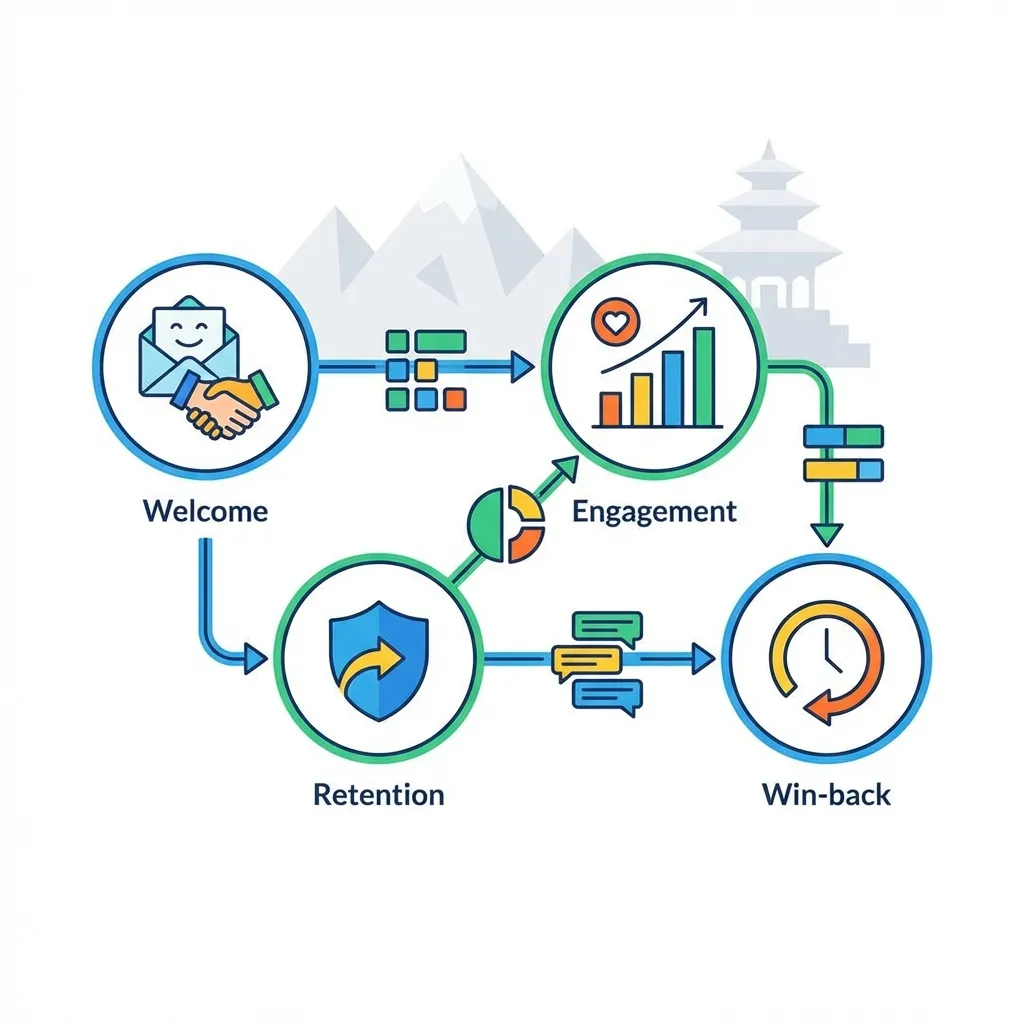
graph TD
    A[New Subscriber] --> B("Welcome & Onboarding");
    B --> C("Nurture & Engagement");
    C -- First Purchase --> D("Active & Loyal Customer");
    D -- Repeat Purchase --> D;
    D -- Inactivity > 90 Days --> E("Lapsing & Win-Back");
    E -- Re-engaged --> C;
    E -- No Response --> F("Unsubscribe/Clean List");
Figure 1: The Email Lifecycle Model Overview