EdTech India Digital Marketing: Market Research & Strategy Report
Industry Overview
The educational technology sector in India represents one of the most heavily scrutinized, rapidly evolving, and macroeconomically significant ecosystems within the global digital economy. Functioning at the complex intersection of immense demographic dividends, systemic educational infrastructure gaps, and unprecedented digital penetration, the Indian EdTech industry has experienced a volatile trajectory over the past half-decade. To formulate an effective, highly targeted digital marketing strategy, it is an absolute necessity to first thoroughly deconstruct the underlying economic realities, the shifting market size trajectories, and the stringent regulatory frameworks currently governing this space.
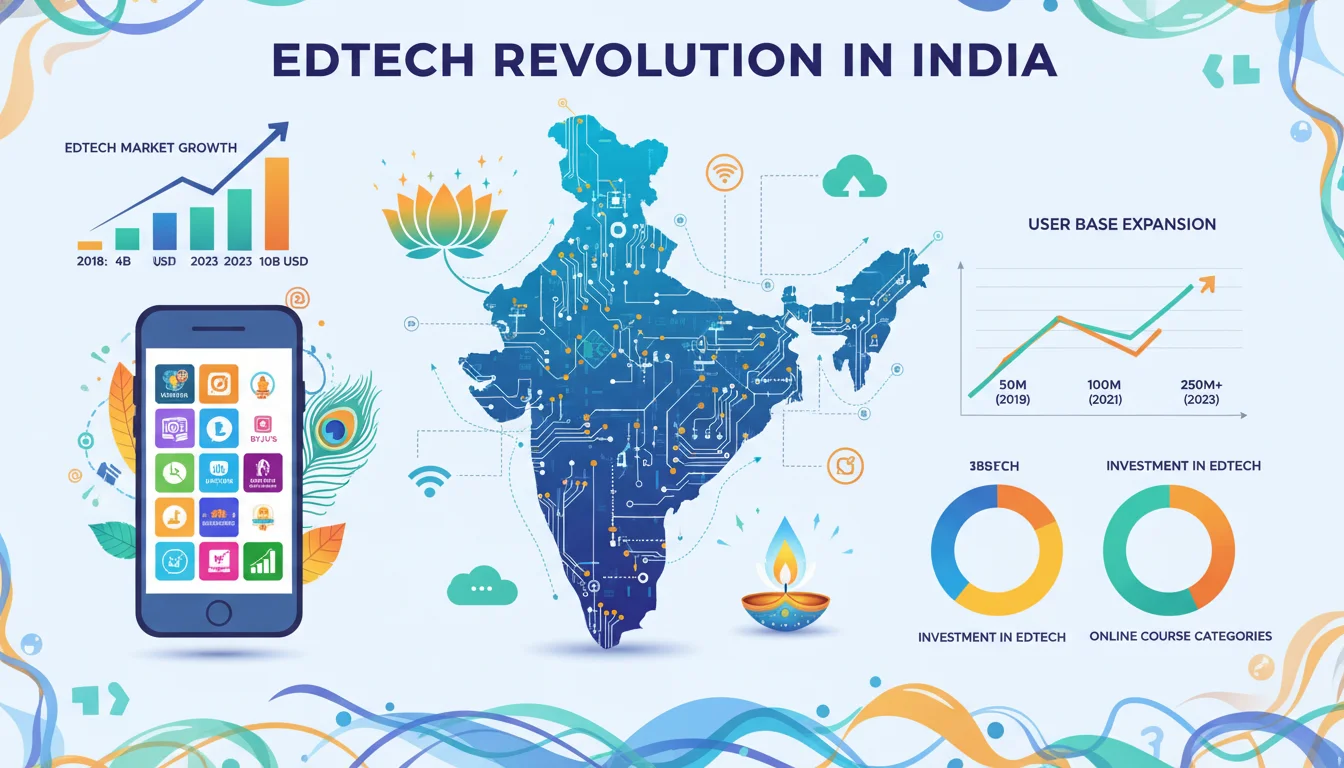
India possesses the world’s largest population in the 5 to 24-year age bracket, encompassing approximately 580 million individuals, which presents an unparalleled total addressable market for educational services. When analyzing the broader Indian education market—which encapsulates traditional offline schooling, higher education institutions, skill development programs, and supplementary digital learning—the sector is projected to reach an impressive total valuation of US$ 313 billion by the fiscal year 2030. This represents a significant acceleration from its US$ 117 billion valuation recorded in the fiscal year 2023. Consequently, the overarching Indian education technology market is expected to generate revenues of US$ 6,595.4 million in 2024, with a projected trajectory aiming for US$ 17,003.7 million by 2030, representing a Compound Annual Growth Rate of 16.9%.
However, the specific subset of the direct-to-consumer online K-12 EdTech market requires a substantially more nuanced and grounded valuation. Following a period of hyper-inflationary venture capital investment between the years 2020 and 2022, the market has undergone a severe and systemic correction. Initial projections touted by venture capitalists during the pandemic boom suggested a $90+ billion digital K-12 market; however, recent forensic market analyses estimate the actual direct-to-consumer online K-12 EdTech market in India at a much more realistic $2 to $3 billion for the 2024 to 2026 period. This corrected figure represents roughly 11% of the total supplemental education spend in the country. Despite this stark correction in the K-12 direct-to-consumer segment, other estimates project the overall EdTech sector, driven heavily by adult upskilling and higher education software models, to reach between $29 billion and $30 billion by 2030.
Broad Education Sector (India): Historic Valuation US$ 117 Billion (FY23), Projected Valuation US$ 313 Billion (FY30), Projected CAGR N/A
Overall EdTech Market (India): Historic Valuation US$ 6,595.4 Million, Projected Valuation US$ 17,003.7 Million, Projected CAGR 16.9%
K-12 Education Segment: Historic Valuation US$ 48.9 Billion, Projected Valuation US$ 125.8 Billion (FY32), Projected CAGR 10.7%
Higher Education Market: Historic Valuation US$ 68.06 Billion, Projected Valuation US$ 134.84 Billion, Projected CAGR 8.1%
Global EdTech Market: Historic Valuation US$ 197.3 Billion, Projected Valuation US$ 353.1 Billion, Projected CAGR 12.3%
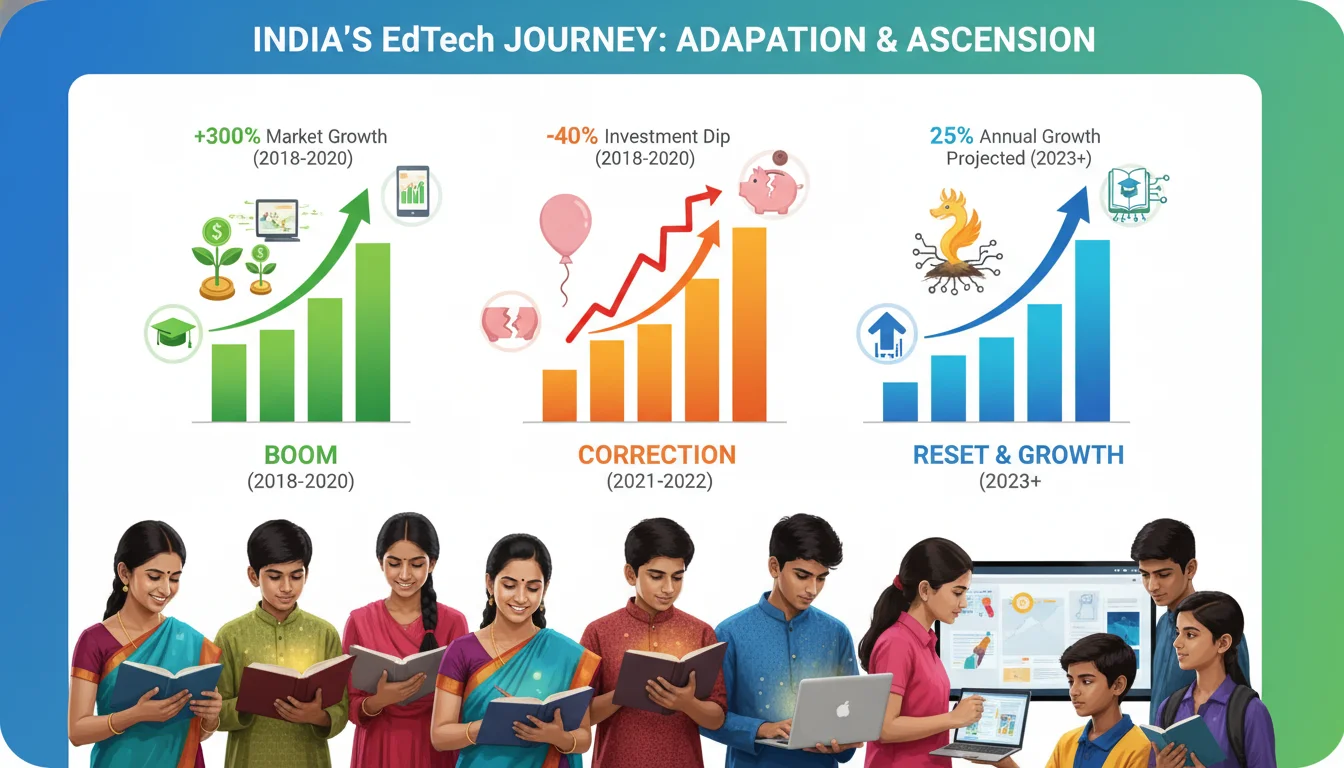
The evolution of the Indian EdTech sector can be categorized into three distinct socioeconomic phases. The Boom phase, spanning from 2020 to 2022, was characterized by rapid funding, irrational exuberance, heavy discounting, and heavily subsidized user acquisition. This was followed by the Correction phase of 2023 to 2024, marked by massive market consolidation, a severe funding winter, the shutdown of over 2,000 startups, and the overhang of high-profile corporate failures. The current environment represents the Reset and Growth phase, beginning in 2025. This phase is defined by a strategic pivot toward sustainable business models, artificial intelligence-driven tools, localized regional language penetration, and a surging demand for hybrid, offline-online learning environments. Artificial intelligence integration is witnessing massive adoption, with global platforms reporting a 107% year-over-year rise in generative AI course enrollments in India as of late 2025.
The transition into this matured era is accompanied by profound structural, financial, and psychological headwinds. Startups operating in the Indian market today must navigate a highly complex web of challenges. The most glaring issue has been broken unit economics. During the pandemic boom, companies operated with Customer Acquisition Costs that far exceeded the Lifetime Value of the consumer. In extreme instances, major market players spent up to 69% of their operating revenue—amounting to over ₹4,144 Crore in a single fiscal year—on aggressive advertising, essentially buying unsustainable growth rather than earning organic market share.
Simultaneously, EdTech platforms have become increasingly vulnerable to sudden regulatory shifts, often referred to as “stroke-of-the-pen” risks. Recent enforcement actions by the Central Board of Secondary Education and various state High Courts have actively targeted the shadow school or dummy school models. In 2024 alone, the Central Board of Secondary Education disaffiliated dozens of institutions for this practice, which instantly invalidated an online school’s ability to seamlessly bypass traditional offline schooling and grant board certificates. Furthermore, a critical directive issued in January 2024 by the Ministry of Education prohibited coaching centers from enrolling students below sixteen years of age. This specific regulation threatens to decimate the lucrative foundation business spanning Classes 6 through 10, forcing EdTech platforms to completely overhaul their marketing strategies and product pipelines for middle-school demographics. Additionally, the Association of Indian Universities explicitly denies equivalence to foreign qualifications obtained through pure online modes, restricting the market for online international schools.
Finally, consumer psychology has fundamentally shifted. The aggressive push sales tactics previously utilized by the industry—which included high-friction counseling, the integration of predatory third-party financial loans, and the use of fictional prodigies in advertising to create a get-rich-quick narrative—have severely damaged sector-wide trust. The Advertising Standards Council of India has had to actively intervene against these marketing malpractices. Consequently, consumer sentiment has shifted radically from a Fear of Missing Out to a Fear of Getting Scammed. By the end of 2024, 74% of parents expressed a strong preference for offline schooling, and retention rates for pure, unsupervised online courses plummeted.
Digital Landscape in India (Contextual to the Industry)
To effectively market educational technology solutions in this highly skeptical environment, it is vital to comprehensively understand the digital infrastructure and the intricate behavioral nuances of the Indian internet consumer. India’s digital transformation has reached unprecedented scales, fundamentally altering how educational content is discovered, evaluated, and ultimately consumed.
As of early 2025, India boasts an infrastructure supporting 806 million active internet users, translating to an online penetration rate of 55.3% of the total population. The telecommunications landscape is supported by 1.12 billion cellular mobile connections. The country is overwhelmingly mobile-first; an astonishing 97.4% of internet users own a smartphone, and the vast majority rely on cellular data rather than expensive, fixed broadband setups. Indian mobile data consumers use massive amounts of data per month, averaging 11 gigabytes per user, leading globally ahead of markets like China, the United States, and Japan, driven heavily by 4G and emerging 5G consumption.
Indians spend an average of 6 hours and 49 minutes online daily, with social media consumption accounting for approximately 2.5 hours per day across seven or more different digital applications. There are currently 491 million active social media user identities in the country. Critically for the EdTech sector, 43.3% of users explicitly state that they go online to learn or upskill, highlighting a massive organic, baseline intent for educational consumption. This underlying consumption behavior is tied to broader economic trends. India’s e-retail market has surged to approximately $60 billion in gross merchandise value, with strong long-term market fundamentals projecting e-retail to exceed 18% growth over the next six years as the country’s per capita GDP surpasses the $3,500 to $4,000 threshold.

Despite these impressive infrastructural statistics, there exists a profound paradox of access versus educational utilization, commonly referred to as the digital learning gap. The Annual Status of Education Report of 2024 highlighted a critical disparity: while 89.1% of rural teenagers aged 14 to 16 have smartphone access at home and 82.2% know how to operate these devices, only 57% utilize them for educational purposes, whereas 76% engage with social media for entertainment. This gap underscores a vital reality for EdTech marketers. Simply building a functional application is no longer a viable strategy; the overarching marketing architecture must actively bridge the gap between entertainment-seeking behavior and structured educational engagement by understanding the socio-economic barriers and parental attitudes that dictate screen time.
The platforms dominating the Indian digital ecosystem dictate the channels through which marketing must flow.
WhatsApp is the undisputed communication backbone of India, utilized by 80.8% of all internet users. It has transcended simple peer-to-peer messaging to become a primary channel for business communication, community building, and even asynchronous learning interventions.
YouTube functions as the de facto primary search engine for educational content in India. Market research indicates that 86% of learners recall seeing an online advertisement while actively researching courses, with Google Search at 81% and YouTube at 73% serving as the top discovery platforms. The Meta ecosystem, encompassing Facebook and Instagram, remains heavily utilized for brand discovery, community engagement, and highly targeted performance marketing, particularly aimed at the parents of K-12 students who control the household educational budget.
However, the online behavior of Indian students and their parents is highly complex and currently facing intense regulatory pushback. The Economic Survey of 2025-2026 issued stark warnings regarding compulsive online behavior among children, linking prolonged social media use to anxiety, attention deficits, and weaker academic outcomes. Consequently, lawmakers have drafted proposals to bar children under the age of 16 from accessing social media platforms without explicit verification, seeking to shift the responsibility of age verification entirely onto technology companies. State governments, such as Andhra Pradesh, are actively studying international models, like Australia’s social media bans for minors, to implement local restrictions.
Furthermore, data privacy has become a paramount concern. Evidence suggests that the intermeshing of artificial intelligence in EdTech has led to instances of non-consensual digital tracking of children, where piecemeal data is used to construct full behavioral profiles for hard-selling tactics. This surveillance can extend to families and educational institutions through home network scanning. Should stringent privacy regulations and age-gating laws pass, EdTech companies will lose direct marketing access to younger teenagers on social platforms. This imminent legislative threat makes direct-to-parent marketing, transparent data practices, and search engine optimization exponentially more critical than interruptive social media advertising.
Digital Marketing Opportunities
The aforementioned ecosystem challenges—characterized by exorbitant customer acquisition costs, the entrenched Fear of Getting Scammed mentality among parents, and the rapidly shifting regulatory sands—present highly lucrative opportunities for agile EdTech startups capable of leveraging sophisticated, data-driven digital marketing strategies. The historical paradigm of buying market share through indiscriminate, high-volume ad spend is decisively over. The new marketing paradigm relies heavily on precision targeting, empathetic messaging, and deep technological integration across the entire customer journey.
Digital marketing fundamentally solves the unit economic crisis by replacing broad-spectrum advertising with highly filtered, intent-driven acquisition funnels. When executed correctly, an omnichannel marketing strategy can dramatically reduce acquisition costs. For instance, a leading digital marketing agency successfully scaled a professional courses company by completely overhauling their landing pages, refining their user experience, and deploying a synchronized omnichannel strategy across Google Ads, Facebook Ads, LinkedIn Ads, and automated email marketing. This multi-platform orchestration led to a staggering 75% reduction in their Cost Per Lead, thereby creating sustainable, profitable revenue streams over the long term.
One of the most potent strategies currently available to EdTech startups in India is conversational commerce, facilitated primarily through the WhatsApp Business Application Programming Interface. With traditional email open rates hovering at a dismal 20%, WhatsApp marketing software delivers unparalleled engagement, boasting open rates of 98% and click-through rates between 45% and 60% in the Indian market. Startups can strategically deploy the WhatsApp Business API across the entire student lifecycle. This includes utilizing AI-driven chatbots for immediate admission inquiry resolution, deploying automated drip campaigns for new student onboarding, sending regular academic progress reports to heavily involved K-12 parents, and maintaining strong alumni relations. This strategic shift from reactive, manual messaging to proactive, automated nudges drastically lowers the customer acquisition cost while simultaneously improving customer retention and lifetime value.
Precision performance marketing remains a vital component of the acquisition engine, provided it is executed with meticulous segmentation. A detailed case study demonstrating rapid paid ad scaling for an EdTech brand focusing on STEM education highlights this approach. By A/B testing over fifteen different ad creatives, utilizing highly specific long-tail keywords, and targeting parents with a genuine interest in STEM rather than generic educational queries, the brand effectively filtered out low-intent clicks. By explicitly utilizing messaging hooks centered around “Parental Peace of Mind” and directing this filtered traffic to highly optimized, segment-specific landing pages, the campaign achieved a 60% decrease in the average Cost Per Lead and a 98% increase in lead quality within a tightly constrained thirty-day window.
Because of the growing mistrust in traditional corporate advertising within the Indian market, credibility has become the ultimate marketing currency. Startups are successfully bypassing this skepticism by utilizing localized influencer marketing. However, rather than hiring generic Bollywood celebrities or cricketers, successful platforms are elevating subject matter experts, micro-influencers, and superstar teachers to build brand trust. Research analyzing the credibility-building tools of Indian EdTech platforms indicates that the compatibility of the influencer’s educational philosophy with the brand’s core mission is the single most significant attribute in defining credibility and driving conversions.
Examining both global and local case studies provides a concrete framework for these theoretical strategies. On a global scale, the transformation of Khan Academy serves as a masterclass in product-led growth and global scalability. By focusing initially on a mastery-based learning approach in mathematics and providing comprehensive, free tools that allow students to learn at their own pace, Khan Academy achieved monumental organic growth. With over 100 million registered users globally, their platform demonstrates the power of measurable outcomes; studies in specific districts showed students improving their math scores by 15% to 20% over a single academic year through supplementary use of the platform. By supporting teachers with tracking tools and integrating AI enhancements, Khan Academy built an incredibly sticky product that relied on institutional and peer-to-peer word of mouth rather than paid acquisition.
Another global paradigm is Duolingo, which successfully transitioned from a standard freemium model to an artificial intelligence-first global education platform boasting over $1 billion in annual recurring revenue. Duolingo’s success in customer acquisition is heavily attributed to its brilliant, social-first TikTok marketing strategy. By leveraging their mascot, the “Duolingo Owl,” in short, humorous, ten-second videos laden with trending audio and cultural memes, they built massive, organic brand awareness. Crucially, their approach focuses entirely on engagement and entertainment rather than direct sales pitches; they famously avoid explicitly stating “Try Duolingo” in their viral posts, proving that EdTech marketing can be culturally resonant and highly effective without being overtly transactional.
Within the localized Indian context, the Baatu Child Online Protection application provides a textbook example of targeted scaling and frictionless onboarding. The brand partnered with an agency to scale from zero to over 19,500 installs in just two months, maintaining an astonishingly low Cost Per Install of merely ₹6. This was achieved through a rigorous, multi-layered UI/UX audit that removed friction from the complex parent-child profile setup process, improving the first-session completion rate by 25%. Paired with precision Google App Campaigns utilizing empathetic, parent-centric descriptions, and supported by custom event tracking in Google Analytics 4 to distinguish between passive installs and active users, the brand established a highly efficient, data-driven acquisition loop.
Competitive Analysis
The Indian EdTech landscape provides a comprehensive masterclass in contrasting go-to-market strategies. Analyzing the historical approaches and current digital postures of industry giants reveals critical systemic gaps that agile, newly capitalized startups can strategically exploit.
The most prominent cautionary tale in the Indian ecosystem is BYJU’S. Once heralded as the highest-valued EdTech startup in India with a valuation peaking at approximately $22 billion, the company relied on a high-premium, aggressive growth-at-all-costs strategy. Their marketing architecture was characterized by massive, multi-million dollar sponsorships, including the Indian cricket team, high-budget emotional storytelling, and a heavy reliance on tier-one celebrity endorsements to manufacture parent trust. However, their underlying unit economics were fundamentally broken.
BYJU’S over-reliance on aggressive push sales tactics, the peddling of unverified certificates, and advertising campaigns that utilized fictional prodigies to promise unrealistic outcomes ultimately drew severe regulatory ire from the Advertising Standards Council of India. Furthermore, their aggressive acquisitions fueled by high-interest debt, such as a staggering $1.2 billion Term B loan, became impossible to service once the pandemic-era growth subsided. Consequently, the company suffered a total collapse of consumer trust and entered insolvency proceedings by mid-2024. What they did well was achieve unprecedented, ubiquitous brand awareness and establish high standards for visual content production. The opportunity for startups here is vast: by emphasizing highly transparent pricing models, no-pressure sales environments, and flexible cancellation policies, new entrants can easily capture the demographic alienated by legacy predatory tactics.
In contrast, Unacademy utilized a distinct marketplace approach, heavily targeting competitive exam aspirants by aggregating top educators and relying almost entirely on motivational content and community engagement to drive acquisitions. They spent heavily on performance marketing and influencer branding, leveraging the existing audiences of their star teachers. However, the marketplace model struggled fundamentally with educator retention; once star teachers inevitably left for better financial alternatives or to launch their own independent YouTube channels, the platform immediately lost the associated student subscriber base. More recently, Unacademy has attempted to pivot, consolidating with upGrad to bring together complementary businesses across school learning, test preparation, and higher education, while betting heavily on AI-led product innovation to reduce the cost of producing educational content. What they did well was community building and leveraging micro-influencer dynamics. Startups can outperform this model by building proprietary, institution-led curricula augmented by artificial intelligence, ensuring that the platform’s core value proposition and intellectual property are not solely dependent on the whims of individual superstar educators.
PhysicsWallah represents the ultimate disruptor in this space, emerging as a highly profitable unicorn by fundamentally ignoring traditional, high-budget corporate marketing playbooks. The founder, Alakh Pandey, built a massive audience entirely organically through authentic, high-quality YouTube lectures aimed specifically at students from Tier-2 and Tier-3 cities. Every free video essentially acted as a high-converting marketing asset for the paid platform. Their strategy meticulously prioritized affordable pricing—aligning perfectly with the actual purchasing power of the Indian middle class—and authentic community connection over polished, high-budget ad campaigns. What they did exceptionally well was achieve perfect product-market fit for non-metro cities, establish unmatched organic community trust, and maintain highly sustainable unit economics.
As legacy players attempt to correct their courses, massive gaps remain for agile startups. A critical demographic miscalculation by early investors was viewing India’s 260 million K-12 students as a monolithic, addressable market. In reality, 69% attend government or low-fee schools and entirely lack the discretionary income required for premium EdTech subscriptions costing ₹20,000 to ₹50,000 annually. The true addressable market for paid B2C EdTech is estimated at only 30 to 40 million students. Startups that acknowledge this reality can hyper-target their marketing spend. Furthermore, incumbents struggle to retrofit deep artificial intelligence personalization into their legacy, monolithic systems. Startups focusing specifically on AI-led real-time academic evaluation or AI-first speaking proficiency can carve out highly defensible technological moats. Finally, with 74% of Indian parents explicitly preferring offline elements, startups that market a seamless hybrid, or “phygital,” integration will seamlessly capture the market share currently bleeding away from pure-play, online-only platforms.
Recommended Strategy for Educational EdTech Startups in India
To succeed in the current skeptical and highly competitive climate, an EdTech startup must construct a comprehensive go-to-market strategy anchored deeply in empathy, unit economic sustainability, and omnichannel engagement.
Effective segmentation is the absolute bedrock of EdTech marketing in India. The marketing architecture must carefully address dual personas: the Learner, who acts as the end-user, and the Decision Maker, who acts as the economic buyer.
The Aspirational Parent (K-12 Buyer)
- Demographics: Age 30-50; Tier 1 & 2 cities; Middle to Upper-Middle Class income brackets.
- Psychographics & Key Preferences: Values academic safety, measurable board exam results, and holistic child development. Highly susceptible to the “Fear of Getting Scammed” narrative.
- Recommended Marketing Approach: Transparent pricing displays, detailed algorithmic progress tracking, verifiable parent testimonials, and automated WhatsApp communication loops ensuring peace of mind.
The Competitive Aspirant (JEE/NEET/UPSC Learner)
- Demographics: Age 16-25; Pan-India with a heavy skew towards Tier 2 and Tier 3 cities.
- Psychographics & Key Preferences: Exists in a high-stress environment. Seeks credible faculty, highly structured timetables, and peer community support. Extremely price-sensitive.
- Recommended Marketing Approach: Organic YouTube lecture series, authentic teacher-led content, low-cost micro-transactions (e.g., affordable test series), and Telegram/WhatsApp peer study groups.
The Upskilling Professional (Higher Ed/B2B Learner)
- Demographics: Age 22-35; Major urban centers; Active working professionals.
- Psychographics & Key Preferences: Time-poor and career-driven. Demands immediate Return on Investment (salary hikes, corporate placements) and flexible, asynchronous learning models.
- Recommended Marketing Approach: Highly targeted LinkedIn Ads, Google Search campaigns capturing high-intent queries, interactive ROI calculators, and industry-partner webinar events.
The recommended channels and campaign types must map directly to these personas. Developing a structured Go-To-Market strategy is essential for long-term sustainability. This begins with utilizing search engine optimization to establish deep topical authority through a hub-and-spoke content model. The WhatsApp Business API must be deployed as the primary conversational marketing engine, handling everything from lead nurturing drip campaigns to automated fee reminders, provided strict opt-in regulations are followed to avoid carrier bans. For paid acquisition, YouTube pre-roll and discovery ads are non-negotiable, given that a vast majority of learners use the platform for course discovery. Campaigns should utilize Google’s artificial intelligence to display interactive, skippable in-stream advertisements that focus entirely on student outcomes rather than platform features. Meta advertising remains effective for the parent demographic, particularly when utilizing separate funnels for business-to-consumer enrollments versus business-to-business franchise prospects, a strategy proven to reduce Cost Per Lead by up to 30%.
Content ideas must be highly specific and deeply empathetic to the Indian context. Producing “Day in the Life” videos that showcase the platform from a real student’s perspective helps reduce parental anxiety and builds necessary familiarity. Emulating the Duolingo strategy, startups should produce micro-learning snippets—thirty to sixty-second short-form vertical videos breaking down complex academic concepts, such as a rapid mathematics trick or a foundational grammar rule, specifically optimized for Instagram Reels and YouTube Shorts. For the higher education segment, deploying transparent ROI calculators directly on landing pages allows professionals to instantly simulate their expected salary trajectory post-certification, acting as a highly effective mid-funnel conversion tool.
For startups lacking multi-million dollar war chests, budget-friendly digital marketing approaches are critical. The most powerful of these is User-Generated Content. Incentivizing current students to record video testimonials or post authentic reviews on third-party sites acts as a highly converting, virtually free marketing asset because it mimics organic peer-to-peer recommendation. Furthermore, establishing robust affiliate and referral programs turns the existing, satisfied student base into a decentralized micro-marketing force, offering fee discounts or access to premium content in exchange for successful network referrals.
Keywords & SEO Opportunities
Search Engine Optimization in the Indian educational landscape in 2025 has moved drastically beyond basic keyword density manipulation.
The aggressive rise of artificial intelligence overviews and voice-activated search demands Generative Engine Optimization, where website content must directly and comprehensively answer complex, conversational queries. An effective SEO architecture requires meticulously mapping keywords across the Top of Funnel, Middle of Funnel, and Bottom of Funnel.
Broad, short-tail keywords—such as “MBA”, “Online Coaching”, or “ montessori “ (which commands a search volume of 550,000)—possess massive search volumes but suffer from highly vague user intent and brutal, highly capitalized competition from entrenched legacy institutions and university aggregators. Startups should instead architect their content strategies around high-intent, transactional keywords that explicitly signal a user’s readiness to enroll or purchase.
Keyword Category / Intent Level
-
Early Childhood / Foundation
High-Volume / High-Intent Examples: “montessori education”, “preschool near me”
Monthly Search Volume Estimates: 12,100 / 368,000
Context & Value Proposition: Indicates parents actively seeking early childhood developmental frameworks. Requires local SEO optimization.
-
K-12 & Institutional Support
High-Volume / High-Intent Examples: “online education”, “distance learning”
Monthly Search Volume Estimates: 27,100 / 27,100
Context & Value Proposition: Mid-funnel research queries. Users evaluating the legitimacy and methodology of remote learning models.
-
Competitive Exam Preparation
High-Volume / High-Intent Examples: “NEET UG 2026 preparation strategy”, “UPSC offline prelims compass strategy”
Monthly Search Volume Estimates: N/A (Highly specific long-tail)
Context & Value Proposition: Bottom-of-funnel queries. The student has committed to the exam and is comparing specific, actionable course structures.
-
Higher Ed & Upskilling
High-Volume / High-Intent Examples: “enroll in AI marketing course”, “teaching courses”
Monthly Search Volume Estimates: High Commercial Value (CPC > $2) / 27,100
Context & Value Proposition: Professional seeking direct career ROI. Extremely high transactional intent requiring seamless landing page execution.
Long-tail keywords, typically consisting of three or more words, reflect exactly how prospective Indian students naturally speak and search, particularly when utilizing voice search on mobile devices. These granular terms possess significantly lower aggregate search volumes but offer exponentially higher conversion rates due to their exact specificity and lack of competition.
To systematically identify these long-tail opportunities, marketers must leverage Google’s native “People Also Ask” boxes, utilize advanced SEO tools like SEMrush for Keyword Gap analysis, and deeply mine community platforms such as Reddit, Quora, and their own internal customer support logs to extract exact, natural user phrasing.
India-specific long-tail opportunities often revolve around logistical anxieties and hyper-local requirements. Examples of high-converting queries addressing price and logistics include “affordable engineering college with hostel India” or “cost of online data science course in Bangalore”. Queries that address highly specific academic pain points, such as “how to balance class 12 boards and JEE preparation 2026”, provide an opening to create deeply empathetic, problem-solving content. Furthermore, hyper-local “Near Me” searches, such as “best spoken English classes near me” or “offline UPSC coaching in Mukherjee Nagar”, capture users at the exact moment they intend to physically visit or enroll in an institute. By creating dedicated, highly specific landing pages and comprehensive pillar guides for these exact queries, EdTech domains can effectively signal overriding topical authority to search engines, capturing the user exactly at their point of maximum frustration or curiosity.
Implementation Roadmap
Transitioning from a theoretical digital strategy to tangible execution requires a phased, data-driven rollout. EdTech startups must aggressively prioritize short-term quick wins to generate immediate cash flow and validate their acquisition funnels, while simultaneously laying the complex infrastructural groundwork for sustainable, long-term organic growth.
The primary objective in the first one to three months is rapid lead generation, rigorous funnel optimization, and establishing foundational, unshakeable data tracking. The first thirty days must be dedicated to a comprehensive digital audit and infrastructure setup. This involves conducting a multi-layered UI/UX audit of the platform or application to ruthlessly eliminate any onboarding friction, mirroring the strategy deployed for the Baatu app which successfully improved first-session completion rates by 25%. Concurrently, the team must implement advanced analytics, specifically Google Analytics 4 custom event tracking, to accurately attribute marketing conversions and distinguish between passive website visitors and active, engaged users. Finally, this initial phase requires the technical integration of a WhatsApp Business API via enterprise providers, ensuring opt-in checkboxes are seamlessly integrated across all existing website inquiry forms.
Following the infrastructure setup, the second and third months shift toward high-velocity paid marketing and initial automation. The startup should launch hyper-targeted Meta and Google Ads, utilizing rigorous A/B testing across dozens of different creative permutations focusing specifically on outcome-based messaging rather than generic educational platitudes. Traffic from these advertisements must be directed to distinct, meticulously optimized landing pages designed for highly specific audience segments, a tactic proven to maximize ad Quality Scores and drive down Customer Acquisition Costs. Simultaneously, automated WhatsApp drip campaigns must be activated to address cart abandonment and facilitate lead nurturing, such as automatically dispatching a free syllabus PDF to unconverted leads.
The overarching objective from month six to twelve shifts dramatically toward scaling organic traffic, deepening community building, and continuously lowering the blended Customer Acquisition Cost. Months four through six should focus on establishing topical authority and video SEO. The SEO content engine must be scaled to aggressively target Middle of Funnel and Top of Funnel long-tail keywords. Critically, content publication must be intricately aligned with seasonal academic search spikes, such as publishing comprehensive guides on “Scholarships for 2026 intake” several months before the actual application windows open. This organic strategy, when executed flawlessly, can yield immense returns; case studies demonstrate brands achieving a 112% organic traffic growth within a four-month window. Concurrently, the brand must aggressively expand its YouTube channel, posting daily micro-learning shorts and weekly long-form live streams to emulate the highly successful organic growth loops utilized by market disruptors.
In the final phase of the first year, months seven through twelve, the focus pivots to advanced artificial intelligence integration and retention strategies. This involves implementing AI-powered campaigns across Google’s advertising networks to automatically adjust bidding strategies and test creative combinations based on real-time learner interaction data. The startup should also launch a structured alumni and referral marketing program via WhatsApp, systematically turning successful past students into a decentralized, highly trusted sales force. If the startup operates a hybrid physical-digital model, this phase requires the deep integration of offline marketing touchpoints with digital tracking, such as utilizing customized QR codes at physical seminars that lead directly into automated digital onboarding funnels. Finally, analyzing twelve months of aggregated user data allows the business to refine its predictive Customer Lifetime Value models, ensuring the enterprise remains financially sustainable in the rigorous, post-funding-winter era.
Conclusion
The Indian educational technology sector has irrevocably moved past the era of venture capital-subsidized hyper-growth and irrational exuberance. The market has fundamentally matured, and the modern Indian consumer—whether a highly anxious parent navigating the K-12 landscape or a highly ambitious student preparing for hyper-competitive examinations—can no longer be won over by aggressive sales tactics, fear-based marketing narratives, or flashy but pedagogically shallow applications. The projected $313 billion future of the Indian education sector belongs exclusively to the platforms that can systematically build, verify, and maintain genuine academic trust.
In this transformed landscape, digital marketing is no longer merely a mechanistic tool for rapid customer acquisition; it serves as the primary, critical interface through which an EdTech startup demonstrates its pedagogical credibility, its unwavering commitment to measurable student outcomes, and its operational transparency. By strategically leveraging high-intent, Generative Engine Optimization to capture active, high-value searchers, utilizing the ubiquitous, high-engagement power of the WhatsApp API for frictionless, personalized communication, and employing precision, data-backed paid advertising ecosystems, startups can systematically drive down their Cost Per Lead while simultaneously maximizing user Lifetime Value. The blueprint for sustainable success is unequivocally clear: platforms must prioritize rigorous unit economics, deliver localized, vernacular-friendly value, and foster an authentic, engaged learning community.
Navigating the immense complexities of the Indian digital landscape requires significantly more than just an internal, generalized marketing team; it demands a strategic partner equipped with cutting-edge technological tools, deep analytical frameworks, and a profound, localized understanding of the South Asian educational ecosystem.
Gurkha Technology, a premier digital marketing agency based in Nepal with extensive regional expertise, is uniquely positioned to help Indian EdTech startups dominate their specific operational niches. From executing high-velocity, intent-driven paid advertisement campaigns and engineering frictionless UI/UX conversion funnels, to scaling advanced WhatsApp API automation systems and building impregnable organic SEO moats, Gurkha Technology provides the comprehensive, end-to-end digital architecture required to succeed in the EdTech 2.0 era. Partnering with a specialized firm like Gurkha Technology allows startups to effectively translate their educational vision into a scalable, highly profitable, and market-leading digital reality.