Digital Nomad Travel Insurance: World Nomads vs SafetyWing
Comparative Analysis of Travel and Health Insurance for Digital Nomads: A Technical Review of World Nomads and SafetyWing
The fundamental restructuring of global workforce mobility has catalyzed a profound shift in the travel and expatriate insurance markets. The transition from localized, office-based employment to a decentralized, borderless digital economy has given rise to the modern digital nomad. As of 2026, the legislative and geopolitical response to this demographic evolution has been the widespread implementation of Digital Nomad Visas (DNVs) across more than seventy global jurisdictions, including Spain, Portugal, and the United Arab Emirates. A universal, critical prerequisite for the acquisition of these long-term residencies is the demonstration of comprehensive medical and travel insurance, which must meet stringent, state-mandated financial thresholds. Consequently, the traditional travel insurance market has fractured, giving way to specialized nomadic health insurance architectures. Within this highly competitive sector, World Nomads and SafetyWing have emerged as the two dominant, yet fundamentally and architecturally distinct, providers.
This comprehensive analysis evaluates the underlying policy mechanics, actuarial coverage thresholds, specific risk exclusions, and the institutional reliability of World Nomads and SafetyWing. By dissecting their tiered plans—specifically World Nomads’ Standard, Explorer, and Epic tiers against SafetyWing’s Essential and Complete plans—this report delineates the optimal risk-management strategies for varied nomadic profiles, ranging from high-altitude mountaineering adventurers to urban, remote-working professionals.


Architectural Philosophies and Underwriting Models
The primary divergence between World Nomads and SafetyWing lies in their foundational underwriting philosophies, risk pooling strategies, and structural design. While both entities cater to the same broader demographic of location-independent professionals, they address entirely different actuarial risk profiles and operational realities.
World Nomads operates on a highly traditional, trip-based travel insurance model optimized for short-to-medium-term adventure travel. Formulated under the ethos of being created “by travelers for travelers,” its policies are specifically designed to mitigate acute, catastrophic travel disruptions. These disruptions encompass trip cancellations, extreme sports injuries, lost or stolen baggage, and emergency medical stabilizations over fixed, pre-determined durations. It functions primarily as a robust safety net for discrete journeys characterized by high-risk activities, rather than serving as a holistic health maintenance platform. Administratively, World Nomads operates as a global distributor, with its policies underwritten by massive regional conglomerates depending on the policyholder’s jurisdiction. For instance, in the United States, it is affiliated with entities like the United States Fire Insurance Company, while in the United Kingdom and Europe, policies are underwritten by Collinson Insurance and regulated by the Financial Conduct Authority (FCA) and the Central Bank of Ireland. This fragmented underwriting structure leads to significant regional variations in coverage rules, deductibles, and premium costs.
SafetyWing, conversely, leverages a subscription-based health maintenance architecture engineered specifically for continuous, indefinite nomadic living. Marketed as “insurance for nomads, by nomads,” SafetyWing’s foundational premise is to treat the policyholder more akin to a modern expatriate than a temporary tourist. The operational model functions on a rolling four-week billing cycle, allowing travelers to initiate, pause, or cancel their coverage mid-journey without the necessity of defining a return date or providing a rigid itinerary. Furthermore, SafetyWing’s expansion into the “Nomad Insurance Complete” tier represents a deliberate strategy to bridge the gap between emergency travel medical coverage and primary, comprehensive global health insurance. The firm seeks to establish a global social safety net, removing geographical borders as a barrier to equal health opportunities.
The Regulatory Shift from Travel Insurance to Nomad Health Insurance
In the contemporary legal and regulatory environment, the distinction between “Travel Insurance” and “Nomad Health Insurance” is not merely semantic; it carries profound legal and immigration consequences. Traditional travel insurance providers, such as World Nomads, focus predominantly on trip-specific logistical issues. These encompass non-refundable trip cancellations, luggage theft, and the immediate emergency stabilization of unforeseen acute injuries. These policies are generally prohibited from acting as, or replacing, primary domestic healthcare solutions. Travel insurance explicitly will not cover preventative care, routine check-ups, or the ongoing management of chronic illnesses.
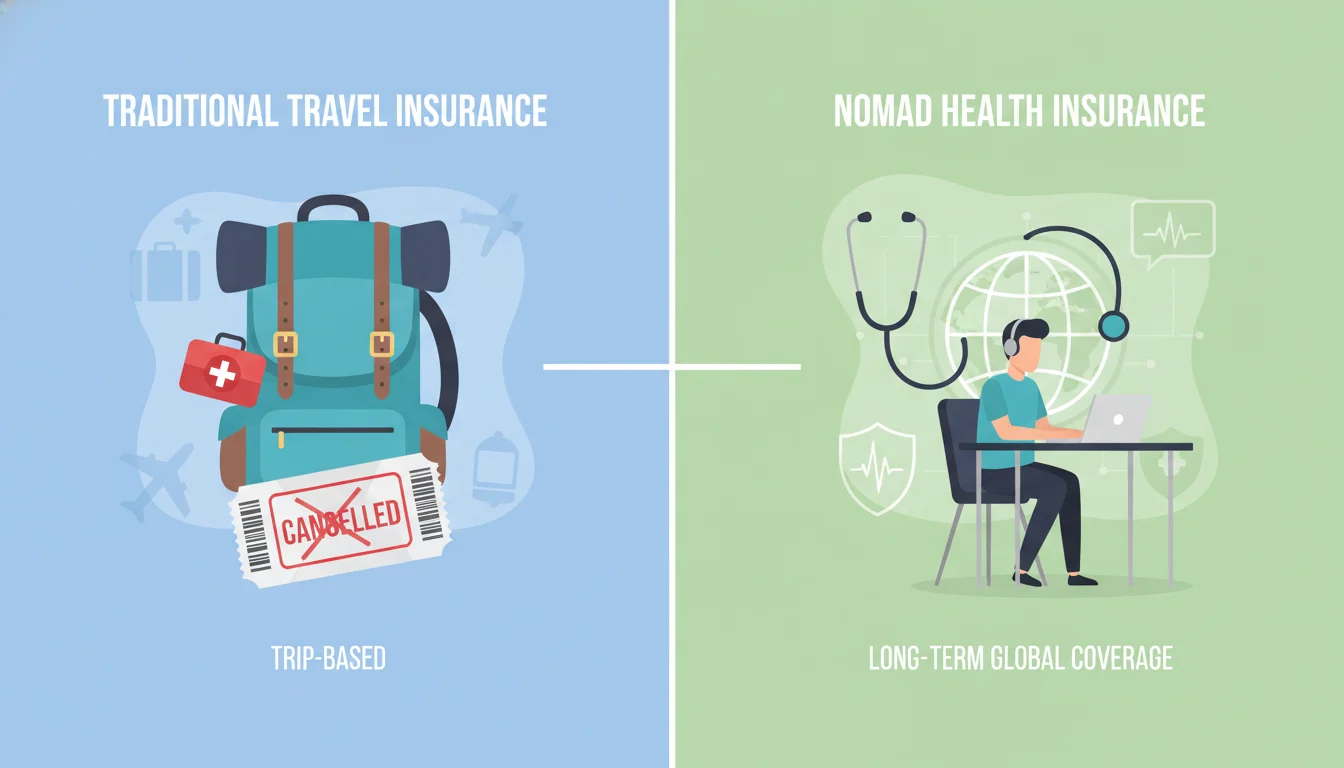
Nomad Health Insurance, epitomized by SafetyWing’s Complete plan or competitors like Genki, functions as a primary health plan. These policies are underwritten to cover routine medical consultations, preventative medicine, standard dental care, mental health support, and ongoing treatments for long-term stays. For digital nomads actively seeking formal residency visas in foreign jurisdictions, immigration authorities increasingly require “Full Health Insurance” rather than standard travel insurance, as the latter fails to cover routine domestic healthcare costs within the host country, thereby presenting a financial risk to the host nation’s public health infrastructure. The failure to comprehend this distinction frequently results in the summary rejection of Digital Nomad Visa applications.
Tiered Plan Structures and Coverage Ceilings
To accurately accommodate varying risk tolerances, activity levels, and capital budgets, both insurance providers utilize heavily structured, tiered coverage systems. The financial ceilings, sub-limits, and specific inclusions embedded within these tiers dictate the ultimate actuarial value of each plan.
World Nomads Tiered Infrastructure
World Nomads structures its risk mitigation protocols into four primary plan architectures for United States residents, with similar but legally distinct variations depending on global residency requirements: the Standard Plan, the Explorer Plan, the Epic Plan, and the Annual Multi-Trip Plan.
The Standard Plan serves as the foundational tier, providing essential coverage for emergency medical expenses up to a maximum limit of $125,000, alongside emergency evacuation and repatriation benefits capped at $400,000. It is underwritten to cover over 250 standard sports, activities, and experiences, broadly categorized as low-to-medium risk. Logistical protections are relatively modest in this tier, with trip cancellation and interruption benefits capped at $2,500, and baggage protection limited to $1,000.
The Explorer Plan represents a robust mid-tier option that elevates emergency medical coverage to $150,000 and expands the emergency evacuation ceiling to $500,000. Crucially for adventure travelers, it expands the activity roster to over 300 activities, incorporating higher-risk sports that are strictly excluded from the Standard tier. Furthermore, it substantially increases trip cancellation and interruption protection to $10,000, while doubling baggage protection to $2,000. This plan also introduces supplementary benefits such as rental car damage coverage and missed connection stipends.
The Epic Plan is specifically engineered for extreme adventure tourism and high-net-worth travel logistics. This top-tier policy maximizes emergency medical coverage at $250,000 and provides an expansive $700,000 limit for complex emergency medical evacuations and repatriations. It covers an exhaustive list of over 340 activities, absorbing the risk for extreme altitude mountaineering, cliff diving, and free soloing. Logistical protections are similarly maximized, with trip cancellation and interruption covered up to $15,000, and baggage coverage elevated to $3,000.
The Annual Plan is aimed strictly at frequent, transient travelers taking multiple discrete trips per year.
It provides continuous coverage for a 12-month period, provided that each individual trip does not exceed a maximum duration of 45 days. This plan limits medical coverage to $100,000 per trip, trip cancellation to $5,000 per individual coverage term, and baggage protection to $2,000 per trip.
A notable actuarial feature available exclusively for the Explorer and Epic plans is the “Cancel for Any Reason” (CFAR) add-on. Standard trip cancellation requires a documented, covered peril—such as severe illness, the death of a family member, or a natural disaster. The CFAR add-on bypasses this strict requirement, allowing travelers to proactively abort a trip for entirely personal or geopolitical reasons, provided the cancellation occurs at least two days prior to the scheduled departure. Under this specific benefit, the Explorer plan may reimburse up to 50% of prepaid, non-refundable costs (maximum $5,000), while the Epic plan reimburses up to 75% (maximum $11,250). This instrument is highly valuable for digital nomads operating in volatile regions, though regulatory restrictions prohibit its sale to residents of certain jurisdictions, such as New York.
SafetyWing Tiered Infrastructure
SafetyWing simplifies its global offerings into two primary, subscription-based categories, distinguished not by the extremity of the activities covered, but by their fundamental purpose: emergency travel medical stabilization versus comprehensive global health maintenance.
Nomad Insurance Essential
Nomad Insurance Essential, the standard policy, provides an overall maximum medical limit of $250,000 for standard policyholders, which is strictly reduced to $100,000 for individuals aged 65 to 69. Emergency medical evacuation under this tier operates under a strict $100,000 lifetime maximum constraint. This evacuation limit is further reduced to a maximum of $25,000 if the medical evacuation is necessitated by the acute, sudden onset of a pre-existing medical condition. The logistical travel disruption benefits included in the Essential plan are notably sparse compared to World Nomads. It offers $5,000 for trip interruption, but this is explicitly limited to extreme scenarios such as the unexpected death of an immediate family member. It provides modest stipends for travel delays (up to $150 a day for three days, or $60 for a three-hour delay) and a $10,000 allowance for political evacuation. Crucially, the Essential plan explicitly does not cover standard trip cancellations due to illness or scheduling conflicts.
Nomad Insurance Complete
Nomad Insurance Complete represents a total architectural evolution from emergency stabilization into a holistic health maintenance organization (HMO) model. The Complete plan raises the annual maximum medical limit to a highly competitive $1,500,000. More importantly, it transcends the boundaries of emergency trauma care by actively funding long-term biological health. The Complete tier includes ongoing, renewable coverage for routine and emergency medical care anywhere in the world, wellness therapies, mental health psychiatric support, and comprehensive oncology and cancer treatments. It also expands logistical protections to include burglary, canceled accommodations, and delayed luggage.
Comparative Financial Ceilings
To contextualize the allocation of actuarial capital between the two firms, a direct comparison of their primary financial ceilings is required.
| Benefit Category | World Nomads (Standard / Epic) | SafetyWing (Essential / Complete) |
|---|---|---|
| Emergency Medical Cap | $125,000 / $250,000 | $250,000 / $1,500,000 |
| Emergency Evacuation | $400,000 / $700,000 | $100,000 (Lifetime) / $100,000 |
| Trip Cancellation | $2,500 / $15,000 | Not Covered / Not Covered |
| Trip Interruption | $2,500 / $15,000 | $5,000 (Specific causes) / $5,000 |
| Baggage & Gear Loss | $1,000 / $3,000 | $3,000 max ($500/item) / $3,000 max |
The data indicates a clear, inverse relationship in capital allocation between the two providers. World Nomads heavily subsidizes and protects against logistical catastrophes—specifically complex helicopter evacuations and massive financial losses from canceled itineraries—while capping general medical expenses. SafetyWing allocates its primary capital toward long-term biological health, as evidenced by the massive $1.5 million medical cap on the Complete plan, while deliberately minimizing its financial exposure to logistical travel disruptions and expensive aerial extractions.
Extreme Risk Mitigation: High-Altitude Trekking and Adventure Sports
For a statistically significant subset of the digital nomad population, periods of remote work are interspersed with high-risk adventure tourism and mountaineering. The underwriting of “adventure sports” is highly scrutinized by insurance actuaries, resulting in strict policy categorization, rigid elevation maximums, and severe exclusions. The legal distinction between a standard recreational hike and technical “mountaineering” can mean the difference between comprehensive financial coverage and immediate, catastrophic claim denial.

The Nepal Case Study: Everest Base Camp and Helicopter Evacuations
Trekking in the Himalayas of Nepal, specifically along the Everest Base Camp (EBC) route, serves as the ultimate real-world stress test for travel insurance policies. The geographic reality of the Khumbu region dictates that the base camp sits at an elevation of 5,364 meters (17,598 feet), while the optimal viewing ridge, Kala Patthar, reaches 5,550 meters. The entire region is completely devoid of vehicular road access. Consequently, any severe onset of Acute Mountain Sickness (AMS), High Altitude Pulmonary Edema (HAPE), or traumatic orthopedic injuries necessitates immediate, highly expensive helicopter evacuation to facilities such as the CIWEC Hospital in Kathmandu or Pokhara.
SafetyWing’s approach to high-altitude risk is highly restrictive. The base Nomad Insurance Essential plan covers standard trekking and mountaineering only up to a maximum altitude of 4,500 meters without requiring supplementary add-ons. Because the entirety of the EBC trek exceeds 5,300 meters, policyholders utilizing the standard Essential plan will have their claims universally denied in the event of an emergency. To secure coverage for this specific environment, SafetyWing users must explicitly purchase the supplementary “Adventure Sports” add-on, which forcefully extends the coverage limit for mountaineering up to 6,000 meters. However, it is paramount to note that SafetyWing unequivocally excludes any activity whatsoever at elevations exceeding 6,000 meters, alongside a broad spectrum of high-risk mechanics including heli-skiing, base jumping, cliff jumping, powerlifting, off-piste skiing, and whitewater rafting, regardless of whether the adventure add-on was purchased.
World Nomads approaches high-altitude risk through its complex, tiered, and color-coded activity roster. The Standard plan broadly covers hiking and trekking up to 19,685 feet (6,000 meters) as a standard “Blue” activity, which technically encompasses the geographic elevation of the EBC trek without requiring a plan upgrade. However, the physical mechanics of the ascent often introduce legal gray areas. If a trek transitions from standard hiking to technical mountaineering—involving the use of fixed rope lines, crampons, or specialized ice axes—it frequently triggers the necessity for the Explorer plan. The Explorer plan elevates the maximum altitude coverage to 21,325 feet (6,500 meters) and incorporates “Orange” activities, absorbing the risk for heli-skiing, cavern diving, and skydiving. For extreme, expeditionary ascents, the Epic plan covers altitudes up to a staggering 26,247 feet (8,000 meters) and “Purple” activities, including technical ice climbing, cliff diving, and free soloing.
| Provider & Plan | Base Altitude Limit | Maximum Upgrade Limit | Excluded High-Risk Activities |
|---|---|---|---|
| SafetyWing Essential | 4,500 meters | 6,000 meters (with Add-on) | Whitewater rafting, Heli-skiing, Off-piste |
| World Nomads Standard | 6,000 meters | N/A | Heli-skiing, Ice climbing, Skydiving |
| World Nomads Explorer | 6,500 meters | N/A | Ice climbing, Free soloing, Cliff diving |
| World Nomads Epic | 8,000 meters | N/A | Professional competition |
The Friction of Emergency Logistics and Extractions
While policy documents technically guarantee coverage thresholds, the execution of emergency logistics in austere environments reveals critical operational friction points. Helicopter rescues in jurisdictions like Nepal are heavily scrutinized by international insurers due to historical patterns of widespread fraud, involving lucrative collusion between unscrupulous trekking agencies, local hospitals, and helicopter operators.
World Nomads provides up to $700,000 in evacuation coverage on the Epic plan, theoretically ensuring a financial ceiling entirely capable of handling the most complex, multi-stage international repatriations. However, market feedback and operational reports from expedition guides indicate severe administrative delays during critical emergencies. Expedition leaders operating on Mount Kilimanjaro and within the Himalayas consistently report that World Nomads mandates direct, synchronous communication with the injured party or their direct representative before officially authorizing the dispatch of a helicopter. In remote, high-altitude environments reliant exclusively on intermittent satellite phone connectivity, this rigid bureaucratic requirement causes life-threatening delays.
Expedition companies complain of spending critical hours waiting for authorization from the World Nomads operations center, forcing climbers to either wait or absorb the exorbitant helicopter fees out-of-pocket (frequently exceeding $10,000) and petition the insurer for reimbursement retroactively.Conversely, specialist extraction firms (such as Global Rescue) bypass this friction by authorizing flights in minutes without requiring arduous patient interviews, though they lack the routine medical coverage provided by travel insurance. While SafetyWing offers a generally smoother digital interface for standard clinical claims, its lifetime emergency evacuation limit of $100,000 is comparatively low for complex, intercontinental medical extractions, and the provider does not specialize in the nuances of extreme high-altitude logistical operations.
Asset Protection: The Professional Equipment Paradox
Digital nomads rely inextricably on high-value technology—including premium laptops, advanced photographic equipment, and specialized digital peripherals—to sustain their remote income streams. The destruction, loss, or theft of this equipment represents a critical failure state for a nomad’s business operations, often halting income generation entirely. Policy responses to hardware protection are fraught with strict financial sub-limits, rapid depreciation schedules, and highly nuanced legal exclusions.
Valuation Limits and Per-Item Sub-Caps
World Nomads structurally incorporates baggage and electronics protection into all its single-trip policies. The total coverage ceiling scales linearly with the chosen plan tier: $1,000 for Standard, $2,000 for Explorer, and $3,000 for the Epic plan. However, insurance actuaries meticulously protect the firm from total loss exposure via the aggressive application of “sub-limits” or “per-item maximums.”
Regardless of the total aggregate limit, an Explorer or Epic policy restricts the maximum allowable payout to $500 to $1000 per individual article. Therefore, if a nomad experiences the theft of a $3,000 MacBook Pro and a $2,000 DSLR camera, the maximum reimbursement under a standard Explorer policy will likely only yield $1,000 per item, leaving the nomad to personally absorb a massive $3,000 deficit. Furthermore, World Nomads treats these claims as “secondary” or “excess” coverage. In the event that a common carrier, such as a commercial airline, loses checked luggage, the nomad must first exhaust all compensation avenues directly with the airline before World Nomads will consider adjudicating the remainder of the claim.
SafetyWing’s approach is equally restrictive but structurally different. The base Nomad Insurance Essential plan explicitly excludes comprehensive electronics and tech gear coverage by default, viewing its mandate strictly as the provision of travel medical stabilization. A nomad traveling solely on the Essential plan receives zero compensation for stolen technology unless they purchase a specific electronics add-on. To secure integrated asset protection, users must upgrade to the Nomad Insurance Complete tier, which includes coverage for burglary and delayed luggage, up to a $3,000 maximum per certificate period. However, mirroring World Nomads, SafetyWing also enforces a strict $500 per-item limit, severely under-insuring modern, high-end professional hardware.
The “Professional Gear” Legal Exclusion
The most critical and often overlooked vulnerability for a remote worker relying on World Nomads is the implementation of the “Professional Gear” exclusion clause. While World Nomads explicitly advertises coverage for personal computers, mobile phones, and cameras, the formal policy fine print dictates that the insurer “may not cover your professional gear that is owned by someone other than yourself or used for professional purposes”.
This creates a systemic legal paradox for the modern digital nomad. By definition, a digital nomad utilizes their laptop and telecommunications equipment for professional, income-generating purposes. During the claims adjudication process, if an adjuster determines that a stolen laptop was primarily utilized as a business asset rather than a personal recreational device, the entire claim can be legally and summarily denied. Furthermore, any corporate-issued hardware—devices owned by the nomad’s remote employer rather than the individual policyholder—is unilaterally and entirely excluded from coverage. This forces serious remote workers to seek separate, specialized commercial property insurance to guarantee the rapid replacement of business-critical hardware.
SafetyWing, targeting the decentralized remote workforce more directly, attempts to circumvent this issue through commercial solutions. They offer a distinct “Remote Health” product engineered for globally distributed teams and remote companies, which shifts the burden of equipment and comprehensive health coverage to the employing corporation, thereby bypassing the individual consumer policy exclusions.
Bureaucratic Requirements for Asset Claims
In the event of theft or loss, the bureaucratic burden placed on the claimant is immense. World Nomads requires policyholders to notify the insurer within 20 days of the incident and submit comprehensive proof of loss within 90 days. Claims must be supported by official police incident reports, original purchase receipts, and proof of ownership. If a nomad is unable to produce the original purchase receipt for a stolen item, the claims team retains the right to heavily depreciate the asset’s value or deny the claim entirely. Furthermore, geopolitical aviation security regulations further complicate coverage. Following the 2017 U.S. and U.K. aviation security restrictions regarding large electronic devices in carry-on luggage from specific Middle Eastern and North African airports, World Nomads updated its policies to cover electronics forced into checked luggage, provided the overarching policy limits and strict compliance conditions were met.
Financial Mechanics: Premium Volatility, Deductibles, and Co-Pays
The pricing architecture of both insurance providers accurately reflects their divergent demographic targets and risk modeling. SafetyWing utilizes an incredibly transparent, age-banded subscription model, while World Nomads employs a highly dynamic, opaque pricing matrix heavily dependent on the traveler’s age, specific itinerary, trip duration, and exact country of legal residence.
Premium Volatility and Quotation Modeling
SafetyWing’s premium pricing is uniform globally, offering predictable forecasting for long-term travelers (excluding travel to the United States, Hong Kong, or Singapore, which requires specific premium add-ons). The Essential plan begins at a highly competitive $56.28 per four weeks for individuals aged 18 to 39. Prices scale predictably and linearly with age brackets. For the comprehensive Complete plan, the cost rises to $161.50 per month for the same 18–39 demographic. This flat-rate subscription model is highly advantageous for budget-conscious nomads maintaining a low cost of living in emerging markets such as Southeast Asia, Eastern Europe, or Latin America, as the premium does not fluctuate based on the specific destination.
World Nomads’ premiums are significantly higher and subject to complex actuarial algorithms that penalize broad, multi-region travel. A theoretical one-month journey through the specific countries of Thailand, Cambodia, and Vietnam for a 30-year-old traveler might generate a quote of approximately $118 for the Standard plan and $209 for the Explorer plan. However, for multi-region global itineraries, World Nomads requires the traveler to specifically list their intended destinations. Selecting “Worldwide” as a destination escalates the premium exponentially. For example, a 32-year-old U.S. resident requiring six months of continuous “Worldwide” coverage could face exorbitant premiums of $150 per month for the Standard plan and $217 per month for the Explorer plan. This pricing model financially penalizes the spontaneous, borderless travel style favored by many digital nomads.
Deductible Thresholds and Out-of-Pocket Exposures
A deductible dictates the exact financial threshold the insured must cross out-of-pocket before the underwriter assumes any financial liability. The application of these deductibles varies wildly between the two providers.
| Provider & Plan | Standard Deductible | U.S. Specific Deductibles / Co-Pays | Co-Insurance Requirements |
|---|---|---|---|
| SafetyWing Essential | $0 | $100 ER / $50 Urgent Care | None |
| SafetyWing Complete | $250 per certificate period | $50 Urgent Care | 10% Outpatient / 20% Maternity |
| World Nomads (U.S. Resident) | $0 | $0 | None |
| World Nomads (U.K. Resident) | £100 | N/A | None |
SafetyWing has aggressively minimized initial friction for minor claims. The Essential plan currently features a $0 standard deductible, eliminating out-of-pocket costs for standard global care and minor ailments. However, if the policyholder opts for U.S. coverage, treatments within the United States incur strict co-pays ($100 for emergency room visits, and $50 for urgent care centers). The Complete plan, acting as a primary health HMO, incorporates traditional co-insurance structures, requiring the patient to cover 10% of the cost for outpatient treatments and 20% for maternity care, while also retaining a $250 deductible per certificate period.
World Nomads’ deductibles are entirely dictated by the policyholder’s home jurisdiction and the corresponding regional underwriting partner.
For United States residents, World Nomads plans universally feature a highly attractive $0 deductible. Conversely, United Kingdom residents are subjected to a mandatory £100 deductible on standard policies before any claim is processed.
Geographic Constraints, Visa Compliance, and Home Country Nuance
The legal definition of a “Home Country” presents a significant, often insurmountable hurdle for long-term travelers. Traditional travel insurance operates on the rigid actuarial assumption that a “trip” is a temporary departure from a permanent residence, to which the traveler will inevitably return.
Home Country Exclusions and Repatriation Requirements
World Nomads strictly adheres to this traditional travel insurance framework. Its policies universally exclude medical and travel coverage while the policyholder is located within their stated country of residence. Furthermore, to even be eligible for a World Nomads policy, the traveler must maintain an unconditional right of entry and have guaranteed access to long-term national medical care in their home country. The underlying logic is that World Nomads expects to medically repatriate the insured back to their home nation’s public health system for any long-term recovery or ongoing care.
For dedicated expatriates and perpetual travelers who have formally severed residency ties, canceled domestic health insurance, or legally abandoned tax domiciles with their passport nations, fulfilling this repatriation requirement is legally perilous and practically impossible. Certain demographics, including permanent residents of specific European Union nations, may find themselves entirely ineligible to purchase World Nomads coverage due to complex regional regulations.
SafetyWing explicitly recognizes the fluidity of modern nomadic life and the reality of borderless living. The Essential plan provides highly valuable incidental coverage within the policyholder’s home country for up to 30 days per every 90 days of active overseas coverage (this is reduced to a 15-day maximum for U.S. citizens returning to the United States). This specific allowance legally facilitates brief holidays, temporary family visits, and necessary visa runs without breaking the continuous coverage cycle or exposing the nomad to uninsured risk. The Nomad Insurance Complete plan takes this evolution further by eliminating home country restrictions entirely, acting as a fully borderless global health insurance protocol with no domestic restrictions.
Digital Nomad Visa (DNV) Immigration Compliance
As global taxation and immigration systems adapt to absorb remote workers, the acquisition of a Digital Nomad Visa demands stringent proof of healthcare solvency. Immigration ministries require incoming remote workers to possess policies that comprehensively cover routine hospitalization, preventative care, and specialized treatments, explicitly to prevent the nomad from becoming a financial burden on the host nation’s subsidized medical infrastructure.
Because World Nomads is strictly classified as travel insurance, explicitly excludes routine local healthcare, and caps its durations, immigration authorities routinely reject World Nomads certificates as valid proof of health insurance for residency applications. SafetyWing’s Essential plan may satisfy less stringent border checks or short-term tourist visa requirements, but the Nomad Insurance Complete plan is specifically architected to meet the comprehensive health insurance thresholds required by 2026 DNV frameworks across the European Union, the Middle East, and Latin America.
Pandemic Response and Sanctioned Jurisdictions
Following the systemic disruption of the global travel sector, both providers have integrated COVID-19 and pandemic-related illnesses into their standard coverage arrays. Both World Nomads and SafetyWing explicitly state that medical treatments for COVID-19 are covered under the exact same terms as any other severe illness, provided the virus was not contracted prior to the policy start date and the testing is deemed medically necessary by an attending physician.
However, coverage remains strictly bound by international geopolitical sanctions. Neither provider will extend coverage, authorize medical evacuations, or facilitate financial payouts in jurisdictions subject to comprehensive United Nations, European Union, or United States trade and economic sanctions. This explicitly voids coverage for travelers attempting to enter nations such as Cuba, Iran, North Korea, Syria, Belarus, and specific conflict regions within Ukraine.
Institutional Reliability and Claims Resolution Friction
An insurance policy’s ultimate actuarial value is tested not at the frictionless point of digital purchase, but at the point of acute crisis and subsequent claim resolution. An exhaustive analysis of market sentiment, aggregated from verified review platforms and decentralized community forums, reveals systemic operational friction points for both providers.
SafetyWing: Digital Marketing vs. Adjudication Realities
SafetyWing maintains a strong, highly visible 5-star aggregate rating on established platforms such as Trustpilot. This high volume of positive sentiment is driven largely by its seamless, modern user interface, the availability of 24/7 digital support via live chat, and the rare ability to initiate coverage instantaneously while already located abroad. The platform leverages a highly effective and aggressive affiliate marketing network, resulting in widespread, positive visibility across digital nomad blogs and YouTube channels. Policyholders routinely praise the simplicity of filing minor claims for issues like food poisoning or minor dental emergencies through straightforward online portals.
However, peer-to-peer discourse on decentralized forums, notably Reddit’s digital nomad communities, presents a sharply contrasting and highly critical narrative regarding SafetyWing’s institutional reliability. Numerous long-term policyholders allege that SafetyWing functions effectively and seamlessly only until a substantial, high-value medical claim is filed. Extensive criticisms highlight an arduous, deeply bureaucratic claims adjudication process characterized by repeated, piecemeal requests for extraneous medical documentation. Users report severe administrative fatigue, intentional delays, and a heavy reliance on a rigid, extensive list of policy exclusions (e.g., denying coverage based on obscure “pre-existing condition” clauses or minor administrative technicalities) to minimize massive payouts. Verified users have reported instances where the firm unilaterally alters its claims submission protocols, delaying legitimate reimbursements for months, leading to widespread accusations within the community that the Essential policy operates as a low-payout structure designed to collect steady subscription premiums while mitigating major capital losses. While minor clinic visits are generally resolved efficiently, complex surgeries or hospitalizations frequently reveal the severe administrative limitations of the Essential plan’s low-cost underwriting architecture.
World Nomads: Bureaucratic Rigidity and Operational Delays
World Nomads benefits from a long-standing, entrenched reputation backed by decades of operation and endorsements from major travel industry titans, including Lonely Planet and Eurail. The general market consensus indicates that while World Nomads is significantly more expensive upfront, its actual financial coverage depth for severe, catastrophic accidents is highly robust and reliable. The firm consistently honors large-scale claims and complex hospitalizations, provided the incident falls strictly within the meticulously detailed policy wording.
The primary operational friction associated with World Nomads lies in its bureaucratic rigidity and communication protocols during critical, time-sensitive emergencies. As previously noted regarding high-altitude helicopter evacuations, the strict requirement for centralized corporate approval and direct patient communication before dispatching life-saving medical transport places an immense, sometimes dangerous logistical burden on the traveler. Furthermore, the company suffered notable reputational damage during the initial onset of the COVID-19 pandemic. While agile competitors rapidly integrated emergency pandemic coverage, World Nomads initially denied mass cancellation claims globally by invoking “known event” clauses, which alienated a significant portion of its long-term, loyal user base. While the firm has since modernized its pandemic response protocols, the perception of slow, highly conservative claims adjudication persists within the long-term travel community.
Strategic Risk-Management Conclusions
The comprehensive actuarial data, policy architecture, and market sentiment analysis indicate that neither World Nomads nor SafetyWing offers a flawless, universally applicable insurance solution. The optimal strategic choice is entirely contingent upon the traveler’s specific operational parameters, geographic risk profile, and long-term regulatory residency requirements.
The Strategic Case for World Nomads:
World Nomads remains the vastly superior underwriting architecture for the traditional, high-intensity adventure traveler.
Nomads undertaking discrete, multi-month global journeys that prioritize high-risk activities—suchs as technical mountaineering up to 8,000 meters, deep scuba diving, or extreme winter sports—will benefit immensely from the comprehensive logistical safety net provided by the Explorer and Epic tiers. The exceptionally high financial caps on emergency medical evacuation ($500,000 to $700,000) and substantial trip cancellation and interruption protections ($10,000 to $15,000) make it the optimal choice for expensive, logistically complex itineraries where the risk of total trip collapse is high. However, the policyholder must willingly accept significantly higher premium costs, the strict exclusion of professional business equipment, the bureaucratic friction of emergency approvals, and the total lack of coverage within their home nation.
The Strategic Case for SafetyWing Essential
SafetyWing’s Nomad Insurance Essential plan is the mathematically and practically optimal choice for the budget-conscious, slow-traveling digital nomad residing indefinitely in low-cost-of-living regions (e.g., Southeast Asia, Eastern Europe, Latin America). At approximately $56 per four weeks, it provides an unbeatable, highly efficient baseline of catastrophic medical liability protection ($250,000) for standard urban and remote work environments. Its continuous subscription flexibility, lack of standard deductibles for global care, and allowance for brief, incidental home-country visits align perfectly with the fluid, undefined nature of modern nomadism. Users must, however, be financially prepared to self-insure their professional electronics, meticulously manage minor out-of-pocket medical expenses, navigate a potentially exhaustive claims process for major injuries, and strictly avoid extreme sports unless utilizing specific altitude add-ons.
The Strategic Case for SafetyWing Complete
For the established, high-income expatriate, long-term digital nomad, or remote worker actively seeking formal residency via a state-sponsored Digital Nomad Visa, the SafetyWing Complete plan represents the necessary, inevitable evolution from temporary travel insurance to permanent global health infrastructure. At $161.50 per month, the provision of a massive $1,500,000 medical cap, the inclusion of routine clinical check-ups, oncology and cancer treatments, mental health psychiatric support, and truly borderless coverage (including unlimited coverage within the home country) effectively replaces the need for a national healthcare system. It successfully bridges the critical gap between transient nomadic adventure and the inescapable biological realities of aging, long-term health maintenance, and global regulatory compliance.
In conclusion, the 2026 digital nomad insurance market requires travelers to explicitly define their primary liability and risk exposure. Those optimizing for the immediate mitigation of physical, adventure-based trauma, complex emergency extractions, and logistical trip collapse are best served by the robust financial ceilings and traditional architecture of World Nomads. Conversely, remote professionals optimizing for continuous, borderless health maintenance, visa immigration compliance, and operational cost-efficiency will find the SafetyWing architecture significantly more aligned with the modern realities of indefinite global mobility.