Digital Marketing for Indian Design Firms: Strategic Guide
Industry Overview
The architecture and interior design industry in India is undergoing a profound and unprecedented transformation, evolving rapidly from what was once considered a niche luxury service reserved for the ultra-wealthy into a functional necessity for a burgeoning urban middle class. Driven by changing lifestyle preferences, rising disposable incomes, and widespread urbanization, the sector currently sits at the critical intersection of commercial real estate development, consumer technology integration, and environmental sustainability. As India’s urban population crossed the 500 million mark in 2025 and races toward a projected 600 million by 2036, the demand for intelligently designed, optimized, and aesthetically pleasing living and working spaces has never been higher.
Current Market Size, Growth, and Trends
The economic footprint of the Indian interior design and architecture sector is substantial, exhibiting aggressive acceleration across both residential and commercial verticals. The Indian interior design market generated a revenue of USD 36.89 billion in 2025 and is projected to reach an impressive USD 74.73 billion by 2034, demonstrating a robust compound annual growth rate (CAGR) of 8.16% from 2026 to 2034. Other industry analyses tracking broader market segments and specific subset revenues project the market could reach USD 65.01 billion by 2031, growing at a remarkable 12.87% CAGR.
The market exhibits distinct segmentation based on application, project type, and geographic distribution, revealing where the deepest pools of capital are currently concentrated:

- Project Type
-
Key Statistics & Economic Projections: New construction commands the largest share, holding 56% to 57.39% of the market.
Underlying Strategic Driving Factors: Continuous expansion of residential and commercial construction across major cities; real estate developers increasingly partnering with design firms to offer move-in-ready homes with pre-designed interiors to enhance property appeal.
- End-User (Residential)
-
Key Statistics & Economic Projections: Commands approximately 60% of the interior design market share.
Underlying Strategic Driving Factors: Rising homeownership among millennials, an increase in dual-income households, the shift toward nuclear family structures requiring optimized urban apartments, and a massive 37.8% year-on-year surge in luxury housing sales in early 2024.
- End-User (Commercial)
-
Key Statistics & Economic Projections: Represents up to 74.44% to 75% of broader revenue in specific industry metrics.
Underlying Strategic Driving Factors: India’s booming commercial real estate market; startups and established enterprises seeking thoughtfully designed, branded environments that enhance productivity, employee retention, and corporate identity.
- Geography
-
Key Statistics & Economic Projections: North India represents the largest market segment, holding a 29% to 39.87% share.
Underlying Strategic Driving Factors: Significant urban infrastructure development in major cities like Delhi, Chandigarh, and Jaipur; strong consumer desire to fuse traditional cultural heritage with modern global design aesthetics.
Beyond raw market valuation, several distinct trends are currently reshaping the operational realities of the Indian architectural and interior design landscape. The most visible technology-driven shift is the aggressive integration of smart home technologies. Consumers are increasingly demanding the seamless integration of automated lighting, climate control, and advanced security systems into their living spaces. The Indian smart home devices market, valued at USD 6.70 billion in 2024, is expected to skyrocket to USD 47.46 billion by 2033, exhibiting a CAGR of 24.30%. Architects and interior designers are now required to conceptualize spatial layouts that elegantly accommodate IoT-enabled devices while maintaining rigorous aesthetic harmony.
Concurrently, sustainability and eco-friendly design have moved from the periphery to the mainstream. With growing awareness around climate change and environmental responsibility, more than 50% of high-value homebuyers now prioritize eco-friendly features in their renovation plans, a stark increase from a negligible percentage a decade ago. This shift necessitates the integration of biophilic design principles, natural woods, recycled components, and low-VOC materials into standard architectural proposals. Furthermore, massive government infrastructure stimulus programs are creating sustained macroeconomic tailwinds. Initiatives such as the PM Awas Yojana Urban 2.0, backed by a ₹10 lakh crore investment to address housing needs for one crore urban families, are directly stimulating downstream demand for interior finishing, turnkey installation, and professional design services at an unprecedented national scale.
Key Challenges Faced by Businesses in this Industry
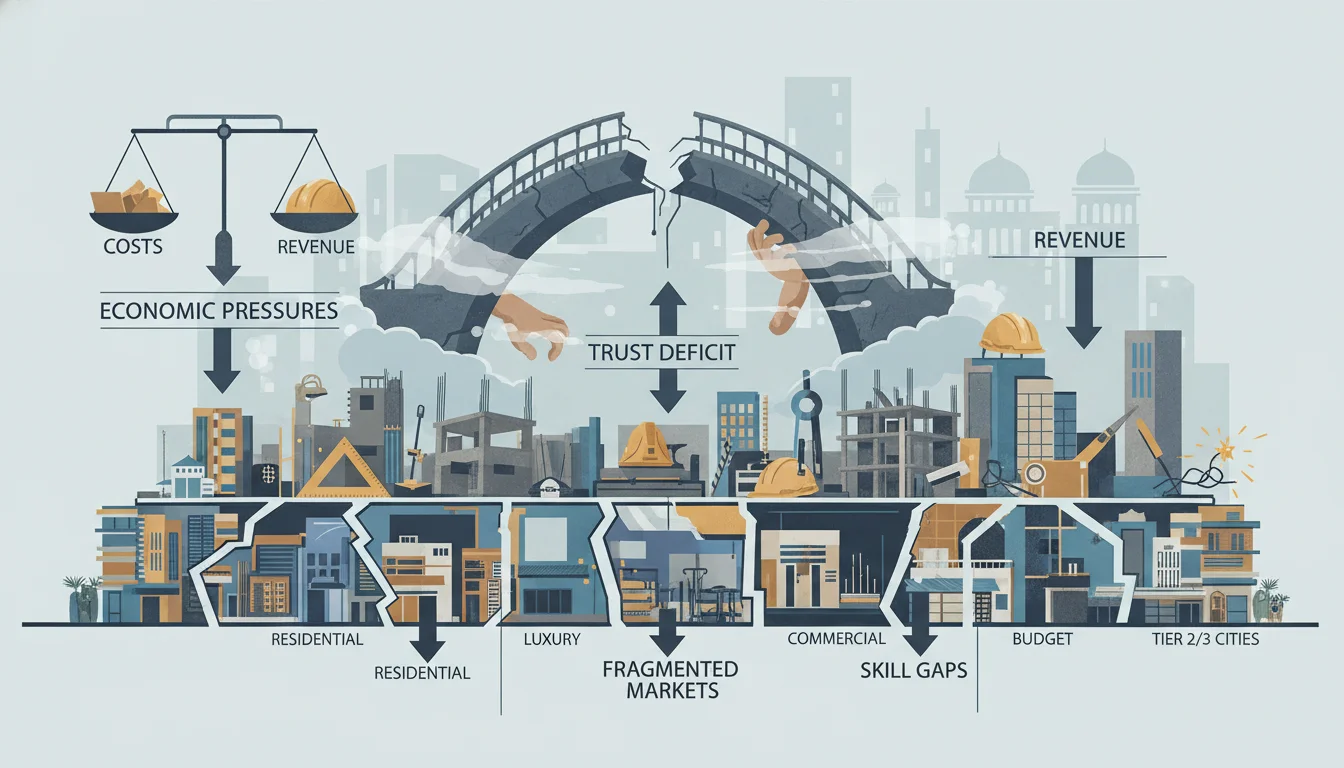
Despite the immense growth potential and favorable macroeconomic conditions, architecture and interior design firms in India operate in a highly complex, fiercely competitive, and structurally challenging environment. Market fragmentation remains a primary hurdle. The sector is dominated by thousands of unorganized players, freelance contractors, and regional designers, which complicates standardization in pricing, service quality, and delivery timelines.
Perhaps the most significant hidden challenge in the Indian interior design market is the profound trust deficit caused by the prevalent vendor commission model. Traditional interior designers in India frequently do not generate their primary profit from transparent design fees; instead, they rely on vendor commissions, typically extracting 18% to 25% on every material purchase made for a project. This creates a massive conflict of interest, where designers may push expensive materials not because they serve the client’s best interest, but because a higher price yields a higher commission. Consequently, homeowners often believe they are receiving “wholesale prices” but are actually subjected to 30% to 40% markups above market rates. As information asymmetry decreases in the digital age, consumers are becoming increasingly aware of this dynamic, leading to profound skepticism and creating a high barrier to trust that legitimate architectural firms must overcome.
Furthermore, the industry is severely constrained by skill gaps and labor shortages. Maintaining high-quality execution standards is exceedingly difficult due to a lack of appropriately skilled craftsmen and experienced project managers. This deficiency routinely leads to project delays, compromised execution quality, and ultimate client dissatisfaction, which in turn harms brand reputation in an industry heavily reliant on localized word-of-mouth. Finally, architectural firms must navigate extreme economic sensitivity and material inflation. Discretionary spending on premium home improvements is frequently slashed during broader economic downturns, while rising costs for raw materials such as steel, wood, and specialized textiles due to supply chain disruptions severely squeeze profit margins, forcing firms to constantly reevaluate their pricing models and procurement strategies.
Digital Landscape in India (Contextual to the Industry)
The proliferation of high-speed internet, driven by initiatives under the Digital India Mission, and the ubiquitous adoption of smartphones have fundamentally altered the mechanics of how Indian consumers discover, evaluate, and select architectural and interior design services. The digital interface is no longer merely a static portfolio; it has evolved into the primary, interactive touchpoint between design brands and their prospective clients, making digital product thinking an essential component of architectural practice.
Internet & Social Media Usage Relevant to Architecture and Interior Design
The Indian media and entertainment ecosystem, encompassing digital media and social networks, drives massive consumer engagement. To illustrate the scale, in January 2023 alone, the category witnessed over 514 million cross-platform actions on Facebook, Instagram, and Twitter, reaching an audience of over 723 million followers. For highly visual industries like architecture and interior design, social platforms that prioritize image and video content have effectively become the de facto search engines for aesthetic inspiration and vendor vetting.
However, modern digital consumers are experiencing profound decision fatigue. Recent consumer journey analysis reveals that 74% of consumers walk away from purchases simply because they feel overwhelmed by the sheer volume of choices, advertising messages, and conflicting claims. Despite companies focusing on personalized experiences, 71% of people see no improvement in the time and effort required to make a purchase decision. This “information overload” requires architectural and design firms to meticulously curate their digital presence, providing clear, structured, and highly relevant touchpoints that simplify decision-making rather than adding to the noise.
Popular Platforms Among the Target Audience
Platform selection and resource allocation are critical for architectural and interior design marketing, as user intent and demographic composition vary drastically across different networks. Understanding the nuanced engagement benchmarks for each platform allows firms to set realistic performance expectations.
- Audience Demographics & Usage Context: The primary visual discovery and validation platform in India.
- High penetration among millennials and urban professionals.
- 3.5% - 5.0% Engagement Rate; 3.5% - 5.0% for Reels.
- Ideal for showcasing highly curated portfolios, dynamic before-and-after transformations, short-form Reels (15-60 seconds) of active site visits, and photorealistic high-end 3D renderings.
- 514 million global MAUs (Q1 2025), with massive recent growth in India. 69.4% of users are female, with Millennials forming the largest segment.
- Boasts a 32% higher Return on Ad Spend (ROAS) than other digital platforms.
- Functions as an early-stage visual search engine. Home decor is the most browsed category globally (over 70 billion impressions). Users save over 1.5 billion pins weekly.
- Professional networking, targeting corporate executives, real estate developers, and facility managers.
- 2.5% - 4.0% Engagement Rate (highly exceptional for B2B).
- Crucial for capturing lucrative B2B commercial architecture contracts, corporate interior design projects, establishing thought leadership, and talent acquisition.
- Broad demographic reach, allowing for highly localized and precise geographic targeting.
- 1.0% - 2.0% Engagement Rate.
- Effective for local community penetration, reaching older demographics (often the ultimate financial decision-makers in joint Indian families), and executing direct lead-generation advertising.
Consumer Online Behavior Related to Architecture and Interior Design
The digital consumer journey for home renovation and architectural services in India is neither linear nor impulsive. Due to the high financial stakes involved—residential interior design projects in metro cities typically range from ₹10 lakhs to over ₹1 crore—the path to purchase is a highly considered process spanning several months and involving distinct digital touchpoints.
The journey typically begins with a prolonged phase of Awareness and Inspiration. During the first several weeks, consumers utilize Pinterest and Instagram to gather ideas, save architectural styles, and formulate a cohesive visual vision. They engage in broad, style-specific searches, utilizing queries like “contemporary Indian home decor” or “small Indian house floor plan ideas”. During this phase, consumers are not looking to hire; they are looking to learn and visualize.
As the journey progresses, the first meaningful digital engagement typically occurs around Day 34. This benchmark often involves an interaction through a paid search click or a highly targeted social media advertisement, indicating a transition from passive inspiration to active provider evaluation. Following this, consumers enter a phase of deep consideration and validation, searching for specific floor plans, evaluating architectural layouts, and heavily scrutinizing local service providers through Google Reviews, detailed website portfolios, and case studies.
The critical threshold of the First Digital Conversion—which involves a high-intent action such as requesting a customized floor plan, initiating a direct webchat, or submitting a consultation form—often does not occur until Day 57 of the journey. Furthermore, modern consumers are increasingly demanding immersive technological validation before committing financially. There is a strong preference for Augmented Reality (AR) and Virtual Reality (VR) tools that allow clients to visualize room setups and spatial dynamics, fundamentally shifting the consultation process from abstract blueprints to experiential virtual tours.
Digital Marketing Opportunities
Strategic digital marketing provides precise, scalable solutions to the most pressing operational and reputational challenges faced by Indian architecture and interior design firms. It empowers mid-sized studios to bypass traditional word-of-mouth limitations, establish undeniable trust in a skeptical market, and precisely target high-net-worth individuals (HNWIs) and corporate decision-makers with minimal wasted expenditure.
Regulatory Context: Navigating Council of Architecture (COA) Guidelines
A critical factor entirely unique to the architectural profession in India is the stringent regulatory framework governing self-promotion. The Council of Architecture (COA), functioning under the Architects (Professional Conduct) Regulations of 1989 (specifically Regulation 2), strictly prohibits registered architects from actively advertising their professional services to solicit work in traditional media, nor can they allow their names to be used for commercial publicity purposes.
However, the COA framework provides essential exceptions. Architects are permitted to publish their work in the press, maintain an informational digital presence, and produce brochures or digital content describing their capabilities and project experience for potential clients. Because direct, aggressive outbound solicitation (such as billboards or print advertisements explicitly asking for business) is restricted, inbound digital marketing—encompassing Search Engine Optimization (SEO), educational content marketing, and organic social media portfolio curation—is not just an alternative opportunity; it is the most legally compliant, ethically sound, and commercially effective mechanism for architectural growth in India. Digital marketing allows firms to position themselves so that clients find them organically, perfectly aligning with the COA’s mandate for professional dignity.
How Digital Marketing Can Solve Key Industry Challenges
The strategic deployment of digital assets directly addresses the industry’s structural weaknesses. To combat the profound trust deficit surrounding hidden vendor commissions and exorbitant material markups, firms can utilize content marketing to enforce radical transparency. Publishing detailed case studies that include price-per-square-foot breakdowns, explicitly explaining the firm’s flat-fee pricing models versus commission-based models, and providing educational content about raw material sourcing establishes the firm as an honest, authoritative fiduciary rather than a mere vendor.
Furthermore, digital marketing mitigates the risks associated with market fragmentation. Local SEO and Google Business Profile (GBP) optimization allow legitimate, mid-sized architectural firms to geographically dominate their specific radius, cutting through the noise generated by unorganized freelance contractors. By maintaining a robust email marketing infrastructure and utilizing sophisticated retargeting advertisements, firms can nurture leads over the characteristically long sales cycles (6-18 months for institutional/commercial projects, 2-6 months for residential), ensuring a predictable, steady pipeline of work that insulates the firm against sudden macroeconomic downturns.
Best Strategies for Architecture and Interior Design Firms in India
To capitalize on the Indian digital ecosystem, architecture and design firms must deploy a multi-faceted approach:
- Search Engine Optimization (SEO): The foundation of digital discovery involves transitioning away from impossibly broad, highly competitive generic terms (like “architecture”) towards high-intent, hyper-local search phrases (e.g., “luxury residential architect Bangalore” or “turnkey interior designers in Indiranagar”). Firms must develop topical authority through comprehensive pillar pages that address specific architectural styles, urban space-saving techniques, and Vastu compliance.
- Social Media & Immersive Visual Marketing: Architecture is inherently visual. Firms must leverage Instagram Reels and Pinterest Boards not merely to show finished rooms, but to narrate the transformation of spaces. Emphasizing “Before and After” content, showcasing behind-the-scenes structural site visits, and publishing high-fidelity 3D architectural renders humanizes the practice and proves execution capability.
- Content Marketing & Thought Leadership: Producing in-depth, long-form content on sustainable design methodologies, the integration of smart home IoT devices, and the science of Vastu Shastra aligns perfectly with COA guidelines regarding the dissemination of architectural knowledge, while simultaneously attracting highly qualified organic traffic.
- Targeted Ads & Influencer Marketing: While direct solicitation is tricky, utilizing targeted Google Search Ads capturing users actively seeking local designers yields high ROI. Furthermore, influencer marketing presents a massive opportunity. Collaborating with Indian lifestyle influencers, real estate vloggers, and home decor personalities to feature completed residential projects allows firms to borrow trust and reach affluent audiences through relatable, aspirational third-party validation without violating professional advertising codes.
Local and Global Examples/Case Studies
The efficacy of these strategies is proven across both the domestic Indian market and the global architectural stage:
- Local Success - Brilliant Interiors (Kochi): A prominent interior design firm in Kerala struggled with online visibility, failing to rank for competitive industry keywords. By partnering with a digital agency to implement a comprehensive SEO strategy, correcting fundamental on-page technical elements (such as H1 tag optimization and mobile responsiveness), and focusing heavily on local search intent, they exponentially increased organic traffic and successfully leveraged Google’s lead generation capabilities to dominate the regional Kochi market.
- Local Success - Grande Forge (Noida): A distinguished manufacturer of luxury architectural metalwork and bespoke railings faced limited market penetration among affluent homeowners, relying too heavily on traditional trade shows.
By executing a targeted SEO plan focused on high-intent keywords like “luxury staircase railings” and optimizing their website for systematic lead capture, they broke their reliance on offline marketing and accelerated direct-to-consumer sales growth.
Global Benchmarking - The Mega-Firms
On the international stage, architectural giants demonstrate the sheer power of social media dominance. Firms like Zaha Hadid Architects (over 1.3 million Instagram followers) and Snøhetta (over 540,000 followers) utilize Instagram not just as portfolios, but as global branding tools, mixing stunning renders with video clips and product designs. Analytical data tracking the top 25 architectural firms globally reveals that Skidmore, Owings & Merrill (SOM) leads in total engagement applause (with a median of 10,800 reactions per post), while Gensler leads in driving active conversations. These global benchmarks indicate that high posting frequency and highly aesthetic visual content are prerequisites for dominating the digital architectural narrative.
Competitive Analysis
The Indian interior design and architecture market is highly polarized. On one end of the spectrum operate massive, venture-backed tech aggregators, and on the other exist highly specialized, premium boutique architectural studios. Analyzing their respective digital footprints reveals significant vulnerabilities and strategic gaps that agile, mid-sized firms can ruthlessly exploit.
Current Digital Presence of Top Businesses in India
The Tech-Enabled Aggregators: Livspace and HomeLane
Companies like Livspace and HomeLane have fundamentally disrupted the Indian interior design market by scaling tech-driven operations. They dominate search engine results pages (SERPs) through sheer volume of content output, aggressive paid search advertising, and massive capital deployment. What they do exceptionally well is user experience (UX) at the top of the funnel. Their online platforms are robust, offering immediate 3D design visualizations, seamless virtual consultations, and the promise of a highly transparent, tech-managed execution process. Livspace’s strategic operational partnership with global giant IKEA further bolsters its market reach, product catalog, and perceived reliability.
The Premium and Global Architectural Studios: Morphogenesis and ZZ Architects
At the apex of the luxury market, firms like Morphogenesis and ZZ Architects leverage highly sophisticated digital presences built around exclusivity, bespoke craftsmanship, and intellectual thought leadership. Morphogenesis focuses heavily on its copyrighted S.O.U.L.© (Sustainable, Optimised, Unique, Liveable) design philosophy. Their website functions less as a sales funnel and more as an academic repository for research, global publications, and prestigious international awards, such as their inclusion in the WA100 list. Conversely, ZZ Architects commands the ultra-luxury residential segment with a dominant visual presence on Instagram, showcasing opulent contemporary duplexes and commercial spaces, effectively utilizing the founders’ personalities and high-society connections to build an aspirational brand ethos.
Gaps and Opportunities to Outperform the Competition
The primary vulnerability of the current market leaders—particularly the tech-enabled aggregators—lies in the stark dichotomy between their polished digital promise and the reality of physical execution.
Despite their digital dominance, giants like Livspace and HomeLane suffer from severe post-sale reputation crises. Consumer reviews across platforms like Trustpilot, MouthShut, and Reddit frequently highlight egregious “execution gaps.” Complaints systematically detail massive project delays (often spanning months past promised handover dates), highly unprofessional staff behavior, bait-and-switch tactics regarding material quality, and rigid “payment traps” where clients are forced to release funds before work is satisfactorily completed.
This presents a massive strategic opportunity for smaller and mid-sized architectural firms. A boutique firm can outperform massive aggregators by weaponizing the “Local Trust Advantage.” While national aggregators rely on volume and algorithms, local architectural firms can optimize their Google Business Profiles with hyper-local case studies, publish authentic, unedited video testimonials from recognizable neighborhood clients, and guarantee direct access to the principal architect. By highlighting highly personalized service, dedicated end-to-end project management, and flawless, delay-free execution records, smaller firms can intercept high-intent local queries that aggregators cannot authentically address.
Furthermore, ultra-premium firms (like Morphogenesis) often neglect localized, high-intent SEO in favor of broad, international brand awareness and PR. Their websites can sometimes appear overly academic, intimidating, or difficult to navigate for an affluent but practical mid-market consumer looking to build a premium 3BHK. There is a distinct void in the market for agile firms to capture the highly lucrative “premium but accessible” segment by combining high-end visual branding with aggressive, localized, and user-friendly lead-generation tactics.
Recommended Strategy for Architecture and Interior Design Firms in India
To thrive in 2026 and beyond, architecture and interior design firms must abandon ad-hoc marketing tactics and adopt a cohesive, omnichannel digital strategy that respects the high-value nature of their services and aligns meticulously with the complex, multi-stage Indian consumer journey.
Target Audience Personas
Effective digital marketing requires strict segmentation. Firms must tailor their messaging to address the distinct socioeconomic realities, preferences, and pain points of various consumer profiles:
| Audience Persona | Demographics & Geographic Location | Design Preferences & Primary Pain Points | Recommended Digital Approach & Messaging |
|---|---|---|---|
| The Urban Millennial Homeowner | Age: 28-40. Location: Rapidly expanding Tier 1 & 2 cities (Bengaluru, Pune, NCR, Hyderabad). Income: Upper-middle class, dual-income. | Preferences: Smart home IoT integration, space-saving modular designs, contemporary aesthetics, eco-friendly materials. Pain Points: Strict budget constraints, extreme fear of being scammed by contractors. | Heavy reliance on visual platforms (Instagram/Pinterest). Messaging must focus on affordability, transparent plug-and-play package deals, and rapid 3D visualization capabilities. |
| The High-Net-Worth Individual (HNI) | Age: 40-60. Location: Prime metro enclaves (South Mumbai, Lutyens’ Delhi) and luxury villa communities. | Preferences: Ultra-luxury, bespoke craftsmanship, strict Vastu compliance, exclusive imported materials, signature architectural styles. Pain Points: Lack of extreme personalization, privacy concerns, generic design. | Long-form thought leadership content, SEO targeting ultra-luxury keywords, exclusive email newsletters showcasing landmark projects, and high-end video portfolios. |
| The Commercial Decision-Maker | Age: 35-55. Location: Pan-India IT hubs and commercial centers. Role: Startup Founder, Corporate Executive, Facility Manager. | Preferences: Brand-aligned corporate aesthetics, environments that boost employee productivity, adherence to ESG and wellness standards. Pain Points: Project delays negatively impacting core business operations and revenue. | Aggressive LinkedIn marketing, detailed B2B case studies focusing on the ROI of office design, and authoritative whitepapers on workplace ergonomics and spatial efficiency. |
Recommended Channels and Campaign Types
To effectively reach these personas, firms must deploy specialized campaigns across carefully selected digital channels:
- Google Business Profile (GBP) & Hyper-Local SEO: This is the absolute foundation of local lead generation. Firms must maintain an impeccably optimized GBP, ensuring the Name, Address, and Phone Number (NAP) are identical across all web directories. Success requires uploading high-quality, localized photos of ongoing and completed projects regularly (strictly avoiding stock photography), actively utilizing the Q&A sections to address common client concerns, and aggressively systematizing the collection of positive client reviews.
- Pinterest as a Visual Search Engine: Architectural firms must treat Pinterest not as social media, but as a primary search engine. Firms should create highly organized boards categorized by room, style, and specific aesthetic (e.g., “Contemporary Indian Living Rooms,” “Vastu Compliant Kitchen Designs”). Because Pinterest offers a 32% higher ROAS, ensuring all pins link directly back to relevant, conversion-optimized landing pages on the firm’s website is critical.
- Instagram Visual Storytelling: Firms must move beyond posting static, polished images of empty rooms. Utilizing Instagram Reels to showcase the “messy middle” of construction, raw site visits, material selection processes at vendor showrooms, and time-lapse transformations humanizes the brand, proves actual execution capability, and builds immense pre-sales trust.
- Targeted Search Ads (PPC): Deploy Google Ads targeting high-intent, long-tail search queries indicating immediate need (e.g., “turnkey interior designers in Indiranagar”). To maximize ad spend, traffic must be directed to dedicated, conversion-optimized landing pages that match the specific search intent, rather than dumping users onto a generic homepage.
Content Ideas Specific to Architecture and Interior Design in India
Content must address the unique cultural and practical realities of the Indian market:
- Vastu Shastra Comprehensive Guides: Given the deep cultural importance of experiential geometry, directional alignment, and energy flow in Indian real estate, Vastu compliance is often a non-negotiable factor for buyers.
Creating comprehensive, authoritative content on Vastu-compliant layouts (e.g., “Best colors for Vastu,” “Vastu principles for small apartments”) will attract massive, highly engaged organic traffic.
- The “True Cost of Construction” Series: To counter market skepticism, firms should publish content that meticulously breaks down the true costs of interior design and architectural builds in specific cities. Explicitly addressing the 18-25% vendor commission trap and explaining flat-fee structures builds unmatched authority through radical transparency.
- 360-Degree Virtual Immersive Tours: Embedding interactive virtual tours of completed projects directly on the website significantly increases user “dwell time” (a positive signal for Google’s search algorithms) and helps overcome the average consumer’s inability to visualize complex spatial dynamics.
Budget-Friendly Digital Marketing Approaches
A standard rule of thumb dictates that architecture and design firms should allocate between 5% to 10% of their annual revenue toward marketing, varying slightly by specialization (Institutional 7%, Commercial 8.5%, Residential 10%). However, to maximize the efficiency of this budget, firms should aggressively leverage modern, cost-effective digital tools:
- AI Visualization (MidJourney & Canva): Instead of spending days rendering initial concepts, firms can utilize AI tools like MidJourney to generate rapid, photorealistic early-stage concept references, and use Canva to assemble polished, branded mood boards and professional design proposals.
- Cloud Rendering (Foyr Neo & HomeByMe): Rather than investing massive capital into expensive, local high-end rendering hardware and software licenses, firms can utilize budget-friendly, cloud-based 3D visualization tools like Foyr Neo or HomeByMe. These platforms allow designers to create stunning 4K renders, AR previews, and interactive panoramas at a fraction of the traditional computational cost.
- Automated Webchat (Podium): Implementing simple website chatbots (such as Podium Webchat) allows firms to engage late-night passive browsers, answer basic FAQs automatically, and capture lead information for consultation scheduling without requiring expensive 24/7 human sales staffing.
Keywords & SEO Opportunities
A successful SEO strategy for Indian architectural firms requires a paradigm shift. Firms must stop chasing impossibly broad, highly competitive generic terms (like “architecture” or “interior design”) and pivot towards highly specific, intent-driven queries that indicate a user’s readiness to hire a professional.
High-Intent Keywords for Ranking
High-intent keywords typically combine a specific architectural service with a geographic location or a distinct design style. These queries represent users at the bottom and middle of the marketing funnel.
| Keyword Category | Keyword Examples | Average Monthly Search Volume (India) | Strategic Intent & Application |
|---|---|---|---|
| Service + Location | interior design company in bangalore interior designer in jaipur | 2,400 6,600 | Bottom of Funnel: The user is actively vetting local professionals for an immediate project. Capture via Google Search Ads and Local SEO. |
| Room / Space Specific | bedroom interior design office interior design | 60,500 18,100 | Middle of Funnel: The user is looking for specific execution styles. Requires highly visual, specialized landing pages showcasing relevant portfolios. |
| Broad Industry Terms | house interior design commercial interior design | 14,800 1,000 | Top of Funnel: High volume but low immediate hiring intent. Useful for broad brand awareness and capturing early-stage researchers via comprehensive blog posts. |
Long-Tail Keyword Opportunities (India-Specific)
Long-tail keywords are less competitive, highly specific, and perfectly reflect the nuanced demands, budget constraints, and cultural requirements of the Indian consumer. Developing “topic clusters” around these long-tail queries is the fastest way for a small firm to build domain authority.
| Keyword Category | India-Specific Long-Tail Examples | Strategic Content Application |
|---|---|---|
| Budget-Focused Searches | low budget Indian home interior design budget friendly Indian home decor ideas | Essential for capturing the entry-level millennial homeowner persona. Create content detailing cost-saving materials and modular solutions. |
| Layout-Driven Searches | 2BHK Indian apartment interior design small Indian house floor plan ideas | Ideal titles for highly actionable blog posts or downloadable lead-magnet PDFs (e.g., “The Ultimate Guide to 2BHK Space Optimization”) to capture email addresses. |
| Vastu-Compliant Searches | vastu shastra for home (1K - 10K SV) vastu compliant home layout best colors for vastu | Establish deep topical authority. Because Vastu principles are critical decision-making factors, dominating these keywords builds immense trust with traditional Indian families. |
| Style-Specific Searches | modern traditional Indian interior design mid century modern interior design (880 SV) | Use these exact phrases to title Pinterest boards and Instagram carousels, showcasing the firm’s versatility in blending global trends with Indian sensibilities. |
Implementation Roadmap
To transition from theoretical strategy to tangible execution, architecture and design firms require a highly structured, phased implementation roadmap. This plan aligns marketing initiatives with key performance indicators (KPIs) relevant to the architectural business model, moving from immediate technical fixes to long-term brand dominance.
Phase 1: Short-Term Quick Wins (Months 1–3)
Objective: Establish undeniable local digital dominance, correct underlying technical SEO errors, and capture low-hanging fruit in the local search ecosystem.
-
Month 1: The Local & Technical Foundation
- Claim, verify, and exhaustively optimize the Google Business Profile (GBP). Ensure Name, Address, and Phone Number (NAP) absolute consistency across all major local Indian directories (JustDial, Sulekha, Houzz India).
- Conduct a comprehensive technical website audit. Ensure flawless mobile responsiveness, optimize image file sizes to ensure page load speeds are under 3 seconds, and apply schema markup for architectural services.
-
Month 2: Visual Asset Deployment & Trust Building
- Launch an aggressive Pinterest strategy. Create 10-15 highly curated boards featuring high-resolution images of past projects, meticulously categorized by room function and aesthetic style.
- Implement a standardized, automated operational system for requesting Google reviews from past and current satisfied clients immediately upon project handover.
-
Month 3: Content Generation and Lead Capture
- Integrate a Webchat feature (e.g., Podium) on the main website to immediately capture passive traffic and facilitate real-time engagement.
- Publish the first 3-5 foundational blog posts targeting high-value, long-tail keywords (e.g., “Integrating Vastu Principles in Modern 3BHK Mumbai Apartments”).
Key Metrics to Track: Increase in GBP profile views, local map pack search appearance rate, and initial organic traffic lift.
Phase 2: Long-Term Strategy & Scaling (Months 6–12)
Objective: Build deep topical authority, generate a predictable and scalable lead flow, and align marketing expenditures with core architectural profitability metrics.
-
Months 6-8: Authority, Social Scaling, and Paid Acquisition
- Develop a rigorous, consistent Instagram and LinkedIn content calendar. Shift focus toward short-form video creation (Reels of 15-60 seconds) showcasing the behind-the-scenes reality of site progress and material selection.
- Launch highly targeted Google Search Ads focusing strictly on bottom-of-funnel “Service + Location” keywords (e.g., “Luxury residential architect South Mumbai”). Ensure these ads direct users to bespoke landing pages.
- Develop a high-value “Digital Download” lead magnet (e.g., “The 2026 Definitive Guide to Turnkey Renovation Costs in Bangalore”) to aggressively build an email subscriber list for long-term nurturing.
-
Months 9-10: Immersive Experiences and Digital PR
- Integrate 360-degree virtual tours into primary portfolio pages using cloud-rendering tools like HomeByMe or Foyr Neo to drastically increase user engagement.
- Begin targeted digital PR outreach. Submit completed, high-profile projects to premier architectural digital publications (e.g., Architect and Interiors India, ArchDaily) to earn high-authority backlinks, strictly adhering to COA guidelines for legitimate project publication.
-
Months 11-12: Omnichannel Analytics and Budget Optimization
- Review multi-touch attribution modeling to definitively understand which digital channels are driving the most qualified, highest-paying leads.
- Implement sophisticated retargeting ad campaigns across the Google Display Network and Meta to re-engage users who visited the firm’s portfolio but did not initiate an inquiry.
Key Performance Indicators (KPIs) for Long-Term Tracking: To ensure marketing efforts are positively impacting the firm’s bottom line, leadership must track the intersection of digital marketing KPIs and architectural operational KPIs:
- Cost Per Acquisition (CPA) / Cost Per Lead (CPL): Marketing must ensure the cost of acquiring a client aligns profitably with the overall margin of the architectural project.
- Return on Ad Spend (ROAS): The critical metric for evaluating the financial effectiveness of Google and Pinterest ad campaigns.
- Proposal Win Rate (Bid-to-Win): Calculated as (Number of Wins / Number of Proposals Submitted) * 100.
A low win rate despite high digital lead volume indicates a severe disconnect in the sales process, poor initial lead qualification, or poorly targeted marketing.
- Utilization Rate: Calculated as (Billable Hours / Total Available Hours) * 100. Digital marketing must generate a sufficient pipeline of incoming projects to keep architectural and drafting staff fully utilized without overwhelming firm capacity.
Conclusion
The architecture and interior design industry in India is poised for explosive, sustained growth, driven by unprecedented urban migration, rising domestic affluence, and massive government infrastructure stimulus. However, as the market rapidly expands, it becomes increasingly crowded, fragmented, and fiercely competitive. The traditional reliance on localized word-of-mouth referrals—while historically reliable—is no longer sufficient to scale or sustain a modern architectural practice.
Digital marketing is no longer an optional luxury for Indian design firms; it is an absolute strategic imperative. With modern consumers suffering from acute decision fatigue and harboring deep, justified skepticism regarding opaque pricing structures, hidden vendor commissions, and execution quality, architectural firms must utilize digital channels to build authority, demonstrate operational competence, and foster unbreakable trust long before the first client consultation ever occurs. Furthermore, elegantly navigating the restrictive COA guidelines requires a sophisticated inbound marketing approach—leveraging localized SEO, immersive visual storytelling, and academic thought leadership to attract clients organically without violating professional codes of conduct.
Firms that master this digital ecosystem—by seamlessly integrating high-intent SEO, dominating local Google searches, deploying AR/VR 3D visualization, and authentically humanizing their brand through strategic social media—will inevitably capture an outsized share of this booming market, leaving technologically stagnant and traditional competitors far behind.
Partnering for Digital Excellence
Executing a sophisticated, multi-channel digital marketing strategy requires specialized technical expertise, consistent execution, and an intimate understanding of search algorithms that most architectural firms simply do not possess in-house. Attempting to manage complex SEO, PPC campaigns, and conversion rate optimization internally often distracts firm principals from their core competency: designing exceptional spaces. This is where a professional, industry-aligned digital partnership becomes invaluable.
Gurkha Technology stands as a premier digital marketing agency uniquely equipped to drive this transformation for architectural firms. Recognized as a leading, award-winning agency with over a decade of proven excellence and deep international expertise, Gurkha Technology brings together a formidable team of 20+ certified specialists across SEO, Pay-Per-Click advertising, social media strategy, content marketing, and advanced web development.
Having successfully engineered digital growth and brand transformations for numerous high-profile local and international brands—including comprehensive web development for Jay Mangalam Cements and social media brand transformations for corporate entities like Nepal Airlines—Gurkha Technology understands the highly nuanced digital behaviors and aesthetic expectations of the South Asian market. From executing hyper-local SEO strategies that dominate geographic radiuses and managing high-ROAS paid campaigns, to developing stunning, mobile-optimized, fast-loading portfolio websites, Gurkha Technology provides the exact end-to-end digital solutions required to elevate architecture and interior design firms above the noise of unorganized competitors. By partnering with Gurkha Technology, design principals can focus entirely on what they do best—creating transformative architectural masterpieces—while a dedicated team of digital experts ensures a consistent, high-quality, and highly profitable pipeline of ideal clients.