Teaching Algorithms Without Computers (CS Unplugged in Nepal)
The biggest myth in Nepali education is this: “To teach computer science, you need a computer.”
This is like saying “To teach astronomy, you need a rocket ship.”
Computers are just the tools we use to execute algorithms. But the thinking happens in the brain, not the keyboard.
In fact, sometimes the computer gets in the way. Students get distracted by the syntax (missing ; error) and miss the logic.
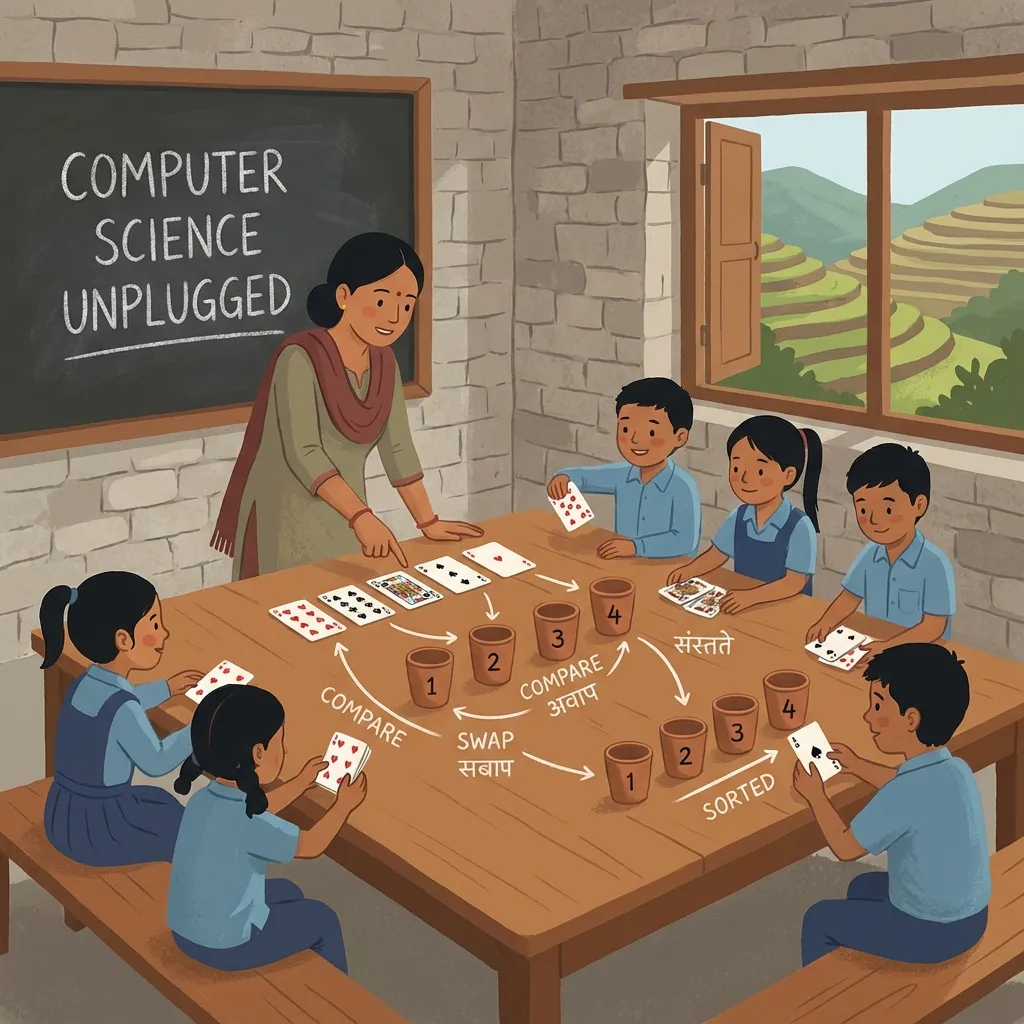
This is why I love CS Unplugged.
The Human Sorting Network
Want to teach “Bubble Sort”? Don’t write code.
- Get 5 students to the front of the class. Assign them random numbers (hold up a card).
- Tell them they can only talk to their neighbor.
- If the left number is bigger than the right number, swap places.
- Repeat until the line is sorted.
You just taught a fundamental sorting algorithm. And because they moved their bodies, they will remember it longer than if they memorized for i in range(n).
Binary Search with a Dictionary
Bring a physical Nepali Dictionary. Ask a student to find the word “Kamal”.
- Do they start at Page 1? No.
- They open the middle. “M”. “K” is before “M”.
- They ignore the second half of the book.
- They split the first half again.
That is Binary Search. It is an $O(\log n)$ algorithm. And every student already knows it intuitively. Your job is to give it a name.
The “Teacher Developer” Advantage
When you teach CS Unplugged:
- Load Shedding doesn’t matter.
- Broken keyboards don’t matter.
- You democratize intelligence. The kid who doesn’t have a laptop at home can still be the best algorithmic thinker in the class.
So next time the power goes out, don’t cancel Computer Science class. Get out the playing cards.
Related Posts and Resources
- Low-Tech, High-Impact Teaching in Nepal
- Coding for Teachers in Nepal
- Data-Driven Grading for Educators
- Open-Source Schools in Nepal
- Gamification in Nepali Classrooms
- Cyber Hygiene for Students and Teachers
- Flipped Classroom in Nepal
- School Wi-Fi Budget Planning
- AI-Based Assessment in Nepal
- Digital Marketing in Nepal (Complete Guide)