Cross-Border B2B Payment Gateways Guide for Global Dropshippers
The global dropshipping ecosystem operates at the complex intersection of localized business-to-consumer (B2C) revenue collection and decentralized business-to-business (B2B) supply chain settlement. As the global B2B cross-border payments market scales toward an estimated valuation of $186.2 trillion, digital merchants are increasingly abandoning legacy banking infrastructure in favor of agile, multi-currency financial technology platforms. Analysts project the subset of pure B2B cross-border transaction volume to surge from $31.6 trillion in 2024 to nearly $50 trillion by 2032, representing a 60% growth trajectory driven by relentless international expansion. The global B2B payment volume continues to dwarf the B2C market by a factor of nearly five to one, catalyzed by the digital transformation of historically opaque supply chains.
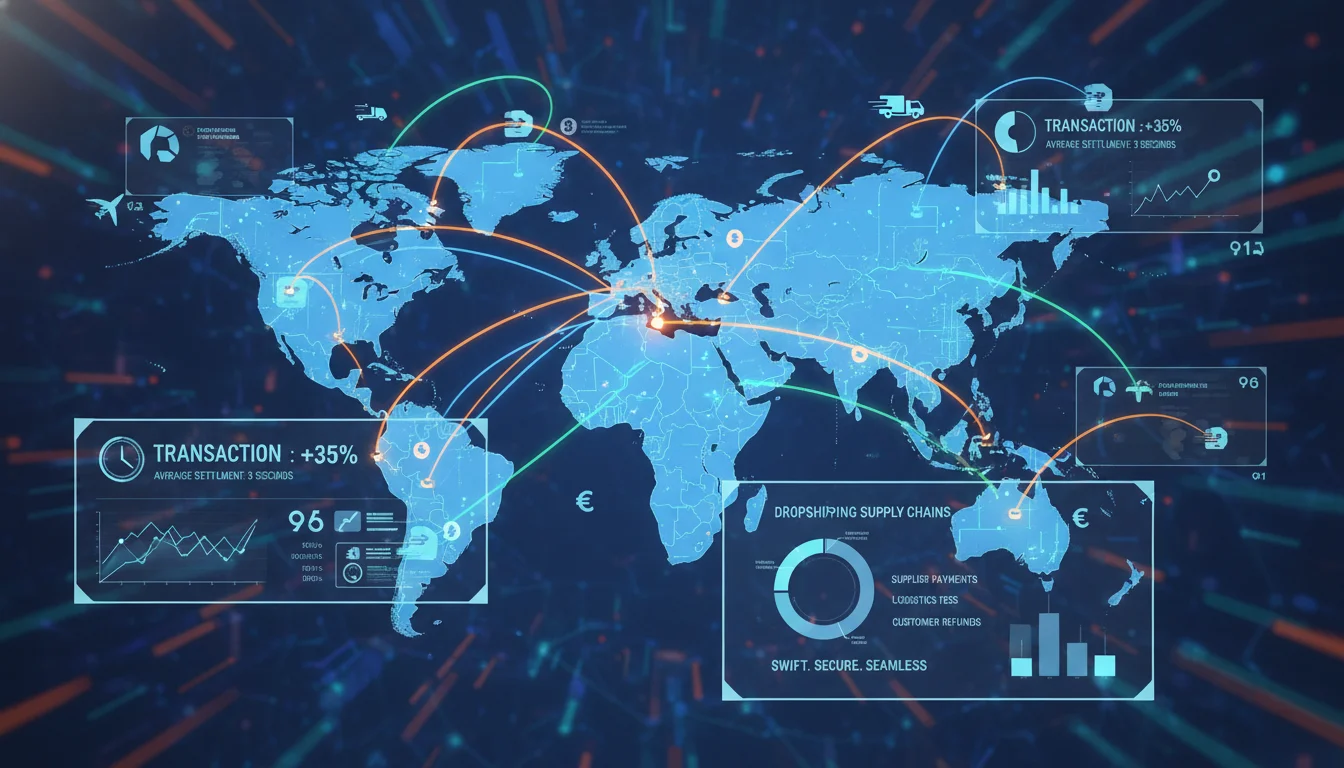
For global dropshippers—particularly those operating from emerging markets characterized by stringent capital controls—the selection of a B2B payment gateway is not merely an operational necessity; it is the ultimate determinant of margin preservation, supply chain velocity, and regulatory survival. The structural inefficiency of traditional cross-border payments, which are characterized by correspondent banking delays, SWIFT network fees, and opaque foreign exchange (FX) markups, poses an existential threat to dropshipping models operating on thin margins. The transition is stark: paper checks now account for less than 15% of total B2B payment value, signaling a permanent migration to real-time digital rails.
This exhaustive analysis dissects the top cross-border B2B payment platforms, evaluates supplier-specific settlement dynamics across major manufacturing hubs, categorizes advanced Accounts Payable (AP) automation systems, and provides a granular examination of the regulatory crucible facing operators in restricted jurisdictions. To ground this analysis in a real-world macroeconomic context, the regulatory environment of Nepal is utilized as a primary case study for emerging market capital constraints.
The Dichotomy of B2B Payments: AP Automation vs. Transactional Gateways
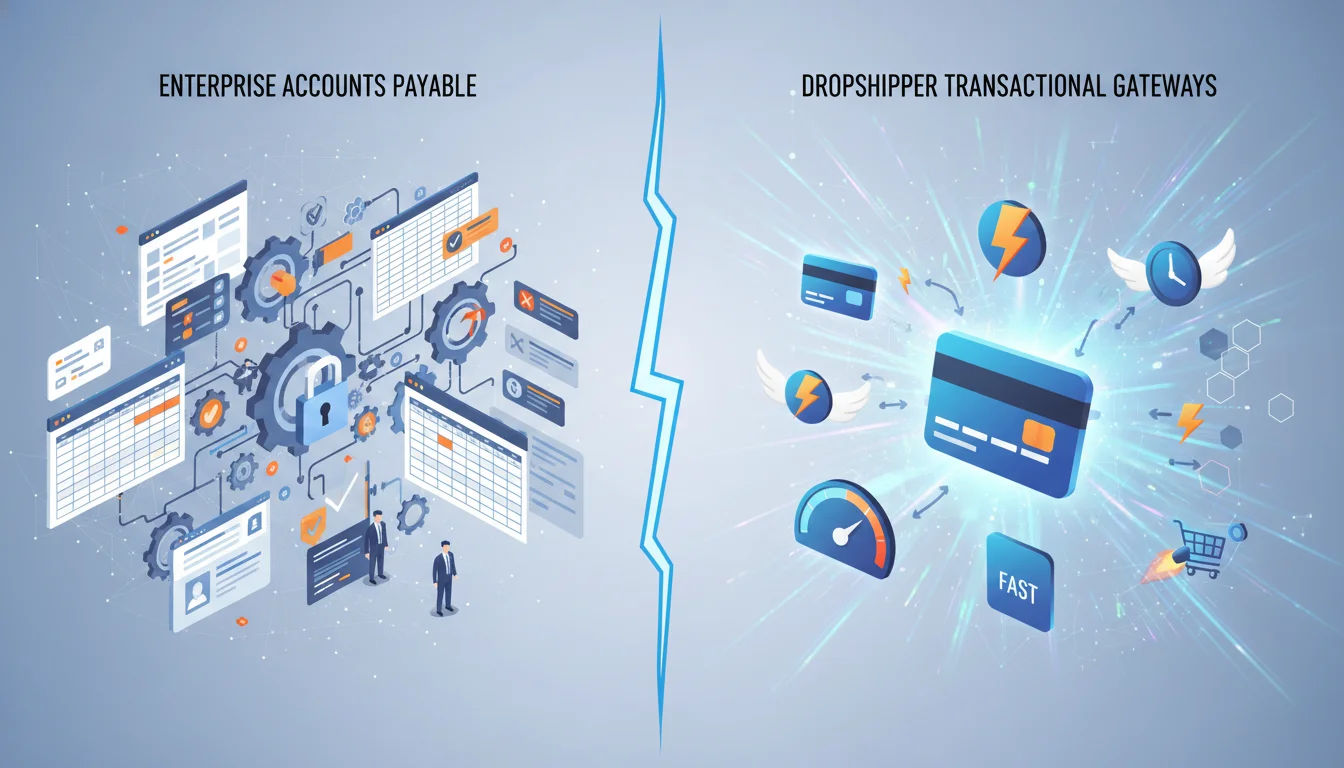
Before evaluating specific cross-border gateways, it is critical to distinguish between heavy B2B Accounts Payable (AP) software designed for enterprise treasury teams and high-velocity transactional gateways utilized by dropshipping merchants. Analysts frequently categorize the broader B2B software market based on the depth of ERP integration, invoicing complexity, and procure-to-pay lifecycle management.
Enterprise-grade B2B platforms focus heavily on workflow automation, approval routing, and vendor communication rather than pure payment routing. For instance, HighRadius provides enterprise B2B payment automation utilizing AI-driven FX optimization deeply integrated into legacy ERP systems. Tipalti is specifically engineered for cross-border AP automation and mass supplier payments for high-growth mid-market entities, managing complex tax compliance and vendor onboarding. Other notable platforms in this heavy AP category include Medius, which provides intelligent automation for complex payment ecosystems; Coupa, which unifies the entire source-to-pay lifecycle into an end-to-end spend management platform; and Stampli, which centralizes vendor communication. Platforms like BILL operate as a comprehensive one-stop shop for vendor payments for small to mid-sized businesses outgrowing basic AP tools, while Sage Intacct and SAP Concur provide robust expense tracking for modern finance teams.
While these platforms represent the zenith of corporate treasury management, their heavy infrastructure, complex onboarding, and subscription pricing models make them unsuitable for the agile, high-frequency transactional needs of a global dropshipper. The dropshipping supply chain demands immediate capital deployment, virtual card issuance, and multi-currency holding wallets rather than complex invoice approval workflows. Consequently, dropshippers rely on a distinct subset of API-driven transactional gateways, such as Airwallex, Wise Business, Payoneer, WorldFirst, and PingPong. Furthermore, developer-first infrastructure providers like Stripe and Currencycloud empower the underlying architecture of many of these platforms, providing the rails for global digital payment acceptance and fintech API integration.
Comprehensive Evaluation of Tier-1 B2B Cross-Border Platforms
The marketplace for cross-border B2B transactional gateways is highly segmented. Platforms differentiate themselves through technological infrastructure, geographic reach, foreign exchange (FX) fee structures, and target demographics. The optimal choice for a dropshipping enterprise depends heavily on transaction volume, corporate registration status, and primary supplier geography.
Airwallex: Enterprise-Grade API Infrastructure
Airwallex positions itself as an enterprise-grade, API-first global financial infrastructure platform, currently serving over 150,000 businesses globally. Engineered for scale, it provides a comprehensive financial stack encompassing multi-currency accounts, local collections in over 60 countries, and corporate virtual card issuance in more than 40 markets.
The platform’s economic advantage lies in its highly competitive foreign exchange pricing model. Airwallex bypasses traditional banking spreads by providing direct access to interbank FX rates, applying a transparent markup of just 0.5% for major global currencies (including AUD, USD, HKD, CNY, EUR, GBP, and SGD) and 1.0% for exotic currencies. Furthermore, it utilizes localized payment rails for transfers to over 120 countries, effectively eliminating international wire transfer fees for standard vendor payouts.
Airwallex offers three primary account tiers to cater to varying business sizes. The “Explore” plan incurs no monthly user fees and supports up to 10 spend users. The “Grow” plan, priced at $12 per user per month, supports up to 250 users, while the “Accelerate” plan offers custom pricing for vast global entities with complex three-way matching workflows. A unique feature for US-based funds is the yield generation capability, allowing merchants to earn returns on USD balances ranging from 3.13% on the Explore plan to 3.40% on the Accelerate plan, with no capital lock-ups.
For dropshippers, Airwallex’s virtual card issuing capability is a vital operational tool. Merchants can generate unlimited multi-currency virtual cards with zero international transaction fees, yielding up to 1.5% in cash rebates on local USD spend. This facilitates programmatic, automated payments to suppliers on platforms like AliExpress that heavily favor card transactions. Despite these advantages, Airwallex’s API-heavy nature implies that its most powerful automation features are best leveraged by businesses with dedicated in-house development teams or sophisticated enterprise resource planning integrations. For smaller entities intimidated by complex developer tools, competitors like Payset offer simplified, developer-free global accounts tailored for complex corporate structures.
Airwallex’s global regulatory footprint dictates its onboarding capabilities. It utilizes distinct legal entities based on the merchant’s registration country; for instance, businesses in the UK are onboarded via the UK entity, while companies in France, Germany, or Austria are processed through entities in the Netherlands or Lithuania. Merchants in India are managed via the Singapore entity, and Indonesian businesses through Hong Kong.
Wise Business: The Benchmark for Fee Transparency
Wise Business (formerly TransferWise) has disrupted the cross-border B2B payment sector by championing absolute fee transparency and strict adherence to mid-market exchange rates. Unlike traditional banks or platforms that obscure costs within inflated, variable exchange rates, Wise charges a distinct, variable fee starting from 0.33% depending on the currency pairing, while executing the conversion at the true mid-market rate.
For global dropshippers, Wise mandates a one-time account setup fee of 50 GBP (or equivalent), which unlocks local account details in 24 distinct currencies, allowing the seamless collection of international revenue from marketplaces and B2C gateways. A critical feature for scalable e-commerce operators is the “Mass Payments” tool, which facilitates bulk batch transfers to up to 1,000 contractors or suppliers simultaneously, drastically reducing administrative overhead. Payment velocity is a core metric for Wise; internal data indicates that 70% of transfers arrive within 20 seconds, and 95% complete within 24 hours.
Wise also features a sophisticated volume discount structure, automatically applying fee reductions for businesses executing over 20,000 GBP (or equivalent) in monthly transfer volume. The platform supports massive institutional limits, allowing business accounts to process up to 6,000,000 USD per local wire transfer, and up to 50,000,000 USD annually for standard transactions. Wise also offers an interest feature for GBP, EUR, and USD balances, investing funds in government-guaranteed assets that have historically yielded an average annual return of 3.03% over a rolling 5-year period.
Despite its dominance in transparency and speed, Wise exhibits severe limitations in specific regulatory environments. The platform imposes stringent compliance rules based on the user’s geographic location.
For instance, while Wise can process inbound payments to a business in certain emerging markets, it outright blocks outbound business transfers from others due to localized regulatory constraints. As noted in their operational documentation, businesses cannot send money outbound from the Malaysian Ringgit (MYR), and Wise completely prohibits outbound business transfers originating from entities registered in Nepal.
Payoneer: The Freelance and Marketplace Ubiquity
Payoneer is arguably the most ubiquitous payment platform within the global freelancer and digital marketplace ecosystem, boasting deep, native integrations with platforms like Upwork, Fiverr, Airbnb, Amazon, and CJ Dropshipping. Its overarching value proposition is massive geographic accessibility; Payoneer supports operations in over 190 countries and territories, managing funds in over 70 currencies, and communicating in 35 different languages.
The platform’s economic structure operates as a “walled garden.” Transfers executed between two internal Payoneer accounts are entirely free. This creates a powerful network effect that encourages dropshippers to mandate that their global suppliers also utilize Payoneer, effectively eliminating transaction friction as long as the capital remains within the Payoneer ecosystem.
However, when funds are extracted from this ecosystem—either transferred to external bank accounts or converted across fiat currencies—the platform applies significant levies. Currency conversion incurs a markup of 0.5% to 2.0% above the mid-market rate. External bank withdrawals are punitively expensive, with fees reaching up to 3% to 4% per transaction depending on the geographic region and transaction volume. Additionally, Payoneer levies an annual account maintenance fee of $29.95; however, this fee is waived if a merchant receives a minimum of $2,000 (or $6,000 depending on the updated regional terms) within a 12-month consecutive period.
For dropshippers lacking formal corporate entities in Tier-1 countries, Payoneer remains highly attractive due to its permissive onboarding requirements. It issues commercial Mastercards (both physical and virtual) in USD, EUR, GBP, and CAD, which are instrumental for paying independent fulfillment agents or purchasing inventory directly from consumer-facing marketplace interfaces. The issuance fee for the first debit card is $29.95, with subsequent cards provided free of charge.
PingPong Payments: Asian Supply Chain Dominance
Founded in 2015 in New York with its global headquarters situated in Hangzhou, China, PingPong Payments has aggressively captured market share among cross-border e-commerce sellers by providing purpose-built integrations with major global marketplaces like Amazon, Shopify, Walmart, and Rakuten. The platform operates at a massive scale, having processed over $250 billion in cumulative transaction volume globally.
PingPong’s strategic advantage is its robust regulatory compliance network. The company holds over 60 global financial licenses, ensuring seamless operations in complex regulatory environments. This includes the Australian Financial Services Licence (AFSL) from ASIC, a Money Service Business (MSB) license from FINTRAC in Canada, a third-party payment license from the People’s Bank of China (PBOC), an Electronic Money Institution (EMI) License from CSSF Luxembourg, and broad licensing across the UK (FCA) and US (FinCEN/State regulators).
PingPong enables merchants to open local receiving accounts in more than 18 countries (including CNY, HKD, IDR, JPY, KRW, MYR, PHP, SGD, and THB) and facilitates local payouts via domestic rails in over 40 markets. Its architecture is highly optimized for the Asian supply chain, offering deep liquidity and fast settlement times for transfers to Chinese suppliers in CNY and HKD. By focusing intensely on marketplace payouts and cross-border vendor settlements, PingPong optimizes exchange rate margins specifically for dropshippers, generally capping foreign exchange markups at 1% or less, which routinely undercuts traditional banking processors and platforms like Payoneer.
A critical development in PingPong’s trajectory is its expansion into B2B enterprise payments through direct connectivity to domestic schemes like SEPA in Europe and FPS in the UK. By securing licenses from Bank Negara Malaysia (BNM) and expanding into Indonesia, Vietnam, Thailand, Singapore, and the Philippines, PingPong is establishing itself as the definitive bridge between Western e-commerce demand and Southeast Asian manufacturing hubs. However, unlike holistic platforms like Stripe or Square, PingPong lacks comprehensive direct-to-consumer checkout and point-of-sale capabilities, requiring merchants to maintain separate payment processors for frontend B2C sales.
WorldFirst: The 1688.com Integration Pioneer
WorldFirst, an international payment provider established in 2004, processes cross-border transactions for over 1.5 million businesses and has transferred over $500 billion globally. It differentiates itself through an aggressive zero-fee account structure—charging absolutely no setup fees, no annual maintenance fees, and no minimum balance requirements. It provides multi-currency holding accounts capable of managing funds in over 20 currencies, including USD, GBP, AUD, HKD, SGD, and exotic currencies like ILS, SAR, ZAR, TRY, CZK, CHF, and MXN.
The platform’s FX pricing is highly competitive, capping currency conversion margins at a maximum of 0.75%, with major currency pairings scaling down to 0.50%. Businesses with a monthly turnover exceeding €100,000 gain access to tailored, significantly discounted fee structures. Internal transfers between World Accounts are instantaneous and entirely free.
WorldFirst’s most formidable asset for the dropshipping sector is its proprietary “World Pay” integration with 1688.com (跨境宝). World Pay functions as the officially authorized payment solution that permits international businesses to execute direct checkouts with Chinese manufacturers. By funding a World Account in USD, EUR, or GBP, dropshippers can instantly convert capital to CNH (Offshore Yuan) and execute direct manufacturer payments at a flat 1.5% transaction fee. This API-level integration ensures that order data and payment settlement remain synchronized on the 1688 dashboard, effectively eliminating the need for third-party sourcing agents and onshore Chinese bank accounts.
Gateway Feature and Economic Matrix
The following matrix standardizes the economic and structural parameters of the tier-1 B2B platforms analyzed above, providing a concise comparison for dropshipping operators.
| Platform / Metric | Target Demographic | Base Account Maintenance Fee | Foreign Exchange (FX) Markup | External / SWIFT Transfer Fee | Native B2B Supply Chain Integrations | Regulatory Footprint |
|---|---|---|---|---|---|---|
| Airwallex | Enterprise scale, API-focused users | $0 (Explore), $12/mo (Grow) | 0.5% (Major) - 1.0% (Exotic) | $0 via local rails, $15-$25 SWIFT | Xero, QuickBooks, Custom APIs | ASIC, FCA, MAS, FinCEN |
| Wise Business | SMBs prioritizing absolute transparency | £50 (One-time setup fee) | True Mid-Market + Transparent Fee (From 0.33%) | Variable by currency, highly competitive | Xero, Sage, QuickBooks | FCA, FinCEN, Global |
| Payoneer | Freelancers, emerging market sellers | $29.95/year (waived if volume > $2k) | 0.5% - 2.0% above mid-market | Up to 3.0% - 4.0% for bank withdrawals | CJ Dropshipping, Amazon, Upwork, Fiverr | FinCEN, FCA, Global |
| PingPong | Cross-border Asian supply chain sellers | $0 | Generally capped at 1.0% | Variable by region and volume | Shopify, Amazon, Walmart, Rakuten | 60+ Licenses (PBOC, FINTRAC, AFSL, CSSF) |
| WorldFirst | 1688.com buyers, high-volume B2B | $0 | Max 0.50% - 0.75% | Variable (From €0.30) | 1688.com (World Pay), AliExpress, Amazon | FCA, ASIC, MSB Class A (Malaysia) |
Data derived from aggregated institutional pricing models spanning Q1 2025 to Q1 2026. Fees are subject to jurisdictional variation, localized promotional structures, and corporate transaction volume discounting.
Emerging and Alternative Payment Frameworks
While the tier-1 providers dominate the landscape, several emerging and alternative payment frameworks cater to specific niches within the global B2B ecosystem.
Payset
Recognizing that Airwallex’s advanced features heavily favor companies with in-house development teams, Payset offers a developer-free alternative. It specializes in serving small-to-medium businesses and complex corporate structures (like holding companies) that require multi-entity controls, bulk payments, and transaction management through a simplified, intuitive dashboard.
Kea
For businesses operating at the bleeding edge of global finance, platforms like Kea represent the hybridization of traditional fiat rails and blockchain technology. Kea handles both traditional banking (SEPA/SWIFT) and cryptocurrency payments (USDC/USDT stablecoins) within a single platform, requiring only one KYB (Know Your Business) verification. This dual infrastructure allows merchants to cut processing costs significantly—often saving thousands of dollars monthly by shifting suppliers to instantaneous, near-zero-fee stablecoin settlements.
Unlimit
For merchants requiring unparalleled localized payment acceptance, Unlimit provides access to over 1000 alternative payment methods (APMs) and 150 currencies across 200+ locations. By integrating a vast network of local licenses, Unlimit eliminates payment intermediaries, offering multi-currency accounts and corporate card issuance designed to capture highly fragmented emerging market consumer revenue.
Supplier-Specific Settlement Dynamics in Dropshipping
The efficacy of a cross-border B2B gateway is strictly defined by the acceptance policies of the underlying manufacturing or fulfillment supplier.
Global dropshippers primarily source from distinct mega-marketplaces or private fulfillment agencies, each exhibiting rigidly enforced payment preferences.
AliExpress Supplier Payment Architecture
AliExpress functions as a massive B2C and B2B hybrid platform, facilitating high-frequency, low-volume dropshipping transactions. The platform operates a highly protected escrow environment, holding funds until the end customer confirms successful delivery, thereby mitigating supplier fraud.
Consequently, traditional wire transfers (T/T) are highly inefficient for AliExpress dropshipping. Due to extensive SWIFT processing times and exorbitant fixed fees per order, executing T/T for individual unit purchases eradicates profitability. The dominant payment methodologies include:
- Alipay: The native, frictionless settlement mechanism of the Alibaba ecosystem. Alipay operates with zero hidden fees on the platform, providing instantaneous settlement and robust buyer protection. It is highly recommended for dropshippers executing frequent daily orders.
- Corporate Virtual Cards: Credit and debit cards (Visa, Mastercard) remain the most universally accepted methodology on AliExpress. Crucially, they integrate seamlessly with automated dropshipping software like AutoDS, which processes payments and tracks orders programmatically in the background. Dropshippers heavily leverage virtual cards issued by Airwallex, Revolut, Payoneer, or WorldFirst to execute these high-frequency purchases. Utilizing virtual cards isolates financial risk, prevents primary account exposure, limits fraud through single-use numbers, and frequently yields valuable cashback rewards on business expenditures.
- PayPal: While highly secure and ubiquitous, PayPal is not universally accepted by all AliExpress vendors. Many Chinese suppliers avoid PayPal due to its aggressive chargeback policies, high dispute rates, and elevated merchant processing fees.
CJ Dropshipping Settlement Protocols
CJ Dropshipping operates as a dedicated fulfillment entity, deeply integrated into the global dropshipping architecture through native plugins with Shopify, WooCommerce, and eBay. Unlike the fragmented, individual vendor base of AliExpress, CJ Dropshipping acts as a singular payee, vastly standardizing the B2B settlement process.
The platform supports a highly diverse array of payment gateways, including credit cards, WeChat Pay, iDEAL, Pix, Sofort, Boleto, and Payssion. However, CJ Dropshipping explicitly favors and deeply integrates with Payoneer. Merchants can link their Payoneer accounts directly to the CJ dashboard via an API token, enabling frictionless, authenticated batch payments without repetitive manual data entry during checkout.
Furthermore, CJ Dropshipping aggressively incentivizes specific capital flow mechanisms to improve its own corporate liquidity. Merchants utilizing traditional wire transfers (T/T) to preemptively fund their native “CJ Wallet” receive up to a 2% financial bonus on the deposited capital. This structural incentive encourages dropshippers to utilize low-cost, large-volume SWIFT or local rail transfers via platforms like Wise or Airwallex to bulk-fund their fulfillment operations, rather than paying higher percentage-based card processing fees on thousands of individual micro-orders.
1688.com and the Chinese Wholesale Ecosystem
1688.com represents the absolute bedrock of Chinese domestic manufacturing, offering raw wholesale pricing tiers that are significantly lower than consumer-facing export platforms like AliExpress or Alibaba.com. Historically, 1688.com presented an impenetrable barrier to global dropshippers; the platform strictly required an onshore Chinese bank account, an Alipay business account linked to a Chinese corporate entity, and settlement in domestic Renminbi. To bypass this, global merchants were forced to hire local sourcing agents, who exacted heavy commission margins ranging from 5% to 10% just to process payments.
The integration of WorldFirst’s “World Pay” architecture has systematically dismantled this systemic barrier. World Pay functions as an officially authorized payment solution that permits international businesses to bypass agents and execute direct checkouts on 1688.com. By funding a World Account in USD, EUR, or GBP, dropshippers can instantly convert capital to CNH (Offshore Yuan) and execute direct manufacturer payments at a flat 1.5% transaction fee. This API-level integration ensures that order data, logistics tracking, and payment settlement remain synchronized, eliminating the intermediary friction that historically plagued direct-to-manufacturer sourcing.
The Regulatory Crucible: The Nepal Macroeconomic Case Study
Evaluating global B2B payment gateways strictly through the lens of tier-1 Western jurisdictions ignores the profound operational complexities faced by dropshippers operating from emerging markets. A comprehensive analysis requires an examination of the systemic friction generated by localized central bank policies, anti-money laundering frameworks, and strict capital controls. Nepal provides a quintessential model of a highly regulated foreign exchange environment, highlighting the jurisdictional arbitrage required to operate a global dropshipping enterprise.
Foreign Exchange Regulations and Capital Controls
Nepal’s macroeconomic policy is heavily governed by the imperative to protect domestic foreign currency reserves against structural, systemic trade deficits. The Nepal Rastra Bank (NRB)—the central monetary authority—enforces the Foreign Exchange (Regulation) Act, 1962, and the NRB Act, 2002, which strictly regulate and largely prohibit the outward flow of capital without explicit regulatory approval. Consequently, conducting unrestricted cross-border B2B payments directly from domestic Nepali bank accounts is structurally impossible for individual citizens or unregistered e-commerce entities.
To facilitate minor online transactions for consumers, the NRB permits Nepali commercial (Class ‘A’) and development (Class ‘B’) banks to issue prepaid foreign currency cards (colloquially known as Dollar Cards) linked to domestic NPR accounts. However, this facility is strictly capped at a draconian annual limit of USD 500 per individual user. In the context of a dropshipping business—where the cost of goods sold (COGS) rapidly exceeds thousands of dollars monthly—the $500 annual limit restricts the merchant to an average daily purchasing power of approximately $1.36, rendering domestic banking infrastructure entirely useless for scaling supply chain payments.
For officially registered businesses engaging in international trade, the regulatory framework is slightly broader but fundamentally misaligned with the digital economy. The NRB permits the import of goods up to USD 100,000 per transaction via Telegraphic Transfer (TT) or Demand Draft. However, this framework is designed explicitly for traditional physical imports involving customs clearance, physical bills of lading, and physical border inspections. The dropshipping model, where goods are purchased in China and shipped directly to consumers in the United States or Europe without ever entering Nepalese territory, falls into a complex regulatory gray area. The inability to produce physical domestic customs import documentation permanently prevents merchants from executing legitimate TT transfers to global suppliers via domestic banks. Furthermore, payments for foreign services are capped at USD 25,000 per month without prior NRB approval, creating further operational ceilings.
Recent Liberalization and the Information Technology Sector
Recognizing the severe economic friction suppressing digital exports, the Nepalese government introduced pivotal amendments in the 2025/2026 fiscal budget. The NRB’s updated Foreign Investment and Foreign Loan Management Bylaw now permits domestic Information Technology (IT) companies to utilize a portion of their hard-earned foreign currency to invest abroad. Specifically, entities that have actively exported IT services over the previous three fiscal years can reinvest up to 25% of their export income offshore, provided that 50% of the resultant profits are repatriated directly to Nepal. Furthermore, the budget introduced legal provisions for Nepali citizens to receive “sweat equity” from foreign companies in exchange for specialized technological knowledge.
While this represents a monumental shift toward the globalization of Nepalese enterprises, it predominantly benefits software development agencies and SaaS operators. Pure e-commerce and dropshipping operators still face high thresholds for compliance, emphasizing the necessity for meticulous corporate structuring and reliance on offshore financial technology platforms to manage the B2B supply chain leg of their operations.
The Disconnect of Domestic Payment Gateways
Nepal boasts a rapidly maturing domestic digital payment ecosystem, spearheaded by localized digital wallets and payment service providers (PSPs) such as eSewa, Khalti, IME Pay, and the Fonepay interoperable network. Fonepay, developed in collaboration with Compass Plus Technologies and its TranzAxis platform, has recently launched a domestic virtual credit card accepted at over 1.5 million merchants, aimed at empowering digital-first consumers. Furthermore, the NRB has established the National Payment Switch (NPS) and NEPALPAY QR to standardize domestic settlements and facilitate inter-network clearing. The NRB has also approved dozens of institutions, including Jyoti Bikas Bank, Citizens Bank International, Everest Bank, Global IME Bank, and Himalayan Bank, to operate international payment gateways, primarily to process inbound tourism and remittance flows.
However, these domestic gateways are structurally isolated from the global B2B supply chain ecosystem.
While platforms like eSewa, Khalti, and NIMB’s payment gateway excel at domestic utility payments, peer-to-peer transfers, and localized e-commerce, they lack the global correspondent banking ties, multi-currency conversion APIs, and integration partnerships required to settle high-volume commercial invoices on platforms like AliExpress or 1688. Additionally, domestic platforms face challenges related to digital literacy, complex integration hurdles, and strict NRB KYC/AML documentation requirements—which frequently demand notarized documents, apostilles, and English translations of Nepali corporate records. Consequently, dropshippers cannot utilize domestic PSPs to fuel their international supply chains.
Onboarding Bottlenecks and Jurisdictional Arbitrage
The intersection of strict local capital controls and the rigid compliance requirements of global fintech platforms creates severe onboarding bottlenecks for merchants in emerging markets. When a dropshipper seeks to open an account with a tier-1 B2B gateway, they are subject to rigorous Anti-Money Laundering (AML) and Know Your Business (KYB) protocols.
Geographic Eligibility Discrepancies
The availability of B2B payment services is not monolithic; platforms enforce drastically different risk appetites regarding the jurisdictions they support for business registration.
Airwallex
Despite its vast global payout network, Airwallex enforces strict geographic boundaries for corporate onboarding. The platform natively onboards businesses registered in major hubs such as the United States, United Kingdom, Australia, Hong Kong, Singapore, and the European Economic Area. Crucially, Airwallex explicitly does not support the onboarding of businesses registered in Nepal. While Airwallex allows its global clients in the US or UK to send high-speed payouts to Nepalese bank accounts in NPR using local clearing systems like NCHL, a dropshipper cannot open an Airwallex holding account utilizing a Nepalese company registration.
Wise Business
Wise exhibits a highly nuanced, corridor-specific approach to restricted markets. According to its operational documentation, while funds can be sent to Nepal from international origins, Wise strictly prohibits outbound business transfers originating from Nepal. The platform’s internal compliance protocol dictates: “The originating currency can arrive to us from a business or personal account, however we cannot make transfers to any businesses in Nepal”. This regulatory firewall renders Wise Business completely ineffective as an outbound B2B payment hub for locally registered Nepalese dropshippers aiming to pay suppliers in China or the US.
Payoneer
Payoneer stands out as the most permissive tier-1 platform for emerging market operators. Payoneer explicitly supports the registration of businesses (LLCs) and individual entrepreneurs (FOPs) residing in highly complex geopolitical zones, actively providing localization guides for non-Western jurisdictions like Ukraine and the Middle East. By allowing merchants from restricted regions to access local receiving accounts in USD, EUR, and GBP, and by issuing virtual commercial Mastercards, Payoneer effectively democratizes access to the global supply chain for entrepreneurs who are otherwise locked out by geographic risk profiling.
PingPong
Similar to Payoneer, PingPong maintains a broad onboarding footprint, driven by its focus on global marketplace sellers. The platform actively facilitates e-commerce operations for merchants based in Southeast and South Asia (including Pakistan, Bangladesh, Indonesia, and the Philippines), allowing them to participate in frictionless B2B transactions.
The Strategy of Offshore Corporate Structuring
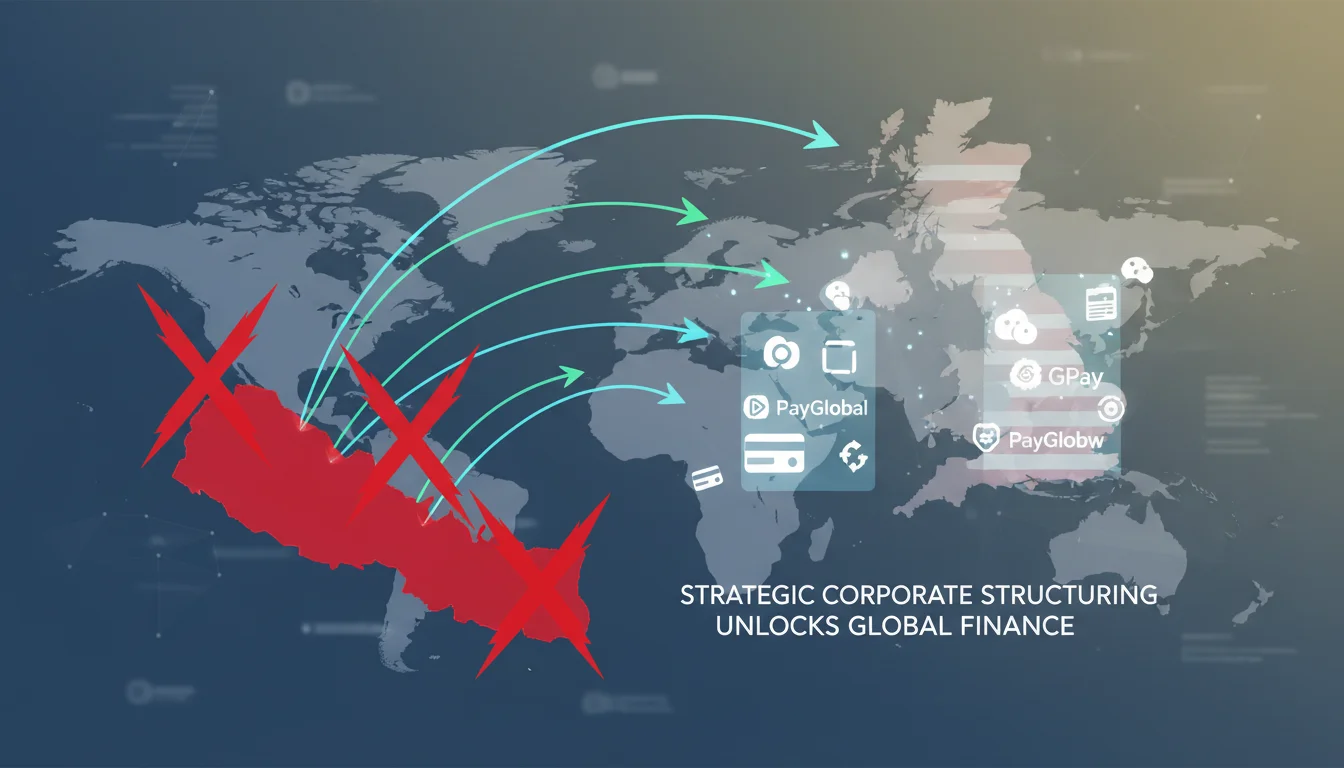
To bypass the geographic constraints imposed by platforms like Airwallex and Wise, and to permanently circumvent domestic capital controls like Nepal’s $500 prepaid card limit, professional global dropshippers routinely engage in jurisdictional arbitrage. This strategy involves the legal incorporation of offshore commercial entities—most commonly a United States Limited Liability Company (US LLC) in business-friendly states like Wyoming or Delaware, or a United Kingdom Private Limited Company (UK LTD).
By establishing a non-resident US LLC and obtaining an Employer Identification Number (EIN) from the IRS, an emerging-market dropshipper legally transitions their financial profile to a tier-1 jurisdiction. This strategic maneuver yields massive systemic benefits:
- Gateway Unlocking: It instantly unlocks the ability to onboard seamlessly with top-tier B2B payment gateways like Airwallex and WorldFirst, passing complex KYB checks under the umbrella of a recognized US or UK corporate entity.
- Revenue Capture: It grants access to premier B2C revenue collection gateways like Stripe Payments and Shopify Payments, which are otherwise completely unavailable to residents in regions like Nepal.
- Capital Retention: It allows the merchant to evade local banking friction entirely, holding vast sums of working capital in secure offshore multi-currency wallets (like Wise or Payoneer) rather than being forced to repatriate funds into a restricted domestic banking system subject to forced currency conversions and heavy taxation.
Designing the Optimal, Resilient Payment Architecture
Relying on a singular payment gateway exposes a global dropshipping enterprise to catastrophic operational risk. The intersection of high dispute rates typical in dropshipping, aggressive automated fraud algorithms, and volatile geographic risk profiles frequently results in abrupt account suspensions, rolling reserves, or frozen capital. To ensure business continuity and maximize margin retention, operators must engineer a decentralized, multi-layered payment architecture.
The Tripartite Gateway System
A highly resilient cross-border architecture segregates financial risk and isolates specific fiscal functions across specialized platforms.
Layer 1: Revenue Collection (B2C)
The initial point of transaction occurs at the consumer checkout interface. Platforms like Stripe and Shopify Payments are deployed to capture credit card revenue directly on the merchant’s storefront. Because dropshipping relies heavily on impulse purchasing, optimizing the checkout experience with localized currencies and alternative payment methods (e.g., Apple Pay, Google Pay, Klarna) is paramount for conversion rates. The revenue is collected and settled in major fiat currencies (typically USD or EUR).
Layer 2: Treasury and Multi-Currency Holding
Due to the perpetual risk of rolling reserves or sudden account freezes at the B2C layer, funds must be immediately swept into an independent treasury account upon clearance. Dropshippers establish multi-currency accounts with platforms like Wise Business, PingPong, or Payoneer. These gateways provide the virtual routing and account numbers required by Stripe or Shopify to settle payouts. The funds are now securely held in an offshore environment, insulated from the consumer-facing gateway’s volatile risk algorithms.
Layer 3: Supplier Settlement (B2B)
The final stage is the deployment of capital into the supply chain. The strategic selection at this layer dictates the ultimate cost structure and profitability of the business.
- If the dropshipper is executing high-frequency retail purchases on AliExpress, funds are loaded onto an Airwallex or Payoneer corporate virtual card to process immediate, fee-free card transactions.
- If the merchant is sourcing in bulk via a fulfillment partner like CJ Dropshipping, they route a low-cost bulk transfer to their CJ Wallet via the native Payoneer integration to capitalize on 2% deposit bonuses.
- If the merchant is procuring directly from wholesale Chinese factories on 1688.com, capital is transferred to a WorldFirst account, seamlessly converted to CNH, and executed via World Pay.
By deploying this tripartite structure, the dropshipper achieves complete isolation of risk. If a B2C collection gateway (e.g., Stripe) suspends an account due to an influx of consumer chargebacks, the treasury and supplier payment layers (e.g., Payoneer, WorldFirst) remain fully operational and fully capitalized, ensuring that previously collected revenue can still be deployed to manufacture and ship pending orders, preventing a cascading failure of the supply chain.
The Mathematics of Margin Preservation
The cumulative impact of optimizing the B2B payment gateway stack is best understood through practical mathematics. Consider a dropshipping entity generating $100,000 in monthly revenue, operating at a theoretical 20% net margin prior to FX and transfer fees. Let the Cost of Goods Sold (COGS) payable to international suppliers equal $40,000.
If the merchant utilizes a suboptimal payment architecture—such as traditional bank wires or high-margin payment platforms—they may face a 3% currency conversion markup and flat wire fees averaging $25 per transaction.
Assuming the merchant executes 10 batch supplier transactions a month:
| Cost Component | Calculation | Subtotal Friction |
|---|---|---|
| Foreign Exchange (FX) Costs | $40,000 × 0.03 (3% markup) | $1,200 |
| Traditional Wire Transfer Fees | 10 transactions × $25 | $250 |
| Total Monthly Payment Friction | $1,450 |
This systemic friction immediately eradicates $1,450, or over 7.25% of the merchant’s $20,000 expected monthly profit.
Conversely, an optimized architecture utilizing a modern gateway like PingPong or Airwallex, which caps FX markups at 0.5% and utilizes free local payout rails, radically transforms the economic equation:
| Cost Component | Calculation | Subtotal Friction |
|---|---|---|
| Foreign Exchange (FX) Costs | $40,000 × 0.005 (0.5% markup) | $200 |
| Localized Transfer Fees | 10 transactions × $0 | $0 |
| Total Monthly Payment Friction | $200 |
Through precise gateway selection and architectural design, the merchant reclaims $1,250 monthly—a direct injection into bottom-line profitability that compounds exponentially as the enterprise scales.
Conclusion
The modern global dropshipping enterprise operates in a highly decentralized, borderless ecosystem where the rapid, frictionless movement of capital is an absolute operational necessity. The transition from monolithic traditional banking to agile, API-driven fintech platforms marks a fundamental evolution in global commerce. As the macroeconomic data dictates, a monolithic approach to payment processing is no longer viable; operators must architect multi-layered, highly resilient payment stacks utilizing specialized tools like Airwallex for programmable virtual cards, Payoneer for maximum geographic onboarding accessibility, and WorldFirst for deep integration into Asian manufacturing hubs.
For operators situated in highly regulated environments like Nepal, the barriers to entry are stark, defined by central bank capital controls, restrictive foreign exchange limits, and rigorous KYB exclusions from tier-1 financial platforms. Success in these jurisdictions mandates an advanced understanding of macroeconomic regulatory constraints and a willingness to leverage offshore corporate structuring to access the requisite financial infrastructure. By systematically mitigating foreign exchange markups, eliminating international wire transfer fees, and isolating operational risk across multiple platforms, global dropshippers can safeguard their margins and ensure the seamless, highly profitable velocity of their international supply chains.