Avoiding the Pitfalls: Common CRO Mistakes in Nepal
Conversion Rate Optimization (CRO) is the art and science of increasing the percentage of website visitors who complete a desired action—whether it’s making a purchase, filling out a form, or signing up for a newsletter. While the principles of CRO are universal, applying them effectively in the unique context of Nepal requires a nuanced understanding. Many Nepali businesses, despite their best efforts, fall into common CRO mistakes that hinder their ability to convert visitors into customers.
As a digital marketing expert in Nepal, I’ve observed recurring patterns that prevent businesses from achieving their full conversion potential. Understanding these pitfalls is the first step towards building truly impactful conversion rate optimization strategies.
Mistake 1: Copying Western Strategies Without Localization
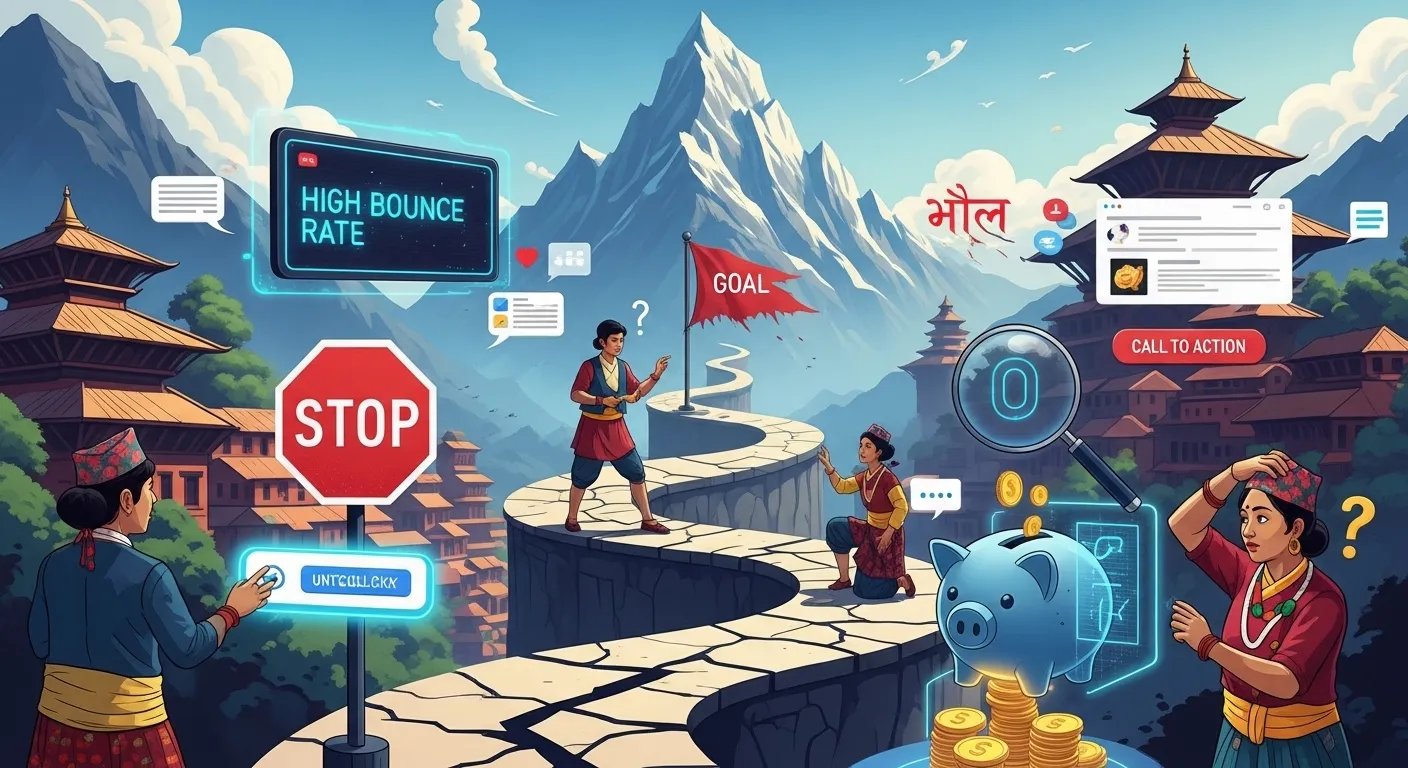
The Problem: Blindly implementing CRO tactics that work in Western markets without considering the unique cultural, linguistic, and behavioral nuances of the Nepali audience.
The Impact: What resonates with a consumer in the US or Europe might not resonate with a Nepali consumer. This can lead to irrelevant messaging, ineffective calls-to-action, and a disconnect with your target audience, resulting in low conversion rates.
How to Avoid It:
- Cultural Sensitivity: Understand local customs, festivals, and values. Tailor your messaging and imagery to reflect these. For example, using local models or showcasing products in a Nepali context.
- Language Preference: While English is common, consider offering content and CTAs in Nepali (or Romanized Nepali) where appropriate, especially for local services or products.
- Local Payment Methods: Ensure your checkout process supports popular local payment gateways and mobile wallets.
- User Research: Conduct surveys, interviews, and user testing with your actual Nepali target audience to understand their preferences and pain points.
mindmap
  root((Localizing CRO for Nepal))
    Cultural Sensitivity
      Understand local customs
      Tailor messaging & imagery
      Use local models/context
    Language Preference
      Offer Nepali/Romanized Nepali content
      Appropriate for local services/products
    Local Payment Methods
      Support popular local gateways
      Include mobile wallets
    User Research
      Conduct surveys & interviews
      User testing with Nepali audience
      Understand preferences & pain points
Figure 1: Key Strategies for Localized CRO in Nepal
Mistake 2: Neglecting Mobile User Experience
The Problem: Designing for desktop first and treating mobile as an afterthought, despite the overwhelming majority of internet users in Nepal accessing the web via mobile devices.
The Impact: Slow loading times, difficult navigation, tiny text, and non-responsive forms on mobile devices lead to high bounce rates and frustrated users. This directly translates to lost conversions.
How to Avoid It:
- Mobile-First Design: Always design and optimize your website and landing pages for mobile devices first.
- Speed Optimization: Compress images, leverage browser caching, and minimize code to ensure lightning-fast loading times on mobile networks.
- Simplified Forms: Keep forms short and easy to fill out on a small screen. Use auto-fill where possible.
- Large, Tappable CTAs: Ensure buttons are large enough and spaced appropriately for easy tapping with a thumb.
Mistake 3: Not Understanding Your Conversion Funnel
The Problem: Focusing on isolated elements (like a single button) without understanding its place within the entire conversion funnel and user journey.
The Impact: You might optimize one step, only to find that users are dropping off at another. Without a holistic view, you’re just playing whack-a-mole with your conversion problems.
How to Avoid It:
- Map the User Journey: Clearly define the steps a user takes from awareness to conversion on your website.
- Analyze Funnel Reports: Use Google Analytics (GA4) to identify where users are dropping off in your conversion paths.
- Address Bottlenecks Systematically: Prioritize fixing the biggest leaks in your funnel first.
Mistake 4: Making Assumptions Instead of A/B Testing
The Problem: Implementing changes based on gut feelings, industry best practices (without local validation), or what competitors are doing, without actually testing their impact on your specific audience.
The Impact: You might spend time and resources on changes that don’t improve conversions, or even worse, negatively impact them. What works for one business might not work for another, especially in a different market.
How to Avoid It:
- Formulate Hypotheses: Before making any change, clearly state what you expect to happen and why.
- A/B Test Everything: Use A/B testing tools to compare different versions of your pages, headlines, CTAs, images, and forms. Let data, not assumptions, guide your decisions.
- Ensure Statistical Significance: Don’t make decisions based on small sample sizes or short test durations. Ensure your results are statistically significant.
Mistake 5: Ignoring Qualitative Data
The Problem: Relying solely on quantitative data (numbers from analytics) and neglecting qualitative data (user feedback, surveys, session recordings).
The Impact: Quantitative data tells you what is happening, but qualitative data tells you why. Without understanding the “why,” you’re guessing at solutions.
How to Avoid It:
- User Surveys: Ask your visitors directly about their experience, pain points, and what they were looking for.
- Session Recordings: Watch recordings of actual user sessions to see how they navigate your site and where they struggle.
- Heatmaps: Visualize where users click, scroll, and spend their time on your pages.
- User Interviews: Conduct one-on-one interviews to gain deeper insights into user motivations and frustrations.
Final Thoughts
Conversion rate optimization is a continuous process of learning and improvement. By actively avoiding these common CRO mistakes and adopting a data-driven, user-centric approach, Nepali businesses can significantly enhance their online performance. Focus on understanding your unique Nepali audience, prioritize mobile, test your hypotheses, and combine quantitative with qualitative data to unlock your full conversion potential in the digital marketing Nepal landscape.
Related Posts and Resources
- Digital Marketing in Nepal (Complete Guide)
- Google Ads in Nepal: Practical Strategy
- SEO Analytics for Nepali Businesses
- eCommerce Analytics Setup in Nepal
- eCommerce Metrics That Matter
- Email Marketing Guide for Nepal
- Email Marketing ROI in Nepal
- Facebook Ads Budget Guide (Nepal)
- Cultural PPC Strategy for Nepal
- Competitor Analysis Framework for Nepal \n\n## Visual Summaries\n
graph TD
  A["Awareness: Visitor Arrives"] --> B{"Interest: Explores Content"}
  B --> C{"Consideration: Views Products/Services"}
  C --> D{"Intent: Adds to Cart/Starts Form"}
  D --> E(("Conversion: Purchase/Signup"))

  B -- Drop-off --> F(Lack of Relevance)
  C -- Drop-off --> G("Poor UX/Information")
  D -- Drop-off --> H("Payment Issues/Complex Form")
Figure 2: Typical Conversion Funnel Stages and Potential Drop-offs